
FORCES AND NEWTONS LAWS WHAT IS A FORCE





- Slides: 60
FORCES AND NEWTON’S LAWS
WHAT IS A FORCE? A “push” or “pull. ” Some are obvious (students pushing other students in the hallway) Some are less obvious (your chair is pushing up on you, air pressure is pushing down) Can cause a change in the motion of an object.
WHAT FORCES ARE YOU EXPERIENCING RIGHT NOW?
CHANGING MOTION The velocity of an object can be affected by forces. Pitcher throws ball, batter hits it Soccer player kicks ball that was passed to them Mean student pushes other student, changing the direction they are moving
NET FORCE The sum of all of the forces acting on an object. Unit: Newtons (N) Takes about 3 N to pick up a full pop can 2 types of force. Balanced Unbalanced
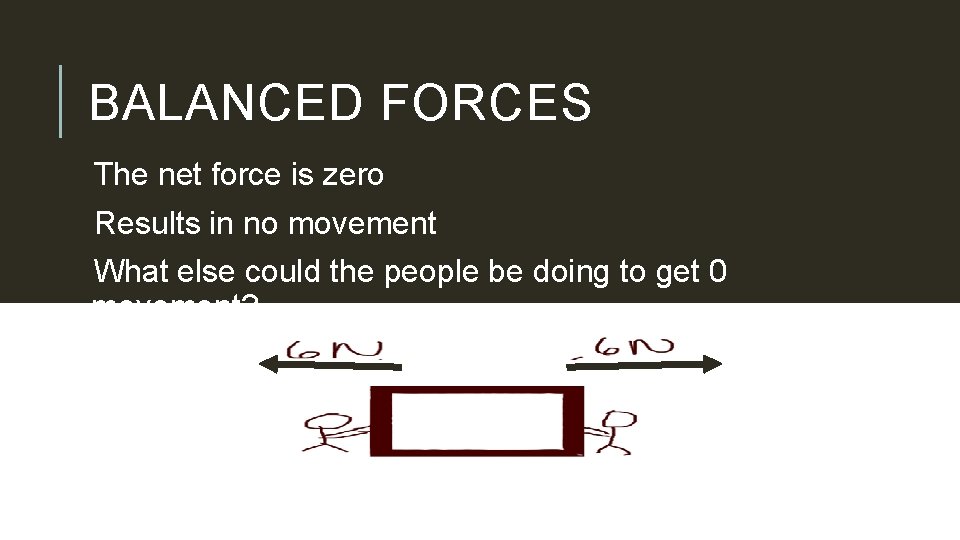
BALANCED FORCES The net force is zero Results in no movement What else could the people be doing to get 0 movement?
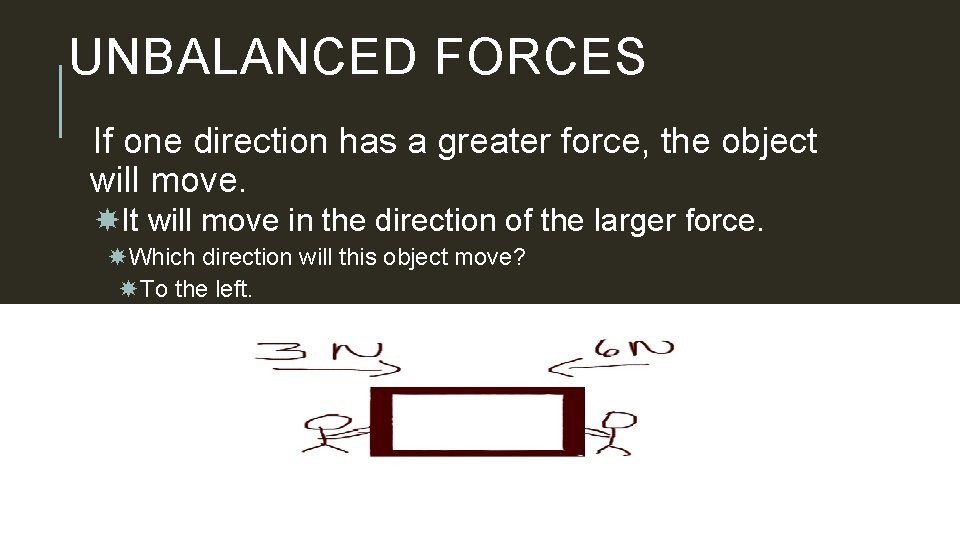
UNBALANCED FORCES If one direction has a greater force, the object will move. It will move in the direction of the larger force. Which direction will this object move? To the left.
RULES FOR ADDING FORCES 1. Add forces in the same direction. 2. Subtract forces in the opposite direction. 3. Forces that are not in the same direction or in opposite direction cannot be directly added. Need trigonometry…
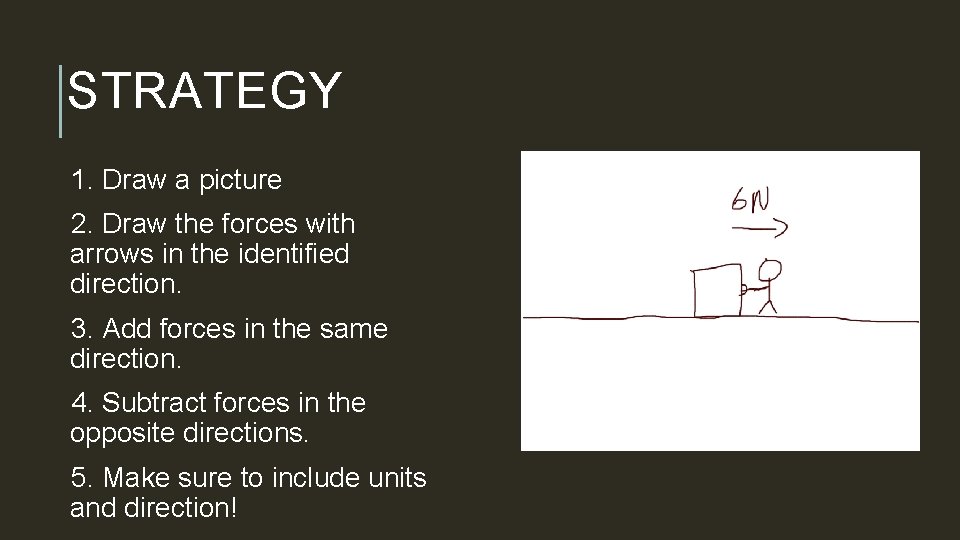
EXAMPLE PROBLEM Suppose you pull an object to the right with a force of 6 Newtons. What is the net force on the object?
STRATEGY 1. Draw a picture 2. Draw the forces with arrows in the identified direction. 3. Add forces in the same direction. 4. Subtract forces in the opposite directions. 5. Make sure to include units and direction!
GUIDED PRACTICE You are trying to move an object. You push to the right with a force of 6 N. While you are doing this, another person is pushing to the left with a force 6 N. What is the net force on the object? What direction will the object move?
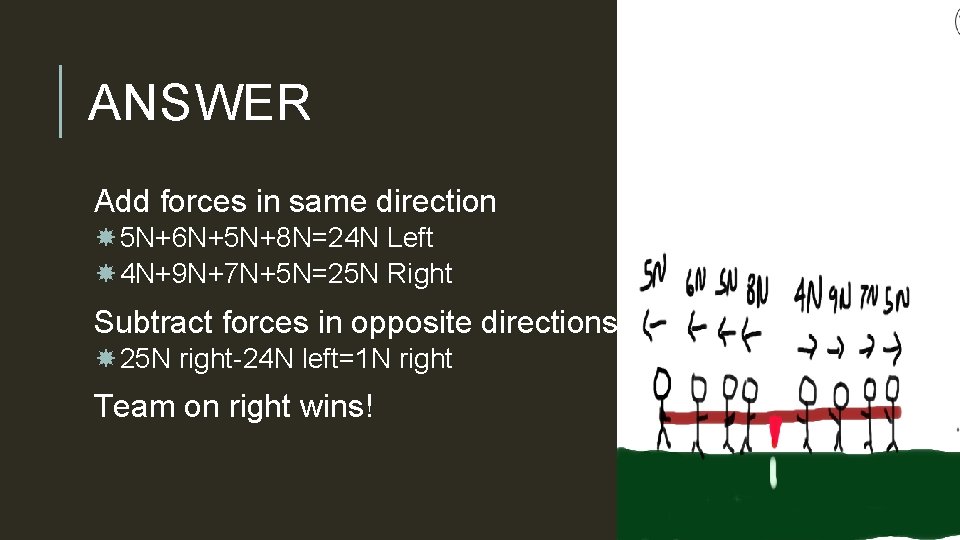
YOU TRY IT! In a game of Tug-of-War, 2 teams each have 4 players. The team members each pull with the following force. Left Team: 5 N, 6 N, 5 N, 8 N Right Team: 4 N, 9 N, 7 N, 5 N Which team won the match, and what was the net force allowing them to win?
ANSWER Add forces in same direction 5 N+6 N+5 N+8 N=24 N Left 4 N+9 N+7 N+5 N=25 N Right Subtract forces in opposite directions. 25 N right-24 N left=1 N right Team on right wins!
FRICTION The force that opposes the sliding motion of 2 objects that are touching one another. Caused by little bumps and indents on the surface of all objects. These are found on even the most polished of surfaces. When 2 objects are in contact, sticking occurs where these objects touch.
FRICTION CONTINUED The amount of friction depends on the surfaces. Rough surfaces have more places for these microwelds to occur, smooth surfaces have less. The amount of friction also depends on the force pushing the surfaces together. More mass=more force, so need more force to move the object.
TYPES OF FRICTION 3 Types: Static Friction Sliding Friction Rolling Friction
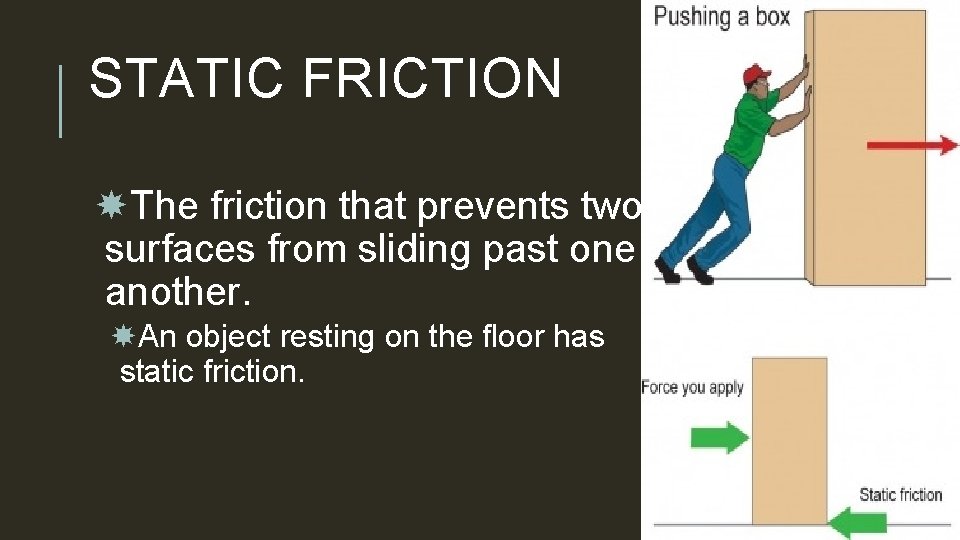
STATIC FRICTION The friction that prevents two surfaces from sliding past one another. An object resting on the floor has static friction.
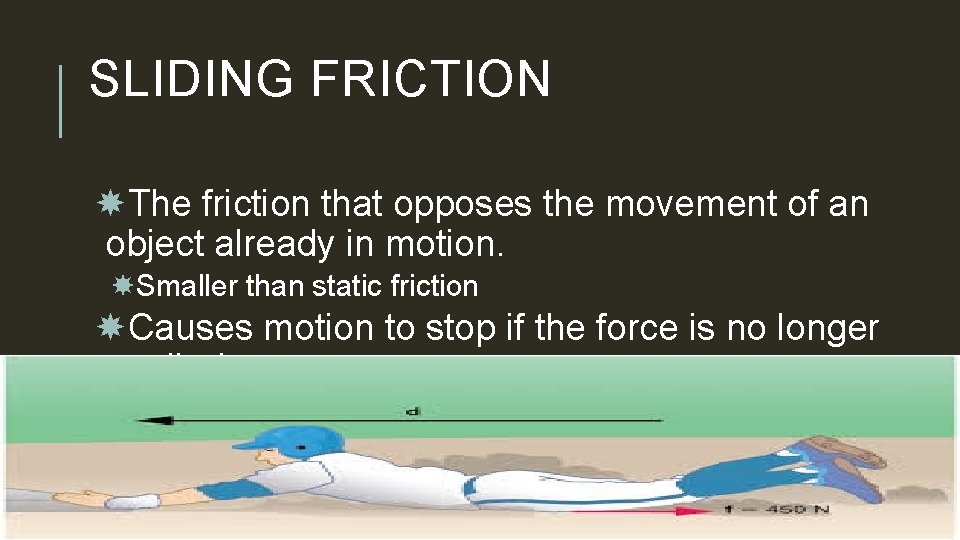
SLIDING FRICTION The friction that opposes the movement of an object already in motion. Smaller than static friction Causes motion to stop if the force is no longer applied.
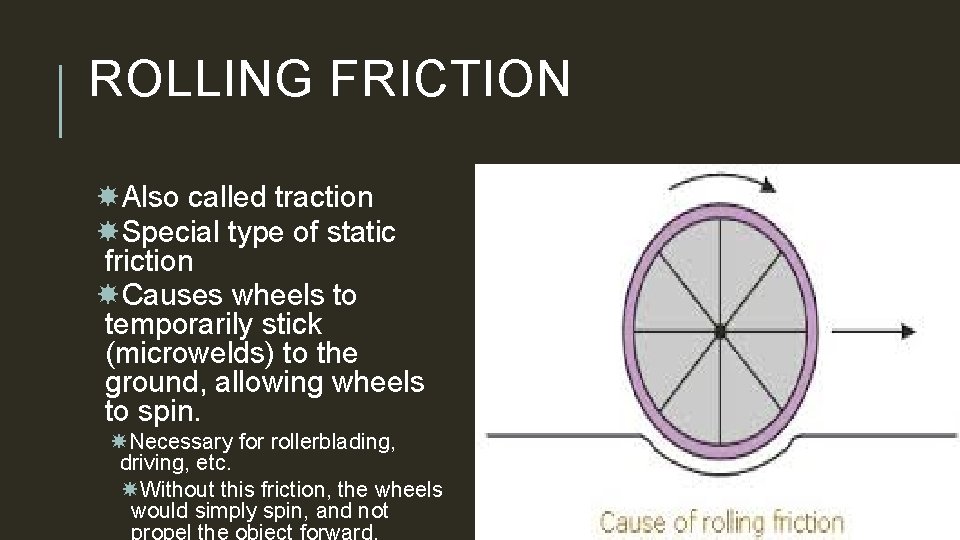
ROLLING FRICTION Also called traction Special type of static friction Causes wheels to temporarily stick (microwelds) to the ground, allowing wheels to spin. Necessary for rollerblading, driving, etc. Without this friction, the wheels would simply spin, and not propel the object forward.
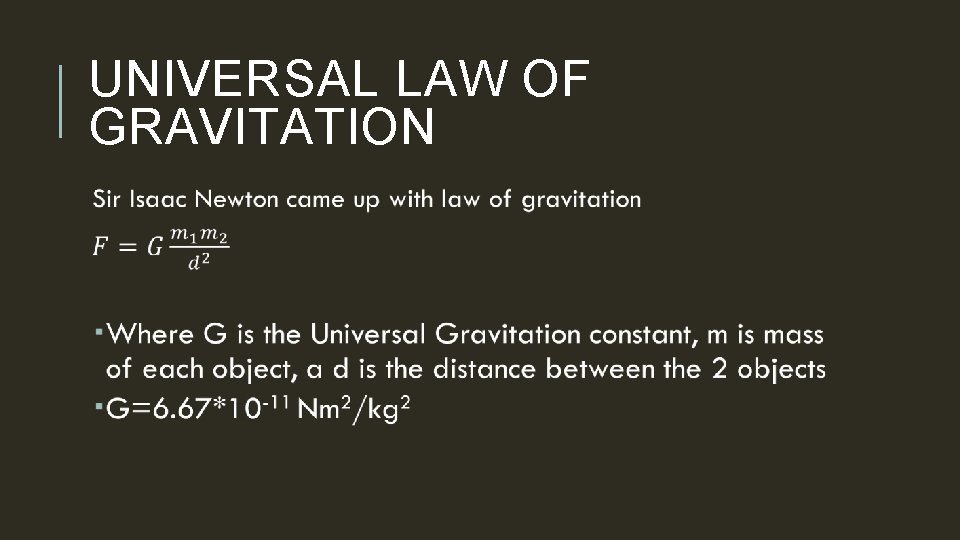
GRAVITY An attractive force between any 2 objects Depends on the masses of the objects and the distance between them. One of the 4 basic forces in nature Gravity, electromagnetic force, weak nuclear force, strong nuclear force. Has an infinite range (i. e. the furthest away atom in the universe has a tiny pull on you)
If dropped in a vacuum, which will hit the ground first: a hammer or a feather?
UNIVERSAL LAW OF GRAVITATION
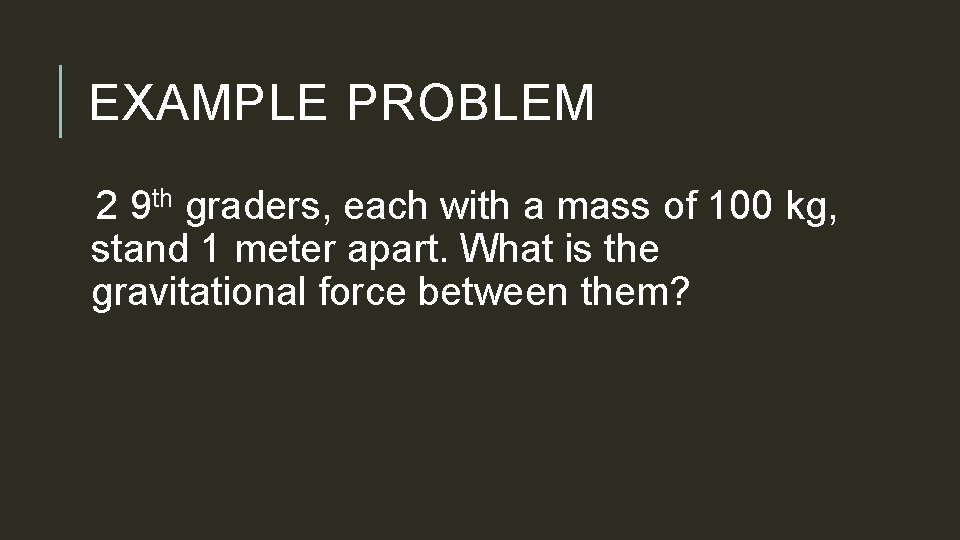
EXAMPLE PROBLEM 2 9 th graders, each with a mass of 100 kg, stand 1 meter apart. What is the gravitational force between them?
INTERESTING For comparison, it takes about 0. 05 N to pick up a piece of paper.
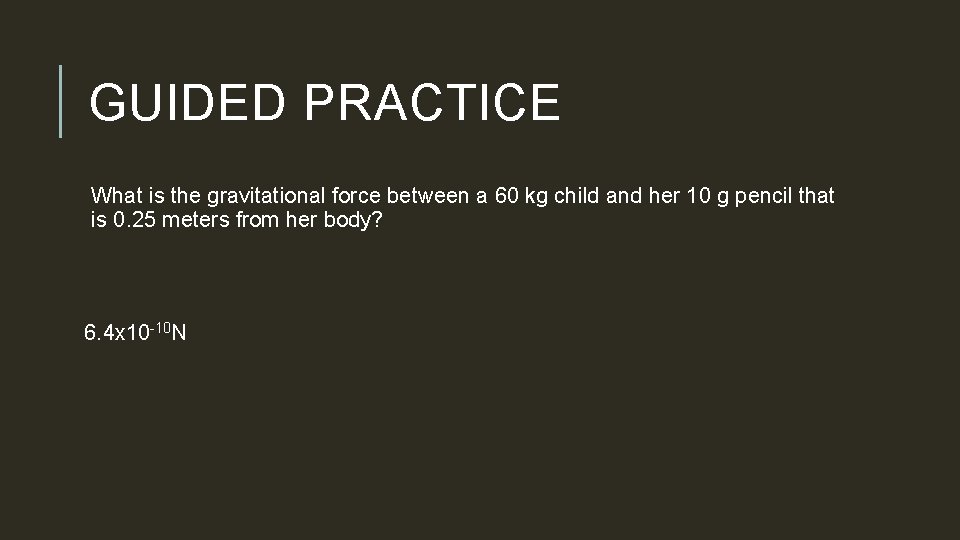
GUIDED PRACTICE What is the gravitational force between a 60 kg child and her 10 g pencil that is 0. 25 meters from her body? 6. 4 x 10 -10 N
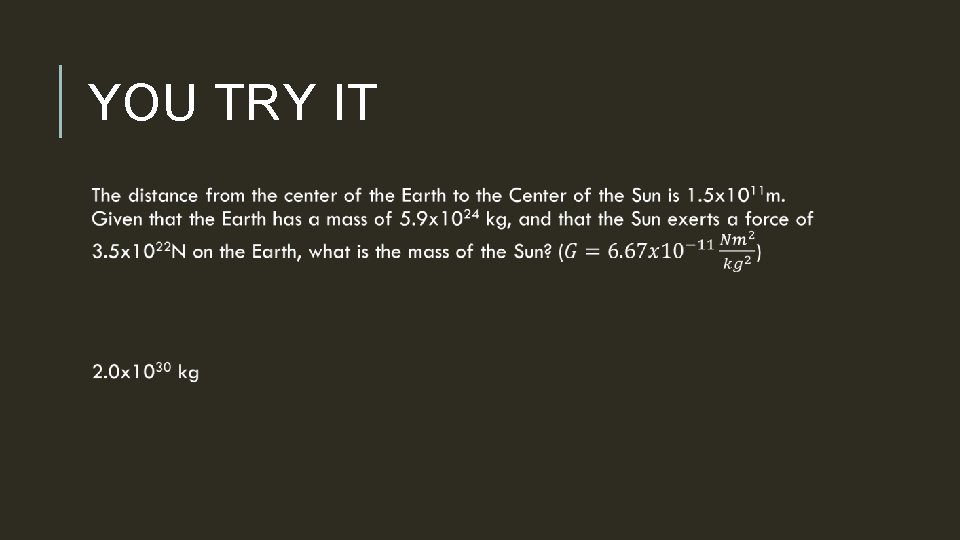
YOU TRY IT
EFFECT OF MASS As the mass of either, or both, of the objects increases, the force of gravity increases This is why a black hole does not need to be large in order to have a large amount of gravity. Similarly, as the mass decreases, the force of gravity decreases. This is why smaller planets have less gravity than larger ones
EFFECT OF DISTANCE As you are aware, as the distance between 2 objects increases, the force of gravity increases by the square of the distance.
THESE PROBLEMS CAN GET DIFFICULT…. What is the distance between 2, 10, 000 -kg objects that have a gravitational force of 1 x 10 -8 N? 8. 2 x 10² m
GRAVITY CONTINUED Gravity and you: You are each attracting one another, and you are attracting all planets, asteroids, even the sun! You cannot feel this. The books, students, etc. have too little mass to pull you. The sun and other objects away from earth are too far away for you to feel the force. The range of gravity: Because the force depends on the distance squared (d 2), it means that the force decreases rapidly as objects get further away. Twice the distance=1/4 the gravitational pull
GRAVITATIONAL FIELD Field=a region of space that has a physical quantity (such as a force) at every point. See textbook for picture Gravity is higher near the surface. Gravity near the surface=9. 8 N/kg=9. 8 m/s 2
WEIGHT The gravitational force exerted on an object. Weight is different than mass-do not confuse them Weight=gravitational force exerted on an object Mass=amount of matter Does not change no matter where you go, whether on Earth or the moon, or Jupiter Weight would be different in each of these places Equation for weight: Fg=mg Where m is mass and g is gravity Units are N because it is the gravitational force
UNIT FOR ACCELERATIONNOT IN YOUR NOTES The unit force is the Newton Let’s determine what Newtons stand for Fg=mg Mass has the units of kg g is an acceleration, which has units of m/s 2 Fg=(kg)x(m/s 2) So, N/kg and m/s 2 mean the same thing
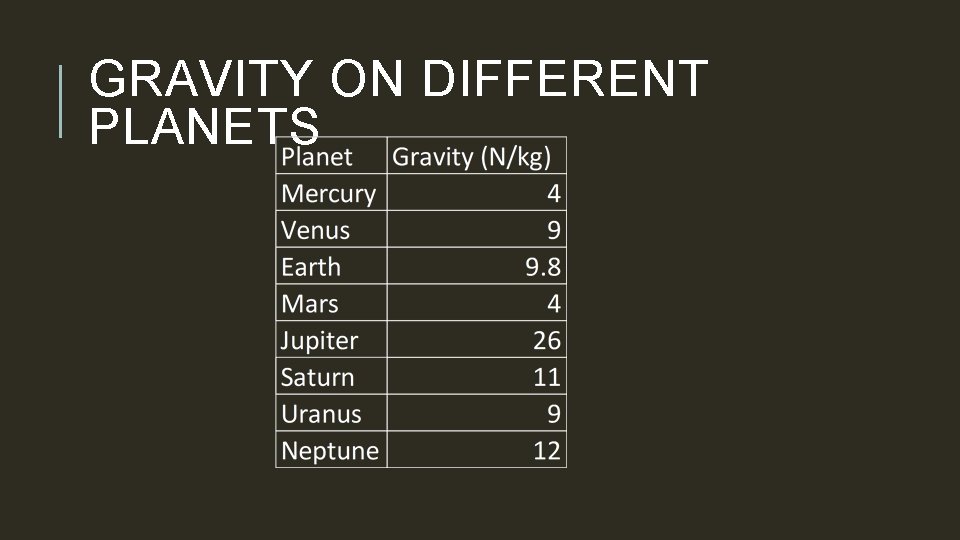
GRAVITY ON DIFFERENT PLANETS
EXAMPLE PROBLEM What is the weight of a 50 kg student on earth?
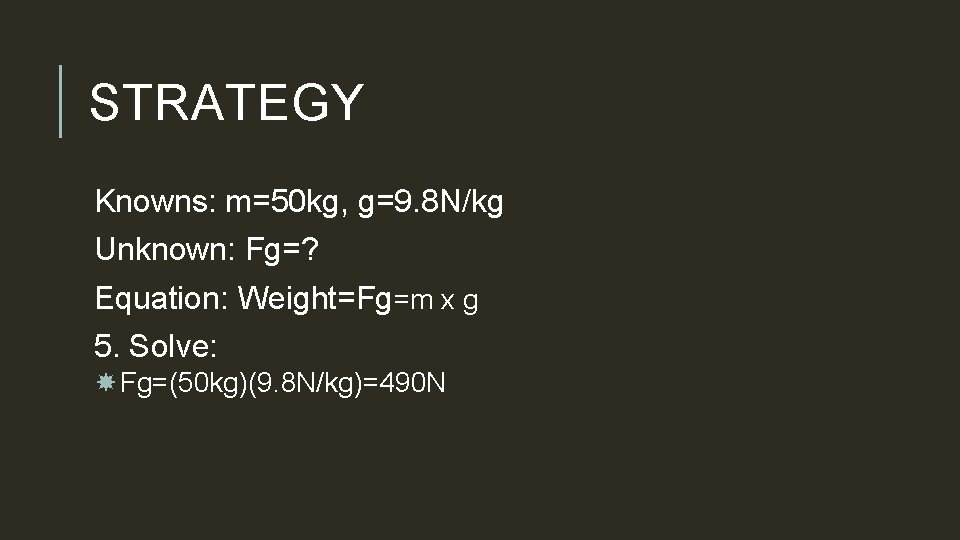
STRATEGY Knowns: m=50 kg, g=9. 8 N/kg Unknown: Fg=? Equation: Weight=Fg=m x g 5. Solve: Fg=(50 kg)(9. 8 N/kg)=490 N
GUIDED PRACTICE What is the weight of a 50 kg student on the Mars?
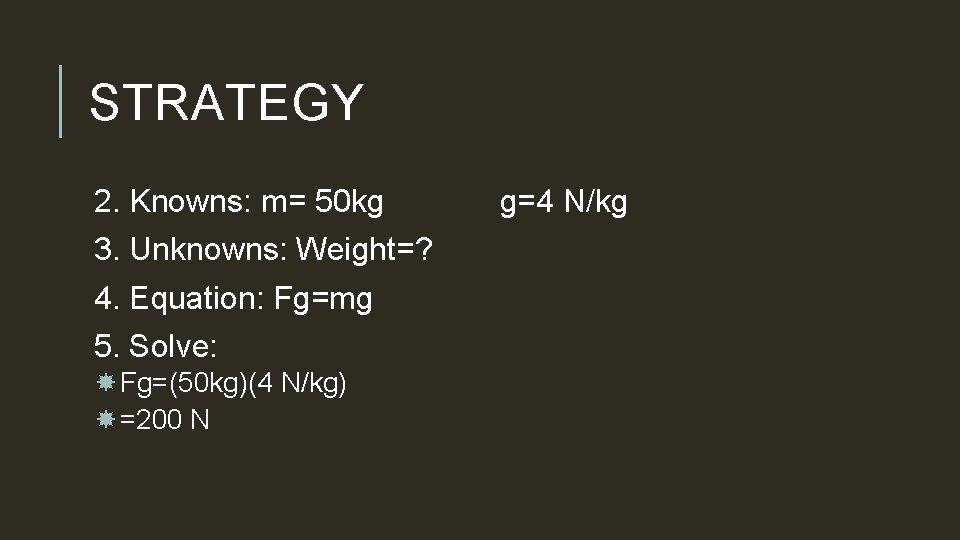
STRATEGY 2. Knowns: m= 50 kg 3. Unknowns: Weight=? 4. Equation: Fg=mg 5. Solve: Fg=(50 kg)(4 N/kg) =200 N g=4 N/kg
YOU TRY IT A person weighs 770 N on Saturn. What is their mass? 70 kg
FINDING OTHER PLANETS One way that astronomers find other planets is by observing the effect that the planet has on its star. Due to gravity, the planet will pull on the star, just a tiny fraction. Astronomers can see the tiny movement of the star, and can figure out the distance and mass of the planet!
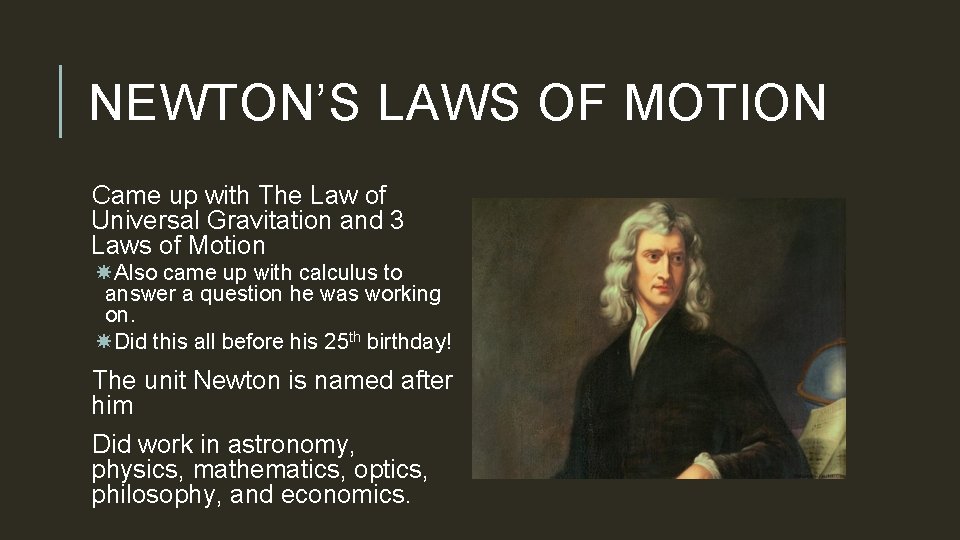
NEWTON’S LAWS OF MOTION Came up with The Law of Universal Gravitation and 3 Laws of Motion Also came up with calculus to answer a question he was working on. Did this all before his 25 th birthday! The unit Newton is named after him Did work in astronomy, physics, mathematics, optics, philosophy, and economics.
NEWTON’S FIRST LAW An object moves at a constant velocity unless acted on by an unbalanced force. Also called the Law of Inertia=the tendency of an object to resist changes in motion. Sometimes phrased as: “An object at rest stays at rest, and an object in motion stays in motion, unless acted on by an outside force. ” Inertia is related to an object’s mass You can easily kick a ball and change its direction, but you cannot do the same with a car.
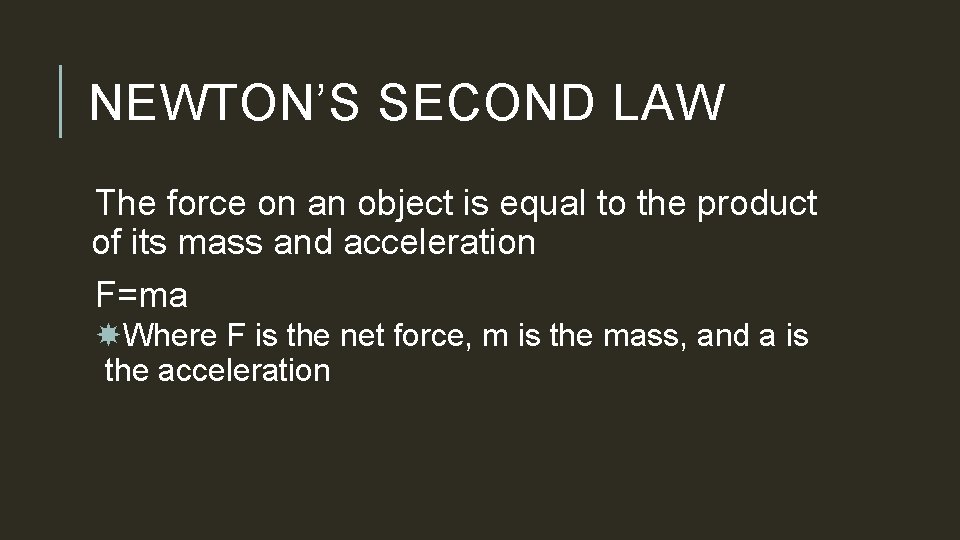
NEWTON’S SECOND LAW The force on an object is equal to the product of its mass and acceleration F=ma Where F is the net force, m is the mass, and a is the acceleration
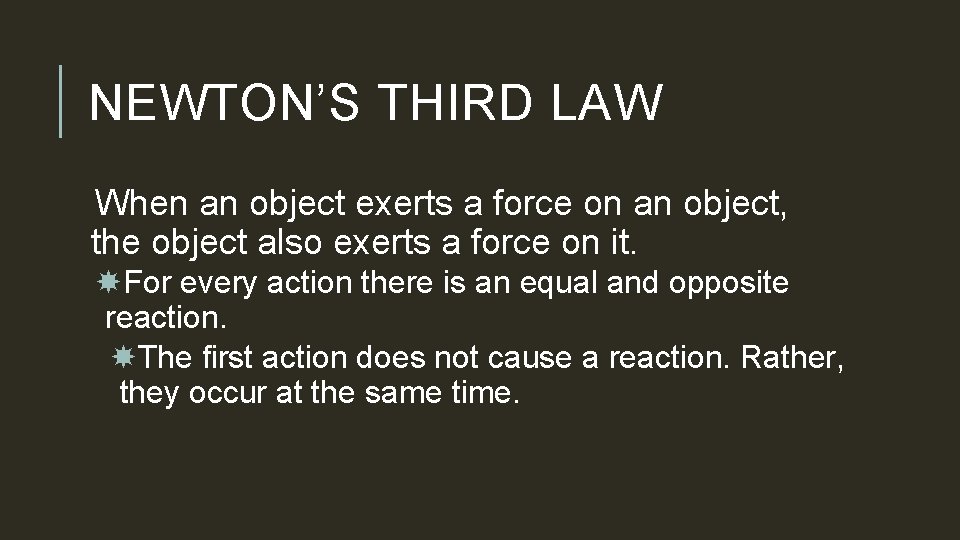
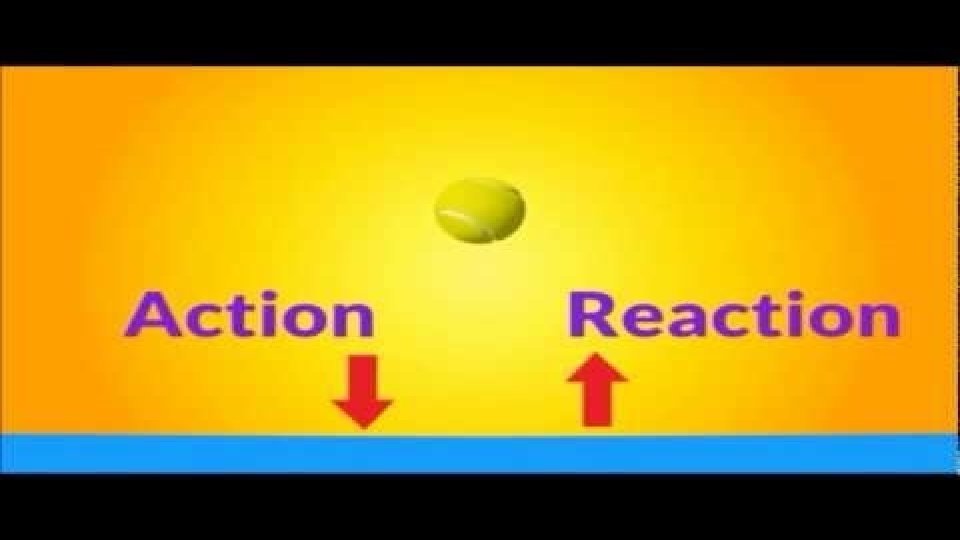
NEWTON’S THIRD LAW When an object exerts a force on an object, the object also exerts a force on it. For every action there is an equal and opposite reaction. The first action does not cause a reaction. Rather, they occur at the same time.
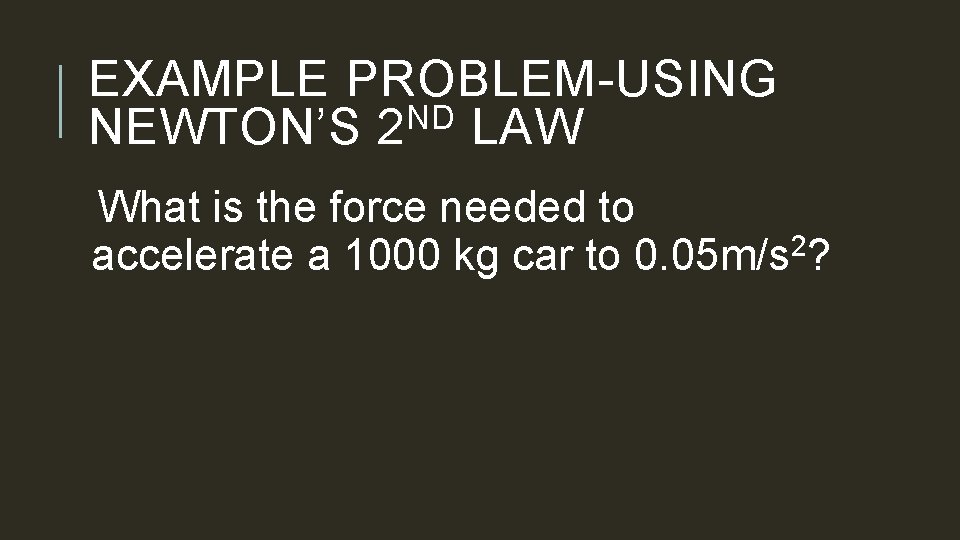
EXAMPLE PROBLEM-USING ND NEWTON’S 2 LAW What is the force needed to accelerate a 1000 kg car to 0. 05 m/s 2?
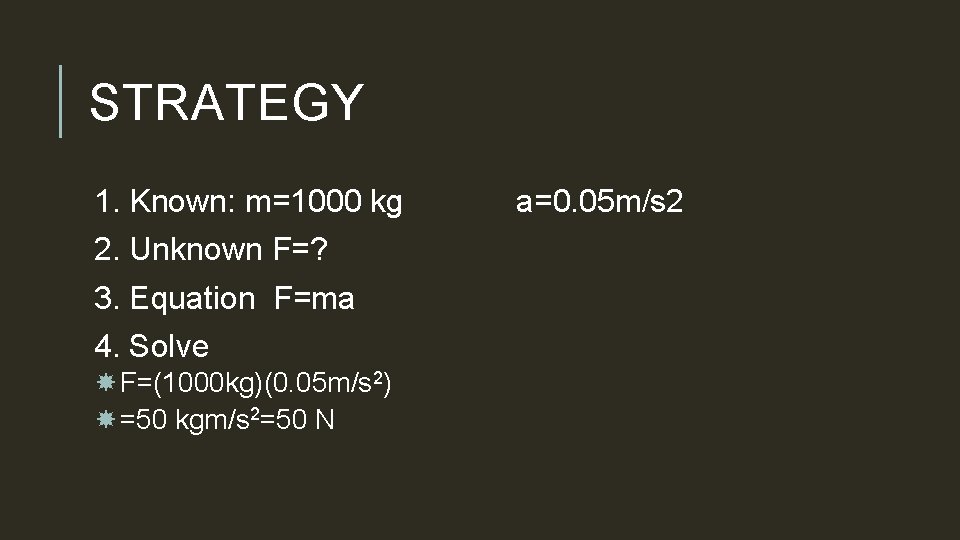
STRATEGY 1. Known: m=1000 kg 2. Unknown F=? 3. Equation F=ma 4. Solve F=(1000 kg)(0. 05 m/s 2) =50 kgm/s 2=50 N a=0. 05 m/s 2
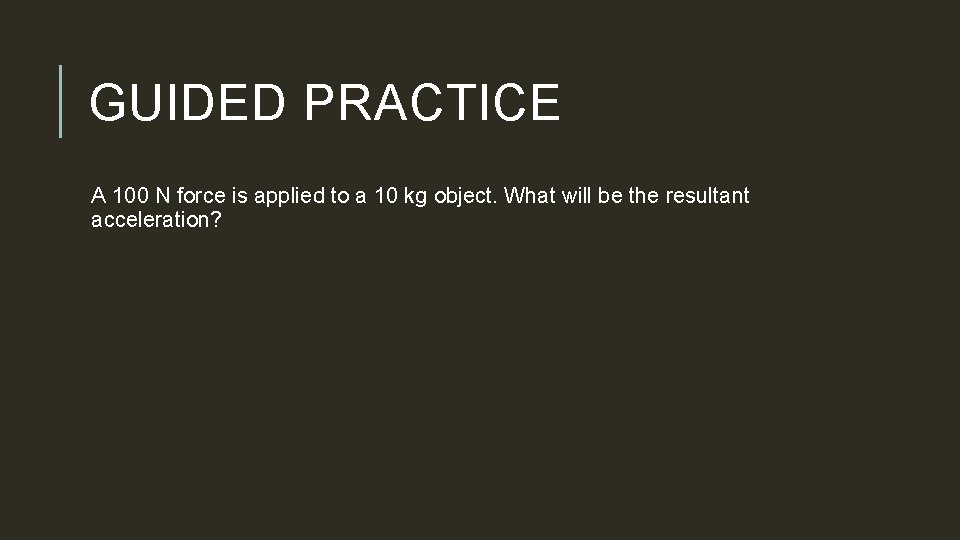
GUIDED PRACTICE A 100 N force is applied to a 10 kg object. What will be the resultant acceleration?
YOU TRY IT! What force is needed to accelerate a 3, 000 kg rocket to 0. 01 m/s 2? 30, 000 N
USING NEWTON’S LAWS Safety belts Inertia If not for the safety belt, you would continue in your motion. Air bags Decreases the force
AIR RESISTANCE The friction-like force that opposes the motion of object in the air. Acts in the direction opposite to the motion. Depends on the properties of the air (thin air vs. humid air) Also depends on the object’s size, shape, speed, aerodynamics, etc. The more spread out an object, the more air resistance it will experience, and the slower it will fall The amount of air resistance also increases as speed increases. Eventually gravity and air resistance become equal This stops acceleration, and the object falls at constant speed. Called terminal velocity
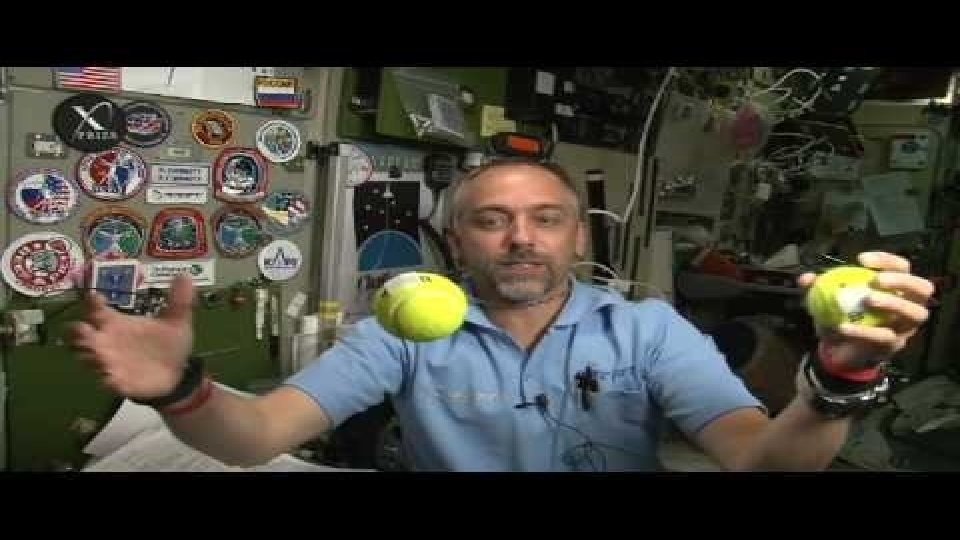
FREE FALL If gravity is the only force acting on an object, it is said to be in free fall. Object in orbit Earth is in free fall towards the sun. If it did not have a velocity, it would fall into the sun. Weightlessness In freefall, objects feel weightless because their acceleration equals the acceleration of gravity.
CENTRIPETAL FORCES Force exerted towards the center of a curved path. Causes an object to move in a circle. Gravity is the centripetal force that keeps the planets in orbit Will be the same direction as centripetal acceleration
FORCE AND MOMENTUM Law of conservation of momentum If no outside factor acts on a group of objects, the total momentum does not change. It can however be transferred to another object. In a collision, the momentum is transferred from one object to the next P=mv m 1 v 1 i+m 2 v 2 i=m 1 v 1 f+m 2 v 2 f