
Forces and Motion Created by Gina Groover West
Forces and Motion Created by Gina Groover West Ottawa Public Schools April, 2011 Property of West Ottawa Public Schools
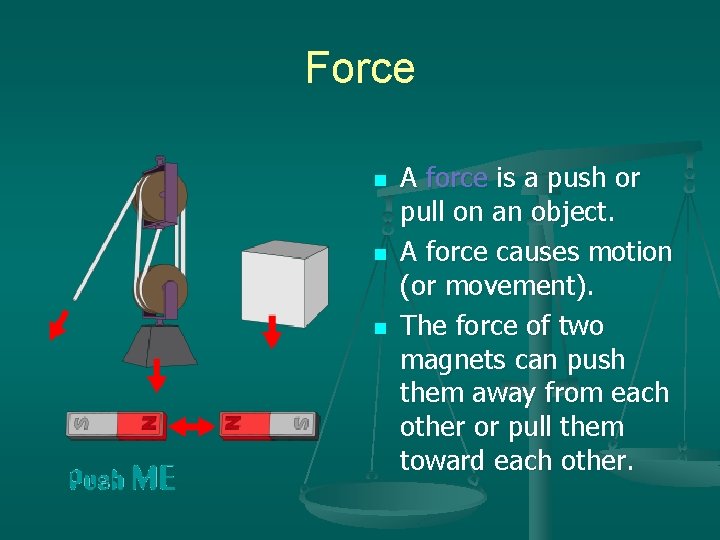
Force n n n A force is a push or pull on an object. A force causes motion (or movement). The force of two magnets can push them away from each other or pull them toward each other.
Motion n n Motion is when an object moves or changes its position. Motion is the result of a force. We can tell if an object is in motion by looking at a point of reference (another object).
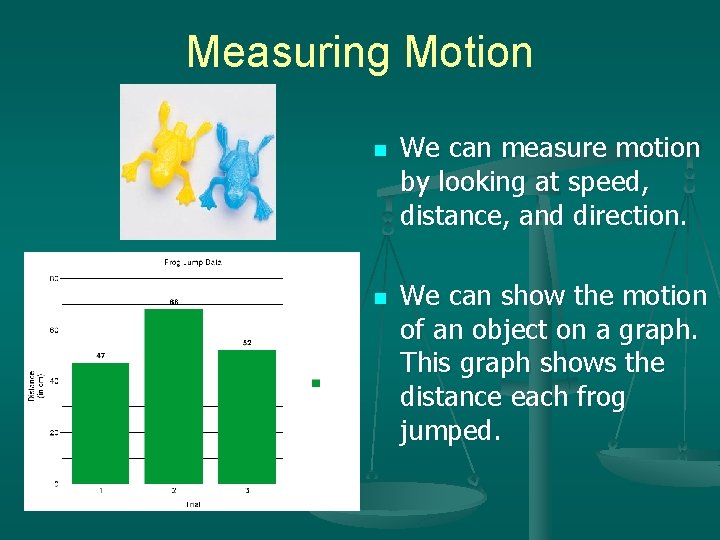
Measuring Motion n n We can measure motion by looking at speed, distance, and direction. We can show the motion of an object on a graph. This graph shows the distance each frog jumped.
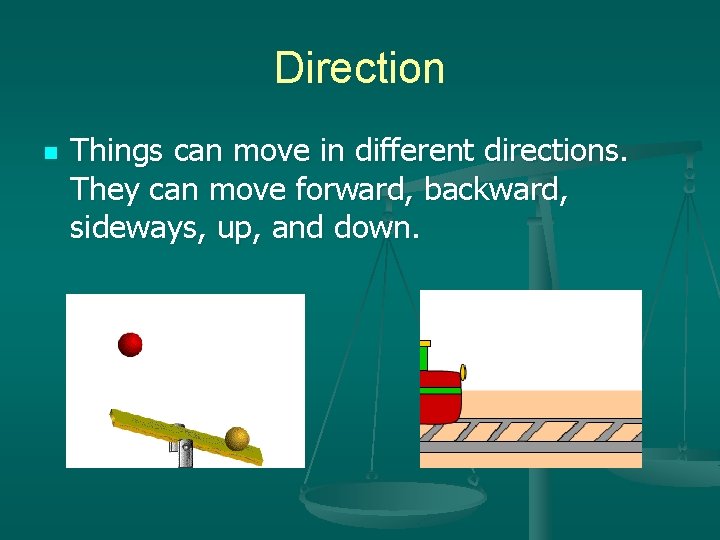
Direction n Things can move in different directions. They can move forward, backward, sideways, up, and down.

Speed n n Speed is how fast an object travels from one point to another. We use points of reference to measure an object’s speed.
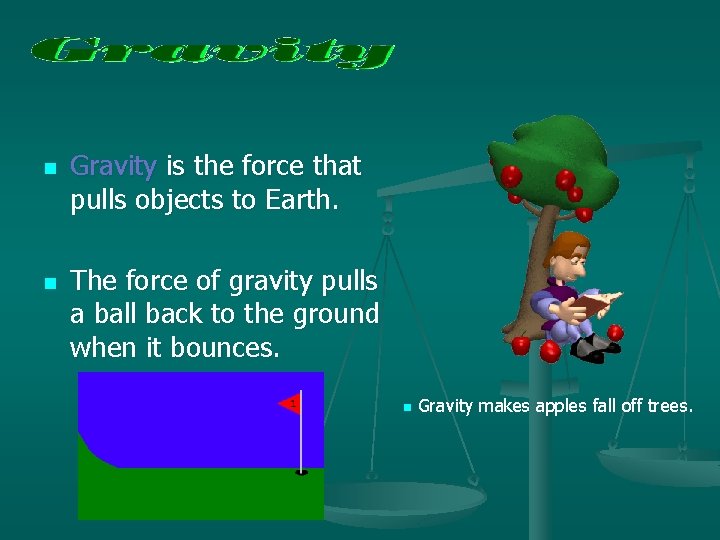
n n Gravity is the force that pulls objects to Earth. The force of gravity pulls a ball back to the ground when it bounces. n Gravity makes apples fall off trees.
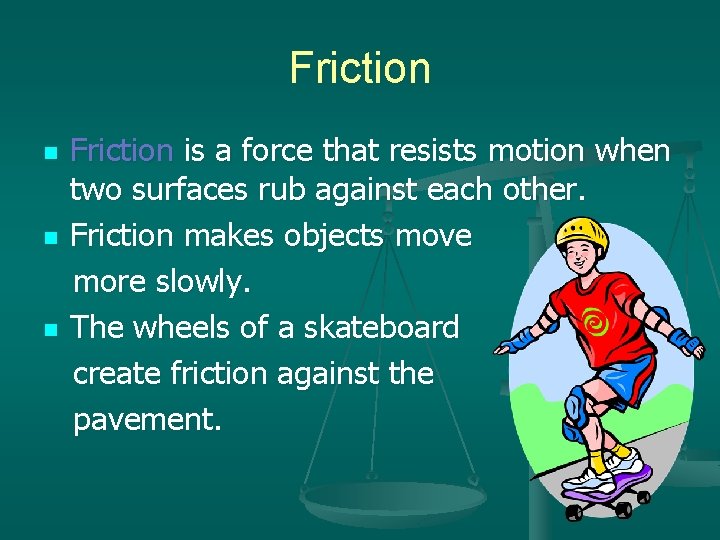
Friction n Friction is a force that resists motion when two surfaces rub against each other. Friction makes objects move more slowly. The wheels of a skateboard create friction against the pavement.
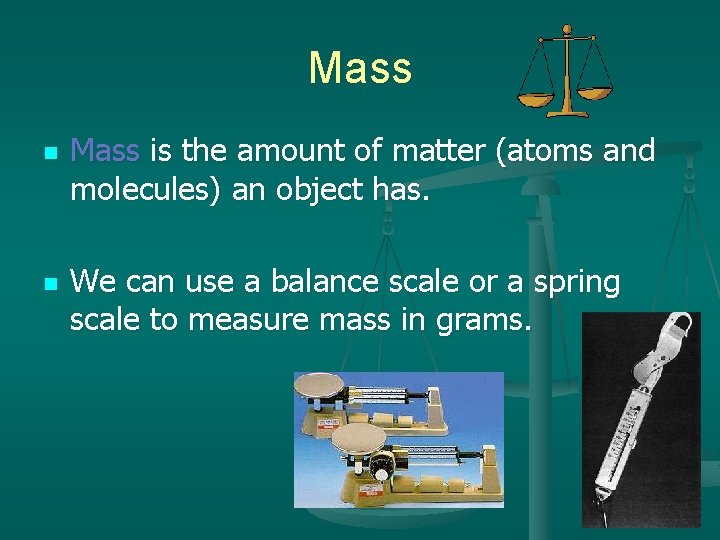
Mass n n Mass is the amount of matter (atoms and molecules) an object has. We can use a balance scale or a spring scale to measure mass in grams.
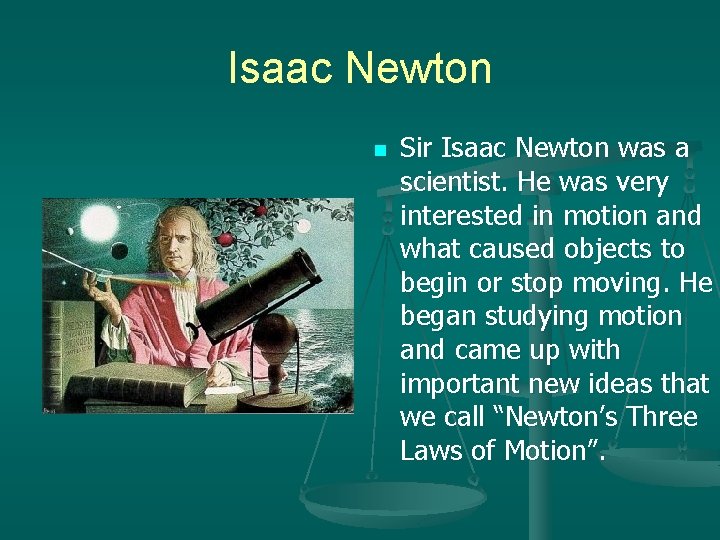
Isaac Newton n Sir Isaac Newton was a scientist. He was very interested in motion and what caused objects to begin or stop moving. He began studying motion and came up with important new ideas that we call “Newton’s Three Laws of Motion”.
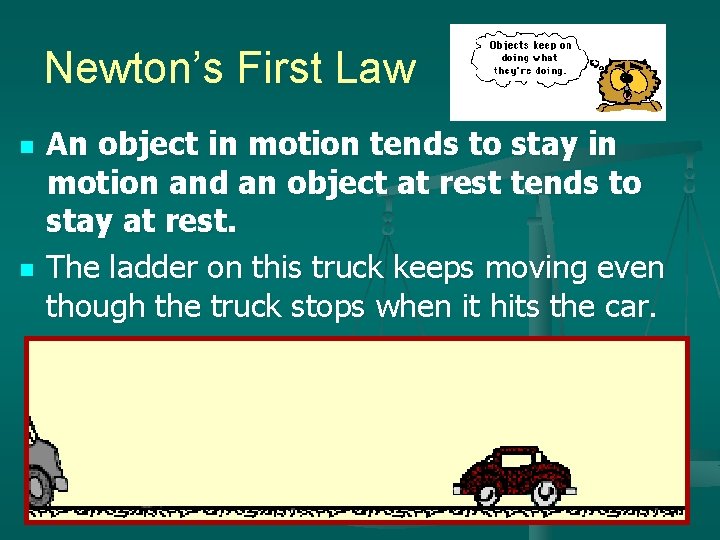
Newton’s First Law n n An object in motion tends to stay in motion and an object at rest tends to stay at rest. The ladder on this truck keeps moving even though the truck stops when it hits the car.
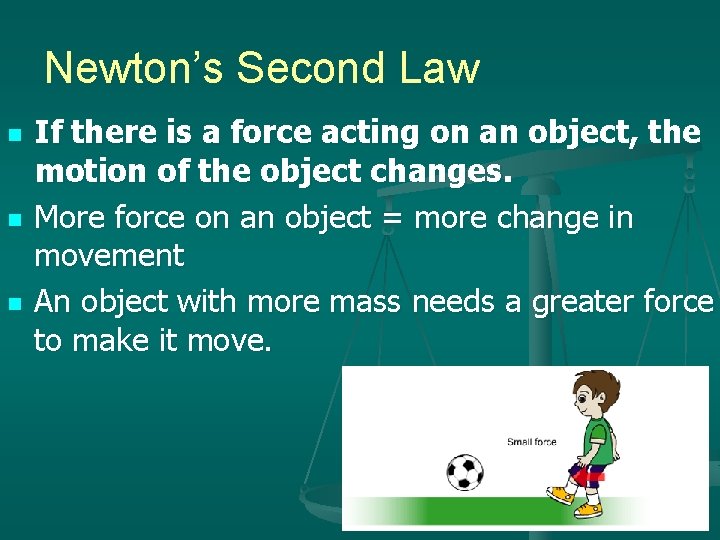
Newton’s Second Law n n n If there is a force acting on an object, the motion of the object changes. More force on an object = more change in movement An object with more mass needs a greater force to make it move.
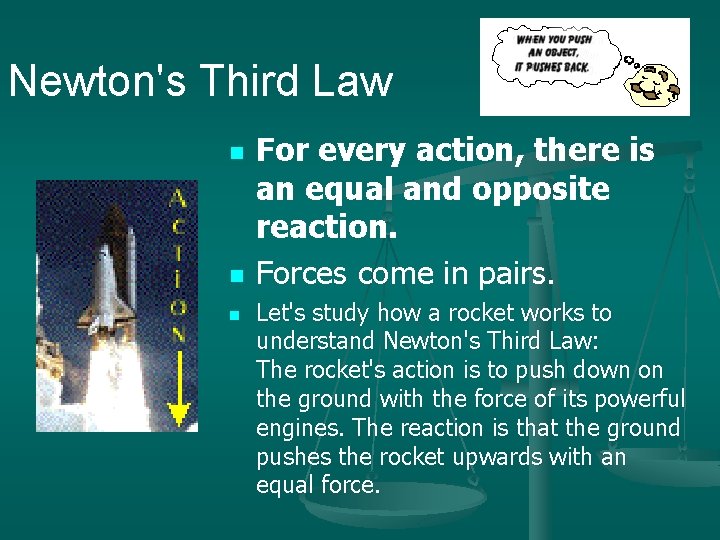
Newton's Third Law n n n For every action, there is an equal and opposite reaction. Forces come in pairs. Let's study how a rocket works to understand Newton's Third Law: The rocket's action is to push down on the ground with the force of its powerful engines. The reaction is that the ground pushes the rocket upwards with an equal force.
Newton’s Laws n n Sir Isaac Newton proposed three laws of motion in 1665: If an object is not moving, it will not start moving by itself. If an object is moving, it will not stop or change direction unless something pushes it. Objects will move farther and faster when they are pushed harder. When an object is pushed in one direction, there is always a resistance of the same size in the opposite direction.
n n Thanks to scientists like Isaac Newton we now know a lot about motion and forces. We know that a force is needed to make an object start or stop moving. We know that friction slows down motion. We know that forces come in pairs.
- Slides: 15