
Forces and Motion Chapter 3 Sir Isaac Newton

- Slides: 11
Forces and Motion Chapter 3
Sir Isaac Newton (1642 -1727), an English physicist and mathematician, is one of the most brilliant scientists in history. Before the age of 30, he formulated the basic laws of mechanics, discovered the universal law of gravitation, and invented calculus!
Newton’s Laws 1. Unless you apply force, things tend to keep on doing what they were doing in the first place. 2. Force causes an object to accelerate, while the object’s mass resists acceleration. 3. For every action, there is an equal and opposite reaction.
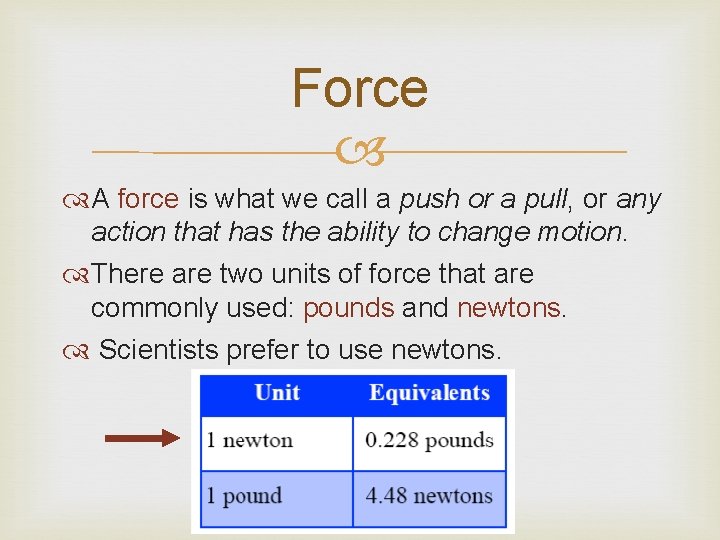
Force A force is what we call a push or a pull, or any action that has the ability to change motion. There are two units of force that are commonly used: pounds and newtons. Scientists prefer to use newtons.
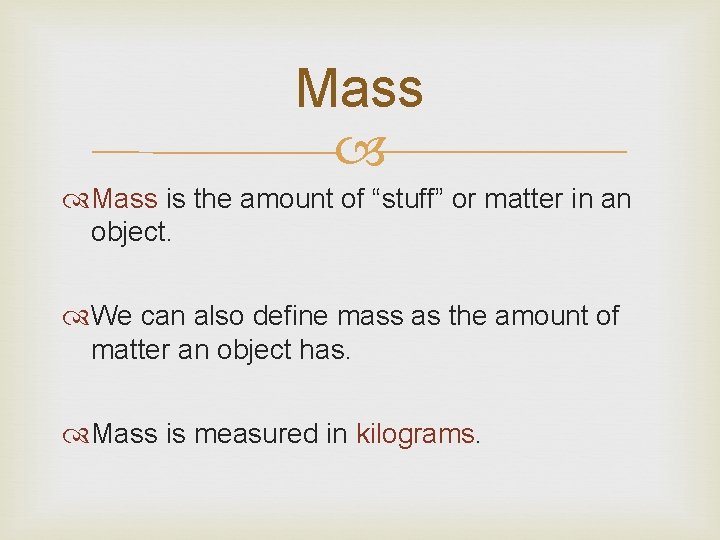
Mass is the amount of “stuff” or matter in an object. We can also define mass as the amount of matter an object has. Mass is measured in kilograms.
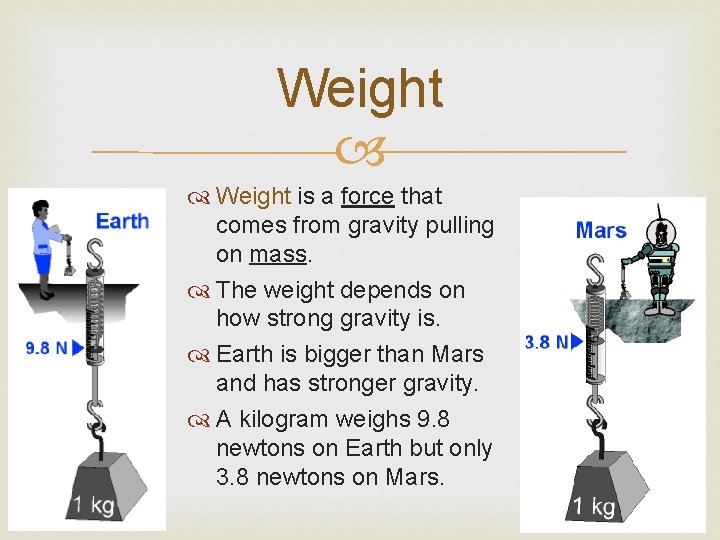
Weight is a force that comes from gravity pulling on mass. The weight depends on how strong gravity is. Earth is bigger than Mars and has stronger gravity. A kilogram weighs 9. 8 newtons on Earth but only 3. 8 newtons on Mars.
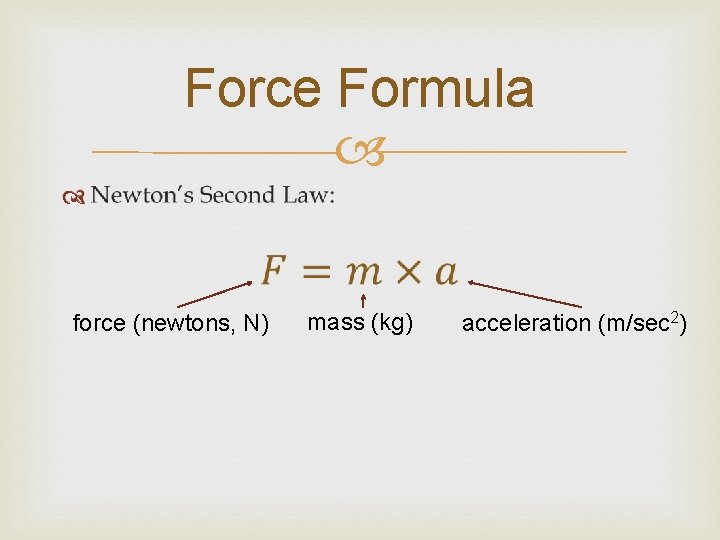
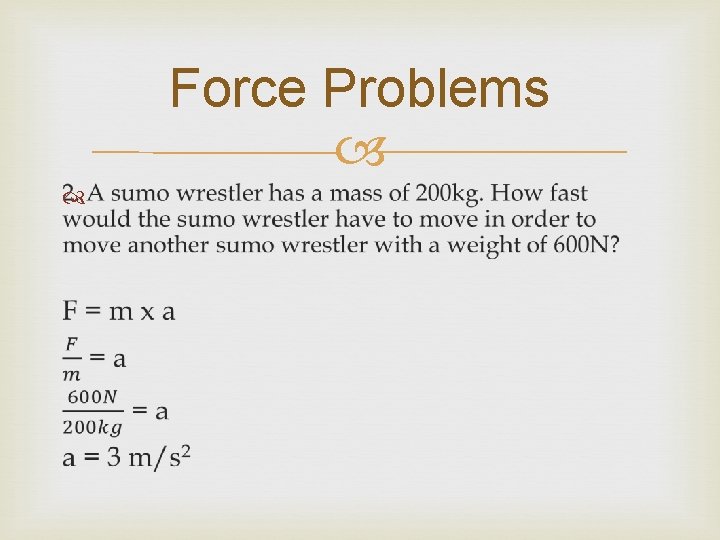
Force Formula force (newtons, N) mass (kg) acceleration (m/sec 2)
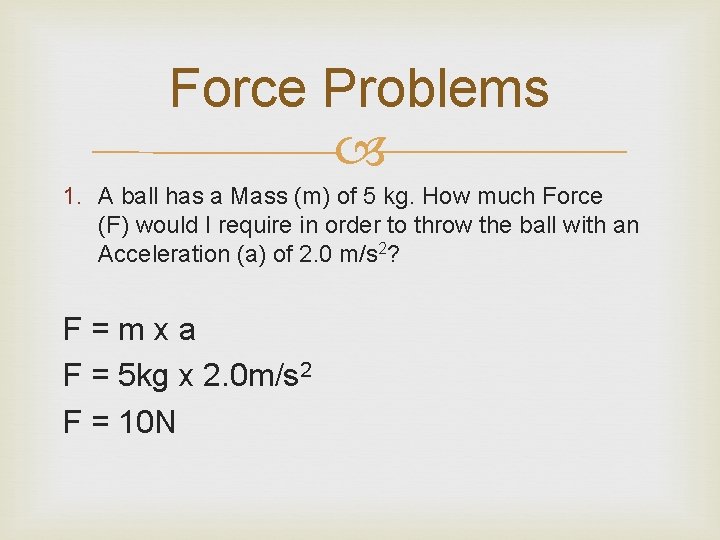
Force Problems 1. A ball has a Mass (m) of 5 kg. How much Force (F) would I require in order to throw the ball with an Acceleration (a) of 2. 0 m/s 2? F=mxa F = 5 kg x 2. 0 m/s 2 F = 10 N
Force Problems
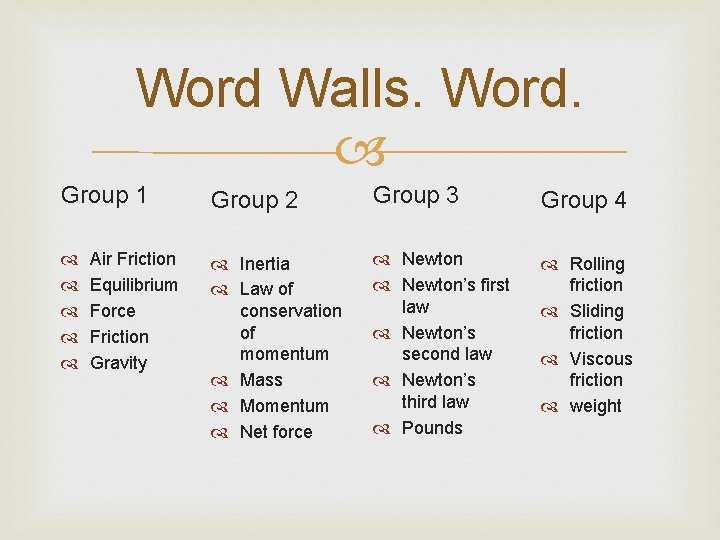
Word Walls. Word. Group 1 Group 2 Group 3 Group 4 Inertia Law of conservation of momentum Mass Momentum Net force Newton’s first law Newton’s second law Newton’s third law Pounds Rolling friction Sliding friction Viscous friction weight Air Friction Equilibrium Force Friction Gravity