
Forces and Motion A push oris a pull
- Slides: 14
Forces and Motion
• A push oris a pull What a force? • Force is something that causes a body to move, change its speed or direction, or distort (change) its shape • Forces can be balanced causing no change in motion (meaning to continue at the same speed or to stay motionless) • Unbalanced forces cause a change in motion due to one force being greater than the other
What is motion? • Motion is a change in position of an object compared to a reference point • Reference points are usually stationary objects on Earth like a tree or building • Forces cause motion
More on Motion • Speed is the rate an object moves and is calculated as S = D/T where d=distance and t=time • Velocity is an object’s speed with direction ex: The car was traveling 85 km/h to the south • Acceleration is the change in velocity of an object, it can be positive (increasing acceleration) or negative when slowing down (deceleration) • Momentum is an object’s mass x it’s velocity (M=mv)
Some Types of Forces • Gravity (non-contact) • Friction (contact) • Magnetism (non-contact) • Elastic (contact) • Static Electricity (non-contact)
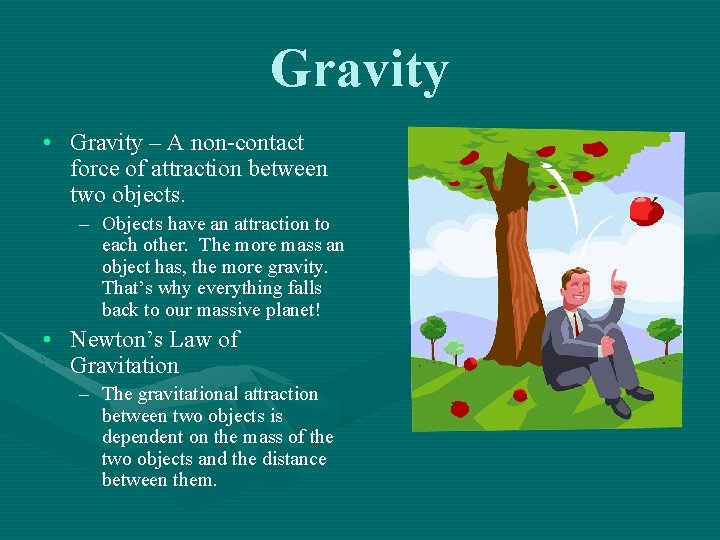
Gravity • Gravity – A non-contact force of attraction between two objects. – Objects have an attraction to each other. The more mass an object has, the more gravity. That’s why everything falls back to our massive planet! • Newton’s Law of Gravitation – The gravitational attraction between two objects is dependent on the mass of the two objects and the distance between them.
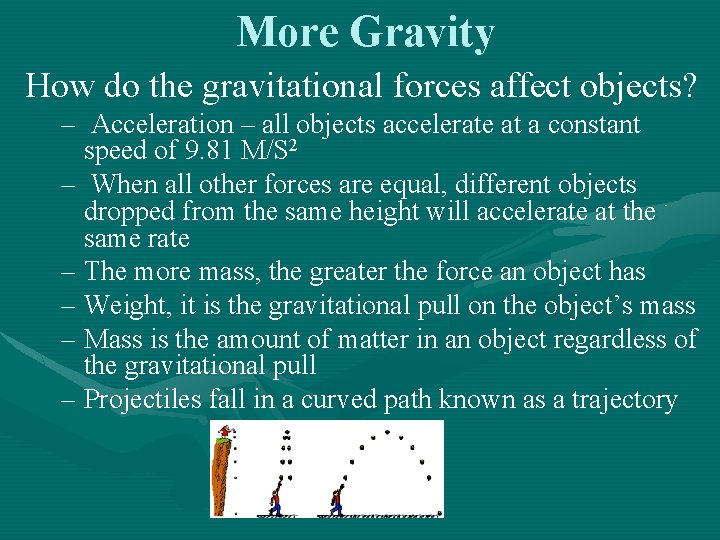
More Gravity How do the gravitational forces affect objects? – Acceleration – all objects accelerate at a constant speed of 9. 81 M/S 2 – When all other forces are equal, different objects dropped from the same height will accelerate at the same rate – The more mass, the greater the force an object has – Weight, it is the gravitational pull on the object’s mass – Mass is the amount of matter in an object regardless of the gravitational pull – Projectiles fall in a curved path known as a trajectory
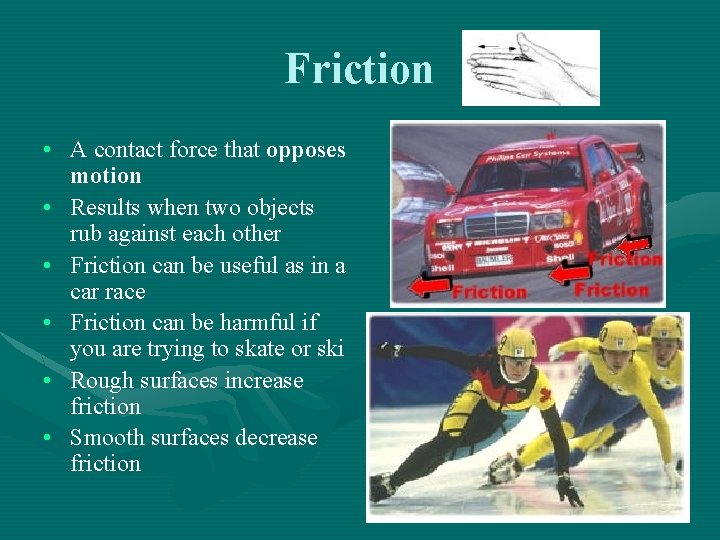
Friction • A contact force that opposes motion • Results when two objects rub against each other • Friction can be useful as in a car race • Friction can be harmful if you are trying to skate or ski • Rough surfaces increase friction • Smooth surfaces decrease friction
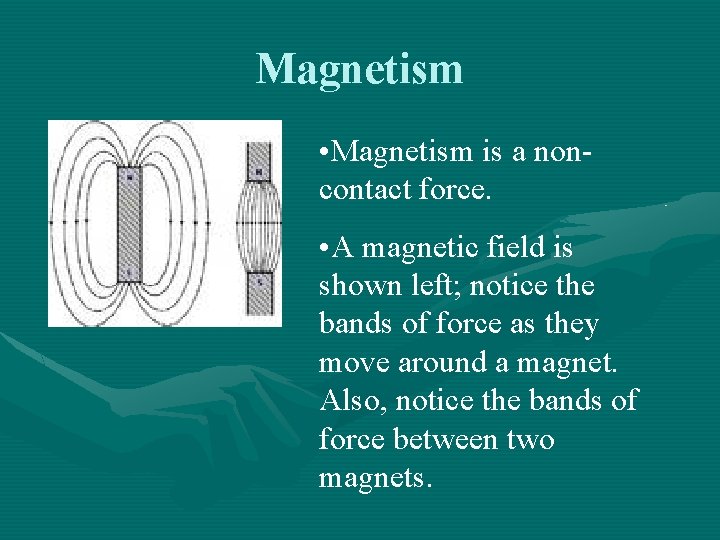
Magnetism • Magnetism is a noncontact force. • A magnetic field is shown left; notice the bands of force as they move around a magnet. Also, notice the bands of force between two magnets.
What Is Energy? • Kinetic Energy – The energy of motion. The more energy an object has, the more force it has. • Potential Energy – The kinetic energy an object potentially has. It is also known as stored energy.
Newton’s Three Laws of Motion • Written in 1687 • Describe the motion we observe • Explain the forces behind the motion • 1 st Law = Inertia • 2 nd Law = F=MA • 3 rd Law = Action/Reaction
Inertia – The First Law • Newton’s First Law of Motion • It states that objects at rest stay at rest, and objects in motion stay in motion until a force acts upon them. • Inertia is why seat belts are so important to wear! • It is also why you can pull the rug out from under something.
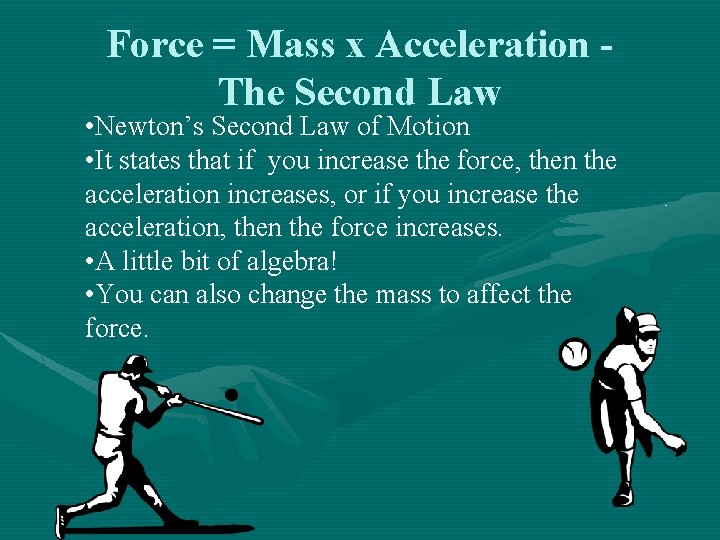
Force = Mass x Acceleration The Second Law • Newton’s Second Law of Motion • It states that if you increase the force, then the acceleration increases, or if you increase the acceleration, then the force increases. • A little bit of algebra! • You can also change the mass to affect the force.
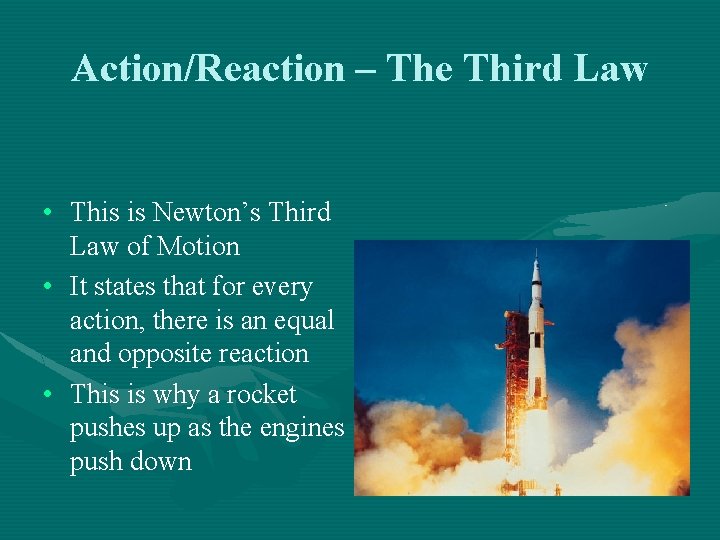
Action/Reaction – The Third Law • This is Newton’s Third Law of Motion • It states that for every action, there is an equal and opposite reaction • This is why a rocket pushes up as the engines push down