
Forces and Free Body Diagrams Physical Science Types
Forces and Free Body Diagrams Physical Science
Types of Forces Contact Forces 1. Friction 2. Normal force AKA- support force 3. Tension force 4. Applied force
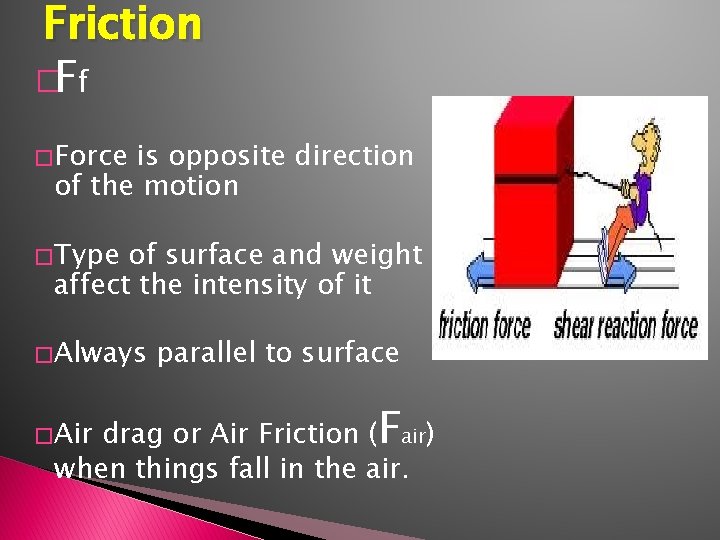
Friction �Ff � Force is opposite direction of the motion � Type of surface and weight affect the intensity of it � Always parallel to surface drag or Air Friction (Fair) when things fall in the air. � Air
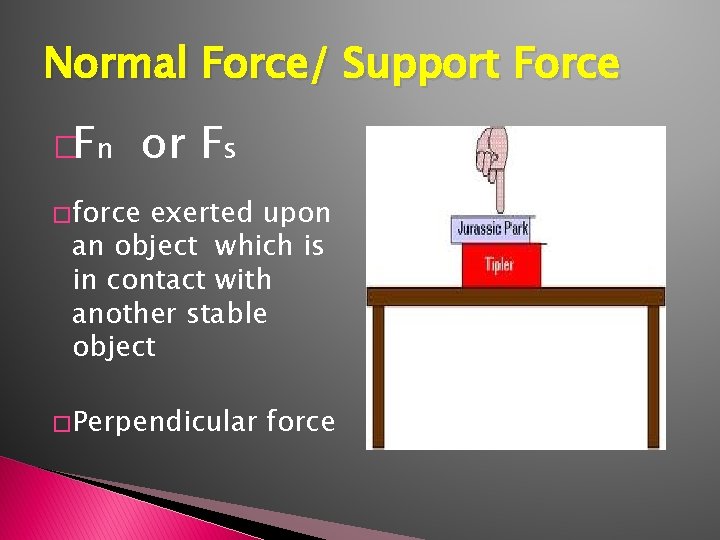
Normal Force/ Support Force �Fn or Fs � force exerted upon an object which is in contact with another stable object � Perpendicular force
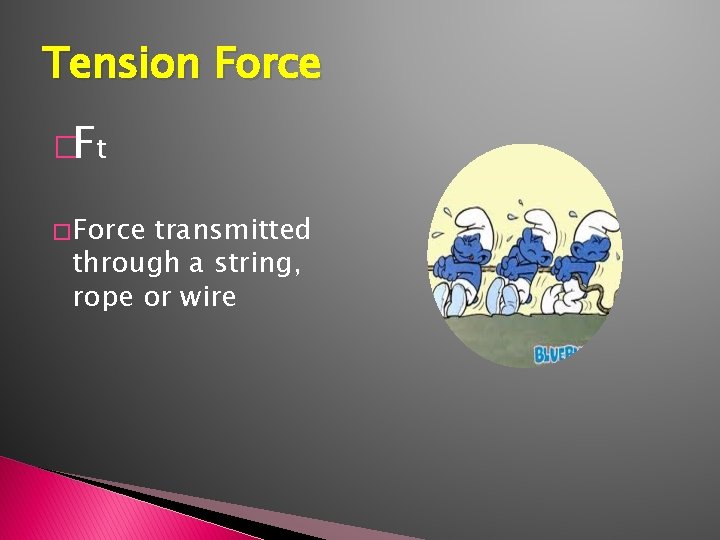
Tension Force �Ft � Force transmitted through a string, rope or wire
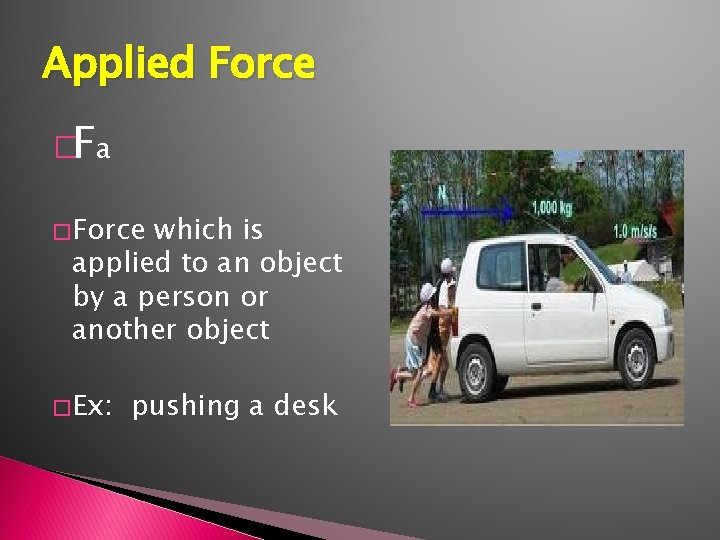
Applied Force �Fa � Force which is applied to an object by a person or another object � Ex: pushing a desk
Types of Forces Distance Forces � Force of Gravity ◦ Fg ◦ Force at which the earth, moon or other objects attract another object towards itself How the acceleration of gravity affects the mass of an object. Fg = mass x gravity Fg = mg Other types of Distance forces � magnetism � electrostatic
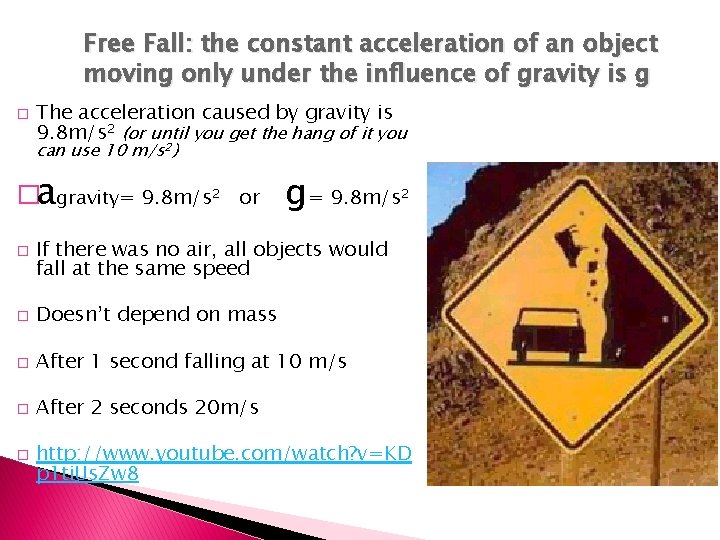
Free Fall: the constant acceleration of an object moving only under the influence of gravity is g � The acceleration caused by gravity is 9. 8 m/s 2 (or until you get the hang of it you can use 10 m/s 2) �agravity= 9. 8 m/s 2 � or g= 9. 8 m/s If there was no air, all objects would fall at the same speed � Doesn’t depend on mass � After 1 second falling at 10 m/s � After 2 seconds 20 m/s � 2 http: //www. youtube. com/watch? v=KD p 1 ti. Us. Zw 8

http: //www. youtube. com/watch? v=PHxv. ML o. KRWg&feature=related
All objects experience a force of gravity downward towards the center of the earth � Force of gravity is AKA weight! �So, Fg and W are the same thing! So what’s the difference between mass and weight?
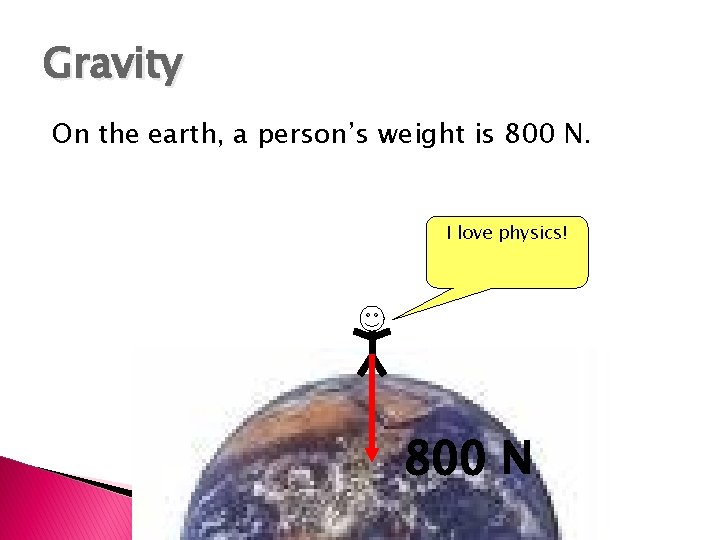
Gravity On the earth, a person’s weight is 800 N. I love physics! 800 N
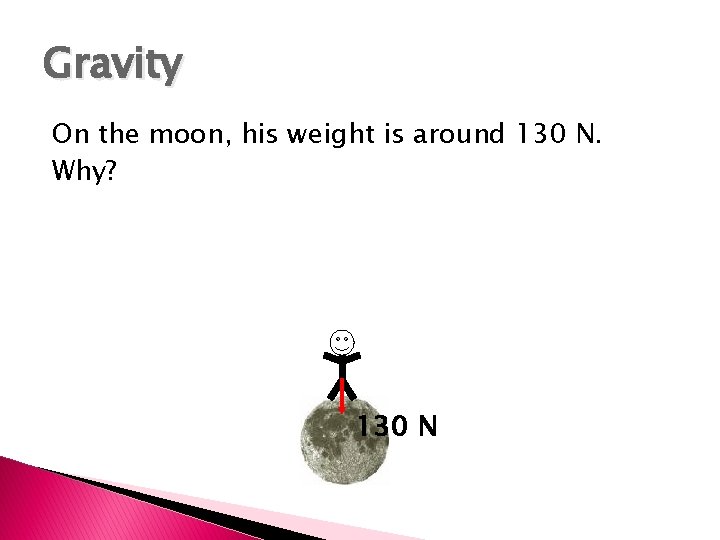
Gravity On the moon, his weight is around 130 N. Why? 130 N
Mass vs Weight � Mass is the amount of matter in an object. ◦ It’s measured in grams or kilograms. ◦ General rule: If you are given a force, you will divide by 9. 8 � Weight is the amount of acceleration of gravity acting on an object’s mass. ◦ It’s measured in Newtons. ◦ General rule: If you are given a mass, you will multiply by 9. 8
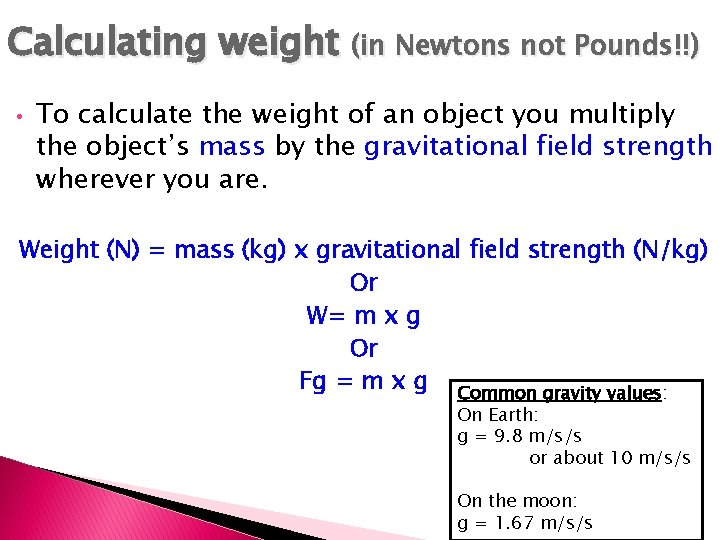
Calculating weight (in Newtons not Pounds!!) • To calculate the weight of an object you multiply the object’s mass by the gravitational field strength wherever you are. Weight (N) = mass (kg) x gravitational field strength (N/kg) Or W= m x g Or Fg = m x g Common gravity values: On Earth: g = 9. 8 m/s/s or about 10 m/s/s On the moon: g = 1. 67 m/s/s
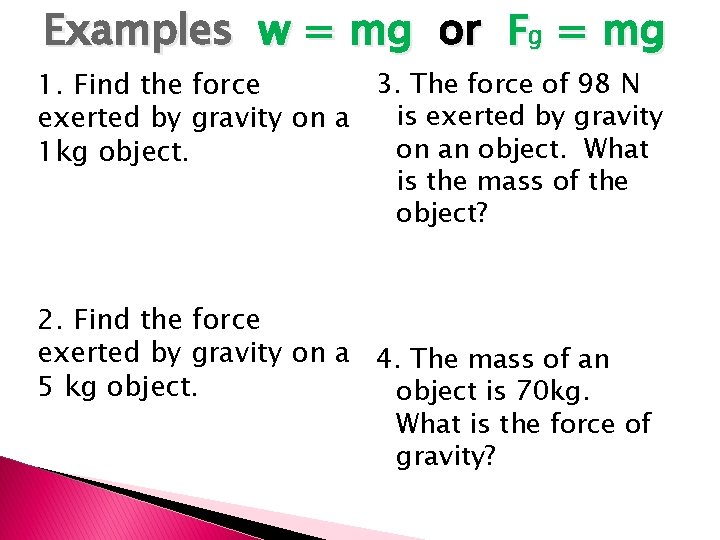
Examples w = mg or Fg = mg 3. The force of 98 N 1. Find the force is exerted by gravity on an object. What 1 kg object. is the mass of the object? 2. Find the force exerted by gravity on a 4. The mass of an 5 kg object is 70 kg. What is the force of gravity?
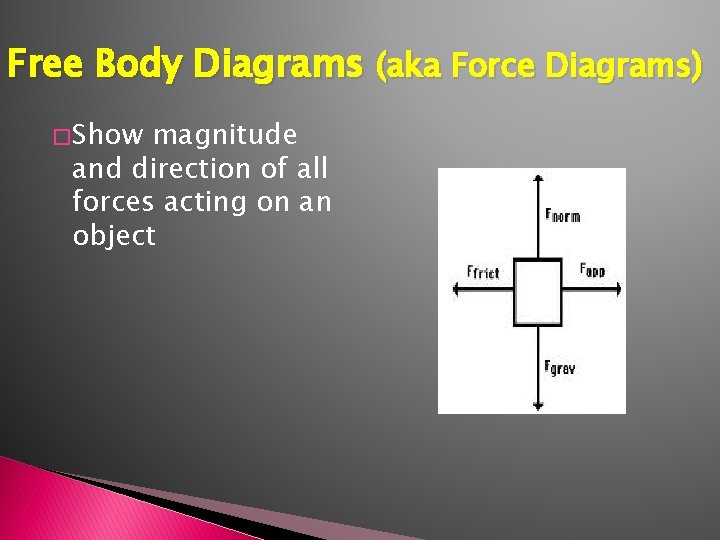
Free Body Diagrams (aka Force Diagrams) � Show magnitude and direction of all forces acting on an object
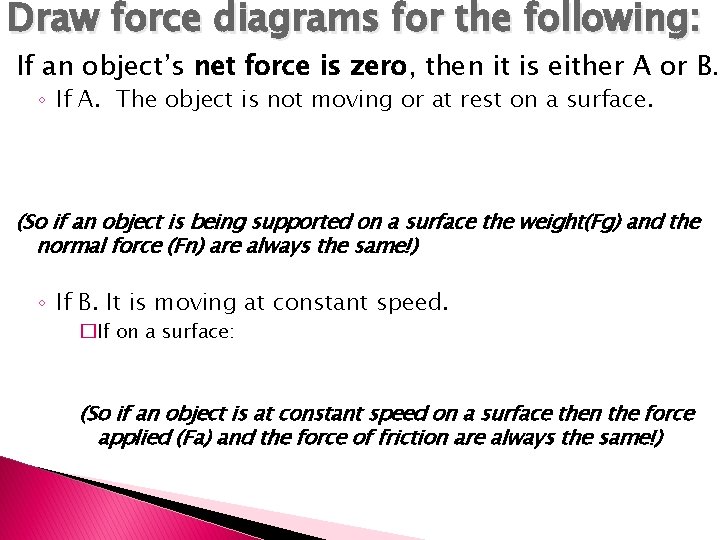
Draw force diagrams for the following: If an object’s net force is zero, then it is either A or B. ◦ If A. The object is not moving or at rest on a surface. (So if an object is being supported on a surface the weight(Fg) and the normal force (Fn) are always the same!) ◦ If B. It is moving at constant speed. �If on a surface: (So if an object is at constant speed on a surface then the force applied (Fa) and the force of friction are always the same!)
Practice Problem 1 w= mg �A 55 kg person is sitting on a chair. ◦ a. What is their weight (in Newtons!) ◦ b. What is the normal force (support force)? ◦ c. Draw a force diagram showing the forces. ◦ d. What is the net force on the block?
Practice Problem 2 �A block with a mass of 6 kg is being dragged across a table at a constant speed. It requires 3 N of force to drag it because of friction. Draw a force diagram showing the forces involved. What is the net force on the block?
- Slides: 19