
Force Work and Power Chapter 41 What is








- Slides: 18
Force, Work and Power Chapter 41
What is a force? • A force is anything that causes an object to change its velocity. • Force is measured in Newton’s(N)
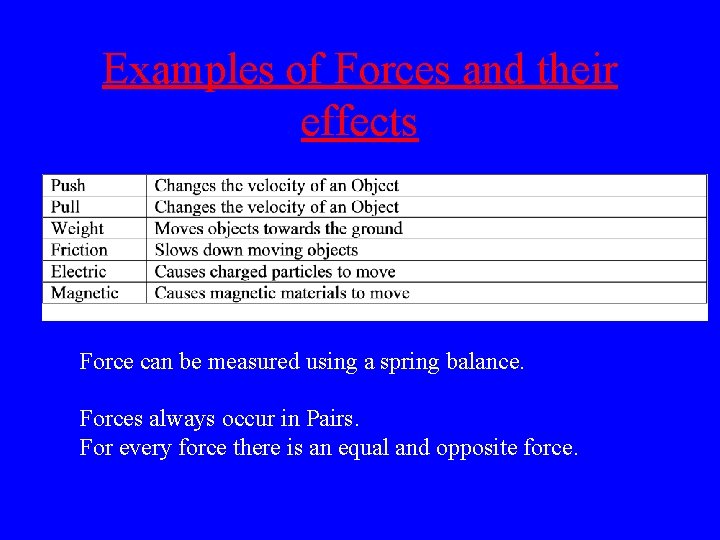
Examples of Forces and their effects Force can be measured using a spring balance. Forces always occur in Pairs. For every force there is an equal and opposite force.
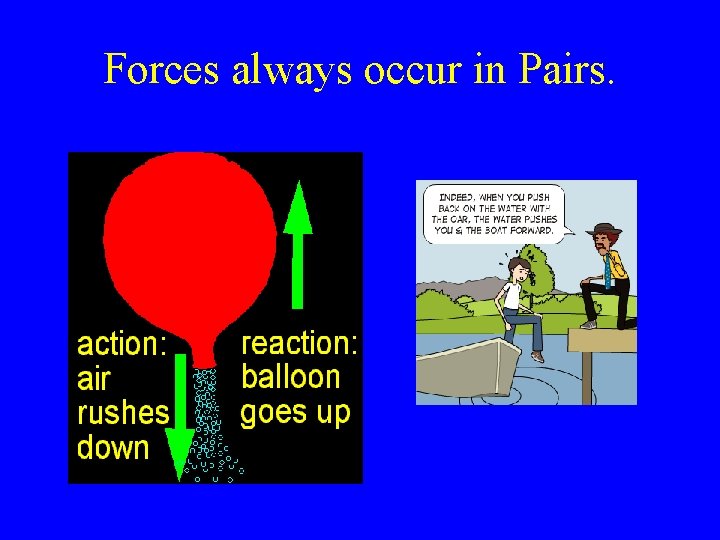
Forces always occur in Pairs.
For every force there is an equal and opposite force
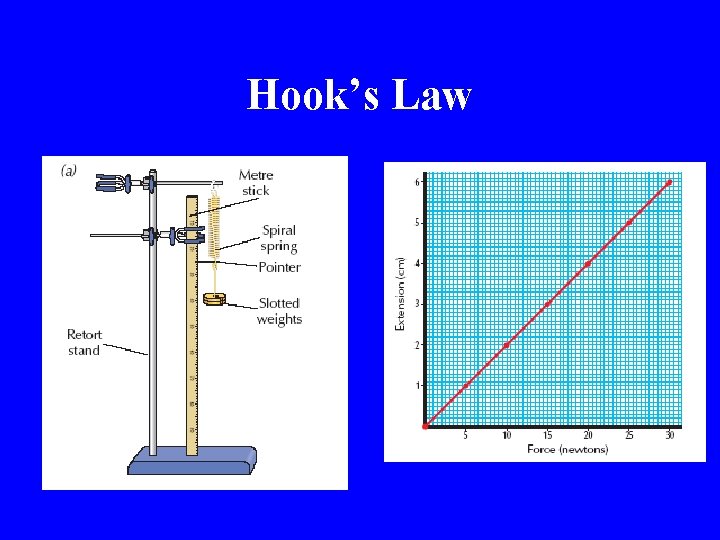
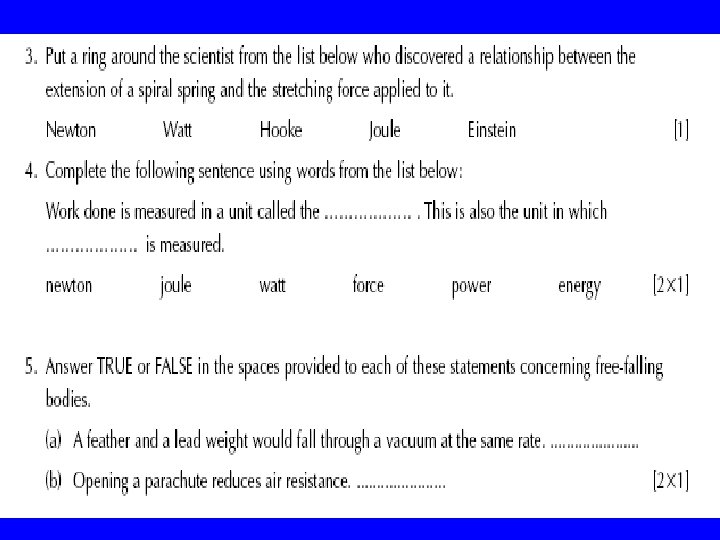
The Effects of force on a spring(Hook’s Law) • The extension of a spiral spring is directly proportional to the force stretching it. • It is found that by adding equal weights to the spring will extend it in equal amounts.
Hook’s Law
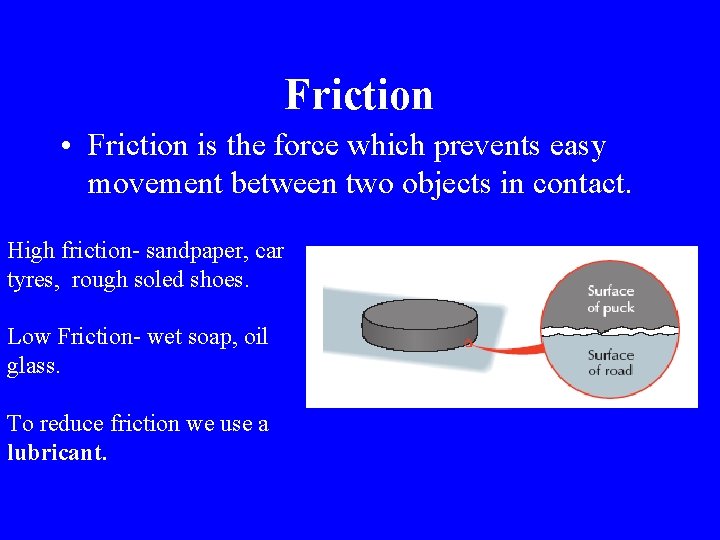
Friction • Friction is the force which prevents easy movement between two objects in contact. High friction- sandpaper, car tyres, rough soled shoes. Low Friction- wet soap, oil glass. To reduce friction we use a lubricant.
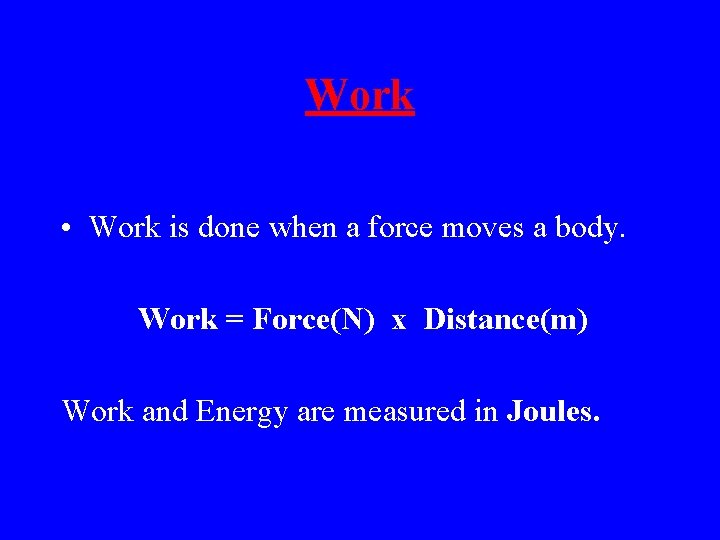
Work • Work is done when a force moves a body. Work = Force(N) x Distance(m) Work and Energy are measured in Joules.
Examples: Find the work done when a force of 6 N moves a glass a distance of 0. 5 m across a counter? Answer Work done = Force x Distance = 6 N x 0. 5 m = 3 Nm = 3 Joules
Example Find the work done by a weightlifter who has lifted 90 kg from the floor to a height of 1. 6 m. Answer Mass lifted = 90 kg --> WEIGHT LIFTED = 90 kg X 10 = 900 N Work done = Force x Distance moved = 900 N x 1. 6 m = 1440 N m = 1440 J
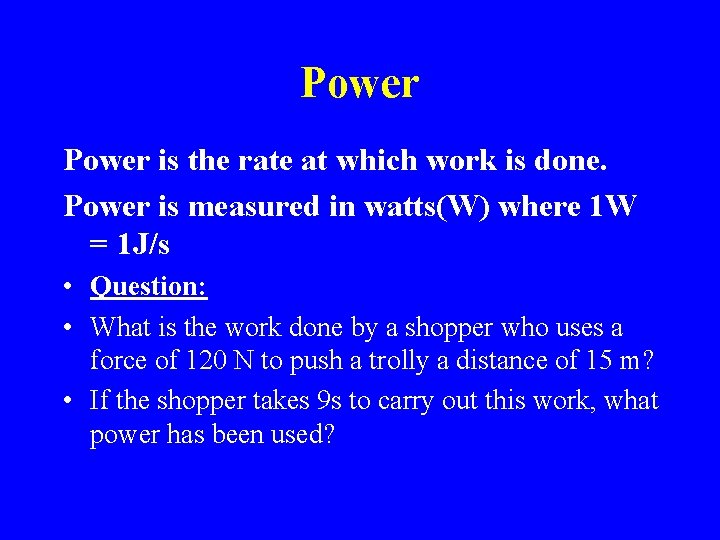
Power is the rate at which work is done. Power is measured in watts(W) where 1 W = 1 J/s • Question: • What is the work done by a shopper who uses a force of 120 N to push a trolly a distance of 15 m? • If the shopper takes 9 s to carry out this work, what power has been used?
Answer What is the work done by a shopper who uses a force of 120 N to push a trolly a distance of 15 m? Work done = Force x Distance = 120 N x 15 m = 1800 J If the shopper takes 9 s to carry out this work, what power has been used? Power = Work done Time taken = 1800 J 9 s = 200 W
Textbook Chapter 40 Force, Work and Power A 1. A 2. A 3. A 4. A 5. A 6. A 7. A 8. A 9. A 10. A 11. A 12. A 13. A 14. Push, pull, newtons. Direction. Gravity. Electric. Spring balance. Friction, newtons. Lubricants, friction. Force, object. Energy. Force, newtons, distance, metres, joule. 1200 J. 600 joules. Work. Rate, work, watts
B 1. (a) Anything that causes an object to move or change its velocity; newtons. (b) Spring balance. (c) Bullet from a rifle Two people on roller skates Balloon jet (d) 8 N B 2. (a) A force that prevents easy movement between two objects in contact. High friction: wheels of a car; brakes of a car; thread of shoes , sand paper. Low friction: wet surfaces; wet soap; ice; gears on a bicycle. (b)See Experiment 41. 3, p. 277. (c)Helpful: shoes on the ground; wheels on the road; brakes on a car; sandpaper. Not helpful: hinges on a door; when skiing; pushing large weights; inside a car engine. (d)Lubrication.
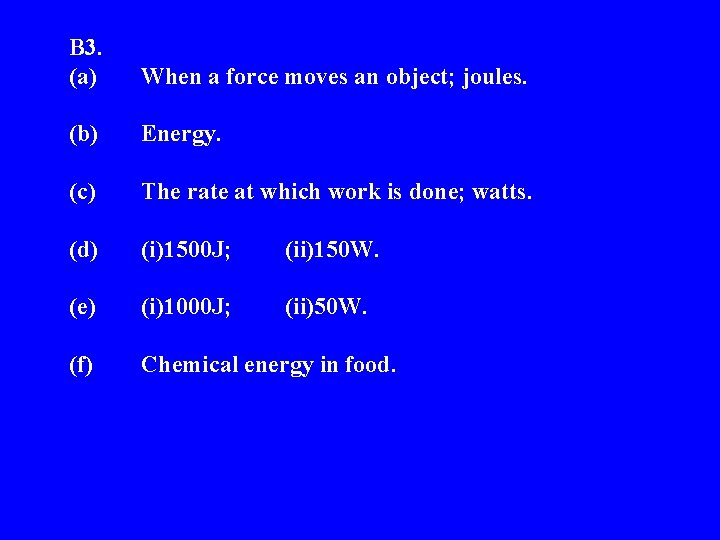
B 3. (a) When a force moves an object; joules. (b) Energy. (c) The rate at which work is done; watts. (d) (i)1500 J; (ii)150 W. (e) (i)1000 J; (ii)50 W. (f) Chemical energy in food.