
Force Feedback of Dual Forcesensing Instrument for Retinal

Force Feedback of Dual Force-sensing Instrument for Retinal Microsurgery Can Wang, Sally Hong, Will Yang (Gr. 8) Mentors: Xingchi He, Dr. Iulian Iordachita, Dr. Russell Taylor
Overview • • Background Objective Technical Approach Deliverables Timeline Management Plan Dependencies Reading List and Reference
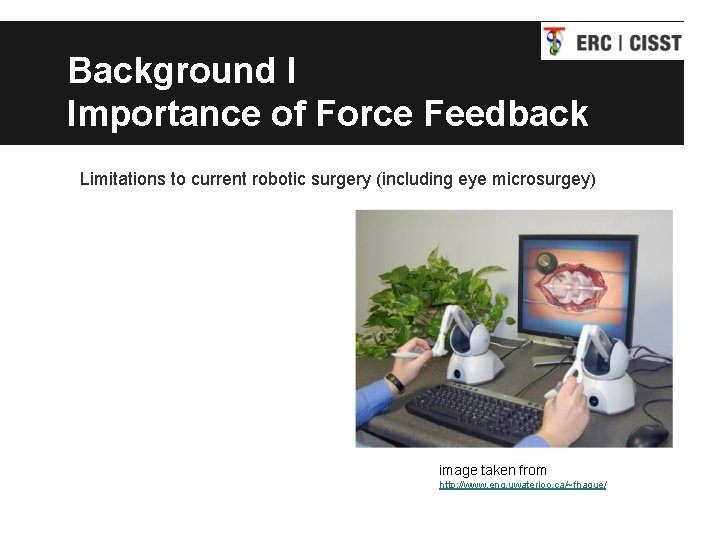
Background I Importance of Force Feedback Limitations to current robotic surgery (including eye microsurgey) image taken from http: //www. eng. uwaterloo. ca/~fhaque/
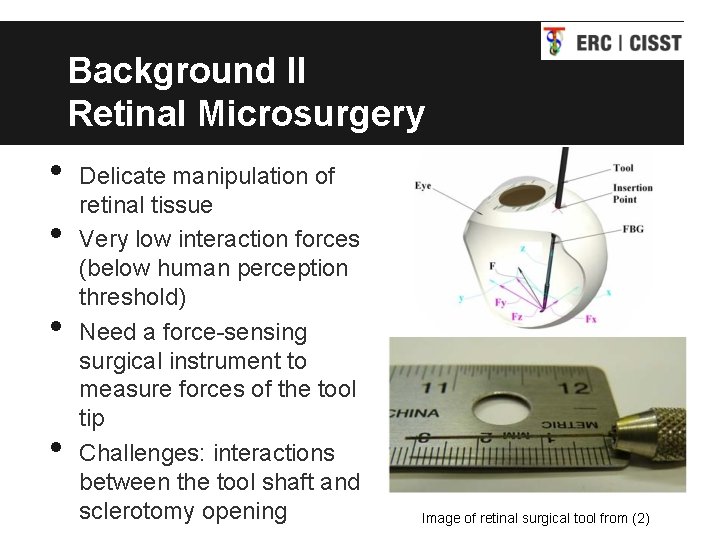
Background II Retinal Microsurgery • • Delicate manipulation of retinal tissue Very low interaction forces (below human perception threshold) Need a force-sensing surgical instrument to measure forces of the tool tip Challenges: interactions between the tool shaft and sclerotomy opening Image of retinal surgical tool from (2)

Background II Retinal Microsurgery

Background III Force Feedback Methods • • Auditory feedback: alarm surgeons if tool force extends beyond threshold o Reduce chance of retinal damage Haptic feedback: exert opposing force to surgeon's hand o Increase safety of the operation Images of the eye robot from(3) credits to ICRA
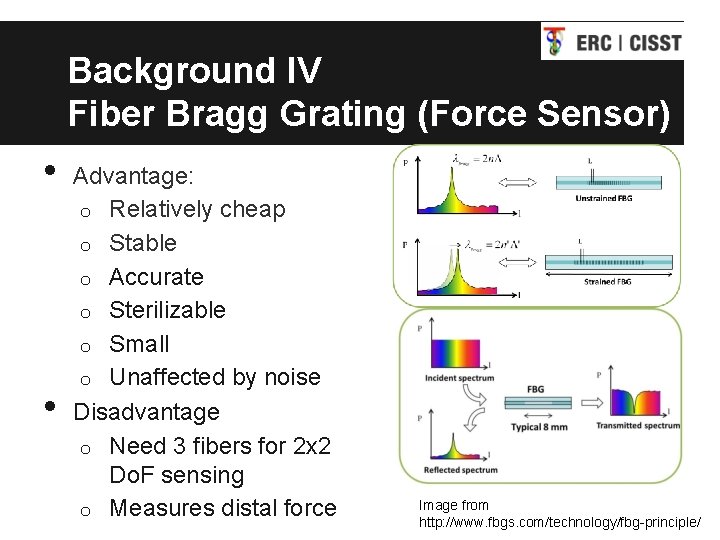
Background IV Fiber Bragg Grating (Force Sensor) • • Advantage: o Relatively cheap o Stable o Accurate o Sterilizable o Small o Unaffected by noise Disadvantage o Need 3 fibers for 2 x 2 Do. F sensing o Measures distal force Image from http: //www. fbgs. com/technology/fbg-principle/
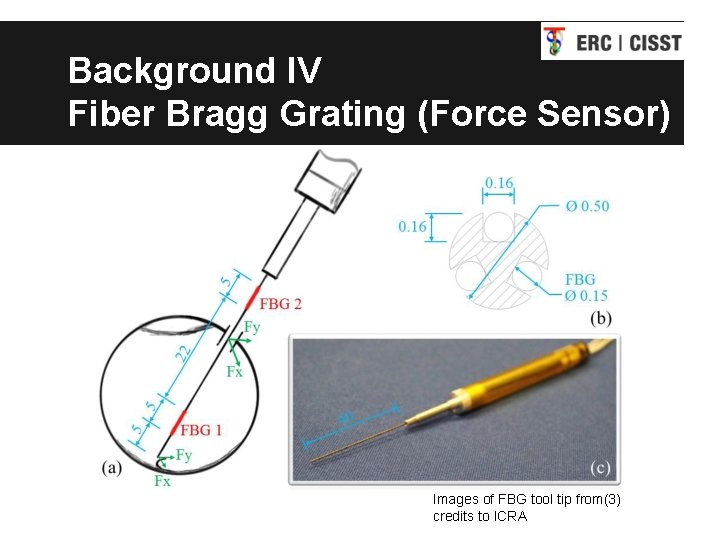
Background IV Fiber Bragg Grating (Force Sensor) Images of FBG tool tip from(3) credits to ICRA
Objective To develop and assess different force feedback methods for a dual force sensing instrument for retinal microsurgery Sites: sclera, retina Forms: haptic, auditory Goal: Assist the surgeon to provide maximal operation safety for the patient • • •
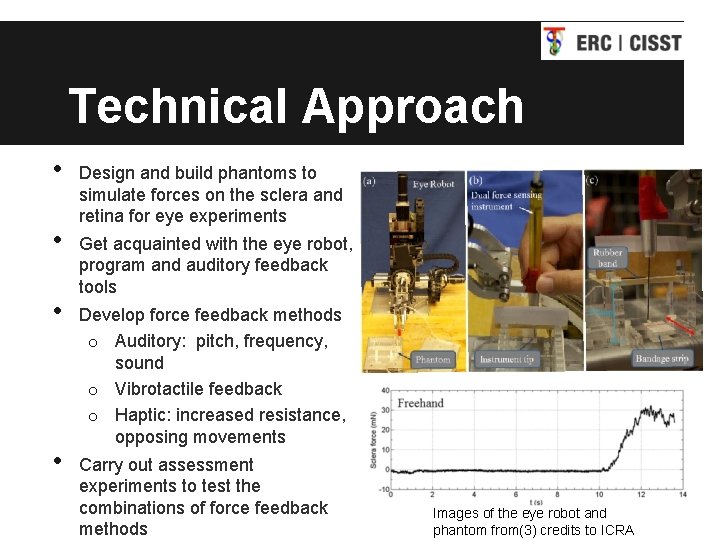
Technical Approach • • Design and build phantoms to simulate forces on the sclera and retina for eye experiments Get acquainted with the eye robot, program and auditory feedback tools Develop force feedback methods o Auditory: pitch, frequency, sound o Vibrotactile feedback o Haptic: increased resistance, opposing movements Carry out assessment experiments to test the combinations of force feedback methods Images of the eye robot and phantom from(3) credits to ICRA
Deliverables Minimum Test & analyze the effectiveness of feedback methods • • • Optimal auditory and haptic feedback methods At least five different experimentation data sets Expected IRB approval of use of outside volunteers for the study • Maximum Vibrotactile substitution for auditory feedback Design and prototype of a better phantom Axial force simulation through a different phantom or depth measurement • • •
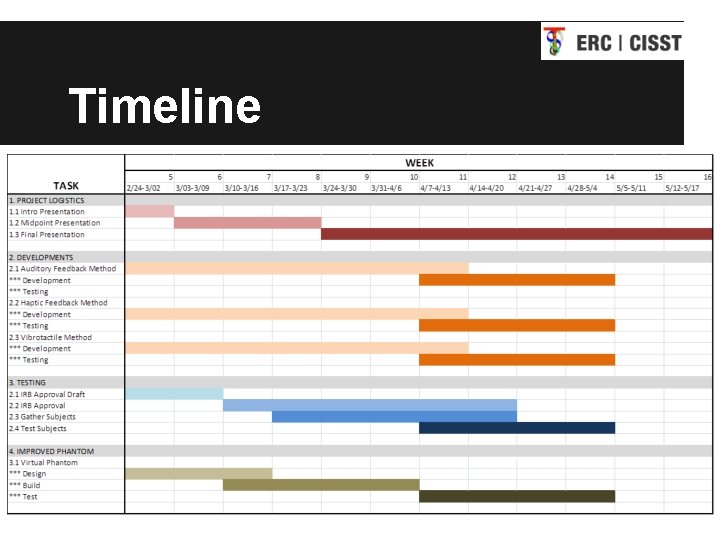
Timeline
Milestones • • • 02/19 Planning and proposal finalization 03/15 IRB submission for use of human subjects. 03/30 Testing haptic vs. auditory testing 04/15 IRB approval for use of human subjects. 04/26 Presentation/final analysis preparation

Management Plans • • Group meeting at 3 PM every Tuesday and Thursday Meeting with mentor (Xingchi He) at 4: 30 every Tuesday Weekly update of the wiki page General Responsibilities o Cathey: Vibrotactile Feedback Development o Will: Axial Force Simulation, Communication o Sally: Wiki Page Update, Subject Recruitment o All: Algorithm Development, Testing, Data Analysis
• • • Dependencies Access to lab (Resolved) Eye phantoms (Available) o stretched rubber bands - sclera model o rubber eye ball (more geometrically similar) Usage of Eye Robot and control software o Training by Xingchi Force sensing Fibers for the instrument o Current: 2 x 1 Do. F (one fiber broken) - to familiarize ourselves with the device Standard: 2 x 2 Do. F - to develop methods and run experiments with o Vibration actuator(s) and (possibly) Arduino o Propose design and budget to Dr. Taylor (~$100) o Feedback from Dr. Gehlbach and Dr Handa
Reading List & References 1. M. Balicki et al. Micro-force Sensing in Robot Assisted Membrane Peeling for Vitreoretinal Surgery. MICCAI 2010, Part III, LNCS 6363, pp. 303 – 310, 2010 2. I. Iordachita et al. A sub-millimetric, 0. 25 m. N resolution fully integrated fiber-optic force-sensing tool for retinal microsurgery. Int J CARS (2009) 4: 383– 390 3. X. He et al. A Novel Dual Force Sensing Instrument with Cooperative Robotic Assistant for Vitreoretinal Surgery 4. R. Kumar et al. Preliminary Experiments in Cooperative Human-Robot Force Control for Robot Assisted Microsurgical Manipulation. IEEE(2000) 610 5. M. Kitagawa et al. Effect of sensory substitution on suture-manipulation forces for robotic surgical systems. The Journal of Thoracic and Cardiovascular Surgery 129: 1, 151
- Slides: 16