
Force Due to an Electric Field Just turn
- Slides: 19
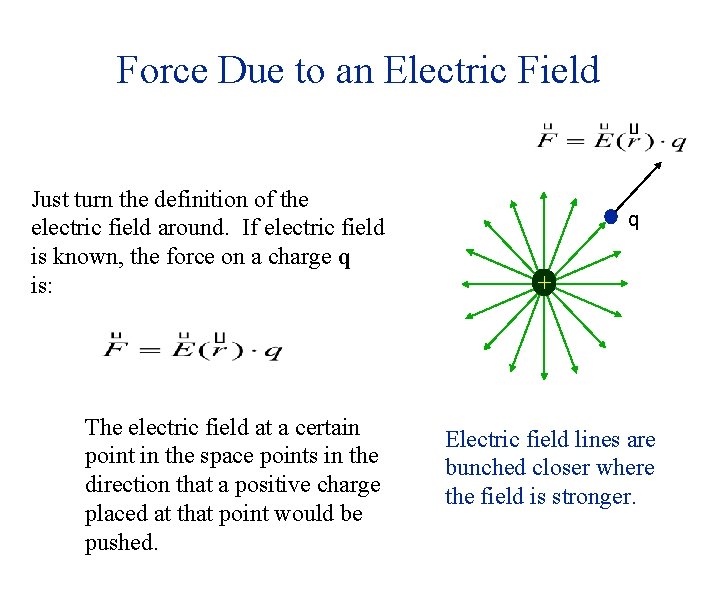
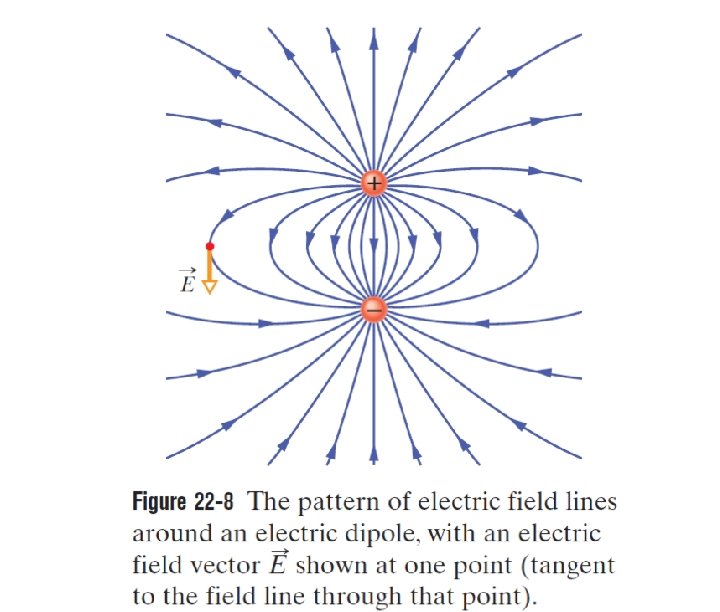
Force Due to an Electric Field Just turn the definition of the electric field around. If electric field is known, the force on a charge q is: The electric field at a certain point in the space points in the direction that a positive charge placed at that point would be pushed. q + Electric field lines are bunched closer where the field is stronger.
Two point charges, + 2 C each, are located on the x axis. One charge is at x = 1 m, and the other at x = - 1 m. a) Calculate the electric field at the origin. b) Calculate (and plot) the electric field along the + y axis. c) Calculate the force exerted on a + 5 C charge, located at an arbitrary location on the + y axis
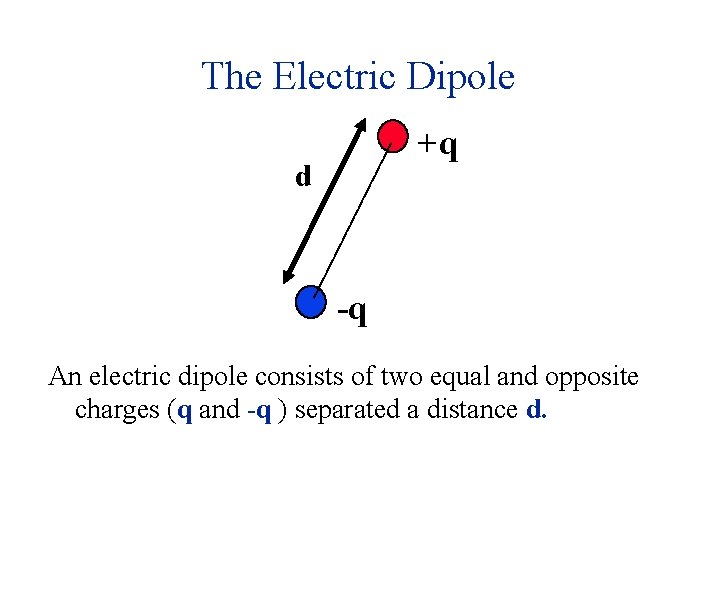
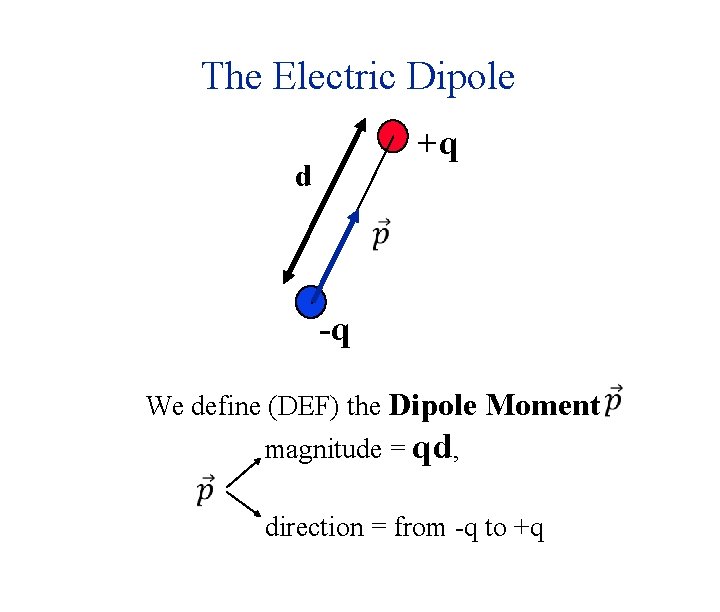
The Electric Dipole +q d -q An electric dipole consists of two equal and opposite charges (q and -q ) separated a distance d.
The Electric Dipole +q d -q We define (DEF) the Dipole Moment magnitude = qd, direction = from -q to +q
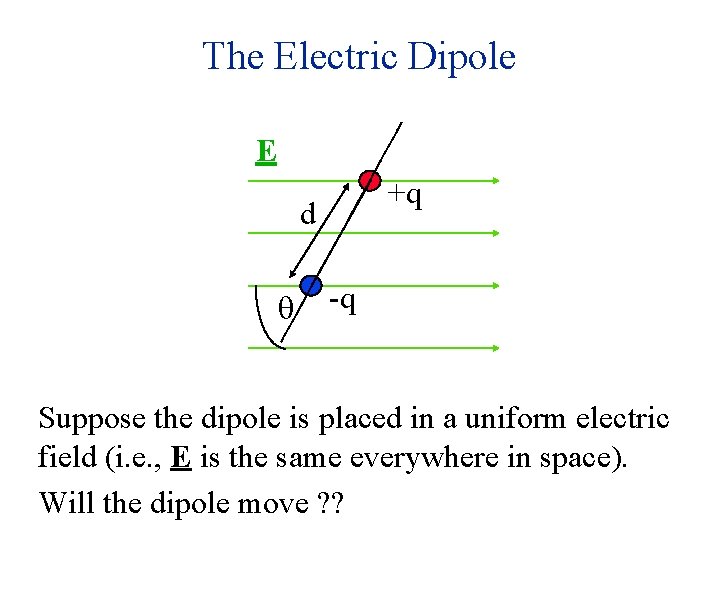
The Electric Dipole E +q d q -q Suppose the dipole is placed in a uniform electric field (i. e. , E is the same everywhere in space). Will the dipole move ? ?
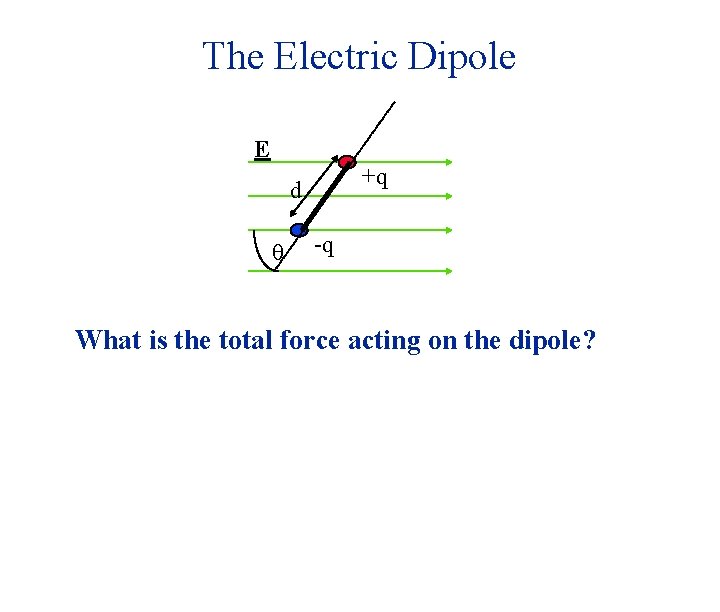
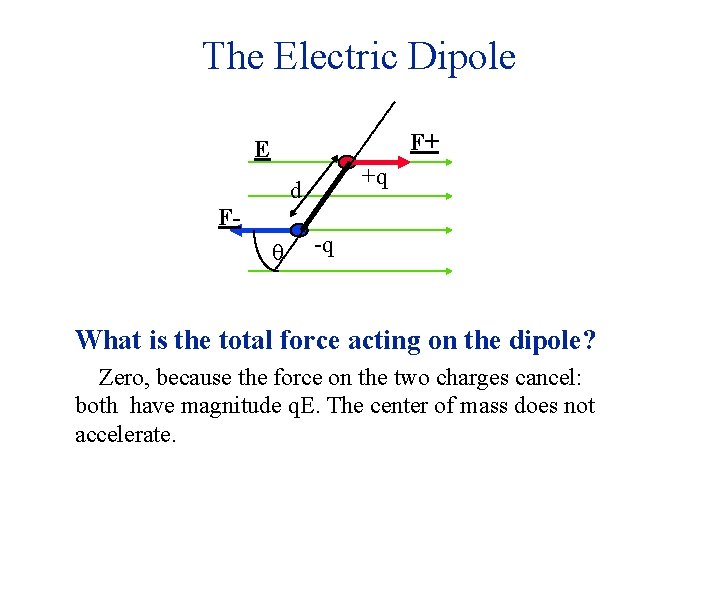
The Electric Dipole E +q d q -q What is the total force acting on the dipole?
The Electric Dipole +q d q -q
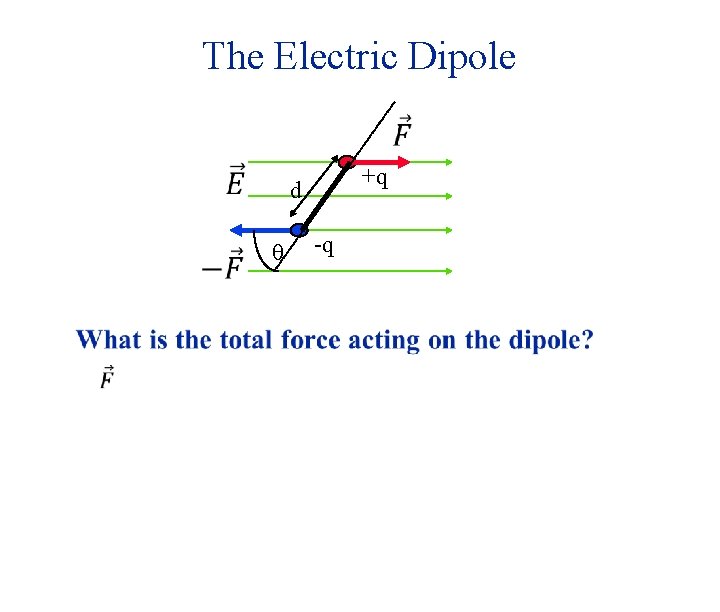
The Electric Dipole F+ E +q d Fq -q What is the total force acting on the dipole? Zero, because the force on the two charges cancel: both have magnitude q. E. The center of mass does not accelerate.
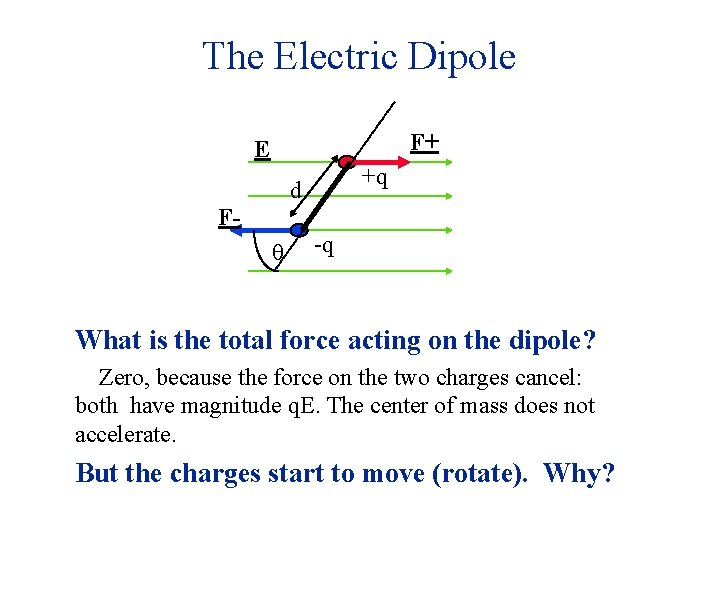
The Electric Dipole F+ E +q d Fq -q What is the total force acting on the dipole? Zero, because the force on the two charges cancel: both have magnitude q. E. The center of mass does not accelerate. But the charges start to move (rotate). Why?
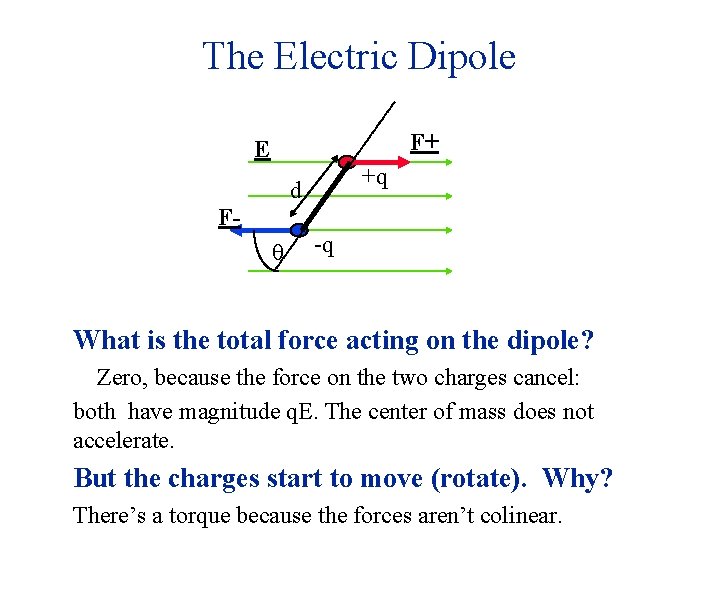
The Electric Dipole F+ E +q d Fq -q What is the total force acting on the dipole? Zero, because the force on the two charges cancel: both have magnitude q. E. The center of mass does not accelerate. But the charges start to move (rotate). Why? There’s a torque because the forces aren’t colinear.
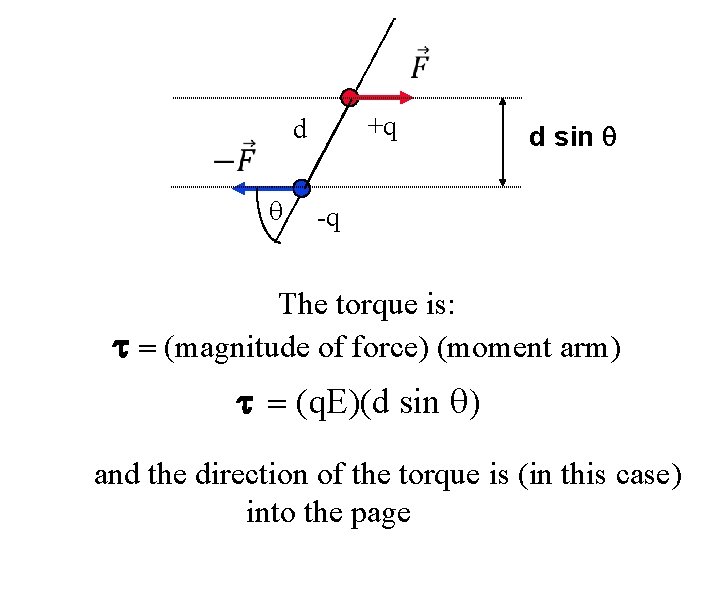
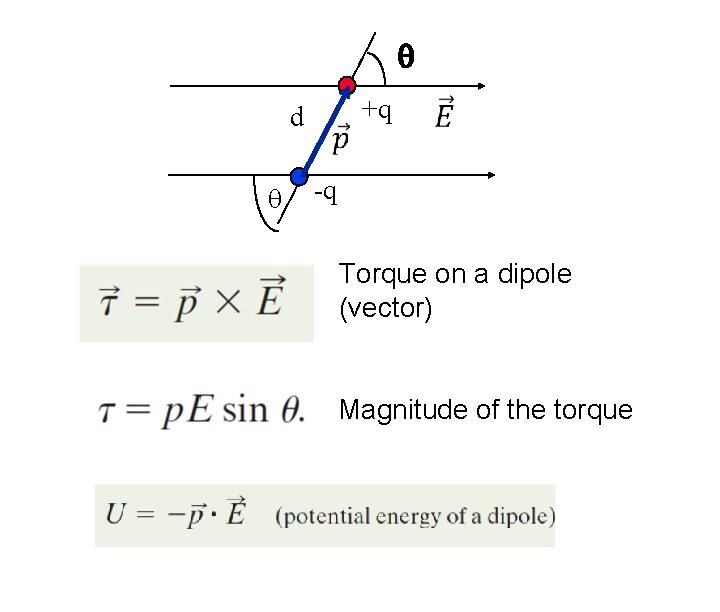
+q d sin q -q The torque is: t = (magnitude of force) (moment arm) t = (q. E)(d sin q) and the direction of the torque is (in this case) into the page
q d q +q -q Torque on a dipole (vector) Magnitude of the torque
Electric fields due to various charge distributions The electric field is a vector which obeys the superposition principle. The electric field of a charge distribution is the sum of the fields produced by individual charges, or by differential elements of charge
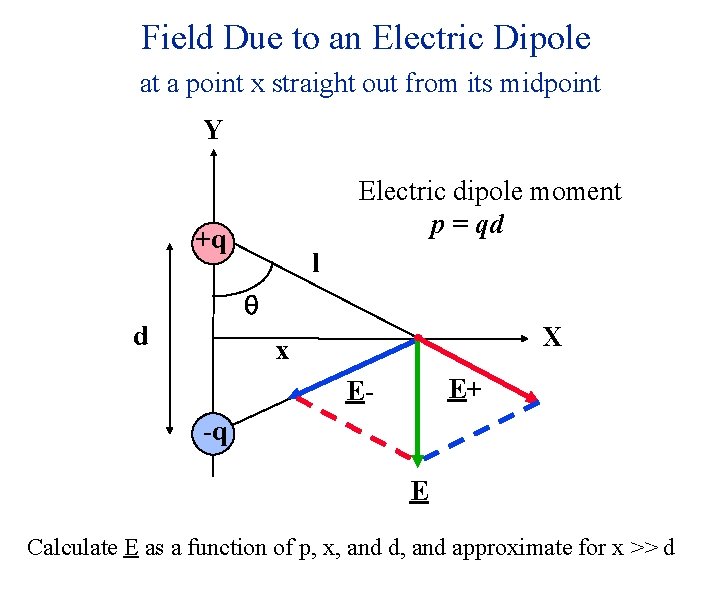
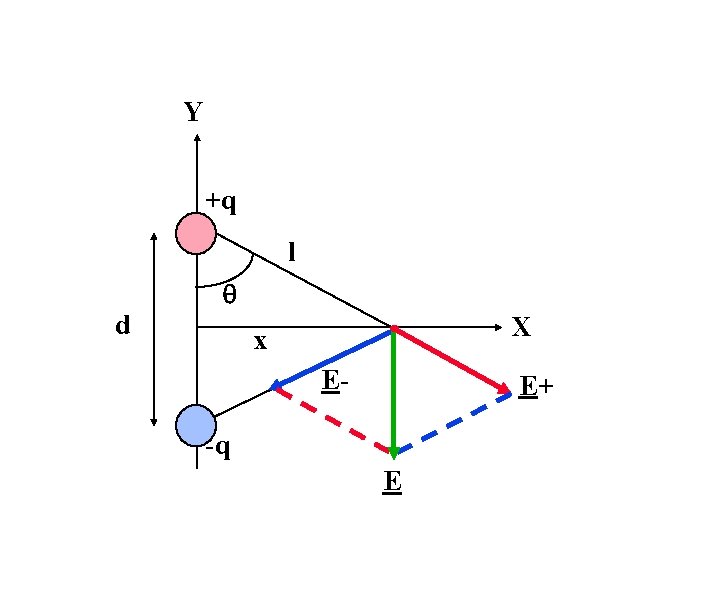
Field Due to an Electric Dipole at a point x straight out from its midpoint Y Electric dipole moment p = qd +q l q d X x E+ E-q E Calculate E as a function of p, x, and d, and approximate for x >> d
Y +q l d q X x E- E+ -q E
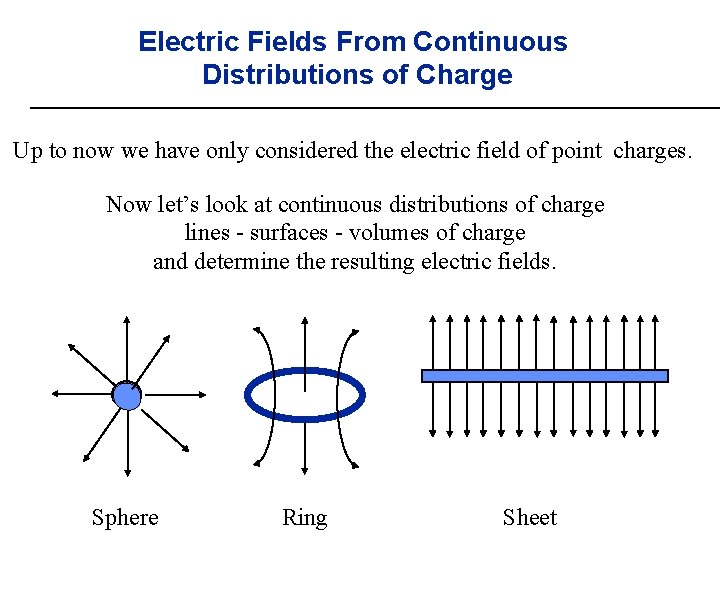
Electric Fields From Continuous Distributions of Charge Up to now we have only considered the electric field of point charges. Now let’s look at continuous distributions of charge lines - surfaces - volumes of charge and determine the resulting electric fields. Sphere Ring Sheet