
Force and Newtons Laws Chapter 2 Section 1
- Slides: 46
Force and Newton’s Laws Chapter 2 Section 1
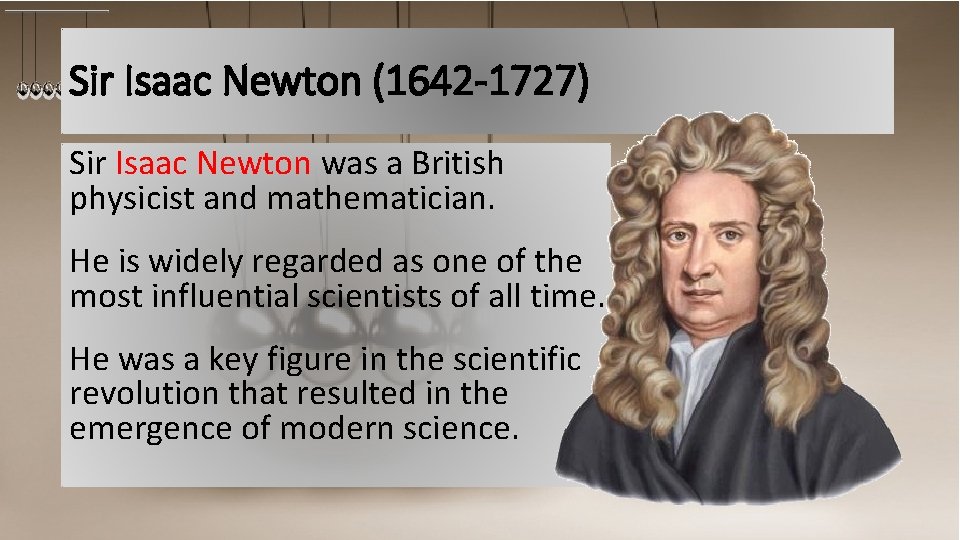
Sir Isaac Newton (1642 -1727) Sir Isaac Newton was a British physicist and mathematician. He is widely regarded as one of the most influential scientists of all time. He was a key figure in the scientific revolution that resulted in the emergence of modern science.
Many people are familiar with the story of Newton formulating theory of gravitation after seeing an apple fall from a tree. “If I have seen further than others it is by standing upon the shoulders of giants”
Force Every change in motion that you observe or feel is caused by a force. In physics a force is any influence which causes an object to undergo a change, either in its movement, direction or its geometrical construction.
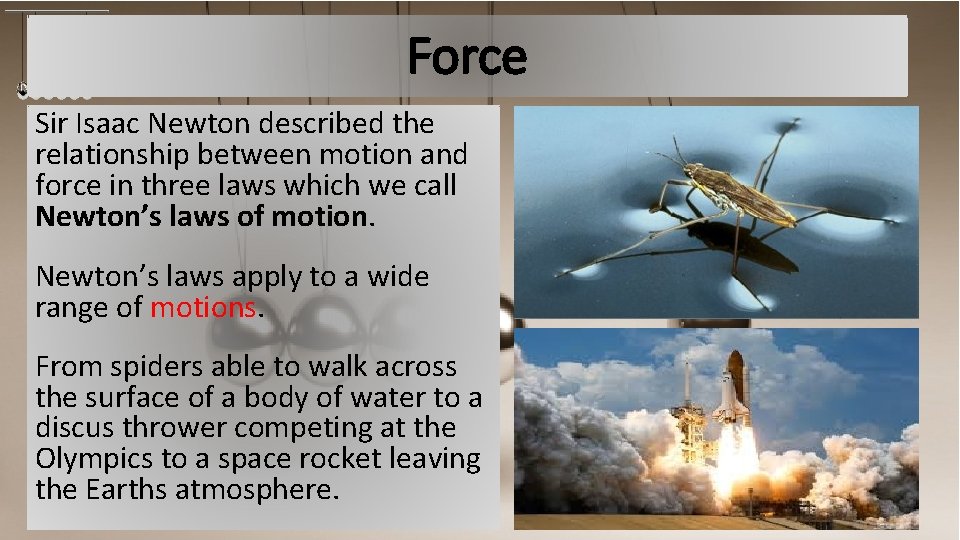
Force Sir Isaac Newton described the relationship between motion and force in three laws which we call Newton’s laws of motion. Newton’s laws apply to a wide range of motions. From spiders able to walk across the surface of a body of water to a discus thrower competing at the Olympics to a space rocket leaving the Earths atmosphere.
Force • A force is a push or a pull on an object. • A force transfers energy to an object. • The force allows the object to start moving, stop moving or to change direction. • More than one force can act on an object at the same time. • When multiple forces act on an object at the same time it is known as a net force.
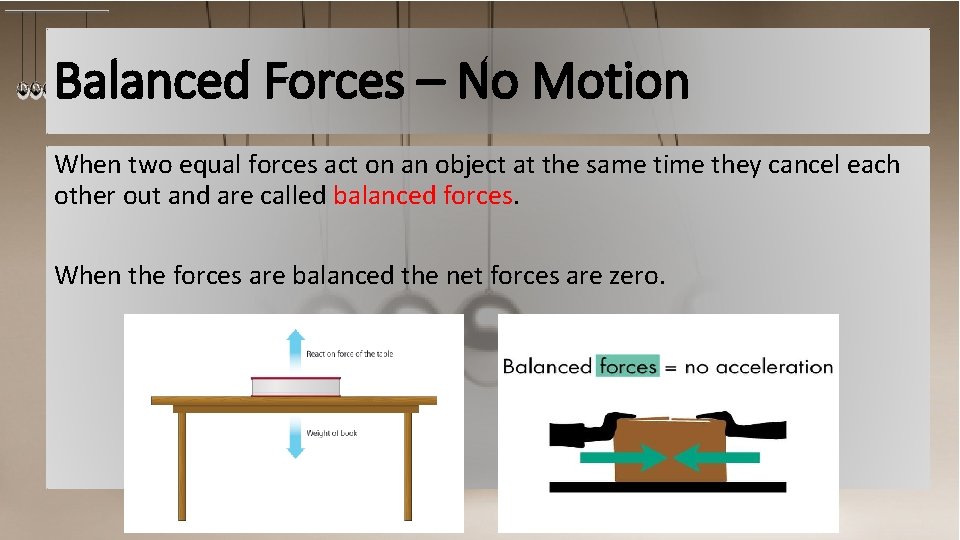
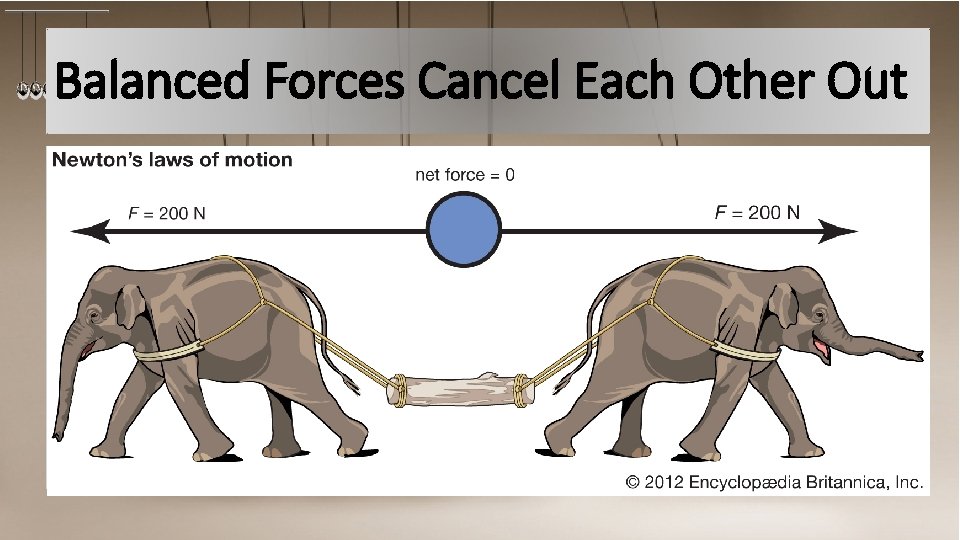
Balanced Forces – No Motion When two equal forces act on an object at the same time they cancel each other out and are called balanced forces. When the forces are balanced the net forces are zero.
Balanced Forces Cancel Each Other Out
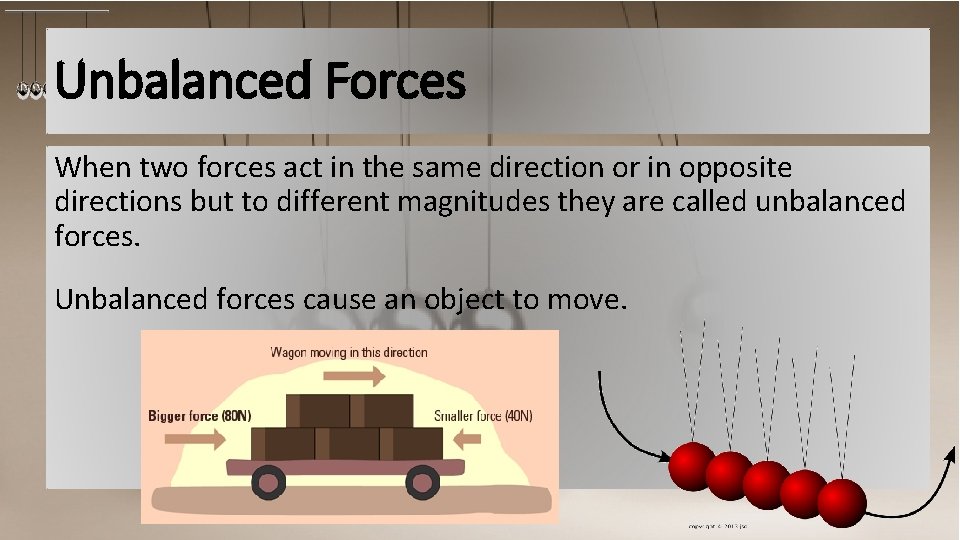
Unbalanced Forces When two forces act in the same direction or in opposite directions but to different magnitudes they are called unbalanced forces. Unbalanced forces cause an object to move.
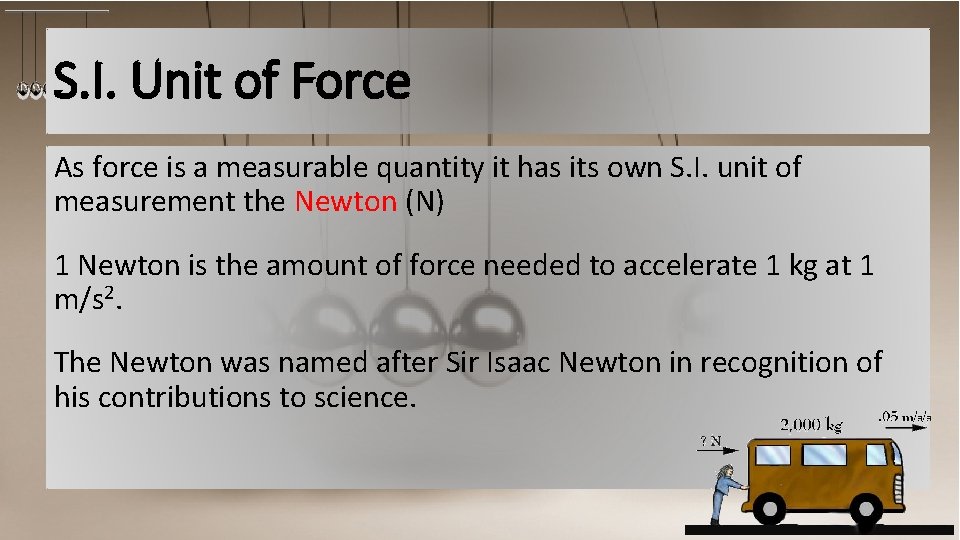
S. I. Unit of Force As force is a measurable quantity it has its own S. I. unit of measurement the Newton (N) 1 Newton is the amount of force needed to accelerate 1 kg at 1 m/s 2. The Newton was named after Sir Isaac Newton in recognition of his contributions to science.
Newton’s First Law An object at rest remains at rest and an object in motion maintains its velocity unless it experiences an external force. If I were to slide a book across a desk the book will soon come to a rest. If the surface were much smoother (such as ice) it would take much longer to stop. This is because there is less friction force between the book and the ice than there is between the book and the desk.
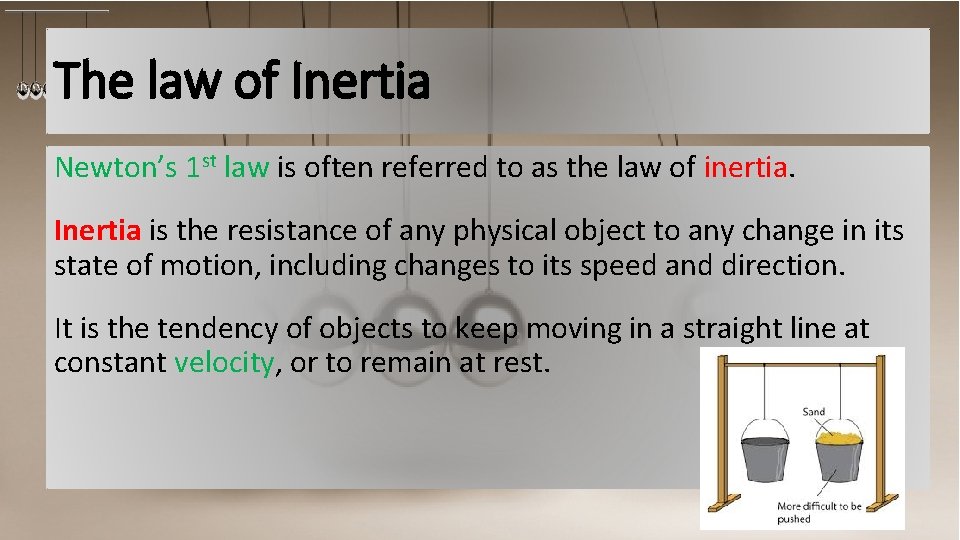
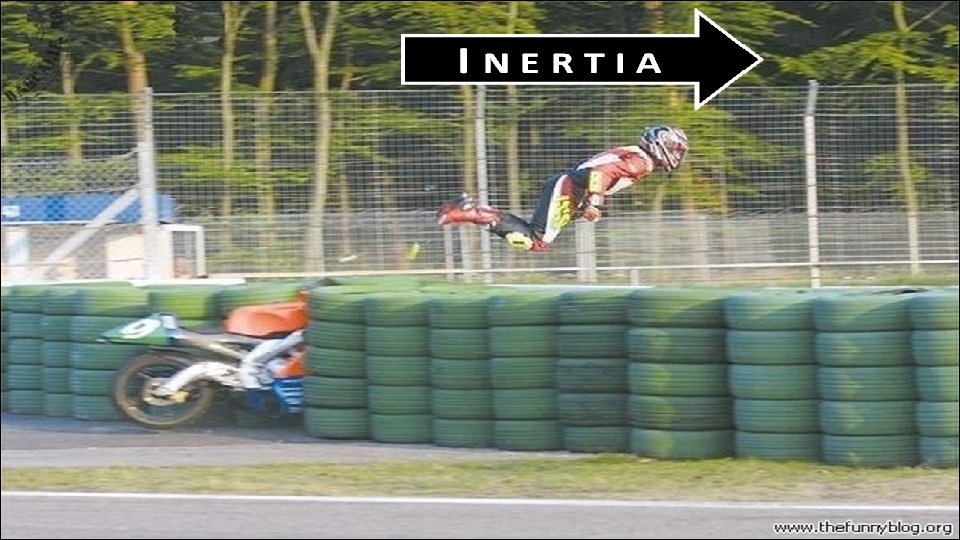
The law of Inertia Newton’s 1 st law is often referred to as the law of inertia. Inertia is the resistance of any physical object to any change in its state of motion, including changes to its speed and direction. It is the tendency of objects to keep moving in a straight line at constant velocity, or to remain at rest.
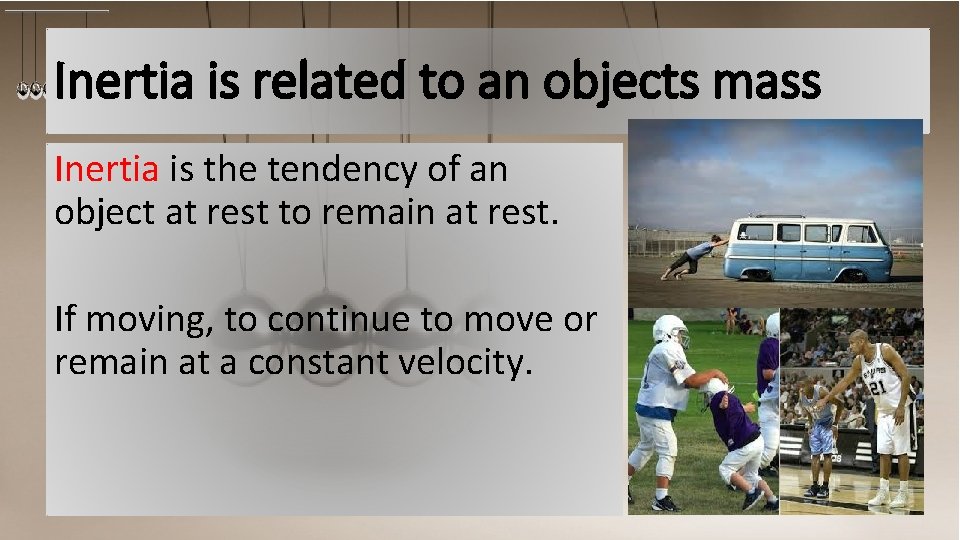
Inertia is related to an objects mass Inertia is the tendency of an object at rest to remain at rest. If moving, to continue to move or remain at a constant velocity.
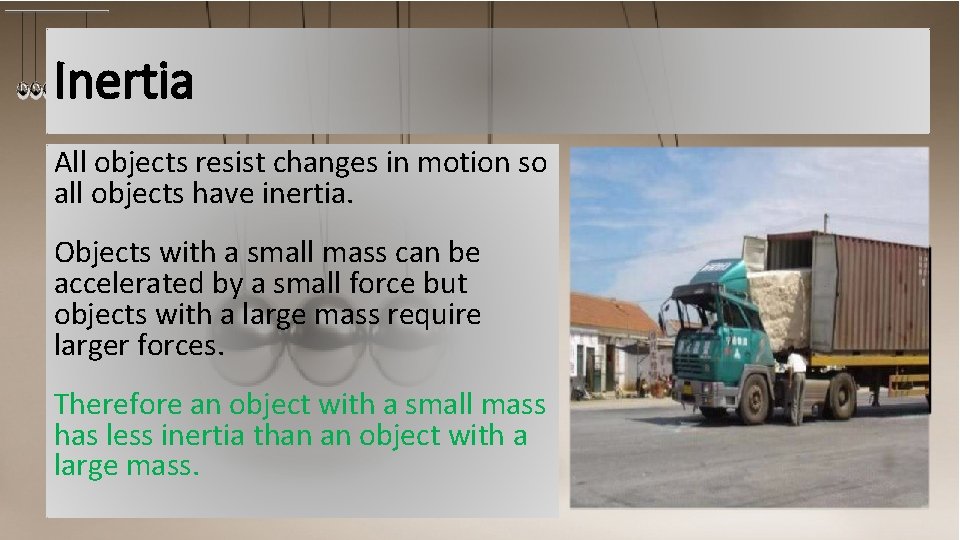
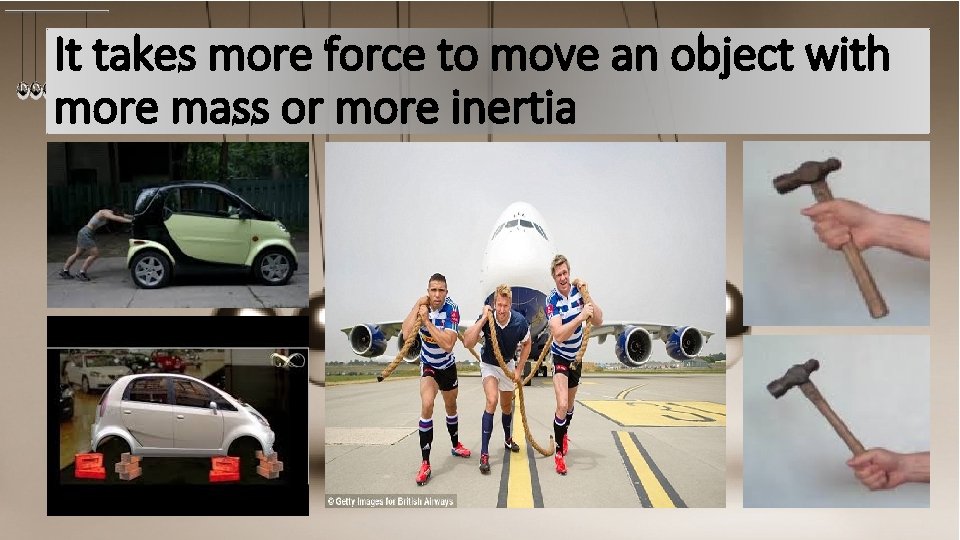
Inertia All objects resist changes in motion so all objects have inertia. Objects with a small mass can be accelerated by a small force but objects with a large mass require larger forces. Therefore an object with a small mass has less inertia than an object with a large mass.
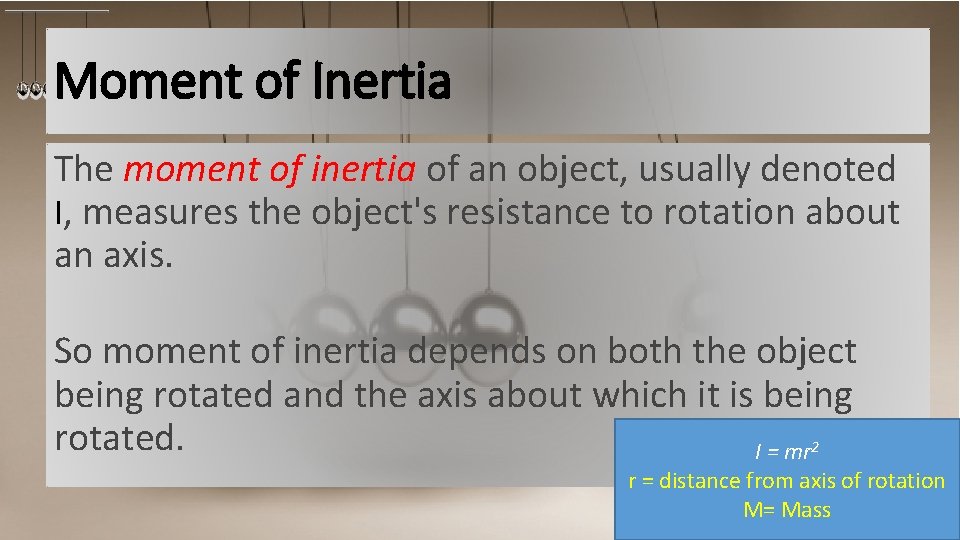
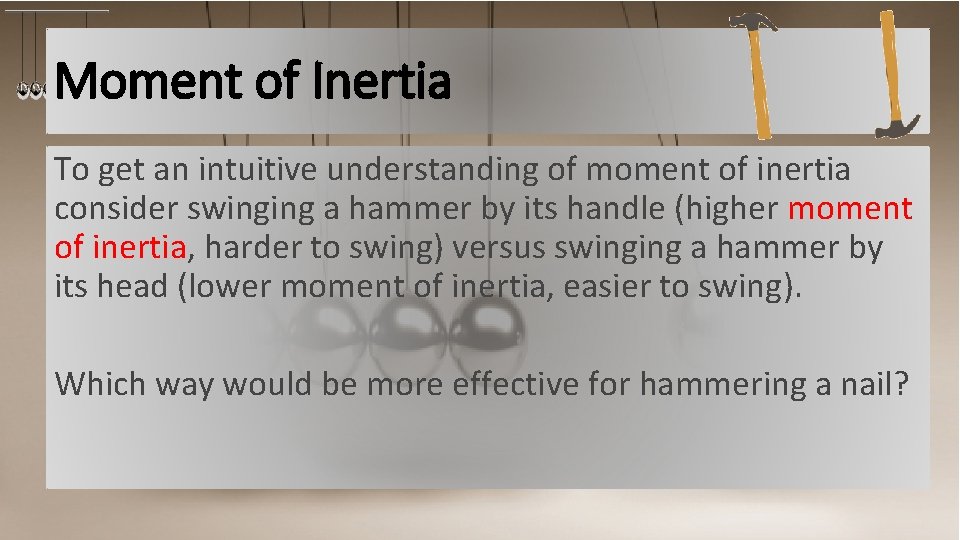
Moment of Inertia The moment of inertia of an object, usually denoted I, measures the object's resistance to rotation about an axis. So moment of inertia depends on both the object being rotated and the axis about which it is being rotated. I = mr 2 r = distance from axis of rotation M= Mass
Moment of Inertia To get an intuitive understanding of moment of inertia consider swinging a hammer by its handle (higher moment of inertia, harder to swing) versus swinging a hammer by its head (lower moment of inertia, easier to swing). Which way would be more effective for hammering a nail?
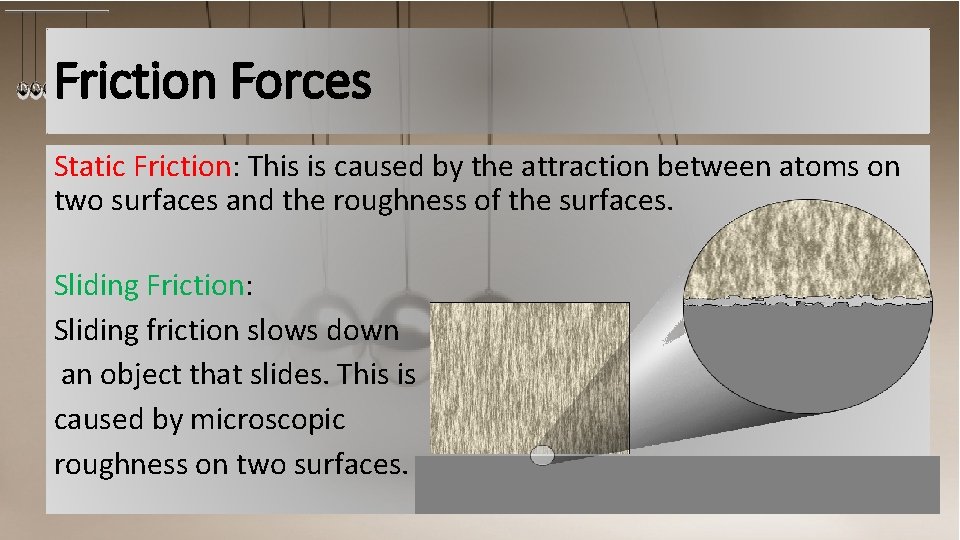
Friction Forces Static Friction: This is caused by the attraction between atoms on two surfaces and the roughness of the surfaces. Sliding Friction: Sliding friction slows down an object that slides. This is caused by microscopic roughness on two surfaces.
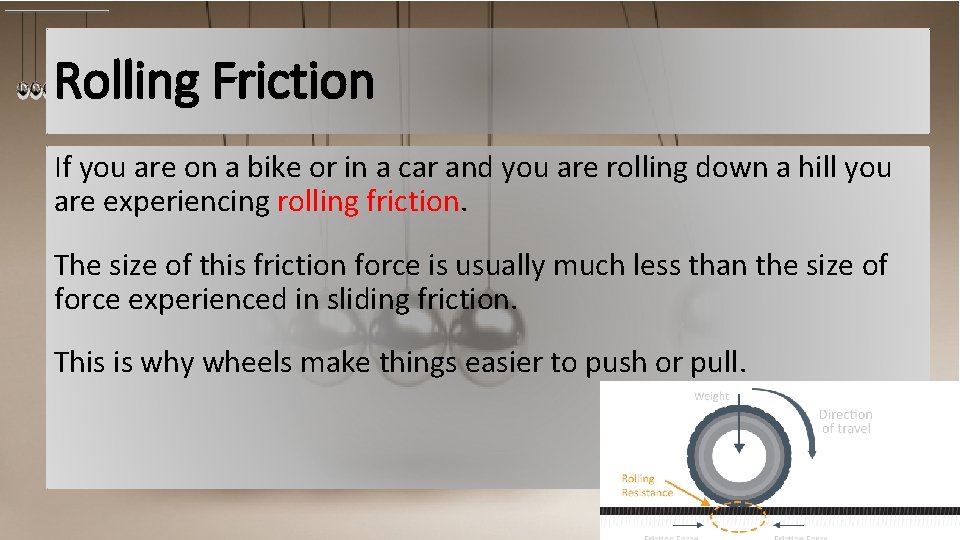
Rolling Friction If you are on a bike or in a car and you are rolling down a hill you are experiencing rolling friction. The size of this friction force is usually much less than the size of force experienced in sliding friction. This is why wheels make things easier to push or pull.
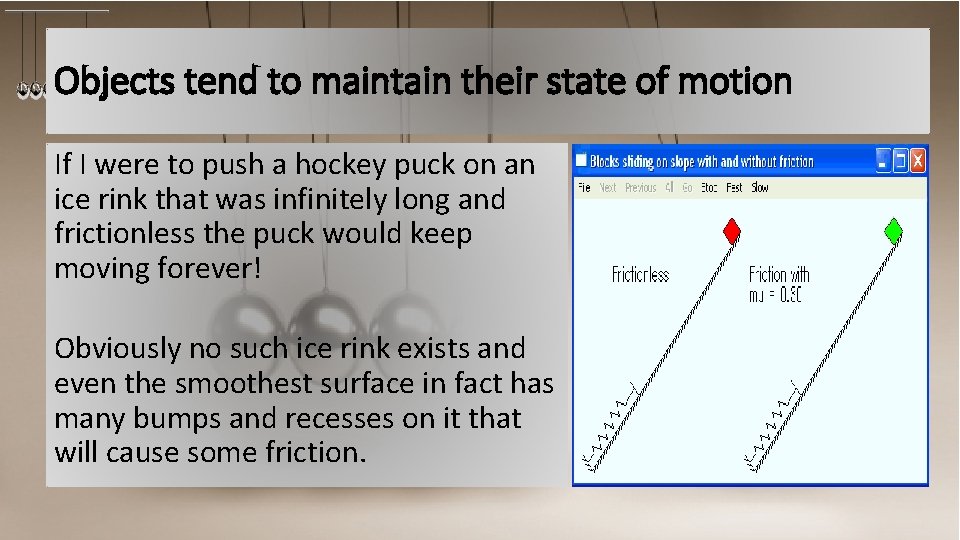
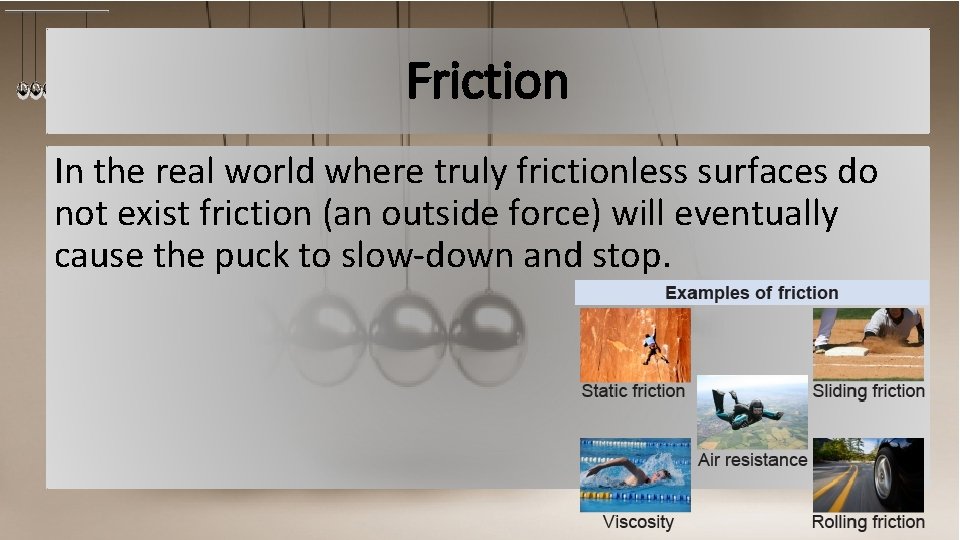
Objects tend to maintain their state of motion If I were to push a hockey puck on an ice rink that was infinitely long and frictionless the puck would keep moving forever! Obviously no such ice rink exists and even the smoothest surface in fact has many bumps and recesses on it that will cause some friction.
Friction In the real world where truly frictionless surfaces do not exist friction (an outside force) will eventually cause the puck to slow-down and stop.
Friction is the reason why we sometimes find Newton’s first law to be a little counter intuitive. We constantly encounter friction. For this reason we sometimes forget that it is there.
Newton’s First Law of Motion: Summary An object at rest tends to stay at rest, and an object in motion tends to stay in motion unless it experiences a net force. Newton’s first law of motion is often called the law of inertia.
Newton’s First Law of Motion: Summary Matter resists any change in motion. This property of matter is called inertia. An object with a small mass has less inertia than an object with a large mass. We also know that shape will play a role in determining an objects inertia. Inertia is the reason it takes time for a car to slow down. When a car stops the seatbelt and the friction between you and the seat stop your forward motion.
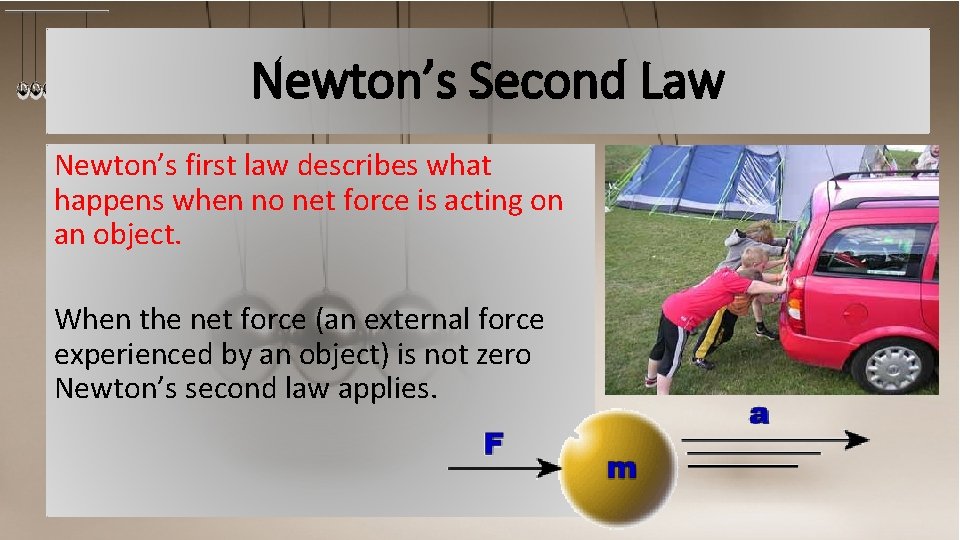
Newton’s Second Law Newton’s first law describes what happens when no net force is acting on an object. When the net force (an external force experienced by an object) is not zero Newton’s second law applies.
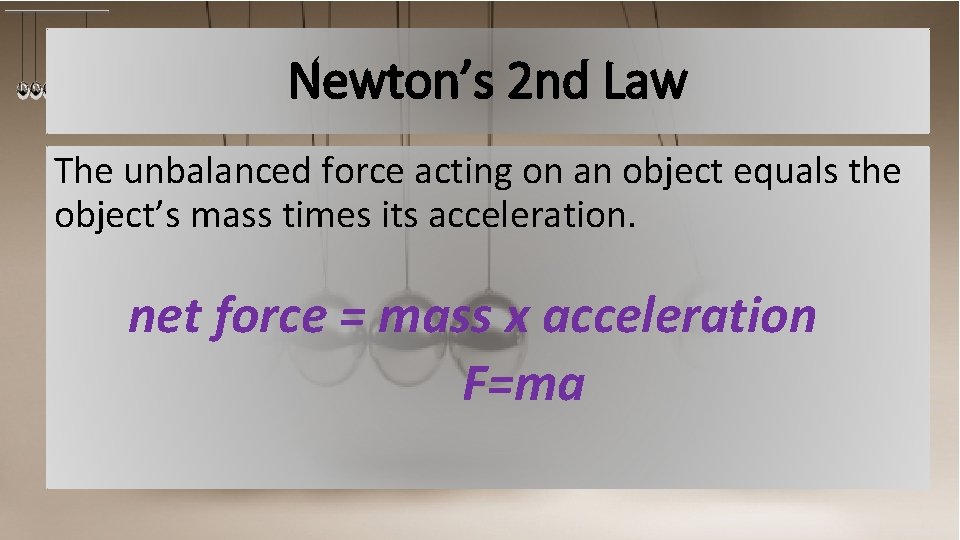
Newton’s 2 nd Law The unbalanced force acting on an object equals the object’s mass times its acceleration. net force = mass x acceleration F=ma
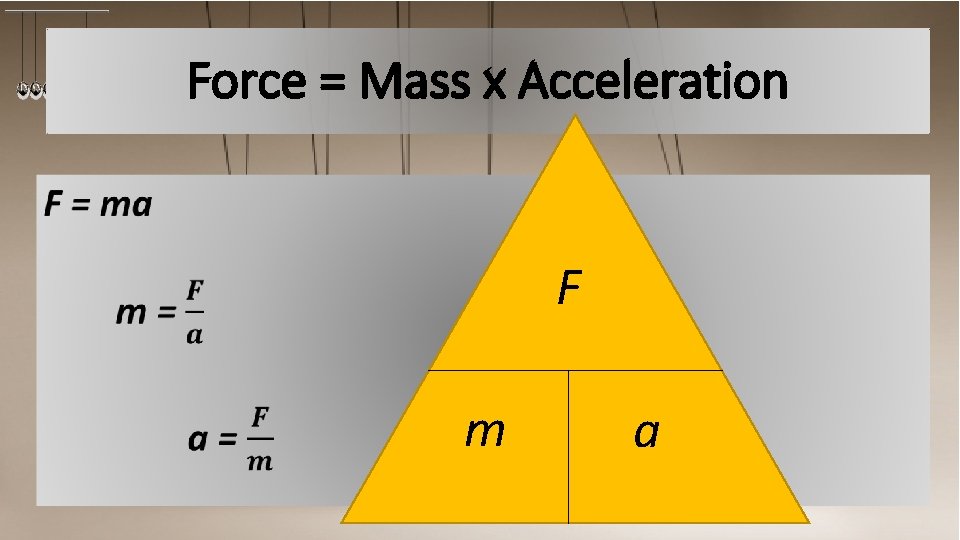
Force = Mass x Acceleration F m a
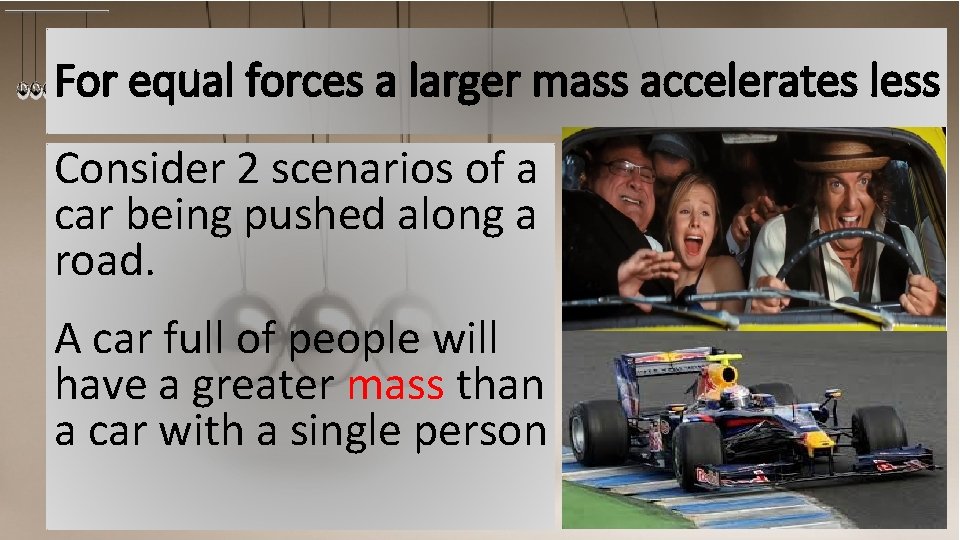
For equal forces a larger mass accelerates less Consider 2 scenarios of a car being pushed along a road. A car full of people will have a greater mass than a car with a single person
For equal forces a larger mass accelerates less If the same amount of force is applied in both instances the car with less mass will experience greater acceleration. This is an example of Newton’s second law in action.
It takes more force to move an object with more mass or more inertia
Force is measured in Newton's Newton’s second law can be used to derive the SI unit of force – the Newton (N). 1 newton is the force that gives a mass of one kilogram an acceleration of one meter per second squared: 1 N = 1 kg mass accelerating @ 1 m/s 2 (1 kg = 9. 81 N if we calculate the weight 1 kg) The lb or lbf is sometimes used as a unit of force. One Newton is equal to 0. 225 lb. Therefore 1 lb = 4. 45 N.
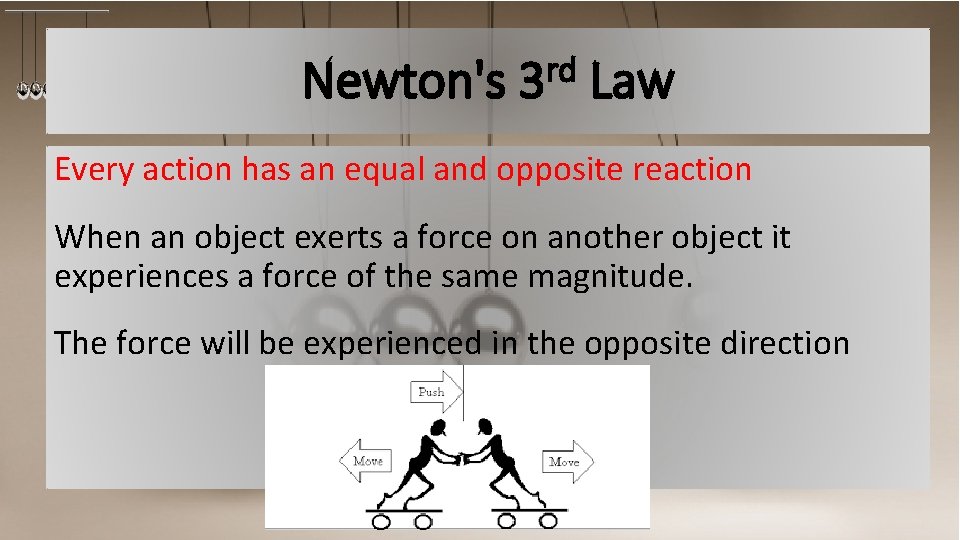
Newton's rd 3 Law Every action has an equal and opposite reaction When an object exerts a force on another object it experiences a force of the same magnitude. The force will be experienced in the opposite direction
Action and Reaction Forces If you were to kick a football you may notice a very obvious action on the ball. But do you notice anything on your foot? Is the only force present the force that acts on the ball? What would the outcome be if the ball were made of concrete?
Forces always occur in pairs The moment that you kick a football the football exerts an equal and opposite force on your foot. The force exerted on the football is called the action force and the force exerted on your foot by the ball is called the reaction force. This pair of forces gives an example of Newton’ s 3 rd law of motion; For every action force there is an equal and opposite reaction force.
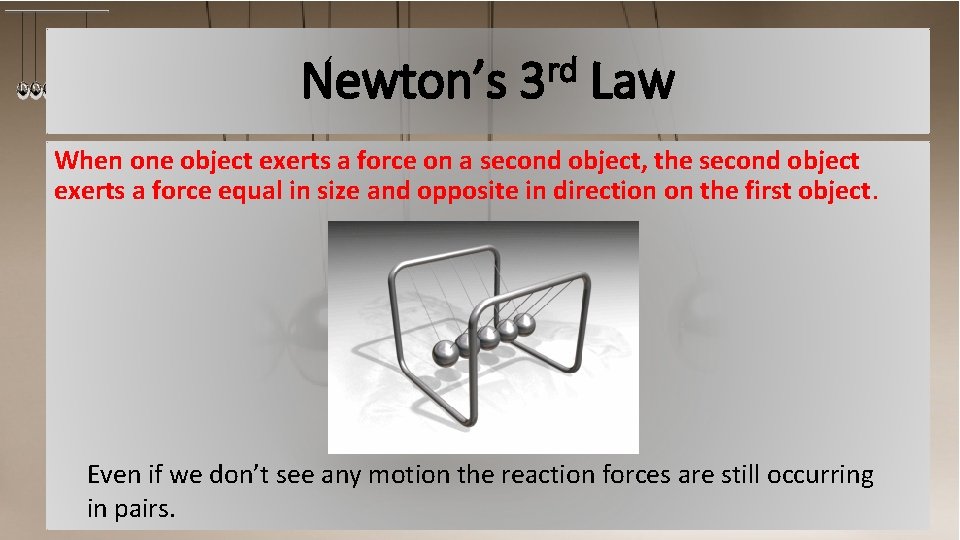
Newton’s rd 3 Law When one object exerts a force on a second object, the second object exerts a force equal in size and opposite in direction on the first object. Even if we don’t see any motion the reaction forces are still occurring in pairs.
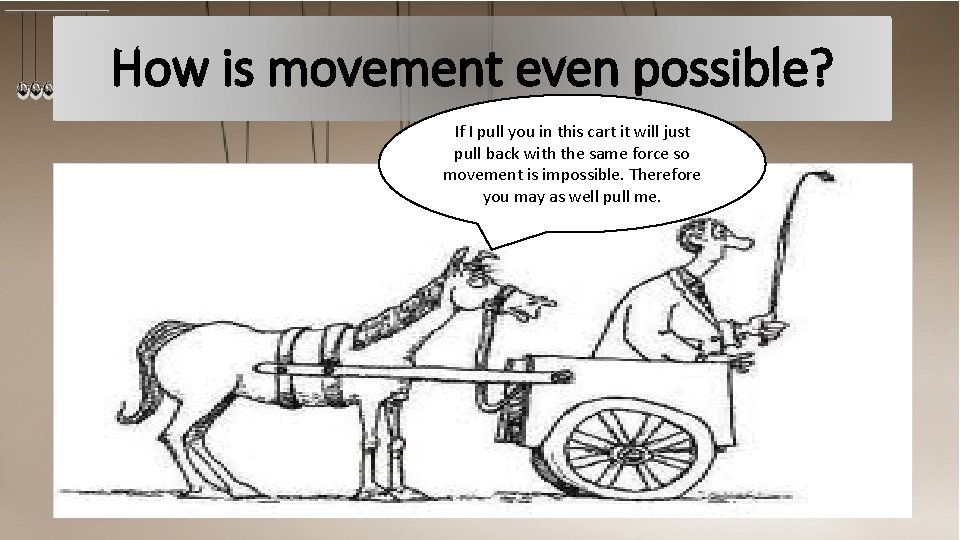
How is movement even possible? If I pull you in this cart it will just pull back with the same force so movement is impossible. Therefore you may as well pull me.
Forces in a force pair do not act on the same object Even though the forces in a force pair are equal and in opposite directions they do not cancel each other out because they act on different objects. For example a swimmer exerts an action force on the water and the water exerts an action force on the swimmers hands and feet. The swimmer pushes the water back and the water pushes the swimmer forwards. The action and reaction forces occur at the same time but they never act on the same object.
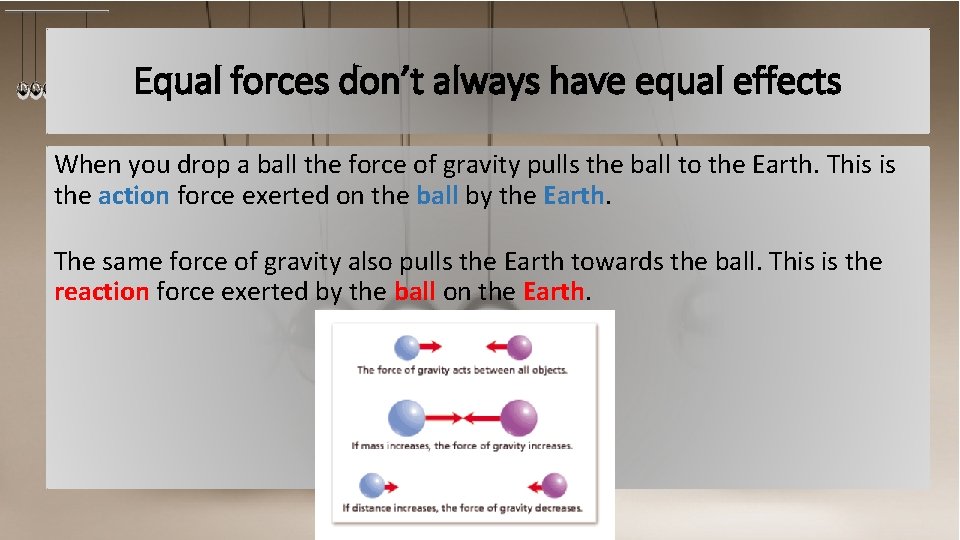
Equal forces don’t always have equal effects When you drop a ball the force of gravity pulls the ball to the Earth. This is the action force exerted on the ball by the Earth. The same force of gravity also pulls the Earth towards the ball. This is the reaction force exerted by the ball on the Earth.
Equal forces don’t always have equal effects The effect of the action force is easy to see. We don’t see the effect of the reaction force due to Newton’s 2 nd law – an objects acceleration is equal to the force applied to the object divided by its mass. Since the Earth’ mass is much larger than the balls the Earth’s acceleration is almost imperceptible.
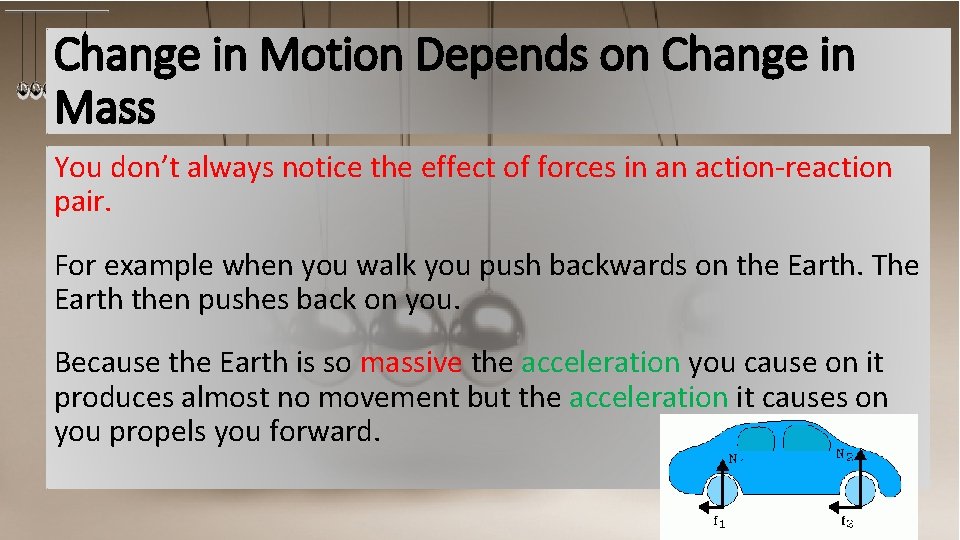
Change in Motion Depends on Change in Mass You don’t always notice the effect of forces in an action-reaction pair. For example when you walk you push backwards on the Earth. The Earth then pushes back on you. Because the Earth is so massive the acceleration you cause on it produces almost no movement but the acceleration it causes on you propels you forward.
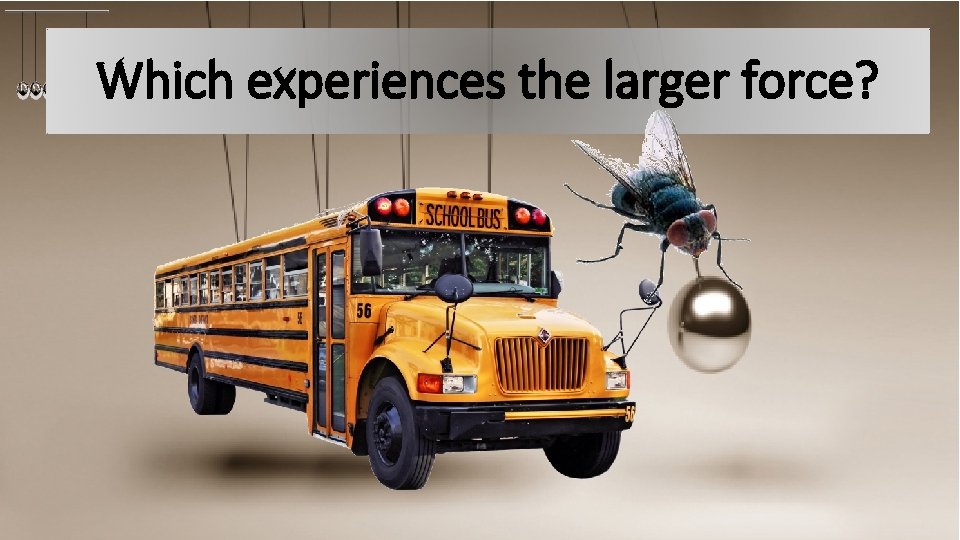
Which experiences the larger force?
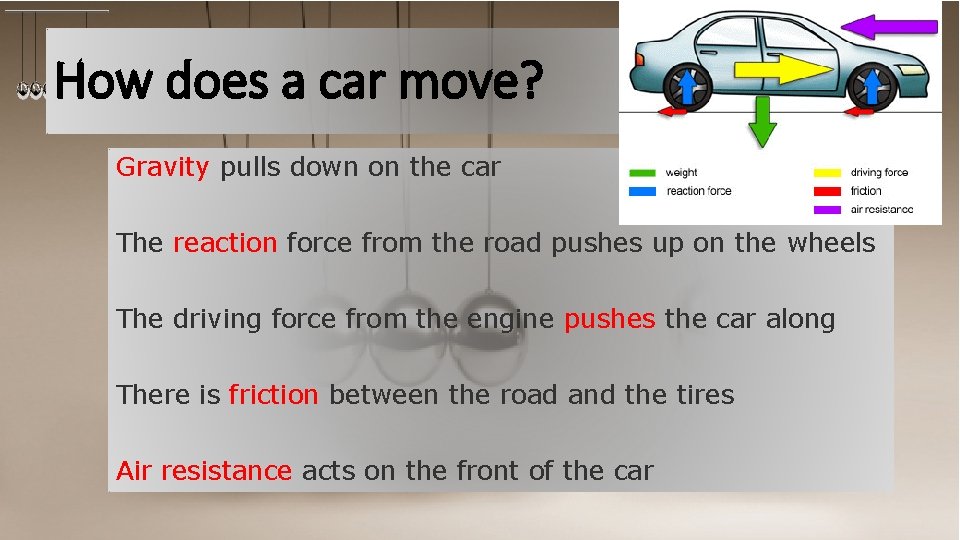
How does a car move? Gravity pulls down on the car The reaction force from the road pushes up on the wheels The driving force from the engine pushes the car along There is friction between the road and the tires Air resistance acts on the front of the car
How does a car move? When a car is started its wheels spin and grip the road (traction – an adhesive friction force). This results in a force that pushes the road backwards. As the result the road exerts a force equal in size on the wheels but in the opposite direction (forward). This results in the car moving ahead on the road. If the surface of the road was ice, the wheels wouldn’t be able to grip the road properly. Hence, it would be difficult to exert a force. This is why automobiles find it difficult to move ahead on icy surface and end up skidding.
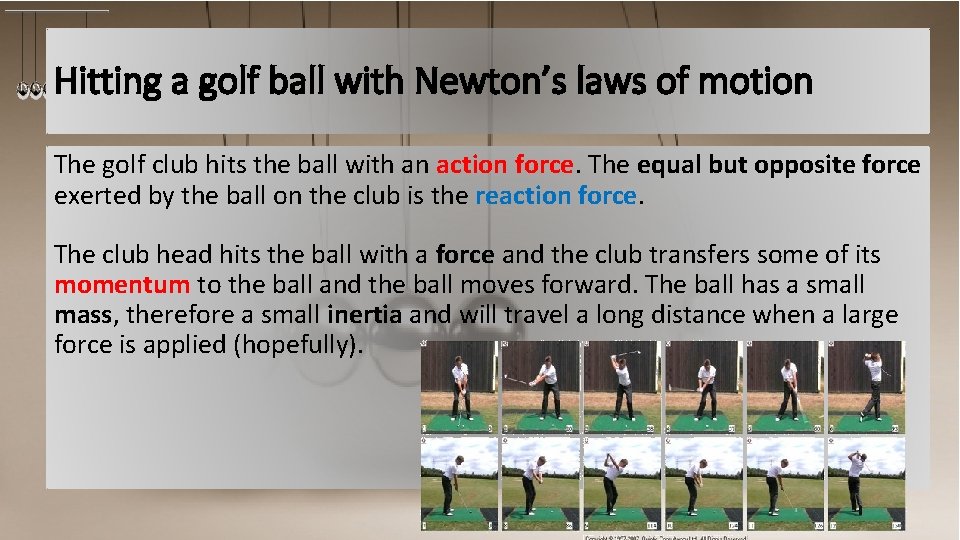
Hitting a golf ball with Newton’s laws of motion The golf club hits the ball with an action force. The equal but opposite force exerted by the ball on the club is the reaction force. The club head hits the ball with a force and the club transfers some of its momentum to the ball and the ball moves forward. The ball has a small mass, therefore a small inertia and will travel a long distance when a large force is applied (hopefully).
Hitting a golf ball with Newton’s laws of motion The friction between the club head and the ball allows the club to push the ball forward. As the ball leaves the club head the horizontal velocity will be constant. Gravity will increase the balls vertical acceleration pulling the ball to the ground and creating a curved path. Once it hits the ground and rolls toward the hole friction will eventually bring the ball to a stop (hopefully in the hole).
Newton’s Laws • An object at rest remains at rest and an object in motion maintains its velocity unless it experiences an external force. • net force = mass x acceleration (f=ma) • When one object exerts a force on a second object, the second object exerts a force equal in size and opposite in direction on the first object.