
FORCE AND MOTION UNIT l Have you ever


















- Slides: 136
FORCE AND MOTION UNIT l. Have you ever wondered why objects move faster than others? l. Why do objects fall to the ground? l. Why some cars, boats, or planes go slower than others?
Forces l Have you ever wondered why and how objects begin to move and why objects stop all of a sudden? l An object starts to move, stops moving, or changes directions ONLY when a force acts on it. l Some forces act on objects directly and some forces act on objects indirectly. l For example, when you push on a door, you directly apply the force that makes the door open. Other forces, such as gravity, act on objects at a distance.
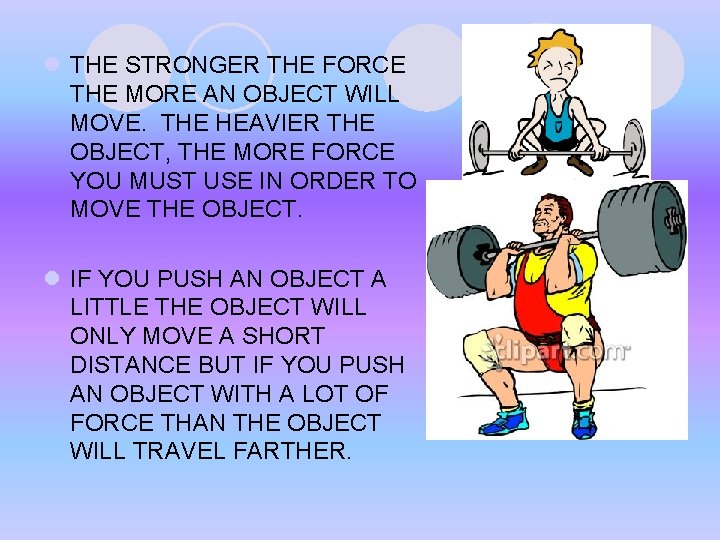
l THE STRONGER THE FORCE THE MORE AN OBJECT WILL MOVE. THE HEAVIER THE OBJECT, THE MORE FORCE YOU MUST USE IN ORDER TO MOVE THE OBJECT. l IF YOU PUSH AN OBJECT A LITTLE THE OBJECT WILL ONLY MOVE A SHORT DISTANCE BUT IF YOU PUSH AN OBJECT WITH A LOT OF FORCE THAN THE OBJECT WILL TRAVEL FARTHER.
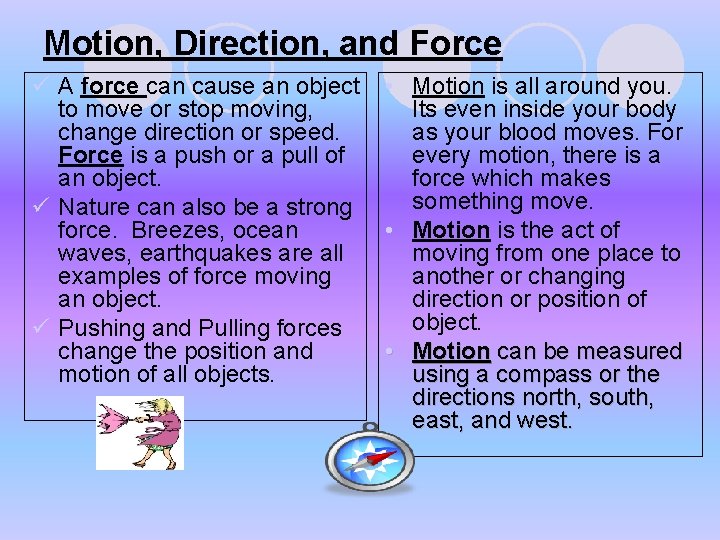
Motion, Direction, and Force ü A force can cause an object to move or stop moving, change direction or speed. Force is a push or a pull of an object. ü Nature can also be a strong force. Breezes, ocean waves, earthquakes are all examples of force moving an object. ü Pushing and Pulling forces change the position and motion of all objects. • Motion is all around you. Its even inside your body as your blood moves. For every motion, there is a force which makes something move. • Motion is the act of moving from one place to another or changing direction or position of object. • Motion can be measured using a compass or the directions north, south, east, and west.
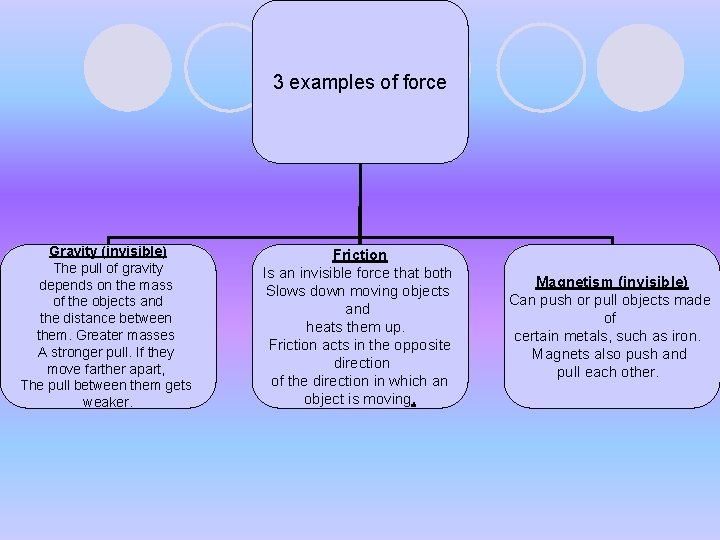
3 examples of force Gravity (invisible) The pull of gravity depends on the mass of the objects and the distance between them. Greater masses A stronger pull. If they move farther apart, The pull between them gets weaker. Friction Is an invisible force that both Slows down moving objects and heats them up. Friction acts in the opposite direction of the direction in which an object is moving. Magnetism (invisible) Can push or pull objects made of certain metals, such as iron. Magnets also push and pull each other.
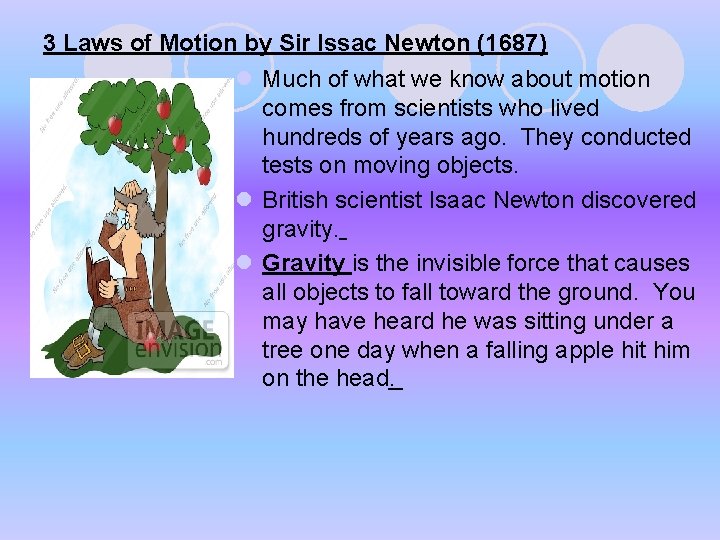
3 Laws of Motion by Sir Issac Newton (1687) l Much of what we know about motion comes from scientists who lived hundreds of years ago. They conducted tests on moving objects. l British scientist Isaac Newton discovered gravity. l Gravity is the invisible force that causes all objects to fall toward the ground. You may have heard he was sitting under a tree one day when a falling apple hit him on the head.
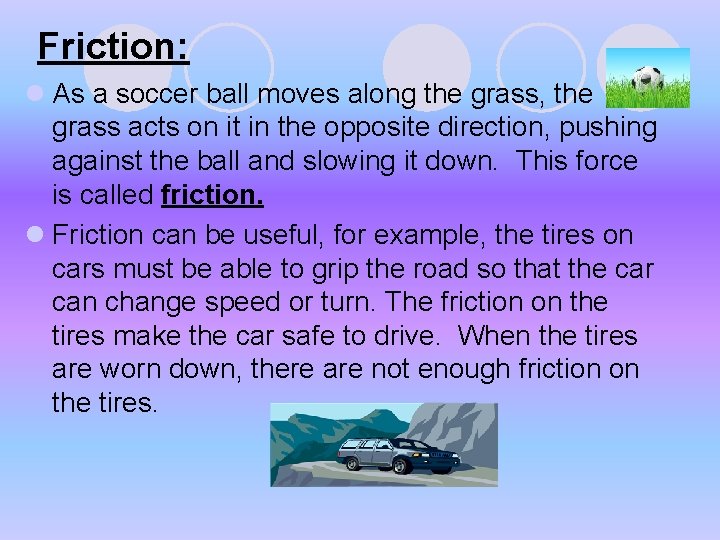
Friction: l As a soccer ball moves along the grass, the grass acts on it in the opposite direction, pushing against the ball and slowing it down. This force is called friction. l Friction can be useful, for example, the tires on cars must be able to grip the road so that the car can change speed or turn. The friction on the tires make the car safe to drive. When the tires are worn down, there are not enough friction on the tires.
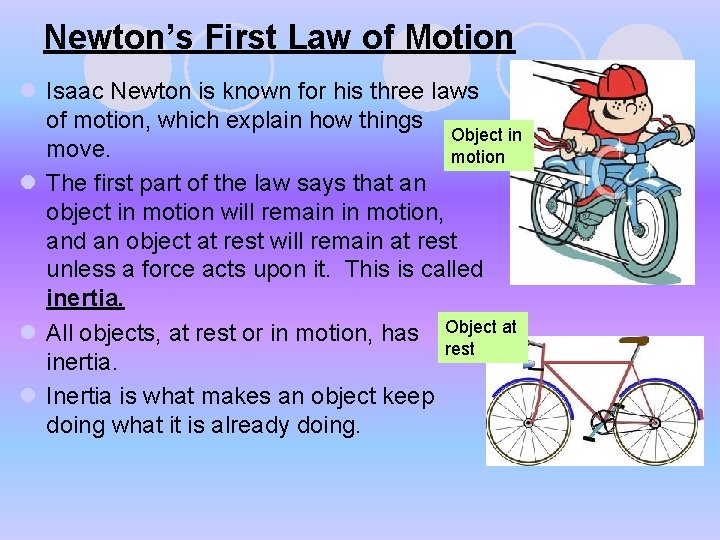
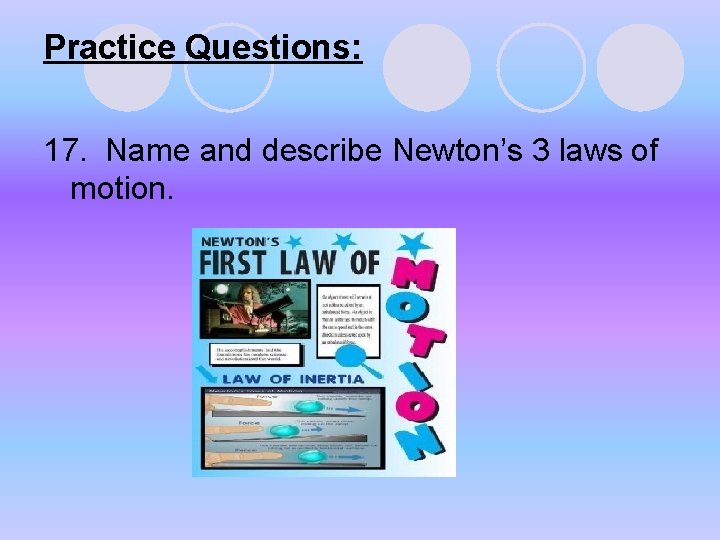
Newton’s First Law of Motion l Isaac Newton is known for his three laws of motion, which explain how things Object in move. motion l The first part of the law says that an object in motion will remain in motion, and an object at rest will remain at rest unless a force acts upon it. This is called inertia. l All objects, at rest or in motion, has Object at rest inertia. l Inertia is what makes an object keep doing what it is already doing.
What is motion? l We know that “motion” is any object that is moving. l We know that we describe motion in 3 ways: ¡HOW it moved ¡The DIRECTION it moved ¡The SPEED it moved
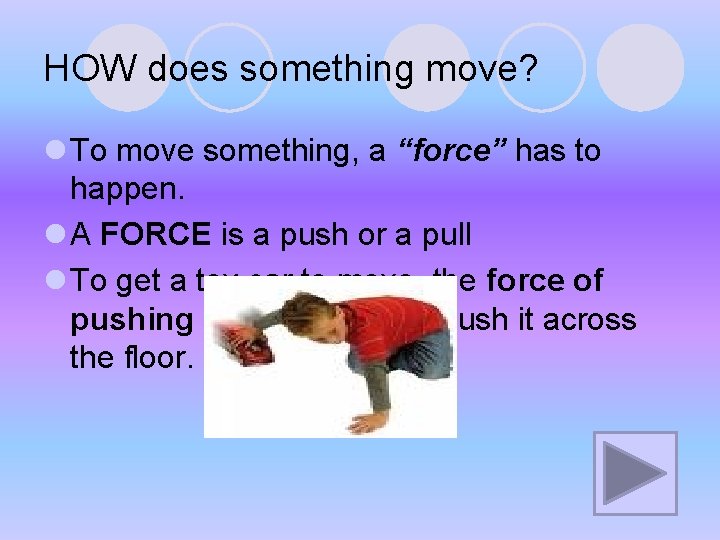
HOW does something move? l To move something, a “force” has to happen. l A FORCE is a push or a pull l To get a toy car to move, the force of pushing is applied as we push it across the floor.
How does something stop? l We can get it to move, but now how do we get it to stop? l An object will stop when it loses speed or “momentum. ” l An object will stop when a “force” acts and stops it. l Our toy car stops when it runs into the wall. l What else makes something stop…
FRICTION • We know that friction can help objects stop. • Friction is when 2 objects rub together.
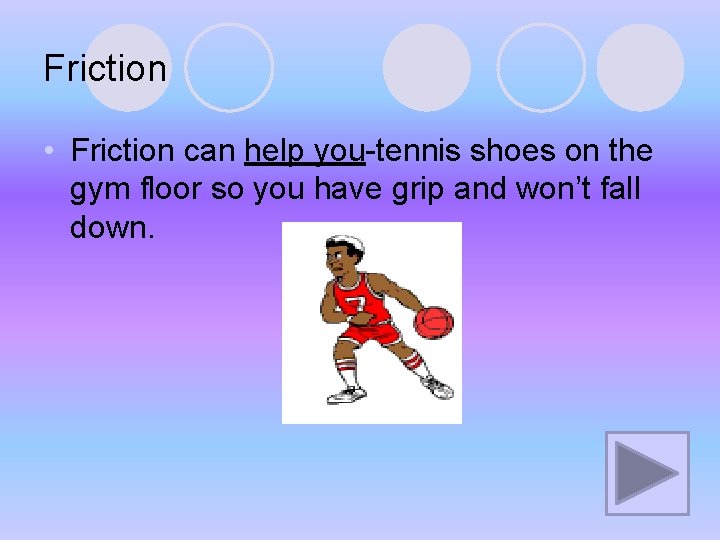
Friction • Friction can help you-tennis shoes on the gym floor so you have grip and won’t fall down.
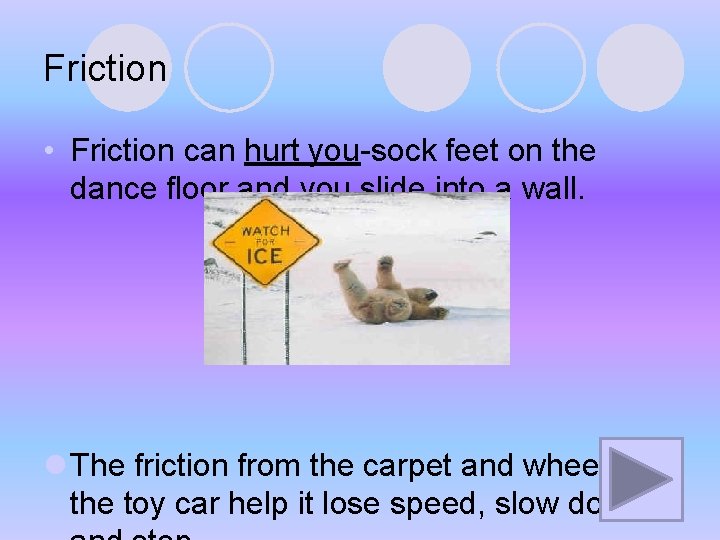
Friction • Friction can hurt you-sock feet on the dance floor and you slide into a wall. l The friction from the carpet and wheels on the toy car help it lose speed, slow down,
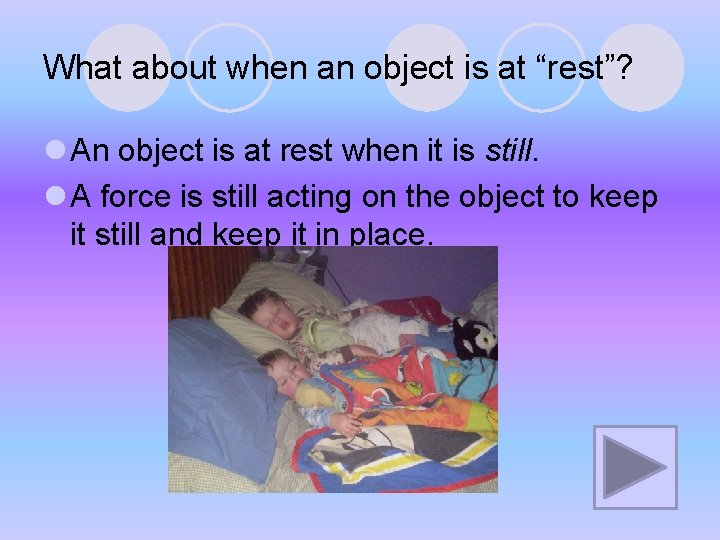
What about when an object is at “rest”? l An object is at rest when it is still. l A force is still acting on the object to keep it still and keep it in place.
What is it? l GRAVITY l Gravity pulls objects DOWN. l Gravity is what keeps you in your seat, brings your ball back down, and you back down after you jump.
What else is there? l We know how something moves and how something stops. l We know that a force is a push or pull that makes things move. l We know friction is 2 objects rubbing together. l We know gravity pulls/pushes everything back down. l There’s more to motion-Let’s find out…
Newton’s First Law of Motion You have a hockey puck It is not moving, it is at rest To get the puck to move, you have to do something to the puck like hit it. This is the force. Without the force, it will stay in the same spot and be at rest. Watch this to learn more! . . DesktopNewton_s_First_Law_of_Motion. asf
Newton’s 1 st Law of Motion-1 st part l “An object at rest remains at rest unless acted on by another force. ” l An object will stay at rest or “look still” until you do something to make it move. l The toy car stays at the starting line (at rest) until you push it (apply a force). l The hockey puck sits on the ice (at rest) until you push it with the stick (apply a force).
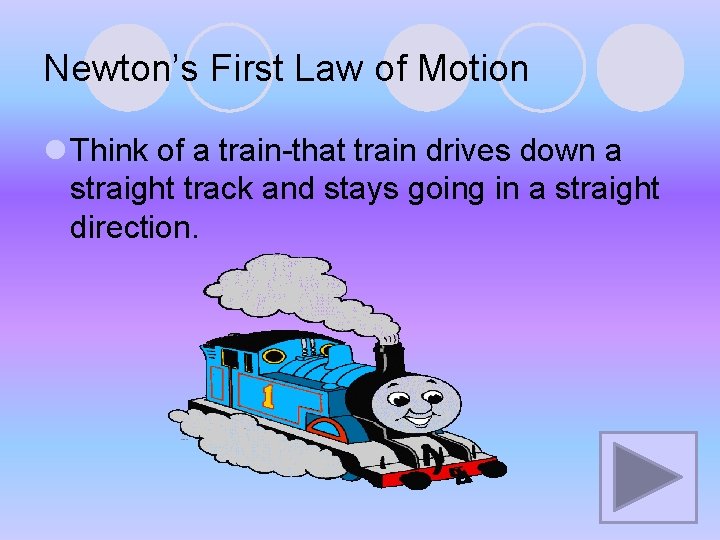
Newton’s First Law of Motion l Think of a train-that train drives down a straight track and stays going in a straight direction.
Newton’s 1 st Law of Motion l What happens when the track curves left or right? l The train turns and goes left or right
Newton’s 1 st Law of Motion-2 nd part “An object in motion in a straight line tends to say in motion in a straight line unless acted upon by another force. ” An object will go straight until a force makes it go another direction. Your paper airplane flies straight until gravity pushes it down. Thomas drives straight until the driver makes it “turn” with the track.
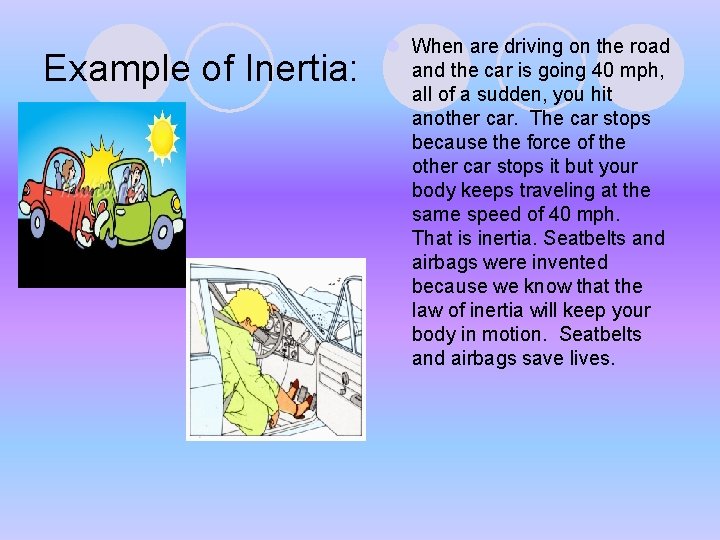
Example of Inertia: l When are driving on the road and the car is going 40 mph, all of a sudden, you hit another car. The car stops because the force of the other car stops it but your body keeps traveling at the same speed of 40 mph. That is inertia. Seatbelts and airbags were invented because we know that the law of inertia will keep your body in motion. Seatbelts and airbags save lives.
Another Example of inertia l HAVE YOU EVER SEEN A MAGICAN PULL A TALBECLOTH OUT FROM UNDER DISHES AND THE DISHES STAY PUT? SINCE THE DISHES HAVE INERTIA, THEY STAY PUT AND ONLY THE TABLECLOTH MOVES BECAUSE THE FORCE (PULL) IS ONLY APPLIED TO THE TABLECLOTH, NOT THE DISHES!!!
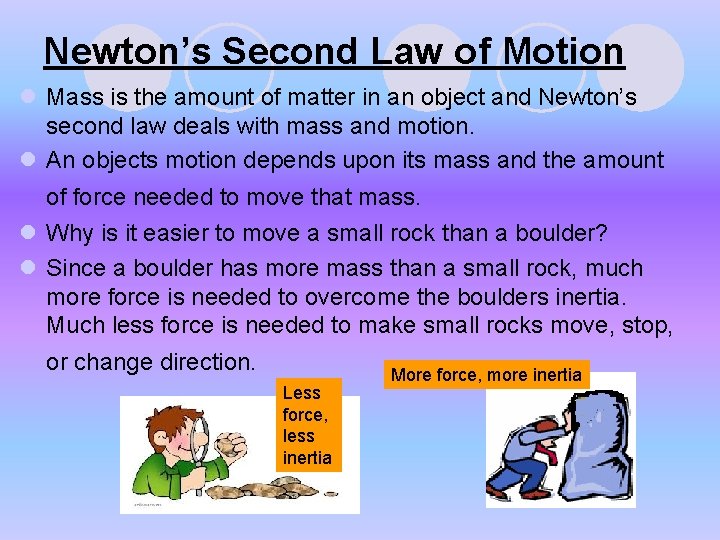
Newton’s Second Law of Motion l Mass is the amount of matter in an object and Newton’s second law deals with mass and motion. l An objects motion depends upon its mass and the amount of force needed to move that mass. l Why is it easier to move a small rock than a boulder? l Since a boulder has more mass than a small rock, much more force is needed to overcome the boulders inertia. Much less force is needed to make small rocks move, stop, or change direction. More force, more inertia Less force, less inertia
Second Law of Motion Deals With Speed l Speed measures how far something travels on a certain amount of time or use the formula l speed = distance divided by time. EX: What is the speed of a car traveling 225 miles in 3 hours l The faster an object moves, the more force is needed to stop it!!! You can measure speed with a clock or stopwatch will measure time and speed. Scientist can calculate speed by dividing distance over time.
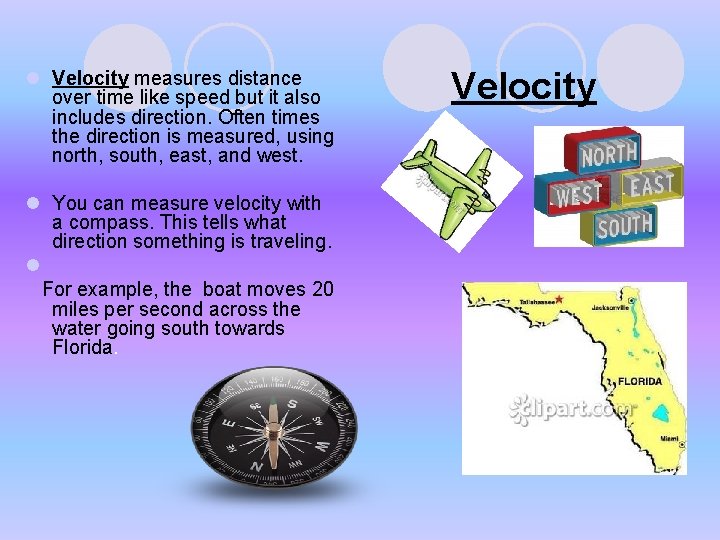
l Velocity measures distance over time like speed but it also includes direction. Often times the direction is measured, using north, south, east, and west. l You can measure velocity with a compass. This tells what direction something is traveling. l For example, the boat moves 20 miles per second across the water going south towards Florida. Velocity
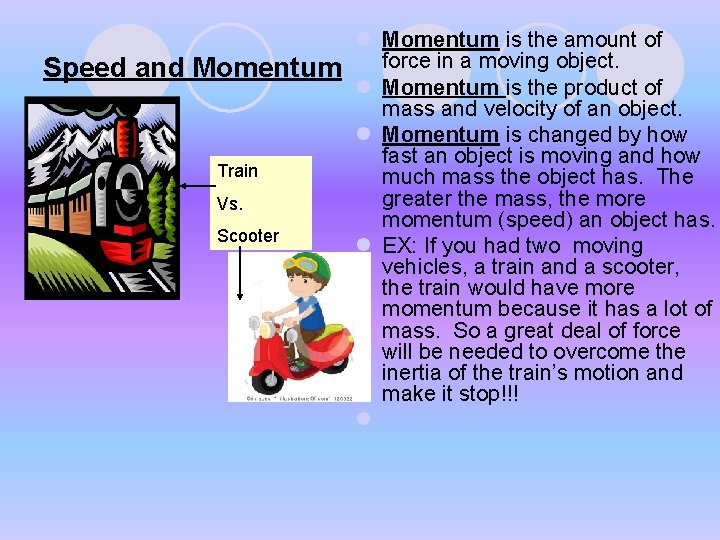
Speed and Momentum Train Vs. Scooter l Momentum is the amount of force in a moving object. l Momentum is the product of mass and velocity of an object. l Momentum is changed by how fast an object is moving and how much mass the object has. The greater the mass, the more momentum (speed) an object has. l EX: If you had two moving vehicles, a train and a scooter, the train would have more momentum because it has a lot of mass. So a great deal of force will be needed to overcome the inertia of the train’s motion and make it stop!!! l
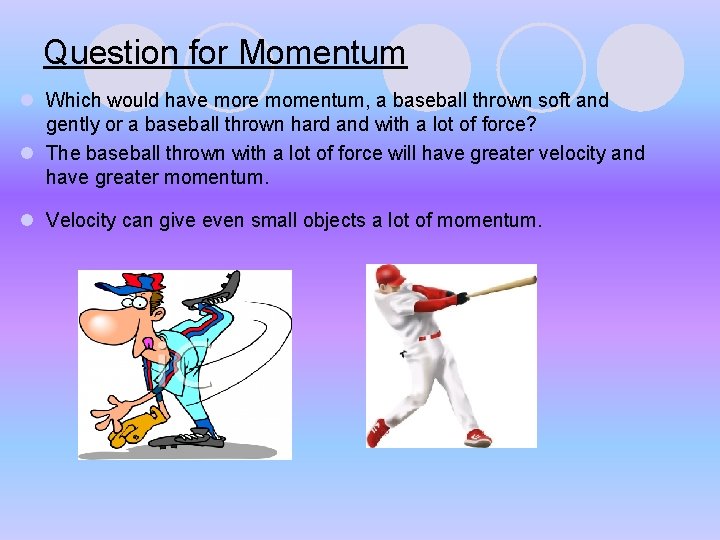
Question for Momentum l Which would have more momentum, a baseball thrown soft and gently or a baseball thrown hard and with a lot of force? l The baseball thrown with a lot of force will have greater velocity and have greater momentum. l Velocity can give even small objects a lot of momentum.
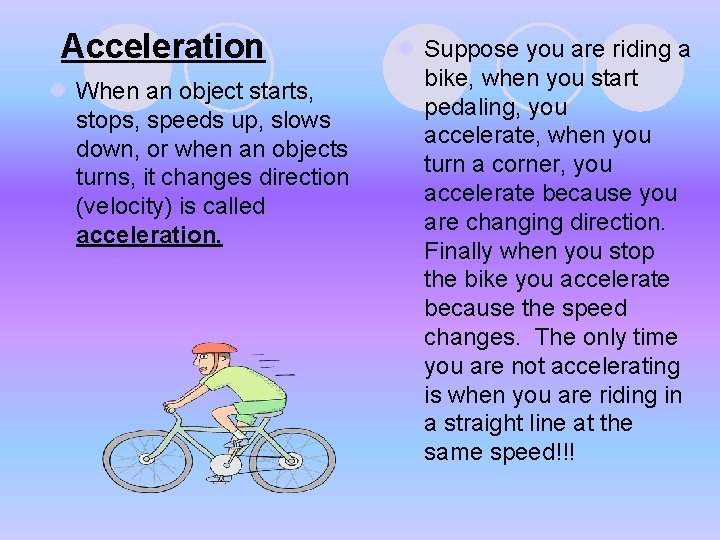
Acceleration l When an object starts, stops, speeds up, slows down, or when an objects turns, it changes direction (velocity) is called acceleration. l Suppose you are riding a bike, when you start pedaling, you accelerate, when you turn a corner, you accelerate because you are changing direction. Finally when you stop the bike you accelerate because the speed changes. The only time you are not accelerating is when you are riding in a straight line at the same speed!!!
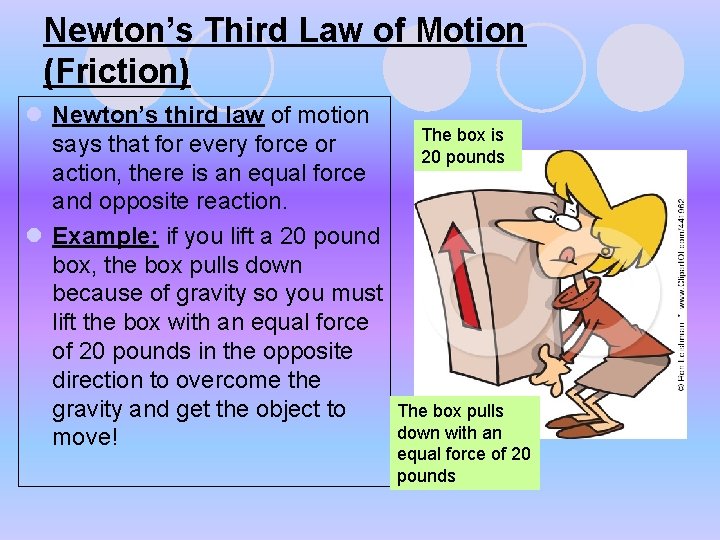
Newton’s Third Law of Motion (Friction) l Newton’s third law of motion says that for every force or action, there is an equal force and opposite reaction. l Example: if you lift a 20 pound box, the box pulls down because of gravity so you must lift the box with an equal force of 20 pounds in the opposite direction to overcome the gravity and get the object to move! The box is 20 pounds The box pulls down with an equal force of 20 pounds
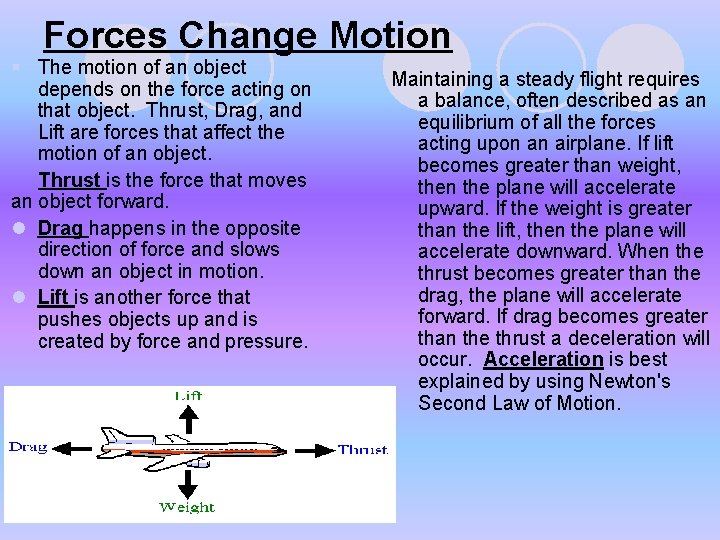
Forces Change Motion § The motion of an object Maintaining a steady flight requires depends on the force acting on a balance, often described as an that object. Thrust, Drag, and equilibrium of all the forces Lift are forces that affect the acting upon an airplane. If lift motion of an object. becomes greater than weight, Thrust is the force that moves then the plane will accelerate an object forward. upward. If the weight is greater l Drag happens in the opposite than the lift, then the plane will direction of force and slows accelerate downward. When the down an object in motion. thrust becomes greater than the drag, the plane will accelerate l Lift is another force that forward. If drag becomes greater pushes objects up and is than the thrust a deceleration will created by force and pressure. occur. Acceleration is best explained by using Newton's Second Law of Motion.
Force, Motion, and Work l In science, work happens when you move something. The amount of work you do depends on the distance the object moves and the force it takes to move it. l Force x distance= work l Energy is the ability to do work. The more energy you have, the more work you can do. l There are two kinds of energy, potential and kinetic.
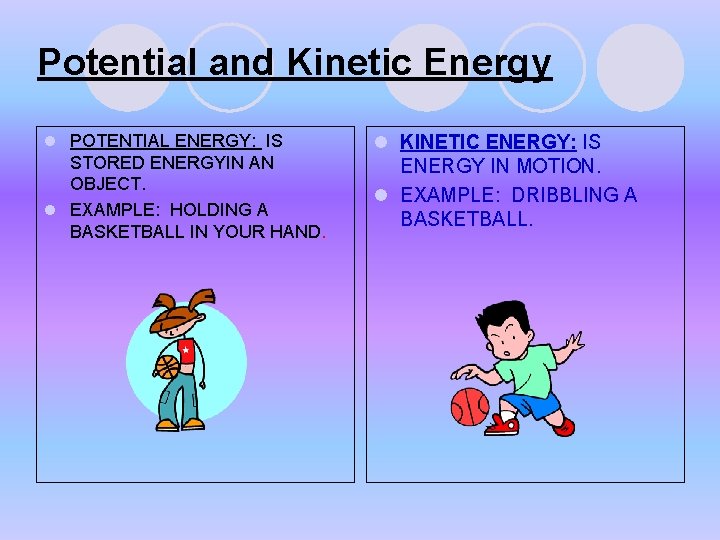
Potential and Kinetic Energy l POTENTIAL ENERGY: IS STORED ENERGYIN AN OBJECT. l EXAMPLE: HOLDING A BASKETBALL IN YOUR HAND. l KINETIC ENERGY: IS ENERGY IN MOTION. l EXAMPLE: DRIBBLING A BASKETBALL.
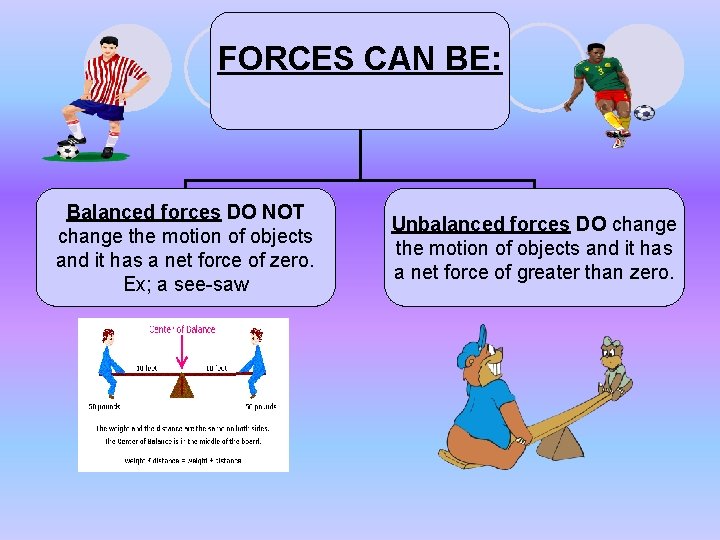
FORCES CAN BE: Balanced forces DO NOT change the motion of objects and it has a net force of zero. Ex; a see-saw Unbalanced forces DO change the motion of objects and it has a net force of greater than zero.
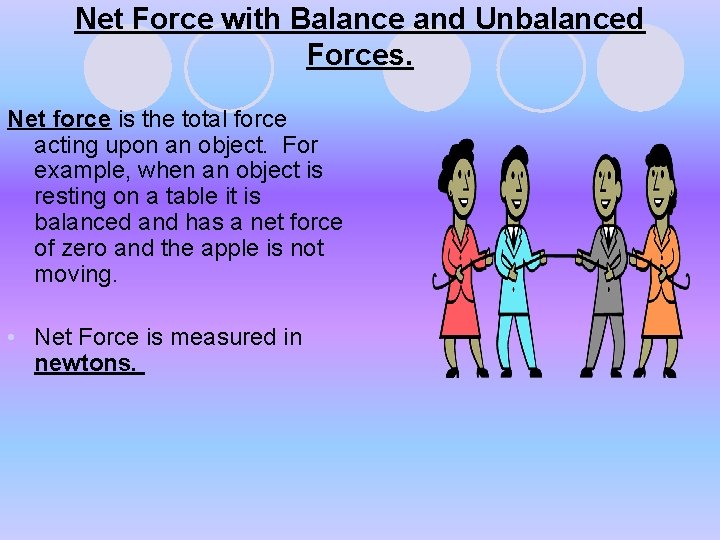
Net Force with Balance and Unbalanced Forces. Net force is the total force acting upon an object. For example, when an object is resting on a table it is balanced and has a net force of zero and the apple is not moving. • Net Force is measured in newtons.
Practice Questions: 1. What is needed to change the direction of a moving mass? 2. What happens to an object moving in one direction? 3. What is friction?
Practice Questions: 4. What do you think would be the fastest surface for a toy car to travel if pushed with the same force? l A. Ice l B. Grass l C. Concrete l D. Carpet
Practice Questions: 5. What slows an object l A. speed l B. friction l C. gravity l D. momentum
Practice Questions: 6. Two toy race cars are going to be raced down the same ramp. Which information is most helpful in predicting which car will win the race? l. A. Length of ramp l. B. Volume of the cars l. C. Slope of the ramp l. D. Mass of the cars
Practice Questions: 7. Which is the best example of a pushing force that reduces the speed of an object? A. A ball hitting a baseball B. A break rubbing against a wheel C. A Pedal turning the wheels of a bike D. A skateboard wheel rolling against pavement.
Practice Questions: 8. Sometimes machines are used to lower heavy object from the top of the building to the ground. What is most responsible for making the object move to the ground. A. wind l B. gravity l C. friction l D. Momentum
Practice Questions: 9. Why is it important for basketball players to wear shoes with treads? l A. to increase the speed of the player l B. to decrease the force between the player and the floor l C. To increase friction between the floor and the player’s feet l D. To decrease the amount of force needed for the player to move
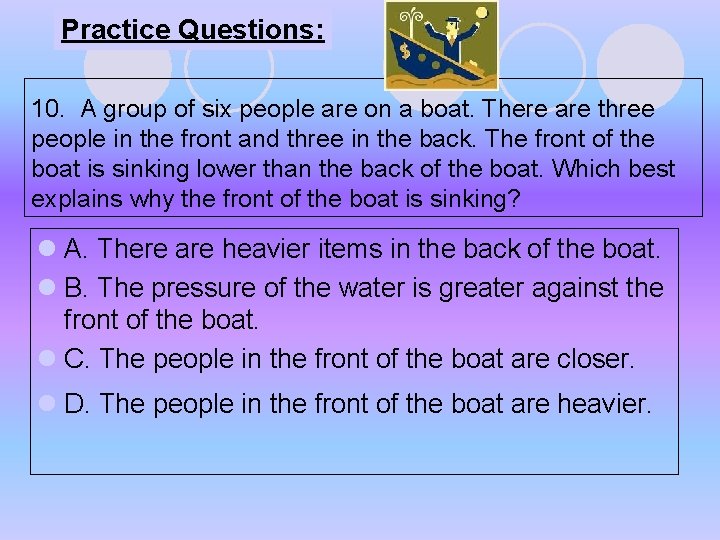
Practice Questions: 10. A group of six people are on a boat. There are three people in the front and three in the back. The front of the boat is sinking lower than the back of the boat. Which best explains why the front of the boat is sinking? l A. There are heavier items in the back of the boat. l B. The pressure of the water is greater against the front of the boat. l C. The people in the front of the boat are closer. l D. The people in the front of the boat are heavier.
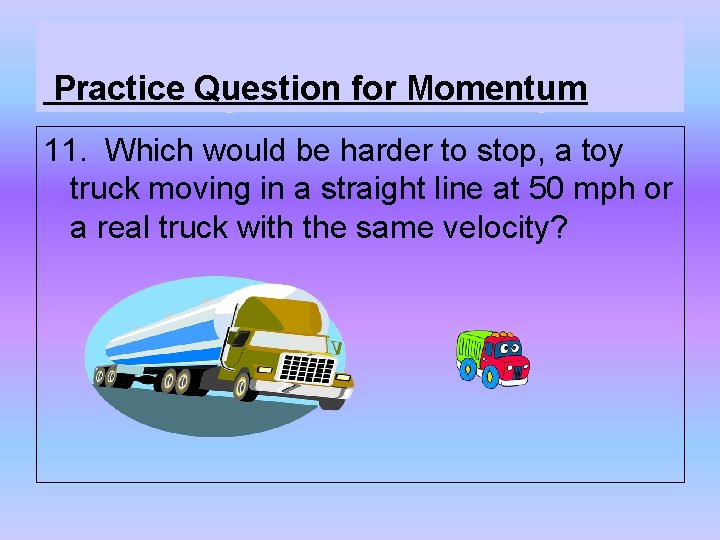
Practice Question for Momentum 11. Which would be harder to stop, a toy truck moving in a straight line at 50 mph or a real truck with the same velocity?
Practice Question for Speed What is the speed of a train traveling 100 miles in 2 hours?
Practice Questions, True or False 13. For every force, there is a motion? _______ 14. For every motion, there is a force? _______ 15. Forces and motion have the same meaning? _______ 16. People and nature produces forces, while machines produce motion. _____
Practice Questions: 17. Name and describe Newton’s 3 laws of motion.
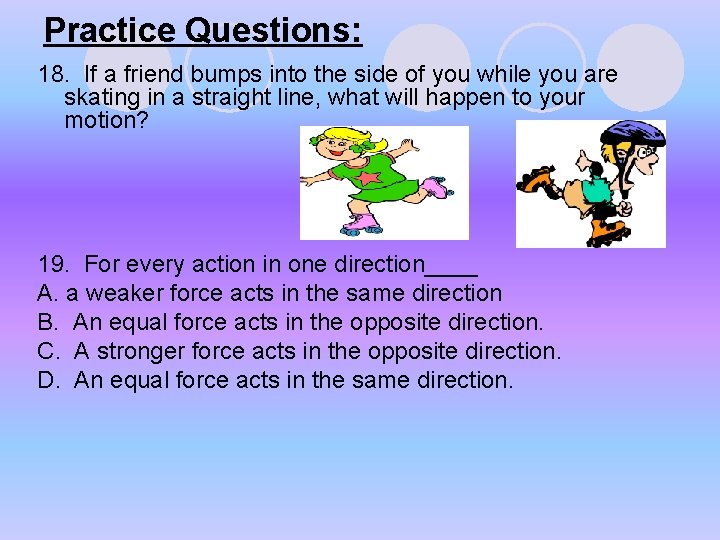
Practice Questions: 18. If a friend bumps into the side of you while you are skating in a straight line, what will happen to your motion? 19. For every action in one direction____ A. a weaker force acts in the same direction B. An equal force acts in the opposite direction. C. A stronger force acts in the opposite direction. D. An equal force acts in the same direction.
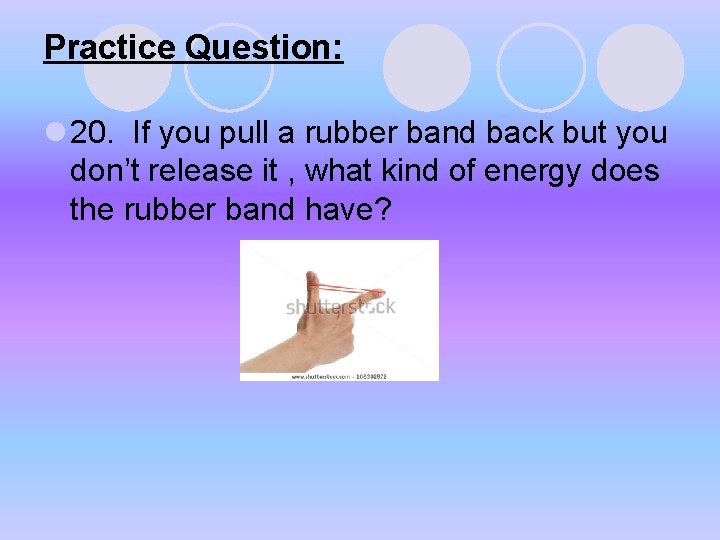
Practice Question: l 20. If you pull a rubber band back but you don’t release it , what kind of energy does the rubber band have?
l 21. If an equal force acts on each of the following objects, which will have the greatest acceleration? l a. a golf ball c. a soccer ball l b. a basketball d. a football
l 22. During a tug of war contest, each team is pulling the rope with equal force in the opposite directions. What is this an example of? l a. unbalanced forces c. balanced forces l b. friction force d. mechanical force l 23. What happens to an object’s motion when unbalanced forces act on it? l a. its motion changes c. its motion doesn’t change l b. its gravity changes d. its weight changes
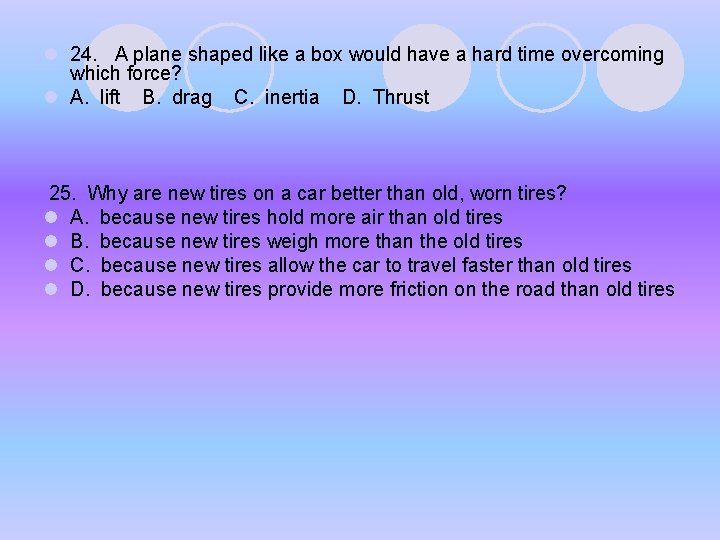
l 24. A plane shaped like a box would have a hard time overcoming which force? l A. lift B. drag C. inertia D. Thrust 25. Why are new tires on a car better than old, worn tires? l A. because new tires hold more air than old tires l B. because new tires weigh more than the old tires l C. because new tires allow the car to travel faster than old tires l D. because new tires provide more friction on the road than old tires
l 26. Miguel and Jasmine were pulling on a rope from opposite ends. Which best explains why the center of the rope began moving towards Jasmine? l A. The force of the rope was greater than the force of Miguel pulling l B. The force of Miguel pulling was greater than the force of Jasmine pulling. l C. The force of the rope was greater than the force of Jasmine pulling l D. The force of Jasmine pulling was greater than the force of Miguel pulling.
27. Which best explains how mass affects the acceleration of an object? l a. As the mass of an object increases, the force needed to move it increases l b. As the mass of an object increases, the force needed to move it decreases l c. As the mass of an object changes, the force needed to move it remains the same.
28. This is a force that pushes objects up and is created by force and pressure. l a. thrust b. drag c. lift d. Gravity 29. A book is sitting still on a table. Which best describes the force acting on the book? l a. the force of gravity pulling on the book is the same as the force pulling on the table l b. the force of gravity pulling on the book is greater than he force of the table holding it up. l c. the force of gravity pulling on the book is less than the force holding the table up l d. only gravity is acting on the book
l 30. Force is measured in units called newtons (N). Which pair of forces are balanced forces? l a. a 10 N pull north and a 5 N pull east b. a 5 N pull north and a 5 N pull south l c. a 5 N pull north and a 5 N pull east d. a 5 N pull north and a 5 N pull north
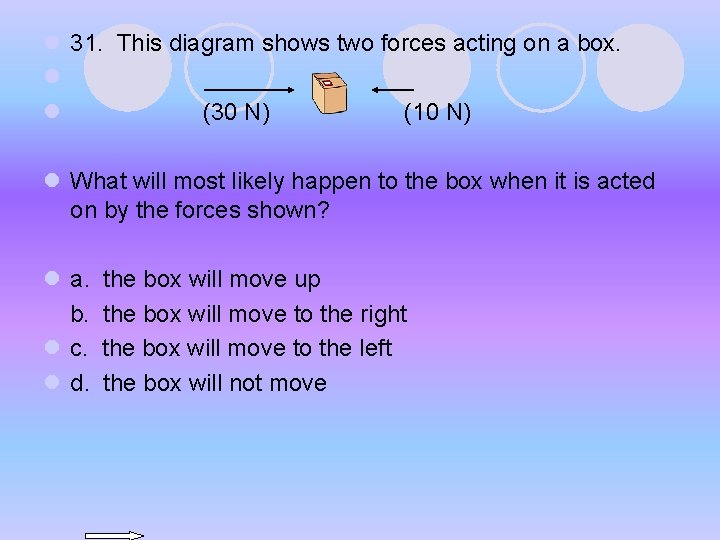
l 31. This diagram shows two forces acting on a box. l (30 N) (10 N) l What will most likely happen to the box when it is acted on by the forces shown? l a. the box will move up b. the box will move to the right l c. the box will move to the left l d. the box will not move
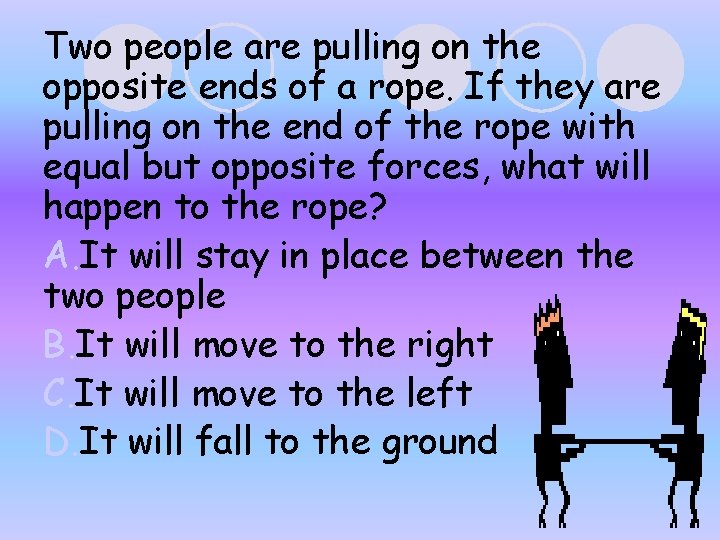
Two people are pulling on the opposite ends of a rope. If they are pulling on the end of the rope with equal but opposite forces, what will happen to the rope? A. It will stay in place between the two people B. It will move to the right C. It will move to the left D. It will fall to the ground
Which statement best describes what must happen in order for a person to lift an object? A. The force of gravity must be greater than the mass of the object. B. The mass of the object must be greater than the force of gravity C. The force of gravity must be greater than the upward push or pull of the object. D. The upward push or pull of the object must be greater than the force of gravity.
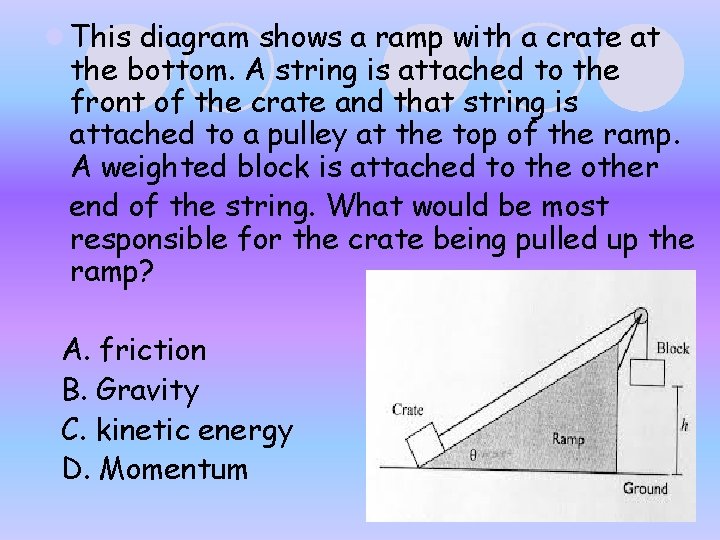
l This diagram shows a ramp with a crate at the bottom. A string is attached to the front of the crate and that string is attached to a pulley at the top of the ramp. A weighted block is attached to the other end of the string. What would be most responsible for the crate being pulled up the ramp? A. friction B. Gravity C. kinetic energy D. Momentum
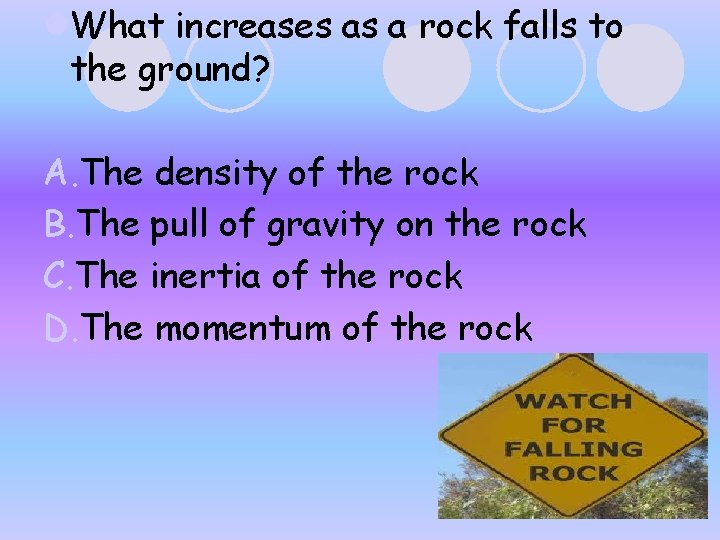
l. What increases as a rock falls to the ground? A. The density of the rock B. The pull of gravity on the rock C. The inertia of the rock D. The momentum of the rock
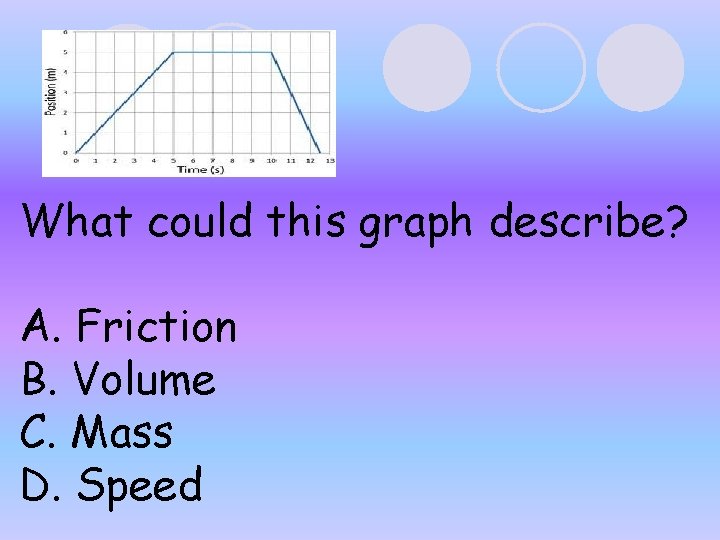
What could this graph describe? A. Friction B. Volume C. Mass D. Speed
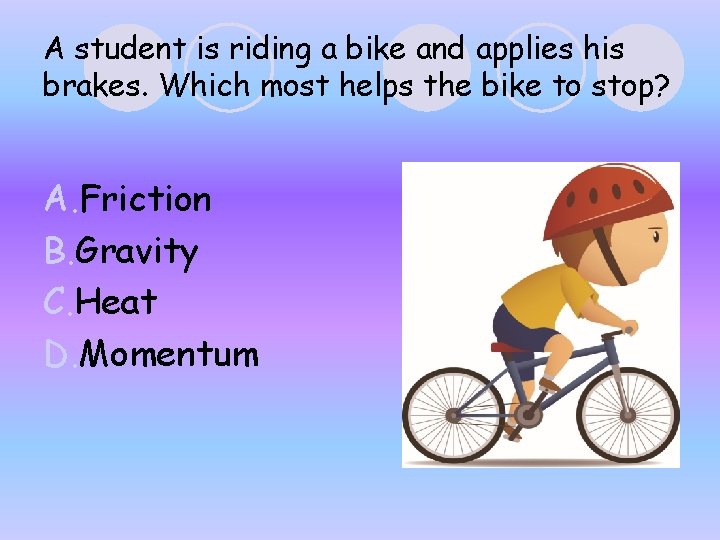
A student is riding a bike and applies his brakes. Which most helps the bike to stop? A. Friction B. Gravity C. Heat D. Momentum
l. A car moves along a road that has markers every kilometer. Over time, it passes the marker in shorter periods of time. Which best describes the motion of the car? A. The car is keeping the same direction. B. The car is maintaining the same speed. C. The car is increasing speed. D. The car is changing direction.
Which best explains why a moving wagon on a sidewalk will slow down? A. The friction between the box and the floor decreases when it is pushed. B. The pull of gravity on the box decreases when it is pushed. C. Unbalanced forces cause the box to move. D. Balanced force cause the box to move.
An object is moving at a constant speed. If a balanced force is applied in the opposite direction the object is moving, what will most likely happen? A. The object will speed up B. The object will change direction C. The object will continue moving at a constant speed. D. The object will slow down and eventually stop moving.
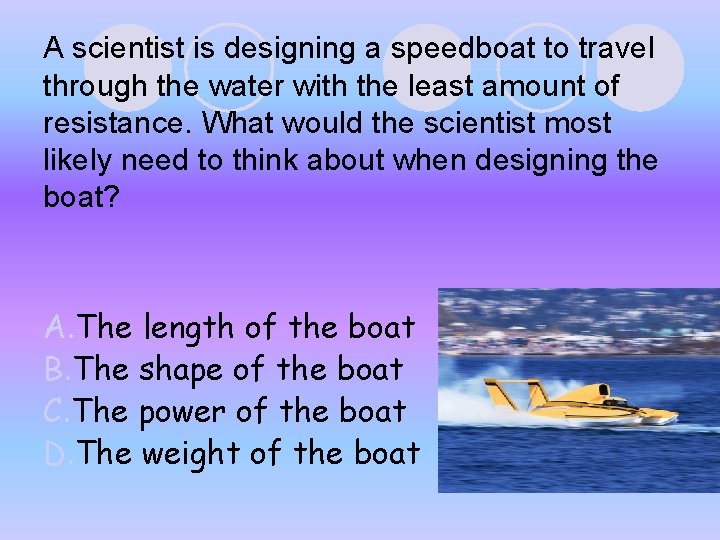
A scientist is designing a speedboat to travel through the water with the least amount of resistance. What would the scientist most likely need to think about when designing the boat? A. The length of the boat B. The shape of the boat C. The power of the boat D. The weight of the boat
Which would slow an object in motion? A. Speed B. Friction C. Gravity D. Force
Why is it important for basketball players to wear shoes with tread when playing? A. To increase speed of player B. To decrease the force between the player and the floor C. To increase friction between the floor and the player’s feet D. To decrease the amount of force needed for the player to move.
What is necessary to determine the speed of an object? A. The mass and volume of object B. The shape of the object and the distance it traveled C. The mass of the object and the time it took to move it D. The distance moved by the object and the amount of time it took to move
Nick and Mike are facing each other on skateboards. They touch palms and push off from each other. Which best describes their movement. A. Neither Nick or Mike will move B. Nick and Mike will move backward, away from each other C. Nick will move forward and Mike will move backward D. Nick will move backward and Mike will move forwad
Which best describes the rate at which an object changes position over time? A. Force B. Speed C. Distance D. Direction
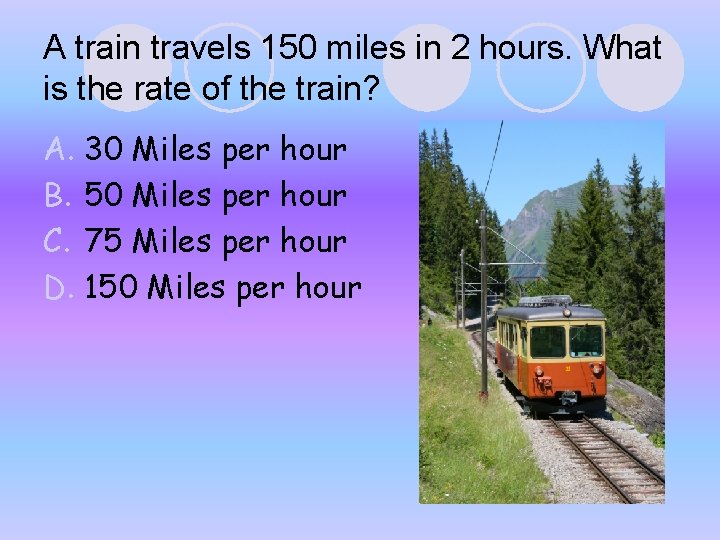
A train travels 150 miles in 2 hours. What is the rate of the train? A. 30 Miles per hour B. 50 Miles per hour C. 75 Miles per hour D. 150 Miles per hour
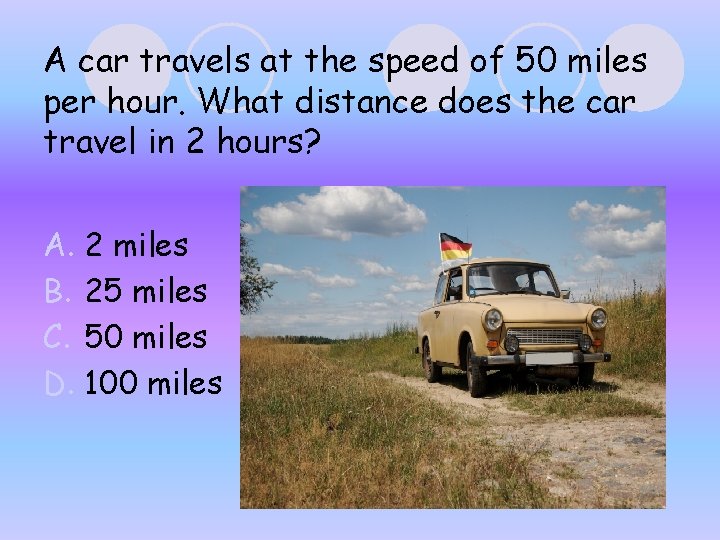
A car travels at the speed of 50 miles per hour. What distance does the car travel in 2 hours? A. 2 miles B. 25 miles C. 50 miles D. 100 miles
What will happen to an object t rest with no other forces acting on it? A. The object will stay at rest B. The object will begin to move C. The mass of the object will increase D. The gravity on the object will increase
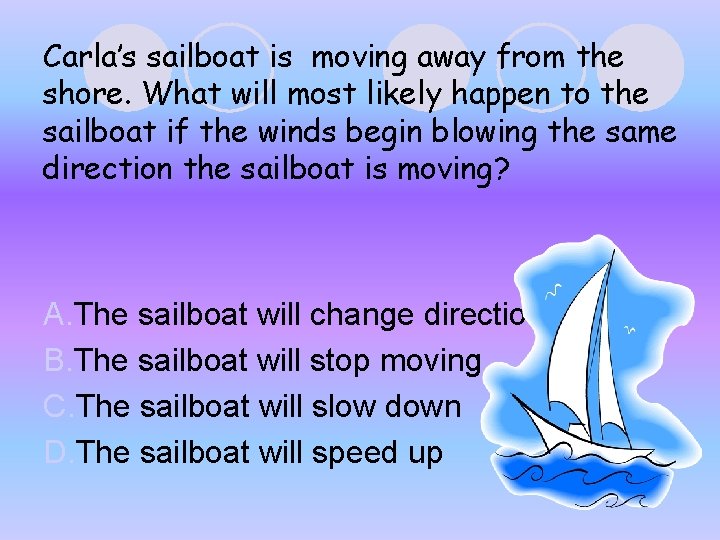
Carla’s sailboat is moving away from the shore. What will most likely happen to the sailboat if the winds begin blowing the same direction the sailboat is moving? A. The sailboat will change direction B. The sailboat will stop moving C. The sailboat will slow down D. The sailboat will speed up
When two equal and opposite forces are at work, what happens to motion? A. It increases B. It decreases C. There is no motion D. There is maximum friction
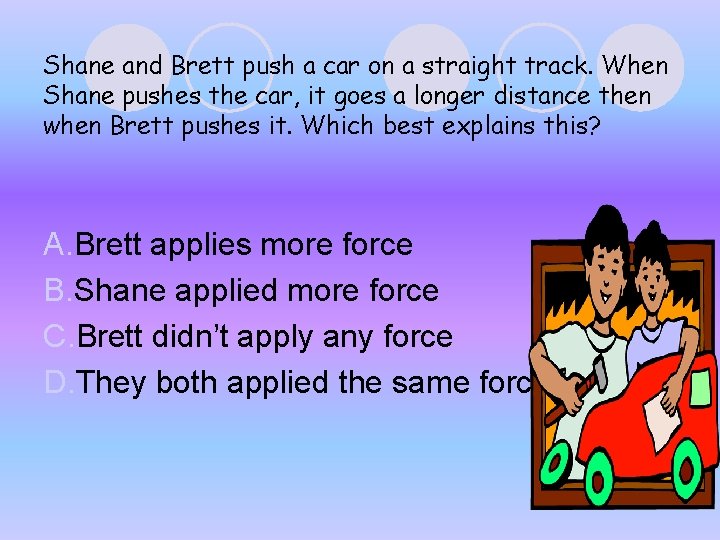
Shane and Brett push a car on a straight track. When Shane pushes the car, it goes a longer distance then when Brett pushes it. Which best explains this? A. Brett applies more force B. Shane applied more force C. Brett didn’t apply any force D. They both applied the same force
What will most likely happen to a kite in the air if the wind stops blowing? A. The kite will go higher due to gravity B. The kite will fall to the ground due to gravity C. The kite will fly away due to decreased wind speed D. The kite will change direction due to decreased wind speed
Maria pulled an empty cart to the library. When she leaves the library the cart is full of books. How does the force of friction on the cart change? A. The force of friction increases because there is more mass B. The force of friction decreases because there is more air pressure C. The force of friction increases because the force of gravity decreases D. The force of friction stays the same because Maria is still pulling the cart with the same force
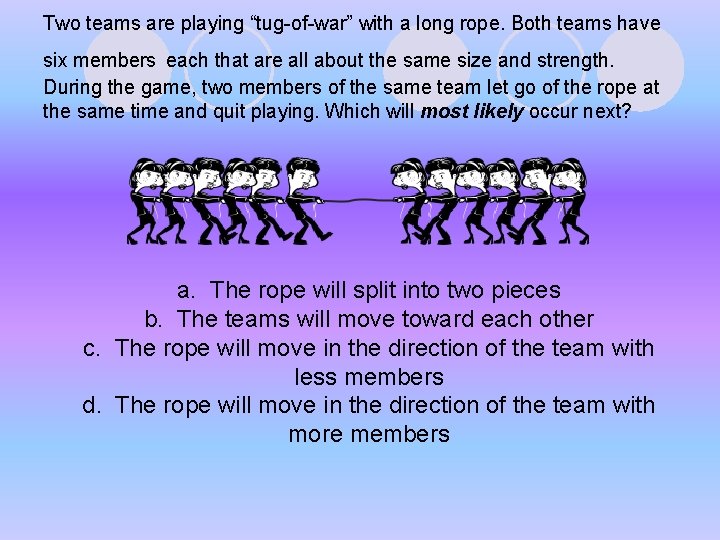
Two teams are playing “tug-of-war” with a long rope. Both teams have six members each that are all about the same size and strength. During the game, two members of the same team let go of the rope at the same time and quit playing. Which will most likely occur next? a. The rope will split into two pieces b. The teams will move toward each other c. The rope will move in the direction of the team with less members d. The rope will move in the direction of the team with more members
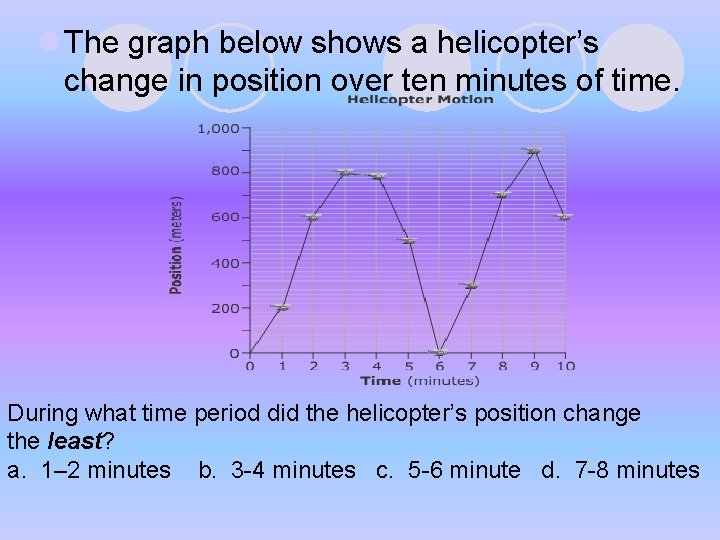
l The graph below shows a helicopter’s change in position over ten minutes of time. During what time period did the helicopter’s position change the least? a. 1– 2 minutes b. 3 -4 minutes c. 5 -6 minute d. 7 -8 minutes
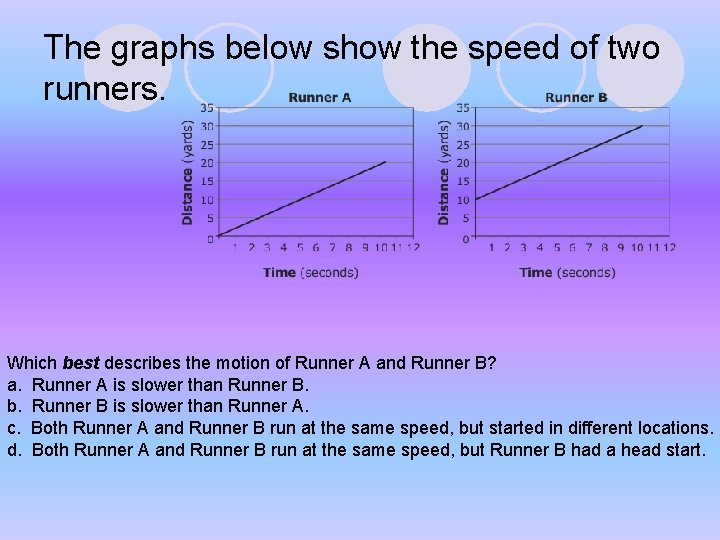
The graphs below show the speed of two runners. Which best describes the motion of Runner A and Runner B? a. Runner A is slower than Runner B. b. Runner B is slower than Runner A. c. Both Runner A and Runner B run at the same speed, but started in different locations. d. Both Runner A and Runner B run at the same speed, but Runner B had a head start.
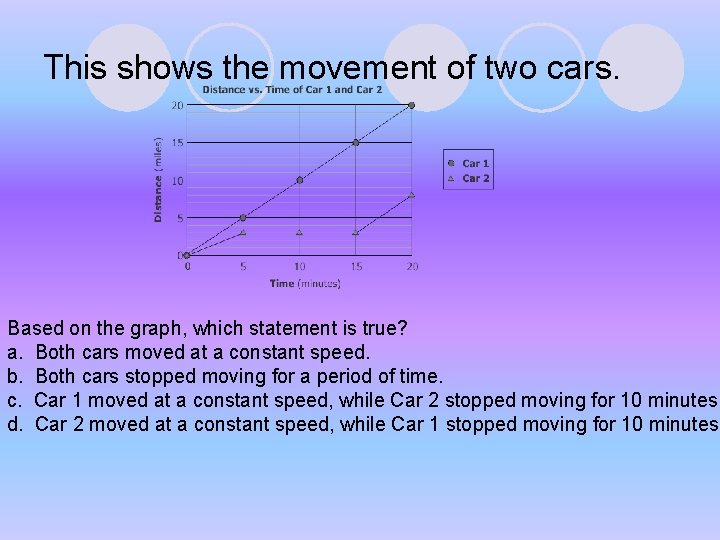
This shows the movement of two cars. Based on the graph, which statement is true? a. Both cars moved at a constant speed. b. Both cars stopped moving for a period of time. c. Car 1 moved at a constant speed, while Car 2 stopped moving for 10 minutes. d. Car 2 moved at a constant speed, while Car 1 stopped moving for 10 minutes.
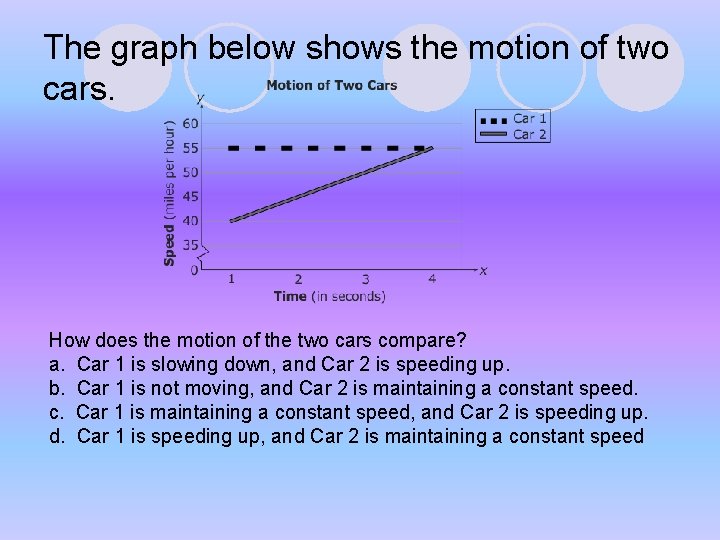
The graph below shows the motion of two cars. How does the motion of the two cars compare? a. Car 1 is slowing down, and Car 2 is speeding up. b. Car 1 is not moving, and Car 2 is maintaining a constant speed. c. Car 1 is maintaining a constant speed, and Car 2 is speeding up. d. Car 1 is speeding up, and Car 2 is maintaining a constant speed
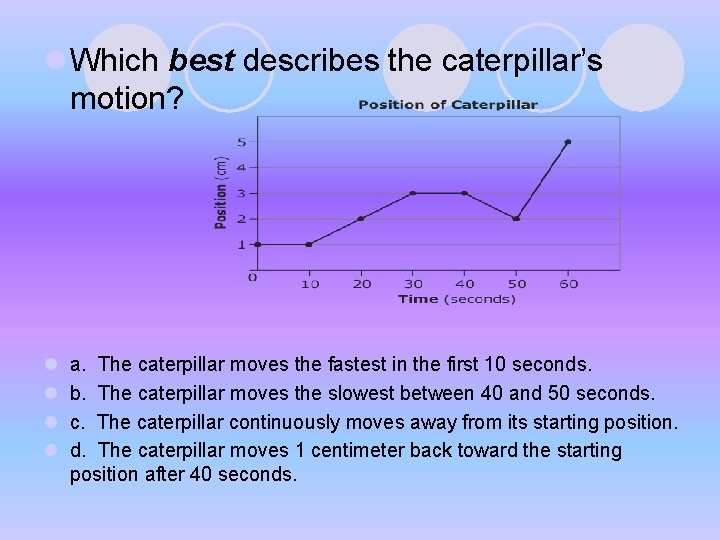
l Which best describes the caterpillar’s motion? l l a. The caterpillar moves the fastest in the first 10 seconds. b. The caterpillar moves the slowest between 40 and 50 seconds. c. The caterpillar continuously moves away from its starting position. d. The caterpillar moves 1 centimeter back toward the starting position after 40 seconds.
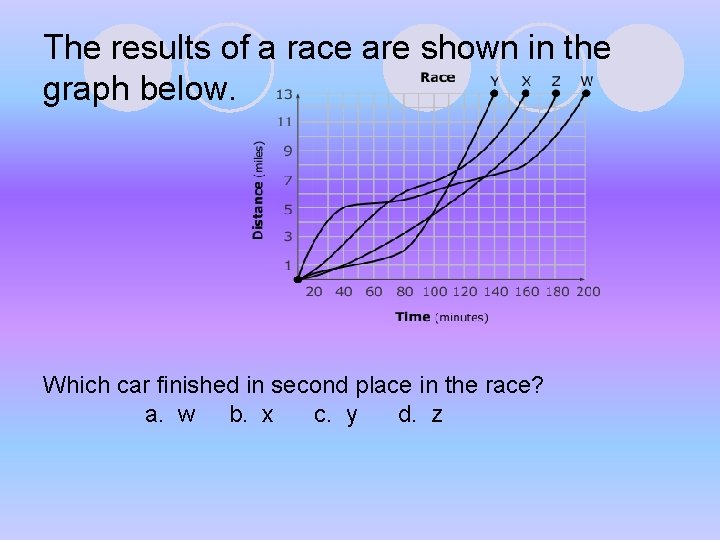
The results of a race are shown in the graph below. Which car finished in second place in the race? a. w b. x c. y d. z
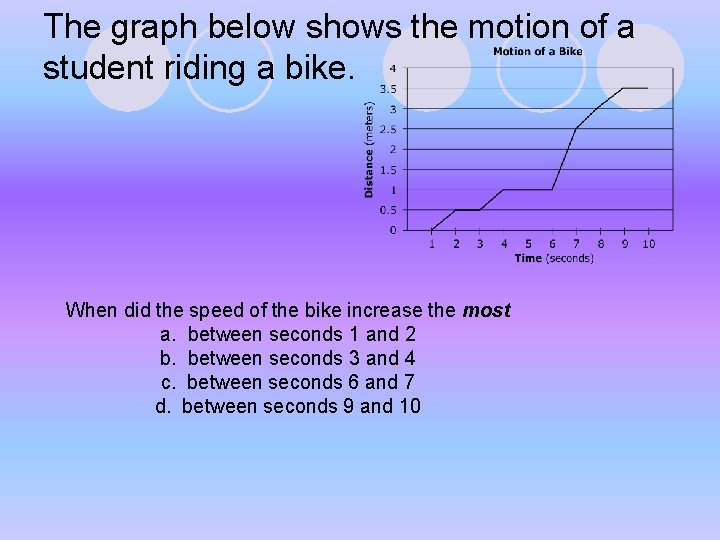
The graph below shows the motion of a student riding a bike. When did the speed of the bike increase the most a. between seconds 1 and 2 b. between seconds 3 and 4 c. between seconds 6 and 7 d. between seconds 9 and 10
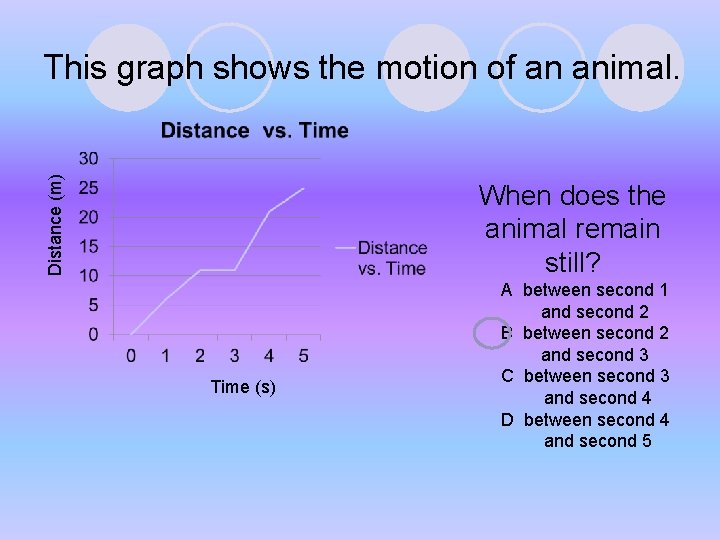
Distance (m) This graph shows the motion of an animal. When does the animal remain still? Time (s) A between second 1 and second 2 B between second 2 and second 3 C between second 3 and second 4 D between second 4 and second 5
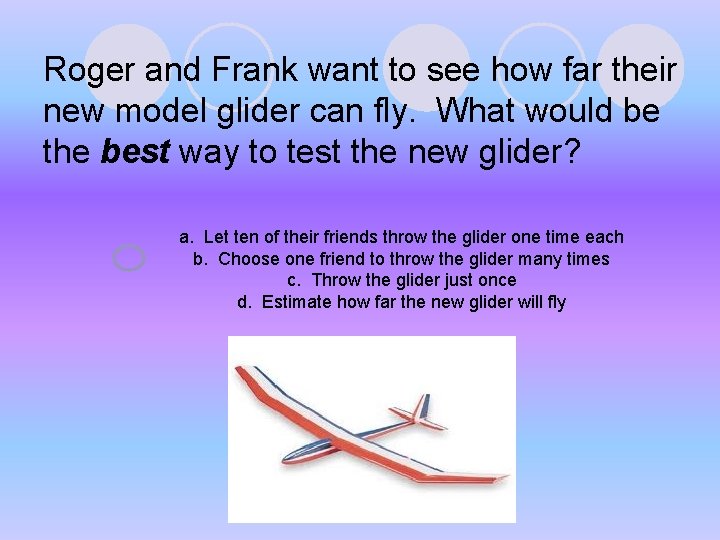
Roger and Frank want to see how far their new model glider can fly. What would be the best way to test the new glider? a. Let ten of their friends throw the glider one time each b. Choose one friend to throw the glider many times c. Throw the glider just once d. Estimate how far the new glider will fly
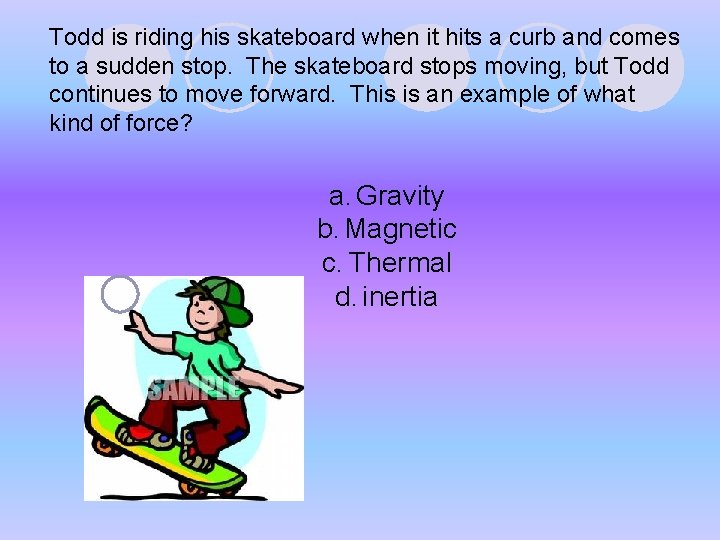
Todd is riding his skateboard when it hits a curb and comes to a sudden stop. The skateboard stops moving, but Todd continues to move forward. This is an example of what kind of force? a. Gravity b. Magnetic c. Thermal d. inertia
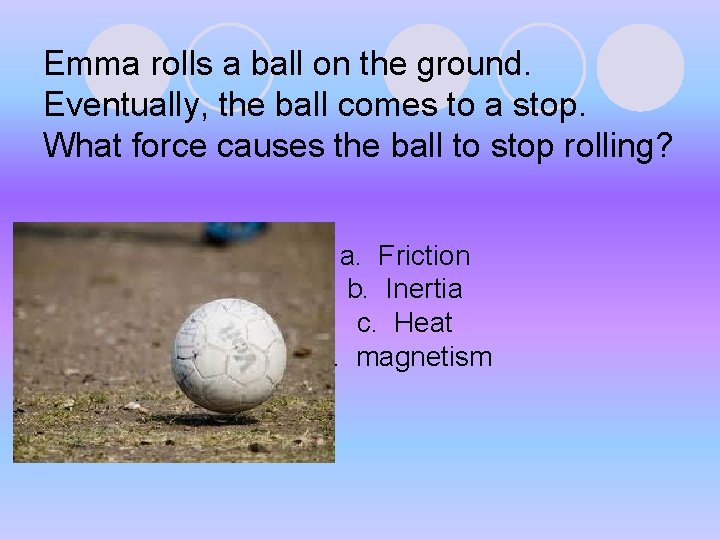
Emma rolls a ball on the ground. Eventually, the ball comes to a stop. What force causes the ball to stop rolling? a. Friction b. Inertia c. Heat d. magnetism
Jacob’s family went on a skiing trip last winter. At the ski resort, Jacob and his parents put wax on the bottom of their skis. What effect will this have on the skis? a. The wax will decrease the inertia of the skis. b. The wax will decrease the friction of the skis. c. The wax will increase the gravity of the skis. d. The was will decrease the momentum of the skis.
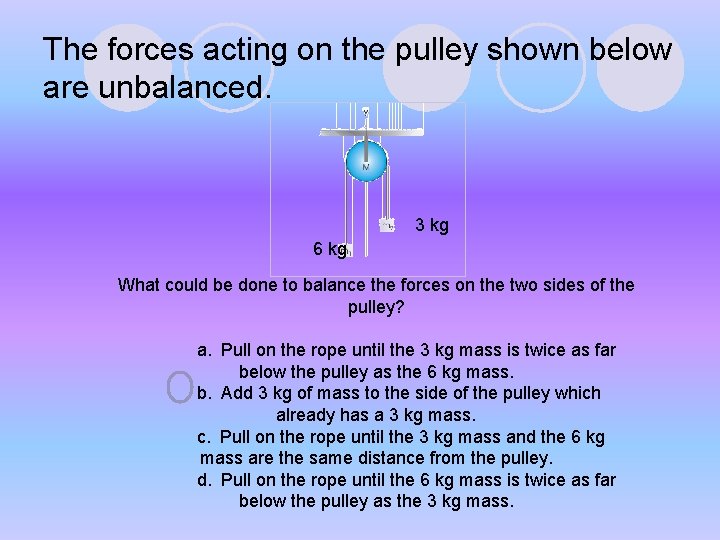
The forces acting on the pulley shown below are unbalanced. 3 kg 6 kg What could be done to balance the forces on the two sides of the pulley? a. Pull on the rope until the 3 kg mass is twice as far below the pulley as the 6 kg mass. b. Add 3 kg of mass to the side of the pulley which already has a 3 kg mass. c. Pull on the rope until the 3 kg mass and the 6 kg mass are the same distance from the pulley. d. Pull on the rope until the 6 kg mass is twice as far below the pulley as the 3 kg mass.
Lisa had to push very hard to start a heavy wagon rolling across a flat surface. This property of objects resisting a change in their motion is called a. Friction. b. Inertia. c. Gravity. d. Resistance.
While Maria is visiting her aunt one winter, there is an ice storm. Maria can slide on the sidewalk, except when her aunt’s neighbor has put sand on the ice. Why is this? a. There is more gravity from the sand. b. There is more friction when the sand is on the sidewalk. c. There is more heat from the sand. d. There is more inertia from the sand.
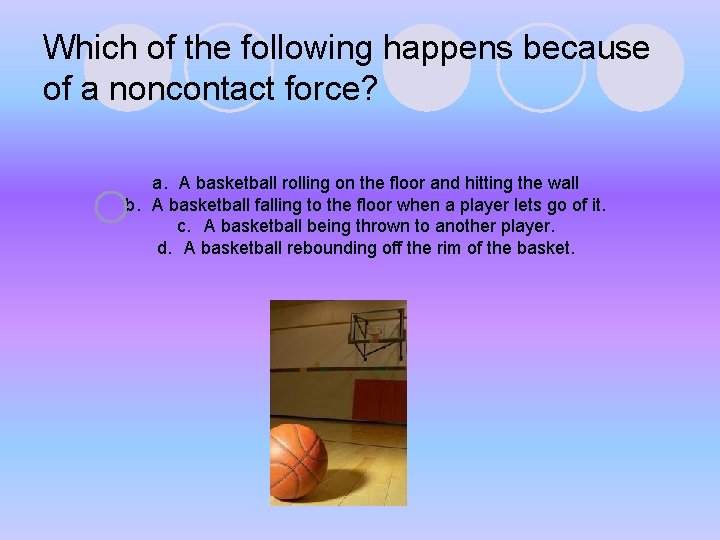
Which of the following happens because of a noncontact force? a. A basketball rolling on the floor and hitting the wall b. A basketball falling to the floor when a player lets go of it. c. A basketball being thrown to another player. d. A basketball rebounding off the rim of the basket.
Which statement best describes what must happen in order for a person to lift an object? A The force of gravity must be greater than the mass of the object. B The mass of the object must be greater than the force of gravity. C The force of gravity must be greater than the upward pull or push on the object. D The upward pull or push on the object must be greater than the force of gravity.
What increases as a rock falls to the ground? A the density of the rock B the pull of gravity on the rock C the inertia of the rock D the momentum of the rock
A car moves along a road that has markers every kilometer. Over time, it passes the markers in shorter periods of time. Which best describes the motion of the car? A The car is keeping the same direction. B The car is maintaining the same speed. C The car is increasing speed. D The car is changing direction.
An object is moving at a constant speed. If a balanced force is applied in the opposite direction the object is moving, what will most likely happen? A The object will speed up. B The object will change direction. C The object will continue moving at a constant speed. D The object will slow down and eventually stop moving.
Which best explains why a moving wagon on a sidewalk will slow down? A The friction between the box and the floor decreases when it is pushed. B The pull of gravity on the box decreases when it is pushed. C Unbalanced forces cause the box to move. D Balanced forces cause the box to move.
A car is traveling at a speed of 45 km/h to a town 90 km away. If time = distance ÷ speed , how long will the car take to get to the town? A 0. 5 hour B 1 hour C 1. 5 hours D 2 hours
When workers spread sand over icy bridges and roads in the winter, how does this help people drive on the roads? A The sand increases friction between the road and the tires of a car. B The sand increases the inertia of a car. C The sand increases the speed of a car. D The sand increases the momentum of a car.
An object moving along a surface suddenly increases speed. What can cause this to happen? A It is moved by balanced forces. B It is moved by two opposite forces. C It is moved by an unbalanced force. D It is moved by a force without direction.
This diagram shows a ball rolling down an inclined plane. The position of the ball is labeled for each second it travels. 0 sec 1 sec 2 sec 3 sec Which best describes the motion of the ball? A getting faster each second B getting slower each second C maintaining the same motion D constantly changing direction
A dog runs 6 meters in one second. By the end of the next second, the dog has traveled an additional 4 meters. Which best describes the motion of the dog during the two seconds? A The dog slows down. B The dog comes to a stop. C The dog changes in mass. D The dog changes direction.
What is the most likely reason cars are designed with smooth surfaces? A to overcome gravity B to stop easier C to reduce air resistance D to keep the engine cool
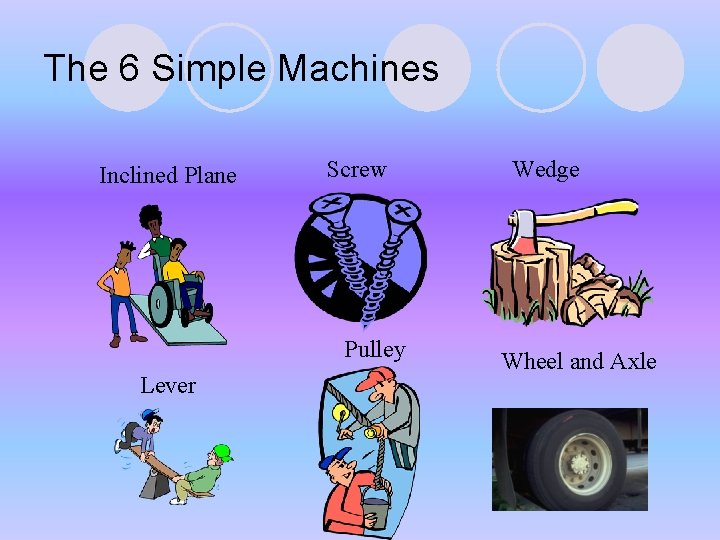
The 6 Simple Machines Inclined Plane Screw Pulley Lever Wedge Wheel and Axle
Definitions: Energy: Ability to do work Work Force x Distance = Force: A Push or a Pull
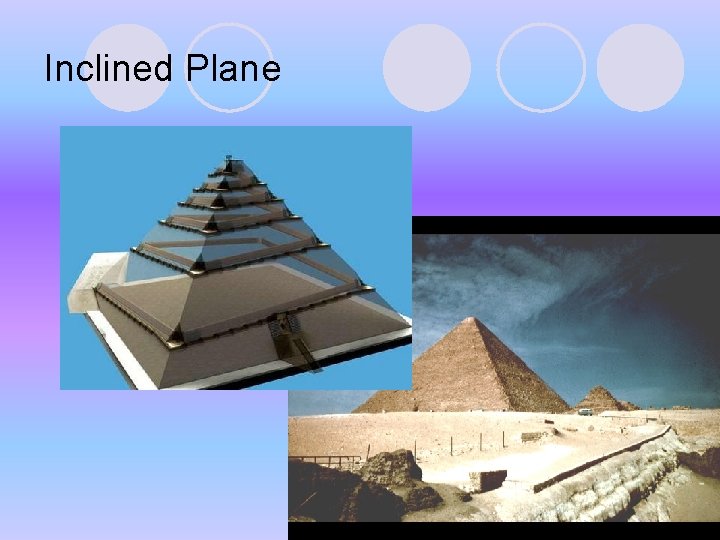
Inclined Plane
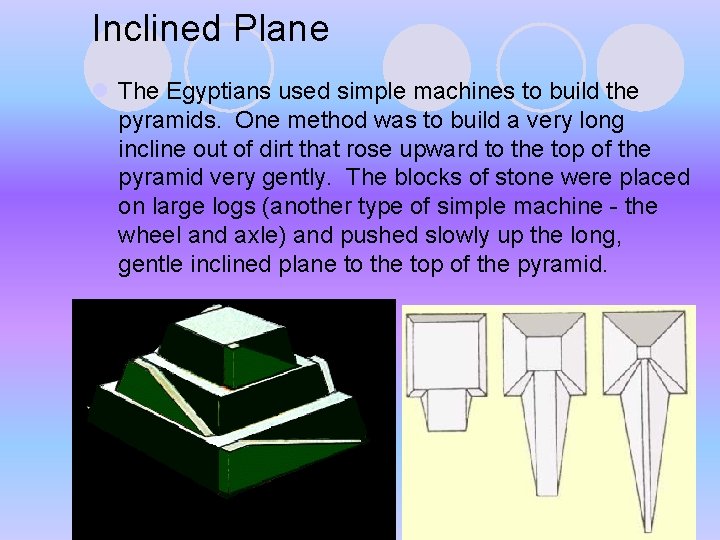
Inclined Plane l The Egyptians used simple machines to build the pyramids. One method was to build a very long incline out of dirt that rose upward to the top of the pyramid very gently. The blocks of stone were placed on large logs (another type of simple machine - the wheel and axle) and pushed slowly up the long, gentle inclined plane to the top of the pyramid.
Inclined Planes l An inclined plane is a flat surface that is higher on one end l Inclined planes make the work of moving things easier
Work input and output l Work input is the amount of work done on a machine. ¡Input force x input distance l Work output is the amount of work done by a machine. ¡Output force x output distance Wout = Win Fout x Dout = Fin x Din Dout 3 m 10 N x 3 m = 2 N x 15 m 10 N Din 15 m Fin
Inclined Plane Mechanical Advantage l The mechanical advantage of an inclined plane is equal to the length of the slope divided by the height of the inclined plane. l While the inclined plane produces a mechanical advantage, it does so by increasing the distance through which the force must move.
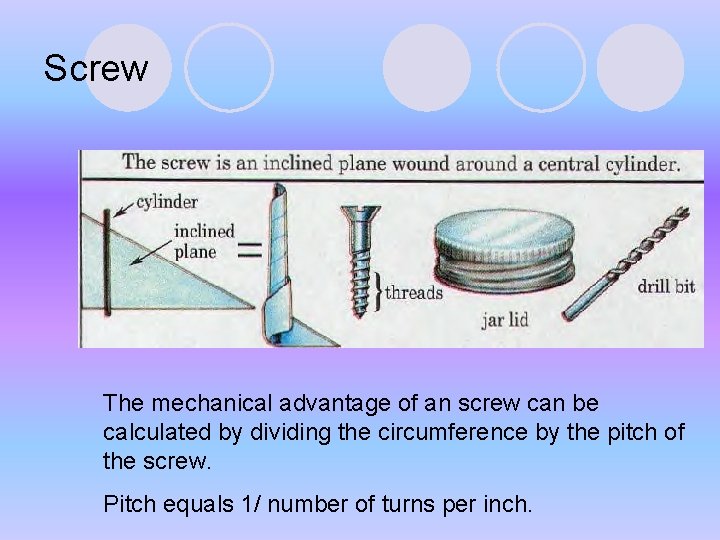
Screw The mechanical advantage of an screw can be calculated by dividing the circumference by the pitch of the screw. Pitch equals 1/ number of turns per inch.
Wedges l Two inclined planes joined back to back. l Wedges are used to split things.
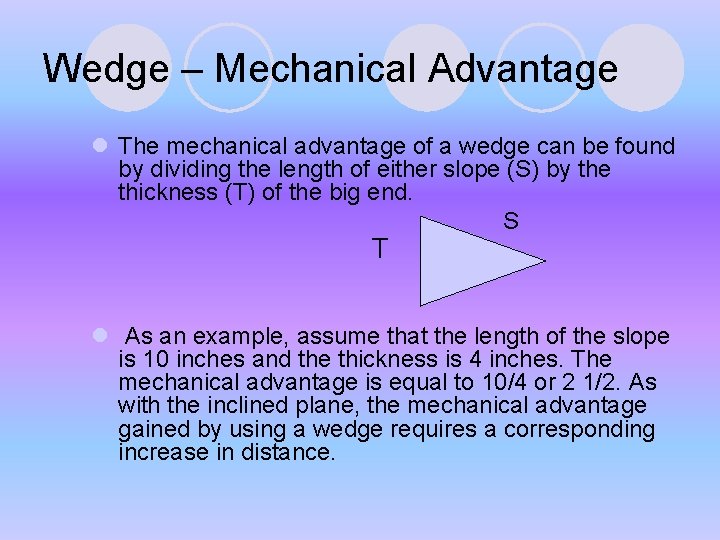
Wedge – Mechanical Advantage l The mechanical advantage of a wedge can be found by dividing the length of either slope (S) by the thickness (T) of the big end. S T l As an example, assume that the length of the slope is 10 inches and the thickness is 4 inches. The mechanical advantage is equal to 10/4 or 2 1/2. As with the inclined plane, the mechanical advantage gained by using a wedge requires a corresponding increase in distance.
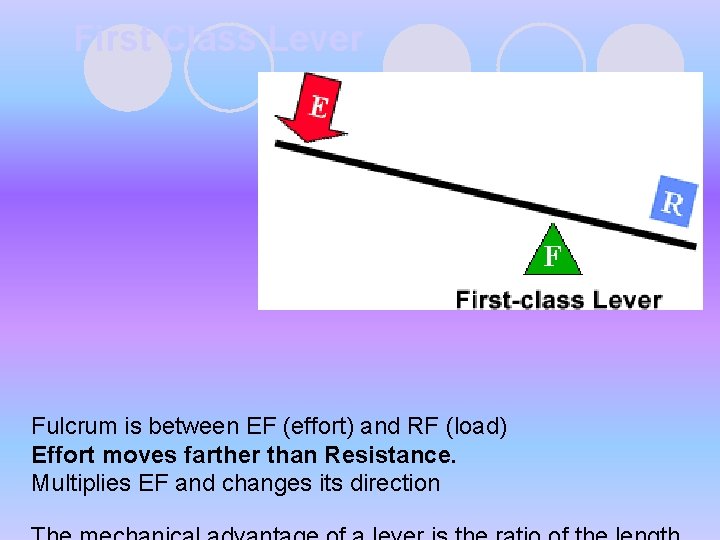
First Class Lever Fulcrum is between EF (effort) and RF (load) Effort moves farther than Resistance. Multiplies EF and changes its direction
First Class Lever. ¡ Common examples of first-class levers include crowbars, scissors, pliers, tin snips and seesaws.
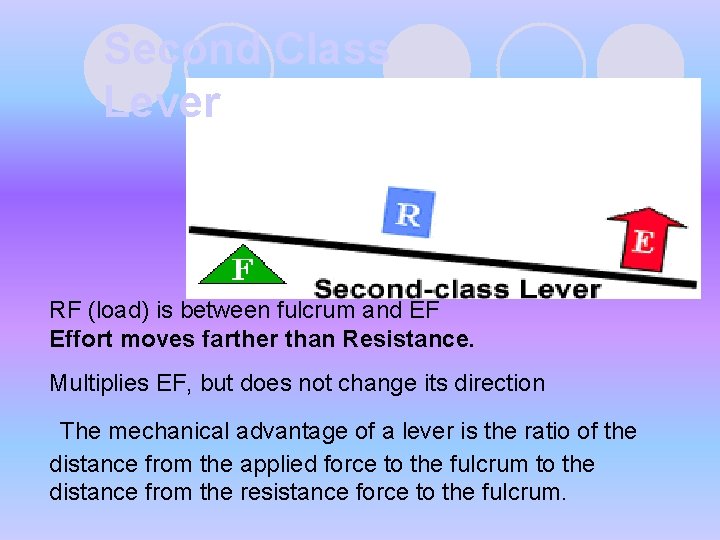
Second Class Lever RF (load) is between fulcrum and EF Effort moves farther than Resistance. Multiplies EF, but does not change its direction The mechanical advantage of a lever is the ratio of the distance from the applied force to the fulcrum to the distance from the resistance force to the fulcrum.
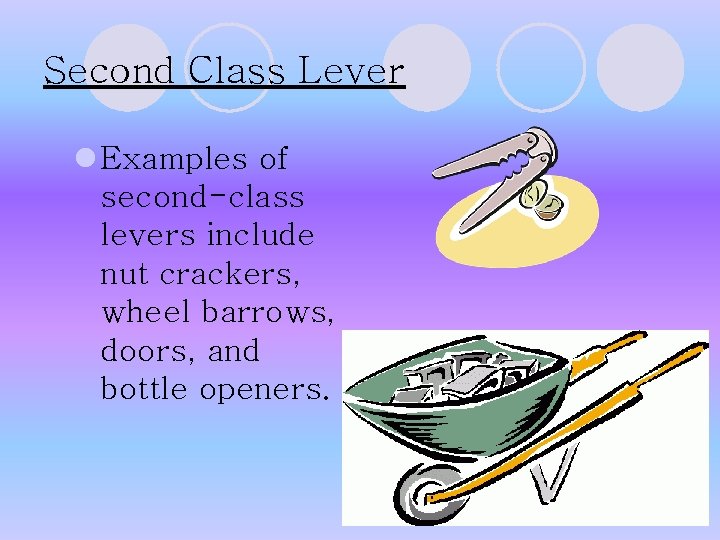
Second Class Lever l Examples of second-class levers include nut crackers, wheel barrows, doors, and bottle openers.
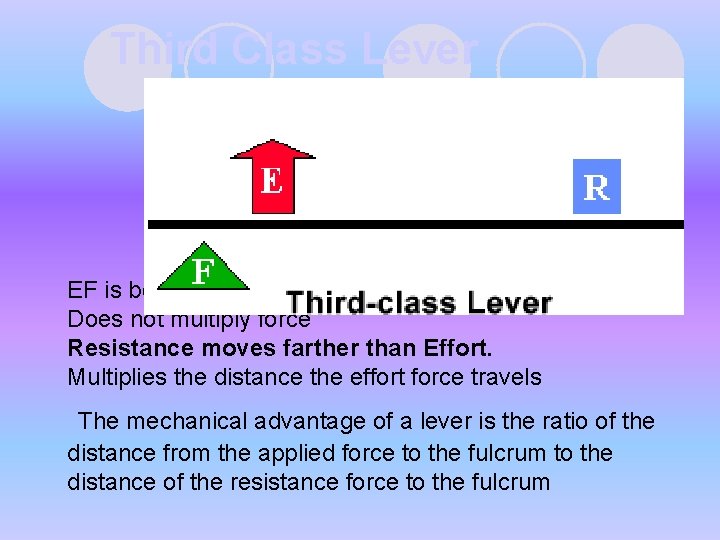
Third Class Lever EF is between fulcrum and RF (load) Does not multiply force Resistance moves farther than Effort. Multiplies the distance the effort force travels The mechanical advantage of a lever is the ratio of the distance from the applied force to the fulcrum to the distance of the resistance force to the fulcrum
Third Class Lever l Examples of third-class levers include tweezers, arm hammers, and shovels.
Pulleys l Pulley are wheels and axles with a groove around the outside l A pulley needs a rope, chain or belt around the groove to make it do work
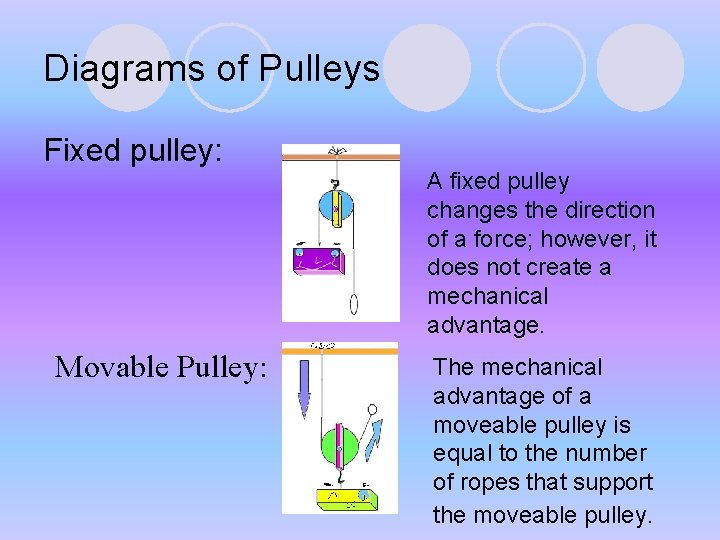
Diagrams of Pulleys Fixed pulley: Movable Pulley: A fixed pulley changes the direction of a force; however, it does not create a mechanical advantage. The mechanical advantage of a moveable pulley is equal to the number of ropes that support the moveable pulley.
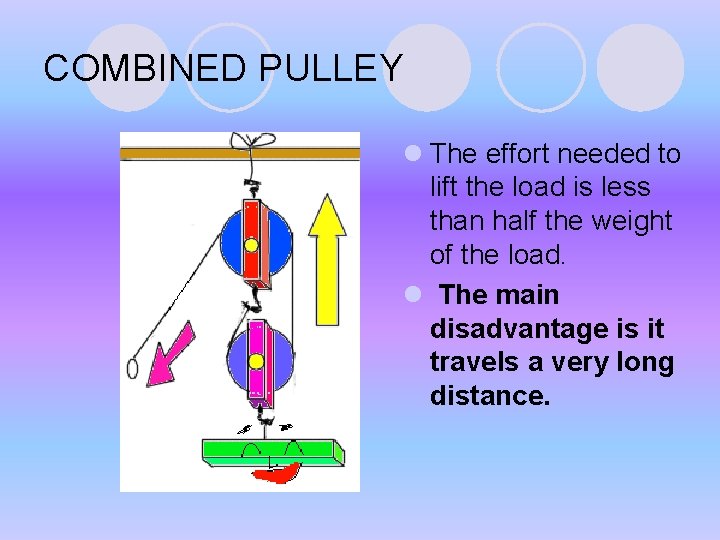
COMBINED PULLEY l The effort needed to lift the load is less than half the weight of the load. l The main disadvantage is it travels a very long distance.
WHEEL AND AXEL l The axle is stuck rigidly to a large wheel. Fan blades are attached to the wheel. When the axel turns, the fan blades spin.
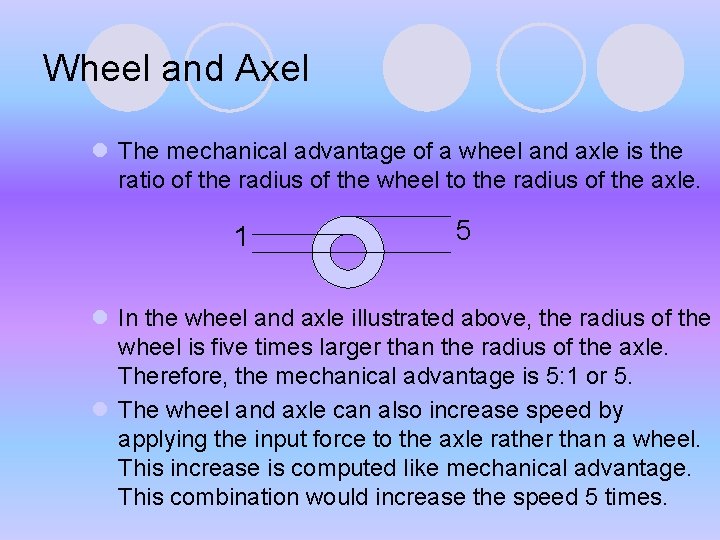
Wheel and Axel l The mechanical advantage of a wheel and axle is the ratio of the radius of the wheel to the radius of the axle. 1 5 l In the wheel and axle illustrated above, the radius of the wheel is five times larger than the radius of the axle. Therefore, the mechanical advantage is 5: 1 or 5. l The wheel and axle can also increase speed by applying the input force to the axle rather than a wheel. This increase is computed like mechanical advantage. This combination would increase the speed 5 times.
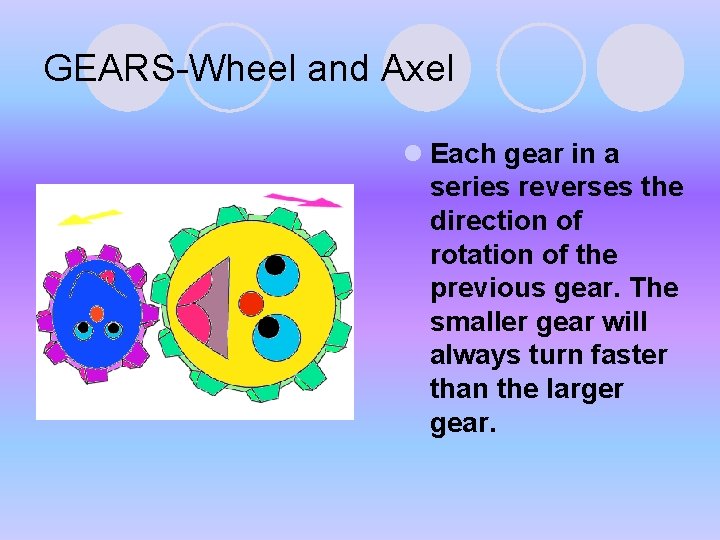
GEARS-Wheel and Axel l Each gear in a series reverses the direction of rotation of the previous gear. The smaller gear will always turn faster than the larger gear.
Rube Goldberg Machines l Rube Goldberg machines are examples of complex machines. l All complex machines are made up of combinations of simple machines. l Rube Goldberg machines are usually a complicated combination of simple machines. l By studying the components of Rube Goldberg machines, we learn more about simple machines
Safety Device for Walking on Icy Pavemen When you slip on ice, your foot kicks paddle (A), lowering finger (B), snapping turtle (C) extends neck to bite finger, opening ice tongs (D) and dropping pi thus allowing you to fall on something soft.
Squeeze Orange Juice Rube Goldberg Machine
More Review Questions with Explanations and Graphs http: //msswanns 5 thgrade. weebly. com/uploads/7/5/3/7/7537779/forces_and_motion_ eog_review. pdf http: //camillasenior. homestead. com/motion_graphs. pdf