
Foraging Decisions of Carolina Chickadees Poecile carolinensis Large
- Slides: 1
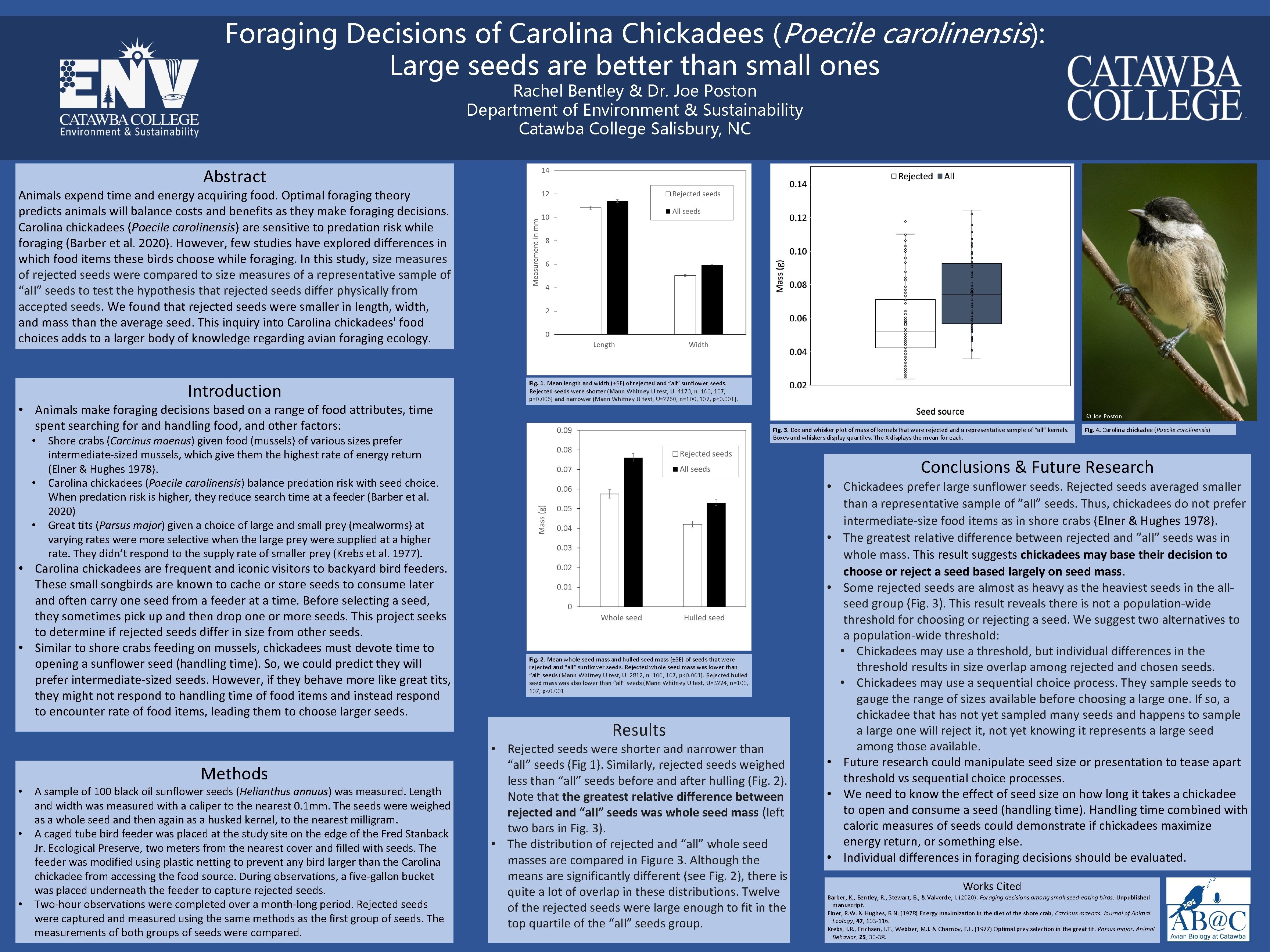
Foraging Decisions of Carolina Chickadees (Poecile carolinensis): Large seeds are better than small ones Rachel Bentley & Dr. Joe Poston Department of Environment & Sustainability Catawba College Salisbury, NC Abstract Animals expend time and energy acquiring food. Optimal foraging theory predicts animals will balance costs and benefits as they make foraging decisions. Carolina chickadees (Poecile carolinensis) are sensitive to predation risk while foraging (Barber et al. 2020). However, few studies have explored differences in which food items these birds choose while foraging. In this study, size measures of rejected seeds were compared to size measures of a representative sample of “all” seeds to test the hypothesis that rejected seeds differ physically from accepted seeds. We found that rejected seeds were smaller in length, width, and mass than the average seed. This inquiry into Carolina chickadees' food choices adds to a larger body of knowledge regarding avian foraging ecology. Introduction • Animals make foraging decisions based on a range of food attributes, time spent searching for and handling food, and other factors: • • • Methods • • © Joe Poston Fig. 3. Box and whisker plot of mass of kernels that were rejected and a representative sample of “all” kernels. Boxes and whiskers display quartiles. The X displays the mean for each. Shore crabs (Carcinus maenus) given food (mussels) of various sizes prefer intermediate-sized mussels, which give them the highest rate of energy return (Elner & Hughes 1978). Carolina chickadees (Poecile carolinensis) balance predation risk with seed choice. When predation risk is higher, they reduce search time at a feeder (Barber et al. 2020) Great tits (Parsus major) given a choice of large and small prey (mealworms) at varying rates were more selective when the large prey were supplied at a higher rate. They didn’t respond to the supply rate of smaller prey (Krebs et al. 1977). • Carolina chickadees are frequent and iconic visitors to backyard bird feeders. These small songbirds are known to cache or store seeds to consume later and often carry one seed from a feeder at a time. Before selecting a seed, they sometimes pick up and then drop one or more seeds. This project seeks to determine if rejected seeds differ in size from other seeds. • Similar to shore crabs feeding on mussels, chickadees must devote time to opening a sunflower seed (handling time). So, we could predict they will prefer intermediate-sized seeds. However, if they behave more like great tits, they might not respond to handling time of food items and instead respond to encounter rate of food items, leading them to choose larger seeds. • Fig. 1. Mean length and width (±SE) of rejected and “all” sunflower seeds. Rejected seeds were shorter (Mann Whitney U test, U=4170, n=100, 107, p=0. 006) and narrower (Mann Whitney U test, U=2260, n=100, 107, p<0. 001). A sample of 100 black oil sunflower seeds (Helianthus annuus) was measured. Length and width was measured with a caliper to the nearest 0. 1 mm. The seeds were weighed as a whole seed and then again as a husked kernel, to the nearest milligram. A caged tube bird feeder was placed at the study site on the edge of the Fred Stanback Jr. Ecological Preserve, two meters from the nearest cover and filled with seeds. The feeder was modified using plastic netting to prevent any bird larger than the Carolina chickadee from accessing the food source. During observations, a five-gallon bucket was placed underneath the feeder to capture rejected seeds. Two-hour observations were completed over a month-long period. Rejected seeds were captured and measured using the same methods as the first group of seeds. The measurements of both groups of seeds were compared. Fig. 4. Carolina chickadee (Poecile carolinensis) Conclusions & Future Research Fig. 2. Mean whole seed mass and hulled seed mass (±SE) of seeds that were rejected and “all” sunflower seeds. Rejected whole seed mass was lower than “all” seeds (Mann Whitney U test, U=2812, n=100, 107, p<0. 001). Rejected hulled seed mass was also lower than ”all” seeds (Mann Whitney U test, U=3224, n=100, 107, p<0. 001 Results • Rejected seeds were shorter and narrower than “all” seeds (Fig 1). Similarly, rejected seeds weighed less than “all” seeds before and after hulling (Fig. 2). Note that the greatest relative difference between rejected and “all” seeds was whole seed mass (left two bars in Fig. 3). • The distribution of rejected and “all” whole seed masses are compared in Figure 3. Although the means are significantly different (see Fig. 2), there is quite a lot of overlap in these distributions. Twelve of the rejected seeds were large enough to fit in the top quartile of the “all” seeds group. • Chickadees prefer large sunflower seeds. Rejected seeds averaged smaller than a representative sample of ”all” seeds. Thus, chickadees do not prefer intermediate-size food items as in shore crabs (Elner & Hughes 1978). • The greatest relative difference between rejected and ”all” seeds was in whole mass. This result suggests chickadees may base their decision to choose or reject a seed based largely on seed mass. • Some rejected seeds are almost as heavy as the heaviest seeds in the allseed group (Fig. 3). This result reveals there is not a population-wide threshold for choosing or rejecting a seed. We suggest two alternatives to a population-wide threshold: • Chickadees may use a threshold, but individual differences in the threshold results in size overlap among rejected and chosen seeds. • Chickadees may use a sequential choice process. They sample seeds to gauge the range of sizes available before choosing a large one. If so, a chickadee that has not yet sampled many seeds and happens to sample a large one will reject it, not yet knowing it represents a large seed among those available. • Future research could manipulate seed size or presentation to tease apart threshold vs sequential choice processes. • We need to know the effect of seed size on how long it takes a chickadee to open and consume a seed (handling time). Handling time combined with caloric measures of seeds could demonstrate if chickadees maximize energy return, or something else. • Individual differences in foraging decisions should be evaluated. Works Cited Barber, K. , Bentley, R. , Stewart, B. , & Valverde, I. (2020). Foraging decisions among small seed-eating birds. Unpublished manuscript. Elner, R. W. & Hughes, R. N. (1978) Energy maximization in the diet of the shore crab, Carcinus maenas. Journal of Animal Ecology, 47, 103 -116. Krebs, J. R. , Erichsen, J. T. , Webber, M. I. & Charnov, E. L. (1977) Optimal prey selection in the great tit. Parsus major. Animal Behavior, 25, 30 -38.