
for OfficeBased Care Online Innovative Training Techniques to

for Office-Based Care Online Innovative Training Techniques to Introduce and Reinforce Team. STEPPS Skills in the Office-Based Care Setting
Team. STEPPS for Office-Based Care This Webinar and Future Webinars n This webinar is part of a library to support and amplify your work on Team. STEPPS for Office-Based Care Online funded by AHRQ Mod 1205. 2 Page 2 Slide TEAMSTEPPS 05. 2
Team. STEPPS for Office-Based Care Rules of Engagement n Dial-in: 1 -877 -410 -5657 Passcode: 165984 n Questions are encouraged throughout the presentation and will be answered at the end. n To submit a question, type it into the Chat Area and send it at any time during the presentation. n An evaluation will be emailed to you shortly after the webinar. Mod 1305. 2 Page 3 Slide TEAMSTEPPS 05. 2
Team. STEPPS for Office-Based Care Presenter Ross Ehrmantraut, RN Clinical Director of Team Performance University of Washington Medicine WWAMI Institute for Simulation in Healthcare rherma@uw. edu Mod 1405. 2 Page 4 Slide TEAMSTEPPS 05. 2
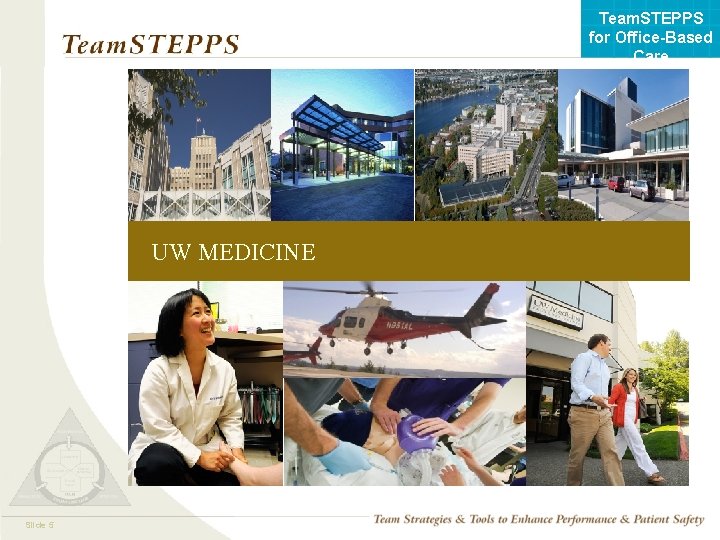
Team. STEPPS for Office-Based Care UW MEDICINE Mod 1505. 2 Page 5 Slide TEAMSTEPPS 05. 2
Team. STEPPS for Office-Based Care Objectives n Demonstrate how UW has enhanced training and reinforced the use of Team. STEPPS tools in different settings and multiple audiences through short, high impact sessions. n Identify low tech simulations/exercises that can be easily customized for training in the outpatient setting. n Discuss quick win tools such as Closed-Loop Communication, SBAR, CUS, Briefs, Huddles, and Debriefs. Mod 1605. 2 Page 6 Slide TEAMSTEPPS 05. 2
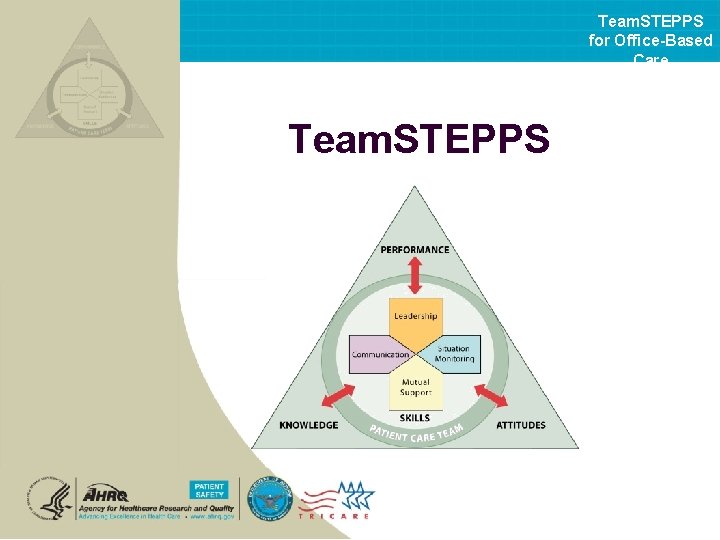
Team. STEPPS for Office-Based Care Team. STEPPS
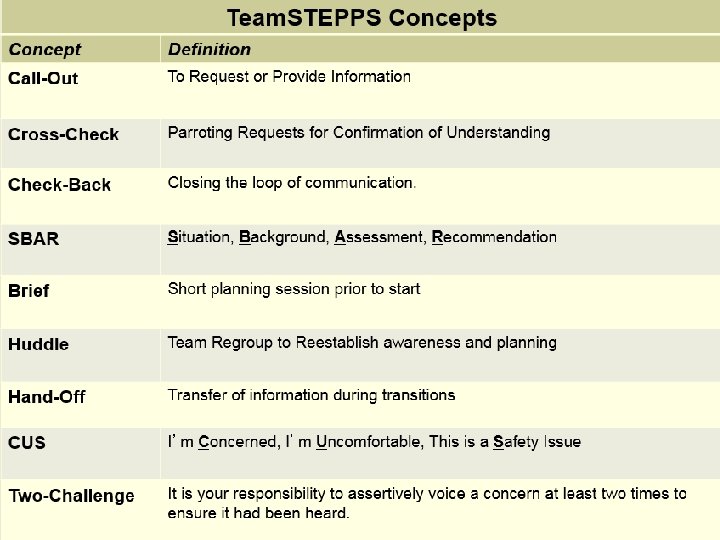
Team. STEPPS for Office-Based Care Mod 1805. 2 Page 8 Slide TEAMSTEPPS 05. 2
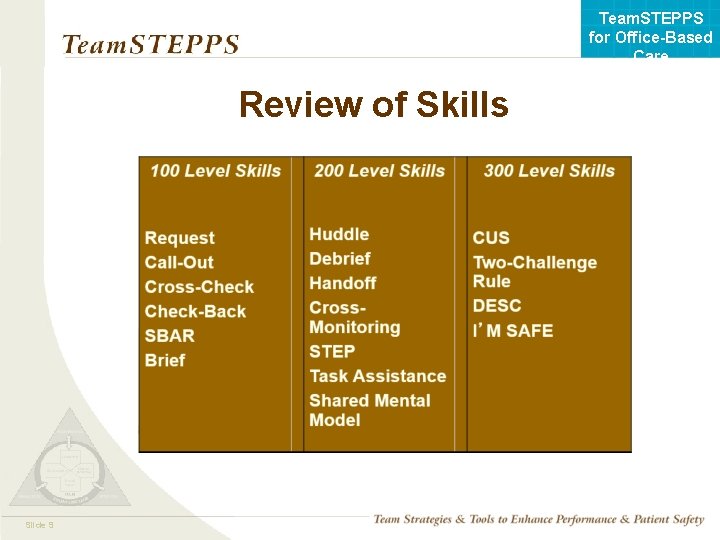
Team. STEPPS for Office-Based Care Review of Skills Mod 1905. 2 Page 9 Slide TEAMSTEPPS 05. 2
Team. STEPPS for Office-Based Care Issues n Difficult to get anything but short training sessions without closing the clinic or conducting retreats on a weekend n Larger clinics have staggered start/end times n Others? Mod 110 Slide 05. 2 Page 10 TEAMSTEPPS 05. 2
What We’ve Learned Team. STEPPS for Office-Based Care n Need leadership support – provider and administration n Work around the clinic schedule – generally 45 -90 minutes n Staff meetings n Take advantage of any time they make available n Early mornings before clinic, or evenings after clinic n May need to repeat the same training multiple times to deliver message to everyone n Best Scenario n Mod 111 Slide 05. 2 Page 11 Two to four hour retreats outside of clinic times TEAMSTEPPS 05. 2
Team. STEPPS for Office-Based Care What We’ve Learned n Everyone needs to find the value in the tool/concepts being introduced n WIFM Radio n Don’t do ice breakers – do simulations/activities that reinforce the tools/concepts of Team. STEPPS n Debrief with a focus on the teamwork and communication n Develop a change team n Mod 112 Slide 05. 2 Page 12 Ownership vs. buy-in TEAMSTEPPS 05. 2
Typical Short Training Session Team. STEPPS for Office-Based Care n Why are we here? n n IOM report, Journal of Patient Safety, Ambulatory care data: n More than 1 billion ambulatory visits n 12 million ambulatory care patients experience a diagnostic error n Paid medical liability claims (Bishop et al, 2013) n Half arose from events in the outpatient setting n 76% due to errors in diagnosis or treatment If a follow up training, review previous sessions n A story related to what tool we’re reinforcing/teaching n Afrin Story for Closed Loop Communication n TRIZ – first session only Mod 113 Slide 05. 2 Page 13 TEAMSTEPPS 05. 2
Team. STEPPS for Office-Based Care Typical Short Training Session (cont. ) n Introduction to the tools n Interactive exercise(s) n Debrief Mod 114 Slide 05. 2 Page 14 TEAMSTEPPS 05. 2
Team. STEPPS for Office-Based Care TRIZ Theory of Inventive Problem Solving How can I ensure our clinic will reliably fail as a functioning team? 1 -2 -4 -All Liberating Structures http: //www. liberatingstructures. com Mod 115 Slide 05. 2 Page 15 TEAMSTEPPS 05. 2 15
Team. STEPPS for Office-Based Care TRIZ Theory of Inventive Problem Solving How can I ensure our clinic will reliably fail as a functioning team? Am I doing any of these things? Liberating Structures http: //www. liberatingstructures. com Mod 116 Slide 05. 2 Page 16 TEAMSTEPPS 05. 2 16
Team. STEPPS for Office-Based Care Key Tools and Concepts to Gain Short Term Wins n Communication n Closed-Loop Communication n SBAR n Leading Teams n Briefs, Huddles, Debriefs n Situation Monitoring n Shared Mental Model – one piece of information can change an outcome n Mutual Support n Mod 117 Slide 05. 2 Page 17 CUS, Two-Challenge Rule TEAMSTEPPS 05. 2
Team. STEPPS for Office-Based Care Debrief n Debriefing is where the majority of the learning occurs n What went well? n What could have gone better? n One thing you will do differently next time? n ALWAYS bring the debrief back to how we worked and communicated as a team Mod 118 Slide 05. 2 Page 18 TEAMSTEPPS 05. 2
Team. STEPPS for Office-Based Care Team Training Tower n Three exercises, with each exercise becoming more difficult n Reinforces all the Team. STEPPS tools/concepts n Faculty guide available n Need at least 90 minutes to do all three exercise n Mod 119 Slide 05. 2 Page 19 Have split into two shorter sessions TEAMSTEPPS 05. 2
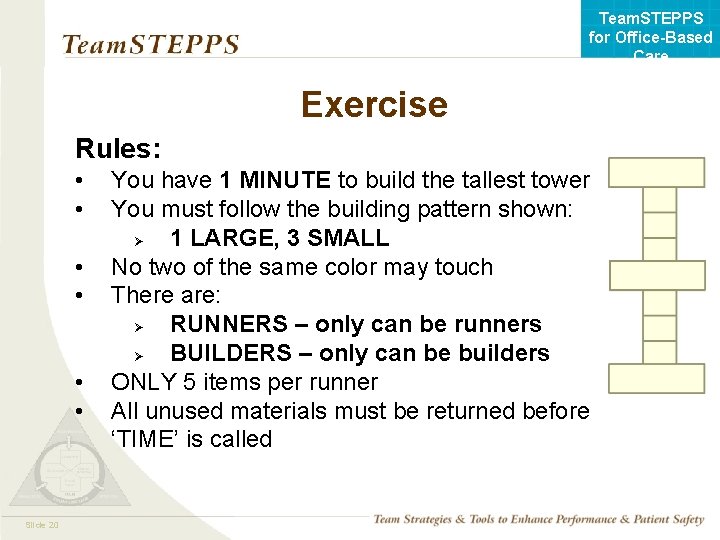
Team. STEPPS for Office-Based Care Exercise Rules: • • • You have 1 MINUTE to build the tallest tower You must follow the building pattern shown: Ø 1 LARGE, 3 SMALL No two of the same color may touch There are: Ø RUNNERS – only can be runners Ø BUILDERS – only can be builders ONLY 5 items per runner All unused materials must be returned before ‘TIME’ is called Mod 120 Slide 05. 2 Page 20 TEAMSTEPPS 05. 2
Team. STEPPS for Office-Based Care Exercise Rules: • You have 30 SECONDS to BRIEF as a team • You have 2 MINUTES to build the tallest tower • You must follow the building pattern outlined in the algorithm. • There are: RUNNERS – only can be runners BUILDERS– only can be builders • ONLY 5 items per runner • All unused materials must be returned before ‘TIME’ is called Mod 121 Slide 05. 2 Page 21 TEAMSTEPPS 05. 2
Team. STEPPS for Office-Based Care Mr. Potato Head n This exercise reinforces the following tools: n Closed loop communication n Brief, huddles, debrief n May have to use: n Mod 122 Slide 05. 2 Page 22 CUS, Two-Challenge TEAMSTEPPS 05. 2
Team. STEPPS for Office-Based Care Mr. Potato Head • • • Your team has been tasked with reassembling the MVA victims Roles include: • Triage (will have photo IDs and group photos of patients before the crash) • Whatever other roles the team assigns (e. g. , surgeon, nurse, coordinator, etc. ) Rules: • Only Triage can see the pictures of the patients and must relay this information to the rest of the team • Triage cannot see what the team is doing (back is turned toward the group) • Triage may not change roles once times starts because they will have seen the pictures You will have 30 seconds to brief and select roles You will have 10 minutes to put your patients back together DO NOT START until we say GO! DEBRIEF Mod 123 Slide 05. 2 Page 23 TEAMSTEPPS 05. 2
Team. STEPPS for Office-Based Care SBAR Simulations n Short bursts of SBAR education n Reinforces the use of SBAR n Effective for: Mod 124 Slide 05. 2 Page 24 n Telephone Encounters n Front desk personnel communication to clinical staff/providers n General communication throughout clinic TEAMSTEPPS 05. 2
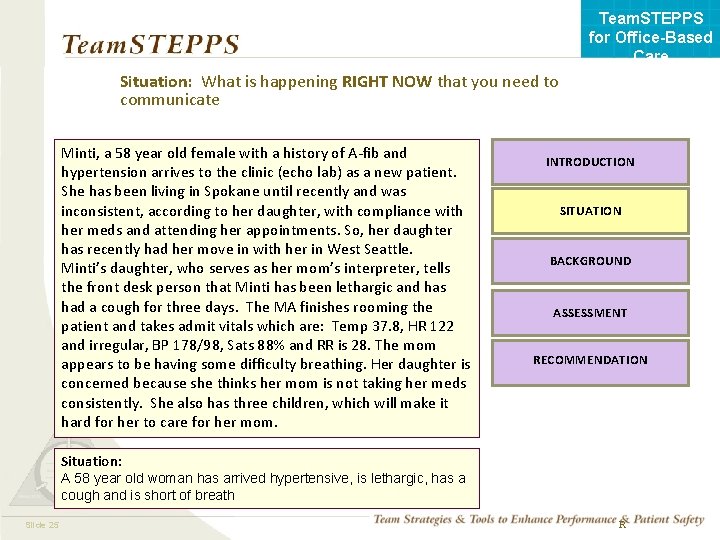
Team. STEPPS for Office-Based Care Situation: What is happening RIGHT NOW that you need to communicate Minti, a 58 year old female with a history of A-fib and hypertension arrives to the clinic (echo lab) as a new patient. She has been living in Spokane until recently and was inconsistent, according to her daughter, with compliance with her meds and attending her appointments. So, her daughter has recently had her move in with her in West Seattle. Minti’s daughter, who serves as her mom’s interpreter, tells the front desk person that Minti has been lethargic and has had a cough for three days. The MA finishes rooming the patient and takes admit vitals which are: Temp 37. 8, HR 122 and irregular, BP 178/98, Sats 88% and RR is 28. The mom appears to be having some difficulty breathing. Her daughter is concerned because she thinks her mom is not taking her meds consistently. She also has three children, which will make it hard for her to care for her mom. INTRODUCTION SITUATION BACKGROUND ASSESSMENT RECOMMENDATION Situation: A 58 year old woman has arrived hypertensive, is lethargic, has a cough and is short of breath Mod 125 Slide 05. 2 Page 25 TEAMSTEPPS 05. 2 R
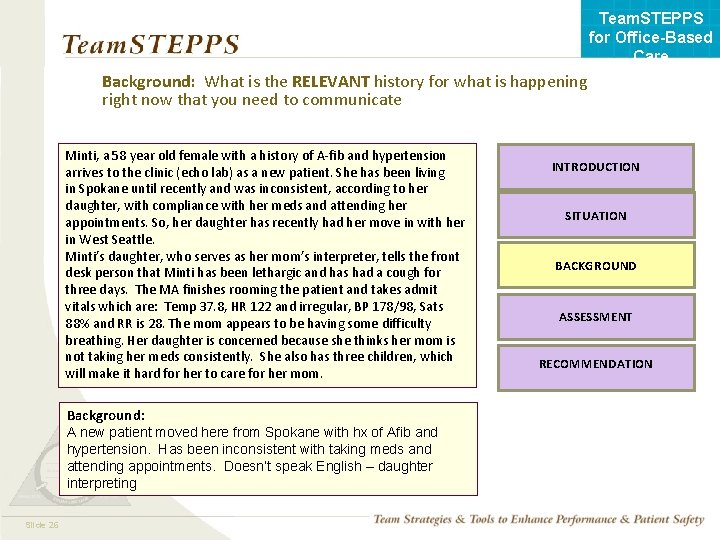
Team. STEPPS for Office-Based Care Background: What is the RELEVANT history for what is happening right now that you need to communicate Minti, a 58 year old female with a history of A-fib and hypertension arrives to the clinic (echo lab) as a new patient. She has been living in Spokane until recently and was inconsistent, according to her daughter, with compliance with her meds and attending her appointments. So, her daughter has recently had her move in with her in West Seattle. Minti’s daughter, who serves as her mom’s interpreter, tells the front desk person that Minti has been lethargic and has had a cough for three days. The MA finishes rooming the patient and takes admit vitals which are: Temp 37. 8, HR 122 and irregular, BP 178/98, Sats 88% and RR is 28. The mom appears to be having some difficulty breathing. Her daughter is concerned because she thinks her mom is not taking her meds consistently. She also has three children, which will make it hard for her to care for her mom. Background: A new patient moved here from Spokane with hx of Afib and hypertension. Has been inconsistent with taking meds and attending appointments. Doesn’t speak English – daughter interpreting Mod 126 Slide 05. 2 Page 26 TEAMSTEPPS 05. 2 INTRODUCTION SITUATION BACKGROUND ASSESSMENT RECOMMENDATION
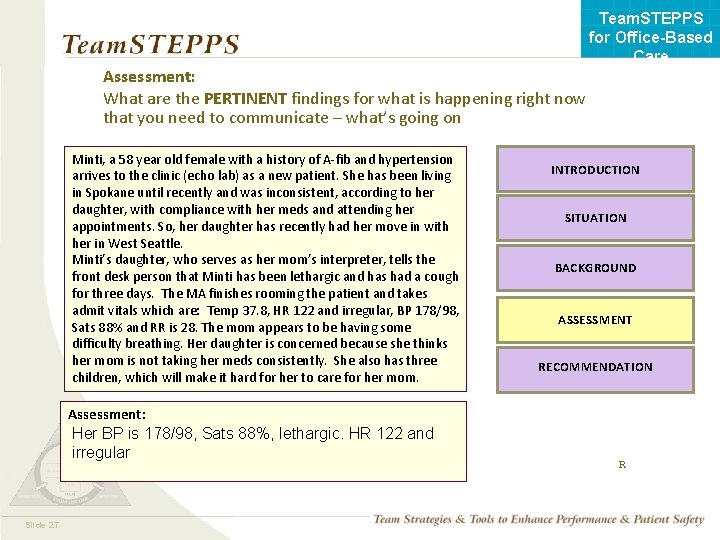
Team. STEPPS for Office-Based Care Assessment: What are the PERTINENT findings for what is happening right now that you need to communicate – what’s going on Minti, a 58 year old female with a history of A-fib and hypertension arrives to the clinic (echo lab) as a new patient. She has been living in Spokane until recently and was inconsistent, according to her daughter, with compliance with her meds and attending her appointments. So, her daughter has recently had her move in with her in West Seattle. Minti’s daughter, who serves as her mom’s interpreter, tells the front desk person that Minti has been lethargic and has had a cough for three days. The MA finishes rooming the patient and takes admit vitals which are: Temp 37. 8, HR 122 and irregular, BP 178/98, Sats 88% and RR is 28. The mom appears to be having some difficulty breathing. Her daughter is concerned because she thinks her mom is not taking her meds consistently. She also has three children, which will make it hard for her to care for her mom. INTRODUCTION SITUATION BACKGROUND ASSESSMENT RECOMMENDATION Assessment: Her BP is 178/98, Sats 88%, lethargic. HR 122 and irregular Mod 127 Slide 05. 2 Page 27 TEAMSTEPPS 05. 2 R
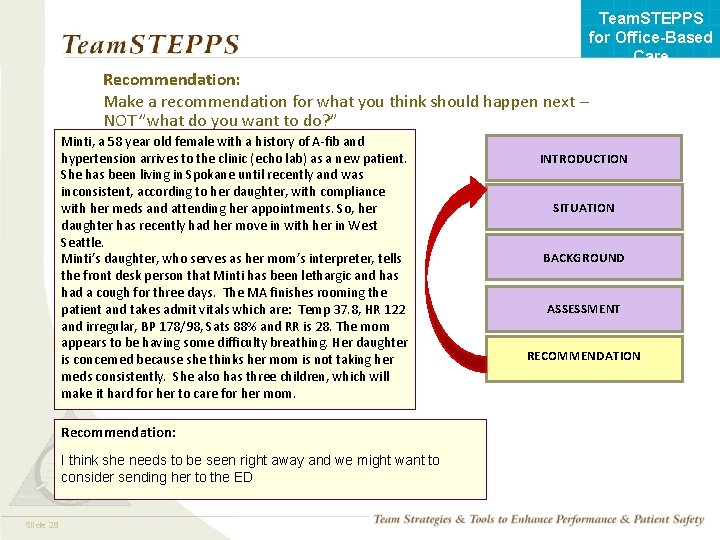
Team. STEPPS for Office-Based Care Recommendation: Make a recommendation for what you think should happen next – NOT ”what do you want to do? ” Minti, a 58 year old female with a history of A-fib and hypertension arrives to the clinic (echo lab) as a new patient. She has been living in Spokane until recently and was inconsistent, according to her daughter, with compliance with her meds and attending her appointments. So, her daughter has recently had her move in with her in West Seattle. Minti’s daughter, who serves as her mom’s interpreter, tells the front desk person that Minti has been lethargic and has had a cough for three days. The MA finishes rooming the patient and takes admit vitals which are: Temp 37. 8, HR 122 and irregular, BP 178/98, Sats 88% and RR is 28. The mom appears to be having some difficulty breathing. Her daughter is concerned because she thinks her mom is not taking her meds consistently. She also has three children, which will make it hard for her to care for her mom. Recommendation: I think she needs to be seen right away and we might want to consider sending her to the ED Mod 128 Slide 05. 2 Page 28 TEAMSTEPPS 05. 2 INTRODUCTION SITUATION BACKGROUND ASSESSMENT RECOMMENDATION
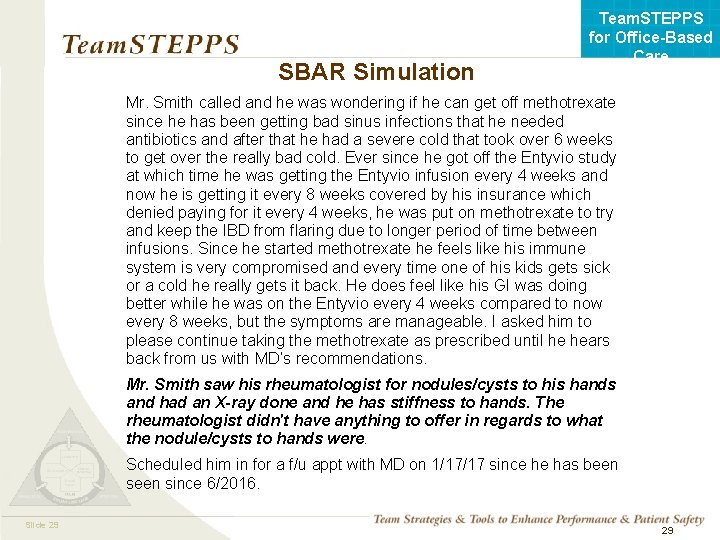
SBAR Simulation Team. STEPPS for Office-Based Care Mr. Smith called and he was wondering if he can get off methotrexate since he has been getting bad sinus infections that he needed antibiotics and after that he had a severe cold that took over 6 weeks to get over the really bad cold. Ever since he got off the Entyvio study at which time he was getting the Entyvio infusion every 4 weeks and now he is getting it every 8 weeks covered by his insurance which denied paying for it every 4 weeks, he was put on methotrexate to try and keep the IBD from flaring due to longer period of time between infusions. Since he started methotrexate he feels like his immune system is very compromised and every time one of his kids gets sick or a cold he really gets it back. He does feel like his GI was doing better while he was on the Entyvio every 4 weeks compared to now every 8 weeks, but the symptoms are manageable. I asked him to please continue taking the methotrexate as prescribed until he hears back from us with MD’s recommendations. Mr. Smith saw his rheumatologist for nodules/cysts to his hands and had an X-ray done and he has stiffness to hands. The rheumatologist didn't have anything to offer in regards to what the nodule/cysts to hands were. Scheduled him in for a f/u appt with MD on 1/17/17 since he has been since 6/2016. Mod 129 Slide 05. 2 Page 29 TEAMSTEPPS 05. 2 29
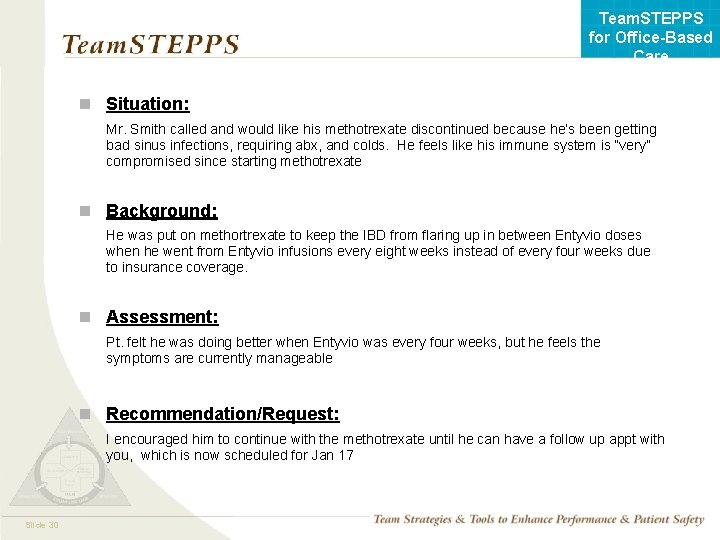
Team. STEPPS for Office-Based Care n Situation: Mr. Smith called and would like his methotrexate discontinued because he’s been getting bad sinus infections, requiring abx, and colds. He feels like his immune system is “very” compromised since starting methotrexate n Background: He was put on methortrexate to keep the IBD from flaring up in between Entyvio doses when he went from Entyvio infusions every eight weeks instead of every four weeks due to insurance coverage. n Assessment: Pt. felt he was doing better when Entyvio was every four weeks, but he feels the symptoms are currently manageable n Recommendation/Request: I encouraged him to continue with the methotrexate until he can have a follow up appt with you, which is now scheduled for Jan 17 Mod 130 Slide 05. 2 Page 30 TEAMSTEPPS 05. 2
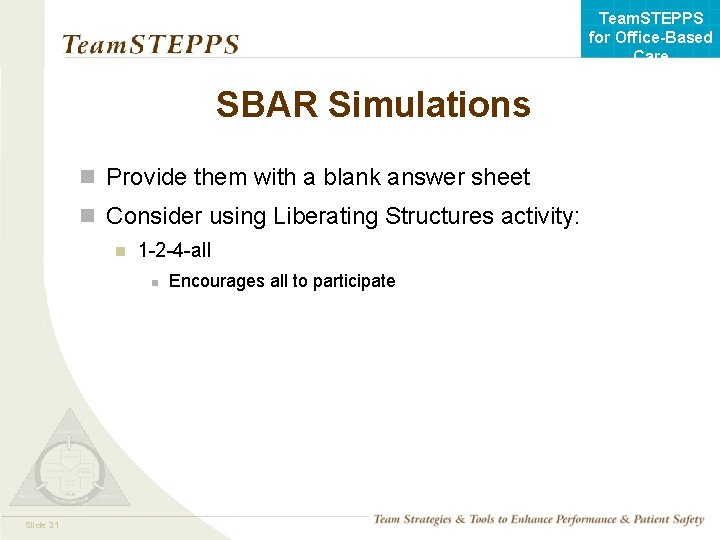
Team. STEPPS for Office-Based Care SBAR Simulations n Provide them with a blank answer sheet n Consider using Liberating Structures activity: n 1 -2 -4 -all n Mod 131 Slide 05. 2 Page 31 Encourages all to participate TEAMSTEPPS 05. 2
Team. STEPPS for Office-Based Care Shared Mental Model Mod 132 Slide 05. 2 Page 32 TEAMSTEPPS 05. 2
Team. STEPPS for Office-Based Care Mod 133 Slide 05. 2 Page 33 TEAMSTEPPS 05. 2
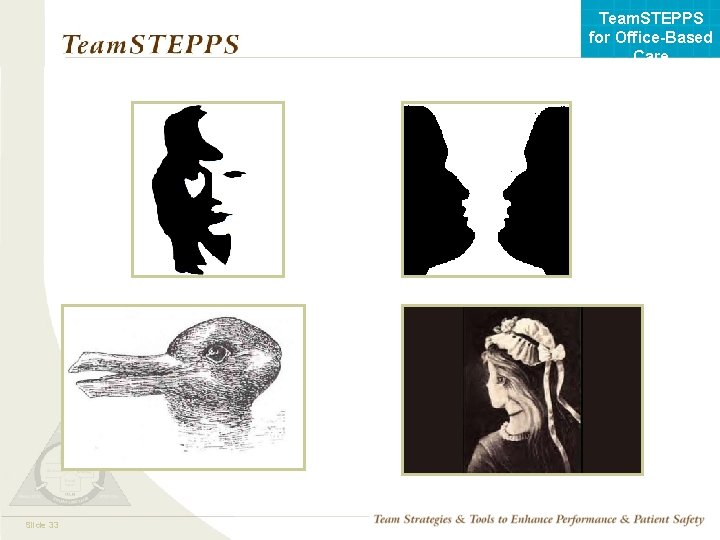
Team. STEPPS for Office-Based Care The Emergency n Shared mental model n Assumptions that break down a shared mental model Mod 134 Slide 05. 2 Page 34 TEAMSTEPPS 05. 2
Team. STEPPS for Office-Based Care The Emergency – A Story The crying child in room 602 stopped suddenly and was silent. Immediately a man cried “help”. A nurse raced in to check the patient. A doctor was called. Two medications were delivered by a pharmacist and administered. The doctor was called again. A woman with a white coat and a stethoscope around her neck entered the room and introduced herself. The doctor checked the patient and insisted he be transferred to the intensive care unit. The pharmacist asked why the transfer was necessary. Two nurses accompanied the child in a wheelchair. Mod 135 Slide 05. 2 Page 35 TEAMSTEPPS 05. 2
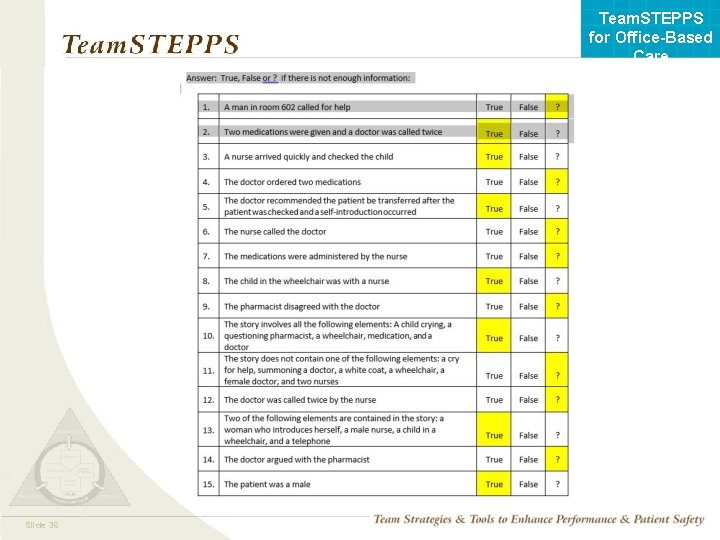
Team. STEPPS for Office-Based Care Mod 136 Slide 05. 2 Page 36 TEAMSTEPPS 05. 2
Team. STEPPS for Office-Based Care Staged Simulations n Disruptive Patient/Visitor n Seizure in the waiting room n Facilitates the following Team. STEPPS concepts n Leadership – identifying a situational leader n Situational Awareness n Specific Tools Mod 137 Slide 05. 2 Page 37 n Briefs, Huddles, Debriefs n CUS, Two-Challenge Rule TEAMSTEPPS 05. 2
Team. STEPPS for Office-Based Care Measurement n Start easy… n Did the brief occur? n n Did the brief provide any information that otherwise not everyone would have known? Did the debrief occur? n Were there any changes from debrief? n Behavioral measures n Mod 138 Slide 05. 2 Page 38 AHRQ Team. STEPPS T-TPQ survey pre/post TEAMSTEPPS 05. 2
Team. STEPPS for Office-Based Care Results n Improved efficiency n Physical environment n Clinic flow n Improved employee satisfaction n Improved patient satisfaction n Improved T-TPQ post survey Mod 139 Slide 05. 2 Page 39 TEAMSTEPPS 05. 2
Team. STEPPS for Office-Based Care Liberating Structures n Activities to enhance the training (and meetings) experience n Liberating Structures n Mod 140 Slide 05. 2 Page 40 http: //www. liberatingstructures. com TEAMSTEPPS 05. 2
Team. STEPPS for Office-Based Care Presenter Information Ross Ehrmantraut, RN Clinical Director of Team Performance University of Washington Medicine WWAMI Institute for Simulation in Healthcare rherma@uw. edu Mod 141 Slide 05. 2 Page 41 TEAMSTEPPS 05. 2
Team. STEPPS for Office-Based Care Resources n Team. STEPPS n https: //www. ahrq. gov/teamstepps/index. html n Liberating Structures http: //www. liberatingstructures. com n Bishop TF. Paid malpractice claims for adverse events in inpatient and outpatient settings. JAMA. 2011; 305 ( 23 ): 2427 – 2431. n Institute of Medicine. To Err Is Human: Building a Safer Health Care System. Washington DC: National Academy Press; 1999. n Singh H, Meyer, A, Thomas, EJ, The frequency of diagnostic errors in outpatient care: estimations from three large observational studies involving US adult populations. BMJ. 2014 Volume 23, issue 9 Mod 142 Slide 05. 2 Page 42 TEAMSTEPPS 05. 2
Team. STEPPS for Office-Based Care QUESTIONS Mod 143 Slide 05. 2 Page 43 TEAMSTEPPS 05. 2
- Slides: 43