
For having upon specious pretenses of public works
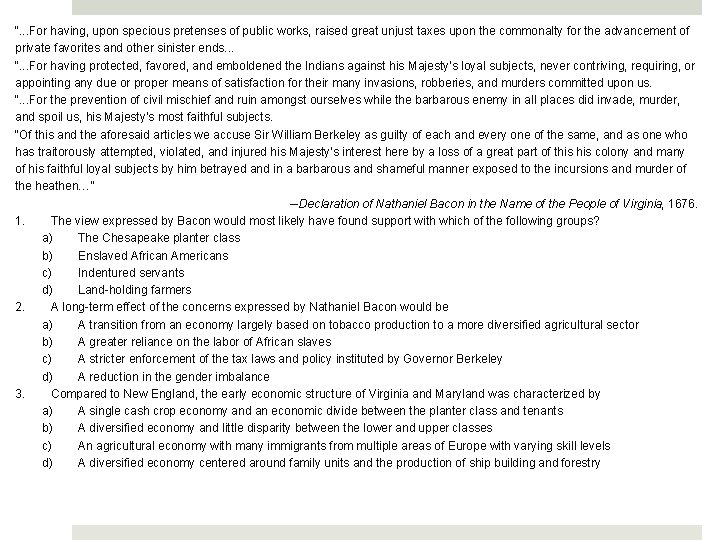
“. . . For having, upon specious pretenses of public works, raised great unjust taxes upon the commonalty for the advancement of private favorites and other sinister ends. . . “. . . For having protected, favored, and emboldened the Indians against his Majesty’s loyal subjects, never contriving, requiring, or appointing any due or proper means of satisfaction for their many invasions, robberies, and murders committed upon us. “. . . For the prevention of civil mischief and ruin amongst ourselves while the barbarous enemy in all places did invade, murder, and spoil us, his Majesty’s most faithful subjects. “Of this and the aforesaid articles we accuse Sir William Berkeley as guilty of each and every one of the same, and as one who has traitorously attempted, violated, and injured his Majesty’s interest here by a loss of a great part of this colony and many of his faithful loyal subjects by him betrayed and in a barbarous and shameful manner exposed to the incursions and murder of the heathen…” --Declaration of Nathaniel Bacon in the Name of the People of Virginia, 1676. 1. The view expressed by Bacon would most likely have found support with which of the following groups? a) The Chesapeake planter class b) Enslaved African Americans c) Indentured servants d) Land-holding farmers 2. A long-term effect of the concerns expressed by Nathaniel Bacon would be a) A transition from an economy largely based on tobacco production to a more diversified agricultural sector b) A greater reliance on the labor of African slaves c) A stricter enforcement of the tax laws and policy instituted by Governor Berkeley d) A reduction in the gender imbalance 3. Compared to New England, the early economic structure of Virginia and Maryland was characterized by a) A single cash crop economy and an economic divide between the planter class and tenants b) A diversified economy and little disparity between the lower and upper classes c) An agricultural economy with many immigrants from multiple areas of Europe with varying skill levels d) A diversified economy centered around family units and the production of ship building and forestry
Growth, Diversity, and Conflict Colonial American Society
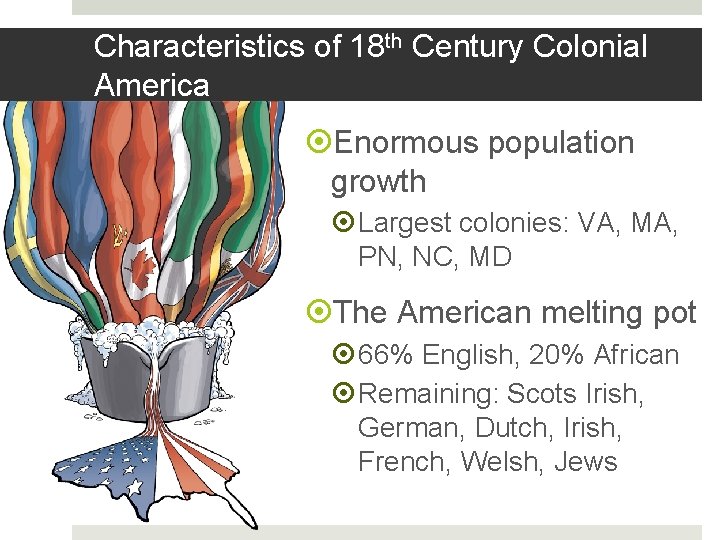
Characteristics of 18 th Century Colonial America Enormous population growth Largest colonies: VA, MA, PN, NC, MD The American melting pot 66% English, 20% African Remaining: Scots Irish, German, Dutch, Irish, French, Welsh, Jews

Colonial Social Structure Small upper class Most were yeoman farmers Small merchants, laborers Indentured servants and prisoners Slaves Stratification Mild in comparison to Europe Frontier vs. Seaboard “American nobility” failed Middle class Democracy
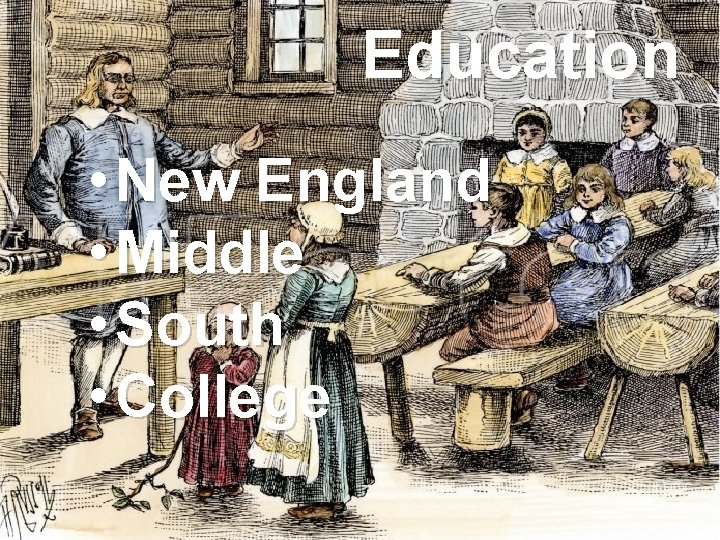
Education • New England • Middle • South • College

Colonial Religion Most common religions Anglican Church: Official faith in several colonies Congregational Church Presbyterian Church Quakers Catholics Jews Religious toleration Toleration came about in large part due to non-church members. Eventually led to separation of church and state (except for New England)
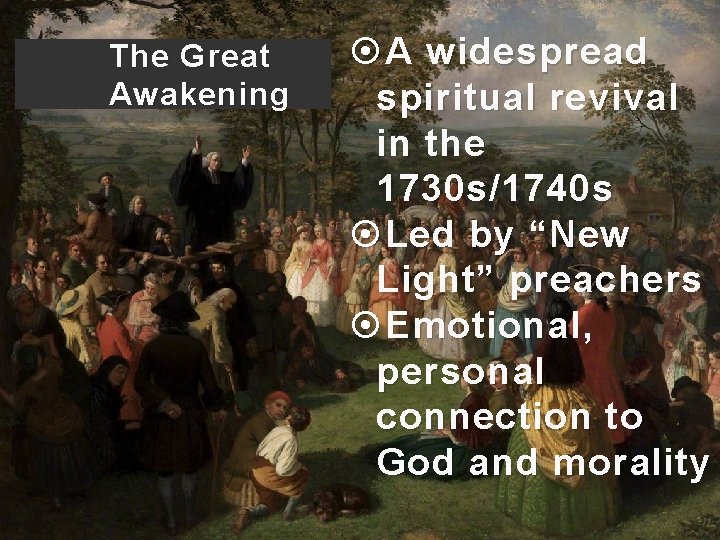
The Great Awakening A widespread spiritual revival in the 1730 s/1740 s Led by “New Light” preachers Emotional, personal connection to God and morality
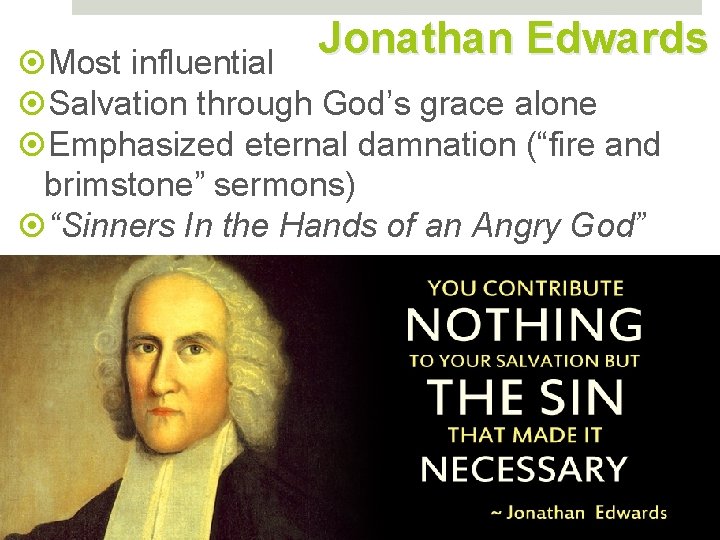
Jonathan Edwards Most influential Salvation through God’s grace alone Emphasized eternal damnation (“fire and brimstone” sermons) “Sinners In the Hands of an Angry God”
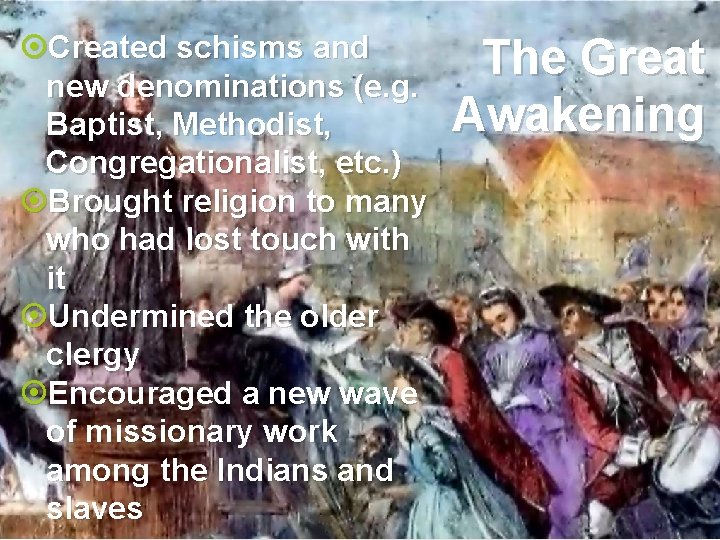
Created schisms and new denominations (e. g. Baptist, Methodist, Congregationalist, etc. ) Brought religion to many who had lost touch with it Undermined the older clergy Encouraged a new wave of missionary work among the Indians and slaves The Great Awakening
The Enlightenment • An 18 thc. cultural movement of intellectuals • Use logic and reason to improve society and government • Challenges traditional authority
- Slides: 10