
For Friday No reading Exercise 1 1 submitted
For Friday • No reading • Exercise 1. 1 submitted to Web. CT (see assignments on Web. CT for details)
Files in C++
Notes on Dynamic Arrays • Need three pieces of information associated with an array – Where’s the data? – What’s the capacity? – What’s the size (current number of elements)?
Dynamic Classes • Classes that use dynamic memory to store some/all of their data members • Constructor typically allocates/initializes the dynamic portions of the class
Destructors • Used to free the dynamically allocated portions of an object when the object is destroyed (either by delete or by going out of scope if statically allocated). • Called ~classname • Like constructor, has no return type • Also always has no parameters
Assignment and Initialization • What’s the difference?
Assignment • Default assignment operator – does a byte-by-byte copy of the object – Why is this an issue? • Solution: – Create your own assignment operator – Either copy the pointer or the data as appropriate for your class – Must be a member function – Always returns *this
Initialization • Copy Constructor
Measuring Program Performance • • Given: 2 programs to accomplish a task Both are correct Which do we pick? Two answers – Smallest – Fastest
Space Complexity • Instruction Space • Data Space – Constants and simple variables – Structures, arrays, dynamically allocated memory • Environment Stack Space – Particularly relevant to recursive programs
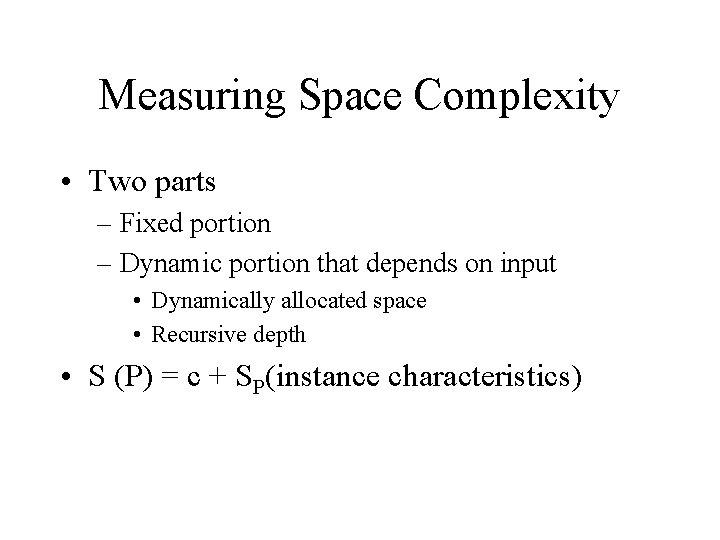
Measuring Space Complexity • Two parts – Fixed portion – Dynamic portion that depends on input • Dynamically allocated space • Recursive depth • S (P) = c + SP(instance characteristics)
Time Complexity • Actual time computation is difficult • Estimates are typically good enough • Two major estimates: – Operation Counts – Step Counts
Operation Counts • Determine or more operations which we believe are most important (contribute the most) to the time complexity • We then count how many times the operation(s) occur(s).
Step Counts • Determine the number of steps in the program in terms of some input characteristic • Defining a “step” – Any computation unit that is independent of the input characteristics
Ways to Count Steps • Can actually add code to a program to count the number of executed steps – Create a global variable count – Increment count for each step execution • Step count table – List all statements in program – For each statement • determine how many steps it is worth • determine its frequency • multiply to produce total steps for the statement – Total the steps per statement
Notes about Step Counts • Need to take into account best, worst, average cases • Take all operations into account, but inexactly. • Purposes of complexity analysis are – Compare two programs that compute the same function – Predict growth in run time as instance characteristics change
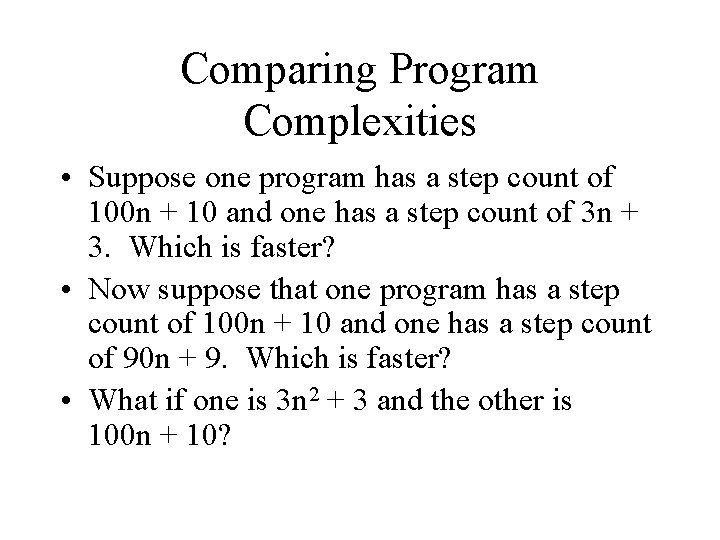
Comparing Program Complexities • Suppose one program has a step count of 100 n + 10 and one has a step count of 3 n + 3. Which is faster? • Now suppose that one program has a step count of 100 n + 10 and one has a step count of 90 n + 9. Which is faster? • What if one is 3 n 2 + 3 and the other is 100 n + 10?
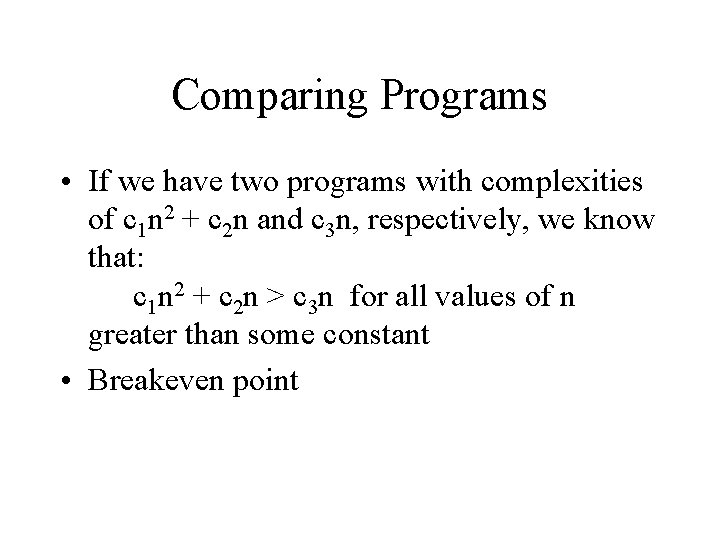
Comparing Programs • If we have two programs with complexities of c 1 n 2 + c 2 n and c 3 n, respectively, we know that: c 1 n 2 + c 2 n > c 3 n for all values of n greater than some constant • Breakeven point
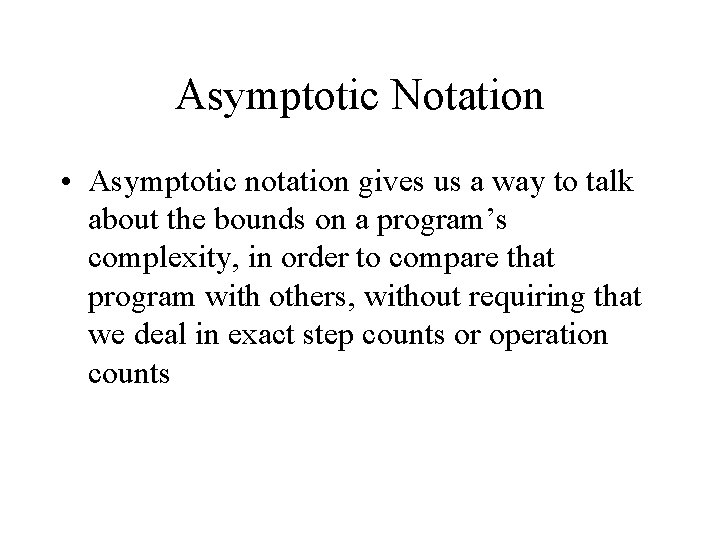
Asymptotic Notation • Asymptotic notation gives us a way to talk about the bounds on a program’s complexity, in order to compare that program with others, without requiring that we deal in exact step counts or operation counts
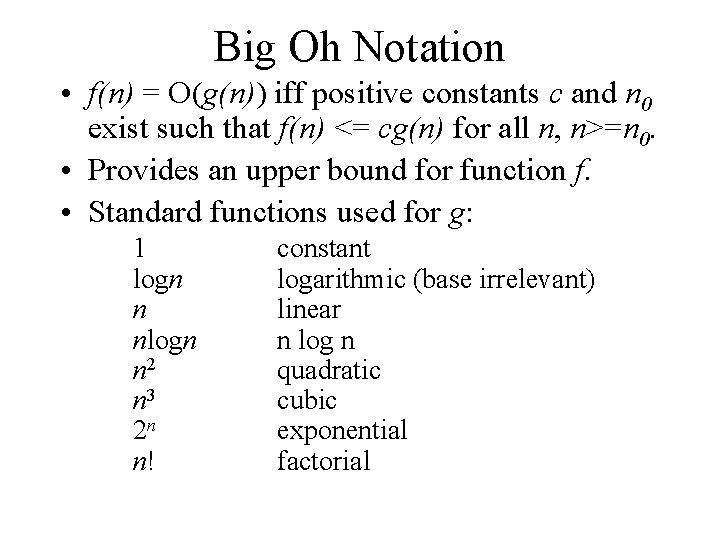
Big Oh Notation • f(n) = O(g(n)) iff positive constants c and n 0 exist such that f(n) <= cg(n) for all n, n>=n 0. • Provides an upper bound for function f. • Standard functions used for g: 1 logn n nlogn n 2 n 3 2 n n! constant logarithmic (base irrelevant) linear n log n quadratic cubic exponential factorial
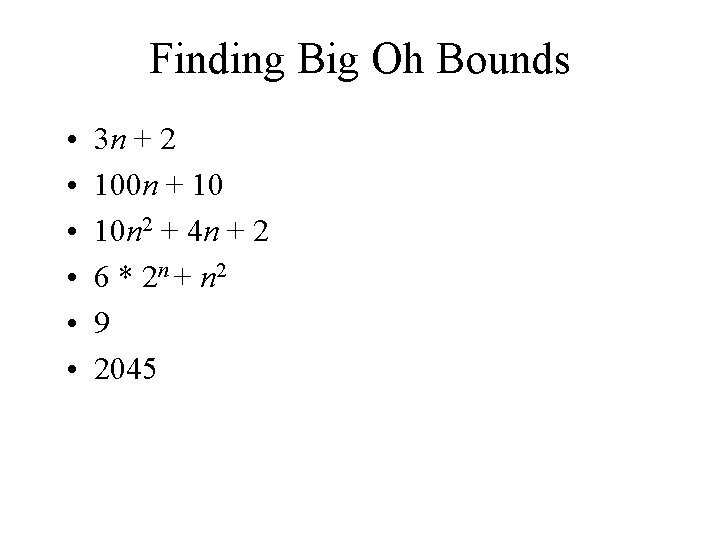
Finding Big Oh Bounds • • • 3 n + 2 100 n + 10 10 n 2 + 4 n + 2 6 * 2 n + n 2 9 2045
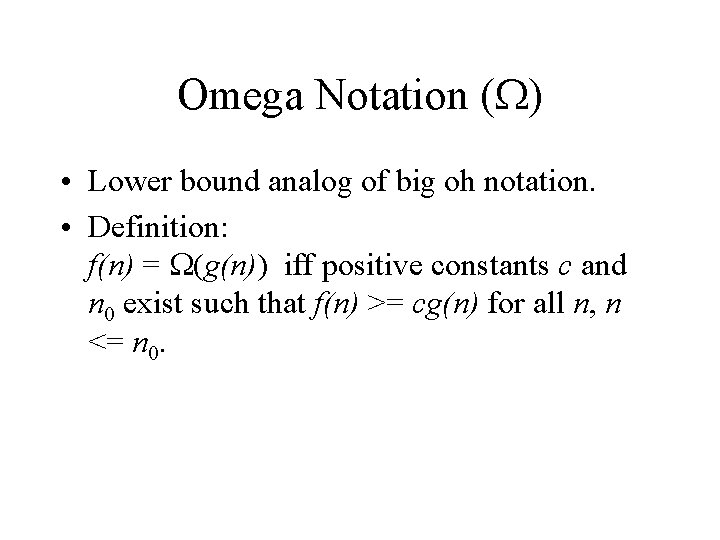
Omega Notation (W) • Lower bound analog of big oh notation. • Definition: f(n) = W(g(n)) iff positive constants c and n 0 exist such that f(n) >= cg(n) for all n, n <= n 0.
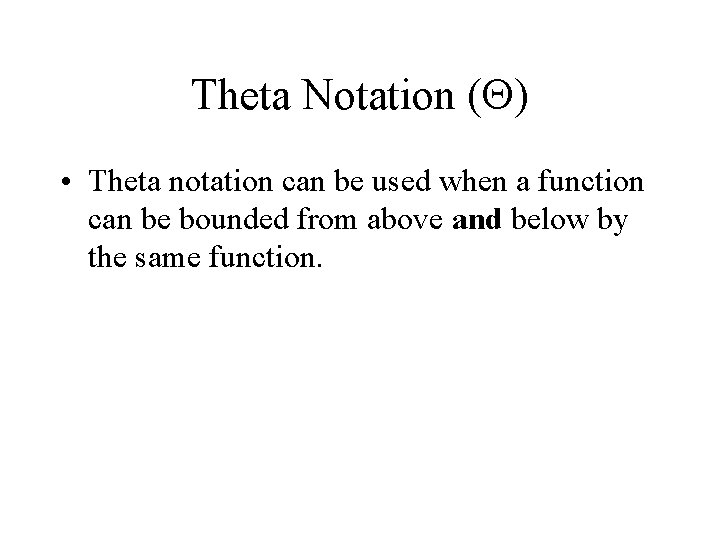
Theta Notation (Q) • Theta notation can be used when a function can be bounded from above and below by the same function.
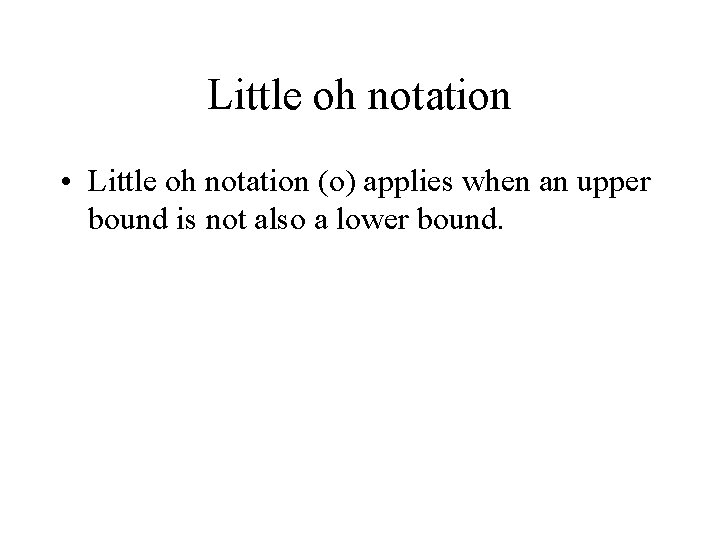
Little oh notation • Little oh notation (o) applies when an upper bound is not also a lower bound.
Computing Running Times • Rule 1: For loops – The running time is at most the running time of the statement inside the for loop (including tests) times the number of iterations. • Rule 2: Nested loops – Analyze inside out.
• Rule 3: Consecutive statements – Add these (meaning the maximum is the one that counts) • Rule 4: if/else – Running time of an if/else statement is no larger than the time of the test plus the larger of the running times of the bodies of the if and else. • In general: work inside out.
- Slides: 26