
Footnotes and Endnotes Decoded What is the purpose






- Slides: 17
Footnotes and Endnotes Decoded What is the purpose of a footnote or endnote?
Footnotes and endnotes are both ways to add clarifying information into a document. They provide important details with which the reader may be unfamiliar. They often save the reader from looking up unfamiliar words, people, places or sources.
What type of writing uses footnotes and endnotes? They are most common in academic writing (essays and papers), but narrative writing (stories and poems) may use them as well.
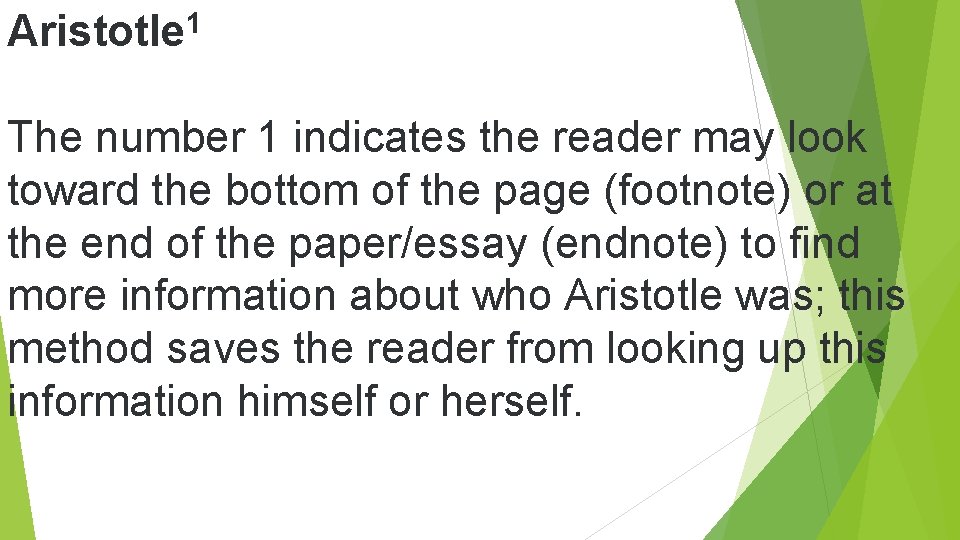
Where do they go in a document? For either a footnote or an endnote, a number will be inserted above the last letter of the word you wish to create a note for. It will look like this: Aristotle 1
Aristotle 1 The number 1 indicates the reader may look toward the bottom of the page (footnote) or at the end of the paper/essay (endnote) to find more information about who Aristotle was; this method saves the reader from looking up this information himself or herself.
A footnote is inserted at the bottom (or "foot") of whatever page the note is on. An endnote is inserted at the end of the document.
Why are footnotes and endnotes numbered? They are numbered so the reader can quickly find the information. For example, if the writer creates 10 endnotes for his essay, and each endnote defines a different word, the reader can quickly look for only the words he or she does not know.
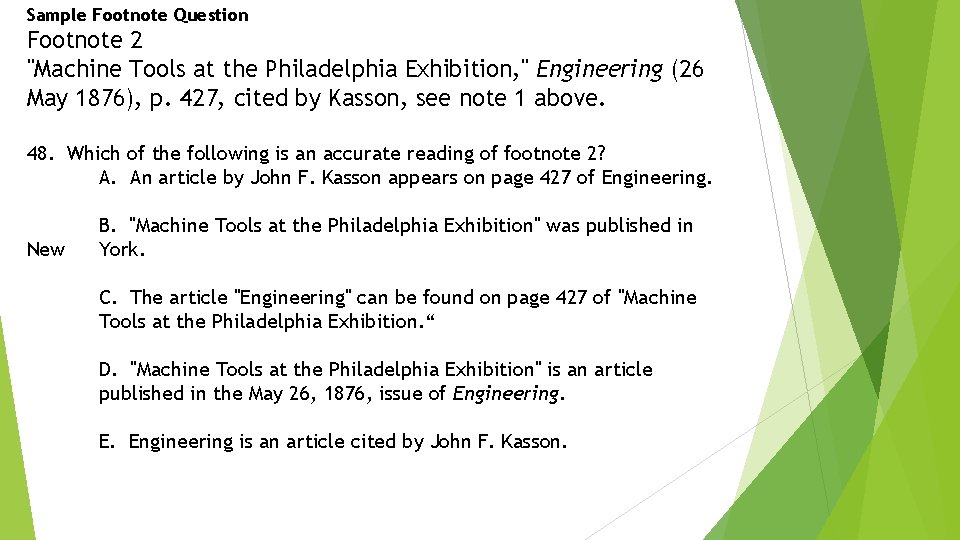
Sample Footnote Question Footnote 2 "Machine Tools at the Philadelphia Exhibition, " Engineering (26 May 1876), p. 427, cited by Kasson, see note 1 above. 48. Which of the following is an accurate reading of footnote 2? A. An article by John F. Kasson appears on page 427 of Engineering. New B. "Machine Tools at the Philadelphia Exhibition" was published in York. C. The article "Engineering" can be found on page 427 of "Machine Tools at the Philadelphia Exhibition. “ D. "Machine Tools at the Philadelphia Exhibition" is an article published in the May 26, 1876, issue of Engineering. E. Engineering is an article cited by John F. Kasson.
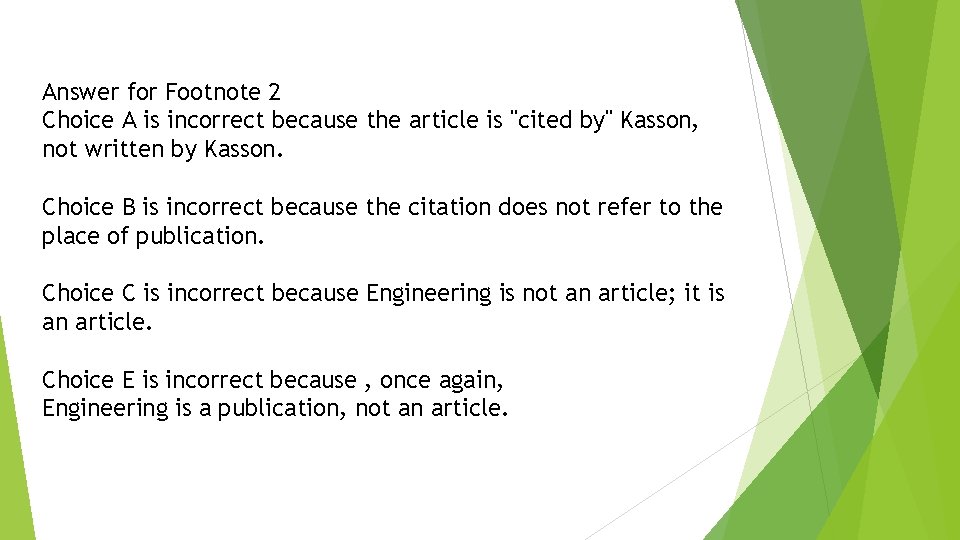
Answer for Footnote 2 Choice A is incorrect because the article is "cited by" Kasson, not written by Kasson. Choice B is incorrect because the citation does not refer to the place of publication. Choice C is incorrect because Engineering is not an article; it is an article. Choice E is incorrect because , once again, Engineering is a publication, not an article.
Footnote 4: Richard Guy Wilson, Dianne H. Pilgrim, Dickran Tasjhian, The Machine Age in America 1918 -1941 (New York: The Brooklyn Museum in association with Harry N. Abrams, Inc. , 1986), p. 85 52. The purpose of footnote 4 is to inform the reader that the quotation in line 49 A. has been attributed to three different designers B. was first cited in 1918 C. was the inspiration for an exhibit at The Brooklyn Museum D. is in an article in The Machine Age in America 1918 -1941 written by Harry N. Abrams, Inc. E. appears in a book written by Wilson, Pilgrim, Tasjhian
Correct Answer is E Again you must know the difference between a book and an article. Choices A, B, and C can quickly be eliminated. Choice D refers to The Machine Age in American 1918 -1941 as an article and is incorrect. Remember a publication will be italicized an article will be in "quotation marks".
Identify the parts in footnote 1 1: Michael Henderson, The Forgiveness Factor: Stories of Hope in a World of Conflict (London: Grosvenor Books, 1996), 28 -54. 2: Ibid. , 17.
1: Michael Henderson, The Forgiveness Factor: Stories of Hope in a World of Conflict (London: Grosvenor Books, 1996), 28 -54. Footnote 1 (above) tells you that the work referenced by the author of the main text is by Michael Henderson. The name of Henderson's book follows. The information in the parentheses indicate the place of publication, the publisher, the year of publication, and the page numbers where the information is found
What does Ibid mean in the second footnote? 1: Michael Henderson, The Forgiveness Factor: Stories of Hope in a World of Conflict (London: Grosvenor Books, 1996), 28 -54. 2: Ibid. , 17.
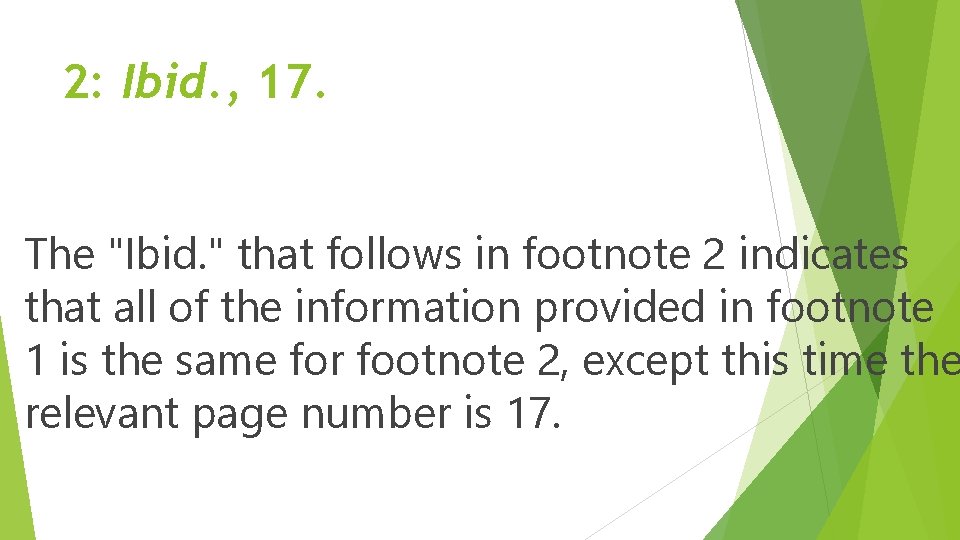
2: Ibid. , 17. The "Ibid. " that follows in footnote 2 indicates that all of the information provided in footnote 1 is the same for footnote 2, except this time the relevant page number is 17.
18 Henderson, M. op. cit. 24 -25 The second odd term you may encounter in footnotes is op. cit. This term is short for the Latin opus citatum/opere citato. It means the work referred to in the footnote has been previously cited. Thus, op. cit. is used for a second or later mention of a work when intervening entries have appeared. For example, there might be 15 more footnotes before Henderson appears again.
https: //herefordhslibrary. pbworks. com/w/page/178468 80/Welcome%20 to%20 the%20 HHS%20 Library%21