
Footings 1 Acknowledgement This Powerpoint presentation was prepared



- Slides: 102
Footings 1
Acknowledgement This Powerpoint presentation was prepared by Dr. Terry Weigel, University of Louisville. This work and other contributions to the text by Dr. Weigel are gratefully acknowledged. 2
Footings Support structural members and transfer loads to the soil Structural members are usually columns or walls Design for load transfer to soil uses unfactored loads Structural design of footing is done with factored loads 3
Footings must be designed to prevent bearing failure, sliding and overturning Footings must be designed to prevent excessive settlement or tilting Typically, bottom of footing must be located below frost line Excavation may be required to reach a depth where satisfactory bearing material is located 4
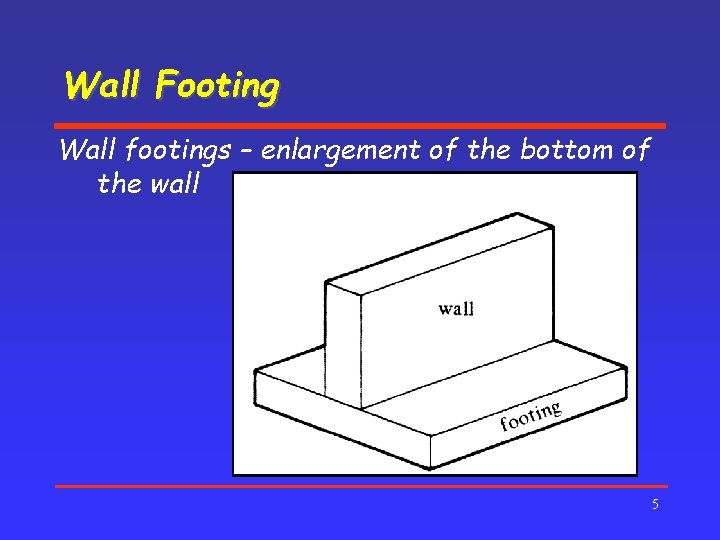
Wall Footing Wall footings – enlargement of the bottom of the wall 5
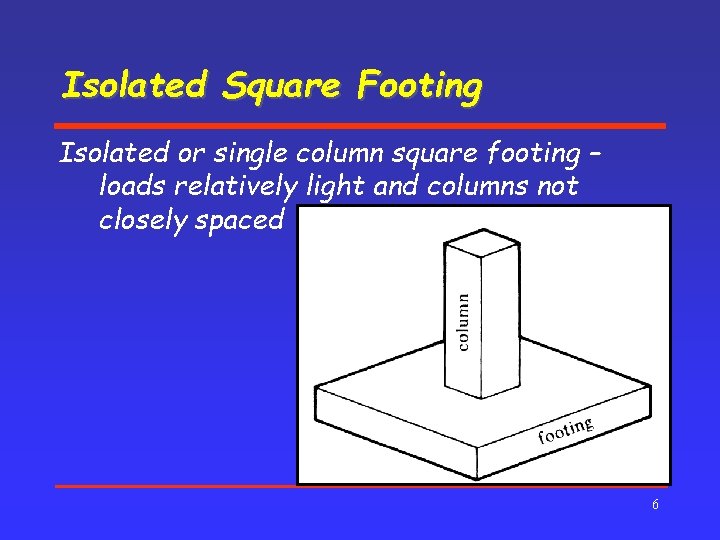
Isolated Square Footing Isolated or single column square footing – loads relatively light and columns not closely spaced 6
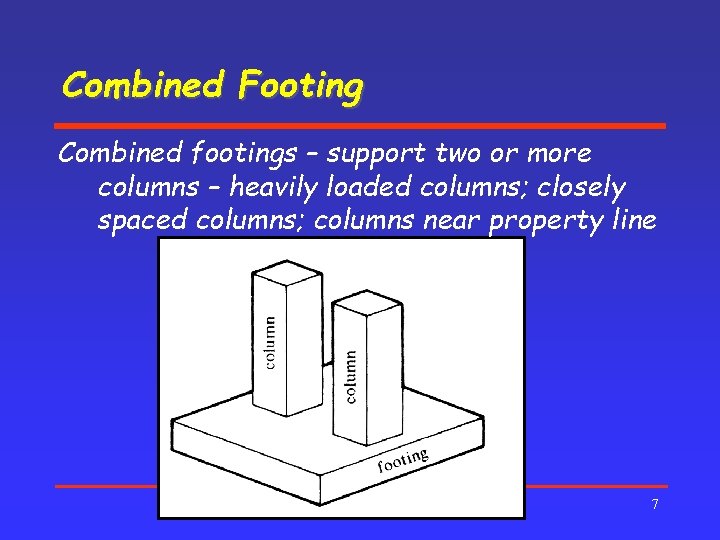
Combined Footing Combined footings – support two or more columns – heavily loaded columns; closely spaced columns; columns near property line 7
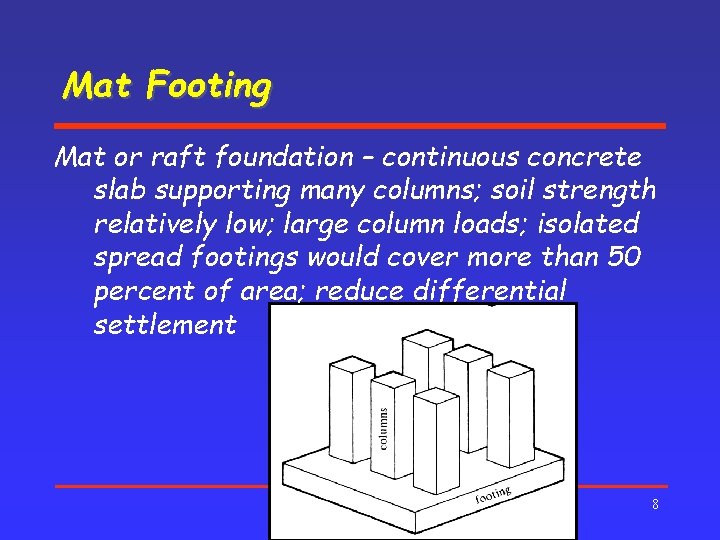
Mat Footing Mat or raft foundation – continuous concrete slab supporting many columns; soil strength relatively low; large column loads; isolated spread footings would cover more than 50 percent of area; reduce differential settlement 8
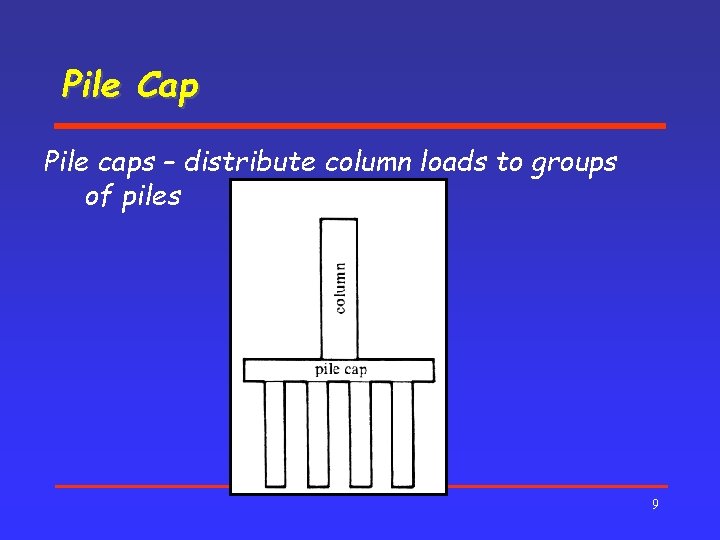
Pile Cap Pile caps – distribute column loads to groups of piles 9
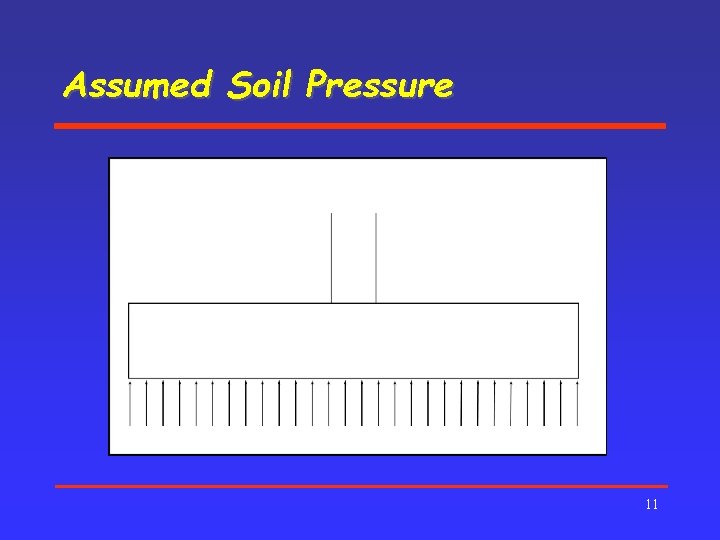
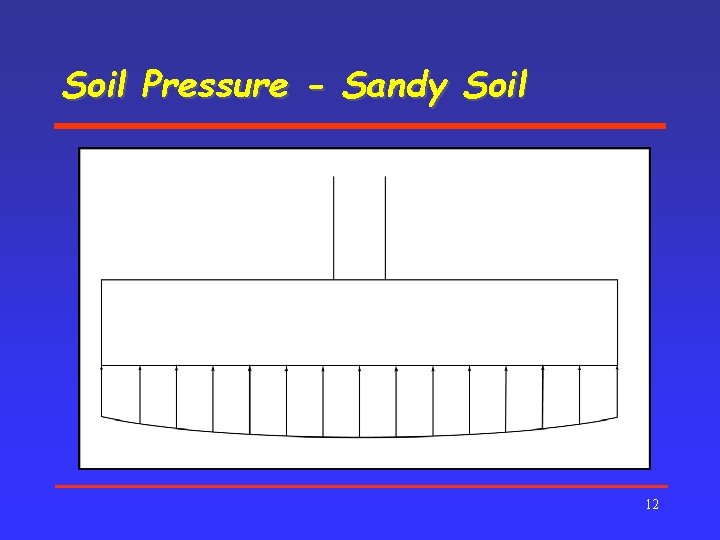
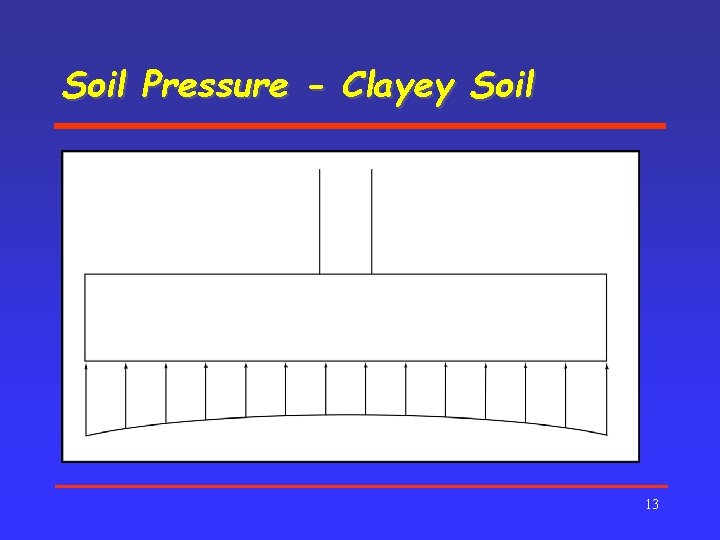
Soil Pressure Soil pressure is assumed to be uniformly distributed beneath footing if column load is applied at the center of gravity of the footing Footings supported by sandy soils Footings supported by clayey soils Footings supported eccentric loads 10
Assumed Soil Pressure 11
Soil Pressure - Sandy Soil 12
Soil Pressure - Clayey Soil 13
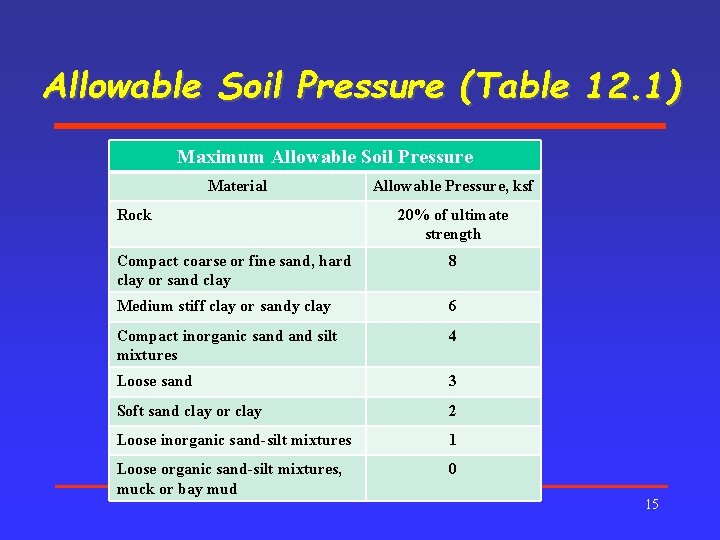
Allowable Soil Pressure Actual soil pressure is based on unfactored loads Allowable soil pressure may be determined by a geotechnical engineer When soil exploration is not feasible, values provided by building codes may be used Factor of safety is typically 3 14
Allowable Soil Pressure (Table 12. 1) Maximum Allowable Soil Pressure Material Rock Allowable Pressure, ksf 20% of ultimate strength Compact coarse or fine sand, hard clay or sand clay 8 Medium stiff clay or sandy clay 6 Compact inorganic sand silt mixtures 4 Loose sand 3 Soft sand clay or clay 2 Loose inorganic sand-silt mixtures 1 Loose organic sand-silt mixtures, muck or bay mud 0 15
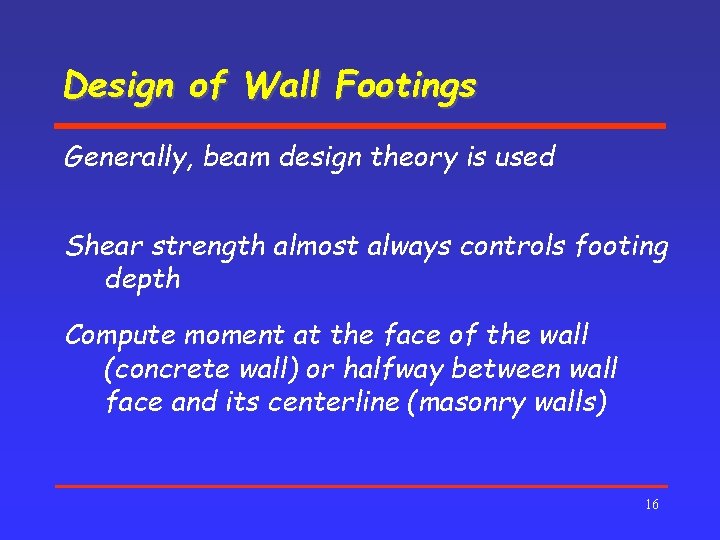
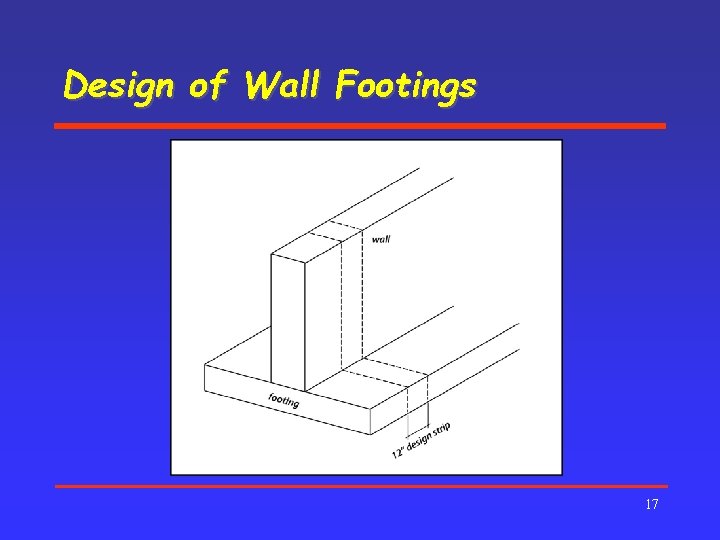
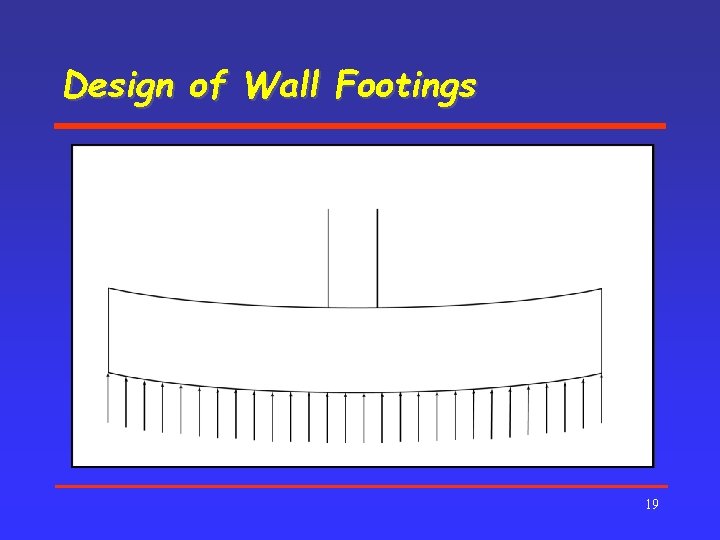
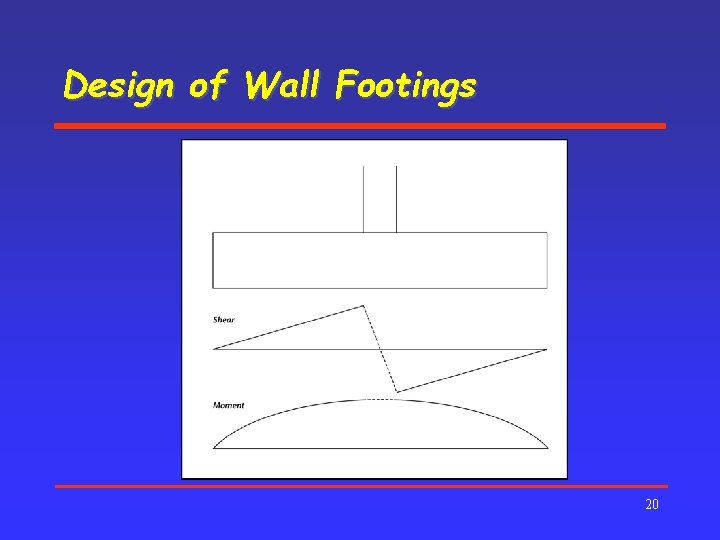
Design of Wall Footings Generally, beam design theory is used Shear strength almost always controls footing depth Compute moment at the face of the wall (concrete wall) or halfway between wall face and its centerline (masonry walls) 16
Design of Wall Footings 17
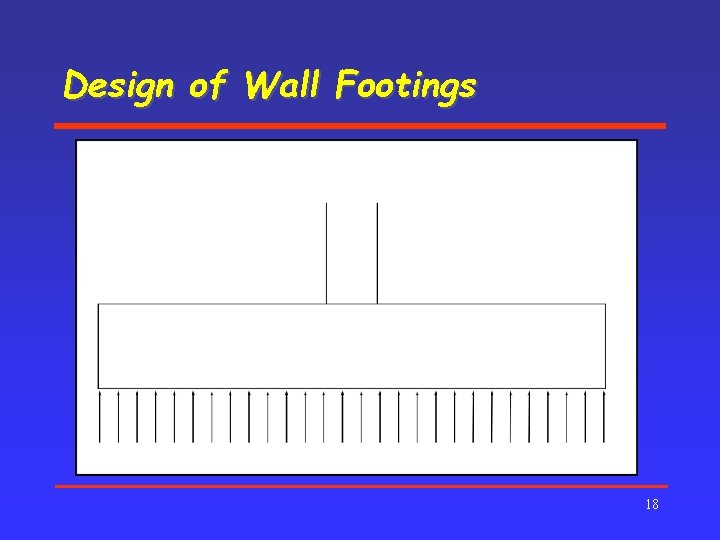
Design of Wall Footings 18
Design of Wall Footings 19
Design of Wall Footings 20
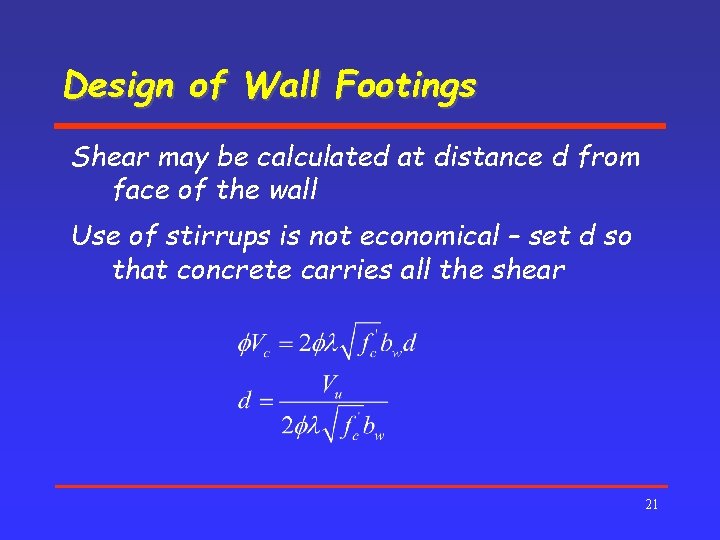
Design of Wall Footings Shear may be calculated at distance d from face of the wall Use of stirrups is not economical – set d so that concrete carries all the shear 21
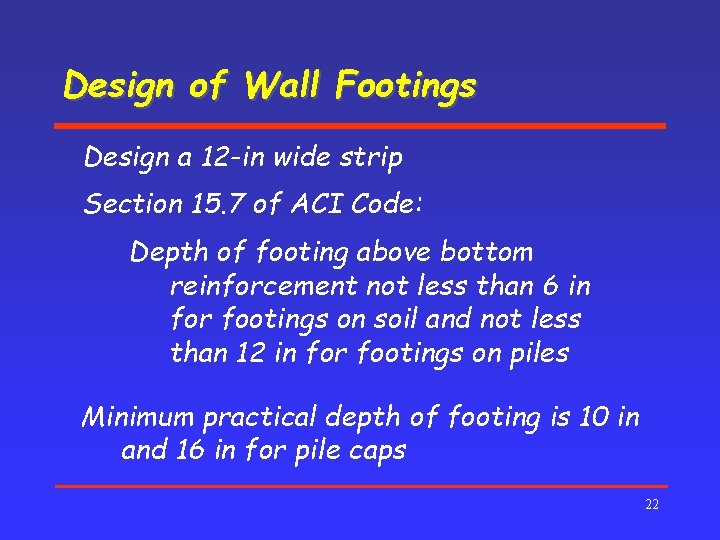
Design of Wall Footings Design a 12 -in wide strip Section 15. 7 of ACI Code: Depth of footing above bottom reinforcement not less than 6 in for footings on soil and not less than 12 in for footings on piles Minimum practical depth of footing is 10 in and 16 in for pile caps 22
Wall Footing Design Examples 23
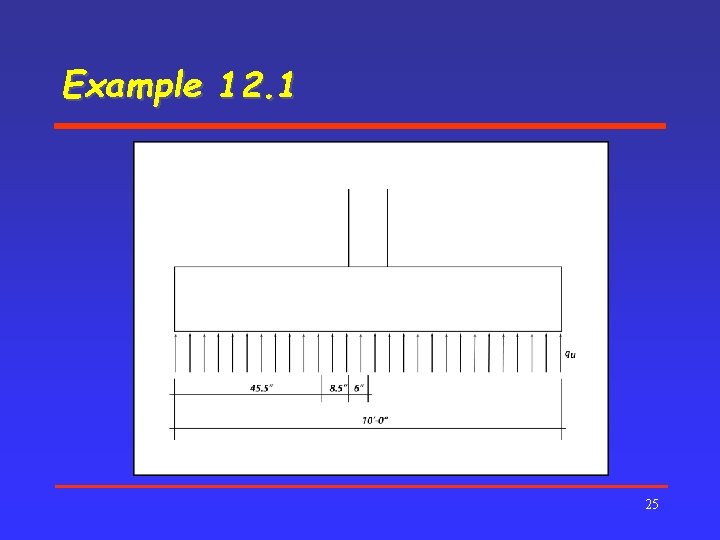
Example 12. 1 Design a wall footing to support a 12 -in. wide reinforced concrete wall with a dead load of 20 k/ft and a live load of 15 k/ft. The bottom of the footing is to be 4 foot below final grade, the soil weighs 100 lb/ft 3 the allowable soil pressure is 4 ksf. The concrete strength is 3, 000 psi and the steel is Grade 60. 24
Example 12. 1 25
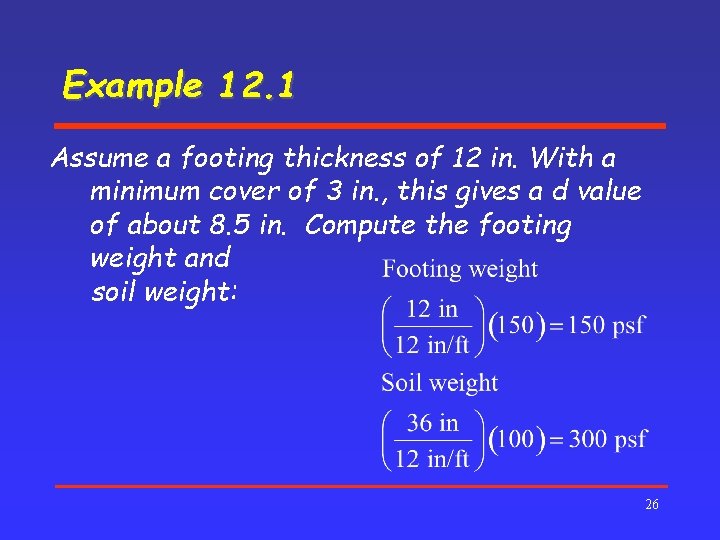
Example 12. 1 Assume a footing thickness of 12 in. With a minimum cover of 3 in. , this gives a d value of about 8. 5 in. Compute the footing weight and soil weight: 26
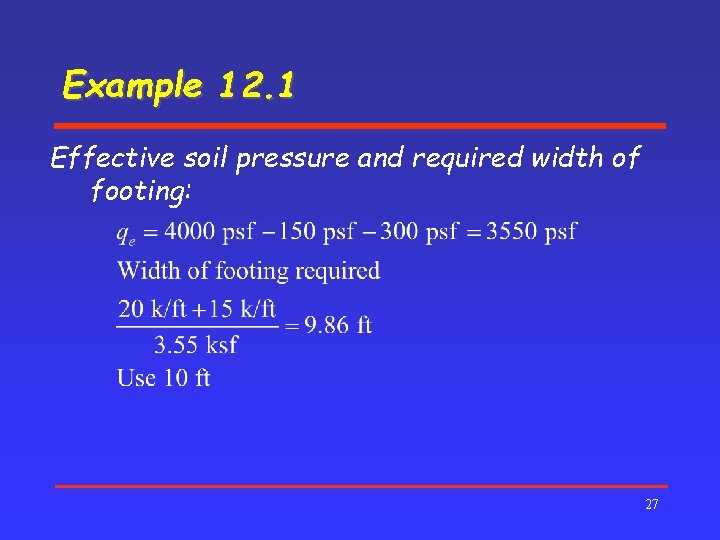
Example 12. 1 Effective soil pressure and required width of footing: 27
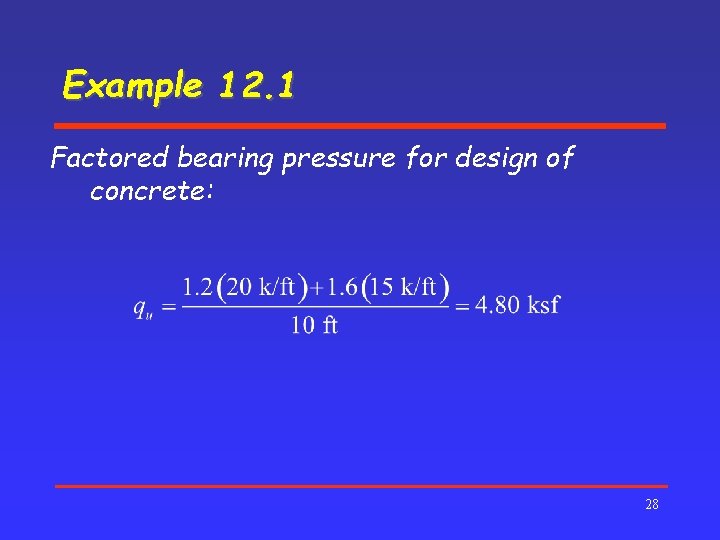
Example 12. 1 Factored bearing pressure for design of concrete: 28
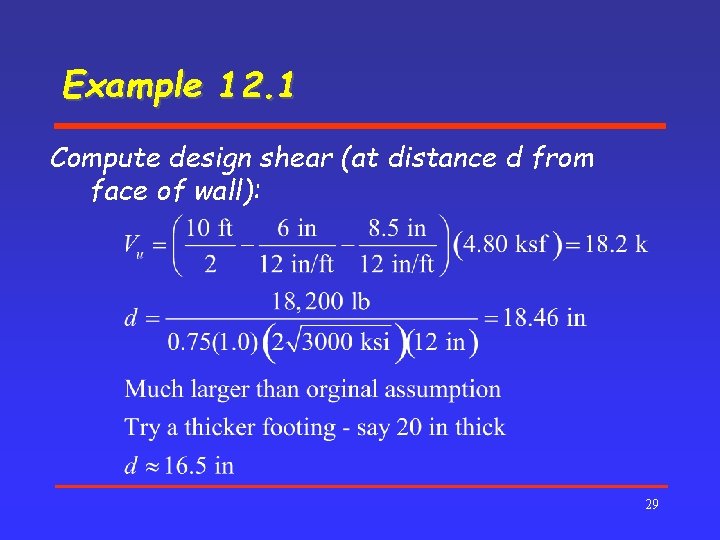
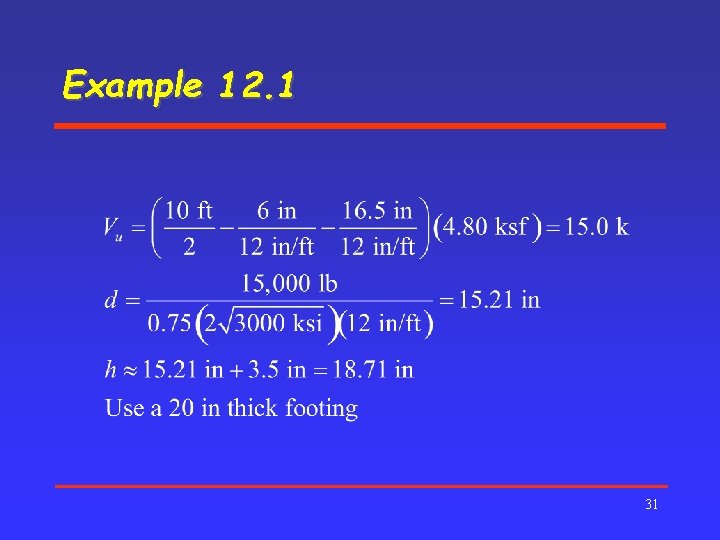
Example 12. 1 Compute design shear (at distance d from face of wall): 29
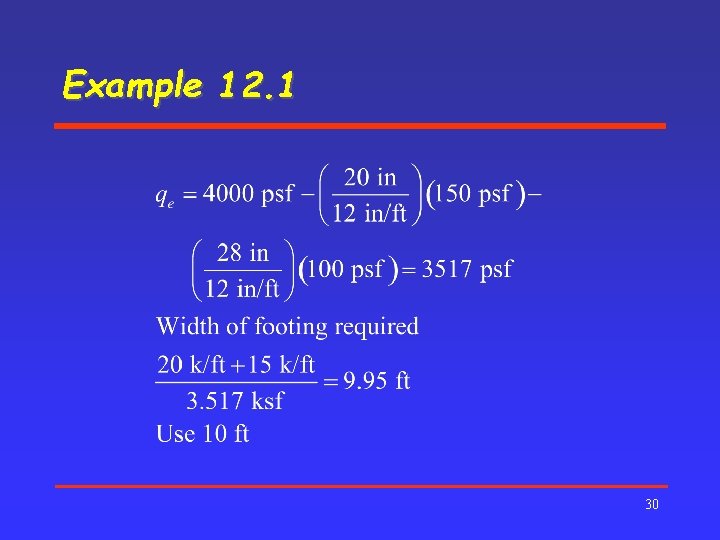
Example 12. 1 30
Example 12. 1 31
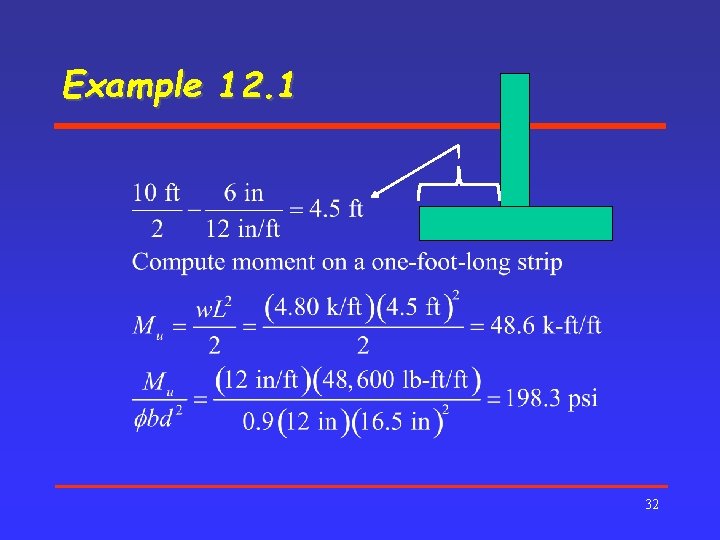
Example 12. 1 32
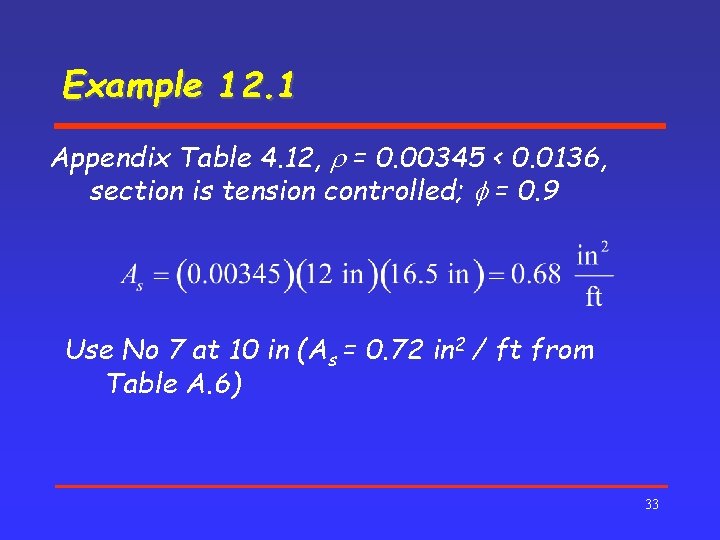
Example 12. 1 Appendix Table 4. 12, r = 0. 00345 < 0. 0136, section is tension controlled; f = 0. 9 Use No 7 at 10 in (As = 0. 72 in 2 / ft from Table A. 6) 33
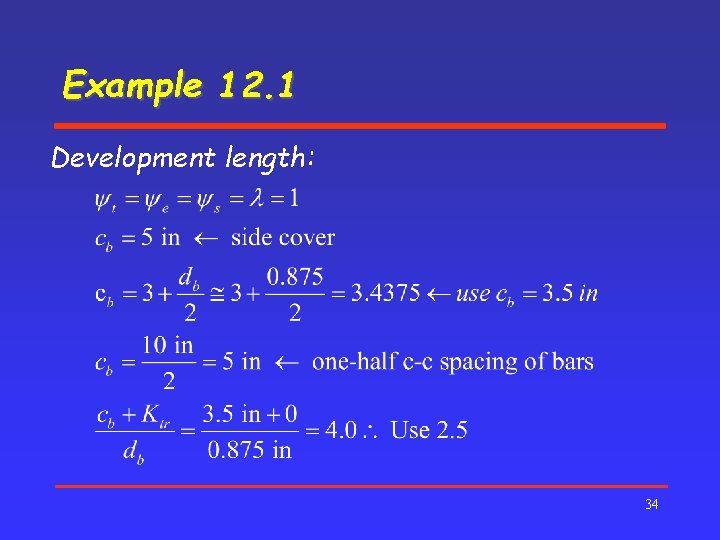
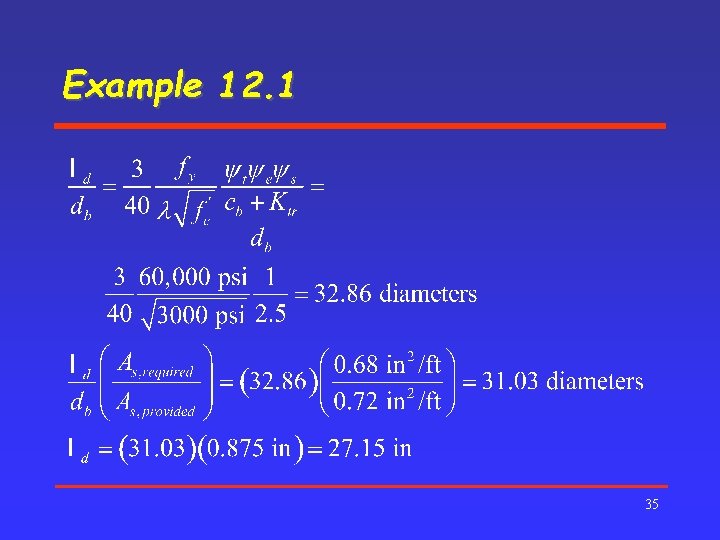
Example 12. 1 Development length: 34
Example 12. 1 35
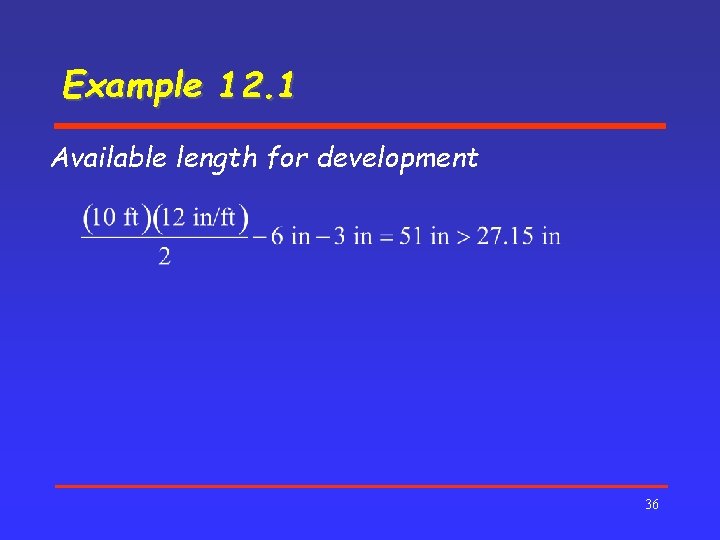
Example 12. 1 Available length for development 36
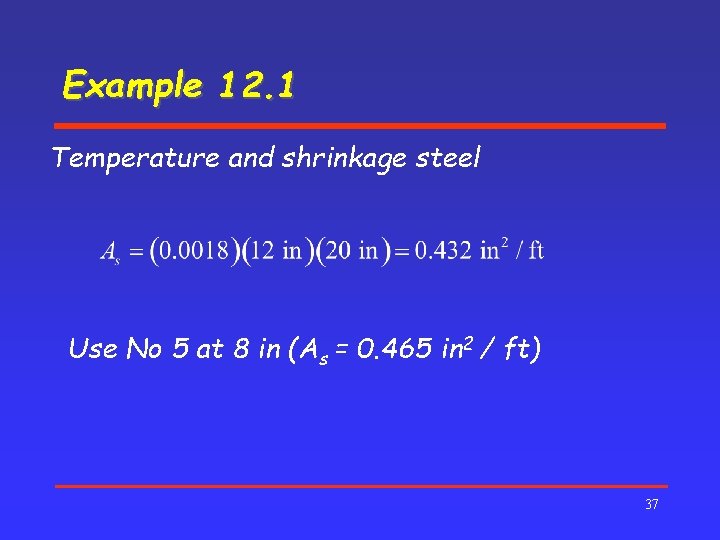
Example 12. 1 Temperature and shrinkage steel Use No 5 at 8 in (As = 0. 465 in 2 / ft) 37
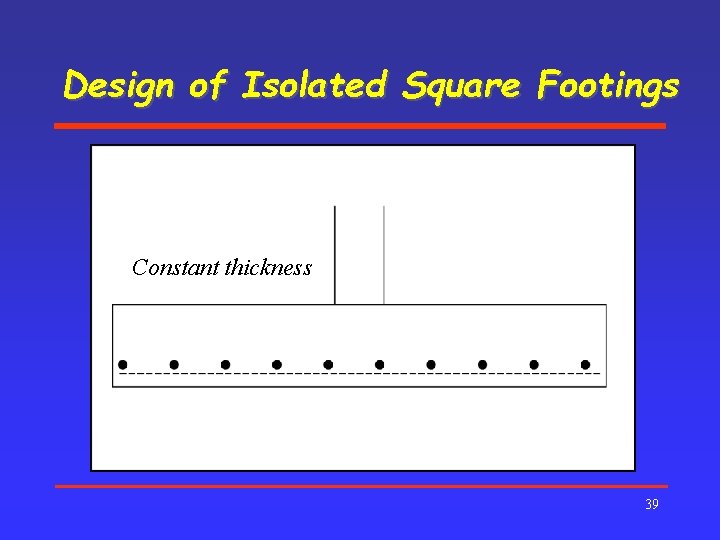
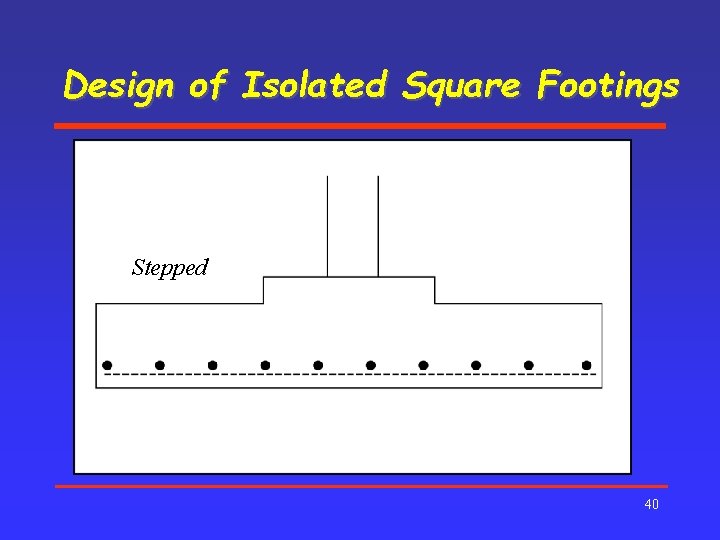
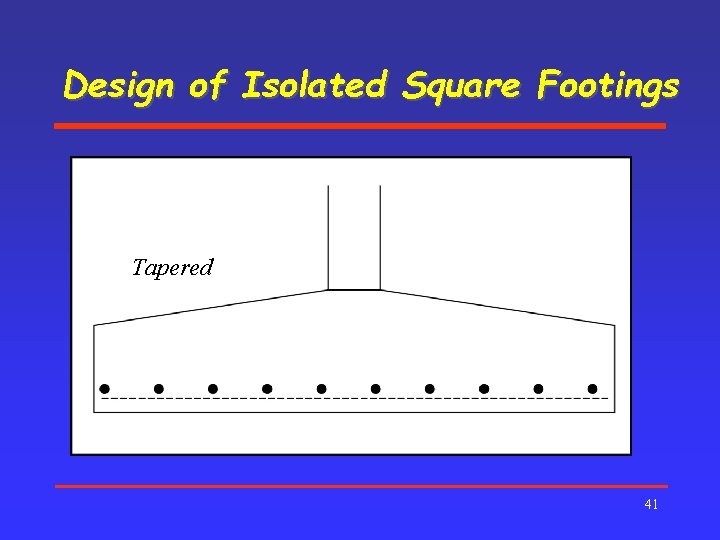
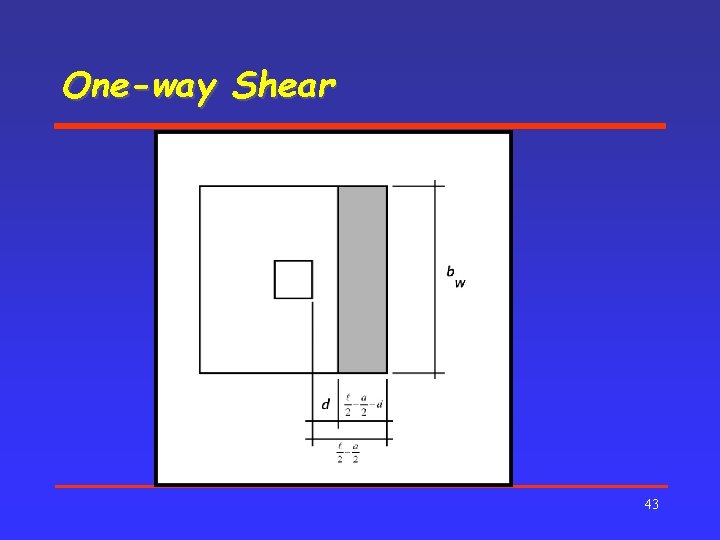
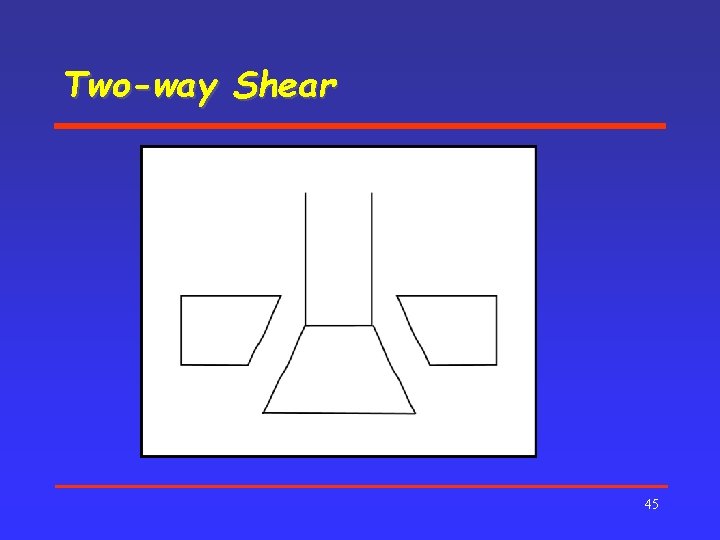
Design of Isolated Square Footings Most isolated square footings have a constant thickness For very thick footings, it may be economical to step or taper footing Two types of shear must be considered – oneway shear and two-way shear 38
Design of Isolated Square Footings Constant thickness 39
Design of Isolated Square Footings Stepped 40
Design of Isolated Square Footings Tapered 41
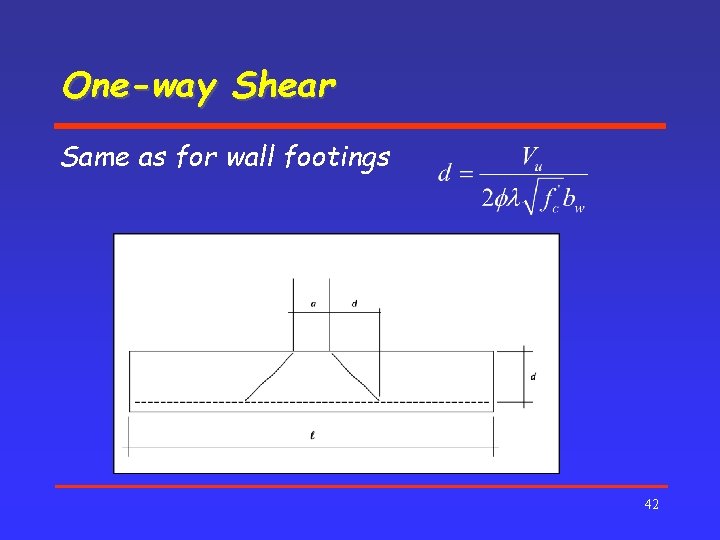
One-way Shear Same as for wall footings 42
One-way Shear 43
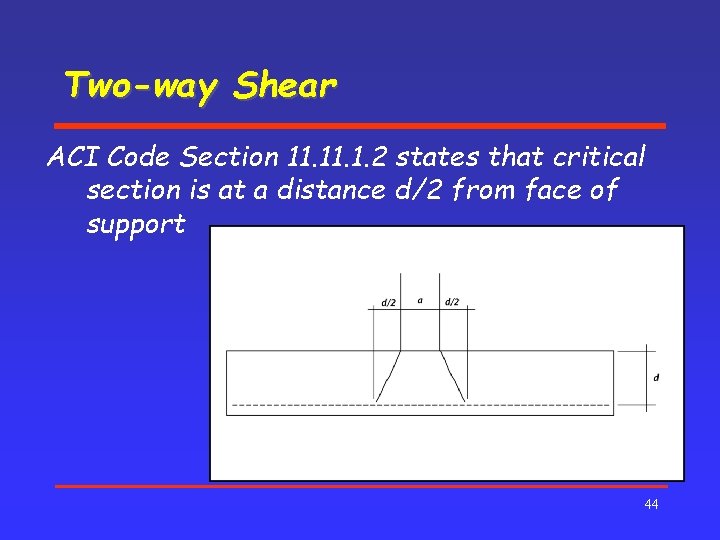
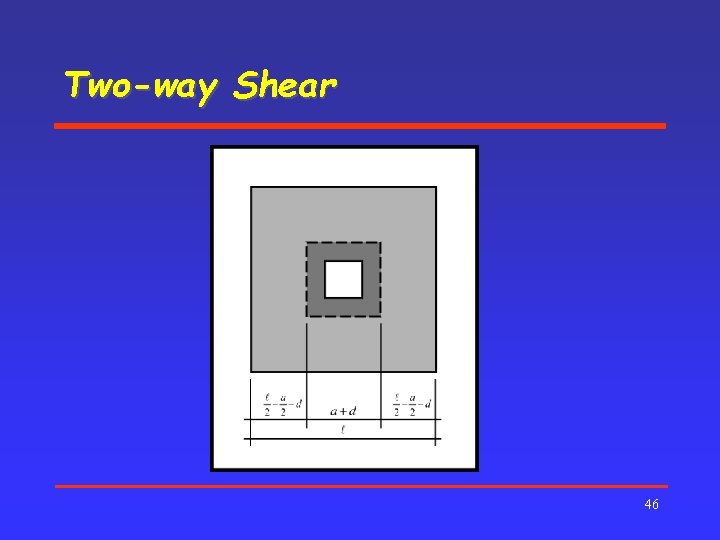
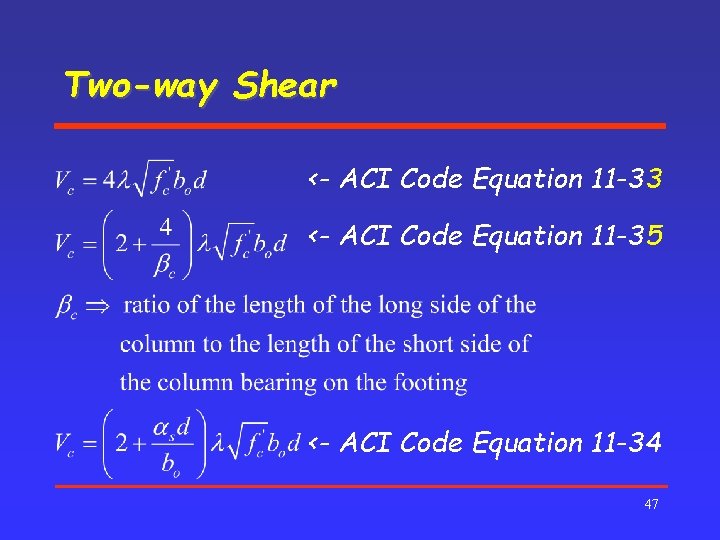
Two-way Shear ACI Code Section 11. 1. 2 states that critical section is at a distance d/2 from face of support 44
Two-way Shear 45
Two-way Shear 46
Two-way Shear <- ACI Code Equation 11 -33 <- ACI Code Equation 11 -35 <- ACI Code Equation 11 -34 47
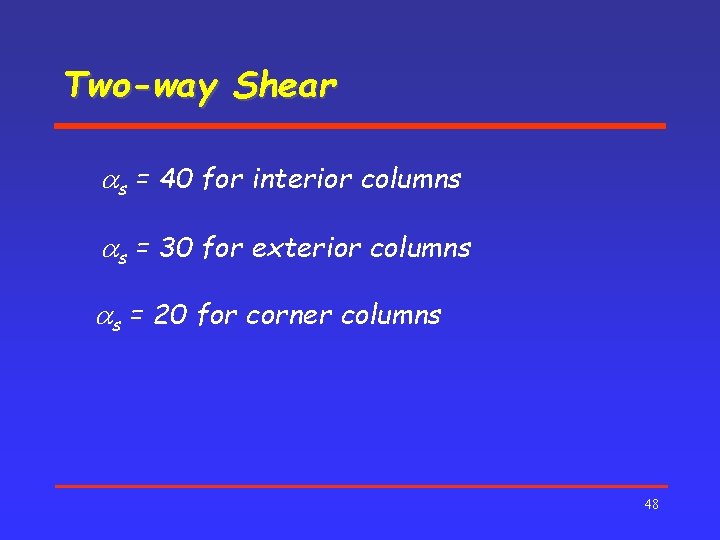
Two-way Shear as = 40 for interior columns as = 30 for exterior columns as = 20 for corner columns 48
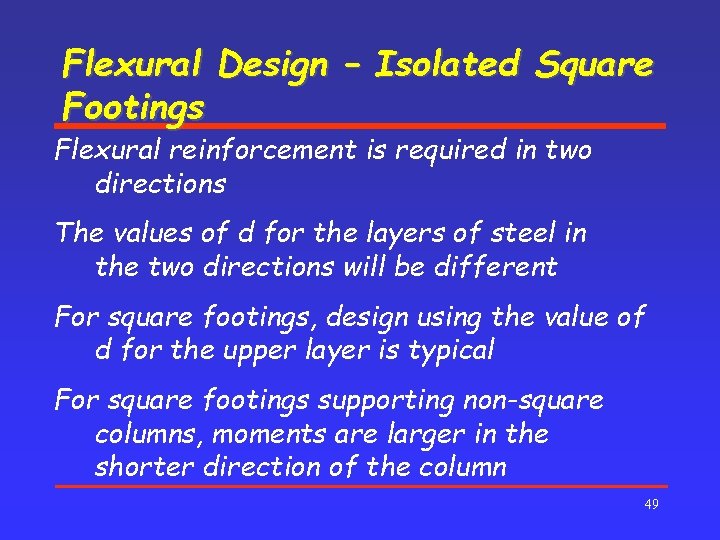
Flexural Design – Isolated Square Footings Flexural reinforcement is required in two directions The values of d for the layers of steel in the two directions will be different For square footings, design using the value of d for the upper layer is typical For square footings supporting non-square columns, moments are larger in the shorter direction of the column 49
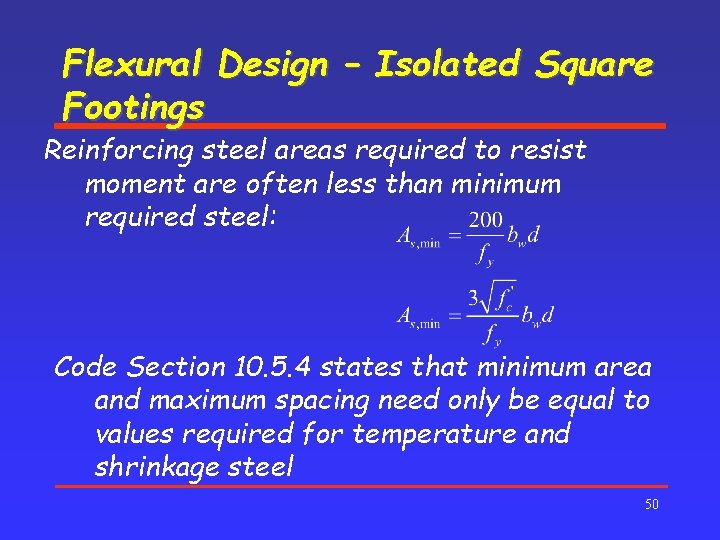
Flexural Design – Isolated Square Footings Reinforcing steel areas required to resist moment are often less than minimum required steel: Code Section 10. 5. 4 states that minimum area and maximum spacing need only be equal to values required for temperature and shrinkage steel 50
Flexural Design – Isolated Square Footings Maximum steel spacing may not exceed three times the footing thickness or 18 in. 51
Load Transfer from Column to Footing All forces at the base of the column must be transferred to the footing Compressive forces must be transferred by bearing Tensile forces may be transferred by reinforcement or mechanical connectors 52
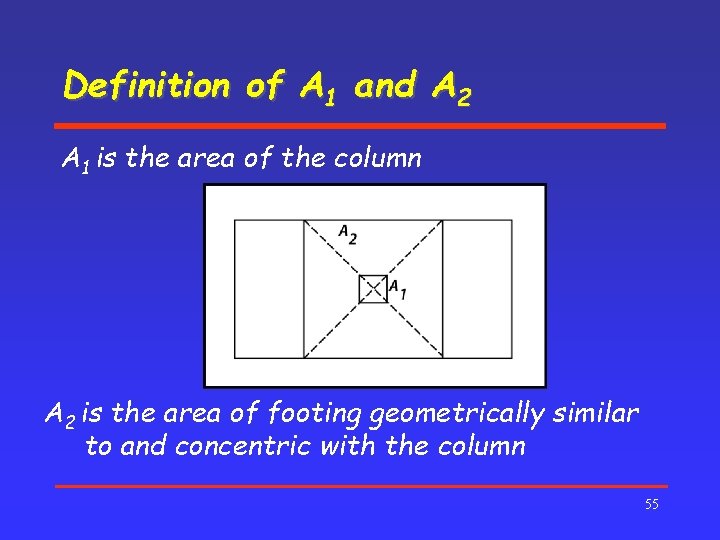
Load Transfer from Column to Footing Columns transfer loads directly over the area of the column Load transfer into the footing may by assumed to occur over an effective area which may be larger than the column area For the same strength of concrete, the footing can support more bearing load than can the column 53
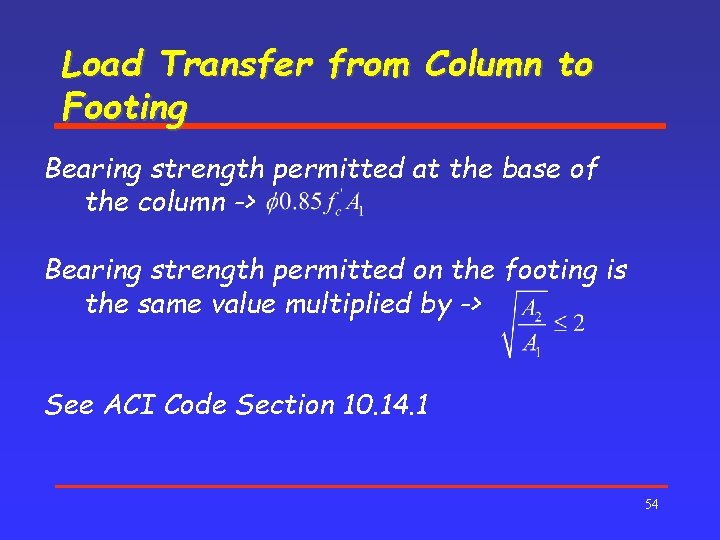
Load Transfer from Column to Footing Bearing strength permitted at the base of the column -> Bearing strength permitted on the footing is the same value multiplied by -> See ACI Code Section 10. 14. 1 54
Definition of A 1 and A 2 A 1 is the area of the column A 2 is the area of footing geometrically similar to and concentric with the column 55
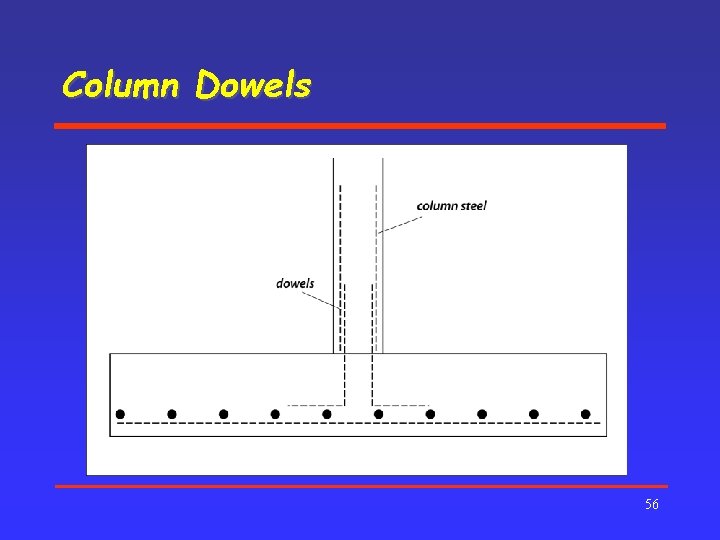
Column Dowels 56
Excess Bearing Load Excess bearing load can be carried by dowels or column bars extended into footing ACI Code Section 15. 8. 2 requires that the dowel area not be less than 0. 005 times the gross cross-sectional area of the column 57
Development Length for Dowels Development length of dowels must be sufficient to transfer column force to footing Development length of dowels may not be less than the length required if bearing stress was not exceeded 58
Splice Length for Dowels ACI Code does not permit splicing of No 14 or No 18 bars ACI Code Section 15. 8. 2. 3 does permit No 14 or No 18 bars to be spliced to No 11 (or larger) dowels in footings These dowels must extend into the column not less than the development length for the No 14 or No 18 bar, or the compression lap splice length for the dowels, whichever is larger 59
Splice Length for Dowels These dowels must extend into the footing for a distance not less than the development length for dowels 60
Insufficient Development or Splice Length Use a larger number of smaller dowels Use a deeper footing Add a cap or pedestal to the footing 61
Column Uplift Development length must be those for tension Splice requirements are those found in ACI Code Section 12. 17 62
Isolated Rectangular Footings Square footings are more econonical than rectangular footings Long direction steel is uniformly distributed along short direction Short direction steel is non uniformly distributed along direction 63
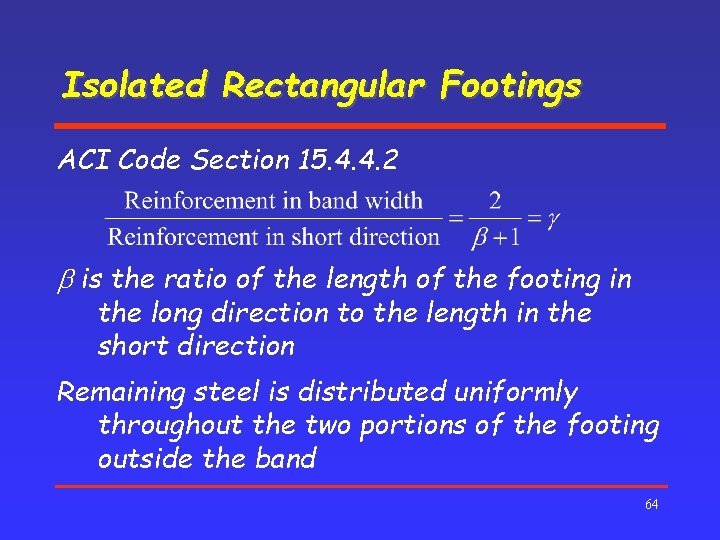
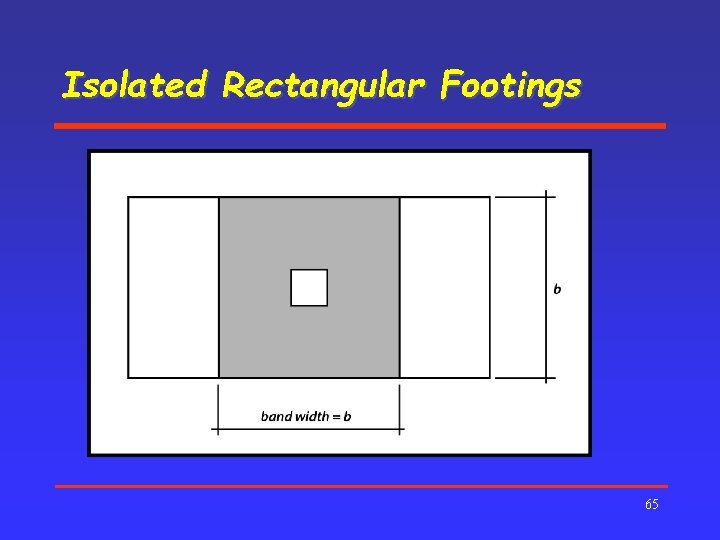
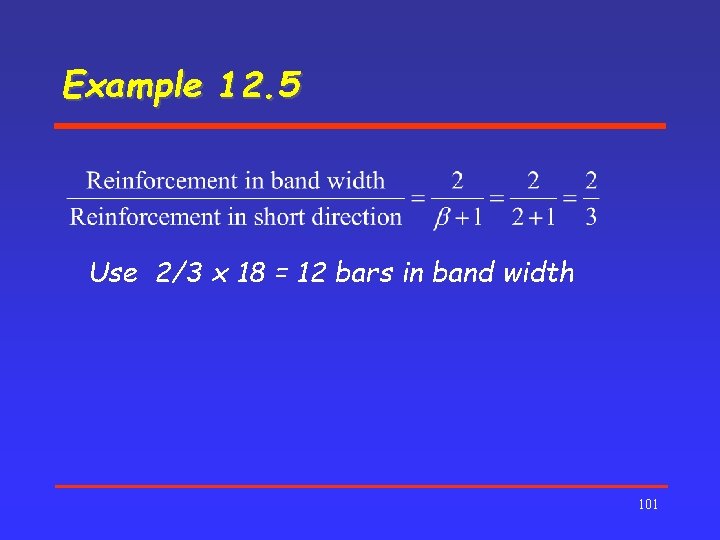
Isolated Rectangular Footings ACI Code Section 15. 4. 4. 2 b is the ratio of the length of the footing in the long direction to the length in the short direction Remaining steel is distributed uniformly throughout the two portions of the footing outside the band 64
Isolated Rectangular Footings 65
Footing Design Examples 66
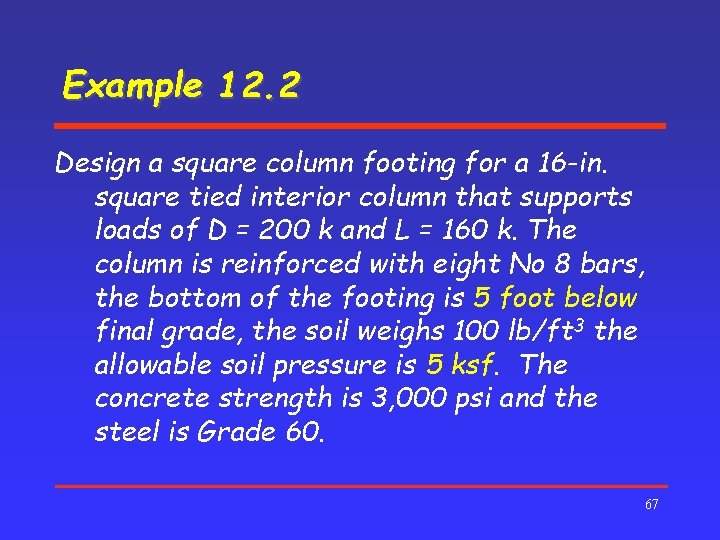
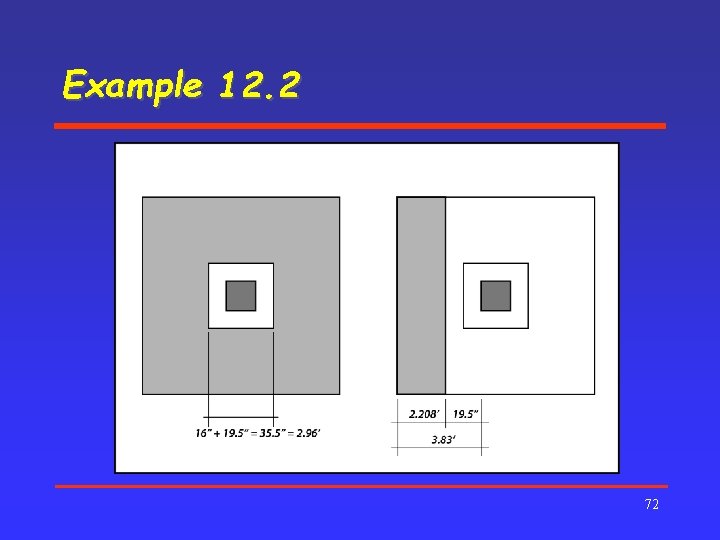
Example 12. 2 Design a square column footing for a 16 -in. square tied interior column that supports loads of D = 200 k and L = 160 k. The column is reinforced with eight No 8 bars, the bottom of the footing is 5 foot below final grade, the soil weighs 100 lb/ft 3 the allowable soil pressure is 5 ksf. The concrete strength is 3, 000 psi and the steel is Grade 60. 67
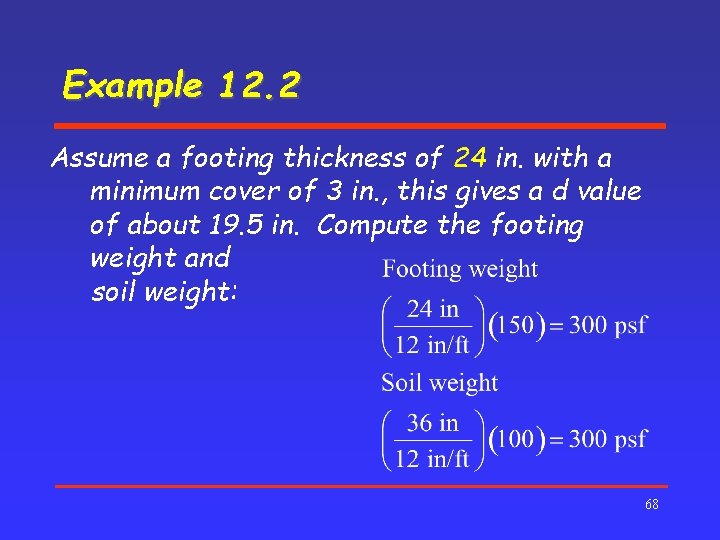
Example 12. 2 Assume a footing thickness of 24 in. with a minimum cover of 3 in. , this gives a d value of about 19. 5 in. Compute the footing weight and soil weight: 68
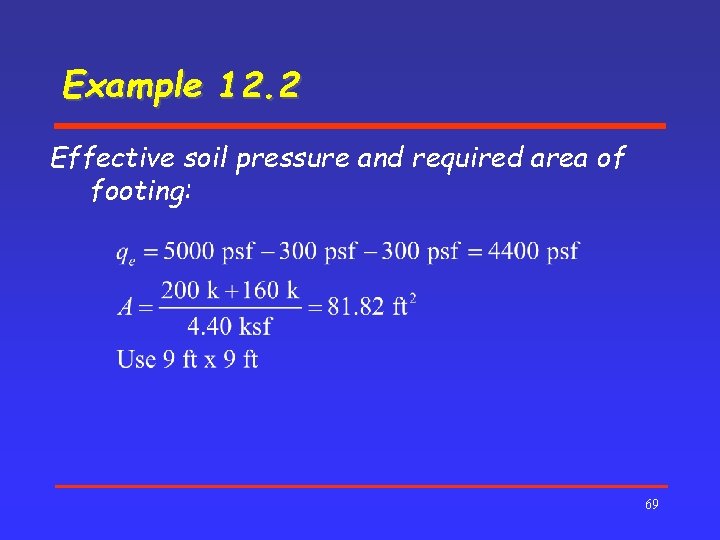
Example 12. 2 Effective soil pressure and required area of footing: 69
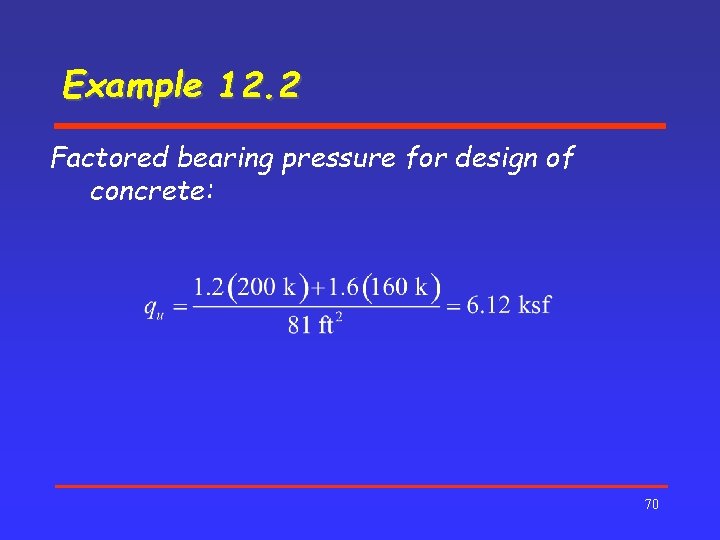
Example 12. 2 Factored bearing pressure for design of concrete: 70
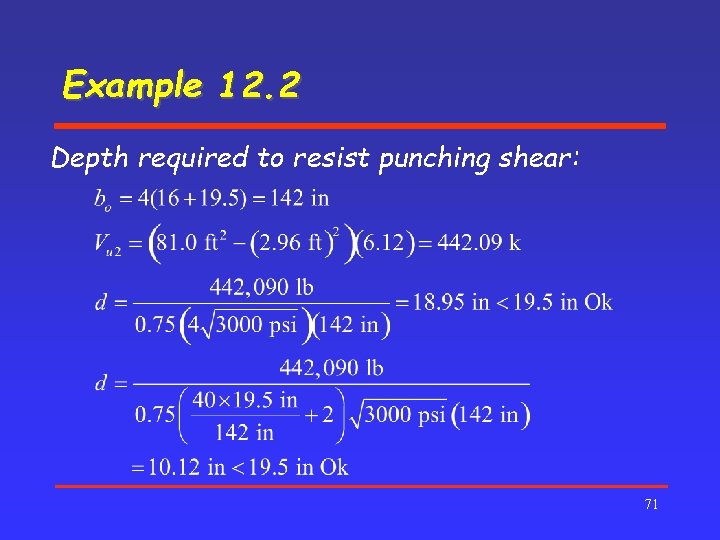
Example 12. 2 Depth required to resist punching shear: 71
Example 12. 2 72
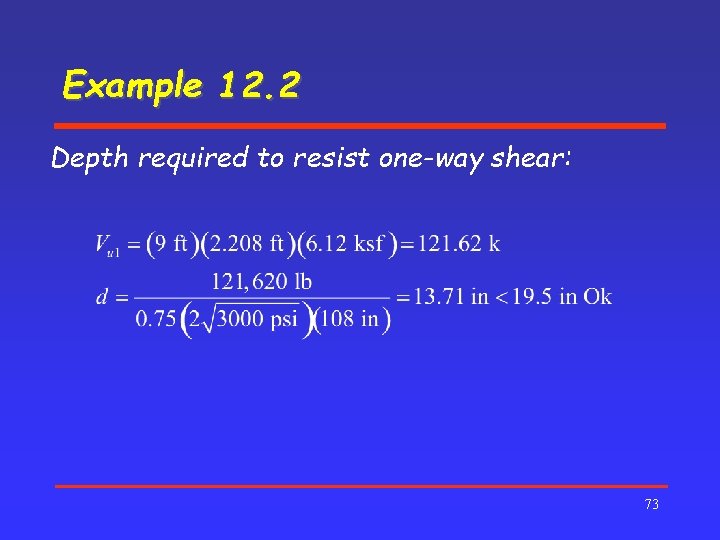
Example 12. 2 Depth required to resist one-way shear: 73
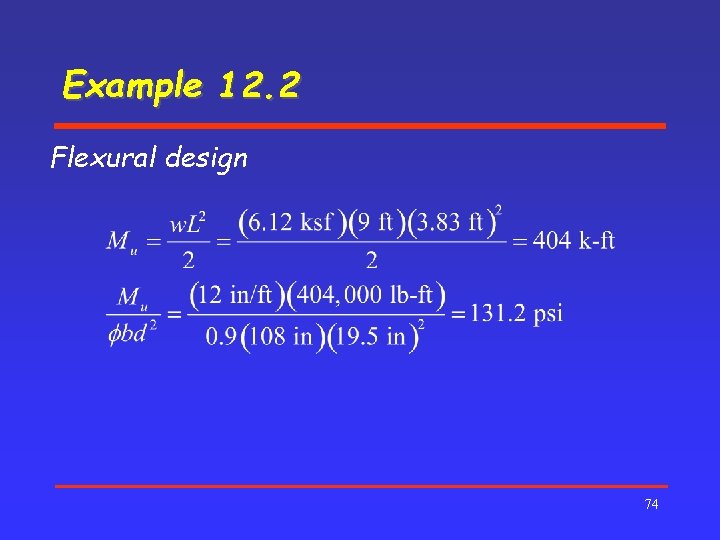
Example 12. 2 Flexural design 74
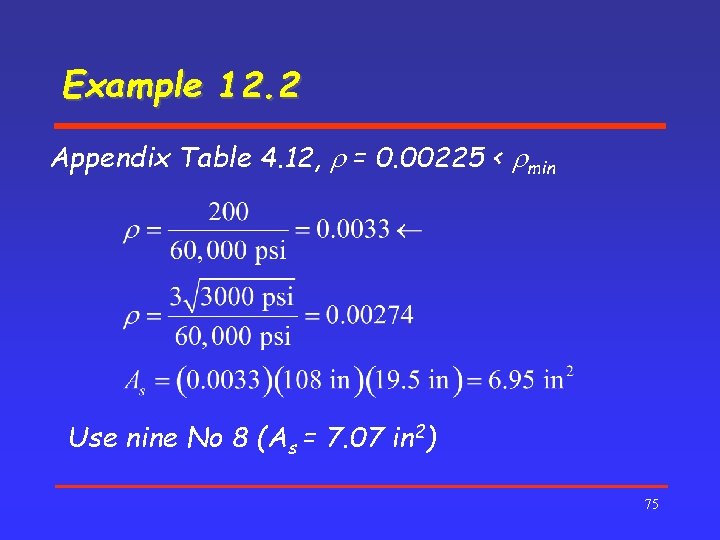
Example 12. 2 Appendix Table 4. 12, r = 0. 00225 < rmin Use nine No 8 (As = 7. 07 in 2) 75
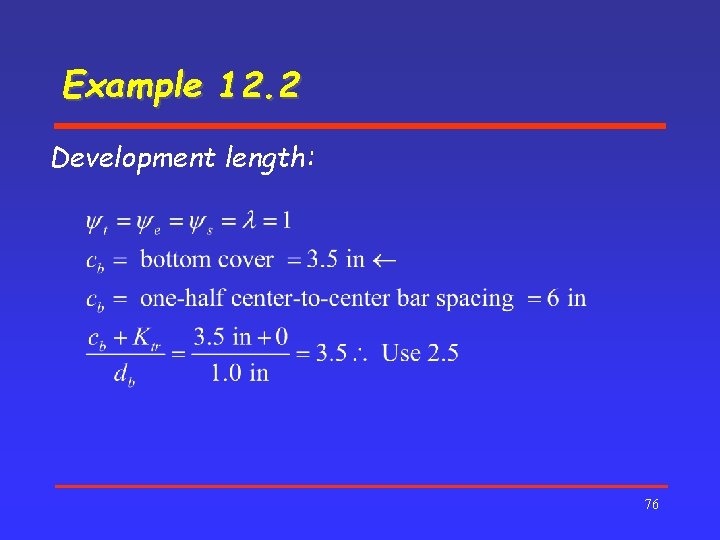
Example 12. 2 Development length: 76
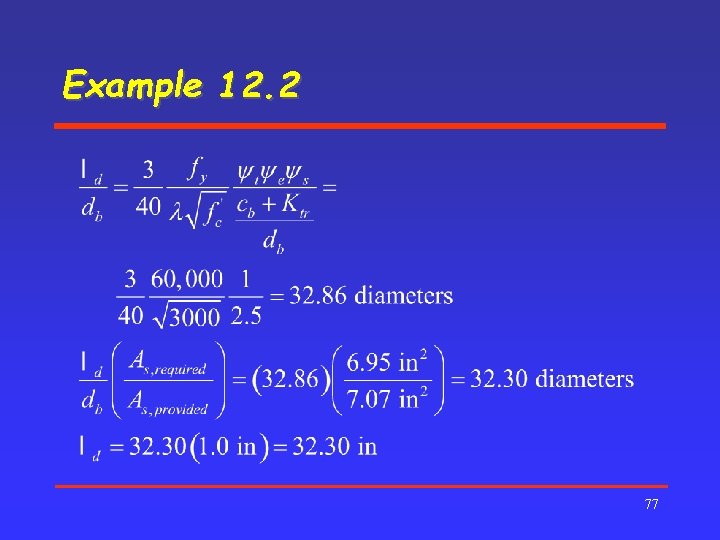
Example 12. 2 77
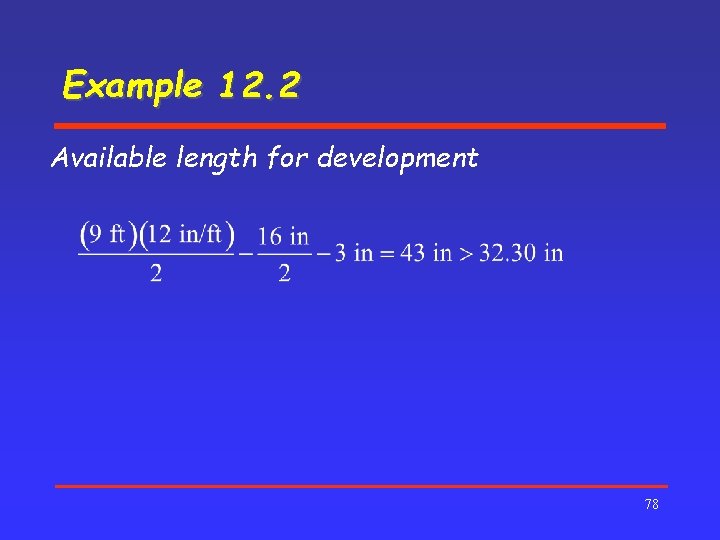
Example 12. 2 Available length for development 78
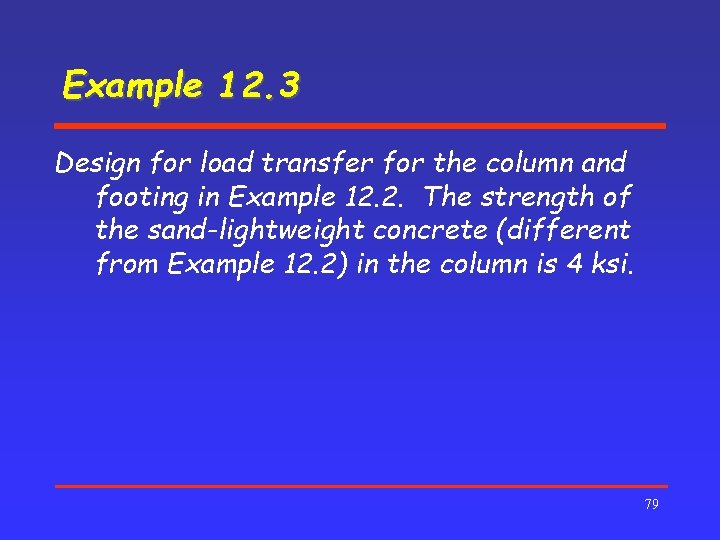
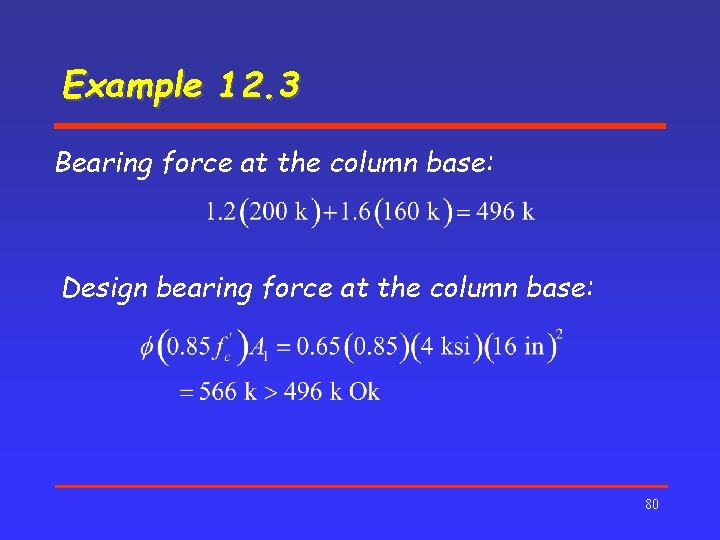
Example 12. 3 Design for load transfer for the column and footing in Example 12. 2. The strength of the sand-lightweight concrete (different from Example 12. 2) in the column is 4 ksi. 79
Example 12. 3 Bearing force at the column base: Design bearing force at the column base: 80
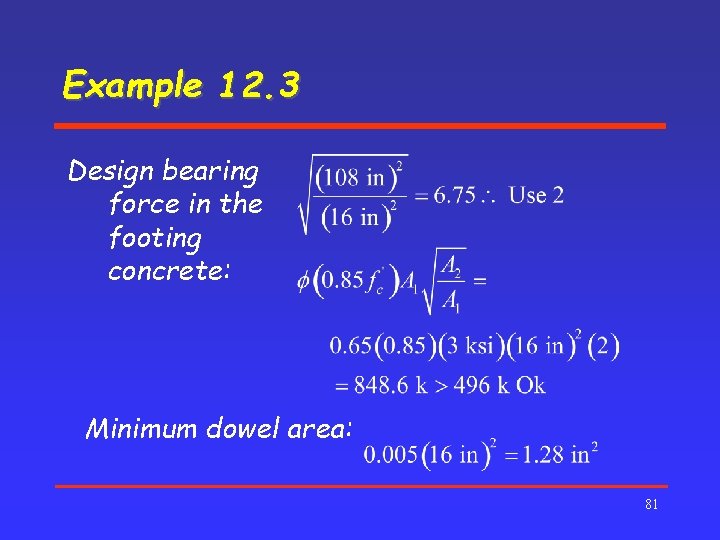
Example 12. 3 Design bearing force in the footing concrete: Minimum dowel area: 81
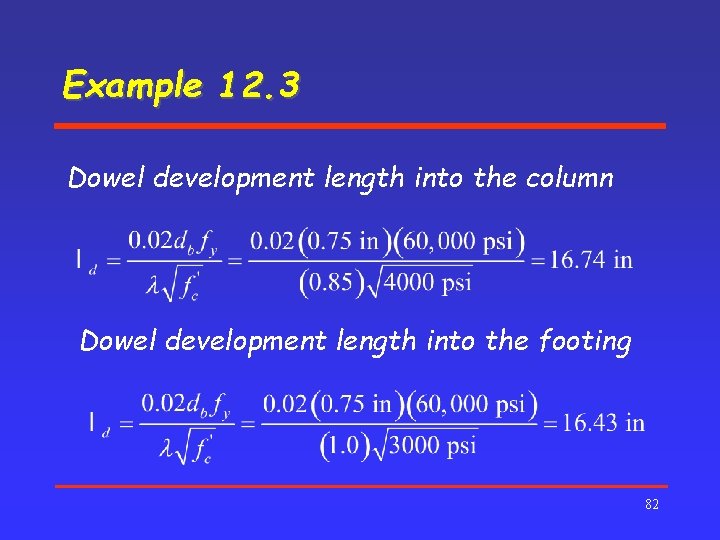
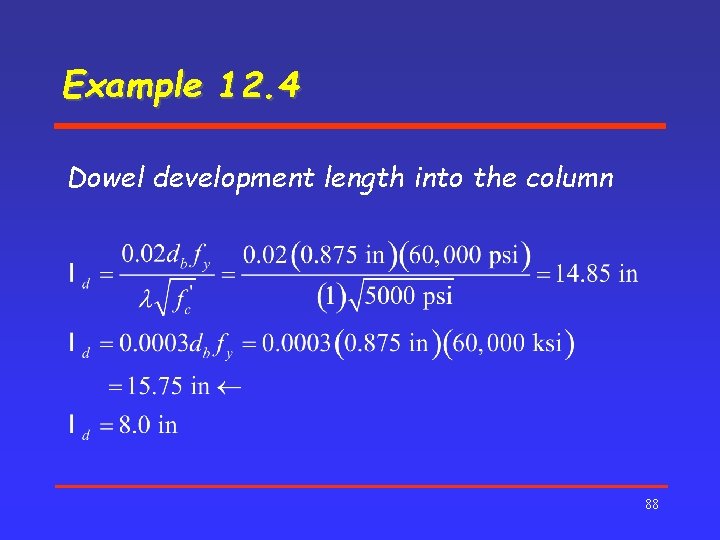
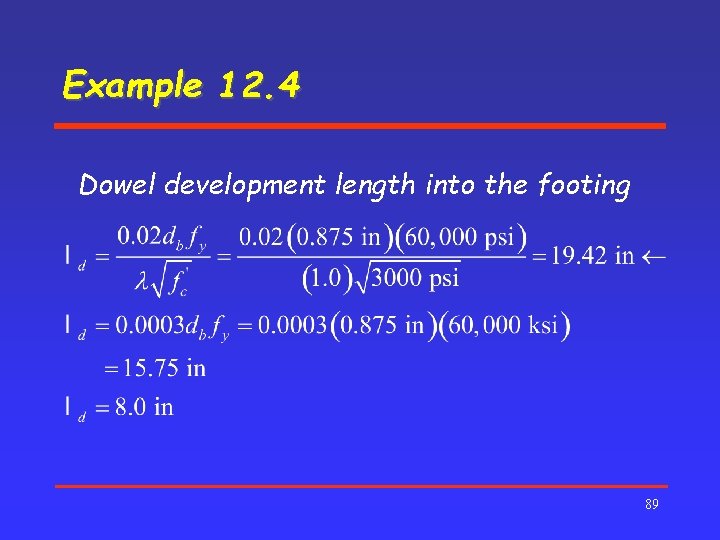
Example 12. 3 Dowel development length into the column Dowel development length into the footing 82
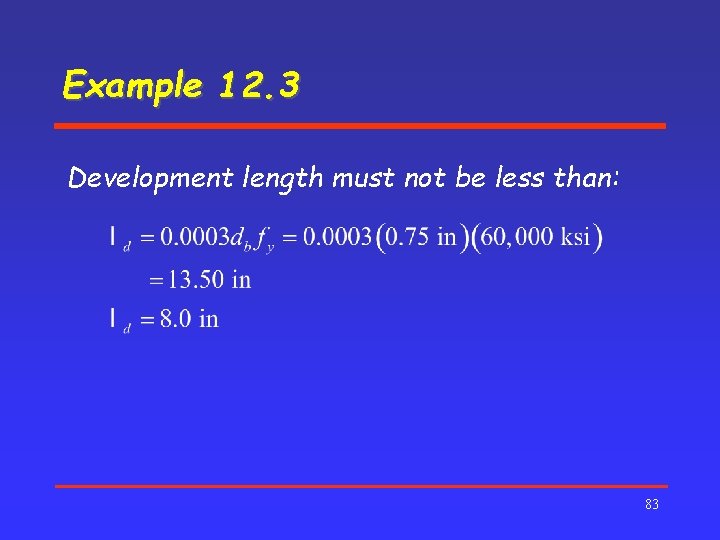
Example 12. 3 Development length must not be less than: 83
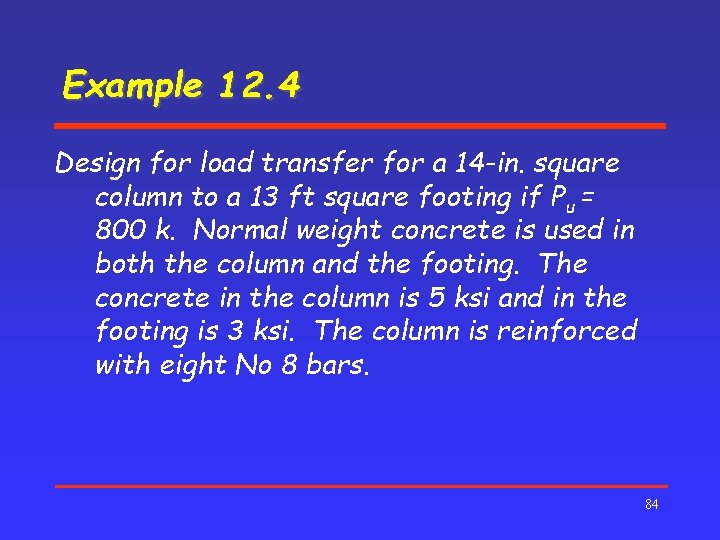
Example 12. 4 Design for load transfer for a 14 -in. square column to a 13 ft square footing if Pu = 800 k. Normal weight concrete is used in both the column and the footing. The concrete in the column is 5 ksi and in the footing is 3 ksi. The column is reinforced with eight No 8 bars. 84
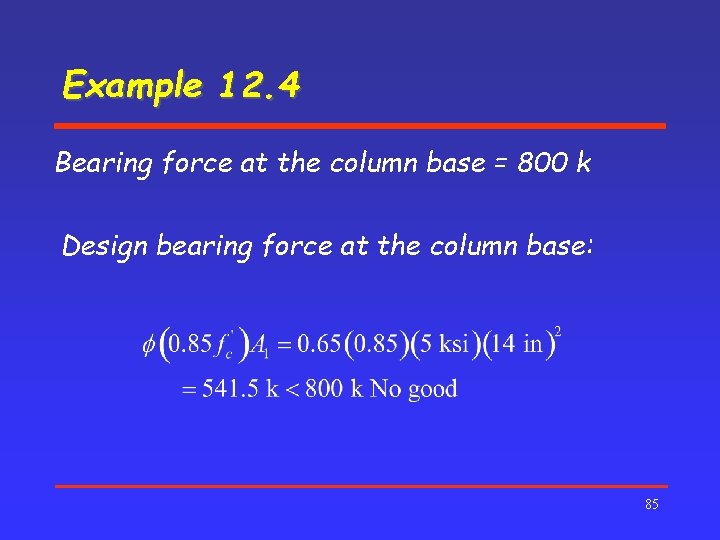
Example 12. 4 Bearing force at the column base = 800 k Design bearing force at the column base: 85
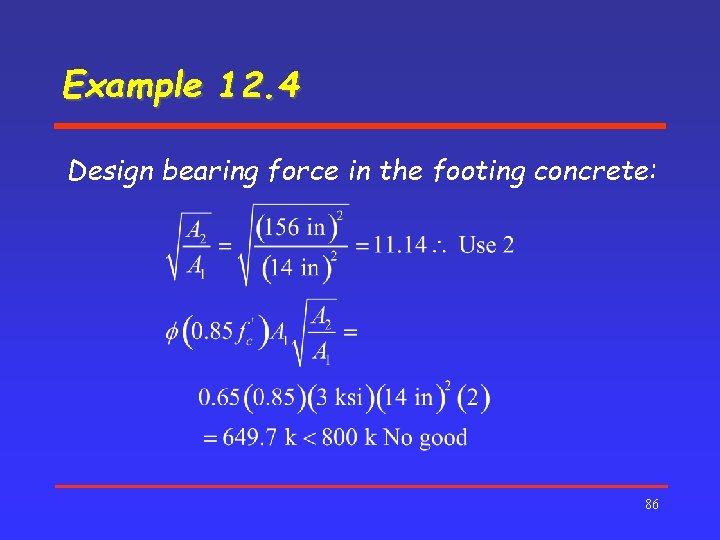
Example 12. 4 Design bearing force in the footing concrete: 86
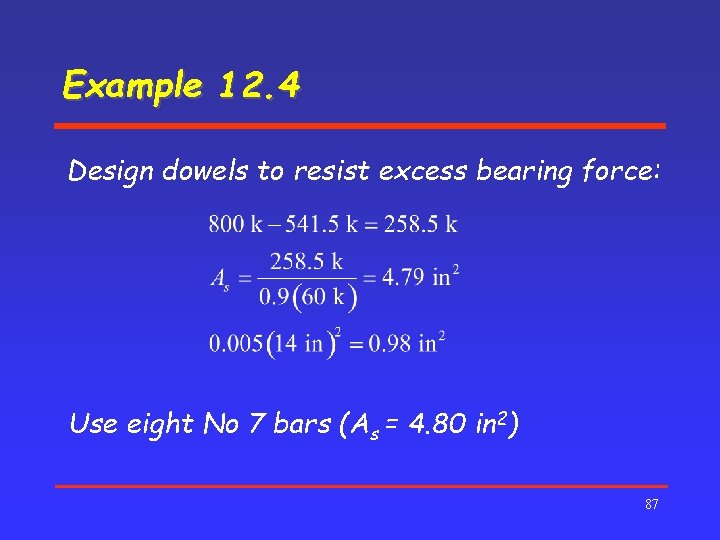
Example 12. 4 Design dowels to resist excess bearing force: Use eight No 7 bars (As = 4. 80 in 2) 87
Example 12. 4 Dowel development length into the column 88
Example 12. 4 Dowel development length into the footing 89
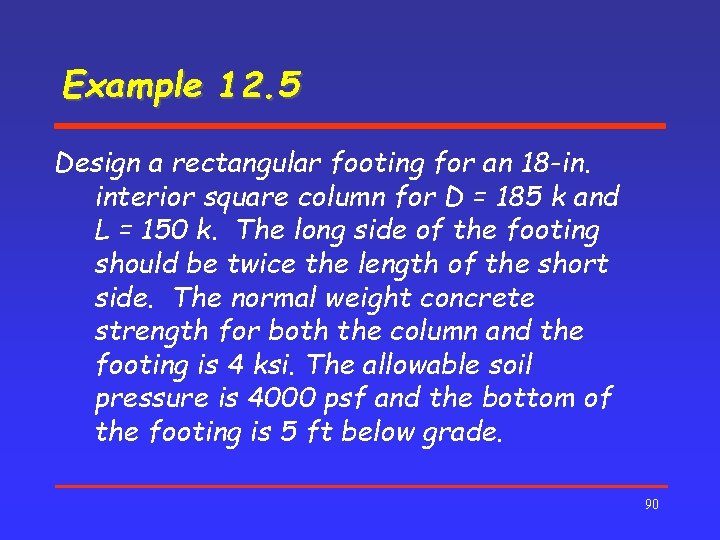
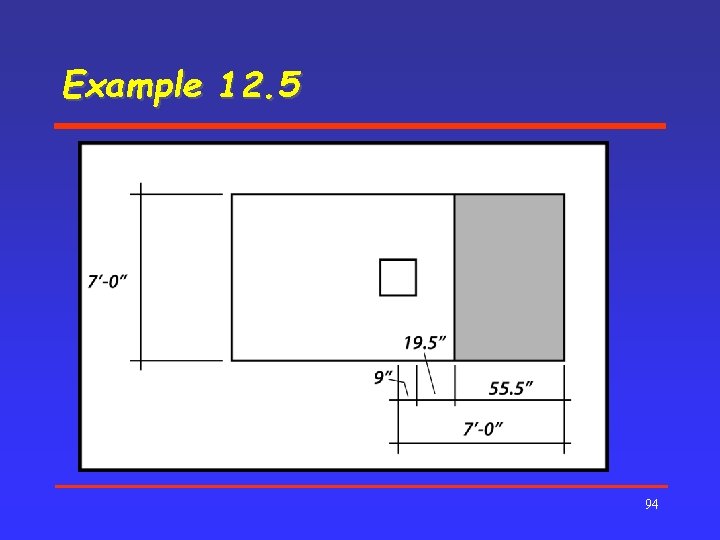
Example 12. 5 Design a rectangular footing for an 18 -in. interior square column for D = 185 k and L = 150 k. The long side of the footing should be twice the length of the short side. The normal weight concrete strength for both the column and the footing is 4 ksi. The allowable soil pressure is 4000 psf and the bottom of the footing is 5 ft below grade. 90
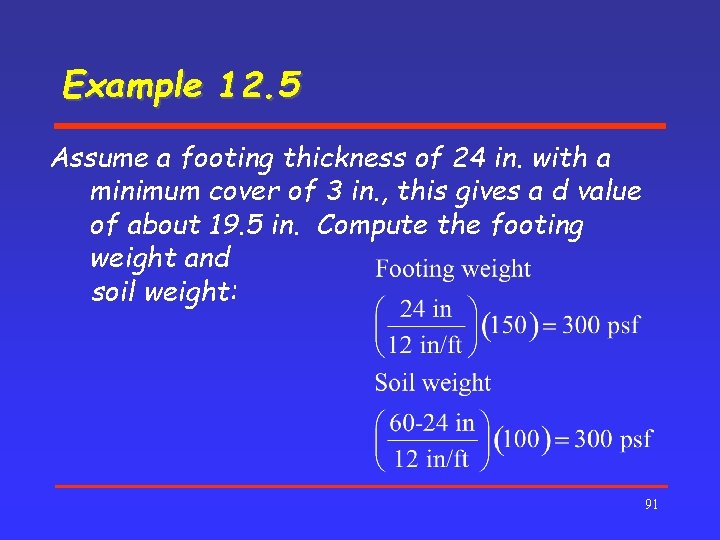
Example 12. 5 Assume a footing thickness of 24 in. with a minimum cover of 3 in. , this gives a d value of about 19. 5 in. Compute the footing weight and soil weight: 91
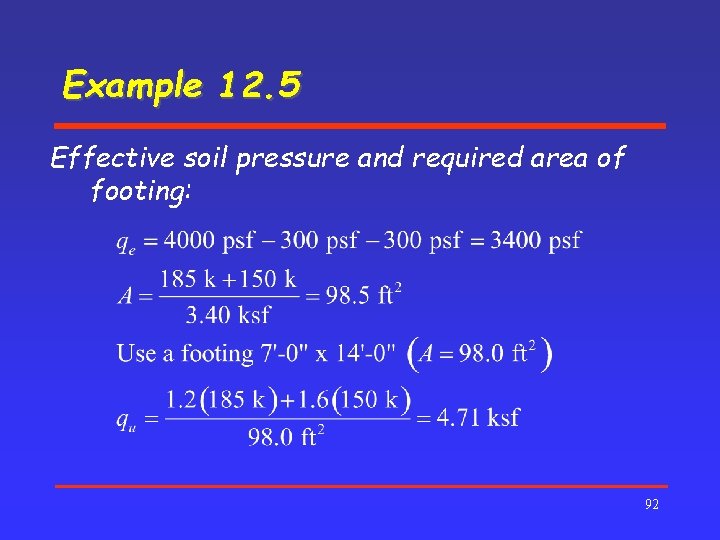
Example 12. 5 Effective soil pressure and required area of footing: 92
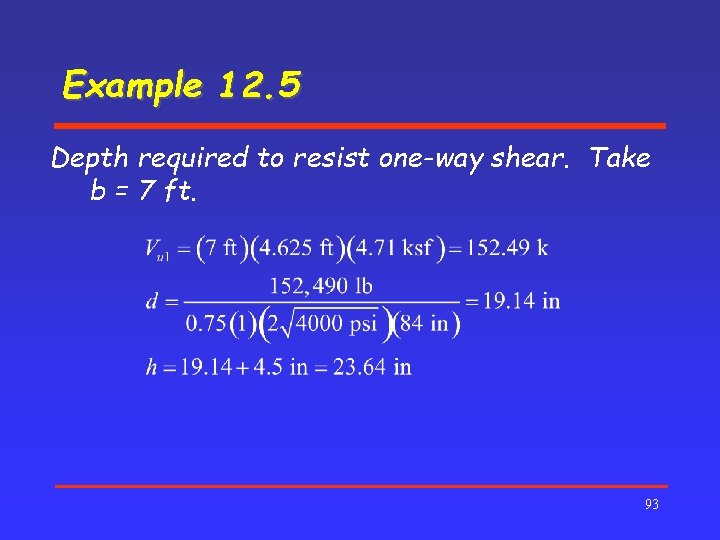
Example 12. 5 Depth required to resist one-way shear. Take b = 7 ft. 93
Example 12. 5 94
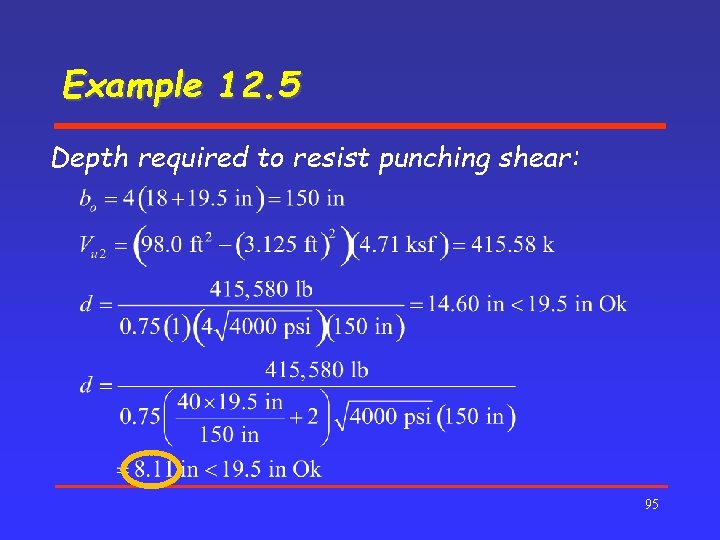
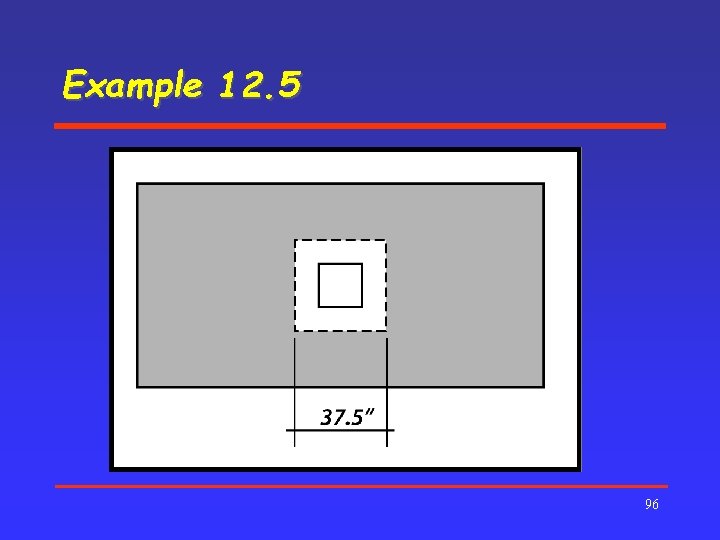
Example 12. 5 Depth required to resist punching shear: 95
Example 12. 5 96
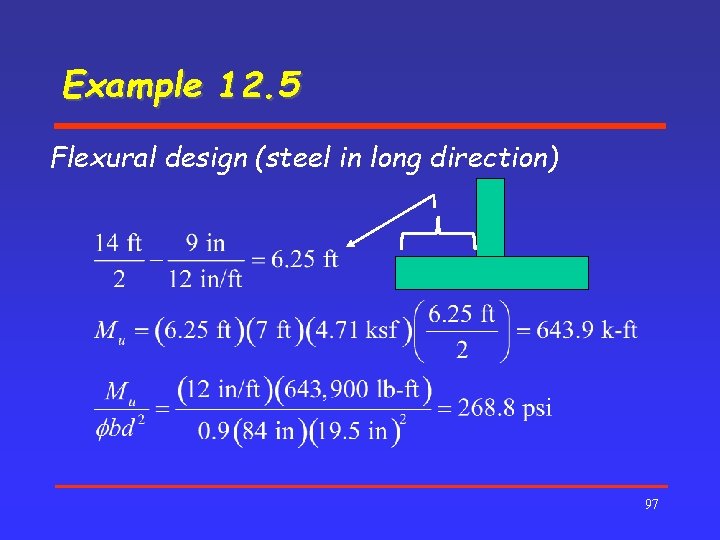
Example 12. 5 Flexural design (steel in long direction) 97
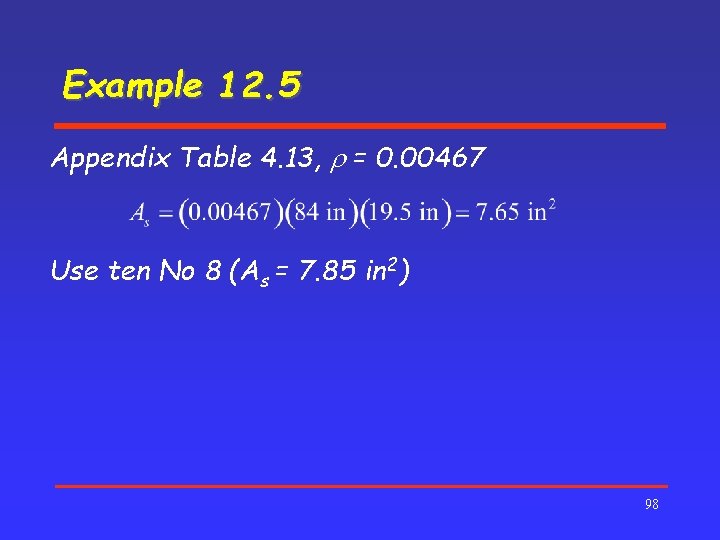
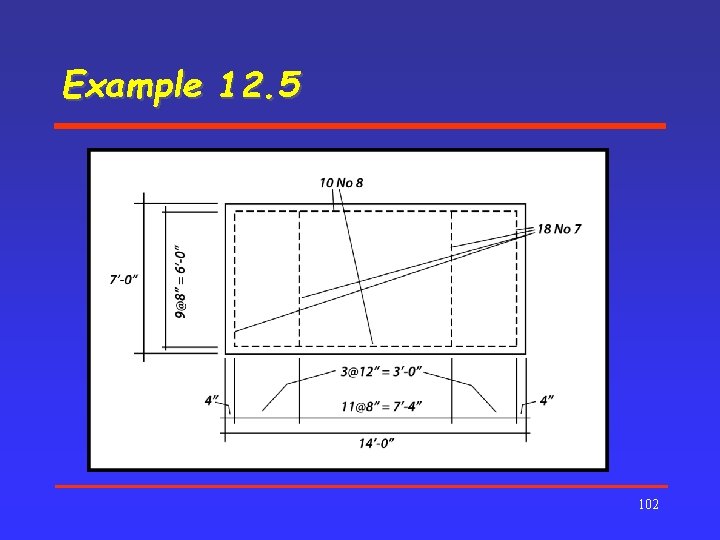
Example 12. 5 Appendix Table 4. 13, r = 0. 00467 Use ten No 8 (As = 7. 85 in 2) 98
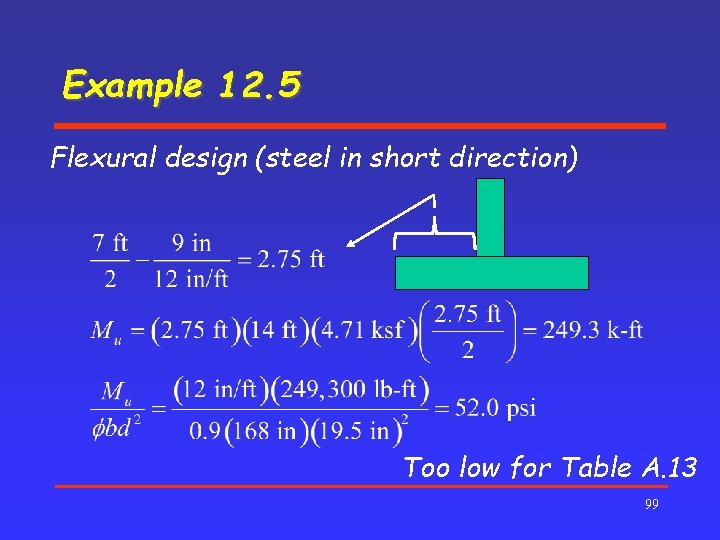
Example 12. 5 Flexural design (steel in short direction) Too low for Table A. 13 99
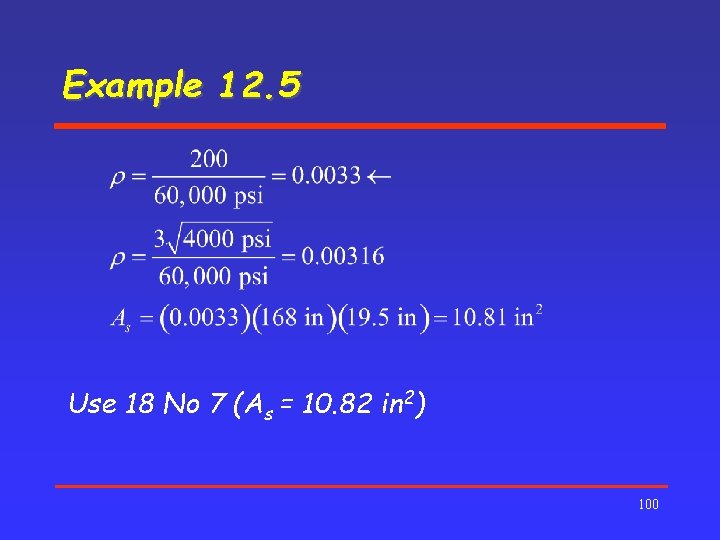
Example 12. 5 Use 18 No 7 (As = 10. 82 in 2) 100
Example 12. 5 Use 2/3 x 18 = 12 bars in band width 101
Example 12. 5 102