
Foot Ankle Injuries Edited by Mehdi jalali majd
Foot & Ankle Injuries Edited by: Mehdi jalali majd
Basic Physical Exam • Inspection: o Swelling, Ecchymosis, Deformity • Range of Motion: o Dorsiflexion, Plantarflexion o Inversion and Eversion • Strength • Palpation: o o o Medial and Lateral Malleolus Base of 5 th Metatarsal Achilles Tendon Midfoot Proximal Fibula • Assess neurovascular status
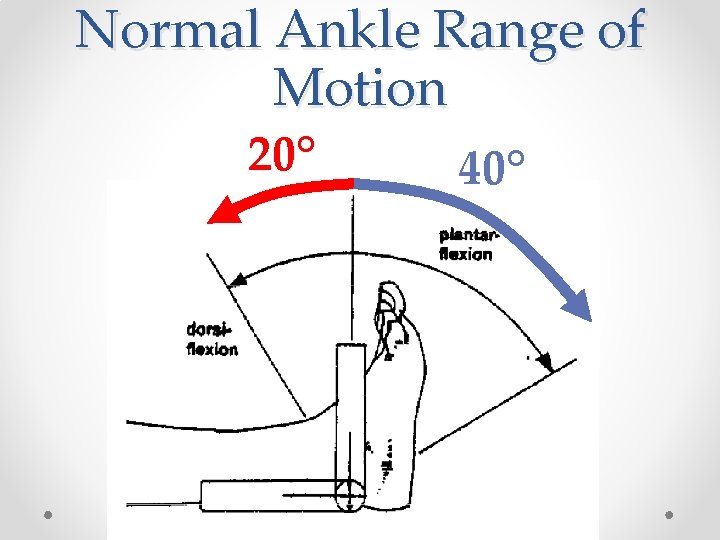
Normal Ankle Range of Motion 20° 40°
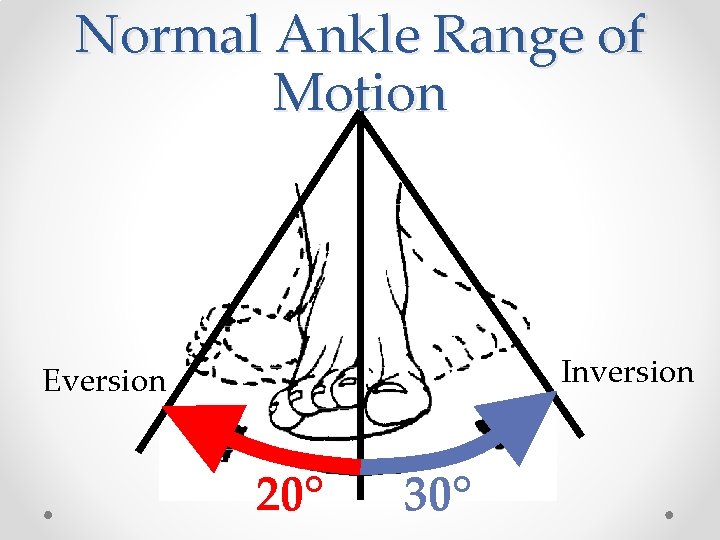
Normal Ankle Range of Motion Inversion Eversion 20° 30°
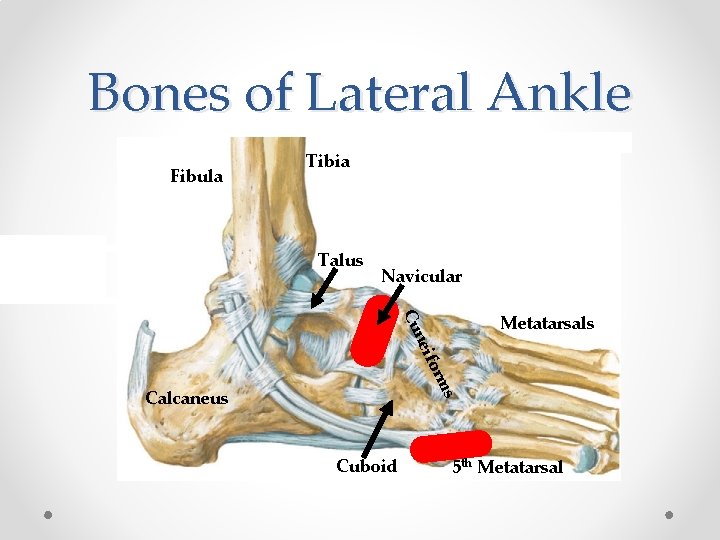
Bones of Lateral Ankle Fibula Tibia Talus Navicular ms for nei Cu Metatarsals Calcaneus Cuboid 5 th Metatarsal
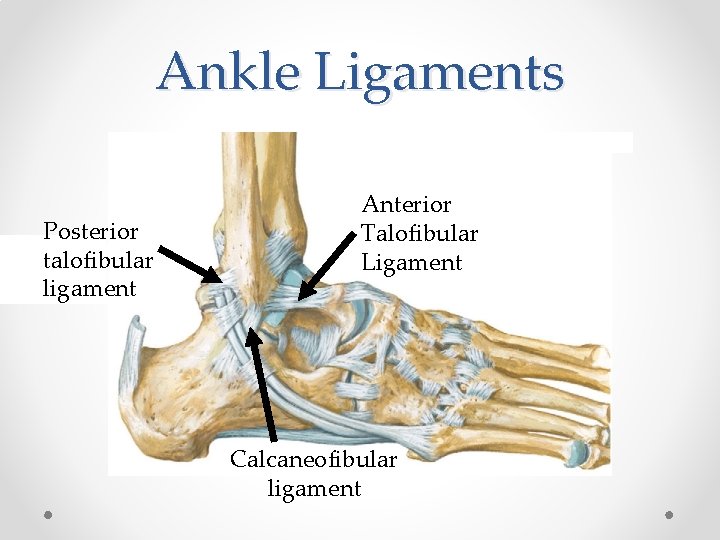
Ankle Ligaments Posterior talofibular ligament Anterior Talofibular Ligament Calcaneofibular ligament
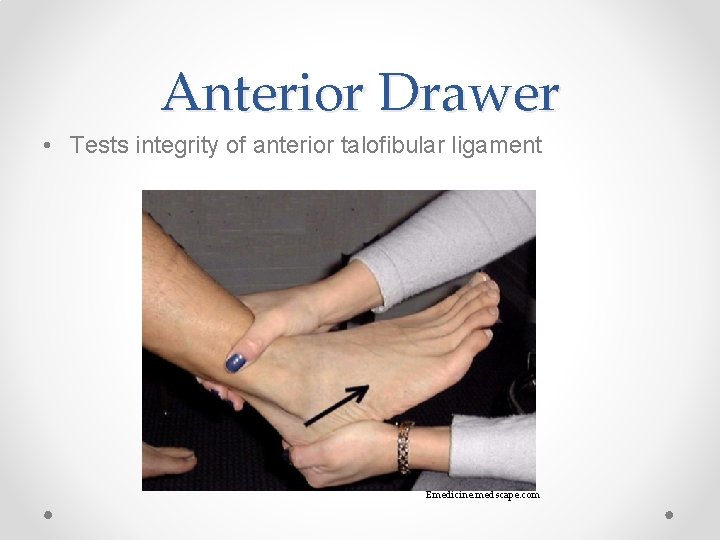
Anterior Drawer • Tests integrity of anterior talofibular ligament Emedicine. medscape. com
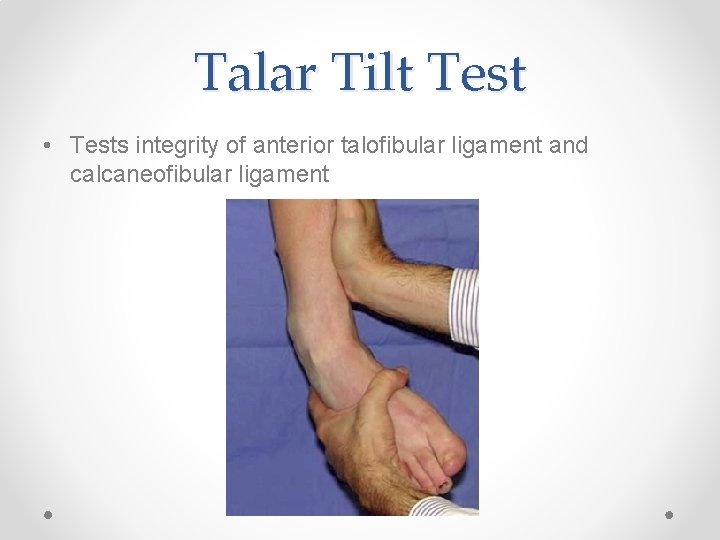
Talar Tilt Test • Tests integrity of anterior talofibular ligament and calcaneofibular ligament
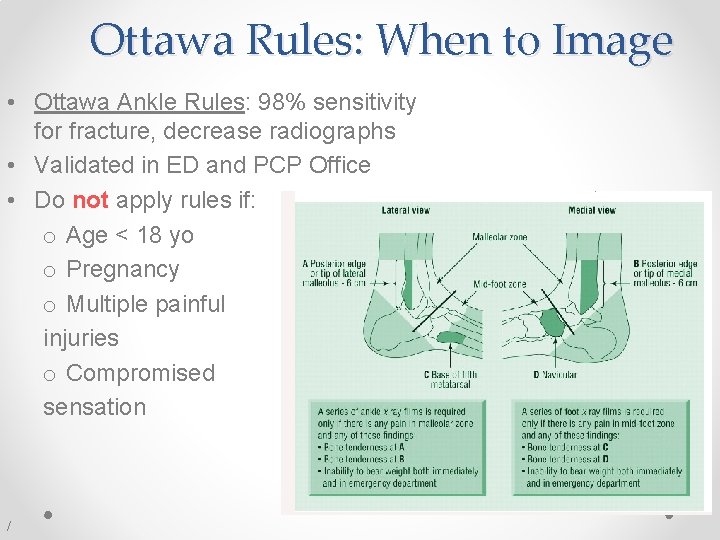
Ottawa Rules: When to Image • Ottawa Ankle Rules: 98% sensitivity for fracture, decrease radiographs • Validated in ED and PCP Office • Do not apply rules if: o Age < 18 yo o Pregnancy o Multiple painful injuries o Compromised sensation /
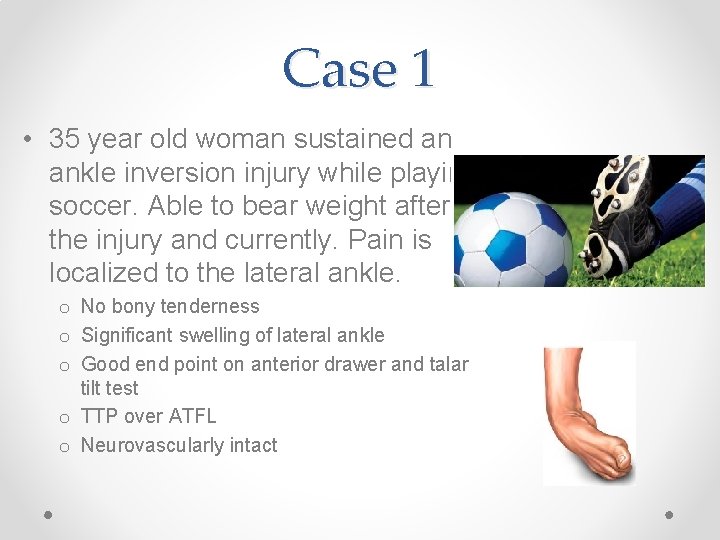
Case 1 • 35 year old woman sustained an ankle inversion injury while playing soccer. Able to bear weight after the injury and currently. Pain is localized to the lateral ankle. o No bony tenderness o Significant swelling of lateral ankle o Good end point on anterior drawer and talar tilt test o TTP over ATFL o Neurovascularly intact
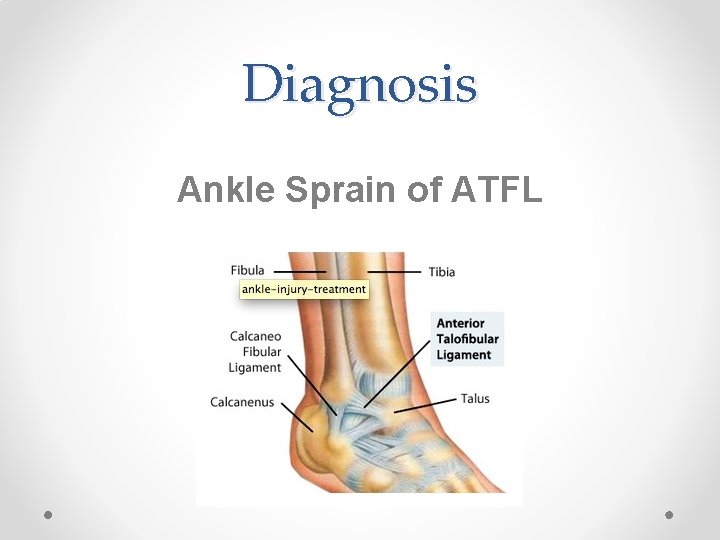
Diagnosis Ankle Sprain of ATFL
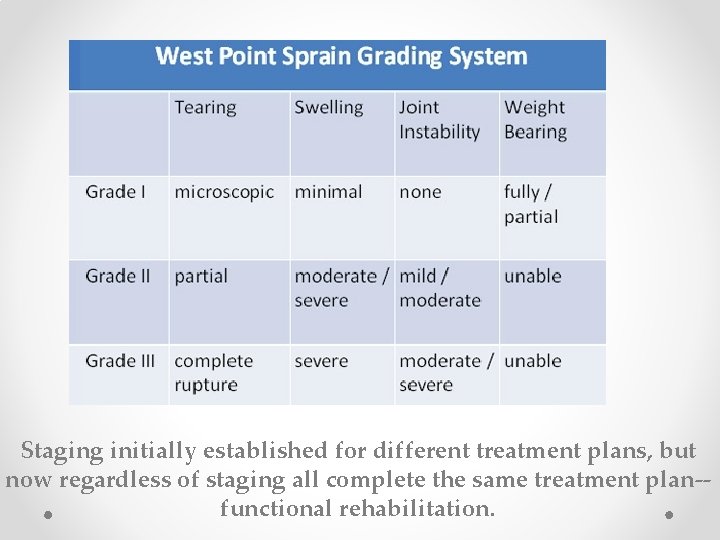
Staging initially established for different treatment plans, but now regardless of staging all complete the same treatment plan-functional rehabilitation.
Management of Ankle Sprain • Neuromuscular ankle training o Increased strength o Improved proprioception—balance exercises • Air Splint initially (additional lateral stability) o Boot only if think more severe diagnosis on differential • Crutches for Pain—weight bearing as tolerated with heel to toe walking • RICE—Rest, Ice, Compression, Elevation • Emphasize early range of motion exercises o Write ABCs with foot
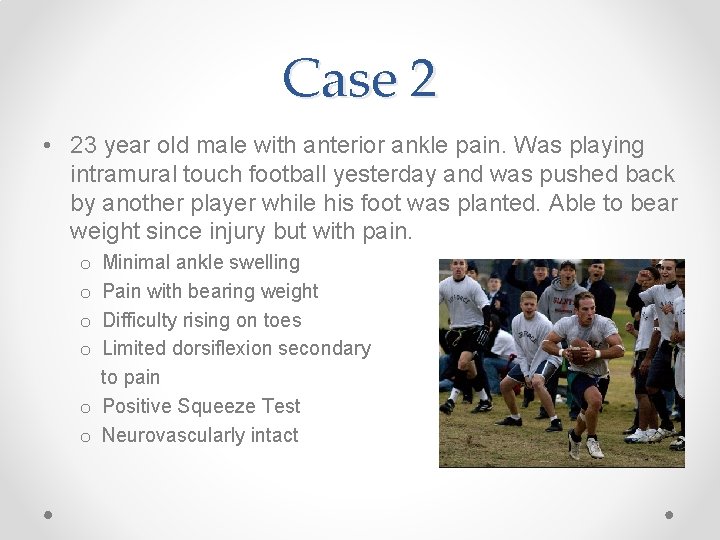
Case 2 • 23 year old male with anterior ankle pain. Was playing intramural touch football yesterday and was pushed back by another player while his foot was planted. Able to bear weight since injury but with pain. Minimal ankle swelling Pain with bearing weight Difficulty rising on toes Limited dorsiflexion secondary to pain o Positive Squeeze Test o Neurovascularly intact o o
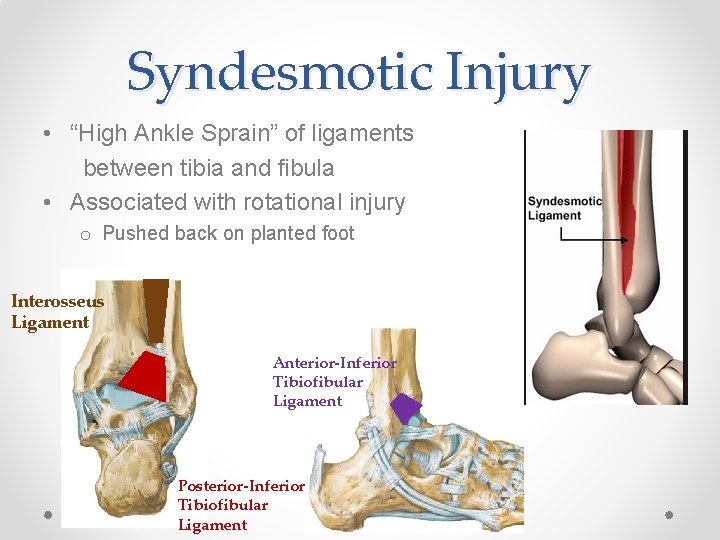
Syndesmotic Injury • “High Ankle Sprain” of ligaments between tibia and fibula • Associated with rotational injury o Pushed back on planted foot Interosseus Ligament Anterior-Inferior Tibiofibular Ligament Posterior-Inferior Tibiofibular Ligament
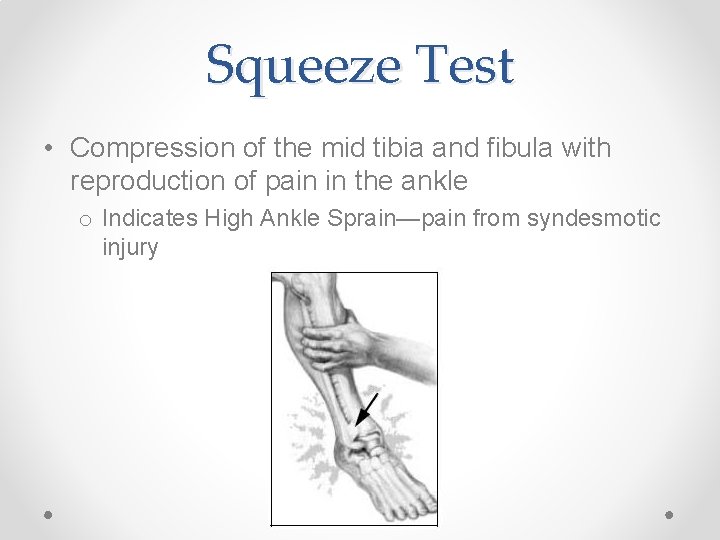
Squeeze Test • Compression of the mid tibia and fibula with reproduction of pain in the ankle o Indicates High Ankle Sprain—pain from syndesmotic injury
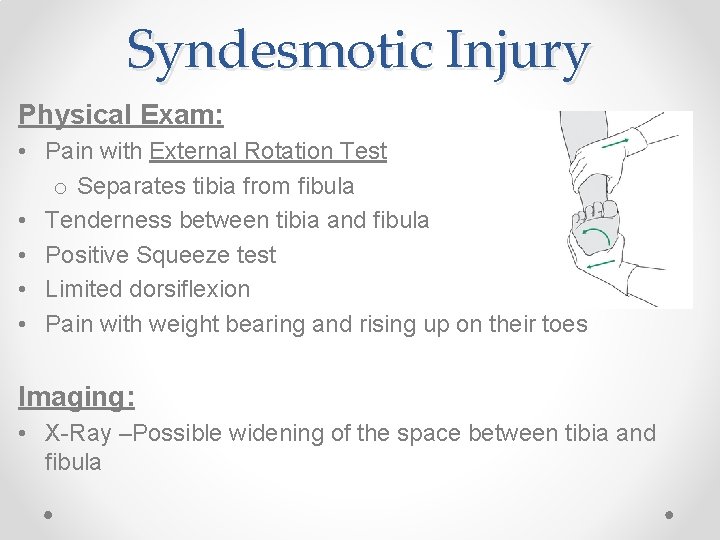
Syndesmotic Injury Physical Exam: • Pain with External Rotation Test o Separates tibia from fibula • Tenderness between tibia and fibula • Positive Squeeze test • Limited dorsiflexion • Pain with weight bearing and rising up on their toes Imaging: • X-Ray –Possible widening of the space between tibia and fibula
Treatment of High Ankle Sprain • Boot as needed—if severe pain • Functional Rehab o Strengthening, early ROM o Similar to ankle sprain • Takes twice as long to recover as compared to ankle sprain • Widening with fracture may require Ortho referral for surgical repair
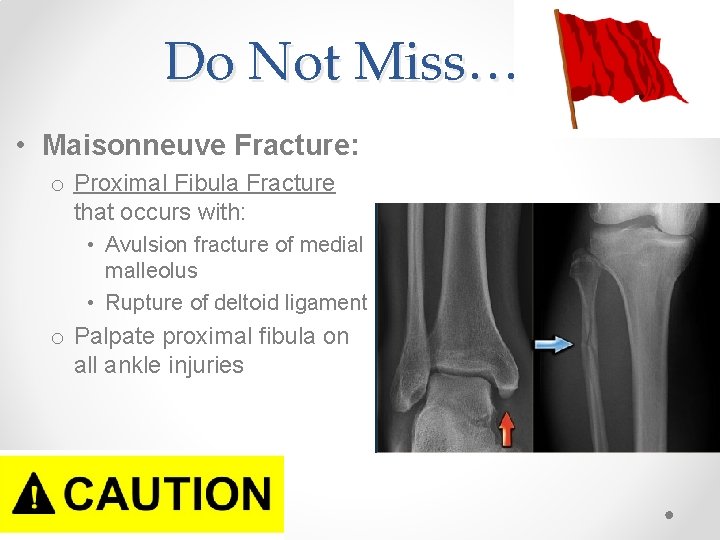
Do Not Miss… • Maisonneuve Fracture: o Proximal Fibula Fracture that occurs with: • Avulsion fracture of medial malleolus • Rupture of deltoid ligament o Palpate proximal fibula on all ankle injuries
Case 3 • 65 year old woman who sustained an inversion injury of her ankle while stepping off a curb yesterday. Localizes pain to foot and lateral ankle. Unable to bear weight at the time of the injury, but can now. o Significant swelling of lateral ankle o TTP over the base of the 5 th metatarsal o Neurovascularly Intact
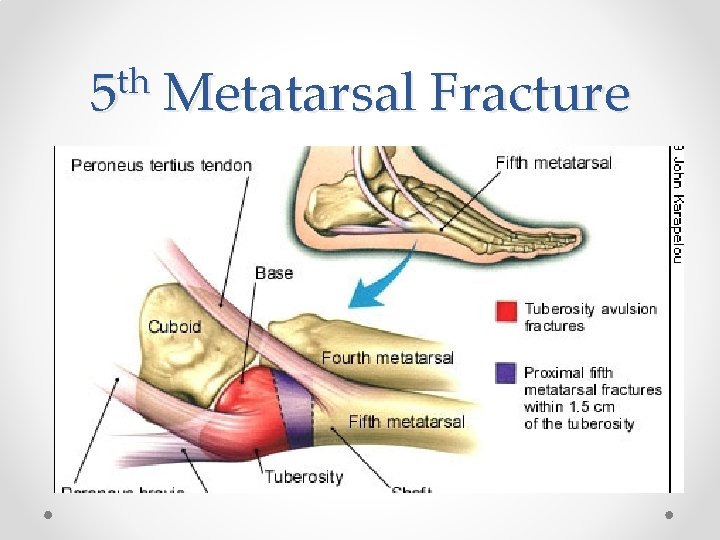
th 5 Metatarsal Fracture
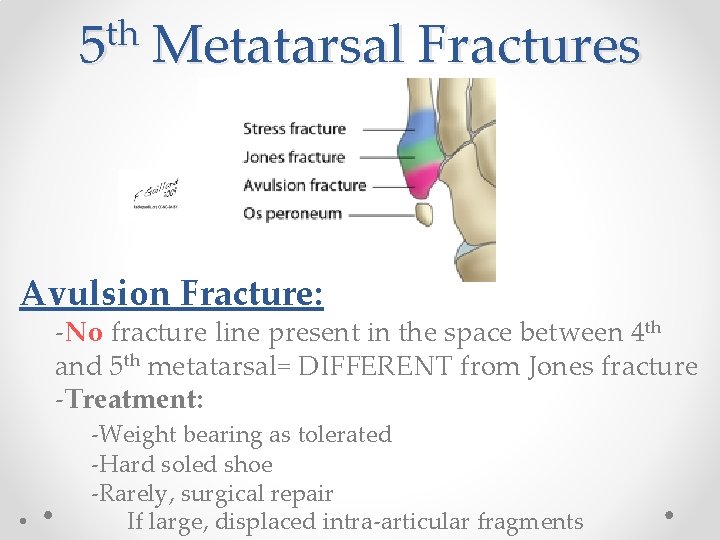
th 5 Metatarsal Fractures Avulsion Fracture: -No fracture line present in the space between 4 th and 5 th metatarsal= DIFFERENT from Jones fracture -Treatment: • -Weight bearing as tolerated -Hard soled shoe -Rarely, surgical repair If large, displaced intra-articular fragments
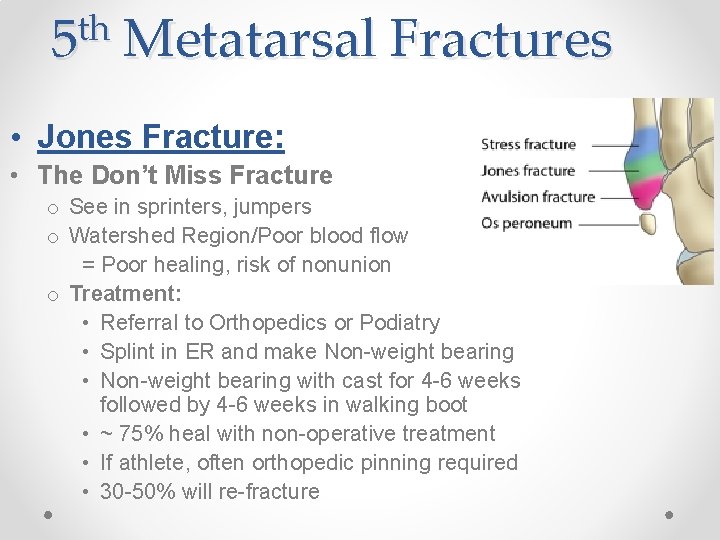
th 5 Metatarsal Fractures • Jones Fracture: • The Don’t Miss Fracture o See in sprinters, jumpers o Watershed Region/Poor blood flow = Poor healing, risk of nonunion o Treatment: • Referral to Orthopedics or Podiatry • Splint in ER and make Non-weight bearing • Non-weight bearing with cast for 4 -6 weeks followed by 4 -6 weeks in walking boot • ~ 75% heal with non-operative treatment • If athlete, often orthopedic pinning required • 30 -50% will re-fracture
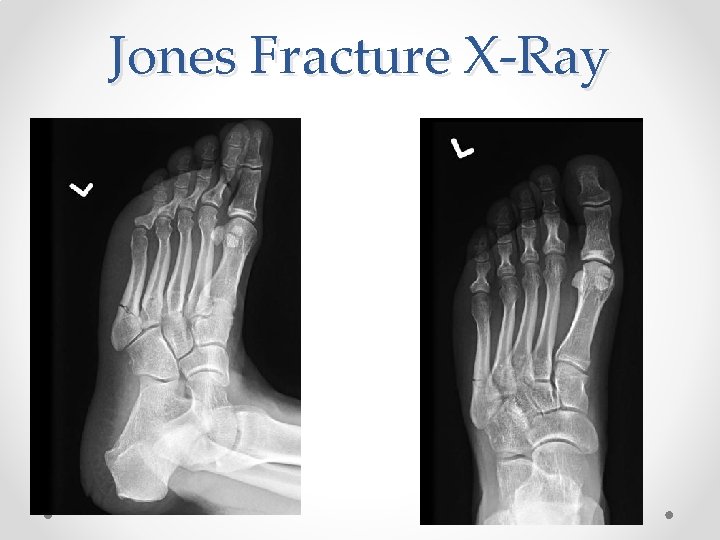
Jones Fracture X-Ray
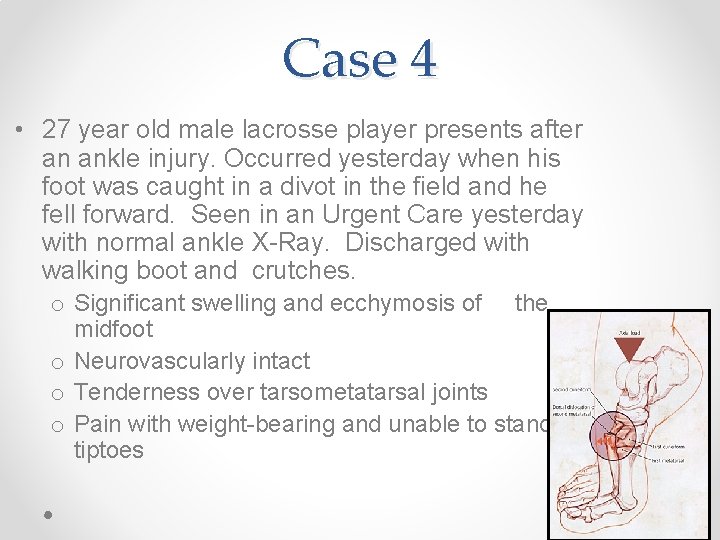
Case 4 • 27 year old male lacrosse player presents after an ankle injury. Occurred yesterday when his foot was caught in a divot in the field and he fell forward. Seen in an Urgent Care yesterday with normal ankle X-Ray. Discharged with walking boot and crutches. o Significant swelling and ecchymosis of the midfoot o Neurovascularly intact o Tenderness over tarsometatarsal joints o Pain with weight-bearing and unable to stand on tiptoes
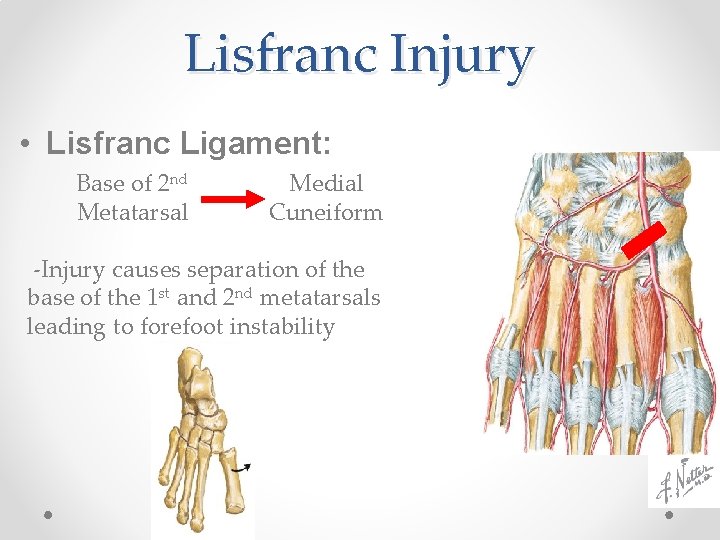
Lisfranc Injury • Lisfranc Ligament: Base of 2 nd Metatarsal Medial Cuneiform -Injury causes separation of the base of the 1 st and 2 nd metatarsals leading to forefoot instability
Lisfranc Injury • Injury is referred to as a Lisfranc if there is any disruption of the tarsometatarsal joint complex o Injury can range from sprain of the Lisfranc ligament to dislocation (due to ligament tear) to fracture • Why is this area of the foot prone to injury? o Transverse ligaments connect the bases of the four lateral metatarsals • No transverse ligament exists between the 1 st and 2 nd metatarsal bases o Minimal support = increased risk of injury
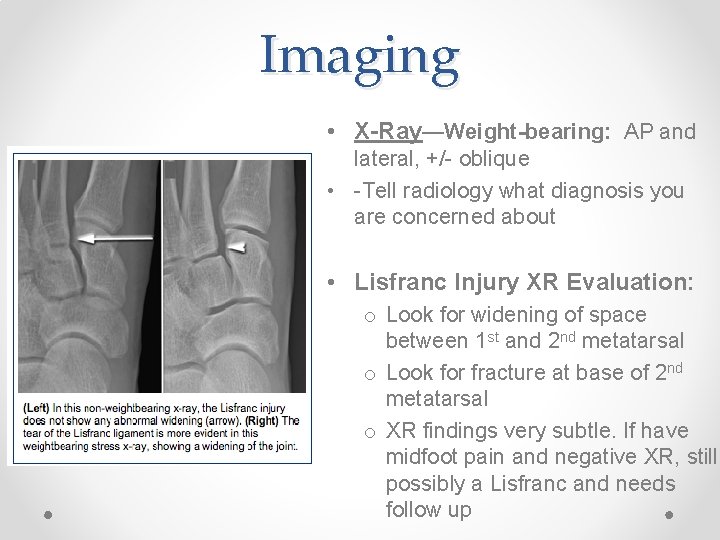
Imaging • X-Ray—Weight-bearing: AP and lateral, +/- oblique • -Tell radiology what diagnosis you are concerned about • Lisfranc Injury XR Evaluation: o Look for widening of space between 1 st and 2 nd metatarsal o Look for fracture at base of 2 nd metatarsal o XR findings very subtle. If have midfoot pain and negative XR, still possibly a Lisfranc and needs follow up
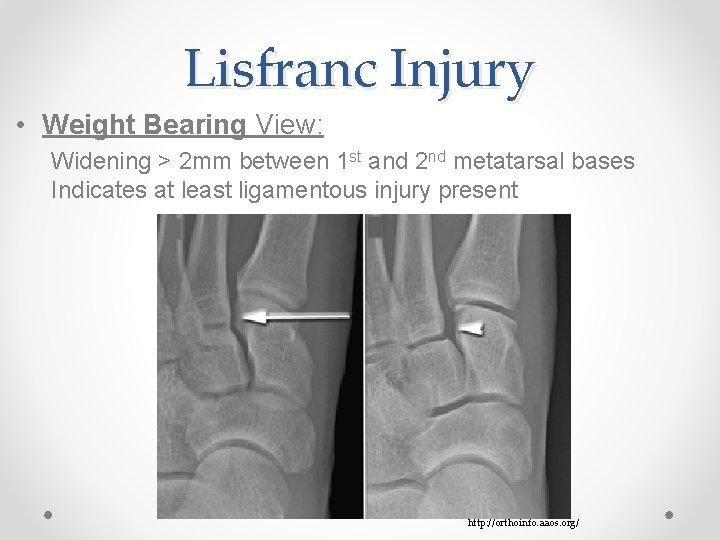
Lisfranc Injury • Weight Bearing View: Widening > 2 mm between 1 st and 2 nd metatarsal bases Indicates at least ligamentous injury present http: //orthoinfo. aaos. org/
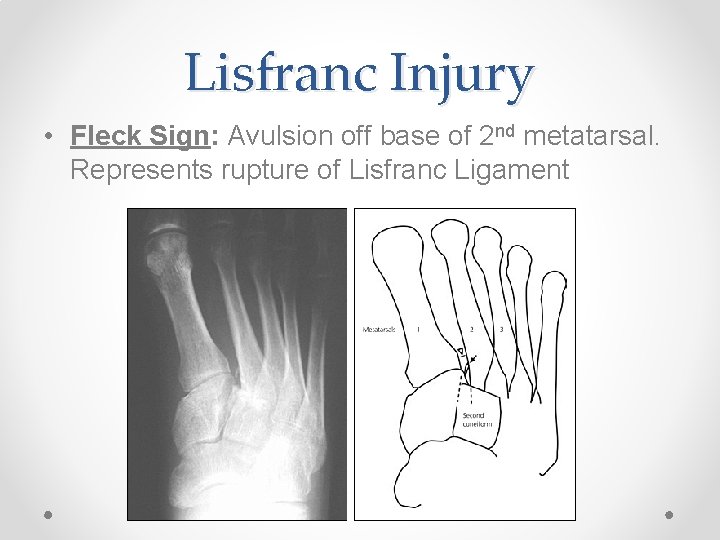
Lisfranc Injury • Fleck Sign: Avulsion off base of 2 nd metatarsal. Represents rupture of Lisfranc Ligament
Lisfranc Treatment • Clinical Diagnosis: Midfoot pain (Tarsometarsal pain) + Injury + Pain with Weight Bearing = Lisfranc o Get weight bearing XR • Treatment: o Prompt Orthopedic referral and follow up o Boot or splint and make non-weight bearing o Treatment usually almost always surgical • Diagnose early as delayed treatment causes: o Chronic pain o Foot dysfunction and arthritis
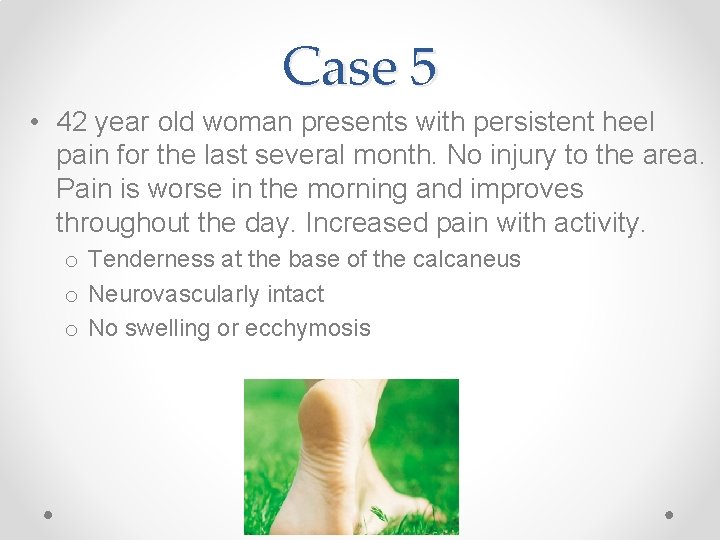
Case 5 • 42 year old woman presents with persistent heel pain for the last several month. No injury to the area. Pain is worse in the morning and improves throughout the day. Increased pain with activity. o Tenderness at the base of the calcaneus o Neurovascularly intact o No swelling or ecchymosis
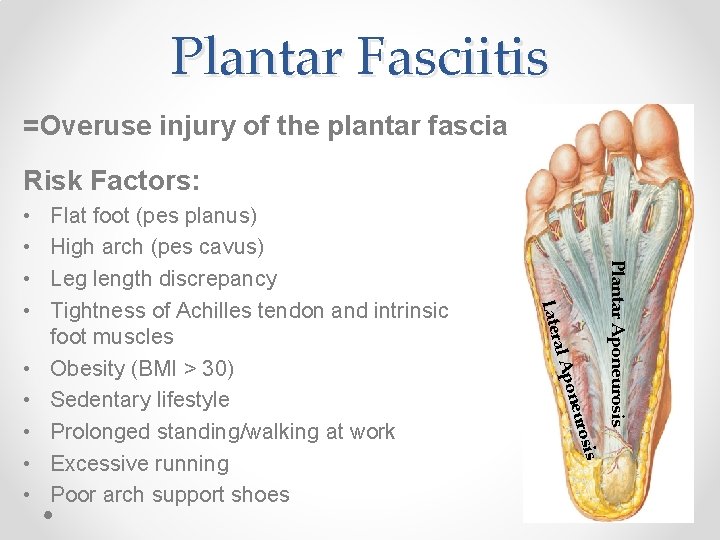
Plantar Fasciitis =Overuse injury of the plantar fascia Risk Factors: is uros pone Plantar Aponeurosis ral A • • • Flat foot (pes planus) High arch (pes cavus) Leg length discrepancy Tightness of Achilles tendon and intrinsic foot muscles Obesity (BMI > 30) Sedentary lifestyle Prolonged standing/walking at work Excessive running Poor arch support shoes Late • •
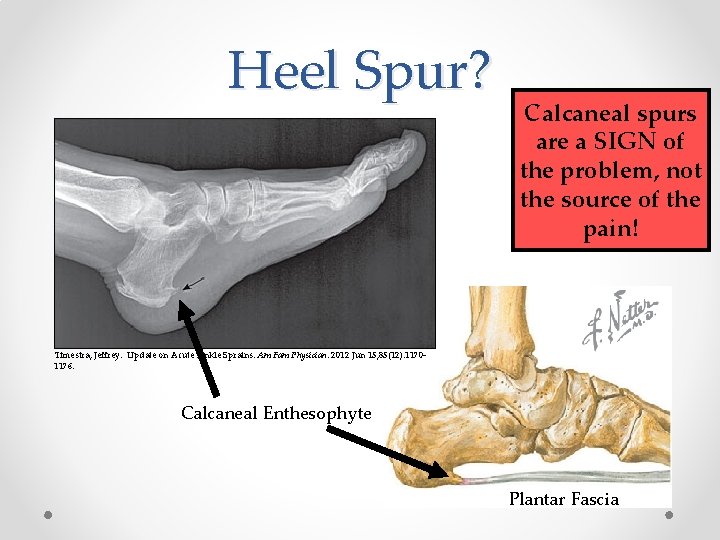
Heel Spur? Calcaneal spurs are a SIGN of the problem, not the source of the pain! Timestra, Jeffrey. Update on Acute Ankle Sprains. Am Fam Physician. 2012 Jun 15; 85(12): 11701176. Calcaneal Enthesophyte Plantar Fascia
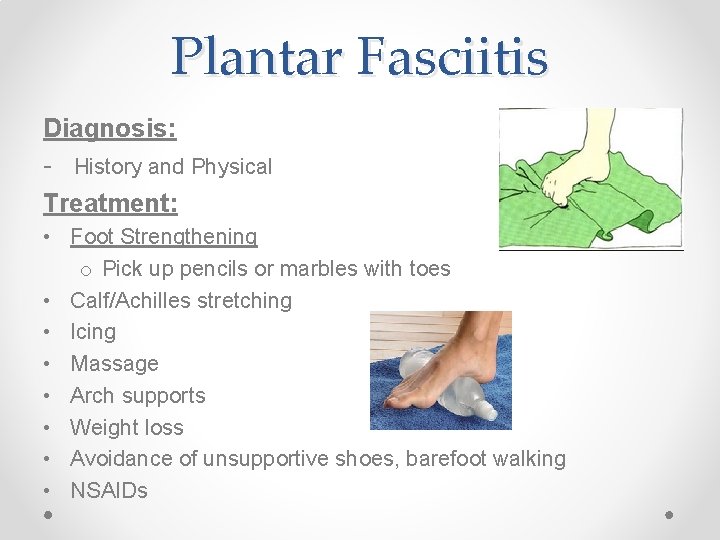
Plantar Fasciitis Diagnosis: - History and Physical Treatment: • Foot Strengthening o Pick up pencils or marbles with toes • Calf/Achilles stretching • Icing • Massage • Arch supports • Weight loss • Avoidance of unsupportive shoes, barefoot walking • NSAIDs
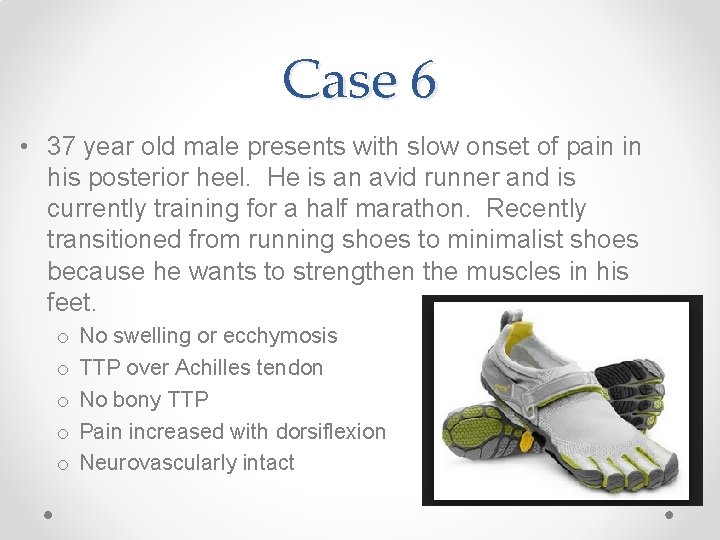
Case 6 • 37 year old male presents with slow onset of pain in his posterior heel. He is an avid runner and is currently training for a half marathon. Recently transitioned from running shoes to minimalist shoes because he wants to strengthen the muscles in his feet. o o o No swelling or ecchymosis TTP over Achilles tendon No bony TTP Pain increased with dorsiflexion Neurovascularly intact
Achilles Tendinopathy • Overuse injury of the Achilles tendon • Thickening and inflammation of the peritendinous tissue • Risk Factors: o Increased activity (distance, speed, terrain) o Reduced recovery time o Change in footwear • Not as much type of footwear o Flat feet o Calf tightness
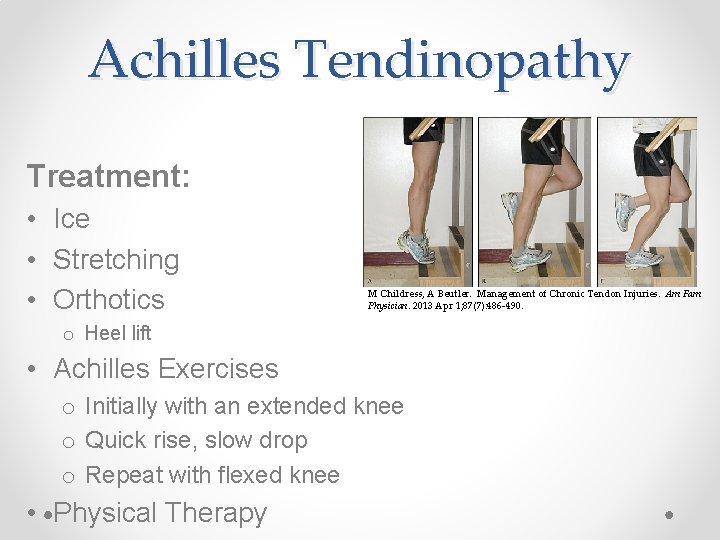
Achilles Tendinopathy Treatment: • Ice • Stretching • Orthotics M Childress, A Beutler. Management of Chronic Tendon Injuries. Am Fam Physician. 2013 Apr 1; 87(7): 486 -490. o Heel lift • Achilles Exercises o Initially with an extended knee o Quick rise, slow drop o Repeat with flexed knee • Physical Therapy
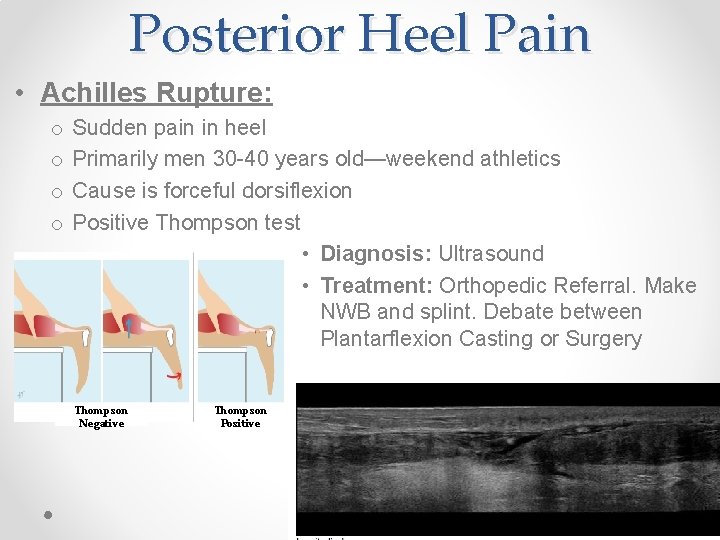
Posterior Heel Pain • Achilles Rupture: o o Sudden pain in heel Primarily men 30 -40 years old—weekend athletics Cause is forceful dorsiflexion Positive Thompson test • Diagnosis: Ultrasound • Treatment: Orthopedic Referral. Make NWB and splint. Debate between Plantarflexion Casting or Surgery Thompson Negative Thompson Positive
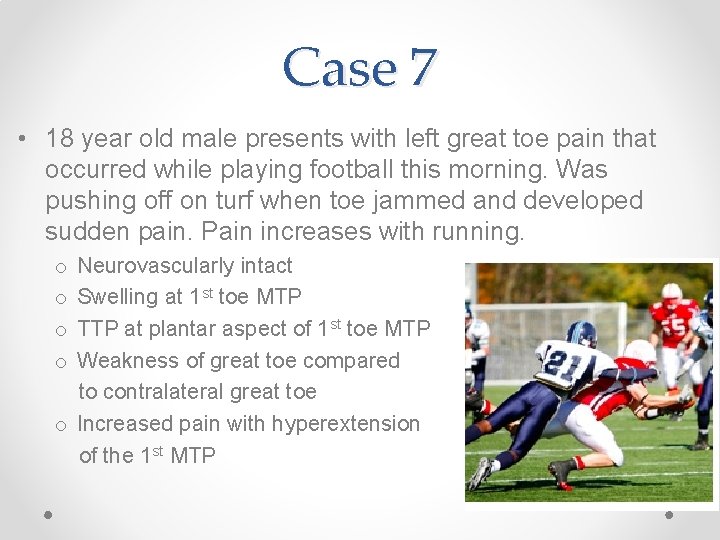
Case 7 • 18 year old male presents with left great toe pain that occurred while playing football this morning. Was pushing off on turf when toe jammed and developed sudden pain. Pain increases with running. Neurovascularly intact Swelling at 1 st toe MTP TTP at plantar aspect of 1 st toe MTP Weakness of great toe compared to contralateral great toe o Increased pain with hyperextension of the 1 st MTP o o
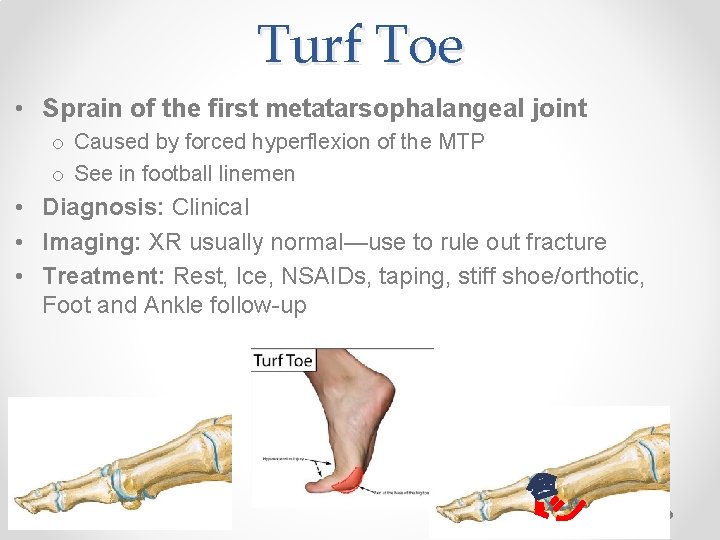
Turf Toe • Sprain of the first metatarsophalangeal joint o Caused by forced hyperflexion of the MTP o See in football linemen • Diagnosis: Clinical • Imaging: XR usually normal—use to rule out fracture • Treatment: Rest, Ice, NSAIDs, taping, stiff shoe/orthotic, Foot and Ankle follow-up
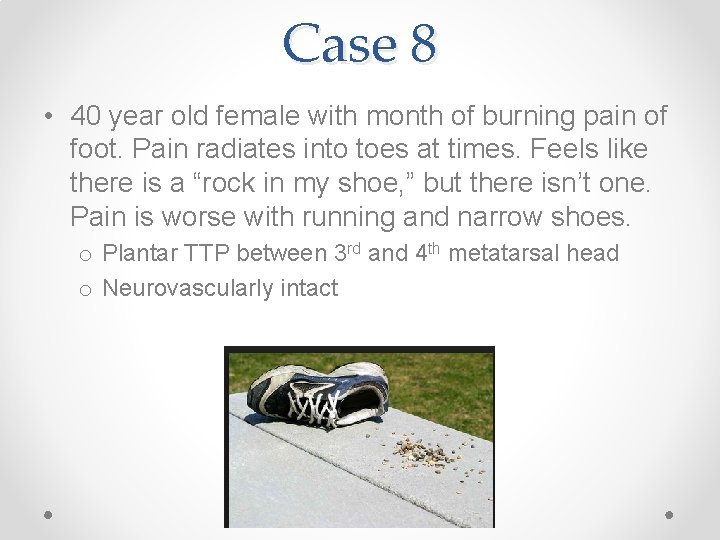
Case 8 • 40 year old female with month of burning pain of foot. Pain radiates into toes at times. Feels like there is a “rock in my shoe, ” but there isn’t one. Pain is worse with running and narrow shoes. o Plantar TTP between 3 rd and 4 th metatarsal head o Neurovascularly intact
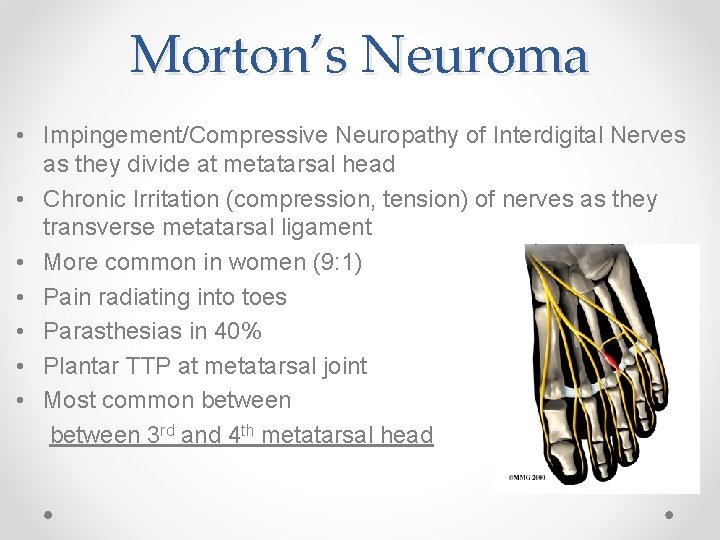
Morton’s Neuroma • Impingement/Compressive Neuropathy of Interdigital Nerves as they divide at metatarsal head • Chronic Irritation (compression, tension) of nerves as they transverse metatarsal ligament • More common in women (9: 1) • Pain radiating into toes • Parasthesias in 40% • Plantar TTP at metatarsal joint • Most common between 3 rd and 4 th metatarsal head
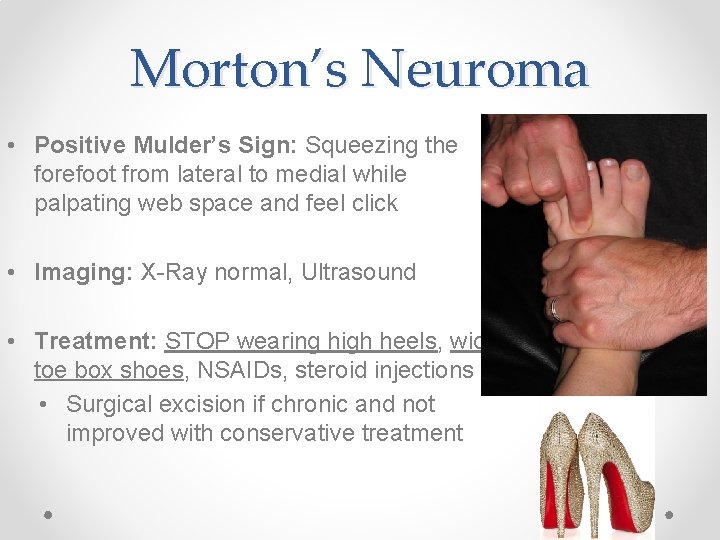
Morton’s Neuroma • Positive Mulder’s Sign: Squeezing the forefoot from lateral to medial while palpating web space and feel click • Imaging: X-Ray normal, Ultrasound • Treatment: STOP wearing high heels, wide toe box shoes, NSAIDs, steroid injections • Surgical excision if chronic and not improved with conservative treatment
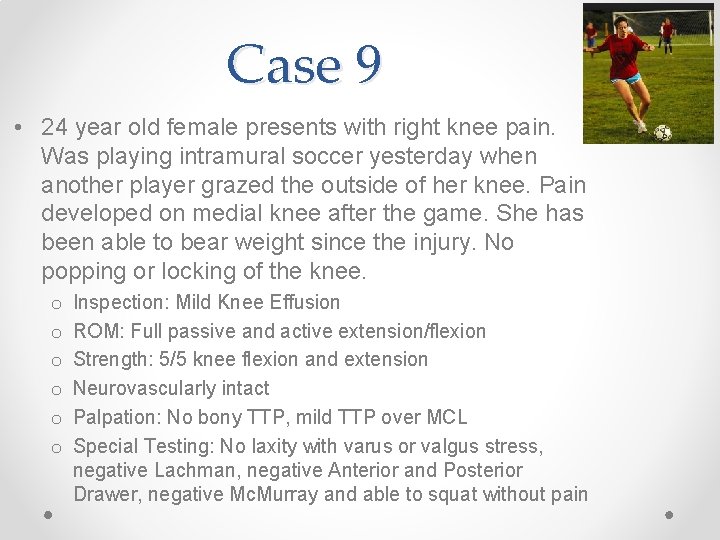
Case 9 • 24 year old female presents with right knee pain. Was playing intramural soccer yesterday when another player grazed the outside of her knee. Pain developed on medial knee after the game. She has been able to bear weight since the injury. No popping or locking of the knee. o o o Inspection: Mild Knee Effusion ROM: Full passive and active extension/flexion Strength: 5/5 knee flexion and extension Neurovascularly intact Palpation: No bony TTP, mild TTP over MCL Special Testing: No laxity with varus or valgus stress, negative Lachman, negative Anterior and Posterior Drawer, negative Mc. Murray and able to squat without pain
MCL Sprain • MCL Sprain—Grade 1 o o o Mild TTP over MCL Force to lateral knee No laxity Normal ROM Mild severity • Knee Immobilizer?
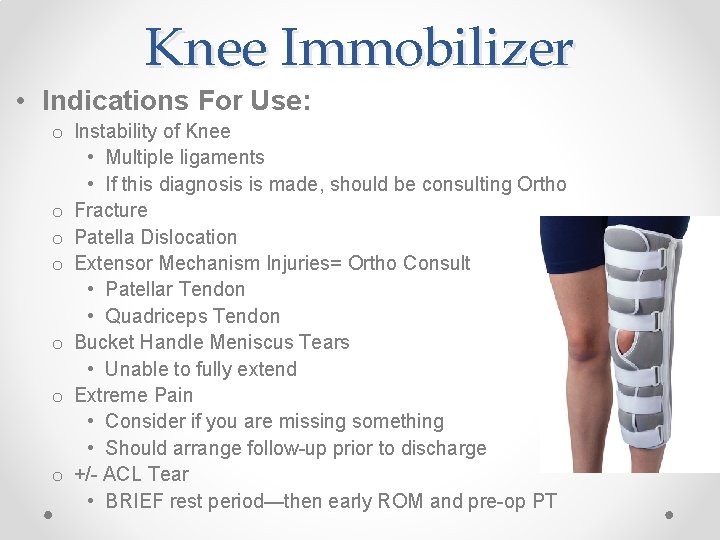
Knee Immobilizer • Indications For Use: o Instability of Knee • Multiple ligaments • If this diagnosis is made, should be consulting Ortho o Fracture o Patella Dislocation o Extensor Mechanism Injuries= Ortho Consult • Patellar Tendon • Quadriceps Tendon o Bucket Handle Meniscus Tears • Unable to fully extend o Extreme Pain • Consider if you are missing something • Should arrange follow-up prior to discharge o +/- ACL Tear • BRIEF rest period—then early ROM and pre-op PT
Knee Immobilizer • NOT Indications For Use: o Osteoarthritis with Effusion o Unsure of knee injury • Should be pretty confident why it is being provided o “Internal Derangement of Knee” o Knee Sprain • LCL or MCL
Knee Immobilizer • Reasonable to provide Knee Immobilizer for acute knee rest and to decrease inflammation after injury • Problem is the patient wears knee immobilizer continuously until follows up o Days to Weeks to Never Following Up o Significant decreased ROM, weakness, atrophy and stiffness develop • Patient education is key—take it off frequently, ROM, early follow-up • Most Orthopedic Surgeons will not operate until effusion resolves and many will start “prehab” PT prior to surgery to improve strength o Aids in post-op recovery o Improved outcomes
AAFP Guidelines • Complete immobilization of the knee for an extended period is generally contraindicated because of the prolonged stiffness, muscle atrophy, and chronic pain that result • Indications for the use of a knee immobilizer include the acute (or presurgical) management of: o o o Quadriceps rupture Patellar tendon rupture Medial collateral ligament rupture Patellar fracture or dislocation Limited number of other acute traumatic knee injuries
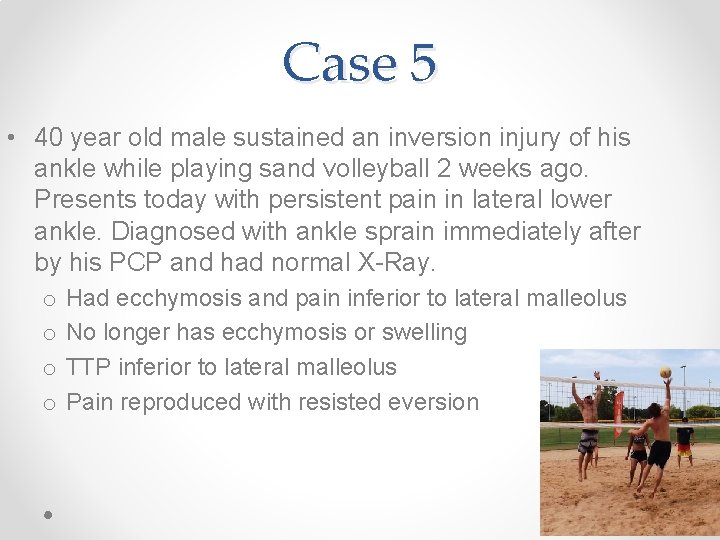
Case 5 • 40 year old male sustained an inversion injury of his ankle while playing sand volleyball 2 weeks ago. Presents today with persistent pain in lateral lower ankle. Diagnosed with ankle sprain immediately after by his PCP and had normal X-Ray. o o Had ecchymosis and pain inferior to lateral malleolus No longer has ecchymosis or swelling TTP inferior to lateral malleolus Pain reproduced with resisted eversion
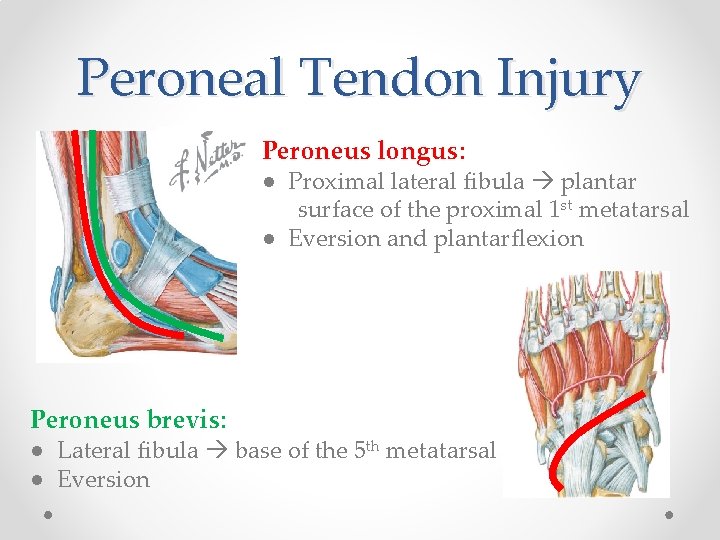
Peroneal Tendon Injury Peroneus longus: ● Proximal lateral fibula plantar surface of the proximal 1 st metatarsal ● Eversion and plantarflexion Peroneus brevis: ● Lateral fibula base of the 5 th metatarsal ● Eversion
Peroneal Tendon Injury Examination: • TTP of peroneal tendons as they pass posterior to the lateral malleolus • Pain with resisted eversion • Pain with passive inversion • Tendon snapping with resisted eversion and dorsiflexion Imaging: • Ultrasound Management: • Ice, rest, and NSAIDS • Walking boot for 2 -4 weeks to allow for rest • Tendon dislocation/subluxation may require Ortho operative management
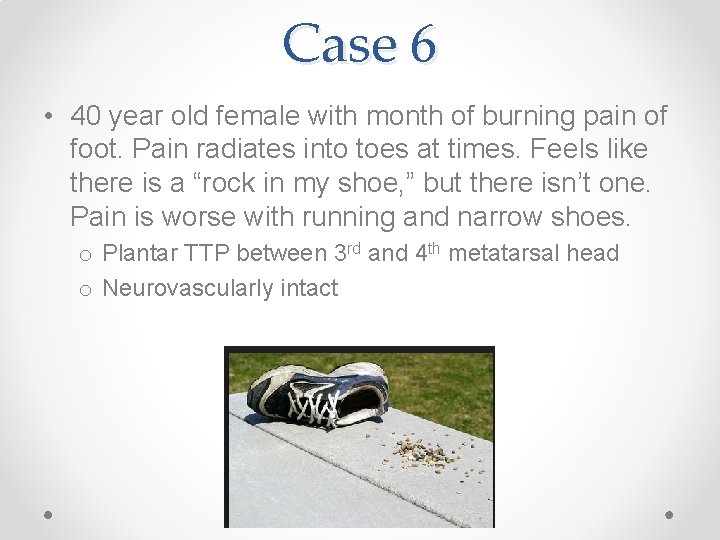
Case 6 • 40 year old female with month of burning pain of foot. Pain radiates into toes at times. Feels like there is a “rock in my shoe, ” but there isn’t one. Pain is worse with running and narrow shoes. o Plantar TTP between 3 rd and 4 th metatarsal head o Neurovascularly intact
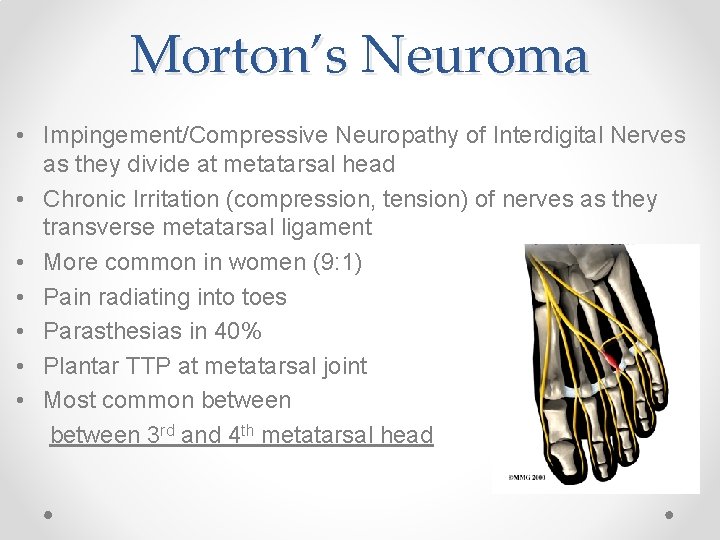
Morton’s Neuroma • Impingement/Compressive Neuropathy of Interdigital Nerves as they divide at metatarsal head • Chronic Irritation (compression, tension) of nerves as they transverse metatarsal ligament • More common in women (9: 1) • Pain radiating into toes • Parasthesias in 40% • Plantar TTP at metatarsal joint • Most common between 3 rd and 4 th metatarsal head
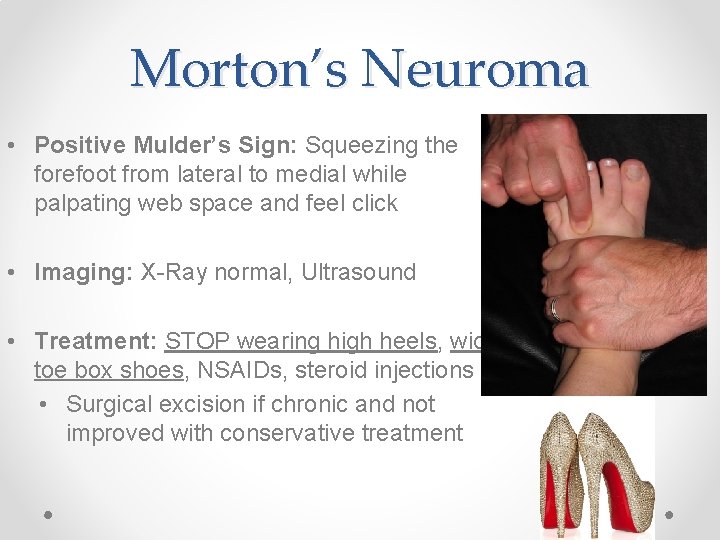
Morton’s Neuroma • Positive Mulder’s Sign: Squeezing the forefoot from lateral to medial while palpating web space and feel click • Imaging: X-Ray normal, Ultrasound • Treatment: STOP wearing high heels, wide toe box shoes, NSAIDs, steroid injections • Surgical excision if chronic and not improved with conservative treatment
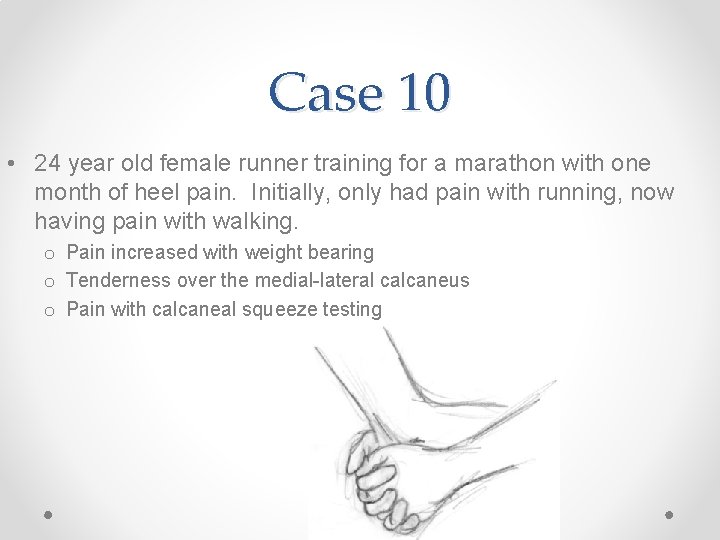
Case 10 • 24 year old female runner training for a marathon with one month of heel pain. Initially, only had pain with running, now having pain with walking. o Pain increased with weight bearing o Tenderness over the medial-lateral calcaneus o Pain with calcaneal squeeze testing
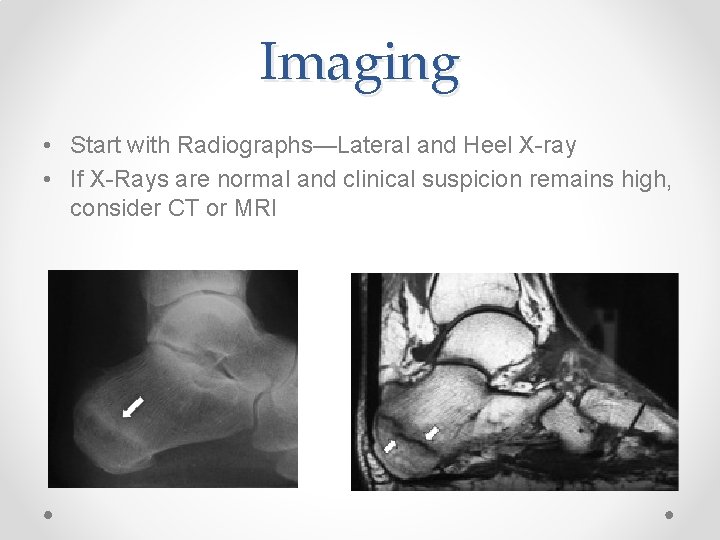
Imaging • Start with Radiographs—Lateral and Heel X-ray • If X-Rays are normal and clinical suspicion remains high, consider CT or MRI

Management of Calcaneal Stress Fracture • Reduction in activity to pain free activity o If pain with walking, may need to be non-weight-bearing until pain free with walking o Slow progression back into activity, again reducing impact if pain returns o Addition of heel cushions or orthotics if needed o Assessment of calcium and vitamin D status • Full healing usually takes 2 -3 months
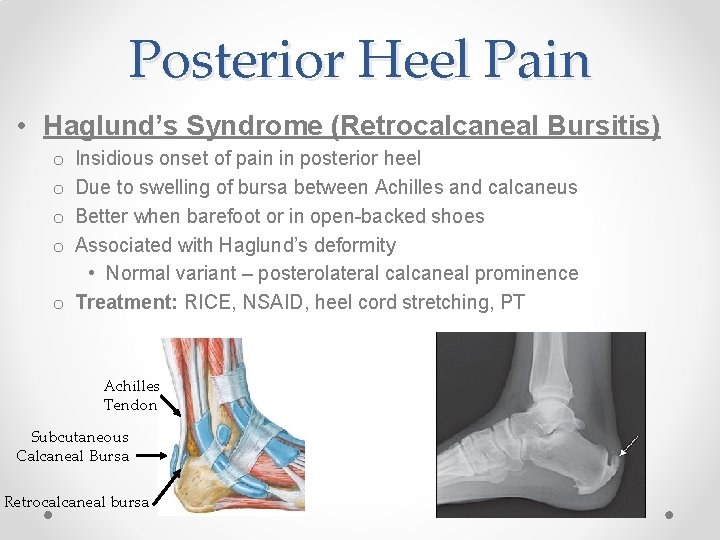
Posterior Heel Pain • Haglund’s Syndrome (Retrocalcaneal Bursitis) Insidious onset of pain in posterior heel Due to swelling of bursa between Achilles and calcaneus Better when barefoot or in open-backed shoes Associated with Haglund’s deformity • Normal variant – posterolateral calcaneal prominence o Treatment: RICE, NSAID, heel cord stretching, PT o o Achilles Tendon Subcutaneous Calcaneal Bursa Retrocalcaneal bursa
Case 11 • 35 year old woman sustained an inversion injury of her ankle while playing basketball. Came down on another players foot after jumping for a rebound o Diagnosed with ankle sprain o Persistent pain in the anterior ankle after 6 weeks o Intermittent ankle swelling o Feels ankle catching and locking
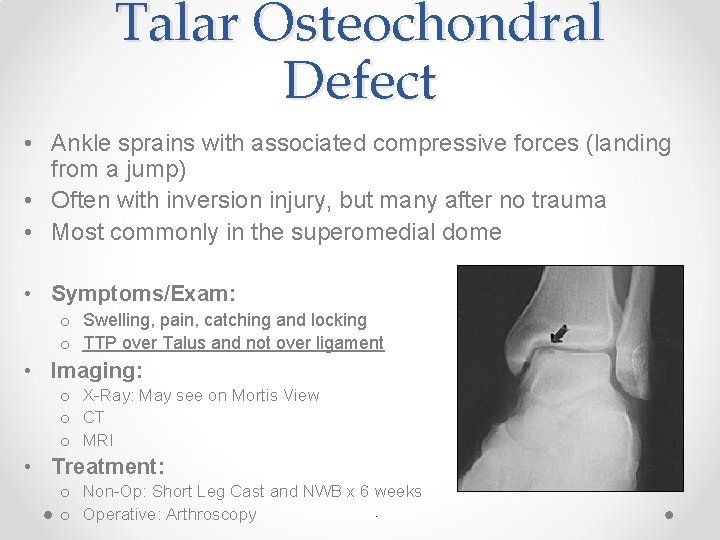
Talar Osteochondral Defect • Ankle sprains with associated compressive forces (landing from a jump) • Often with inversion injury, but many after no trauma • Most commonly in the superomedial dome • Symptoms/Exam: o Swelling, pain, catching and locking o TTP over Talus and not over ligament • Imaging: o X-Ray: May see on Mortis View o CT o MRI • Treatment: o Non-Op: Short Leg Cast and NWB x 6 weeks. o Operative: Arthroscopy
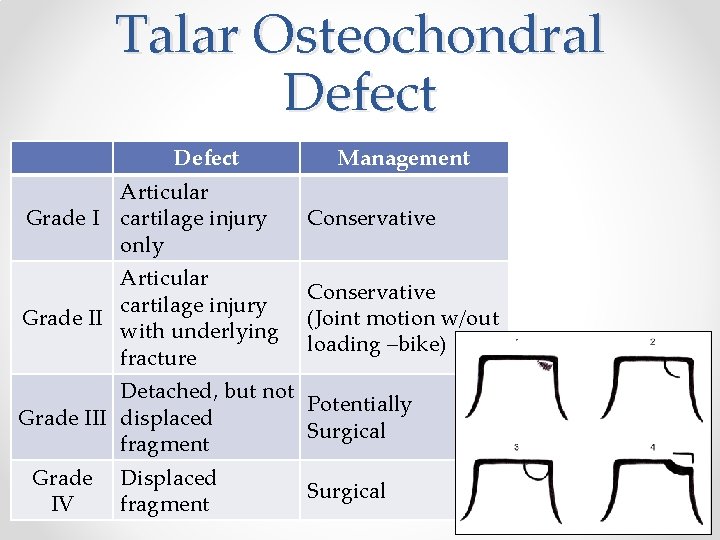
Talar Osteochondral Defect Management Articular Grade I cartilage injury only Conservative Articular cartilage injury Grade II with underlying fracture Conservative (Joint motion w/out loading –bike) Detached, but not Potentially Grade III displaced Surgical fragment Grade IV Displaced fragment Surgical
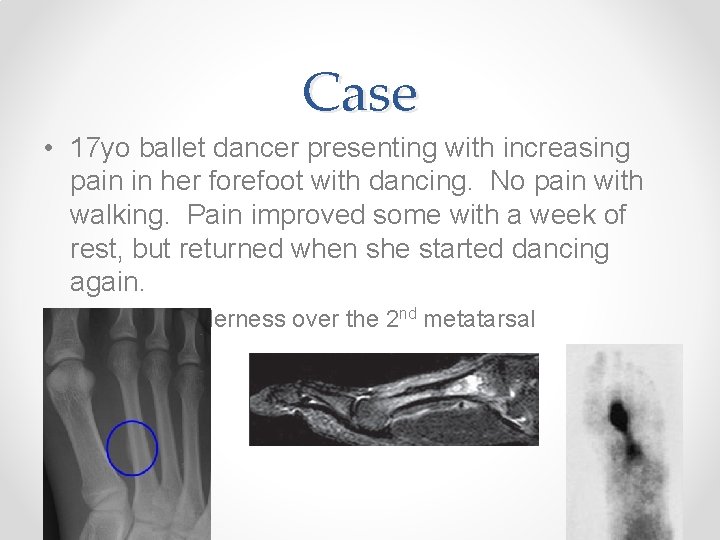
Case • 17 yo ballet dancer presenting with increasing pain in her forefoot with dancing. No pain with walking. Pain improved some with a week of rest, but returned when she started dancing again. o Focal tenderness over the 2 nd metatarsal
Metatarsal Stress Fractures • Risk Factors o High arches o Repetitive impact activity (running, marching, dancing) • Avoidance of painful weight-bearing o Non-weight-bearing with crutches if pain with walking • Slow return to normal activity when pain free with walking and to palpation over the stress injury o May need orthoses to help prevent future injury
DDx of Heel Pain • • • Calcaneal stress fracture/traumatic fracture Plantar fasciitis Fat pad atrophy Achilles tendinopathy Achilles Bursitis (Haglund deformity)
DDx Ankle Pain • • • Ankle Sprain Syndesmotic injury (High Ankle Sprain) 5 th metatarsal fracture Navicular fracture Peroneal Tendon Injury Fractures o o Fibula Tibia Talus Calcaneus • Achilles tendon injury
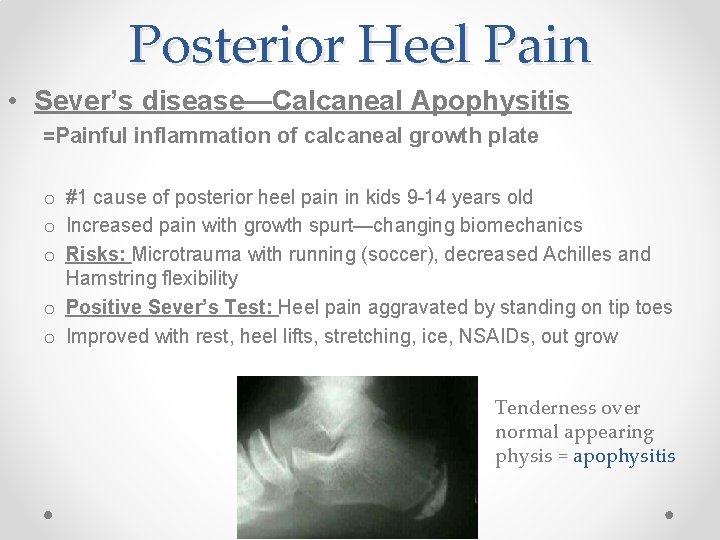
Posterior Heel Pain • Sever’s disease—Calcaneal Apophysitis =Painful inflammation of calcaneal growth plate o #1 cause of posterior heel pain in kids 9 -14 years old o Increased pain with growth spurt—changing biomechanics o Risks: Microtrauma with running (soccer), decreased Achilles and Hamstring flexibility o Positive Sever’s Test: Heel pain aggravated by standing on tip toes o Improved with rest, heel lifts, stretching, ice, NSAIDs, out grow Tenderness over normal appearing physis = apophysitis
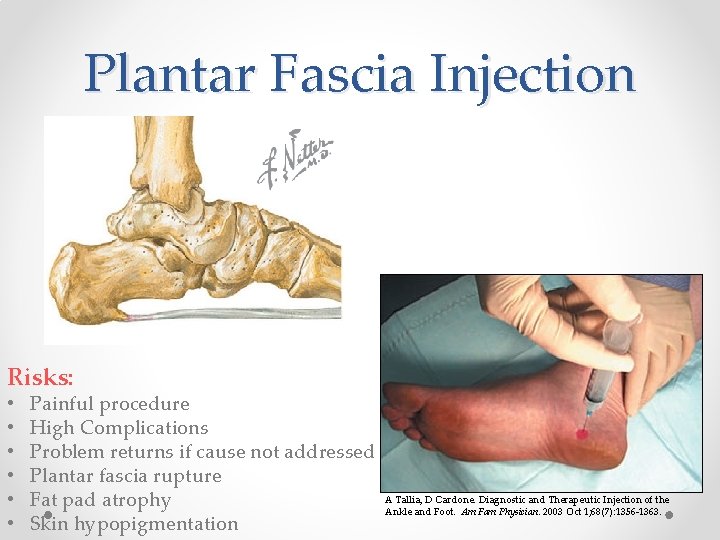
Plantar Fascia Injection Risks: • • • Painful procedure High Complications Problem returns if cause not addressed Plantar fascia rupture Fat pad atrophy Skin hypopigmentation A Tallia, D Cardone. Diagnostic and Therapeutic Injection of the Ankle and Foot. Am Fam Physician. 2003 Oct 1; 68(7): 1356 -1363.
- Slides: 69