
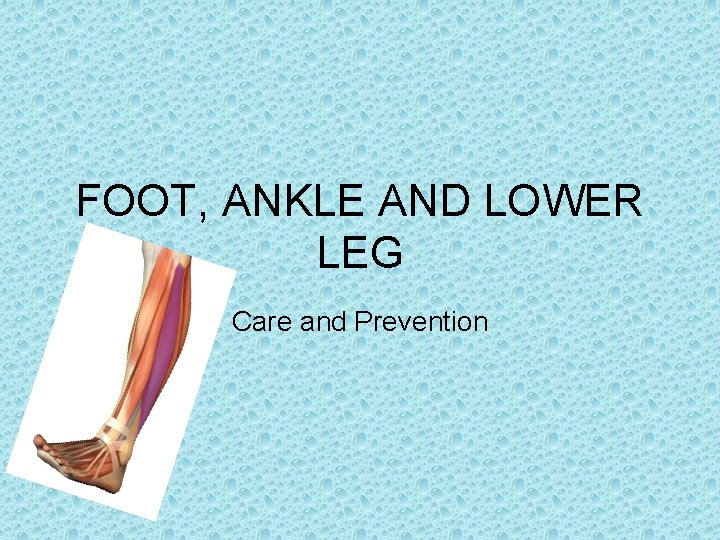
FOOT ANKLE AND LOWER LEG Care and Prevention

- Slides: 21
FOOT, ANKLE AND LOWER LEG Care and Prevention
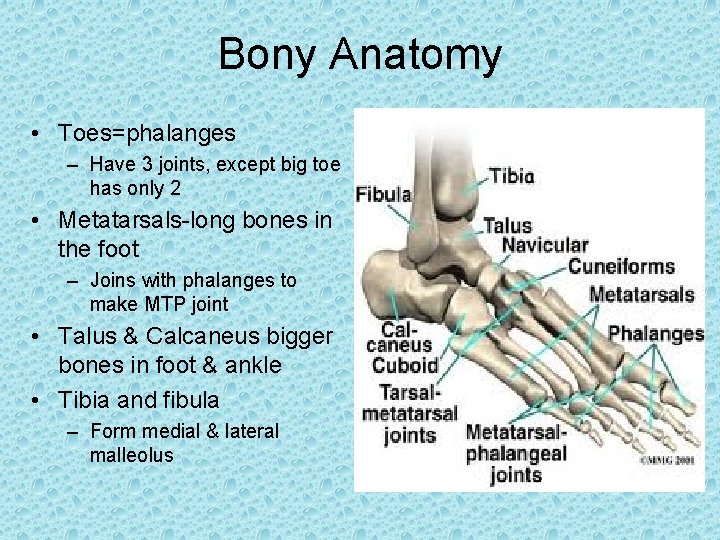
Bony Anatomy • Toes=phalanges – Have 3 joints, except big toe has only 2 • Metatarsals-long bones in the foot – Joins with phalanges to make MTP joint • Talus & Calcaneus bigger bones in foot & ankle • Tibia and fibula – Form medial & lateral malleolus
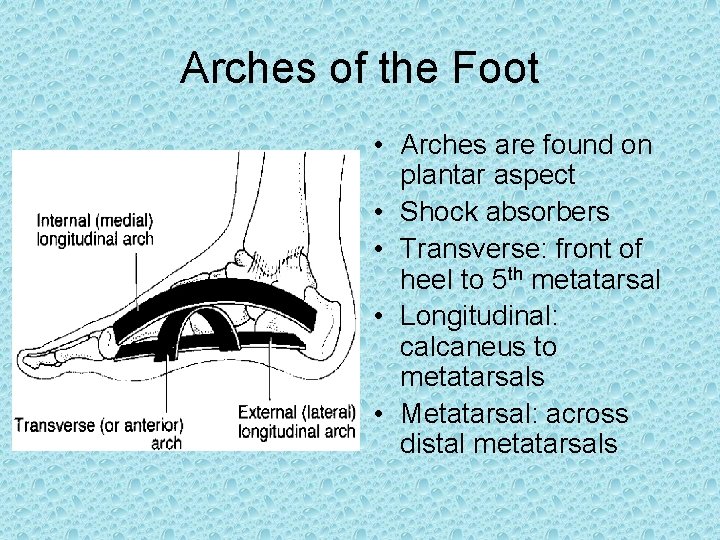
Arches of the Foot • Arches are found on plantar aspect • Shock absorbers • Transverse: front of heel to 5 th metatarsal • Longitudinal: calcaneus to metatarsals • Metatarsal: across distal metatarsals
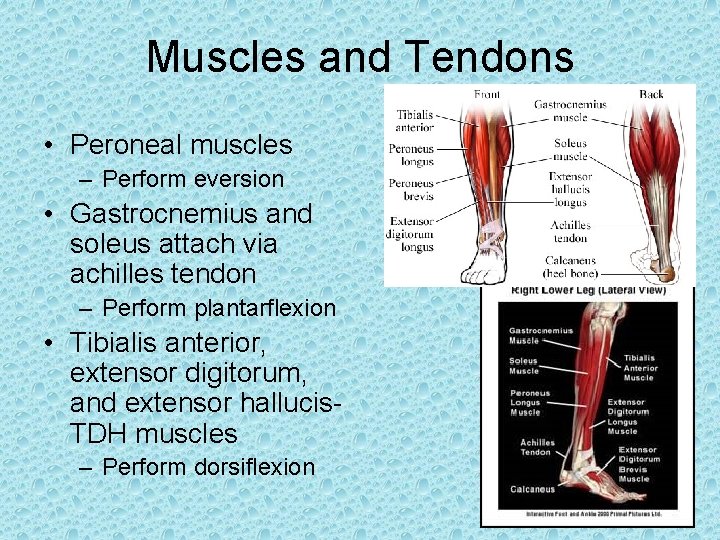
Muscles and Tendons • Peroneal muscles – Perform eversion • Gastrocnemius and soleus attach via achilles tendon – Perform plantarflexion • Tibialis anterior, extensor digitorum, and extensor hallucis. TDH muscles – Perform dorsiflexion
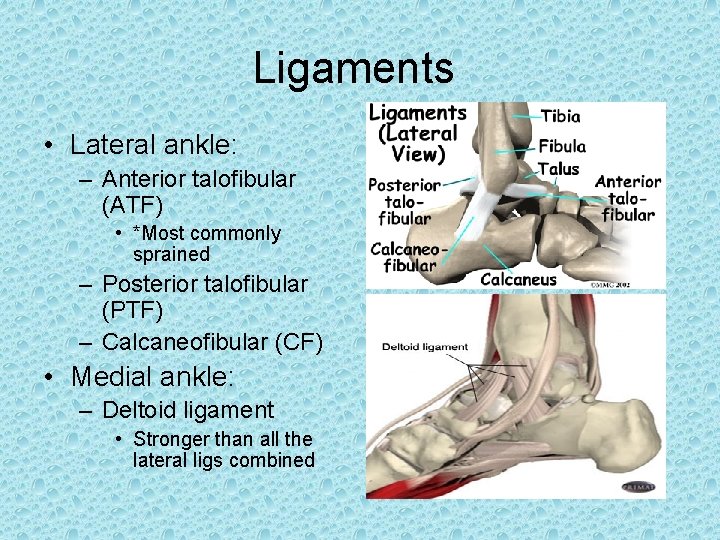
Ligaments • Lateral ankle: – Anterior talofibular (ATF) • *Most commonly sprained – Posterior talofibular (PTF) – Calcaneofibular (CF) • Medial ankle: – Deltoid ligament • Stronger than all the lateral ligs combined
INJURIES • Bone injuries: – Jones Fx – Tibia/Fibula Fx – Stress Fx • Muscle/Tendon injuries: – Medial tibial stress syndrome (Shin splints) – Achilles Tendinitis – Achilles Tendon Rupture • Ligament Injuries – – • Great Toe sprain (Turf toe) (check this) Plantar fasciitis Lateral/Medial ankle sprains Ankle dislocation Tissue Injuries – Contusions – Toe abnormalities – Anterior compartment syndrome
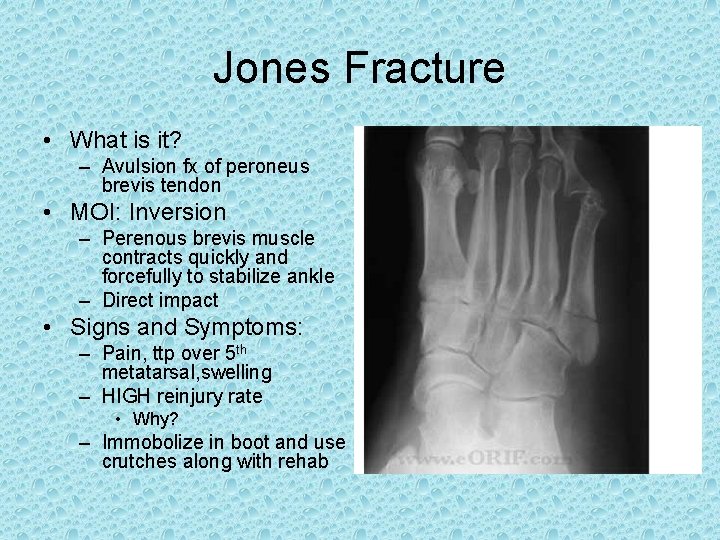
Jones Fracture • What is it? – Avulsion fx of peroneus brevis tendon • MOI: Inversion – Perenous brevis muscle contracts quickly and forcefully to stabilize ankle – Direct impact • Signs and Symptoms: – Pain, ttp over 5 th metatarsal, swelling – HIGH reinjury rate • Why? – Immobolize in boot and use crutches along with rehab
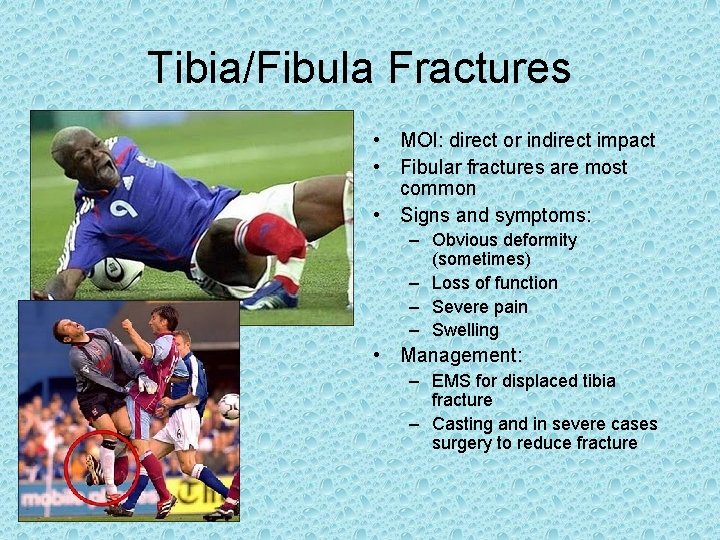
Tibia/Fibula Fractures • MOI: direct or indirect impact • Fibular fractures are most common • Signs and symptoms: – Obvious deformity (sometimes) – Loss of function – Severe pain – Swelling • Management: – EMS for displaced tibia fracture – Casting and in severe cases surgery to reduce fracture
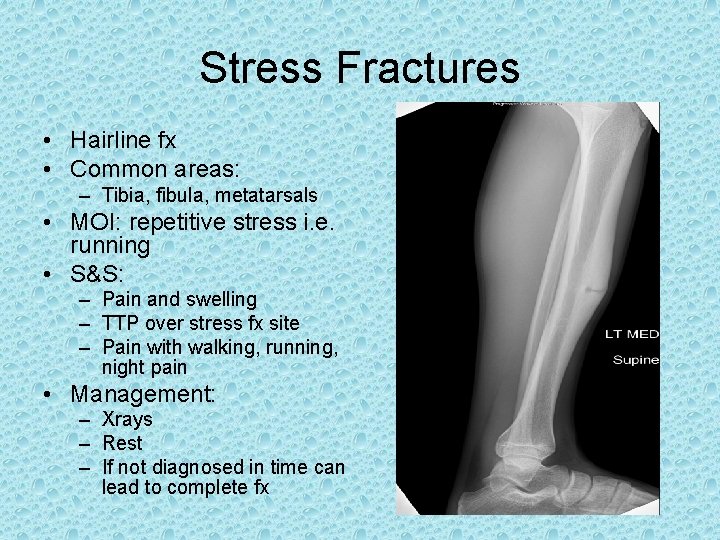
Stress Fractures • Hairline fx • Common areas: – Tibia, fibula, metatarsals • MOI: repetitive stress i. e. running • S&S: – Pain and swelling – TTP over stress fx site – Pain with walking, running, night pain • Management: – Xrays – Rest – If not diagnosed in time can lead to complete fx
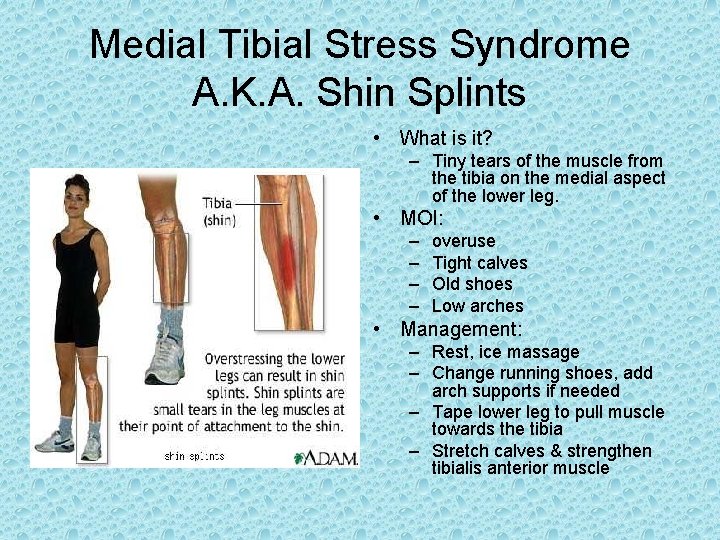
Medial Tibial Stress Syndrome A. K. A. Shin Splints • What is it? – Tiny tears of the muscle from the tibia on the medial aspect of the lower leg. • MOI: – – overuse Tight calves Old shoes Low arches • Management: – Rest, ice massage – Change running shoes, add arch supports if needed – Tape lower leg to pull muscle towards the tibia – Stretch calves & strengthen tibialis anterior muscle
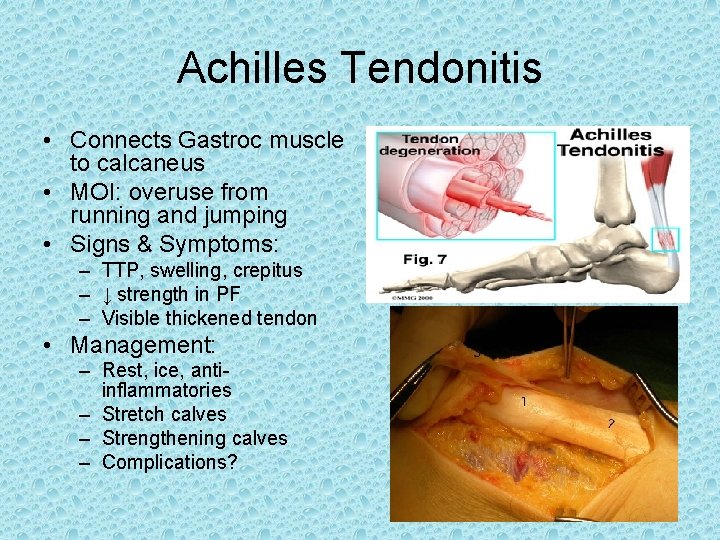
Achilles Tendonitis • Connects Gastroc muscle to calcaneus • MOI: overuse from running and jumping • Signs & Symptoms: – TTP, swelling, crepitus – ↓ strength in PF – Visible thickened tendon • Management: – Rest, ice, antiinflammatories – Stretch calves – Strengthening calves – Complications?
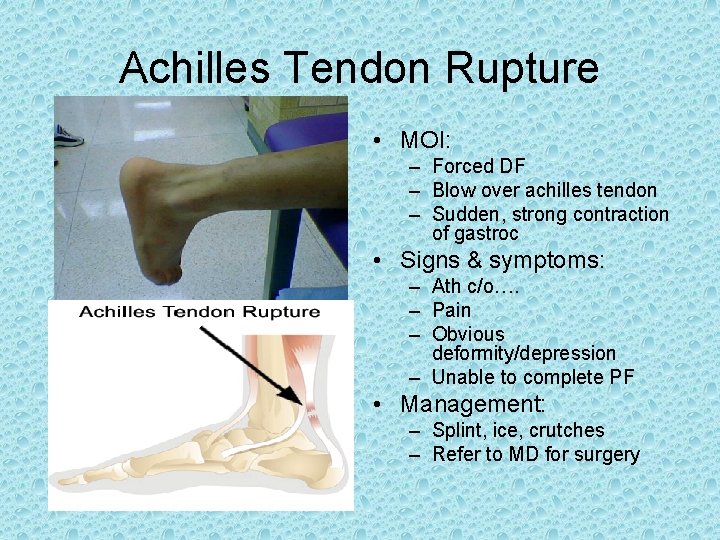
Achilles Tendon Rupture • MOI: – Forced DF – Blow over achilles tendon – Sudden, strong contraction of gastroc • Signs & symptoms: – Ath c/o…. – Pain – Obvious deformity/depression – Unable to complete PF • Management: – Splint, ice, crutches – Refer to MD for surgery
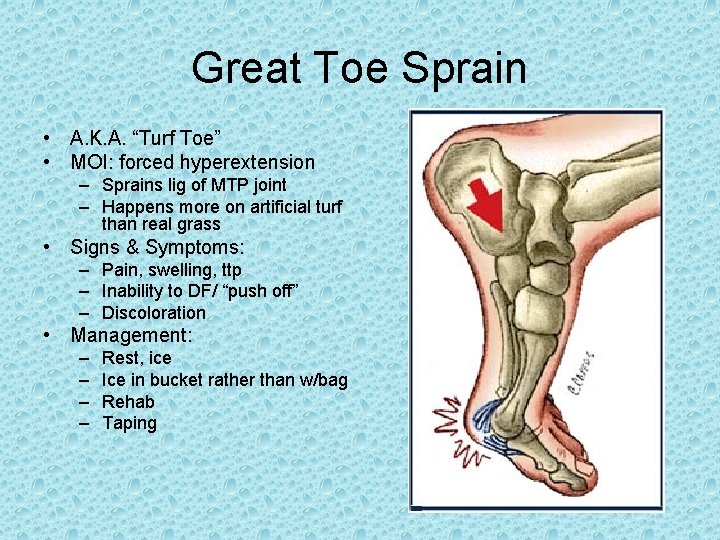
Great Toe Sprain • A. K. A. “Turf Toe” • MOI: forced hyperextension – Sprains lig of MTP joint – Happens more on artificial turf than real grass • Signs & Symptoms: – Pain, swelling, ttp – Inability to DF/ “push off” – Discoloration • Management: – – Rest, ice Ice in bucket rather than w/bag Rehab Taping
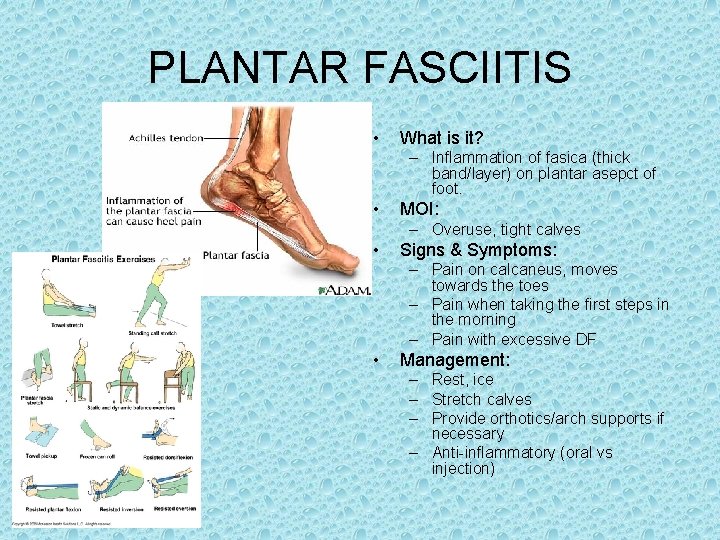
PLANTAR FASCIITIS • What is it? – Inflammation of fasica (thick band/layer) on plantar asepct of foot. • MOI: – Overuse, tight calves • Signs & Symptoms: – Pain on calcaneus, moves towards the toes – Pain when taking the first steps in the morning – Pain with excessive DF • Management: – Rest, ice – Stretch calves – Provide orthotics/arch supports if necessary – Anti-inflammatory (oral vs injection)
Lateral/Inversion Ankle Sprain • • • 85% of ankle sprains are inversion sprains 2 reasons: – Deltoid ligament is stronger than lateral ligs – Fibula prevents excessive eversion MOI: Plantarflexion and excessive inversion – Some examples? Severity depends on force, strength of muscles, protective devices worn Signs & Symptoms: – Pain, swelling, discoloration – TTP over ATF ligament typically – Loss of ROM and strength (depends on severity) Management: – RICE – Anti-inflammatories – Stretching and strengthening – Bracing – Balance exercises – Refer for XRAYs if rapid swelling occurs or TTP over bone
Medial/Eversion Ankle Sprains • • • Only account for 15% of ankle injuries. More severe than inversion sprains Longer recovery time MOI: Excessive eversion Signs & Symptoms: – Pain, swelling, TTP over deltoid ligament – Bruising – Loss of ROM and strength especially eversion • Management: – – RICE NWB XRays to rule out fracture of fibula Rehab and balance activities
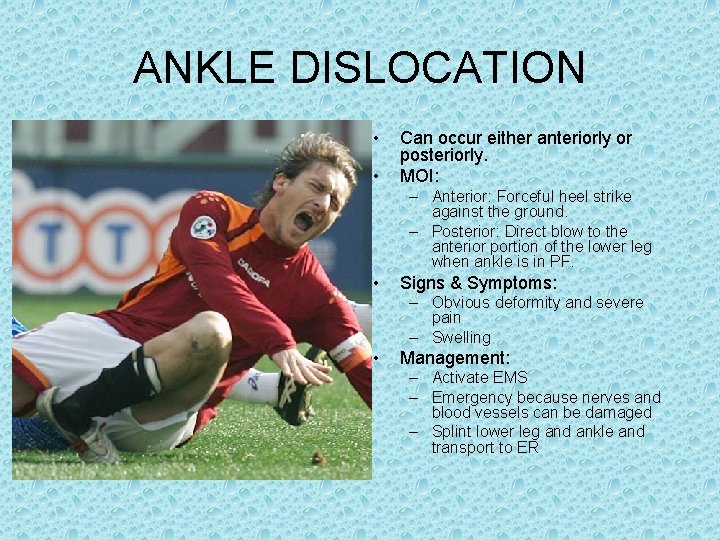
ANKLE DISLOCATION • • Can occur either anteriorly or posteriorly. MOI: – Anterior: Forceful heel strike against the ground. – Posterior: Direct blow to the anterior portion of the lower leg when ankle is in PF. • Signs & Symptoms: – Obvious deformity and severe pain – Swelling • Management: – Activate EMS – Emergency because nerves and blood vessels can be damaged – Splint lower leg and ankle and transport to ER
TOE ABNORMALITIES
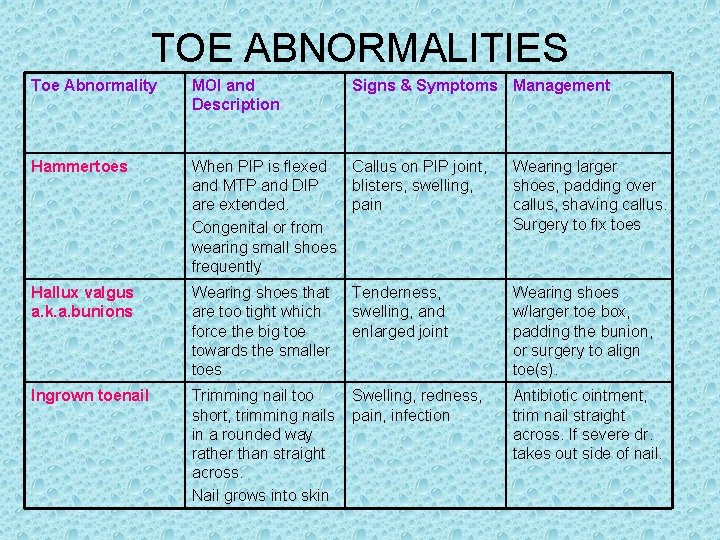
TOE ABNORMALITIES Toe Abnormality MOI and Description Signs & Symptoms Management Hammertoes When PIP is flexed Callus on PIP joint, and MTP and DIP blisters, swelling, are extended. pain Congenital or from wearing small shoes frequently Wearing larger shoes, padding over callus, shaving callus. Surgery to fix toes Hallux valgus a. k. a. bunions Wearing shoes that are too tight which force the big toe towards the smaller toes Tenderness, swelling, and enlarged joint Wearing shoes w/larger toe box, padding the bunion, or surgery to align toe(s). Ingrown toenail Trimming nail too short, trimming nails in a rounded way rather than straight across. Nail grows into skin Swelling, redness, pain, infection Antibiotic ointment, trim nail straight across. If severe dr. takes out side of nail.
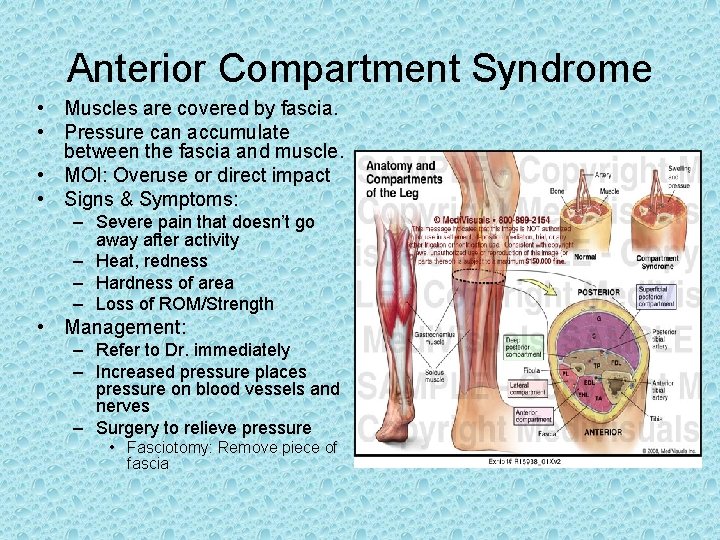
Anterior Compartment Syndrome • Muscles are covered by fascia. • Pressure can accumulate between the fascia and muscle. • MOI: Overuse or direct impact • Signs & Symptoms: – Severe pain that doesn’t go away after activity – Heat, redness – Hardness of area – Loss of ROM/Strength • Management: – Refer to Dr. immediately – Increased pressure places pressure on blood vessels and nerves – Surgery to relieve pressure • Fasciotomy: Remove piece of fascia
References • Cartwright AL, Pitney AW, Fundamentals of Athletic Training. 3 rd edition. Human kinetics. Champaign, IL.