
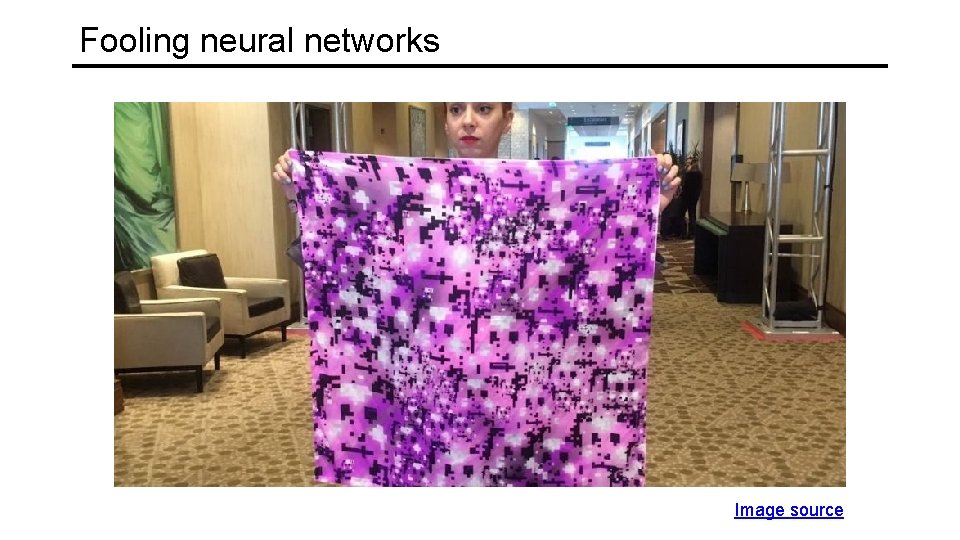
Fooling neural networks Image source Generating preferred inputs

- Slides: 40
Fooling neural networks Image source
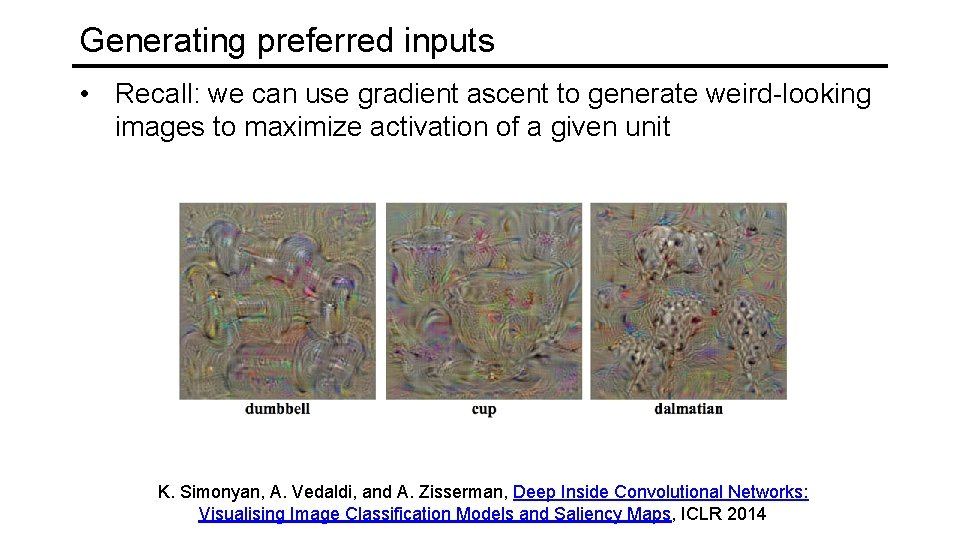
Generating preferred inputs • Recall: we can use gradient ascent to generate weird-looking images to maximize activation of a given unit K. Simonyan, A. Vedaldi, and A. Zisserman, Deep Inside Convolutional Networks: Visualising Image Classification Models and Saliency Maps, ICLR 2014
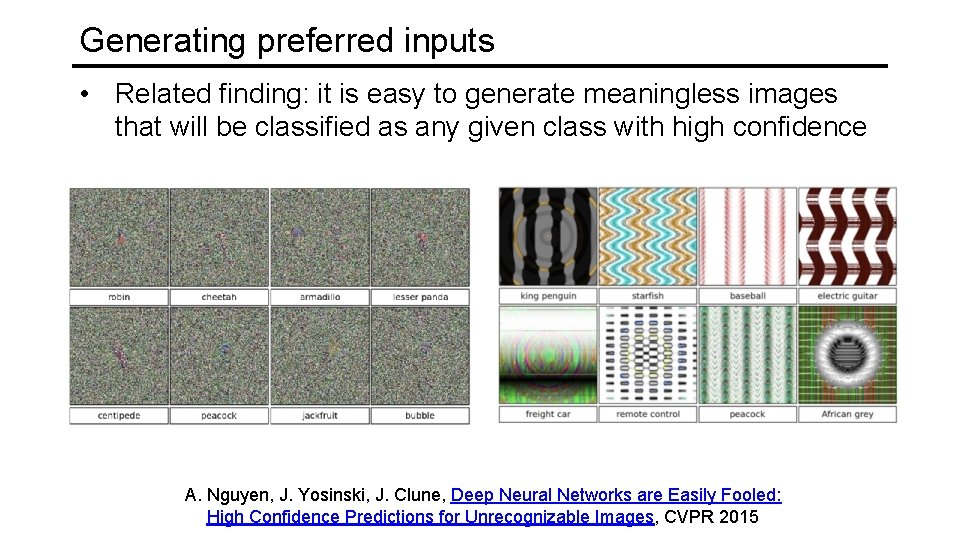
Generating preferred inputs • Related finding: it is easy to generate meaningless images that will be classified as any given class with high confidence A. Nguyen, J. Yosinski, J. Clune, Deep Neural Networks are Easily Fooled: High Confidence Predictions for Unrecognizable Images, CVPR 2015
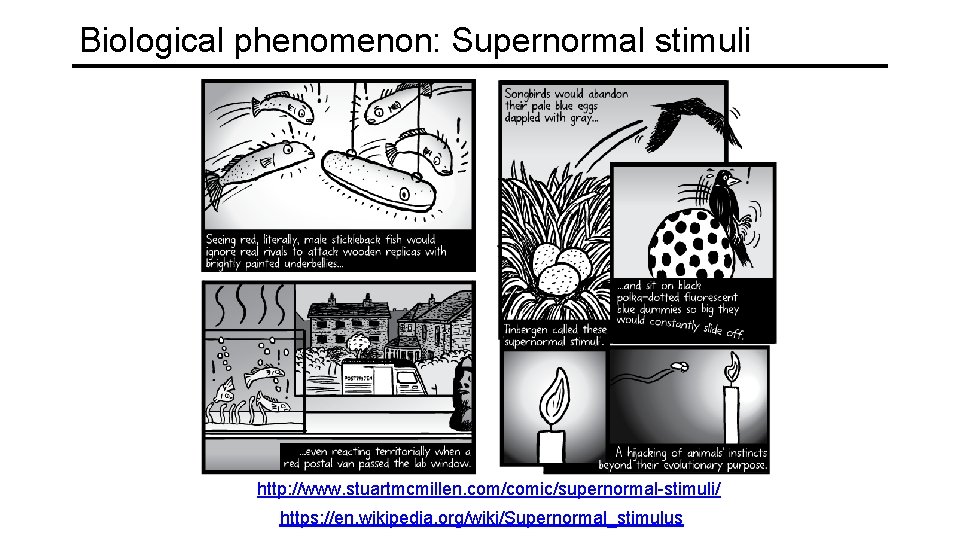
Biological phenomenon: Supernormal stimuli http: //www. stuartmcmillen. com/comic/supernormal-stimuli/ https: //en. wikipedia. org/wiki/Supernormal_stimulus
Supernormal stimuli for humans? https: //en. wikipedia. org/wiki/Supernormal_stimulus
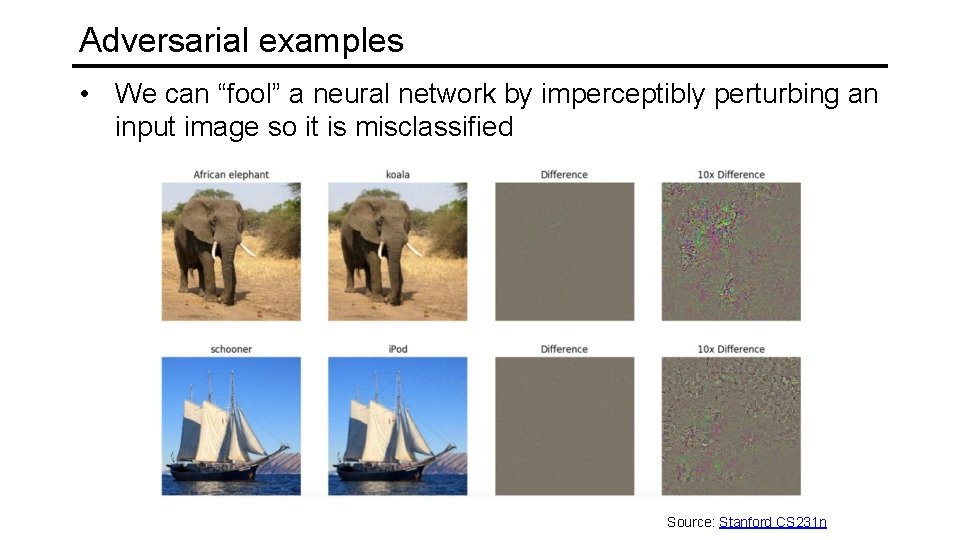
Adversarial examples • We can “fool” a neural network by imperceptibly perturbing an input image so it is misclassified Source: Stanford CS 231 n
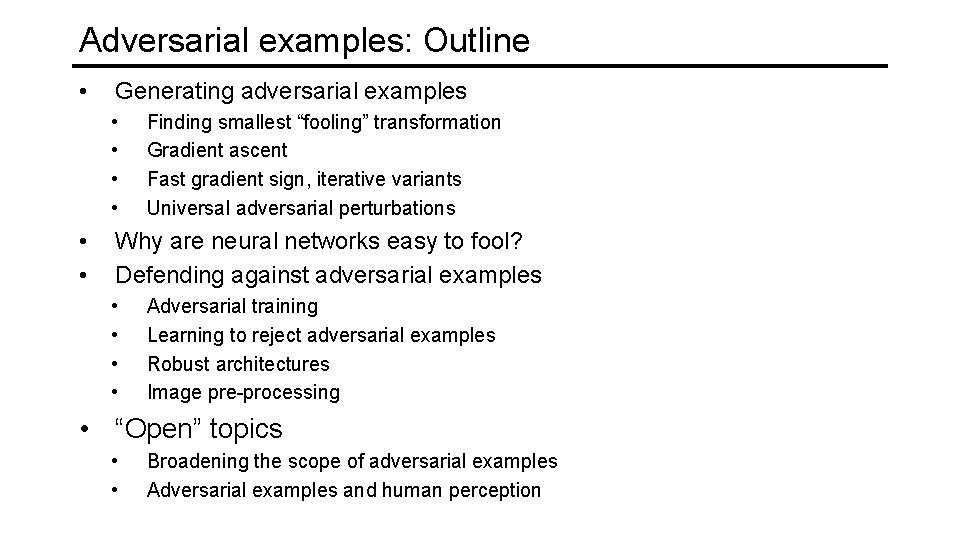
Adversarial examples: Outline • Generating adversarial examples • • • Finding smallest “fooling” transformation Gradient ascent Fast gradient sign, iterative variants Universal adversarial perturbations Why are neural networks easy to fool? Defending against adversarial examples • • Adversarial training Learning to reject adversarial examples Robust architectures Image pre-processing • “Open” topics • • Broadening the scope of adversarial examples Adversarial examples and human perception
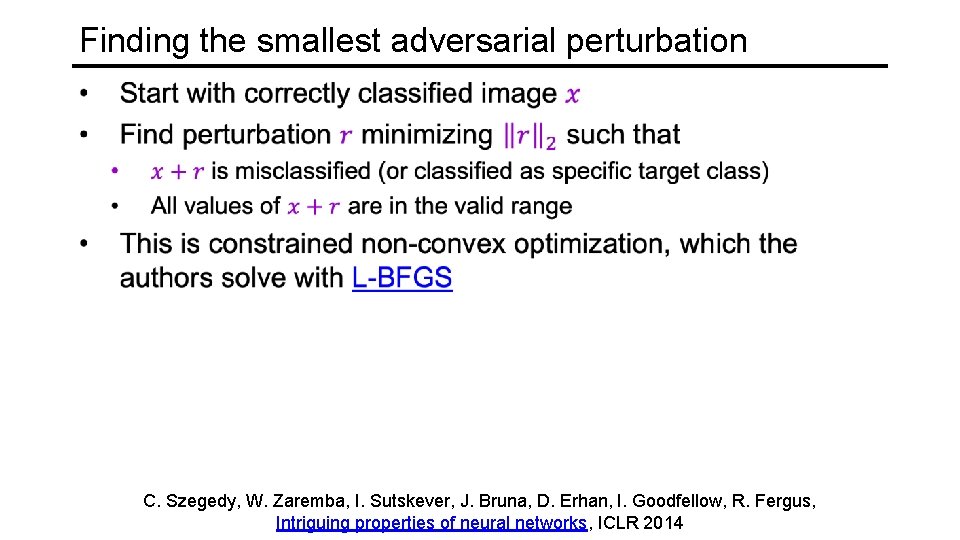
Finding the smallest adversarial perturbation C. Szegedy, W. Zaremba, I. Sutskever, J. Bruna, D. Erhan, I. Goodfellow, R. Fergus, Intriguing properties of neural networks, ICLR 2014
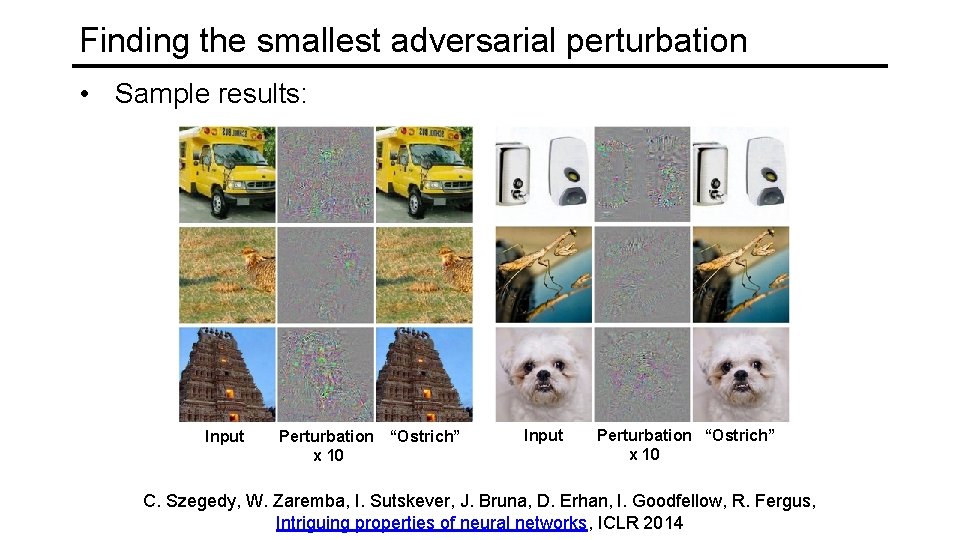
Finding the smallest adversarial perturbation • Sample results: Input Perturbation “Ostrich” x 10 C. Szegedy, W. Zaremba, I. Sutskever, J. Bruna, D. Erhan, I. Goodfellow, R. Fergus, Intriguing properties of neural networks, ICLR 2014
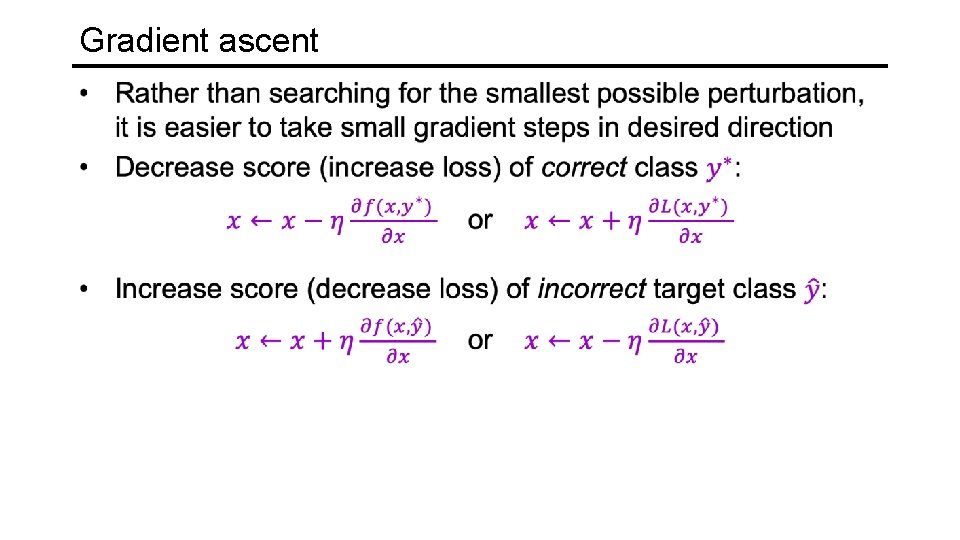
Gradient ascent
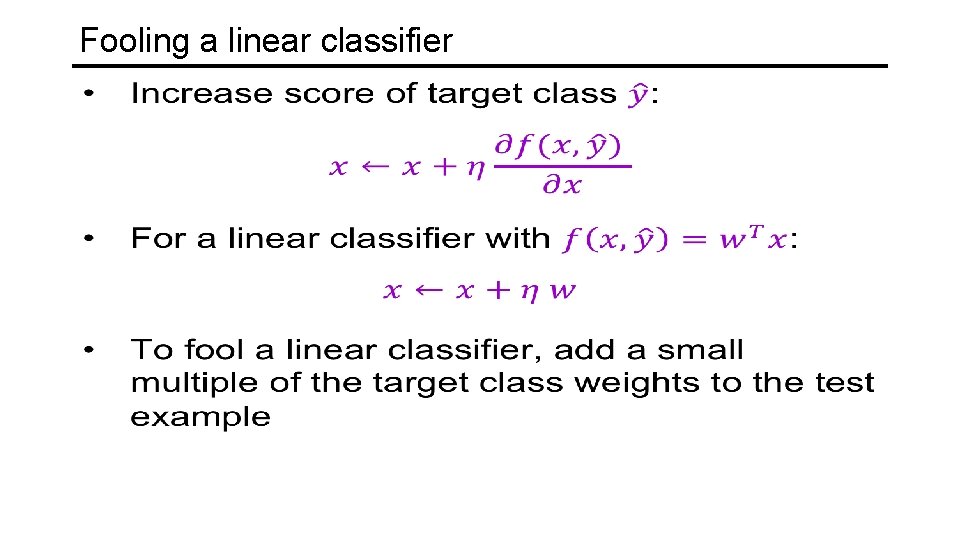
Fooling a linear classifier
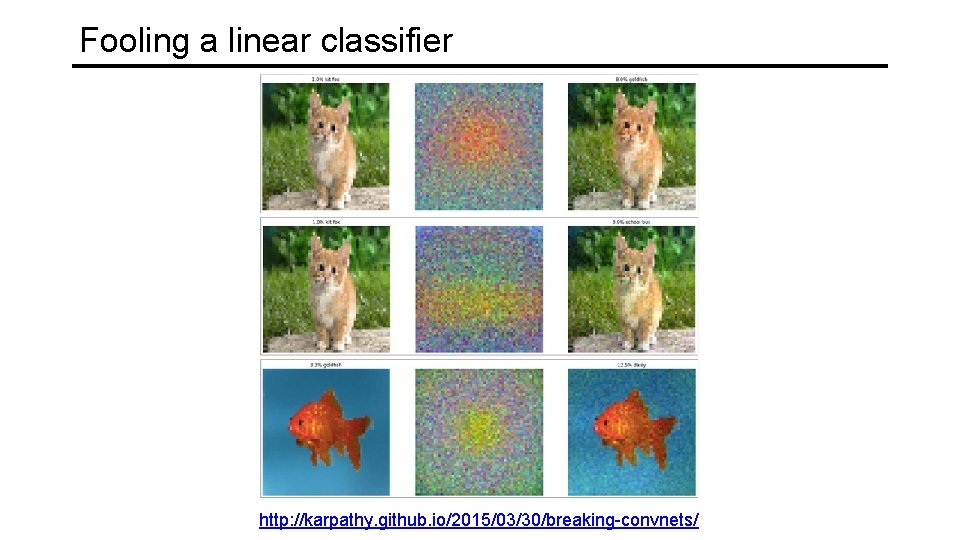
Fooling a linear classifier http: //karpathy. github. io/2015/03/30/breaking-convnets/
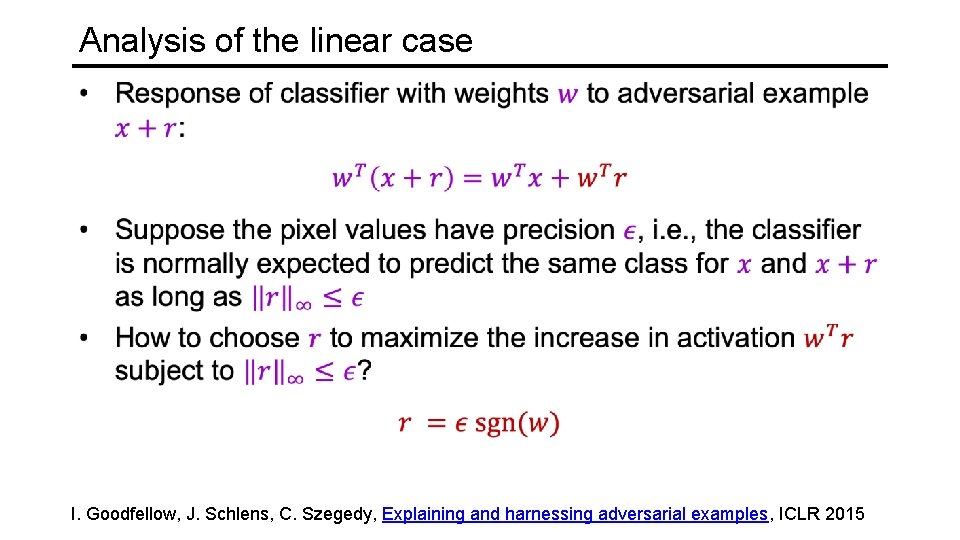
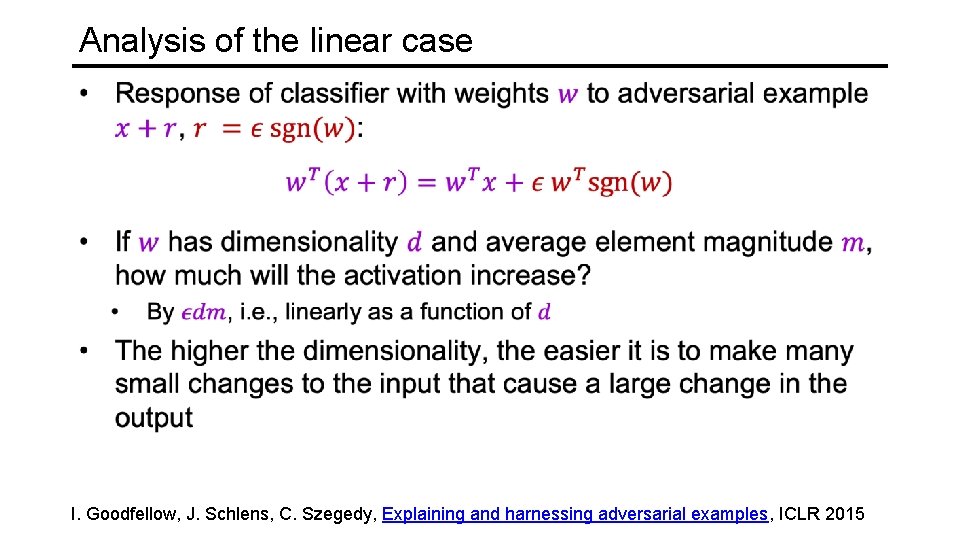
Analysis of the linear case I. Goodfellow, J. Schlens, C. Szegedy, Explaining and harnessing adversarial examples, ICLR 2015
Analysis of the linear case I. Goodfellow, J. Schlens, C. Szegedy, Explaining and harnessing adversarial examples, ICLR 2015
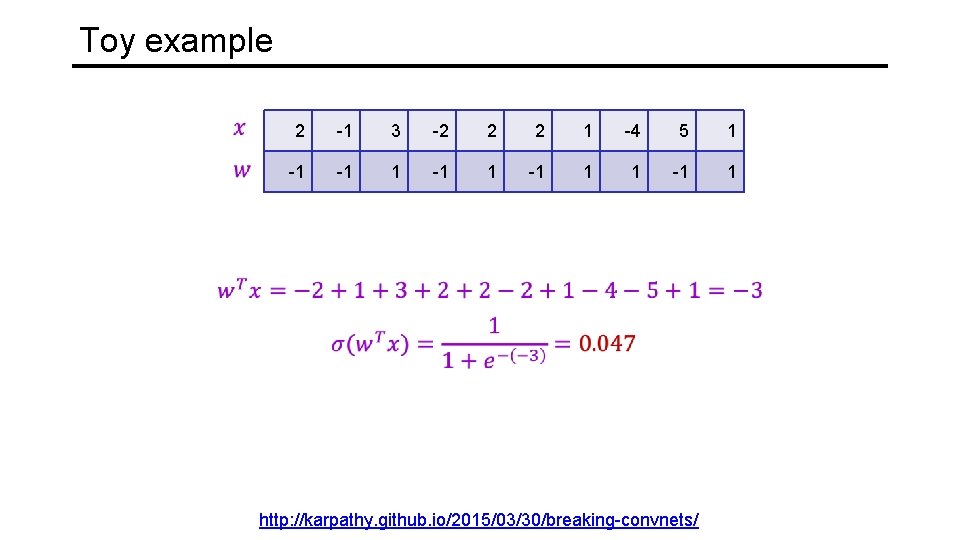
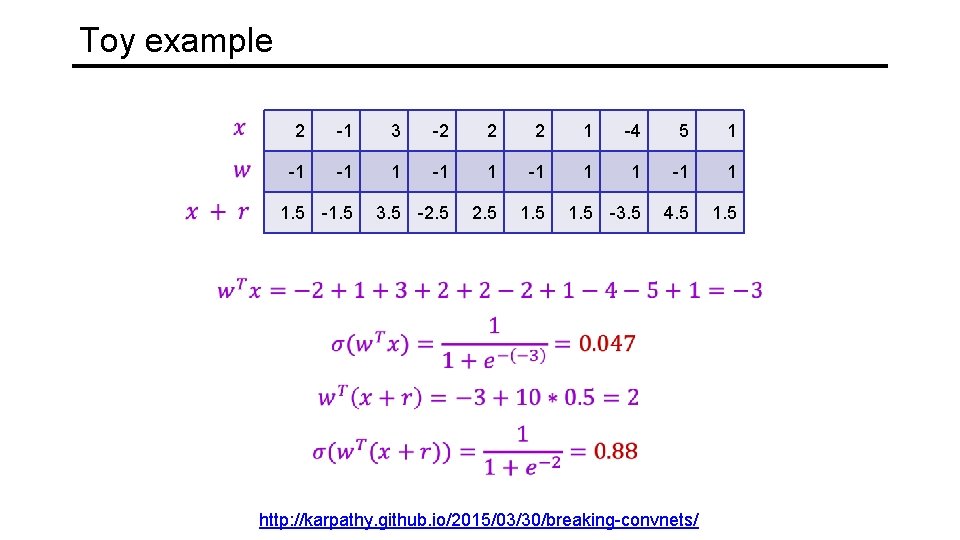
Toy example 2 -1 3 -2 2 2 1 -4 5 1 -1 -1 1 http: //karpathy. github. io/2015/03/30/breaking-convnets/
Toy example 2 -1 3 -2 2 2 1 -4 5 1 -1 -1 1 3. 5 -2. 5 1. 5 -3. 5 4. 5 1. 5 -1. 5 http: //karpathy. github. io/2015/03/30/breaking-convnets/
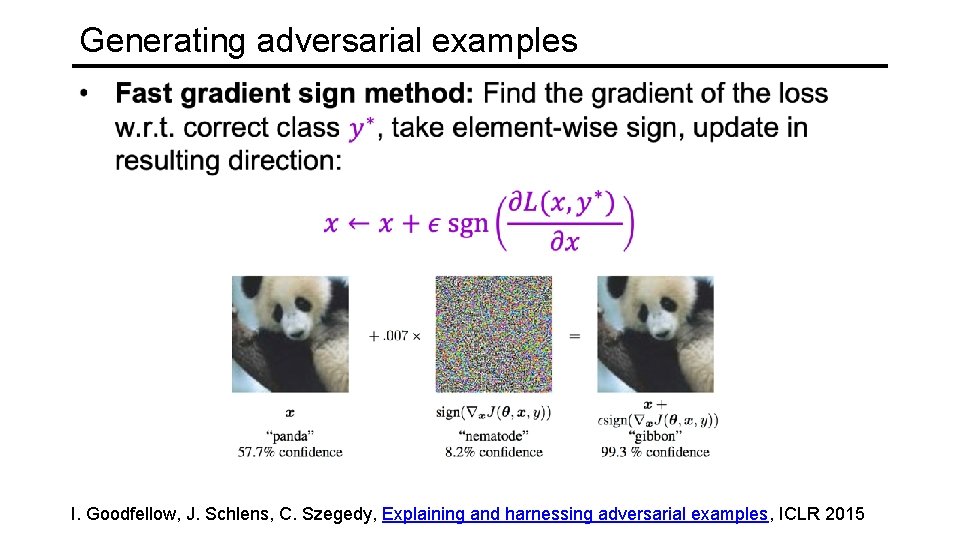
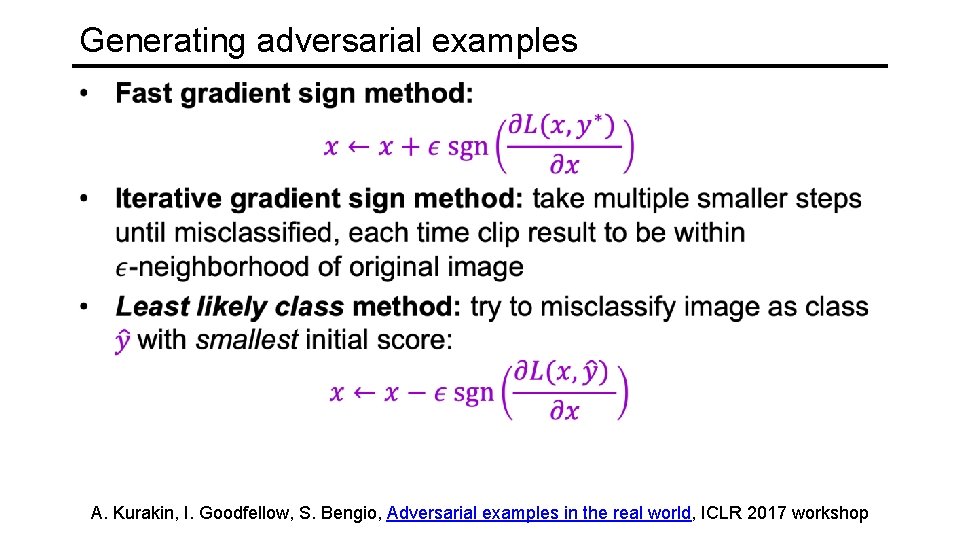
Generating adversarial examples I. Goodfellow, J. Schlens, C. Szegedy, Explaining and harnessing adversarial examples, ICLR 2015
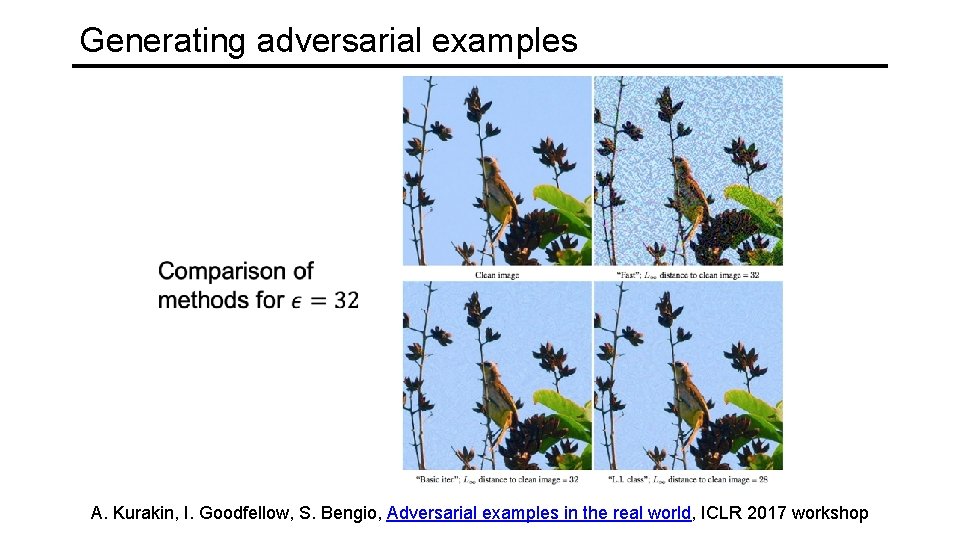
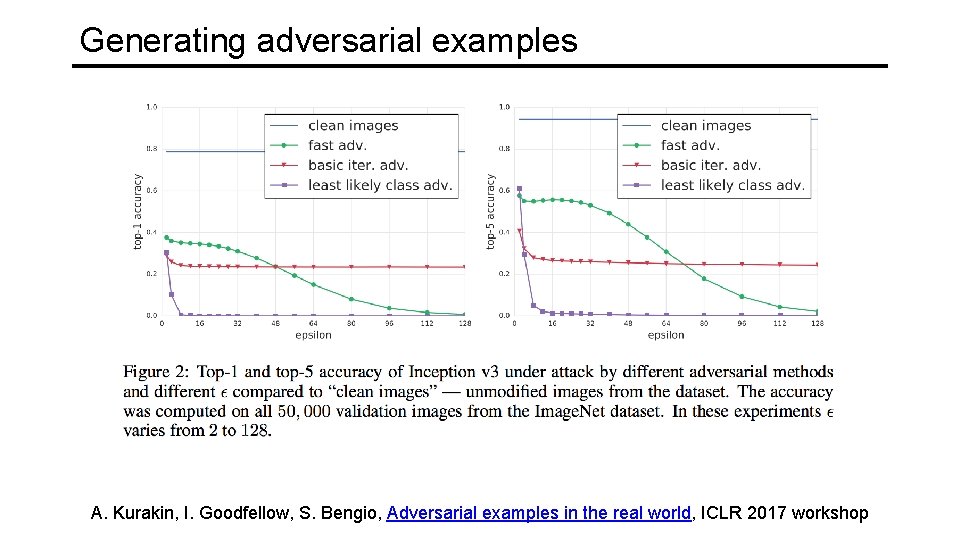
Generating adversarial examples A. Kurakin, I. Goodfellow, S. Bengio, Adversarial examples in the real world, ICLR 2017 workshop
Generating adversarial examples A. Kurakin, I. Goodfellow, S. Bengio, Adversarial examples in the real world, ICLR 2017 workshop
Generating adversarial examples A. Kurakin, I. Goodfellow, S. Bengio, Adversarial examples in the real world, ICLR 2017 workshop
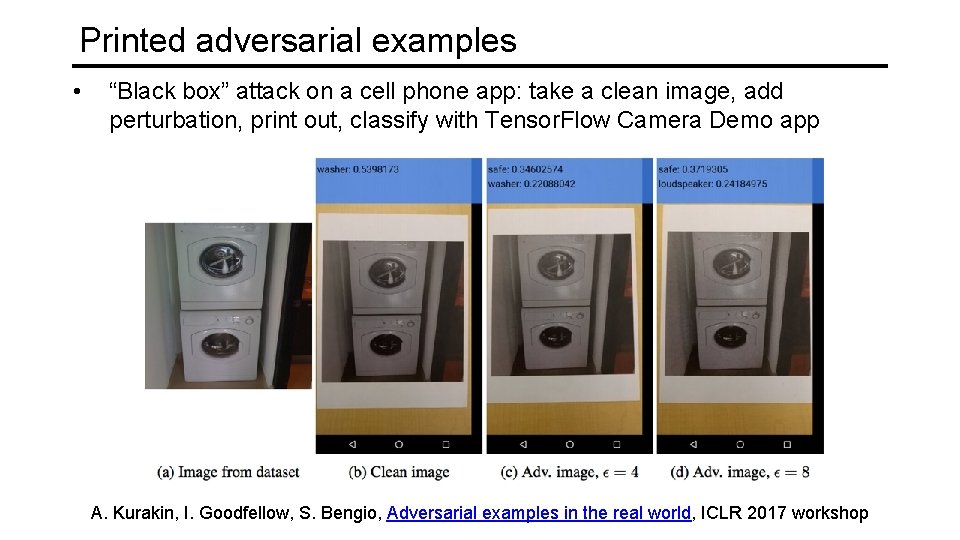
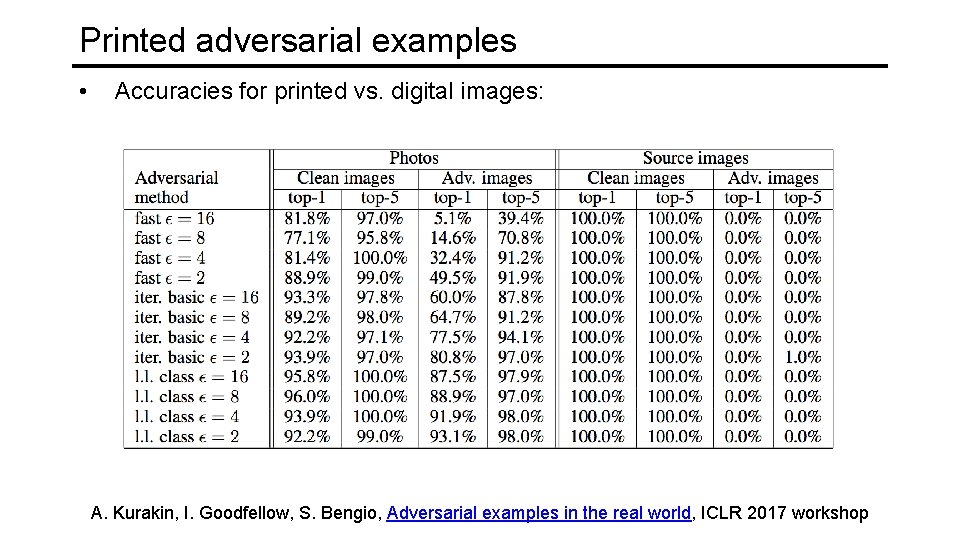
Printed adversarial examples • “Black box” attack on a cell phone app: take a clean image, add perturbation, print out, classify with Tensor. Flow Camera Demo app A. Kurakin, I. Goodfellow, S. Bengio, Adversarial examples in the real world, ICLR 2017 workshop
Printed adversarial examples • Accuracies for printed vs. digital images: A. Kurakin, I. Goodfellow, S. Bengio, Adversarial examples in the real world, ICLR 2017 workshop
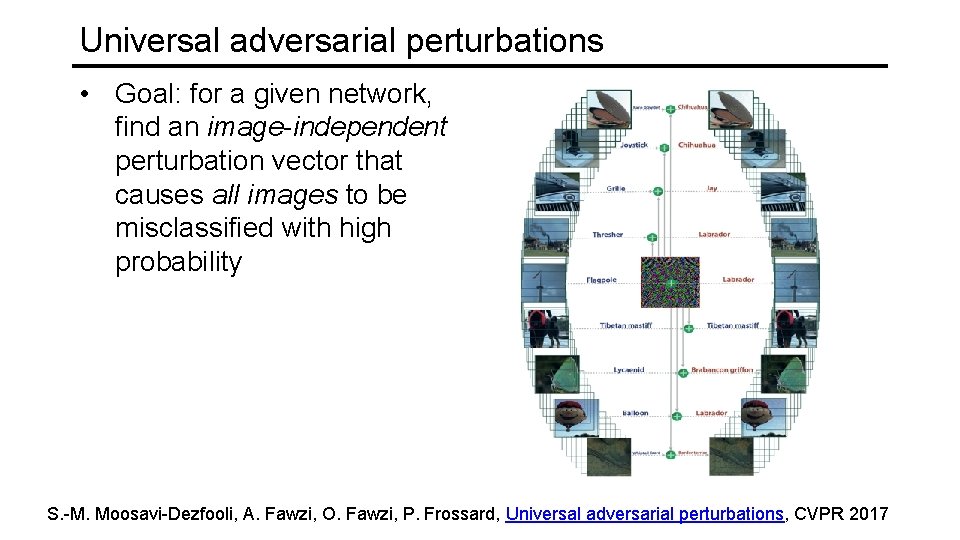
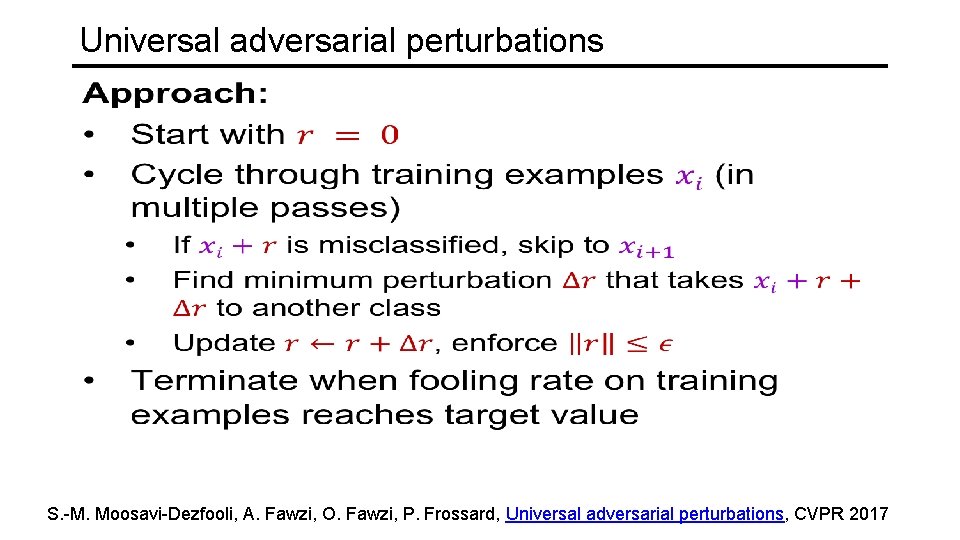
Universal adversarial perturbations • Goal: for a given network, find an image-independent perturbation vector that causes all images to be misclassified with high probability S. -M. Moosavi-Dezfooli, A. Fawzi, O. Fawzi, P. Frossard, Universal adversarial perturbations, CVPR 2017
Universal adversarial perturbations S. -M. Moosavi-Dezfooli, A. Fawzi, O. Fawzi, P. Frossard, Universal adversarial perturbations, CVPR 2017
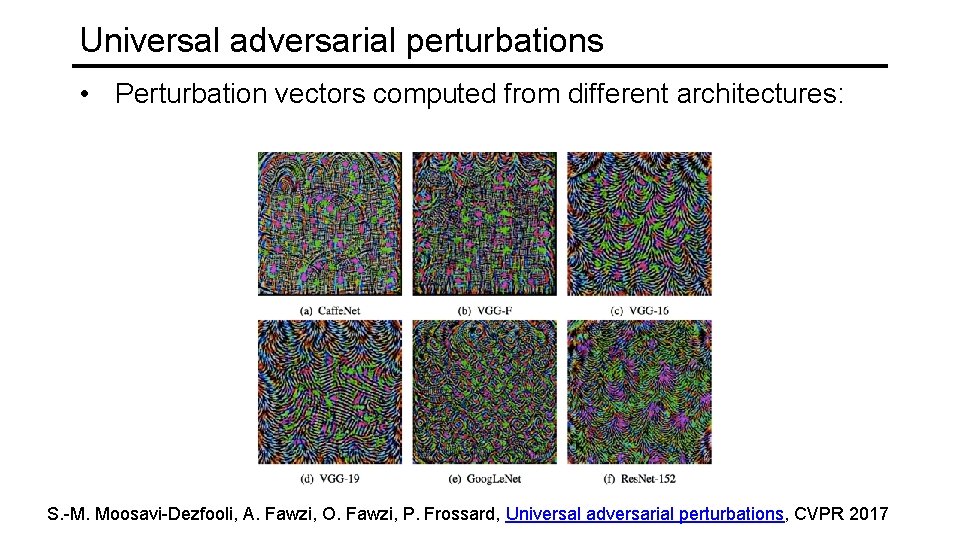
Universal adversarial perturbations • Perturbation vectors computed from different architectures: S. -M. Moosavi-Dezfooli, A. Fawzi, O. Fawzi, P. Frossard, Universal adversarial perturbations, CVPR 2017
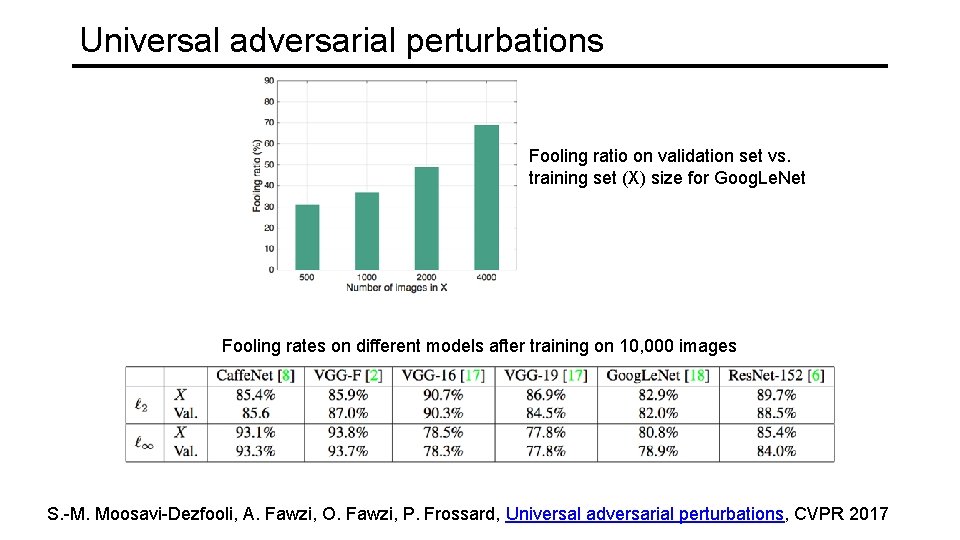
Universal adversarial perturbations Fooling ratio on validation set vs. training set (X) size for Goog. Le. Net Fooling rates on different models after training on 10, 000 images S. -M. Moosavi-Dezfooli, A. Fawzi, O. Fawzi, P. Frossard, Universal adversarial perturbations, CVPR 2017
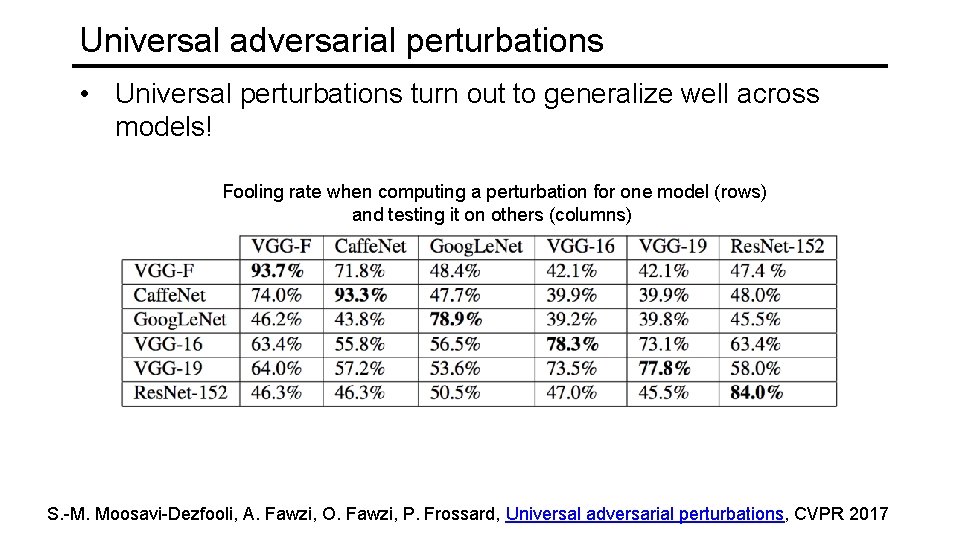
Universal adversarial perturbations • Universal perturbations turn out to generalize well across models! Fooling rate when computing a perturbation for one model (rows) and testing it on others (columns) S. -M. Moosavi-Dezfooli, A. Fawzi, O. Fawzi, P. Frossard, Universal adversarial perturbations, CVPR 2017
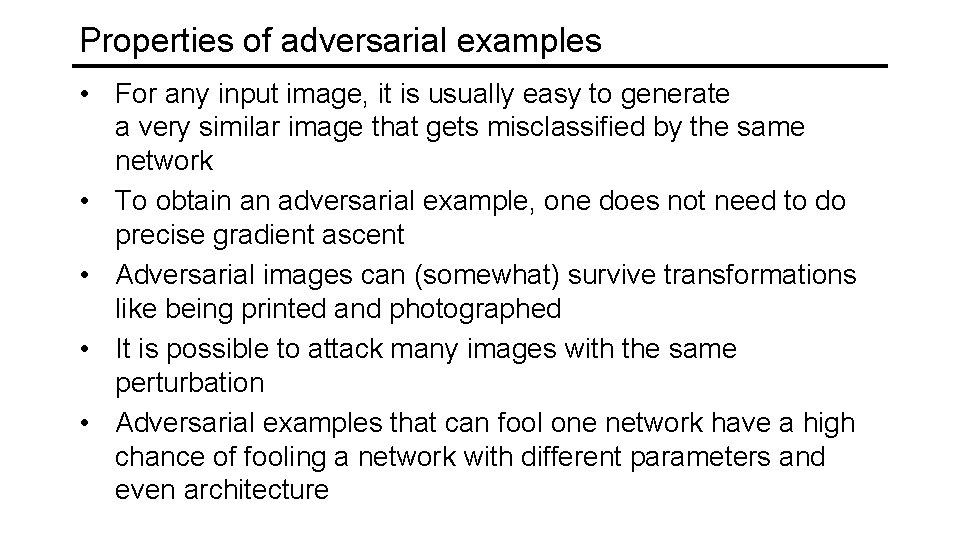
Properties of adversarial examples • For any input image, it is usually easy to generate a very similar image that gets misclassified by the same network • To obtain an adversarial example, one does not need to do precise gradient ascent • Adversarial images can (somewhat) survive transformations like being printed and photographed • It is possible to attack many images with the same perturbation • Adversarial examples that can fool one network have a high chance of fooling a network with different parameters and even architecture
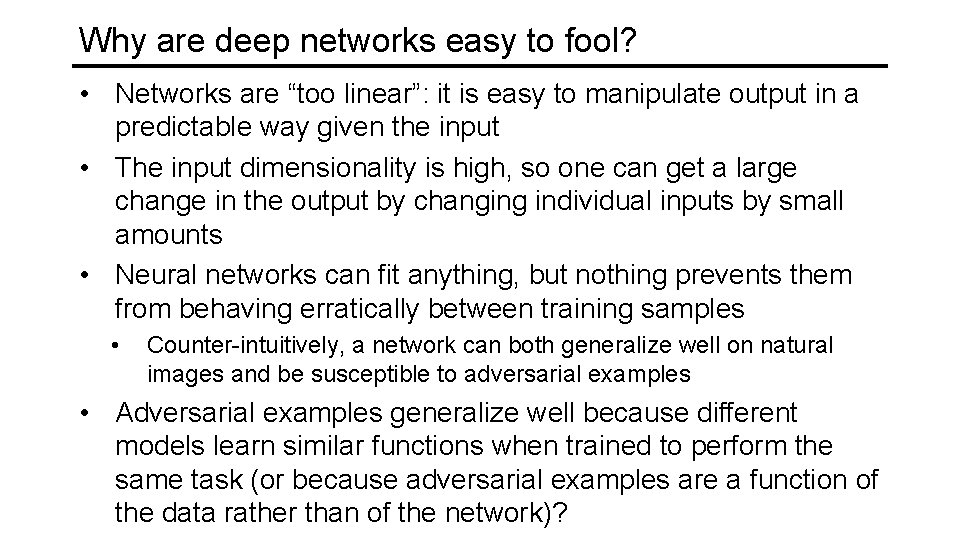
Why are deep networks easy to fool? • Networks are “too linear”: it is easy to manipulate output in a predictable way given the input • The input dimensionality is high, so one can get a large change in the output by changing individual inputs by small amounts • Neural networks can fit anything, but nothing prevents them from behaving erratically between training samples • Counter-intuitively, a network can both generalize well on natural images and be susceptible to adversarial examples • Adversarial examples generalize well because different models learn similar functions when trained to perform the same task (or because adversarial examples are a function of the data rather than of the network)?
Adversarial examples: Outline • Generating adversarial examples • • • Finding smallest “fooling” transformation Gradient ascent Fast gradient sign, iterative variants Universal adversarial perturbations Why are neural networks easy to fool? Defending against adversarial examples • • Adversarial training Learning to reject adversarial examples Robust architectures Image pre-processing
Defending against adversarial examples • Adversarial training: networks can be made somewhat resistant by augmenting or regularizing training with adversarial examples (Goodfellow et al. 2015, Tramer et al. 2018)
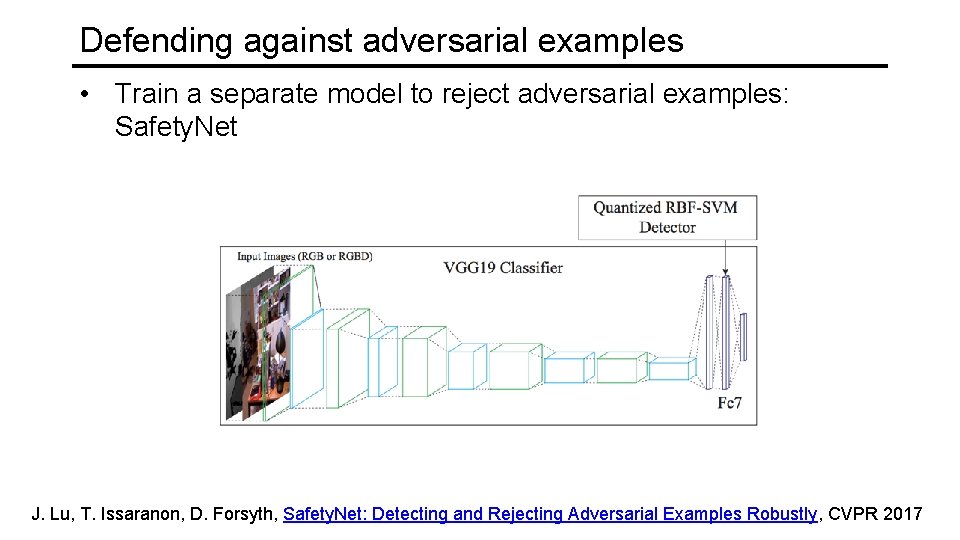
Defending against adversarial examples • Train a separate model to reject adversarial examples: Safety. Net J. Lu, T. Issaranon, D. Forsyth, Safety. Net: Detecting and Rejecting Adversarial Examples Robustly, CVPR 2017
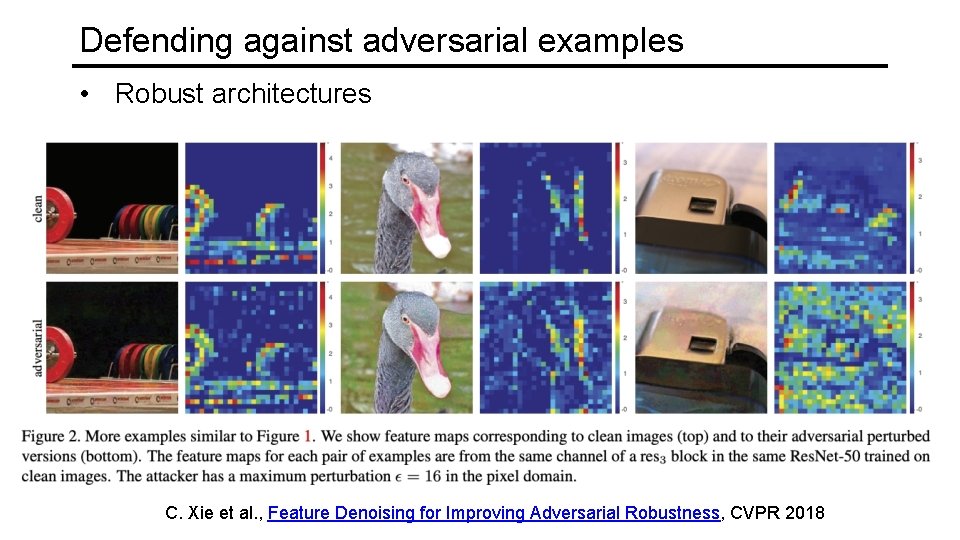
Defending against adversarial examples • Robust architectures C. Xie et al. , Feature Denoising for Improving Adversarial Robustness, CVPR 2018
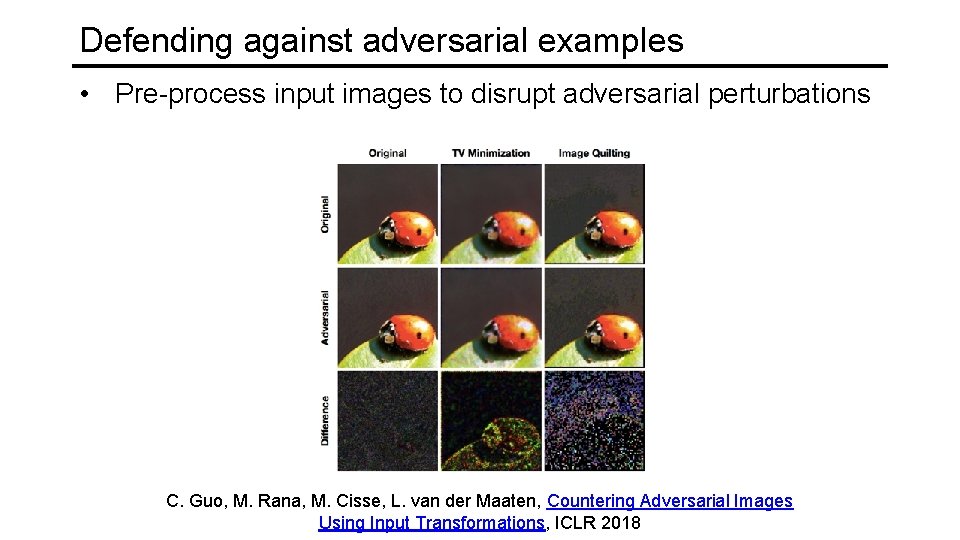
Defending against adversarial examples • Pre-process input images to disrupt adversarial perturbations C. Guo, M. Rana, M. Cisse, L. van der Maaten, Countering Adversarial Images Using Input Transformations, ICLR 2018
Adversarial examples: Outline • Generating adversarial examples • • • Finding smallest “fooling” transformation Gradient ascent Fast gradient sign, iterative variants Universal adversarial perturbations Why are neural networks easy to fool? Defending against adversarial examples • • Adversarial training Learning to reject adversarial examples Robust architectures Image pre-processing • “Open” topics • • Broadening the scope of adversarial examples Adversarial examples and human perception
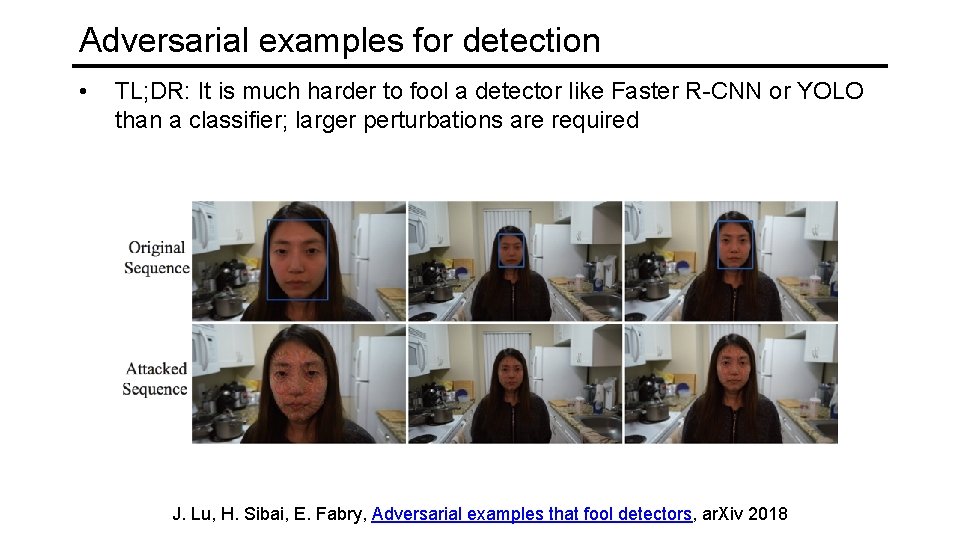
Adversarial examples for detection • TL; DR: It is much harder to fool a detector like Faster R-CNN or YOLO than a classifier; larger perturbations are required J. Lu, H. Sibai, E. Fabry, Adversarial examples that fool detectors, ar. Xiv 2018
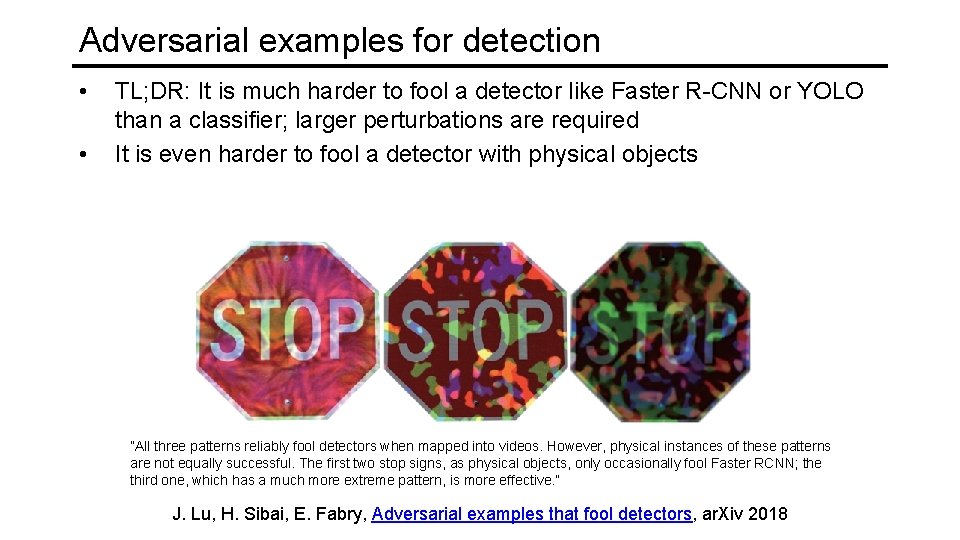
Adversarial examples for detection • • TL; DR: It is much harder to fool a detector like Faster R-CNN or YOLO than a classifier; larger perturbations are required It is even harder to fool a detector with physical objects ”All three patterns reliably fool detectors when mapped into videos. However, physical instances of these patterns are not equally successful. The first two stop signs, as physical objects, only occasionally fool Faster RCNN; the third one, which has a much more extreme pattern, is more effective. ” J. Lu, H. Sibai, E. Fabry, Adversarial examples that fool detectors, ar. Xiv 2018
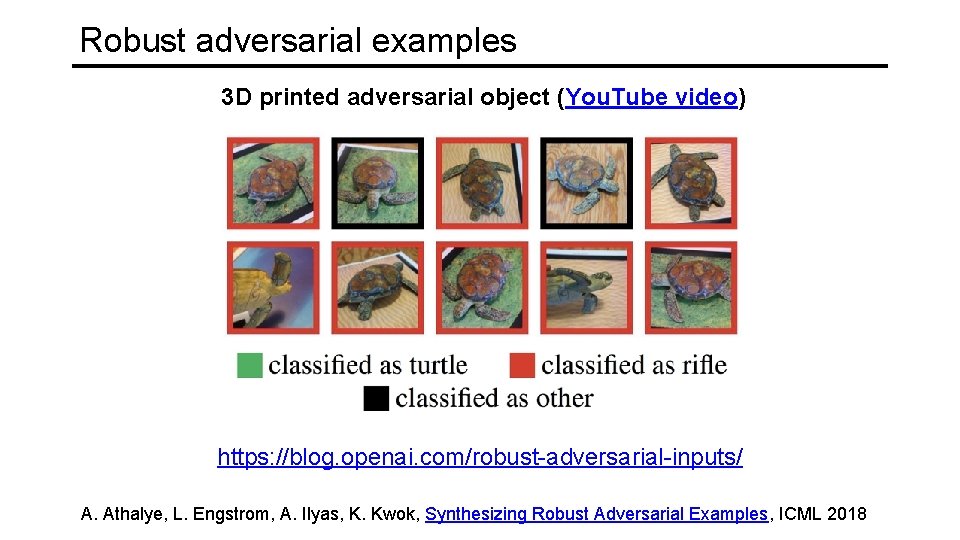
Robust adversarial examples 3 D printed adversarial object (You. Tube video) https: //blog. openai. com/robust-adversarial-inputs/ A. Athalye, L. Engstrom, A. Ilyas, K. Kwok, Synthesizing Robust Adversarial Examples, ICML 2018
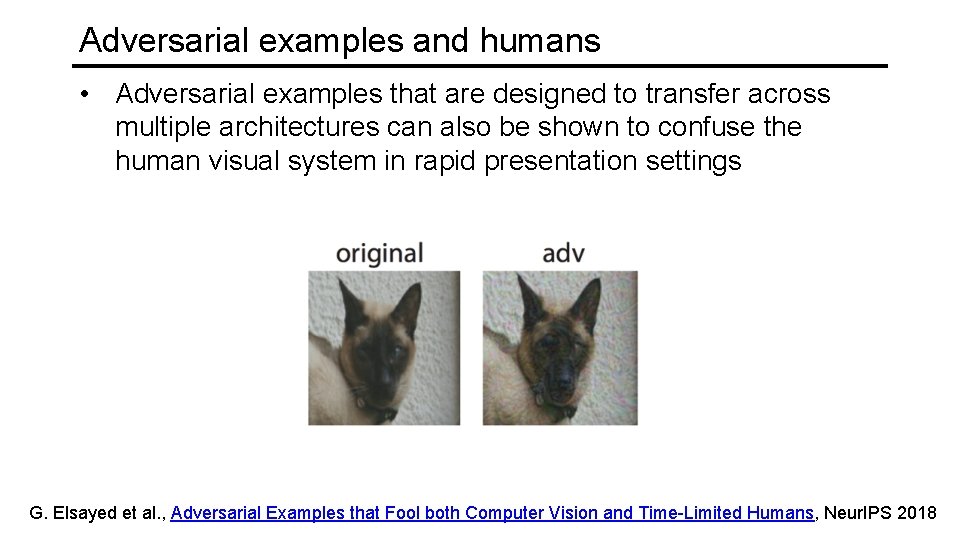
Adversarial examples and humans • Adversarial examples that are designed to transfer across multiple architectures can also be shown to confuse the human visual system in rapid presentation settings G. Elsayed et al. , Adversarial Examples that Fool both Computer Vision and Time-Limited Humans, Neur. IPS 2018
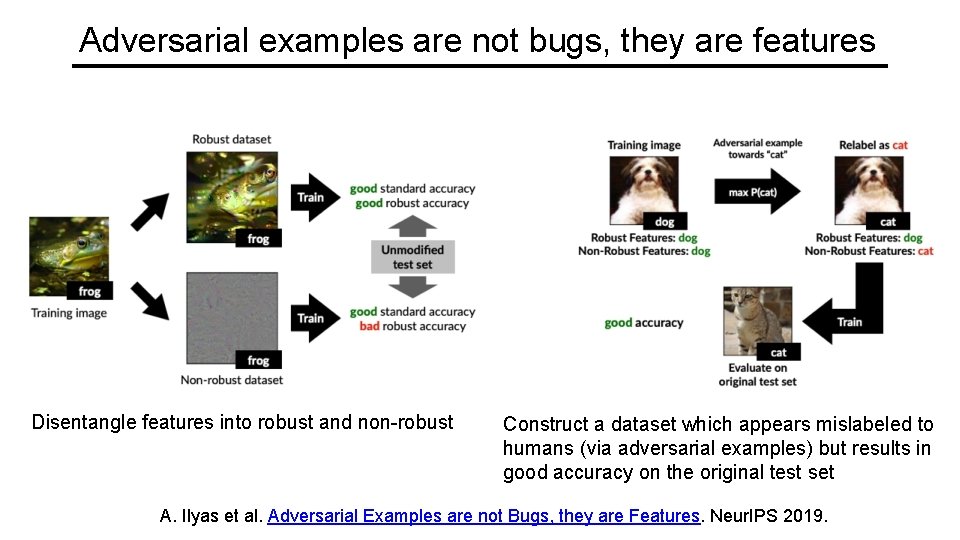
Adversarial examples are not bugs, they are features Disentangle features into robust and non-robust Construct a dataset which appears mislabeled to humans (via adversarial examples) but results in good accuracy on the original test set A. Ilyas et al. Adversarial Examples are not Bugs, they are Features. Neur. IPS 2019.