
FOODS I Lesson Plans 4 02 Understand nutritional
- Slides: 51
FOODS I Lesson Plans 4. 02
Understand nutritional needs through the life cycle, special nutritional needs, and types of eating plans. (4. 02) n n n Opening: Student Input: 4. 02 D key terms Teacher Input: Keep on Track with Good Nutrition Throughout the Life Cycle ppt Individual: Keep on Track with Good Nutrition Graphic Organizer Closing: Newsletter Assignment
Presentation Of Posters
4. 02 A Keep on Track with Good Nutrition Throughout the Life Cycle 4
The Life Cycles n n n n n Pregancy Lactation Infancy (0 -12 months) Toddler (1 -3 years) Preschool (3+ years) School-aged Teen-aged Adults Older Adults (50+ years) 4. 02 A Keep on Track with Good Nutrition Throughout the Life Cycle 5
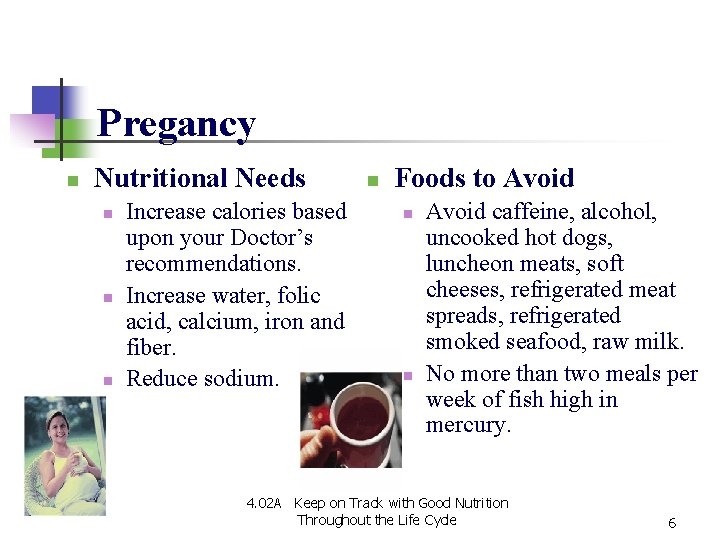
Pregancy n Nutritional Needs n n n Increase calories based upon your Doctor’s recommendations. Increase water, folic acid, calcium, iron and fiber. Reduce sodium. n Foods to Avoid n n Avoid caffeine, alcohol, uncooked hot dogs, luncheon meats, soft cheeses, refrigerated meat spreads, refrigerated smoked seafood, raw milk. No more than two meals per week of fish high in mercury. 4. 02 A Keep on Track with Good Nutrition Throughout the Life Cycle 6
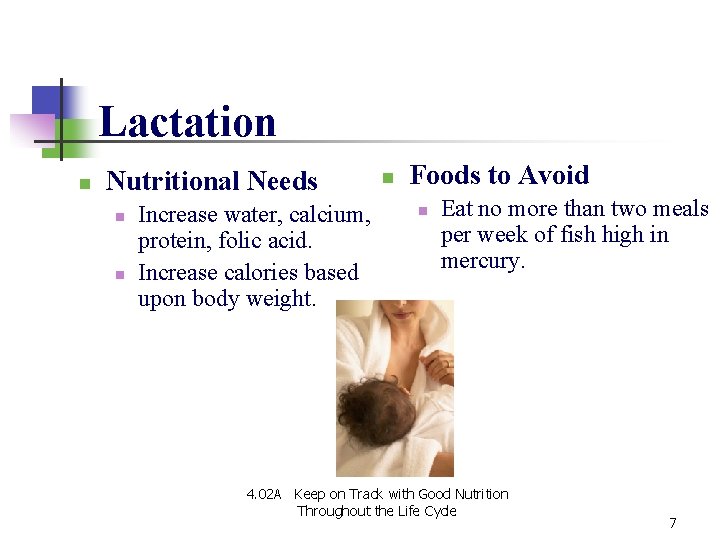
Lactation n Nutritional Needs n n Increase water, calcium, protein, folic acid. Increase calories based upon body weight. n Foods to Avoid n Eat no more than two meals per week of fish high in mercury. 4. 02 A Keep on Track with Good Nutrition Throughout the Life Cycle 7
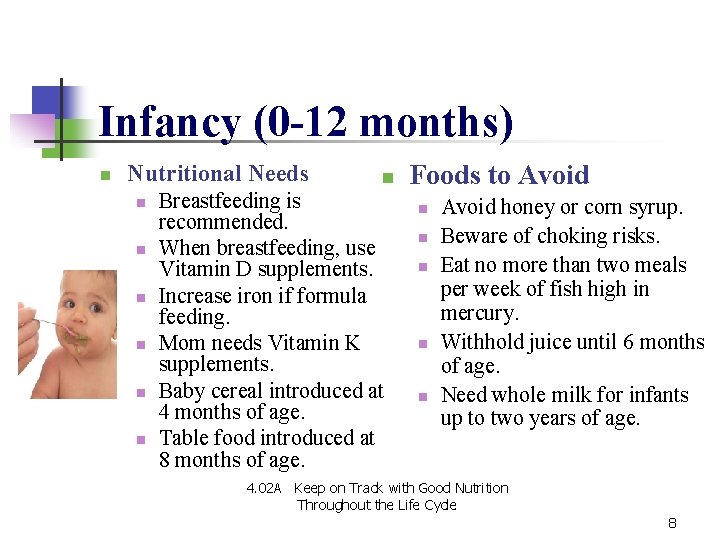
Infancy (0 -12 months) n Nutritional Needs n n n n Breastfeeding is recommended. When breastfeeding, use Vitamin D supplements. Increase iron if formula feeding. Mom needs Vitamin K supplements. Baby cereal introduced at 4 months of age. Table food introduced at 8 months of age. Foods to Avoid n n n Avoid honey or corn syrup. Beware of choking risks. Eat no more than two meals per week of fish high in mercury. Withhold juice until 6 months of age. Need whole milk for infants up to two years of age. 4. 02 A Keep on Track with Good Nutrition Throughout the Life Cycle 8
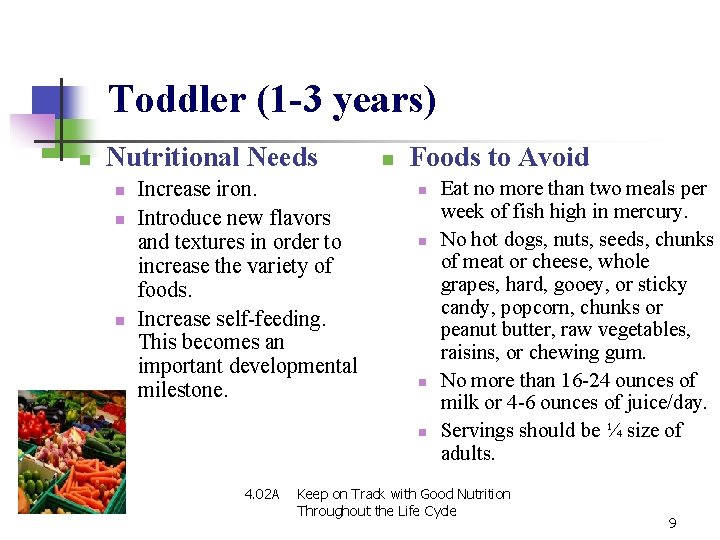
Toddler (1 -3 years) n Nutritional Needs n n n Increase iron. Introduce new flavors and textures in order to increase the variety of foods. Increase self-feeding. This becomes an important developmental milestone. n Foods to Avoid n n 4. 02 A Eat no more than two meals per week of fish high in mercury. No hot dogs, nuts, seeds, chunks of meat or cheese, whole grapes, hard, gooey, or sticky candy, popcorn, chunks or peanut butter, raw vegetables, raisins, or chewing gum. No more than 16 -24 ounces of milk or 4 -6 ounces of juice/day. Servings should be ¼ size of adults. Keep on Track with Good Nutrition Throughout the Life Cycle 9
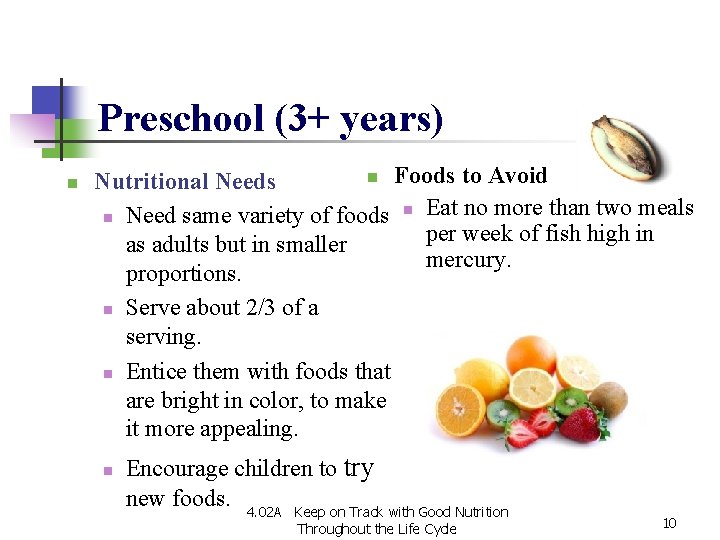
Preschool (3+ years) n n Foods to Avoid Nutritional Needs n Eat no more than two meals n Need same variety of foods per week of fish high in as adults but in smaller mercury. proportions. n Serve about 2/3 of a serving. n Entice them with foods that are bright in color, to make it more appealing. n Encourage children to try new foods. 4. 02 A Keep on Track with Good Nutrition Throughout the Life Cycle 10
School-aged n Nutritional Needs n n n Balanced diet Three servings of dairy daily Daily activity based on age, health, body size n Foods to Avoid n n High-sugar snacks Fatty foods 4. 02 A Keep on Track with Good Nutrition Throughout the Life Cycle
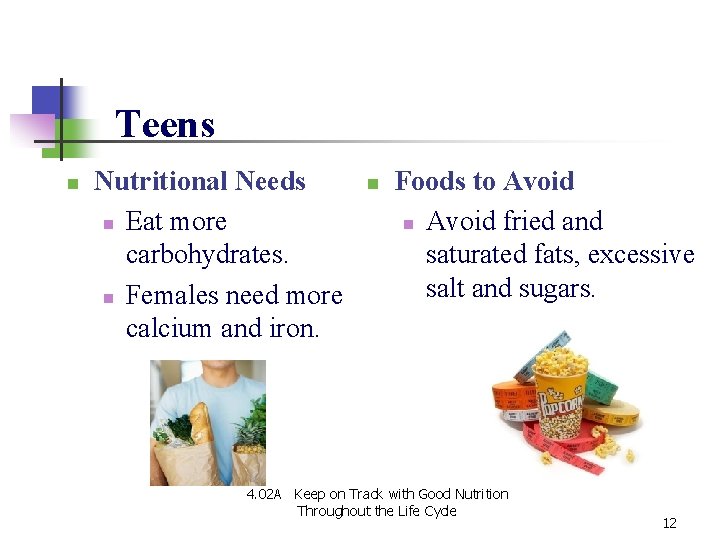
Teens n Nutritional Needs n Eat more carbohydrates. n Females need more calcium and iron. n Foods to Avoid n Avoid fried and saturated fats, excessive salt and sugars. 4. 02 A Keep on Track with Good Nutrition Throughout the Life Cycle 12
Understand nutritional needs through the life cycle, special nutritional needs, and types of eating plans. (4. 02) 1 -3 -2017 n n n Opening: Test Questions Student Input: 4. 02 D key terms (homework due) Teacher Input: Keep on Track with Good Nutrition Throughout the Life Cycle ppt (Finish) Individual: Keep on Track with Good Nutrition Graphic Organizer Closing: Newsletter Assignment
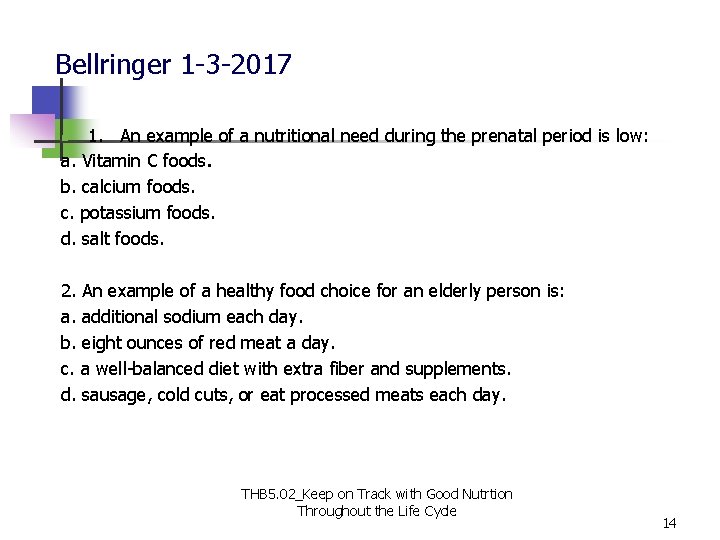
Bellringer 1 -3 -2017 1. An example of a nutritional need during the prenatal period is low: a. Vitamin C foods. b. calcium foods. c. potassium foods. d. salt foods. n 2. An example of a healthy food choice for an elderly person is: a. additional sodium each day. b. eight ounces of red meat a day. c. a well-balanced diet with extra fiber and supplements. d. sausage, cold cuts, or eat processed meats each day. THB 5. 02_Keep on Track with Good Nutrtion Throughout the Life Cycle 14
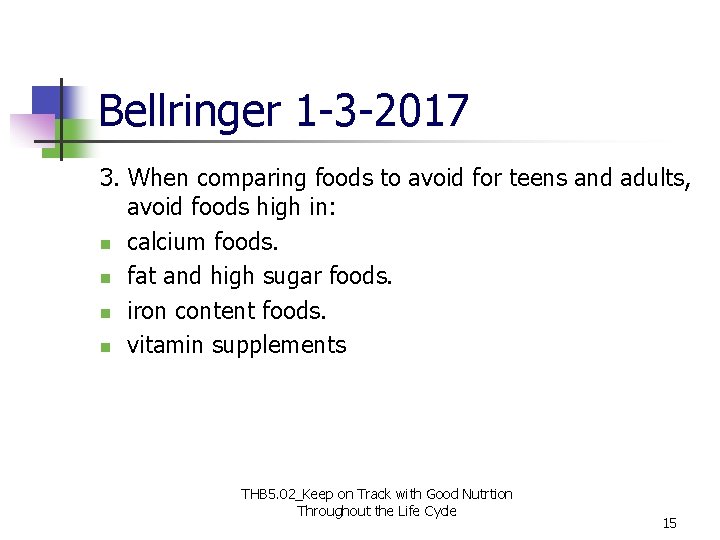
Bellringer 1 -3 -2017 3. When comparing foods to avoid for teens and adults, avoid foods high in: n calcium foods. n fat and high sugar foods. n iron content foods. n vitamin supplements THB 5. 02_Keep on Track with Good Nutrtion Throughout the Life Cycle 15
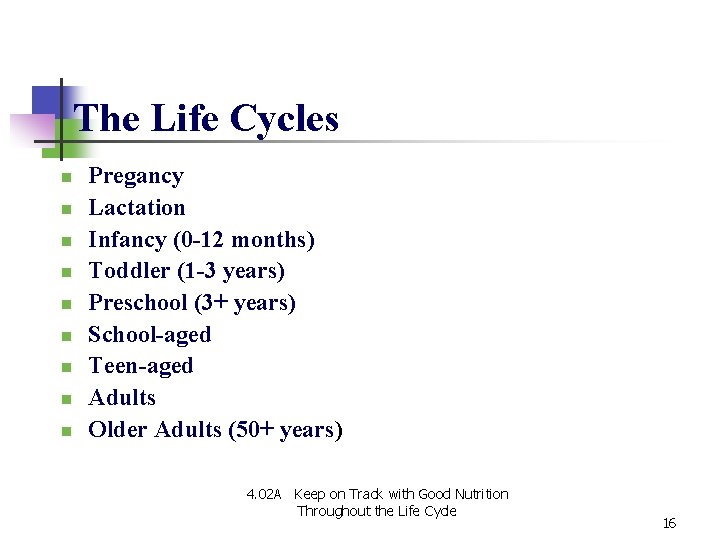
The Life Cycles n n n n n Pregancy Lactation Infancy (0 -12 months) Toddler (1 -3 years) Preschool (3+ years) School-aged Teen-aged Adults Older Adults (50+ years) 4. 02 A Keep on Track with Good Nutrition Throughout the Life Cycle 16
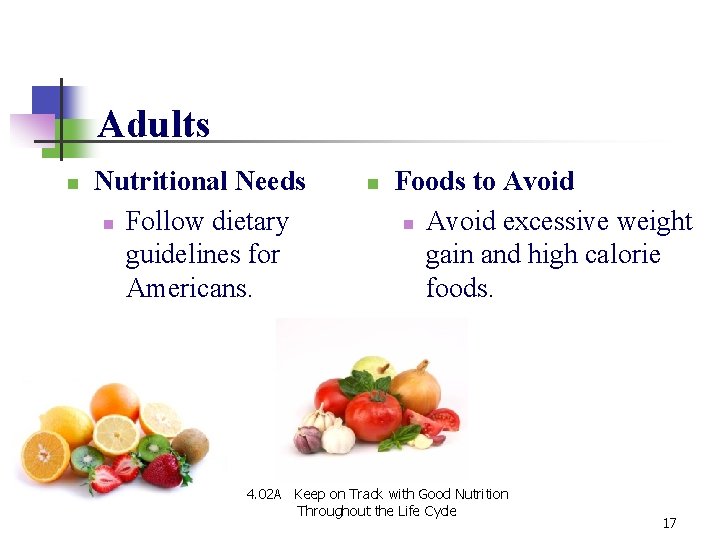
Adults n Nutritional Needs n Follow dietary guidelines for Americans. n Foods to Avoid n Avoid excessive weight gain and high calorie foods. 4. 02 A Keep on Track with Good Nutrition Throughout the Life Cycle 17
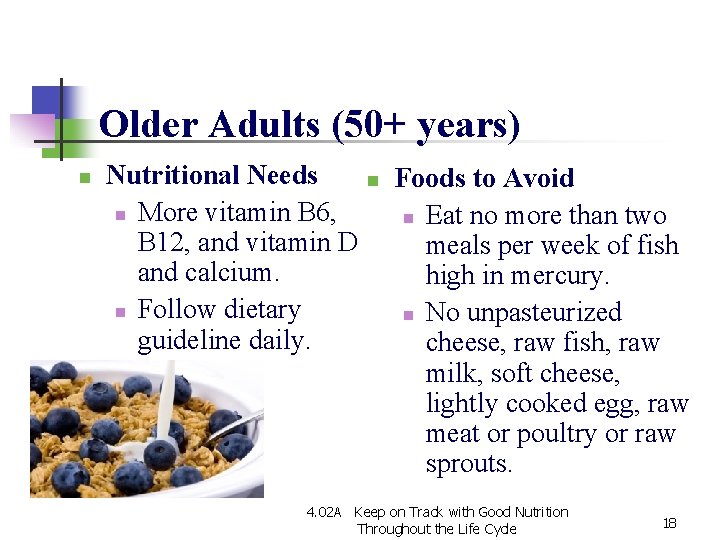
Older Adults (50+ years) n Nutritional Needs n More vitamin B 6, B 12, and vitamin D and calcium. n Follow dietary guideline daily. n Foods to Avoid n Eat no more than two meals per week of fish high in mercury. n No unpasteurized cheese, raw fish, raw milk, soft cheese, lightly cooked egg, raw meat or poultry or raw sprouts. 4. 02 A Keep on Track with Good Nutrition Throughout the Life Cycle 18
Family Life cycles n Pretend you are a Journalist and work for the Sampson Independent. Recently, you’ve interviewed with Pediatricians, Dietitians, Nutritionist t(other specialist) and general family physicians concerning dietary recommendations. Create an newsletter based on the life cycle of choice. Include 1 -2 recipes related to your life cycle. Include graphics and detailed descriptions of nutritional needs and foods to avoid (explain the importance of vitamins, folic acid, milk, exercise etc. (Be creative) (Create a catchy title for your newsletter). THB 5. 02_Keep on Track with Good Nutrition Throughout the Life Cycle 19
Websites n n n n www. Choosemyplate. gov www. babycenter. com www. americanpregnancy. org www. healthychildren. org www. nutrition. gov www. eatright. org www. kidshealth. org THB 5. 02_Keep on Track with Good Nutrtion Throughout the Life Cycle 20
Understand nutritional needs through the life cycle, special nutritional needs, and types of eating plans. (4. 02) 1 -4 -2017 n n Review: Life Cycles/Stages (20 minutes) Teacher Input: Nutrition and Chronic Conditions Individual: Chronic Conditions Question and Answer sheet Closing: Eating Disorder Group Assignment
4. 02 F Nutrition and Chronic Conditions 22
Reducing the Risk Consult a dietitian, nutritionist, or a physician to prescribe one of the following: • a special eating plan. • medical nutrition therapy. 4. 02 F Nutrition and Chronic Conditions 23
High Blood Cholesterol n n Causes n Eating fatty (saturated fats) foods n Eating high cholesterol foods n Lack of fiber in the diet Symptoms n Elevated blood pressure n Elevated HDL/LDL levels n HDL-High-Density lipoprotein l carries excess cholesterol to your liver so it doesn't build up in your bloodstream n Foods to include n n n Low-fat or fat-free Whole grains Lean meats Fish Fresh fruits and vegetables Foods to avoid/Decrease the consumption of n Partially hydrogenated oils (fats/shortening) n Processed snack foods n Highly marbled meats (fat found in meat) 4. 02 F Nutrition and Chronic Conditions 24
What is HDL? /Good Cholesterol n HDL is like a vacuum cleaner or snowplow for cholesterol in the body. When it’s at healthy levels in your blood, it removes extra cholesterol and plaque buildup in your arteries and then sends it to your liver. Your liver expels it from your body. Ultimately, this will help reduce your risk of heart disease, heart attack, and stroke. THB 5. 02_Keep on Track with Good Nutrtion Throughout the Life Cycle 25
What is LDL? (Low-Density Lipoprotein n LDL cholesterol is considered the “bad” cholesterol because it contributes to plaque, a thick, hard deposit that can clog arteries and make them less flexible. THB 5. 02_Keep on Track with Good Nutrtion Throughout the Life Cycle 26
Hypertension/High blood pressure n n Causes n Eating foods with a high sodium content n Eating foods with a high fat content n Low consumption of foods containing calcium, potassium and magnesium. Symptoms n Elevated heart rate n Shortness of breath with exertion n Foods to include n n Low-sodium foods Fresh fruits and vegetables Whole grains Foods to avoid (examples) n Highly processed snack foods n Low fiber content n High fat foods 4. 02 F Nutrition and Chronic Conditions 27
Obesity n n Causes (Factors) n Eating high fat content and low-nutrient dense foods. n Eating oversized portions n Limited physical activity n Inherited genetic traits Symptoms n Increased health problems n Elevated BMI rating n n Foods to include n Smaller portions n Reduced-fat or fat free n Whole grains n Fish n Fresh fruits and vegetables Foods that Impact n Highly processed snack foods n Low-fiber content n High-fat foods https: //www. youtube. com/watch? v= 4. 02 F Nutrition and Chronic Conditions 07 mqh 8 pyv. VU 28
Understand nutritional needs through the life cycle, special nutritional needs, and types of eating plans. (4. 02) Opening: How do we reduce the risk of chronic diseases? What would your recommendation be for a 15 year old obese teen that has a blood glucose level of 275? n Teacher Input: Nutrition and Chronic Conditions n Individual: Chronic Conditions Question and Answer sheet n Closing: Eating Disorder Group Assignment
Diabetes- Type II Foods to include n Low-sugar and sugarfree n Protein foods n Whole grains n Reduced-fat and fatn free n Foods to avoid (examples) n Foods that are high in sugar https: //www. youtube. com/watch? v=Ub. Che n Foods that are high in 6 l. KNxc carbohydrates n Causes n Eating foods high in sugar n Excessive body weight n Low consumption of fiber Symptoms n Excessive thirst n Fatigue n https: //www. youtube. com/watch? v=K 5189 i 4. 02 F Nutrition and Chronic Conditions 3 Kt. N 4 (Diabetes) 30
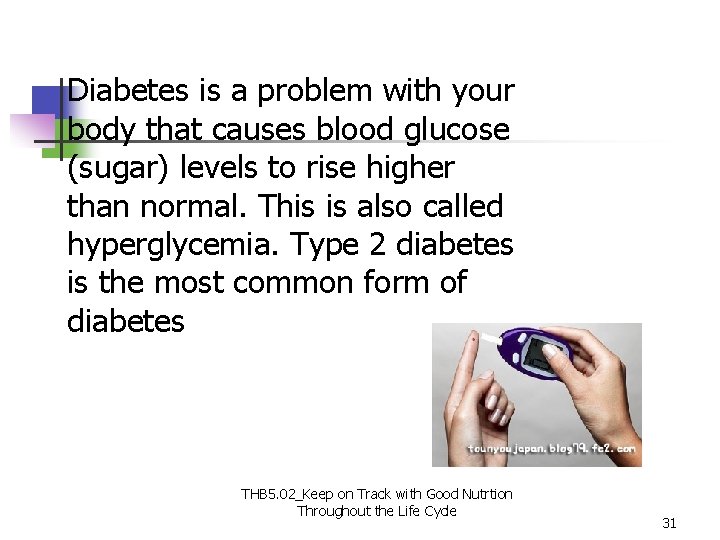
Diabetes is a problem with your body that causes blood glucose (sugar) levels to rise higher than normal. This is also called hyperglycemia. Type 2 diabetes is the most common form of diabetes THB 5. 02_Keep on Track with Good Nutrtion Throughout the Life Cycle 31
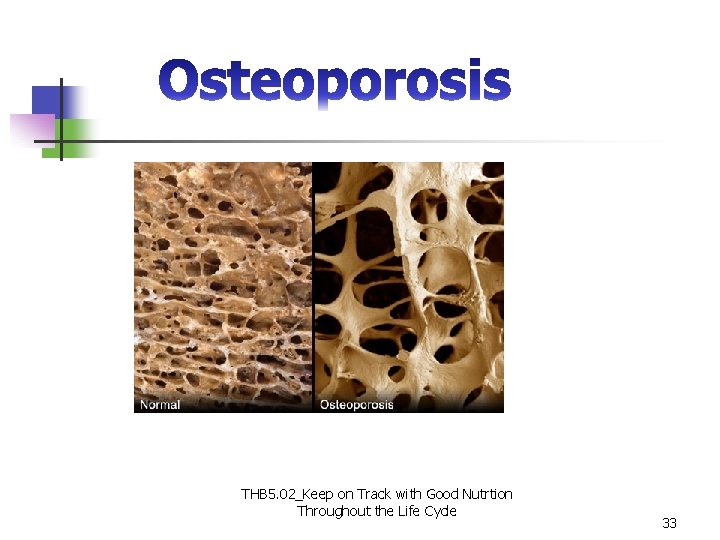
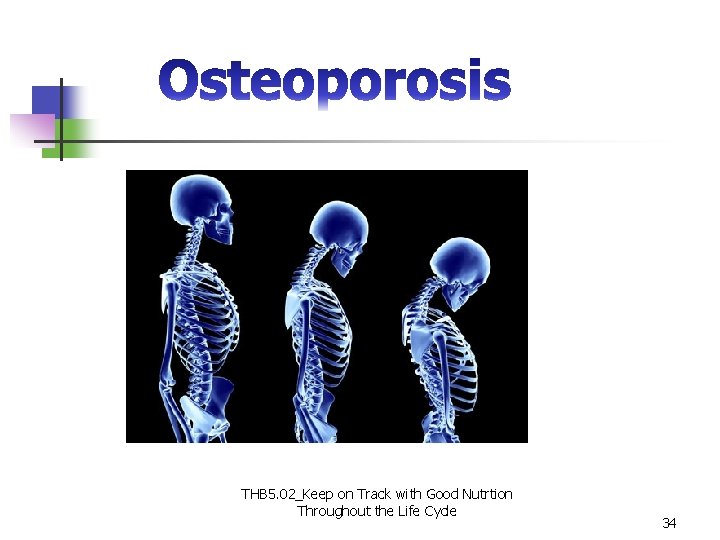
Osteoporosis n n Causes n Lack of calcium and exercise Symptoms n Brittle bones or bones that break easily n Hormonal changes n Deficiency of vitamin D 4. 02 F n n Nutrition and Chronic Conditions Foods to include n Calcium and vitaminrich foods n Foods high in phosphorous n Dark green leafy vegetables Foods to avoid (examples) n Caffeine n Soft drinks n Alcohol n Tobacco products 32
THB 5. 02_Keep on Track with Good Nutrtion Throughout the Life Cycle 33
THB 5. 02_Keep on Track with Good Nutrtion Throughout the Life Cycle 34
Anorexia Nervosa n Causes An unrealistic body image n Peer pressure to be thin Symptoms n Eating rituals n Extensive exercise n Obsession with dieting n n https: //www. youtube. com/watch? v=hj m 3 XTMEUAM https: //www. youtube. com/watch? v=Bb 4. 02 F Nutrition and Chronic Conditions h. T_Dla. Dzo 35
Bulimia Nervosa n n Causes n Guilt associated by over eating n The need to control weight by any means. Symptoms n Tooth decay n Blistered hands n Ruptured esophagus https: //www. youtube. com/watch? v=zx. H 7 X 3 o 0 M 0 A 4. 02 F Nutrition and Chronic Conditions 36
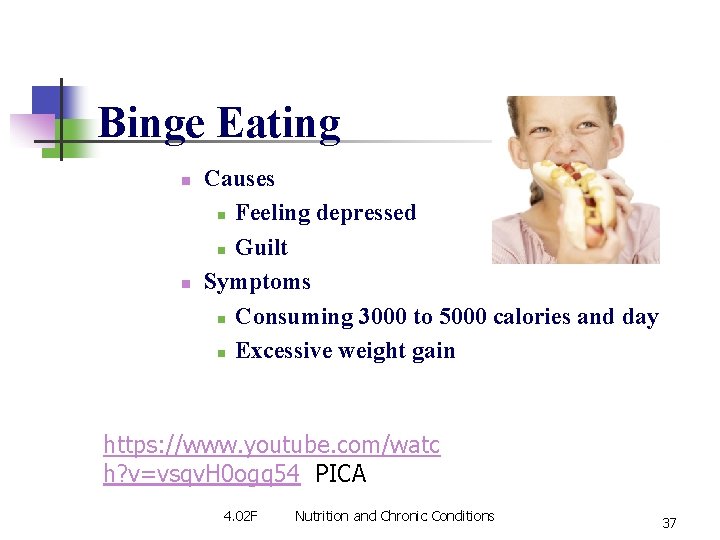
Binge Eating n n Causes n Feeling depressed n Guilt Symptoms n Consuming 3000 to 5000 calories and day n Excessive weight gain https: //www. youtube. com/watc h? v=vsqv. H 0 ogq 54 PICA 4. 02 F Nutrition and Chronic Conditions 37
Eating Disorder Research n n n Each table group will be given an Eating Disorder to research and report to the class. (A Rubric will be provided) Create a Power. Point with a minimal of 6 slides including reference or title slide. Information to be include: causes, symptoms, treatments and health effects relating to your eating disorder. THB 5. 02_Keep on Track with Good Nutrtion Throughout the Life Cycle 38
Group Topics n n Group 1 PICA Group 2 Bulimia Nervosa Group 3 Group 4 Anorexia Nervosa Binge Eating THB 5. 02_Keep on Track with Good Nutrtion Throughout the Life Cycle 39
Understand nutritional needs through the life cycle, special nutritional needs, and types of eating plans. (4. 02) n n Opening: Finish Eating Disorder’s Powerpoint Teacher Input: Where do Extra Calories come from? Individual: Nutrition Graphic Organizer Closing: Chapter: 15 Check your Knowledge p. 218 question 1 -11
4. 02 J Where Do Extra Calories Come From? 41
Condiments § Regular butter and margarine has 112 calories per tablespoon. § Use reduced fat tub or liquid margarine. § Fat-free and low-sugar alternatives – jelly, jam or apple butter. § Salad dressings account for 100 calories per tablespoon and 10 grams of fat. § (Fat- free or low-fat salad dressings or oil and vinegar are good alternatives) 4. 02 J Where Do Extra Calories Come From? 42
Sugar Filled Drinks n n There are 140 calories in one 12 oz. can of soda. Alternatives: n n Substitute diet drinks, water, or flavored waters with fruit. Cut down on sugar in tea or substitute artificial sweeteners. Drink unsweetened tea. – possible 773 calories saved. 4. 02 J Where Do Extra Calories Come From? 43
Use low fat or non-fat dairy products n Cut Calories by using: n n n reduced fat cheese reduced fat or non-fat milk non-fat or reduced fat cream cheese, sour cream and cottage cheese 4. 02 J Where Do Extra Calories Come From? 44
High-Fat Sweets and Desserts n n Eat in moderation. Do not deprive yourself from an occasional treat. Do not buy sweets when you shop. Eat half of the serving. 4. 02 J Where Do Extra Calories Come From? 45
4. 02 R Foods I “MOST WANTED” 4. 02 R Foods I Most Wanted
Why do some foods make me sick? n Food sensitivities fall into two classifications these include: § § food allergies food intolerance 4. 02 R Foods I Most Wanted 47
Food Allergies n n The FDA now requires that all food allergens be clearly identified on food labels. Foods that are common food allergens include: § Milk § Eggs § Peanuts § Wheat § Soy § Shellfish 4. 02 R Foods I Most Wanted 48
Food Intolerance n a physical reaction to food but does not involve the immune system. An intolerance usually is a less serious digestive problem and may include: § § Lactose intolerance (milk) Gluten intolerance (wheat protein) 4. 02 R Foods I Most Wanted 49
Food Name: A. K. A………… Be on the lookout for……… Reward…… Create a “Wanted Poster” for the food allergen The poster must include a picture of your food allergen, the symptoms that the allergen causes, and the ways to prevent the allergic reaction. THB 5. 02_Keep on Track with Good Nutrtion Throughout the Life Cycle 50
Group 1 -Peanuts Group 2 -Soy Group 3 -Peanuts Group 4 - Shellfish THB 5. 02_Keep on Track with Good Nutrtion Throughout the Life Cycle 51