
FoodRestaurant Unit Etiquette and HowTos at a Restaurant
![Let’s Review from Previous Units Sentence Structures • Yes/No Questions • [statement] + ma?](https://slidetodoc.com/presentation_image_h2/85adc6de6c6ea7e55fc0dd0aab244bfb/image-7.jpg "Let’s Review from Previous Units Sentence Structures • Yes/No Questions • [statement] + ma?")
![Yes/No Questions [statement] + ma? • “Do you have soda? ” • You have](https://slidetodoc.com/presentation_image_h2/85adc6de6c6ea7e55fc0dd0aab244bfb/image-8.jpg "Yes/No Questions [statement] + ma? • “Do you have soda? ” • You have")
- Slides: 21
Food/Restaurant Unit (Etiquette and How-To’s at a Restaurant) By: 高老�
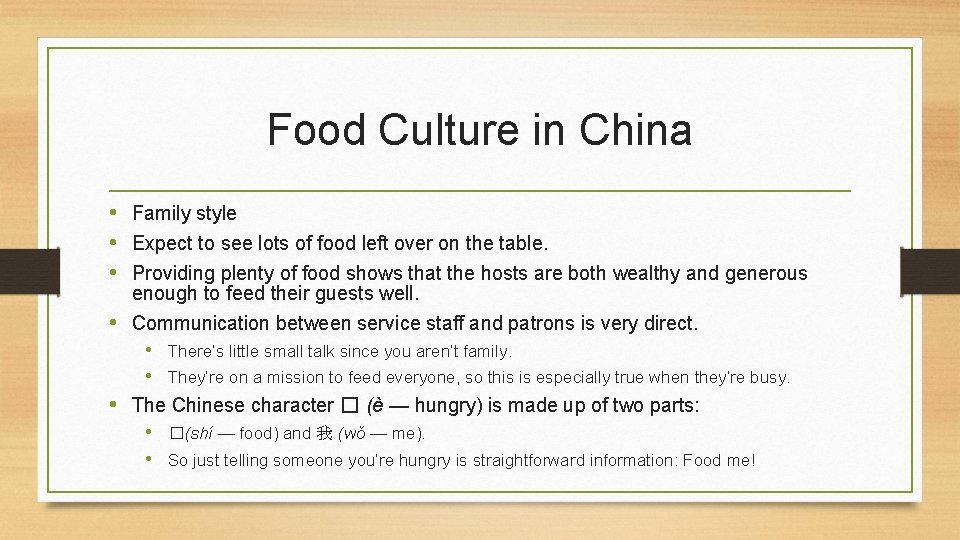
Food Culture in China • Family style • Expect to see lots of food left over on the table. • Providing plenty of food shows that the hosts are both wealthy and generous enough to feed their guests well. • Communication between service staff and patrons is very direct. • There’s little small talk since you aren’t family. • They’re on a mission to feed everyone, so this is especially true when they’re busy. • The Chinese character � (è — hungry) is made up of two parts: • �(shí — food) and 我 (wǒ — me). • So just telling someone you’re hungry is straightforward information: Food me!
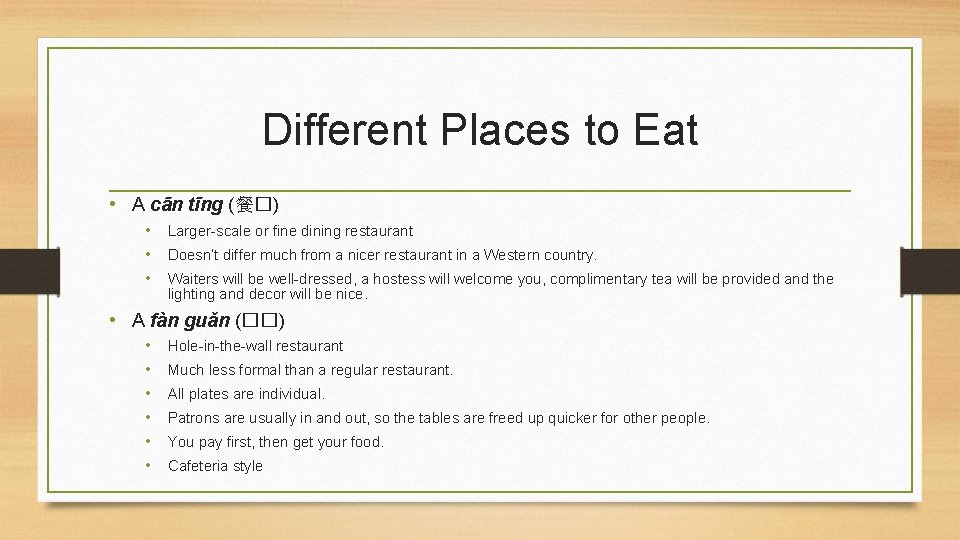
Different Places to Eat • A cān tīng (餐�) • Larger-scale or fine dining restaurant • Doesn’t differ much from a nicer restaurant in a Western country. • Waiters will be well-dressed, a hostess will welcome you, complimentary tea will be provided and the lighting and decor will be nice. • A fàn guǎn (��) • • • Hole-in-the-wall restaurant Much less formal than a regular restaurant. All plates are individual. Patrons are usually in and out, so the tables are freed up quicker for other people. You pay first, then get your food. Cafeteria style
Basics • qǐng (�) Please. (Only used at the beginning of a sentence, and never used on it's own. ) • xiè! (��) Thank you!
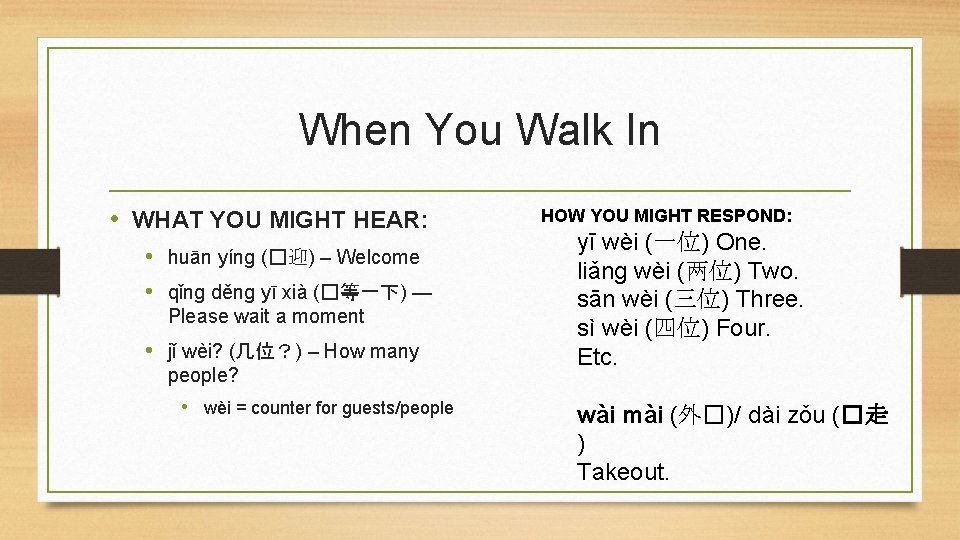
When You Walk In • WHAT YOU MIGHT HEAR: • huān yíng (�迎) – Welcome • qǐng děng yī xià (�等一下) — Please wait a moment • jǐ wèi? (几位?) – How many people? • wèi = counter for guests/people HOW YOU MIGHT RESPOND: yī wèi (一位) One. liǎng wèi (两位) Two. sān wèi (三位) Three. sì wèi (四位) Four. Etc. wài mài (外�)/ dài zǒu (�走 ) Takeout.
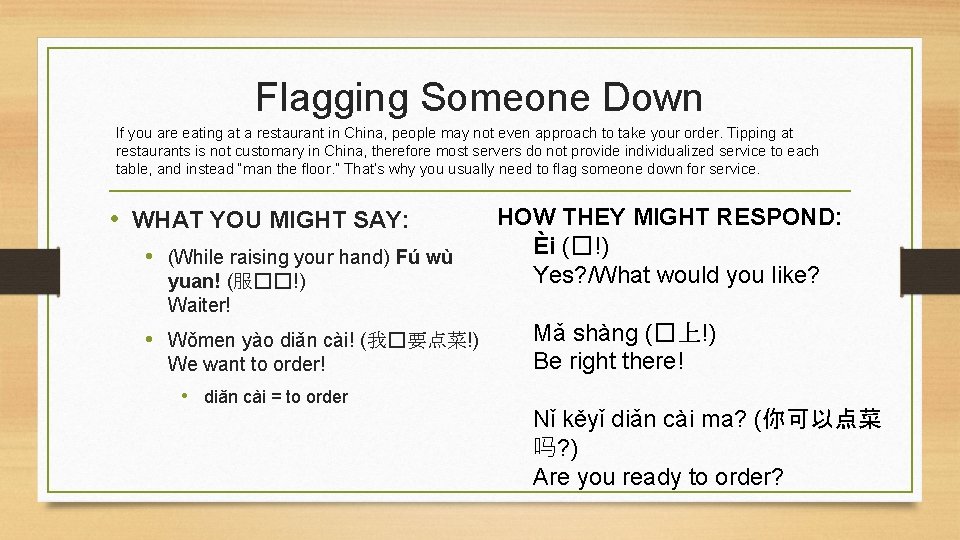
Flagging Someone Down If you are eating at a restaurant in China, people may not even approach to take your order. Tipping at restaurants is not customary in China, therefore most servers do not provide individualized service to each table, and instead “man the floor. ” That’s why you usually need to flag someone down for service. • WHAT YOU MIGHT SAY: • (While raising your hand) Fú wù yuan! (服��!) Waiter! • Wǒmen yào diǎn cài! (我�要点菜!) We want to order! • diǎn cài = to order HOW THEY MIGHT RESPOND: Èi (�!) Yes? /What would you like? Mǎ shàng (�上!) Be right there! Nǐ kěyǐ diǎn cài ma? (你可以点菜 吗? ) Are you ready to order?
Let’s Review from Previous Units Sentence Structures • Yes/No Questions • [statement] + ma? • What/shén me Questions • Subject + verb + shén me + (noun) Counter/Classifiers • People ge (个) wèi (位) • Servings/dish/menu Serving/counter for menu - fèn (份) Plate - pán (�) • For liquids Cup - bēi (杯) Bottle - píng (瓶) Pot - hú (�)
Yes/No Questions [statement] + ma? • “Do you have soda? ” • You have soda, yes/no? • “Do you have a restroom? ” • You have restroom, yes/no? • “Do you have chicken meat? ” • You have chicken meat, yes/no? Nǐ yǒu kělè ma? (你有可乐吗?) Nǐ yǒu cèsuǒ ma? (你有厕所吗?) Nǐ yǒu jī ròu ma? (你有鸡肉吗?)
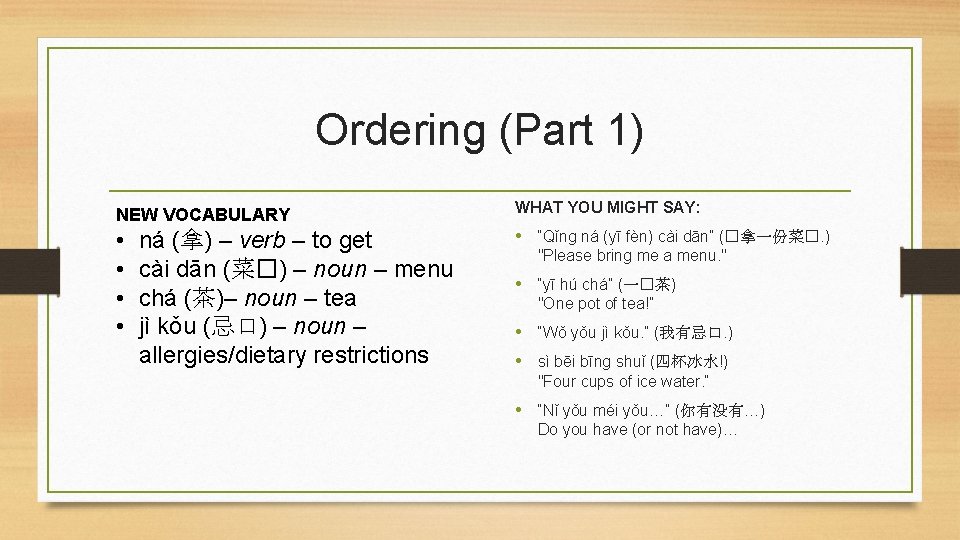
Ordering (Part 1) NEW VOCABULARY WHAT YOU MIGHT SAY: • • • “Qǐng ná (yī fèn) cài dān” (�拿一份菜�. ) ná (拿) – verb – to get cài dān (菜�) – noun – menu chá (茶)– noun – tea jì kǒu (忌口) – noun – allergies/dietary restrictions "Please bring me a menu. " • “yī hú chá” (一�茶) "One pot of tea!” • “Wǒ yǒu jì kǒu. ” (我有忌口. ) • sì bēi bīng shuǐ (四杯冰水!) "Four cups of ice water. “ • “Nǐ yǒu méi yǒu…” (你有没有…) Do you have (or not have)…
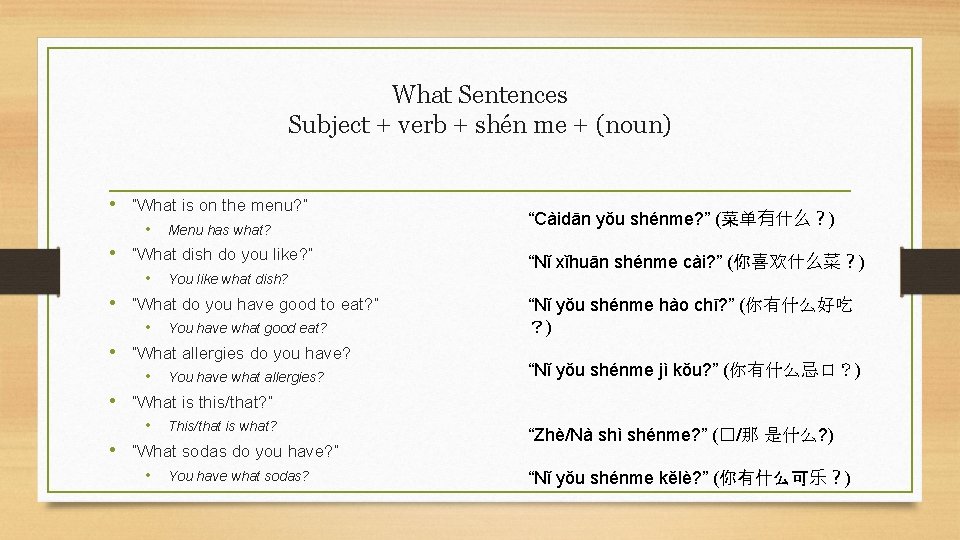
What Sentences Subject + verb + shén me + (noun) • “What is on the menu? ” • Menu has what? • “What dish do you like? ” • You like what dish? • “What do you have good to eat? ” • You have what good eat? • “What allergies do you have? • You have what allergies? “Càidān yǒu shénme? ” (菜单有什么?) “Nǐ xǐhuān shénme cài? ” (你喜欢什么菜?) “Nǐ yǒu shénme hào chī? ” (你有什么好吃 ?) “Nǐ yǒu shénme jì kǒu? ” (你有什么忌口?) • “What is this/that? ” • This/that is what? • “What sodas do you have? ” • You have what sodas? “Zhè/Nà shì shénme? ” (�/那 是什么? ) “Nǐ yǒu shénme kělè? ” (你有什么可乐?)
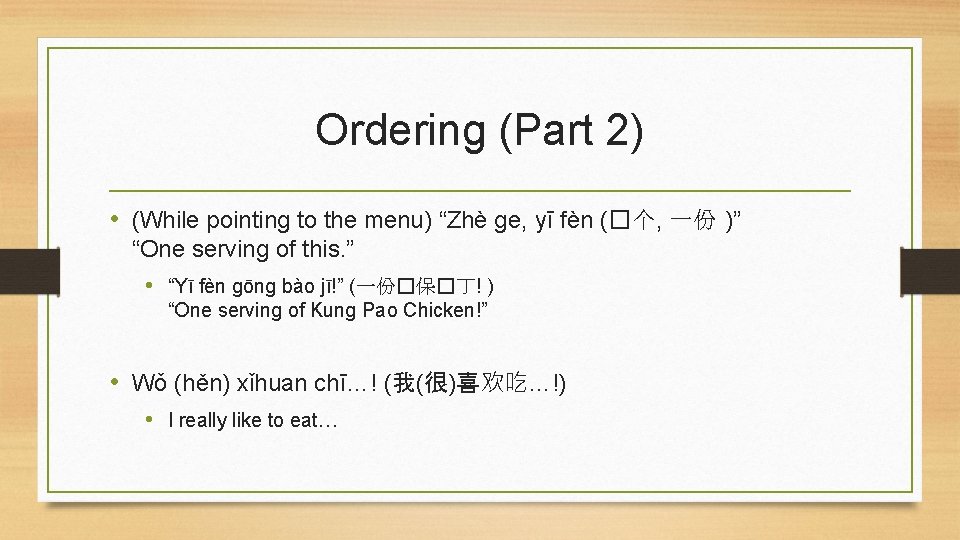
Ordering (Part 2) • (While pointing to the menu) “Zhè ge, yī fèn (�个, 一份 )” “One serving of this. ” • “Yī fèn gōng bào jī!” (一份�保�丁! ) “One serving of Kung Pao Chicken!” • Wǒ (hěn) xǐhuan chī…! (我(很)喜欢吃…!) • I really like to eat…
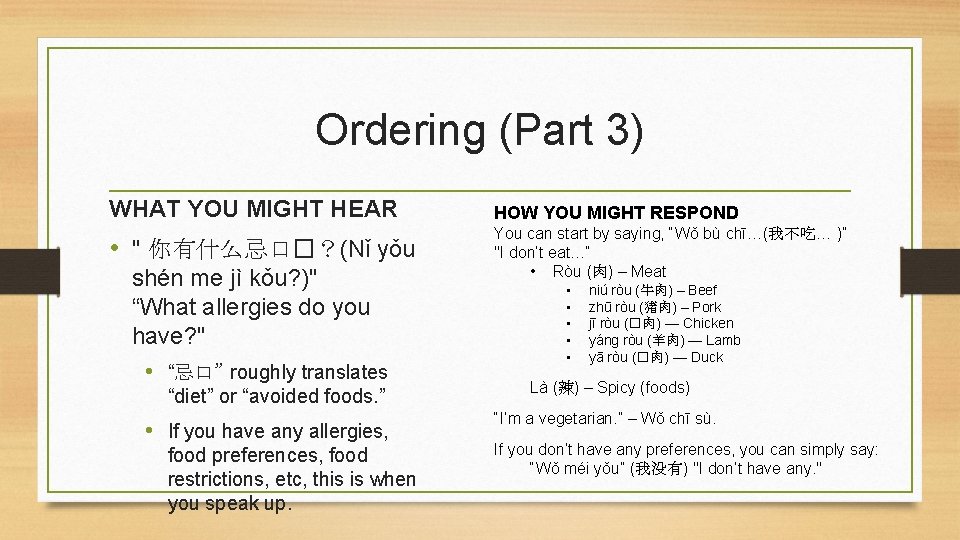
Ordering (Part 3) WHAT YOU MIGHT HEAR HOW YOU MIGHT RESPOND • " 你有什么忌口�?(Nǐ yǒu You can start by saying, “Wǒ bù chī…(我不吃… )” "I don’t eat…“ • Ròu (肉) – Meat shén me jì kǒu? )" “What allergies do you have? " • “忌口” roughly translates “diet” or “avoided foods. ” • If you have any allergies, food preferences, food restrictions, etc, this is when you speak up. • • • niú ròu (牛肉) – Beef zhū ròu (猪肉) – Pork jī ròu (�肉) — Chicken yáng ròu (羊肉) — Lamb yā ròu (�肉) — Duck Là (辣) – Spicy (foods) “I’m a vegetarian. ” – Wǒ chī sù. If you don’t have any preferences, you can simply say: “Wǒ méi yǒu” (我没有) "I don’t have any. "
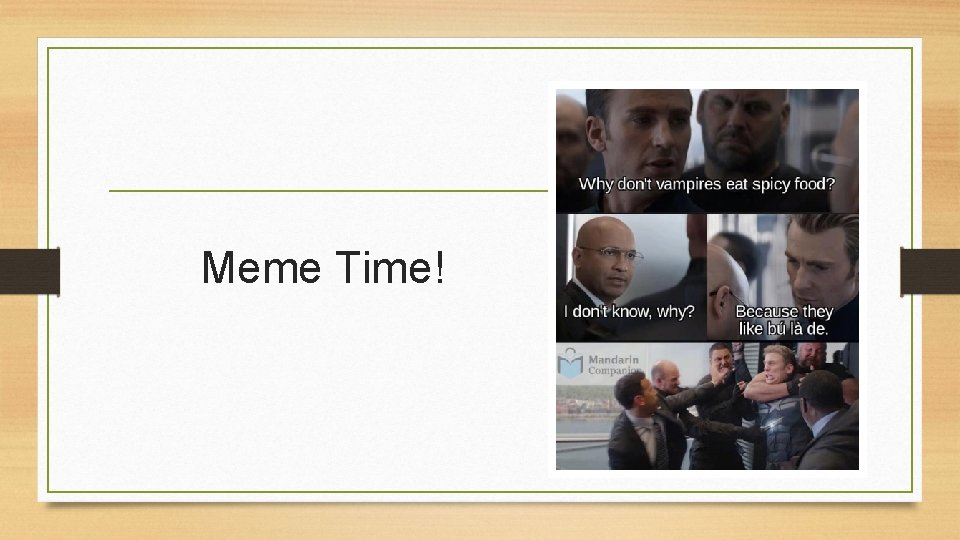
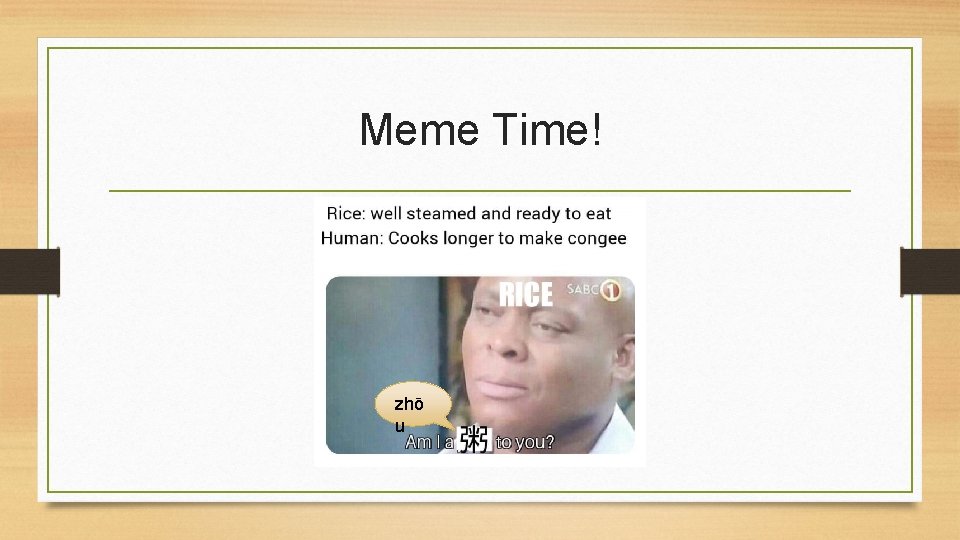
Meme Time!
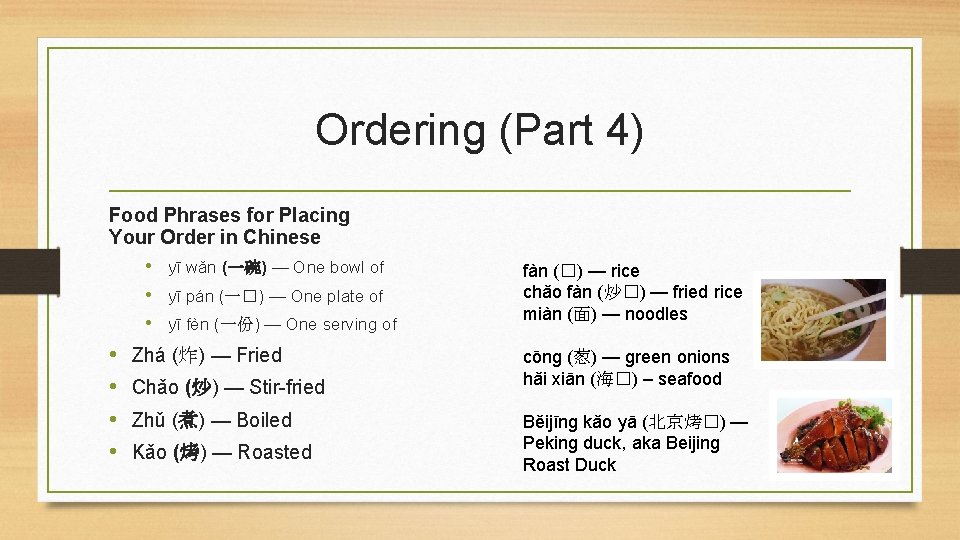
Ordering (Part 4) Food Phrases for Placing Your Order in Chinese • yī wǎn (一碗) — One bowl of • yī pán (一�) — One plate of • yī fèn (一份) — One serving of • • Zhá (炸) — Fried Chǎo (炒) — Stir-fried Zhǔ (煮) — Boiled Kǎo (烤) — Roasted fàn (�) — rice chǎo fàn (炒�) — fried rice miàn (面) — noodles cōng (葱) — green onions hǎi xiān (海�) – seafood Běijīng kǎo yā (北京烤�) — Peking duck, aka Beijing Roast Duck
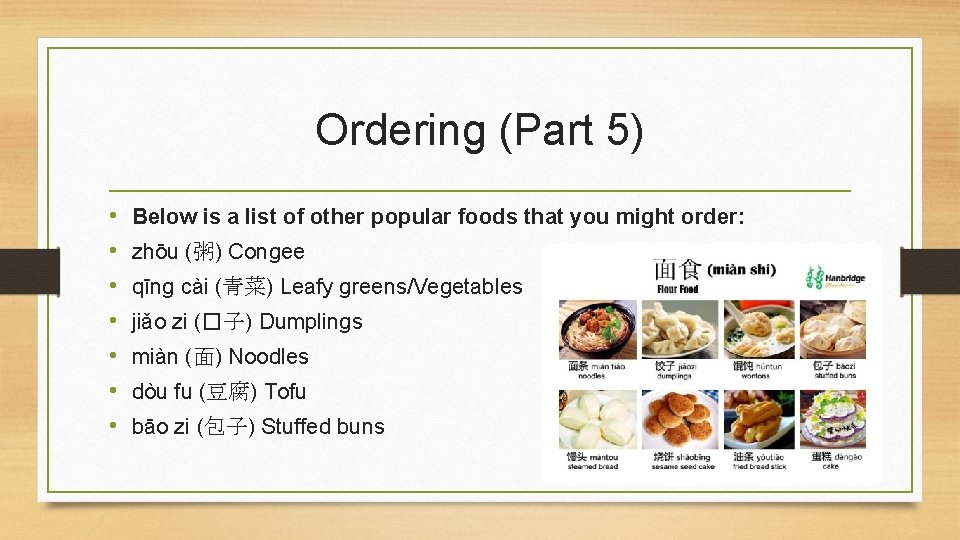
Ordering (Part 5) • • Below is a list of other popular foods that you might order: zhōu (粥) Congee qīng cài (青菜) Leafy greens/Vegetables jiǎo zi (�子) Dumplings miàn (面) Noodles dòu fu (豆腐) Tofu bāo zi (包子) Stuffed buns
Meme Time! zhō u
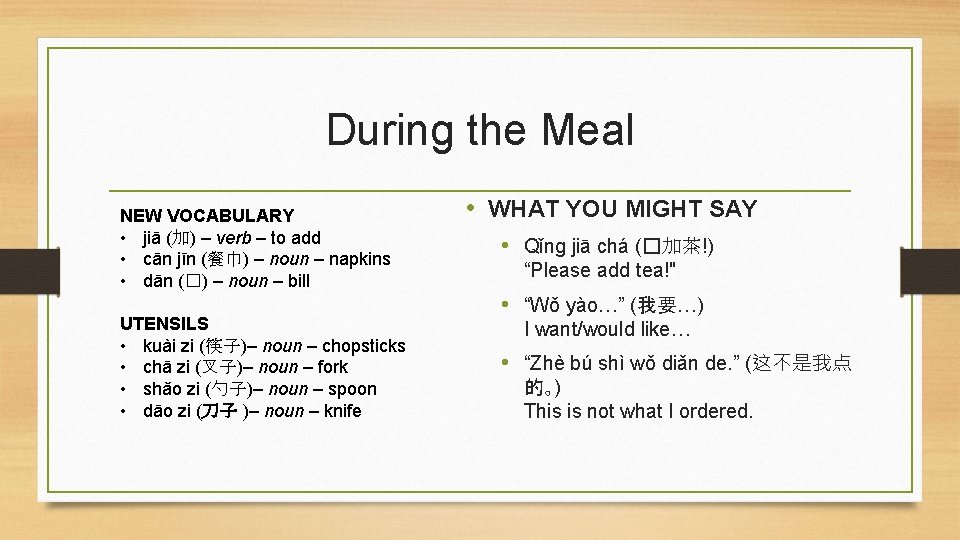
During the Meal NEW VOCABULARY • jiā (加) – verb – to add • cān jīn (餐巾) – noun – napkins • dān (�) – noun – bill UTENSILS • kuài zi (筷子)– noun – chopsticks • chā zi (叉子)– noun – fork • shǎo zi (勺子)– noun – spoon • dāo zi (刀子 )– noun – knife • WHAT YOU MIGHT SAY • Qǐng jiā chá (�加茶!) “Please add tea!" • “Wǒ yào…” (我要…) I want/would like… • “Zhè bú shì wǒ diǎn de. ” (这不是我点 的。) This is not what I ordered.
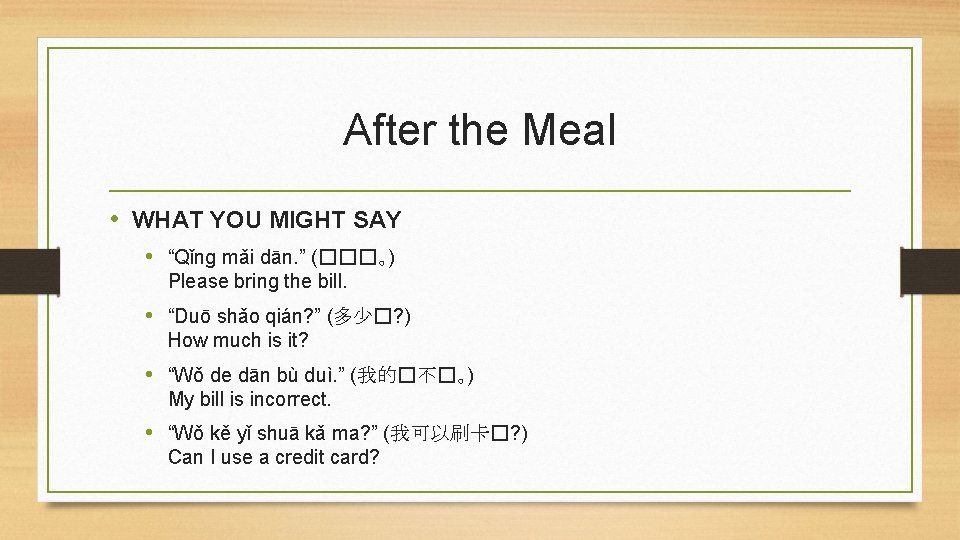
After the Meal • WHAT YOU MIGHT SAY • “Qǐng mǎi dān. ” (���。) Please bring the bill. • “Duō shǎo qián? ” (多少�? ) How much is it? • “Wǒ de dān bù duì. ” (我的�不�。) My bill is incorrect. • “Wǒ kě yǐ shuā kǎ ma? ” (我可以刷卡�? ) Can I use a credit card?
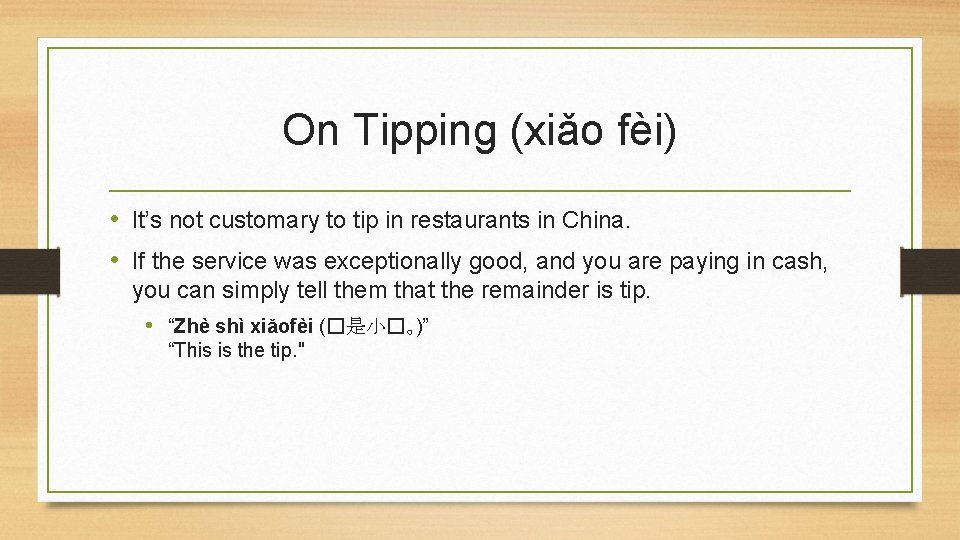
On Tipping (xiǎo fèi) • It’s not customary to tip in restaurants in China. • If the service was exceptionally good, and you are paying in cash, you can simply tell them that the remainder is tip. • “Zhè shì xiǎofèi (�是小�。)” “This is the tip. "
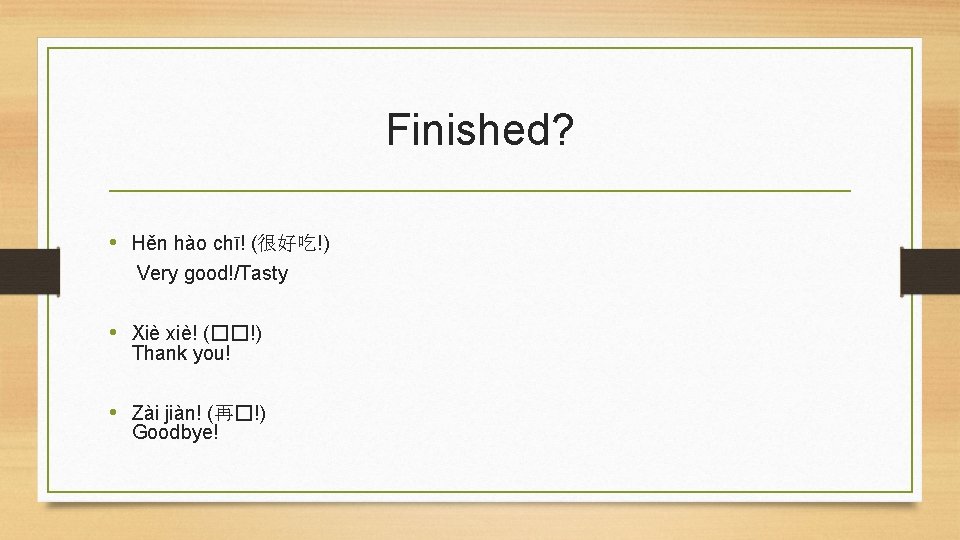
Finished? • Hěn hào chī! (很好吃!) Very good!/Tasty • Xiè xiè! (��!) Thank you! • Zài jiàn! (再�!) Goodbye!
Meme Time!