
FOOD WASTE Survey results show that one third

- Slides: 10
FOOD WASTE Survey results show that one third of the food produced for nutrition is thrown away at the global level, which is about 1. 3 billion tons a year. Almost half of still eatable and healthy food from households, supermarkets, restaurants, hospitals and catering companies is thrown away as garbage. Food waste can be found in all phases of the chain of supplying, from the gathering, processing and production to selling and final consumption.
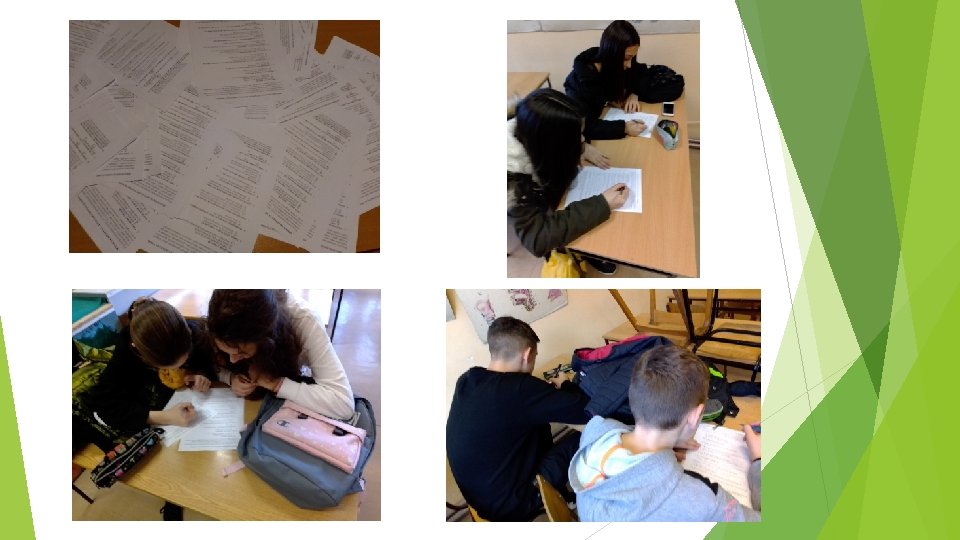
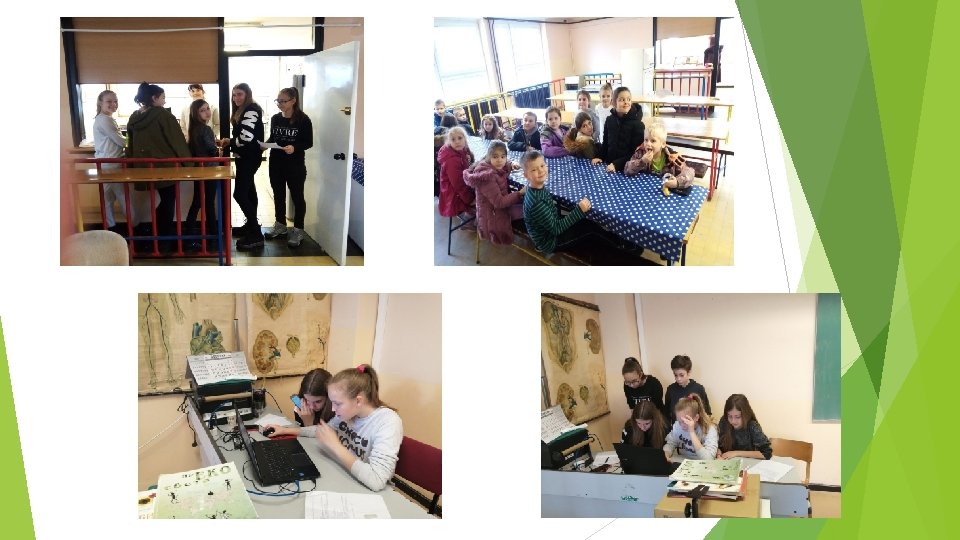
Ø Mini project of Serbian team had an aim to examine knowledge and habits of students and parents about food waste. Ø The survey included students from 3 rd to 7 th grade (9 -13 year -olds) and their parents. Ø The questions examined knowledge and habits about food waste. The idea is to use the results of the survey to organise activities which will educate students and parents about food waste. Ø The survey was conducted in January 2020. Ø The same questionnaire will be given to students and parents after educational activities in February 2021. We hope that the conducted activities will change bad habits of students and parents.
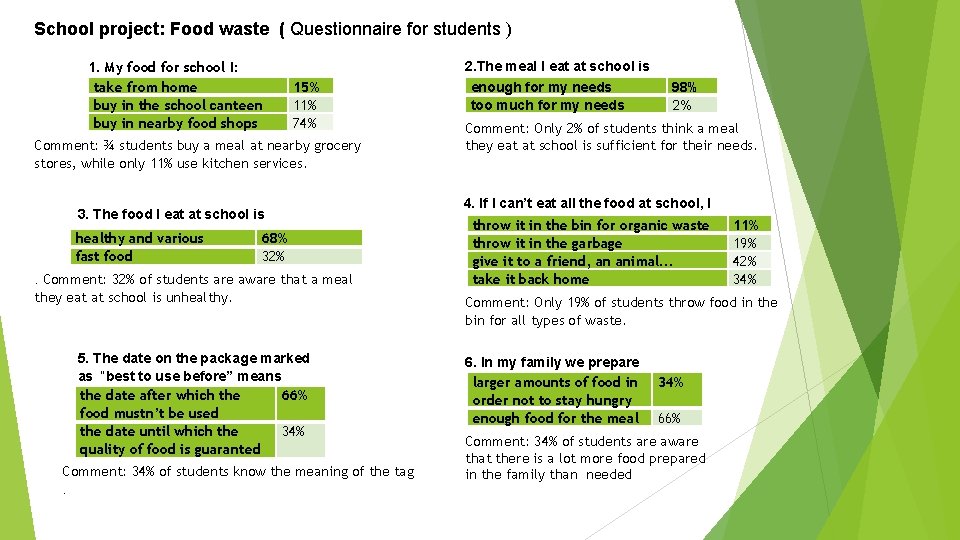
School project: Food waste ( Questionnaire for students ) 1. My food for school I: take from home buy in the school canteen buy in nearby food shops 15% 11% 74% Comment: ¾ students buy a meal at nearby grocery stores, while only 11% use kitchen services. 3. The food I eat at school is healthy and various fast food 68% 32% . Comment: 32% of students are aware that a meal they eat at school is unhealthy. 5. The date on the package marked as “best to use before” means the date after which the 66% food mustn’t be used the date until which the 34% quality of food is guaranted Comment: 34% of students know the meaning of the tag. 2. The meal I eat at school is enough for my needs too much for my needs 98% 2% Comment: Only 2% of students think a meal they eat at school is sufficient for their needs. 4. If I can’t eat all the food at school, I throw it in the bin for organic waste throw it in the garbage give it to a friend, an animal. . . take it back home 11% 19% 42% 34% Comment: Only 19% of students throw food in the bin for all types of waste. 6. In my family we prepare larger amounts of food in order not to stay hungry enough food for the meal 34% 66% Comment: 34% of students are aware that there is a lot more food prepared in the family than needed
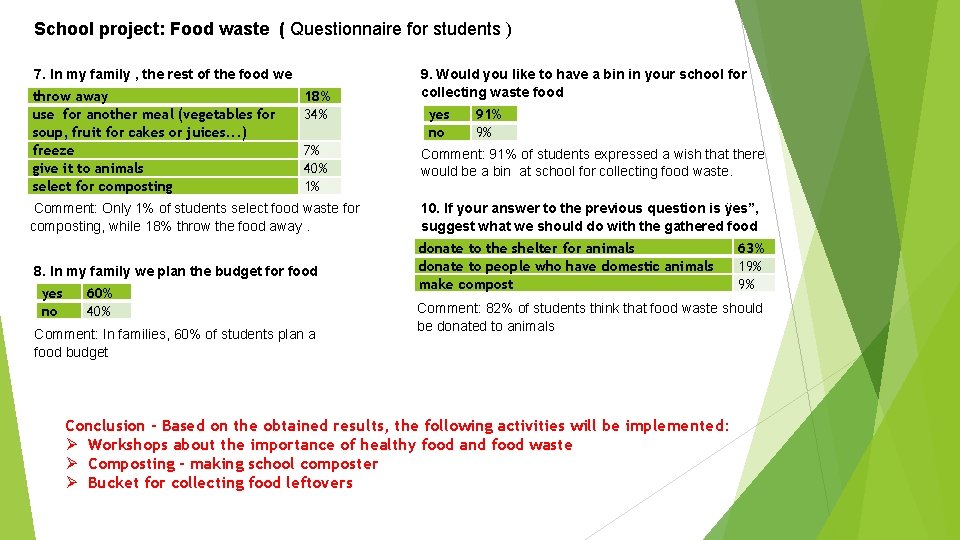
School project: Food waste ( Questionnaire for students ) 7. In my family , the rest of the food we throw away use for another meal (vegetables for soup, fruit for cakes or juices. . . ) freeze give it to animals select for composting 18% 34% 7% 40% 1% Comment: Only 1% of students select food waste for composting, while 18% throw the food away. 8. In my family we plan the budget for food yes no 60% 40% Comment: In families, 60% of students plan a food budget 9. Would you like to have a bin in your school for collecting waste food yes no 91% 9% Comment: 91% of students expressed a wish that there would be a bin at school for collecting food waste. 10. If your answer to the previous question is ÿes”, suggest what we should do with the gathered food donate to the shelter for animals donate to people who have domestic animals make compost 63% 19% 9% Comment: 82% of students think that food waste should be donated to animals Conclusion - Based on the obtained results, the following activities will be implemented: Ø Workshops about the importance of healthy food and food waste Ø Composting - making school composter Ø Bucket for collecting food leftovers
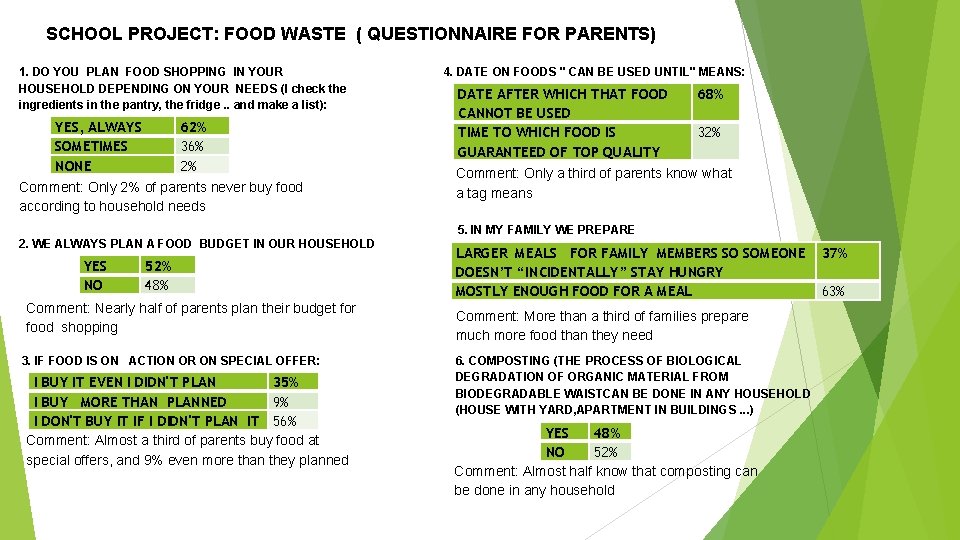
SCHOOL PROJECT: FOOD WASTE ( QUESTIONNAIRE FOR PARENTS) 1. DO YOU PLAN FOOD SHOPPING IN YOUR HOUSEHOLD DEPENDING ON YOUR NEEDS (I check the ingredients in the pantry, the fridge. . and make a list): YES, ALWAYS SOMETIMES NONE 62% 36% 2% Comment: Only 2% of parents never buy food according to household needs 4. DATE ON FOODS " CAN BE USED UNTIL" MEANS: DATE AFTER WHICH THAT FOOD CANNOT BE USED TIME TO WHICH FOOD IS GUARANTEED OF TOP QUALITY 68% 32% Comment: Only a third of parents know what a tag means 5. IN MY FAMILY WE PREPARE 2. WE ALWAYS PLAN A FOOD BUDGET IN OUR HOUSEHOLD YES NO 52% 48% Comment: Nearly half of parents plan their budget for food shopping 3. IF FOOD IS ON ACTION OR ON SPECIAL OFFER: I BUY IT EVEN I DIDN'T PLAN 35% I BUY MORE THAN PLANNED 9% I DON'T BUY IT IF I DIDN'T PLAN IT 56% Comment: Almost a third of parents buy food at special offers, and 9% even more than they planned LARGER MEALS FOR FAMILY MEMBERS SO SOMEONE DOESN’T “INCIDENTALLY” STAY HUNGRY MOSTLY ENOUGH FOOD FOR A MEAL Comment: More than a third of families prepare much more food than they need 6. COMPOSTING (THE PROCESS OF BIOLOGICAL DEGRADATION OF ORGANIC MATERIAL FROM BIODEGRADABLE WAISTCAN BE DONE IN ANY HOUSEHOLD (HOUSE WITH YARD, APARTMENT IN BUILDINGS. . . ) YES 48% NO 52% Comment: Almost half know that composting can be done in any household 37% 63%
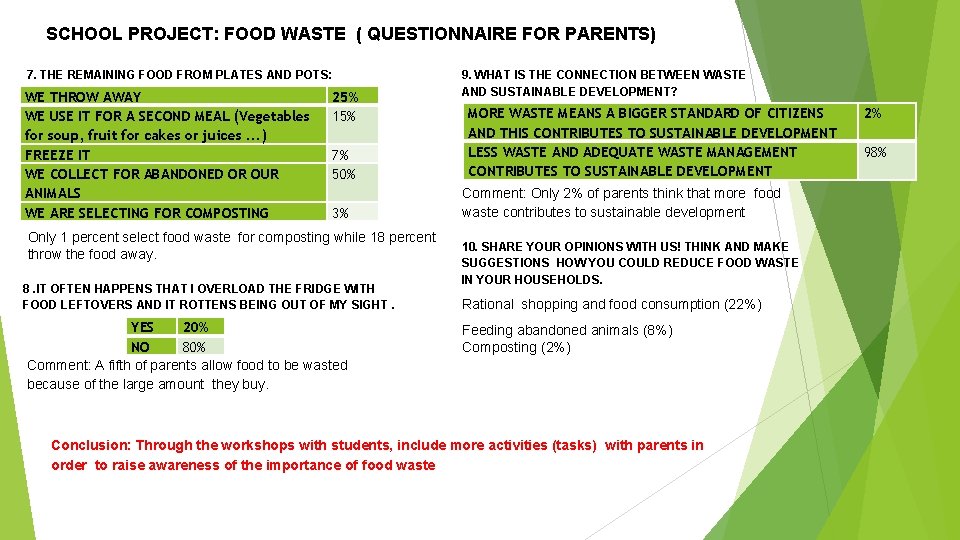
SCHOOL PROJECT: FOOD WASTE ( QUESTIONNAIRE FOR PARENTS) 7. THE REMAINING FOOD FROM PLATES AND POTS: WE THROW AWAY WE USE IT FOR A SECOND MEAL (Vegetables for soup, fruit for cakes or juices. . . ) FREEZE IT WE COLLECT FOR ABANDONED OR OUR ANIMALS WE ARE SELECTING FOR COMPOSTING 25% 15% 7% 50% 3% Only 1 percent select food waste for composting while 18 percent throw the food away. 8. IT OFTEN HAPPENS THAT I OVERLOAD THE FRIDGE WITH FOOD LEFTOVERS AND IT ROTTENS BEING OUT OF MY SIGHT. YES 20% NO 80% Comment: A fifth of parents allow food to be wasted because of the large amount they buy. 9. WHAT IS THE CONNECTION BETWEEN WASTE AND SUSTAINABLE DEVELOPMENT? MORE WASTE MEANS A BIGGER STANDARD OF CITIZENS AND THIS CONTRIBUTES TO SUSTAINABLE DEVELOPMENT LESS WASTE AND ADEQUATE WASTE MANAGEMENT CONTRIBUTES TO SUSTAINABLE DEVELOPMENT Comment: Only 2% of parents think that more food waste contributes to sustainable development 10. SHARE YOUR OPINIONS WITH US! THINK AND MAKE SUGGESTIONS HOW YOU COULD REDUCE FOOD WASTE IN YOUR HOUSEHOLDS. Rational shopping and food consumption (22%) Feeding abandoned animals (8%) Composting (2%) Conclusion: Through the workshops with students, include more activities (tasks) with parents in order to raise awareness of the importance of food waste 2% 98%
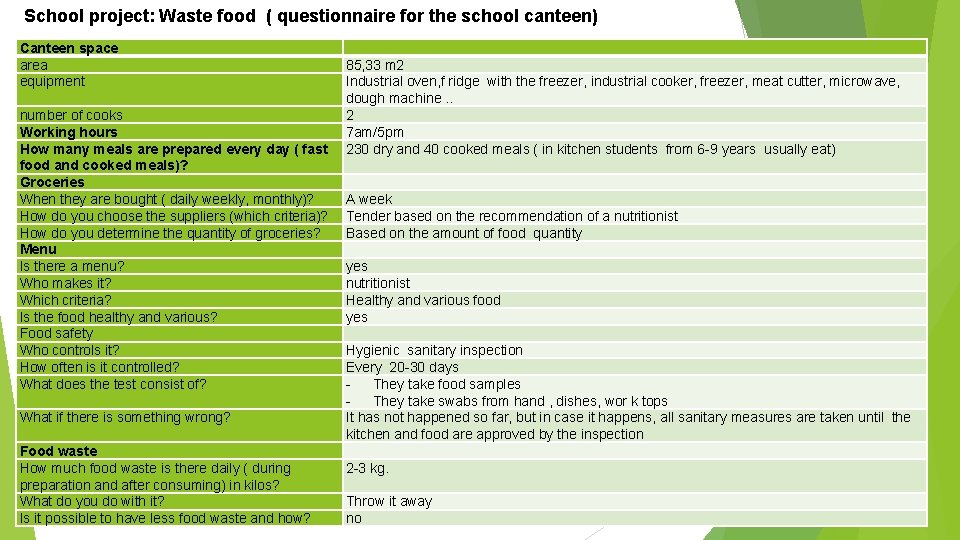
School project: Waste food ( questionnaire for the school canteen) Canteen space area equipment number of cooks Working hours How many meals are prepared every day ( fast food and cooked meals)? Groceries When they are bought ( daily weekly, monthly)? How do you choose the suppliers (which criteria)? How do you determine the quantity of groceries? Menu Is there a menu? Who makes it? Which criteria? Is the food healthy and various? Food safety Who controls it? How often is it controlled? What does the test consist of? What if there is something wrong? Food waste How much food waste is there daily ( during preparation and after consuming) in kilos? What do you do with it? Is it possible to have less food waste and how? 85, 33 m 2 Industrial oven, f ridge with the freezer, industrial cooker, freezer, meat cutter, microwave, dough machine. . 2 7 am/5 pm 230 dry and 40 cooked meals ( in kitchen students from 6 -9 years usually eat) A week Tender based on the recommendation of a nutritionist Based on the amount of food quantity yes nutritionist Healthy and various food yes Hygienic sanitary inspection Every 20 -30 days They take food samples They take swabs from hand , dishes, wor k tops It has not happened so far, but in case it happens, all sanitary measures are taken until the kitchen and food are approved by the inspection 2 -3 kg. Throw it away no
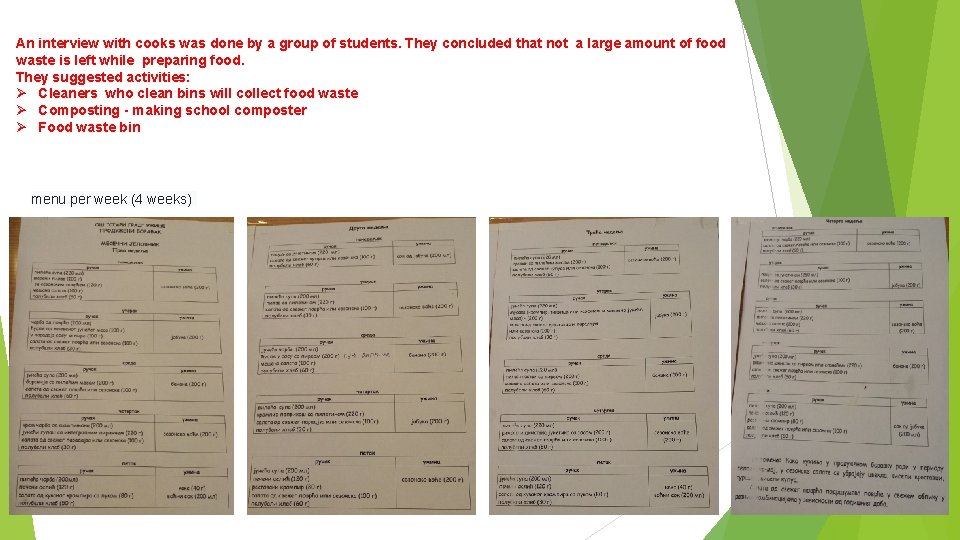
An interview with cooks was done by a group of students. They concluded that not a large amount of food waste is left while preparing food. They suggested activities: Ø Cleaners who clean bins will collect food waste Ø Composting - making school composter Ø Food waste bin menu per week (4 weeks)