
Food to Overcome Outcomes Disparities FOOD Facilitator Training
- Slides: 24
Food to Overcome Outcomes Disparities (FOOD) Facilitator Training Module Immigrant Health & Cancer Disparities Service (IHCD) Memorial Sloan Kettering Cancer Center -1 -
FOOD Course Outline Course objectives Food Insecurity Screening Resources --
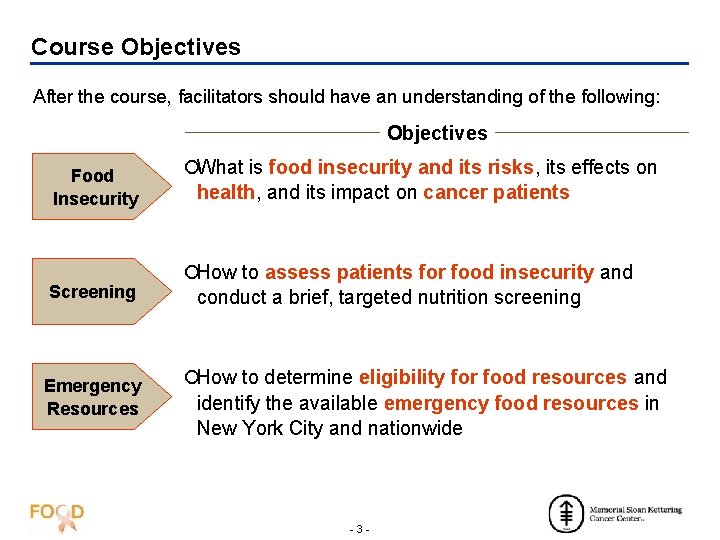
Course Objectives After the course, facilitators should have an understanding of the following: Objectives Food Insecurity ¡What is food insecurity and its risks, its effects on health, and its impact on cancer patients Screening ¡How to assess patients for food insecurity and conduct a brief, targeted nutrition screening Emergency Resources ¡How to determine eligibility for food resources and identify the available emergency food resources in New York City and nationwide -3 -
FOOD Course Outline Course objectives Food Insecurity Screening Resources -4 -
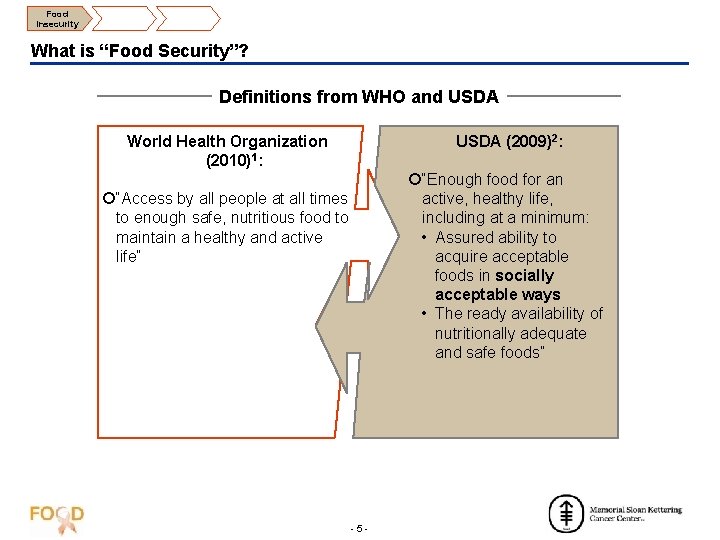
Food Insecurity What is “Food Security”? Definitions from WHO and USDA World Health Organization (2010)1: USDA (2009)2: ¡“Enough food for an active, healthy life, including at a minimum: • Assured ability to acquire acceptable foods in socially acceptable ways • The ready availability of nutritionally adequate and safe foods” ¡“Access by all people at all times to enough safe, nutritious food to maintain a healthy and active life” -5 -
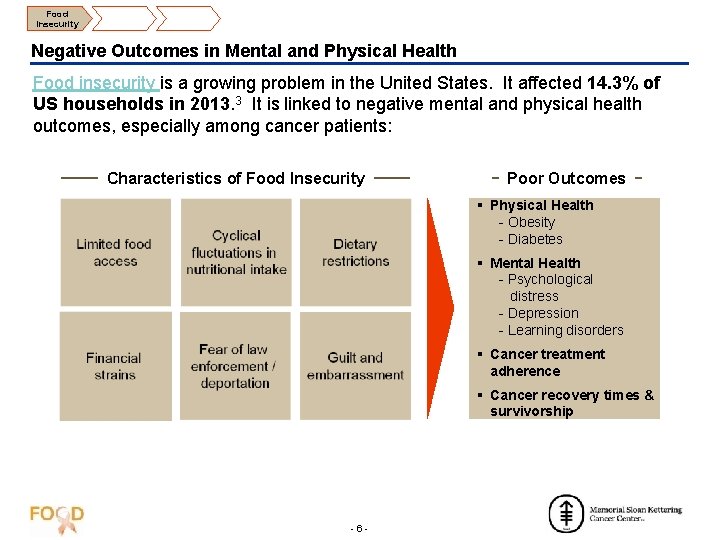
Food Insecurity Negative Outcomes in Mental and Physical Health Food insecurity is a growing problem in the United States. It affected 14. 3% of US households in 2013. 3 It is linked to negative mental and physical health outcomes, especially among cancer patients: Characteristics of Food Insecurity Poor Outcomes § Physical Health - Obesity - Diabetes § Mental Health - Psychological distress - Depression - Learning disorders § Cancer treatment adherence § Cancer recovery times & survivorship -6 -
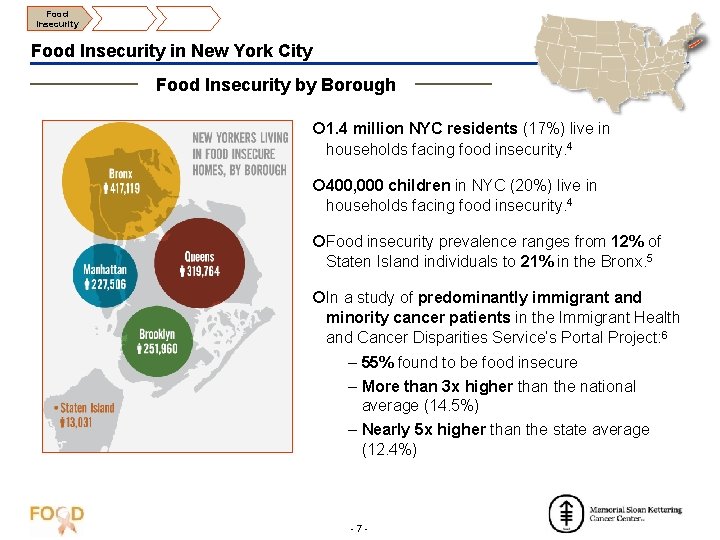
Food Insecurity in New York City Food Insecurity by Borough ¡ 1. 4 million NYC residents (17%) live in households facing food insecurity. 4 ¡ 400, 000 children in NYC (20%) live in households facing food insecurity. 4 ¡Food insecurity prevalence ranges from 12% of Staten Island individuals to 21% in the Bronx. 5 ¡In a study of predominantly immigrant and minority cancer patients in the Immigrant Health and Cancer Disparities Service’s Portal Project: 6 – 55% found to be food insecure – More than 3 x higher than the national average (14. 5%) – Nearly 5 x higher than the state average (12. 4%) -7 -
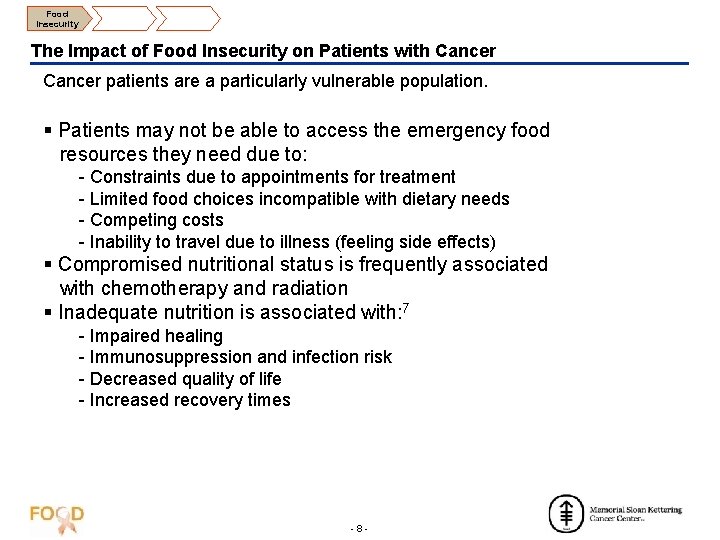
Food Insecurity The Impact of Food Insecurity on Patients with Cancer patients are a particularly vulnerable population. § Patients may not be able to access the emergency food resources they need due to: - Constraints due to appointments for treatment - Limited food choices incompatible with dietary needs - Competing costs - Inability to travel due to illness (feeling side effects) § Compromised nutritional status is frequently associated with chemotherapy and radiation § Inadequate nutrition is associated with: 7 - Impaired healing - Immunosuppression and infection risk - Decreased quality of life - Increased recovery times -8 -
FOOD Course Outline Course objectives Food Insecurity Screening Resources -9 -
Screening Practical Tips for Assessing Patients Develop a plan to engage patients: ¡DO Identify at-risk patients – Unemployed or underemployed – Uninsured or underinsured – The elderly – Single-parent households – Substance abusers – Population-specific risk-factors - 10 -
Screening Practical Tips for Assessing Patients Food insecurity is often “invisible”: ¡DO NOT assume that you can identify food insecure patients by how they look ¡DO NOT assume that patients are food secure because they answer negatively to any question(s) ¡DO ask at least 4 questions about food intake and access if patients have any risk factors for food insecurity, or you suspect they might be at risk - 11 -
Screening Practical Tips for Assessing Patients How to structure a conversation: Ask about food access and intake as part of the standard enrollment process ¡Illness History ¡Are there any factors (money, time, mobility) that make it difficult for the patient to follow treatment diets and/or regimens? ¡Medication History ¡Have medication costs ever made it difficult for the patient to afford food? ¡Social History ¡Have financial strains ever made it difficult for the patient to acquire or prepare enough food? ¡Dietary History ¡Does the patient present any dietary problems, such as skipping meals, eating unbalanced meals, or cutting the size and frequency of meals below safe levels? - 12 -
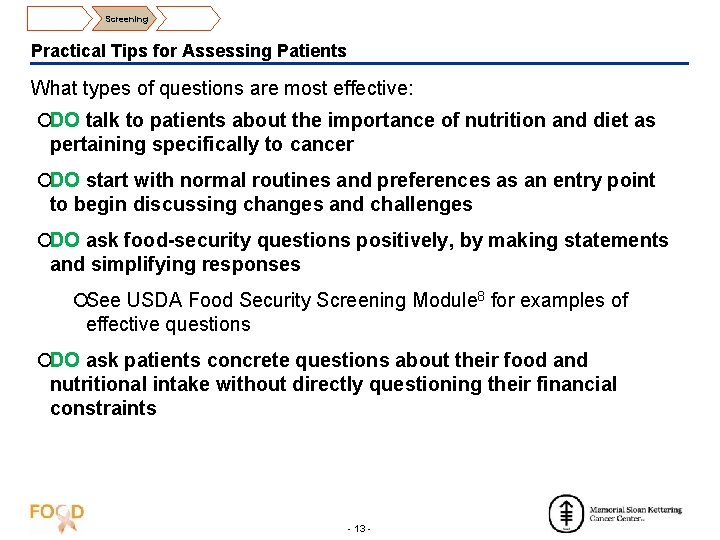
Screening Practical Tips for Assessing Patients What types of questions are most effective: ¡DO talk to patients about the importance of nutrition and diet as pertaining specifically to cancer ¡DO start with normal routines and preferences as an entry point to begin discussing changes and challenges ¡DO ask food-security questions positively, by making statements and simplifying responses ¡See USDA Food Security Screening Module 8 for examples of effective questions ¡DO ask patients concrete questions about their food and nutritional intake without directly questioning their financial constraints - 13 -
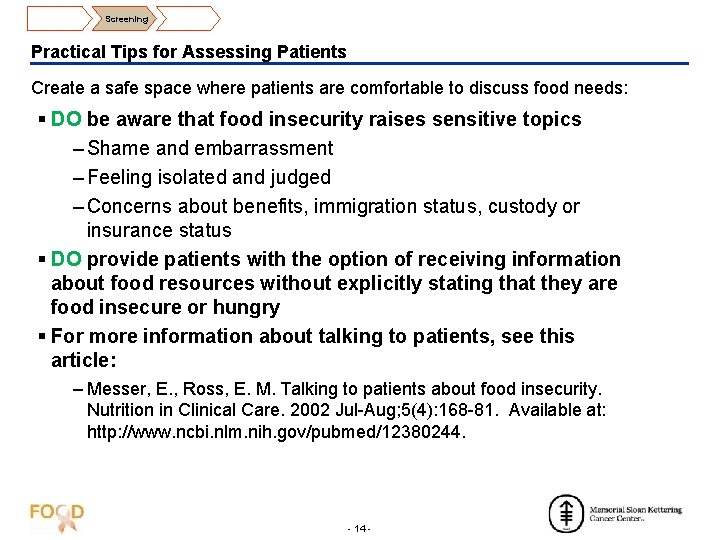
Screening Practical Tips for Assessing Patients Create a safe space where patients are comfortable to discuss food needs: § DO be aware that food insecurity raises sensitive topics – Shame and embarrassment – Feeling isolated and judged – Concerns about benefits, immigration status, custody or insurance status § DO provide patients with the option of receiving information about food resources without explicitly stating that they are food insecure or hungry § For more information about talking to patients, see this article: – Messer, E. , Ross, E. M. Talking to patients about food insecurity. Nutrition in Clinical Care. 2002 Jul-Aug; 5(4): 168 -81. Available at: http: //www. ncbi. nlm. nih. gov/pubmed/12380244. - 14 -
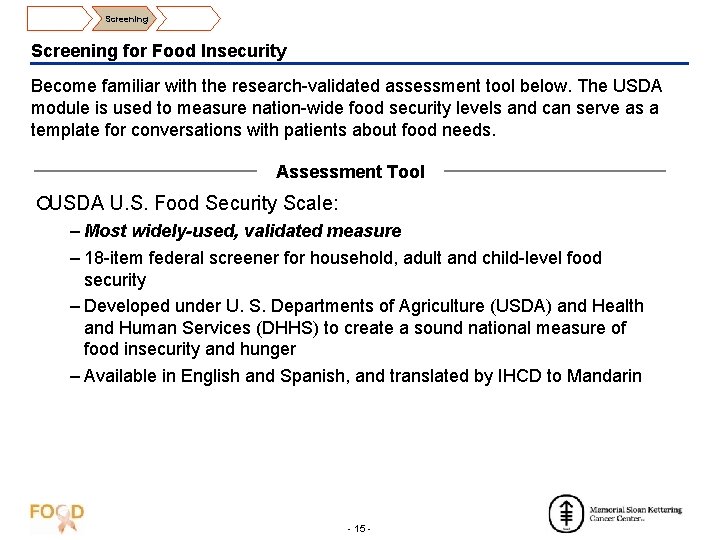
Screening for Food Insecurity Become familiar with the research-validated assessment tool below. The USDA module is used to measure nation-wide food security levels and can serve as a template for conversations with patients about food needs. Assessment Tool ¡USDA U. S. Food Security Scale: – Most widely-used, validated measure – 18 -item federal screener for household, adult and child-level food security – Developed under U. S. Departments of Agriculture (USDA) and Health and Human Services (DHHS) to create a sound national measure of food insecurity and hunger – Available in English and Spanish, and translated by IHCD to Mandarin - 15 -
FOOD Course Outline Course objectives Food Insecurity Screening Resources - 16 -
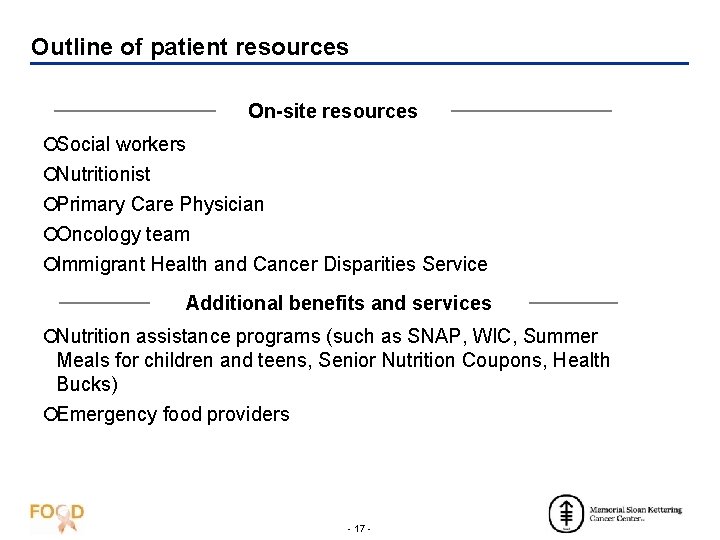
Outline of patient resources On-site resources ¡Social workers ¡Nutritionist ¡Primary Care Physician ¡Oncology team ¡Immigrant Health and Cancer Disparities Service Additional benefits and services ¡Nutrition assistance programs (such as SNAP, WIC, Summer Meals for children and teens, Senior Nutrition Coupons, Health Bucks) ¡Emergency food providers - 17 -
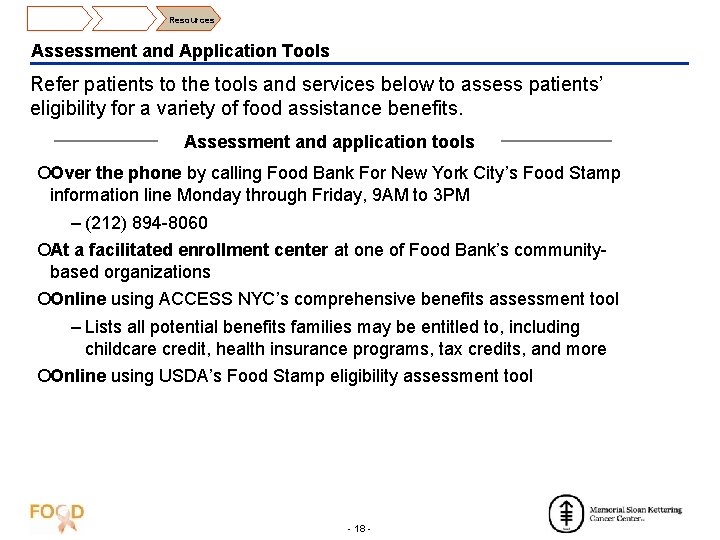
Resources Assessment and Application Tools Refer patients to the tools and services below to assess patients’ eligibility for a variety of food assistance benefits. Assessment and application tools ¡Over the phone by calling Food Bank For New York City’s Food Stamp information line Monday through Friday, 9 AM to 3 PM – (212) 894 -8060 ¡At a facilitated enrollment center at one of Food Bank’s communitybased organizations ¡Online using ACCESS NYC’s comprehensive benefits assessment tool – Lists all potential benefits families may be entitled to, including childcare credit, health insurance programs, tax credits, and more ¡Online using USDA’s Food Stamp eligibility assessment tool - 18 -
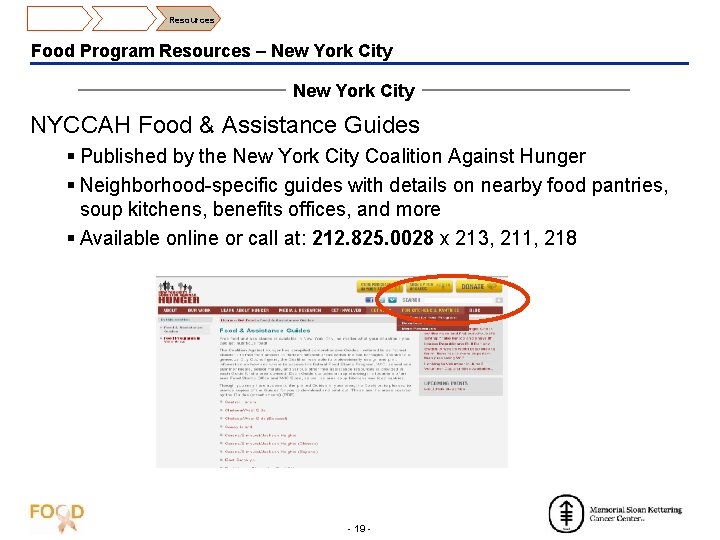
Resources Food Program Resources – New York City NYCCAH Food & Assistance Guides § Published by the New York City Coalition Against Hunger § Neighborhood-specific guides with details on nearby food pantries, soup kitchens, benefits offices, and more § Available online or call at: 212. 825. 0028 x 213, 211, 218 - 19 -
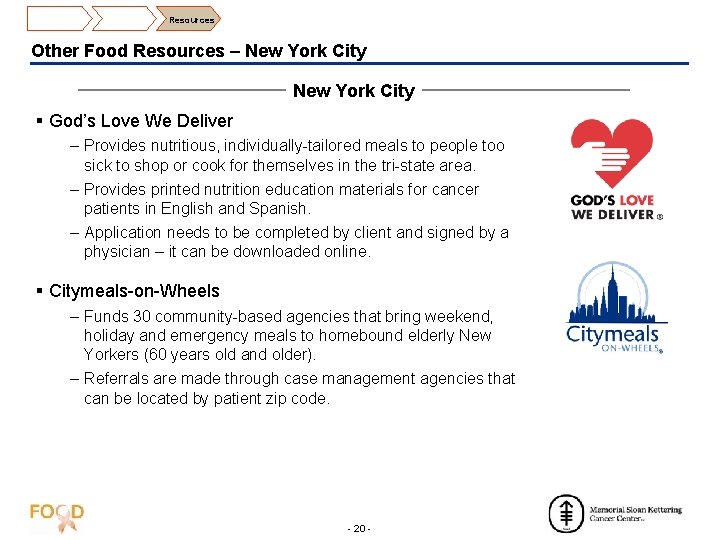
Resources Other Food Resources – New York City § God’s Love We Deliver – Provides nutritious, individually-tailored meals to people too sick to shop or cook for themselves in the tri-state area. – Provides printed nutrition education materials for cancer patients in English and Spanish. – Application needs to be completed by client and signed by a physician – it can be downloaded online. § Citymeals-on-Wheels – Funds 30 community-based agencies that bring weekend, holiday and emergency meals to homebound elderly New Yorkers (60 years old and older). – Referrals are made through case management agencies that can be located by patient zip code. - 20 -
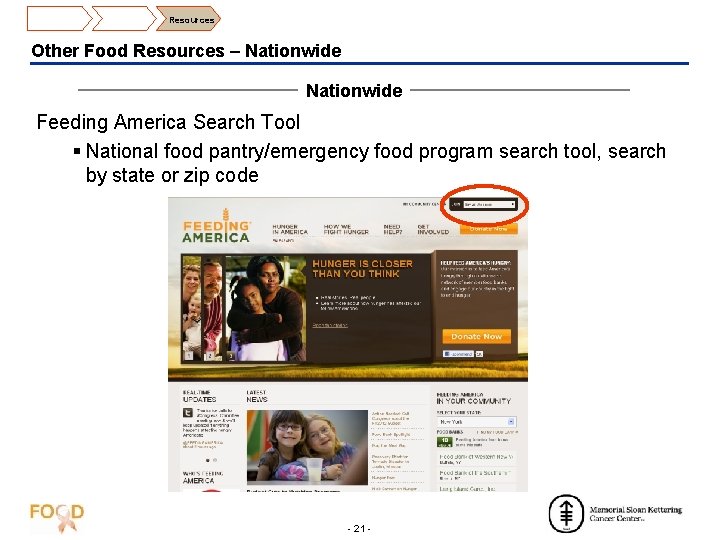
Resources Other Food Resources – Nationwide Feeding America Search Tool § National food pantry/emergency food program search tool, search by state or zip code - 21 -
Resources Food to Overcome Outcomes Disparities (FOOD) FOOD Pantry Program ¡Food security screening ¡Weekly pantry bags ¡Health Bucks distribution Sample pantry bag for cancer patients §Brown rice or brown pasta §Oatmeal §Canned or dried fruits (ex. Raisins) §Corn and sweet peas § 2% milk §Canned salmon or canned tuna §Beans (canned or dry) §Juice §Lentil soup §Peanut butter - 22 -
Resources Food to Overcome Outcomes Disparities (FOOD) Contact FOOD ¡Contact: Julia Ramirez (ramirej 1@mskcc. org) ¡Phone: (646) 888 -8055 ¡Memorial Sloan Kettering Cancer Center 485 Lexington Avenue, 2 nd Floor, New York, NY 10017 ¡Website: https: //www. mskcc. org/departments/psychiatry-behavioralsciences/immigrant-health-disparities-service - 23 -
References 1. World Health Organization. (2010). Food Security. Retrieved from: http: //www. who. int/trade/glossary/story 028/en/ 2. Coleman-Jensen, A & Nord, M. (2013). Food Security in the United States: Measuring Household Food Security. Available at: http: //www. ers. usda. gov/Briefing/Food. Security/measurement. htm 3. United States Department of Agriculture. Economic Research Service. Food Security in the United States. Accessed 10/10/2011. Available at: http: //www. ers. usda. gov/Briefing/Food. Security/. 4. New York City Coalition Against Hunger in New York City. Accessed 5/31/2011. Available at: http: //www. nyccah. org/learn-about-hunger/hunger-in-nyc. 5. City Harvest. Hunger in NYC. Food Insecurity. Accessed 5/31/2011. Available at: http: //www. cityharvest. org/hungerin-nyc/map-the-meal-gap. 6. Gany, F. , Lee, T. , Ramirez, J. , Massie, D. , Moran, A. , Crist, M. , Mc. Nish, T. , Leng, J. Are our severely ill patients hungry? ASCO Annual Meeting, June 2011. 7. Gany F, Bari S, Crist M, Moran A, Rastogi N, Leng J. Food Insecurity: Limitations of Emergency Food Resources for Our Patients. J Urban Health. 2013; 90(3): 552 -8. 8. USDA U. S. Household Food Security Survey Module. Accessed 1/21/2016. Available at: http: //www. ers. usda. gov/datafiles/Food_Security_in_the_United_States/Food_Security_Survey_Modules/hh 2012. pdf 9. NIH, NCI. Accessed 7/27/2015. Available at: http: //www. cancer. gov/about-cancer/what-is-cancer/metastatic-factsheet 10. National Cancer Institute publication “Eating Hints. ” Accessed 7/27/2015. Available at: http: //www. cancer. gov/publications/patient-education/eating-hints 11. American Cancer Society. Nutrition for the Person with Cancer during Treatment: a Guide for Patients and Families. Accessed 7/27/2015. Available at: http: //www. cancer. org/acs/groups/cid/documents/webcontent/002903 -pdf. pdf 12. Academy of Nutrition and Dietetics. Eat Right to Fight Cancer. Accessed 7/27/2015. Available at: http: //www. oncologynutrition. org/erfc/eating-well-when-unwell/chemotherapy/ - 24 -