
Food Testing for Sugar and Starch Benedicts test
Food Testing for Sugar and Starch
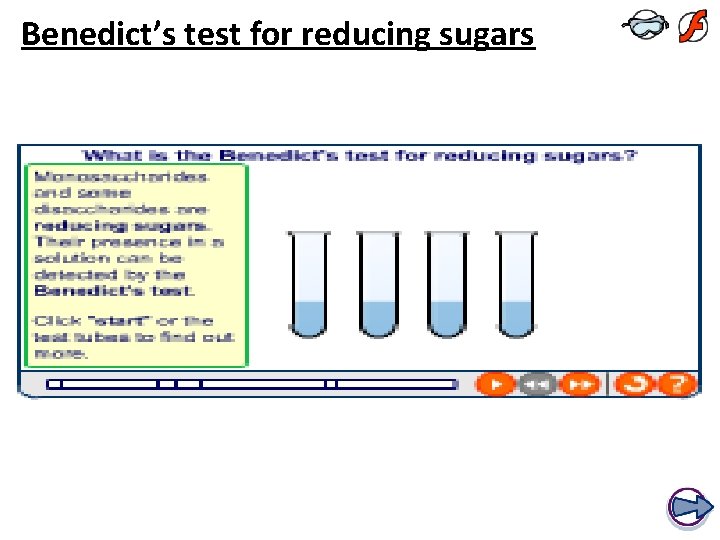
Benedict’s test for reducing sugars
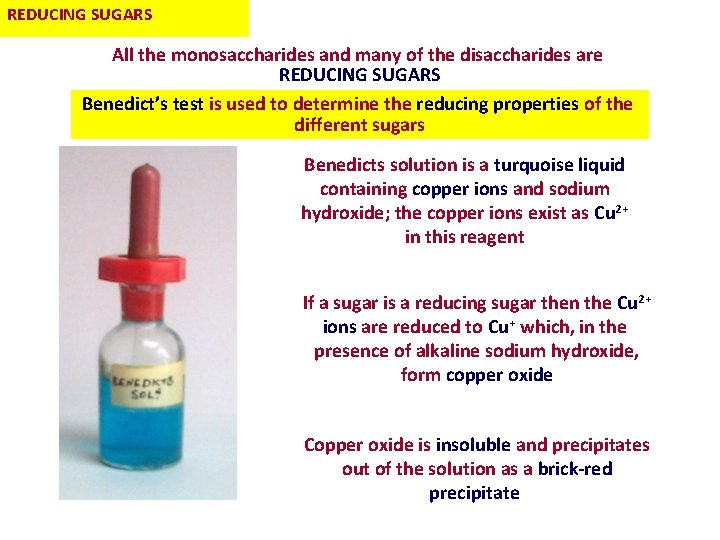
REDUCING SUGARS All the monosaccharides and many of the disaccharides are REDUCING SUGARS Benedict’s test is used to determine the reducing properties of the different sugars Benedicts solution is a turquoise liquid containing copper ions and sodium hydroxide; the copper ions exist as Cu 2+ in this reagent If a sugar is a reducing sugar then the Cu 2+ ions are reduced to Cu+ which, in the presence of alkaline sodium hydroxide, form copper oxide Copper oxide is insoluble and precipitates out of the solution as a brick-red precipitate

REDUCING SUGARS When Benedicts test is performed with the disaccharides maltose and sucrose, the following result is obtained Sucrose is a non-reducing sugar SUCROSE RESULT Maltose is a reducing sugar MALTOSE RESULT
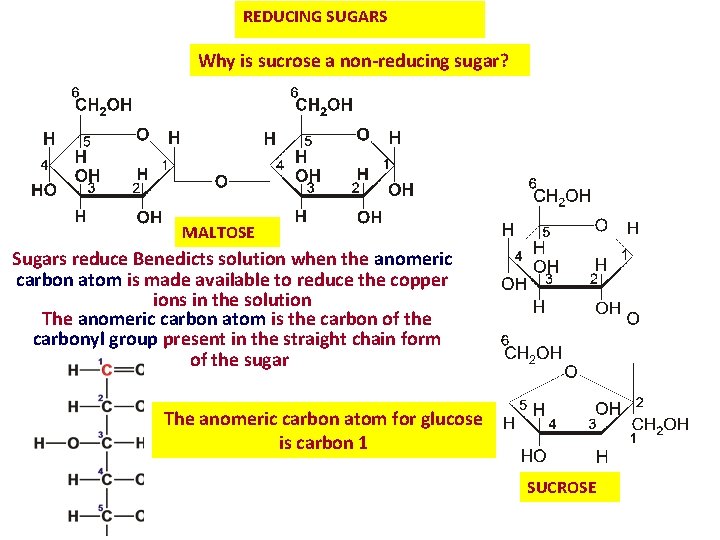
REDUCING SUGARS Why is sucrose a non-reducing sugar? MALTOSE Sugars reduce Benedicts solution when the anomeric carbon atom is made available to reduce the copper ions in the solution The anomeric carbon atom is the carbon of the carbonyl group present in the straight chain form of the sugar The anomeric carbon atom for glucose is carbon 1 SUCROSE
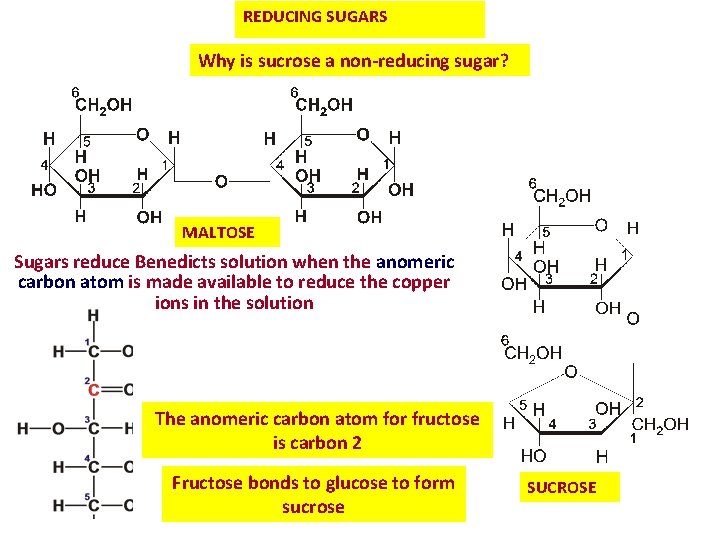
REDUCING SUGARS Why is sucrose a non-reducing sugar? MALTOSE Sugars reduce Benedicts solution when the anomeric carbon atom is made available to reduce the copper ions in the solution The anomeric carbon atom for fructose is carbon 2 Fructose bonds to glucose to form sucrose SUCROSE
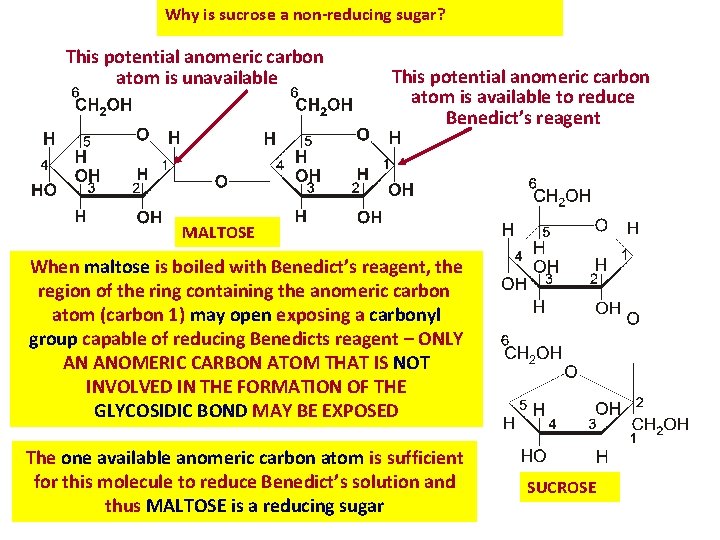
Why is sucrose a non-reducing sugar? This potential anomeric carbon atom is unavailable This potential anomeric carbon atom is available to reduce Benedict’s reagent MALTOSE When maltose is boiled with Benedict’s reagent, the region of the ring containing the anomeric carbon atom (carbon 1) may open exposing a carbonyl group capable of reducing Benedicts reagent – ONLY AN ANOMERIC CARBON ATOM THAT IS NOT INVOLVED IN THE FORMATION OF THE GLYCOSIDIC BOND MAY BE EXPOSED The one available anomeric carbon atom is sufficient for this molecule to reduce Benedict’s solution and thus MALTOSE is a reducing sugar SUCROSE
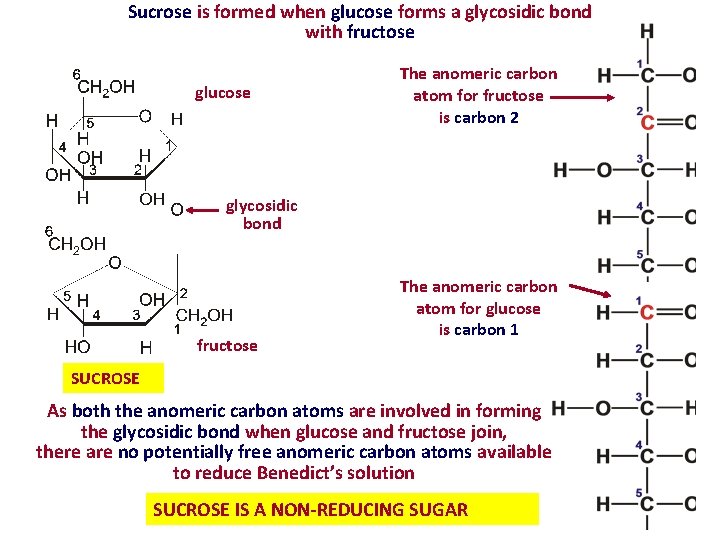
Sucrose is formed when glucose forms a glycosidic bond with fructose glucose The anomeric carbon atom for fructose is carbon 2 glycosidic bond fructose The anomeric carbon atom for glucose is carbon 1 SUCROSE As both the anomeric carbon atoms are involved in forming the glycosidic bond when glucose and fructose join, there are no potentially free anomeric carbon atoms available to reduce Benedict’s solution SUCROSE IS A NON-REDUCING SUGAR
TEST FOR SUCROSE In order to determine if sucrose is present in a sample or solution the following procedure is performed; The sample or solution under consideration is boiled for at least fifteen minutes in hydrochloric acid Boiling in acid breaks glycosidic bonds – the glycosidic bond is hydrolysed This procedure is called ACID HYDROLYSIS The solution is then neutralised by adding drops of alkali while testing with p. H paper Benedict’s test is now performed on the resulting solution If a brick-red precipitate forms then sucrose was present in the original solution Acid hydrolysis breaks the glycosidic bonds in the sucrose molecules releasing free glucose and free fructose into the solution Glucose and fructose are both monosaccharides and therefore reducing sugars If no precipitate is obtained then sucrose was not present in the original sample The need to neutralise the solution following acid hydrolysis is due to the fact that the Benedict’s test requires an alkaline medium
Iodine test for starch
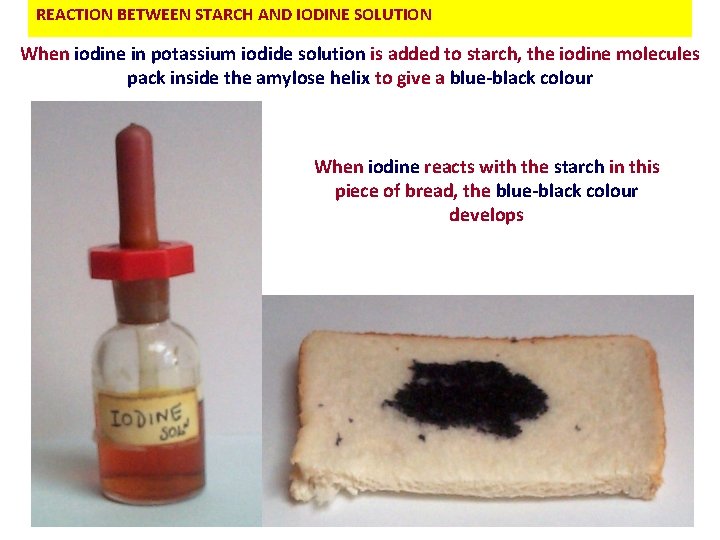
REACTION BETWEEN STARCH AND IODINE SOLUTION When iodine in potassium iodide solution is added to starch, the iodine molecules pack inside the amylose helix to give a blue-black colour When iodine reacts with the starch in this piece of bread, the blue-black colour develops
Instructions Carry out tests for reducing sugars, non-reducing sugars and starch on as many food samples as possible. Write the methods out in your practical book. Record your results in a suitable.
Testing for Starch and Sugars Reducing sugars: Add a small quantity of Benedict’s solution to a sample of the food (add water if the food is a solid). Place in a boiling water bath for 5 minutes. If the solution stays blue, test for non-reducing sugars: Add a small quantity of dilute HCl to the food sample (add water if the food is a solid). Place in a boiling water bath for 5 minutes, then add an equal quantity of Na. HCO 3 (or Na. OH) before testing with Benedict’s as above. Results: green → yellow → orange → brick-red precipitate Low sugar content → → → High sugar content Starch: Add a few drops of iodine solution to a sample of food in a spotting tile. Results: Blue-black colour indicates starch is present.
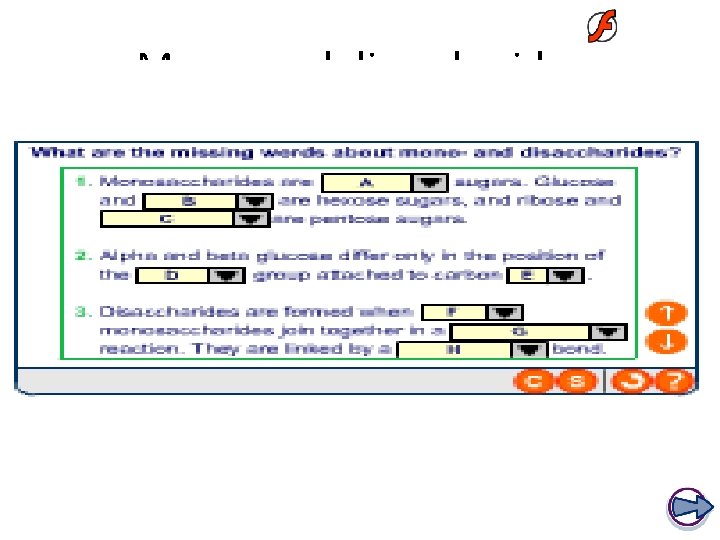
Mono- and disaccharides
- Slides: 14