
Food Systems and Local Food Definition and Examples



- Slides: 26
Food Systems and Local Food Definition and Examples of North Carolina Projects and Programs
Session Objective Be able to define the sectors of the food system, and cite example projects or Cooperative Extension programs that are working to develop local food systems in North Carolina.
What is a Food System?
What is a Food System? sys • tem noun sis-tem A group of related parts that move or work together Merriam-Webster Dictionary
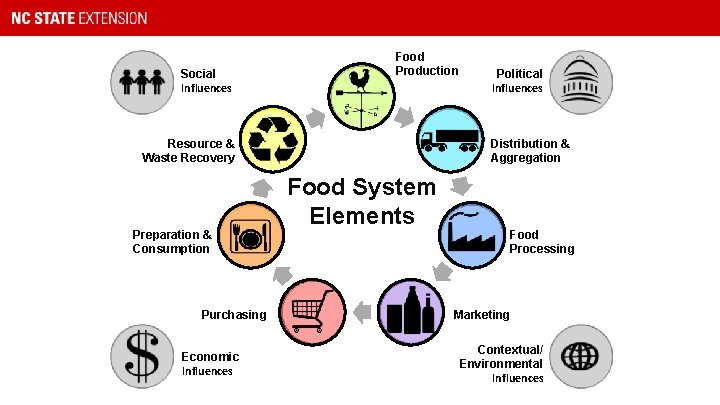
Simplified view of Food as a System Food Production Resource & Waste Recovery Preparation & Consumption Purchasing Distribution & Aggregation Food System Elements Food Processing Marketing Adapted by Christy Shi, from Cornell University, Discovering the Food System; A Primer on Community Food Systems: Linking Food, Nutrition and Agriculture.
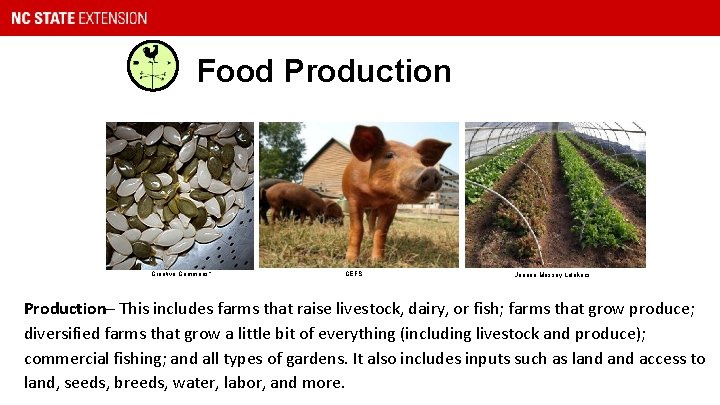
Food Production Creative Commons ** Creative Commons* CEFS Joanna Massey Lelekacs Production– This includes farms that raise livestock, dairy, or fish; farms that grow produce; diversified farms that grow a little bit of everything (including livestock and produce); commercial fishing; and all types of gardens. It also includes inputs such as land access to land, seeds, breeds, water, labor, and more.
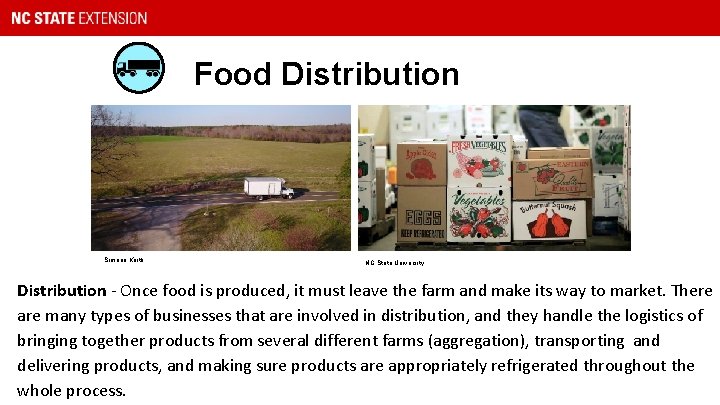
Food Distribution Simone Keith NC State University Distribution - Once food is produced, it must leave the farm and make its way to market. There are many types of businesses that are involved in distribution, and they handle the logistics of bringing together products from several different farms (aggregation), transporting and delivering products, and making sure products are appropriately refrigerated throughout the whole process.
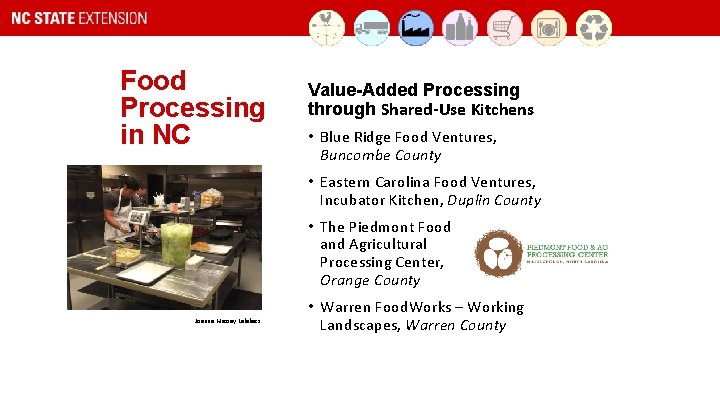
Food Processing NC State University Joanna Massey Lelekacs Processing - Sometimes, food is processed to change its form before it goes to market. Processing means transforming the product in some way, so for example, making jam out of berries, or making sausage out of meat. Processing adds value to products, since farmers and other businesses can charge extra for them, which can help to increase their profits.
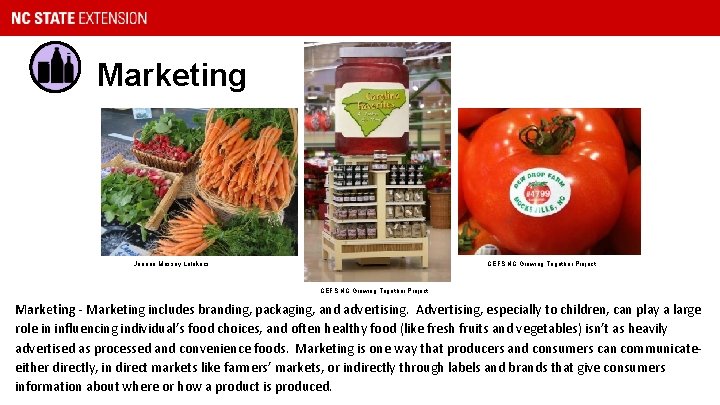
Marketing Joanna Massey Lelekacs CEFS NC Growing Together Project Marketing - Marketing includes branding, packaging, and advertising. Advertising, especially to children, can play a large role in influencing individual’s food choices, and often healthy food (like fresh fruits and vegetables) isn’t as heavily advertised as processed and convenience foods. Marketing is one way that producers and consumers can communicate- either directly, in direct markets like farmers’ markets, or indirectly through labels and brands that give consumers information about where or how a product is produced.
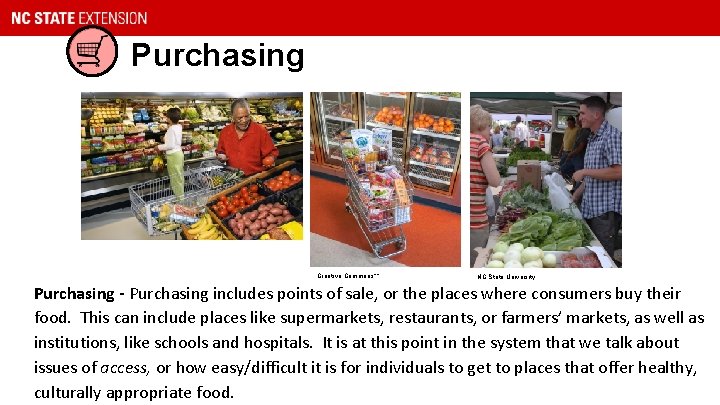
Purchasing Creative Commons** NC State University Purchasing - Purchasing includes points of sale, or the places where consumers buy their food. This can include places like supermarkets, restaurants, or farmers’ markets, as well as institutions, like schools and hospitals. It is at this point in the system that we talk about issues of access, or how easy/difficult it is for individuals to get to places that offer healthy, culturally appropriate food.
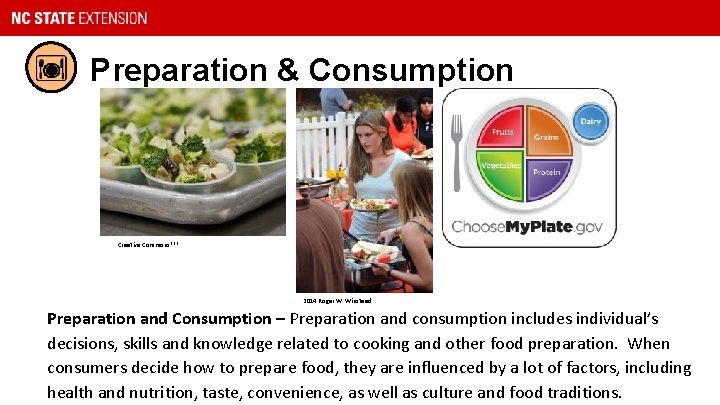
Preparation & Consumption Creative Commons*** 2014 Roger W. Winstead Preparation and Consumption – Preparation and consumption includes individual’s decisions, skills and knowledge related to cooking and other food preparation. When consumers decide how to prepare food, they are influenced by a lot of factors, including health and nutrition, taste, convenience, as well as culture and food traditions.
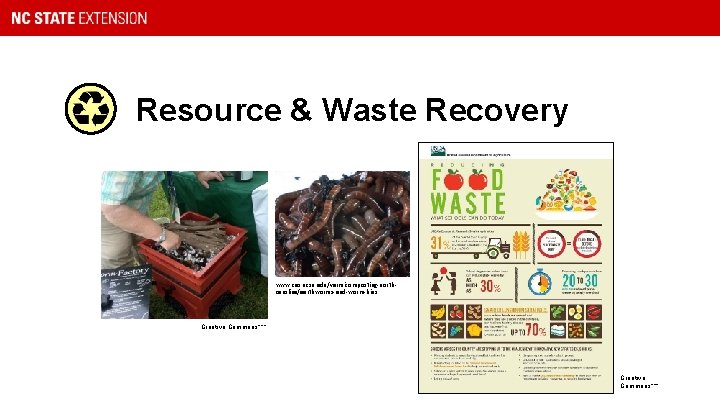
Resource & Waste Recovery www. ces. ncsu. edu/vermicomposting-northcarolina/earthworms-and-worm-bins Creative Commons***
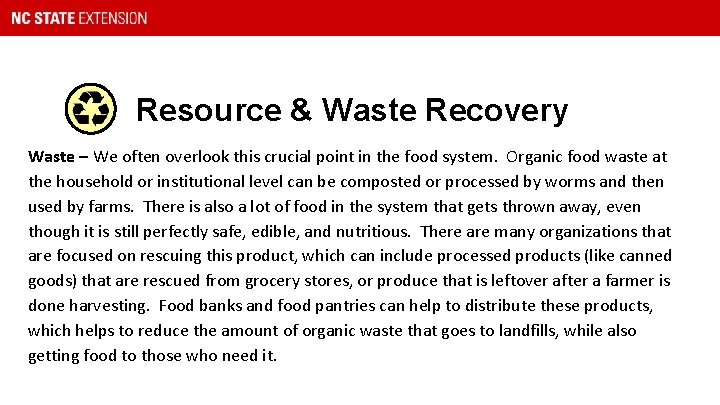
Resource & Waste Recovery Waste – We often overlook this crucial point in the food system. Organic food waste at the household or institutional level can be composted or processed by worms and then used by farms. There is also a lot of food in the system that gets thrown away, even though it is still perfectly safe, edible, and nutritious. There are many organizations that are focused on rescuing this product, which can include processed products (like canned goods) that are rescued from grocery stores, or produce that is leftover after a farmer is done harvesting. Food banks and food pantries can help to distribute these products, which helps to reduce the amount of organic waste that goes to landfills, while also getting food to those who need it.
Social Influences Food Production Resource & Waste Recovery Preparation & Consumption Purchasing Economic Influences Political Influences Distribution & Aggregation Food System Elements Food Processing Marketing Contextual/ Environmental Influences
What is a Local Food System?
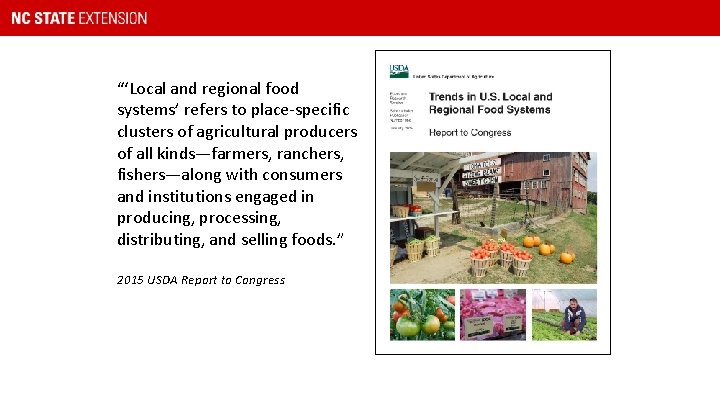
“‘Local and regional food systems’ refers to place-specific clusters of agricultural producers of all kinds—farmers, ranchers, fishers—along with consumers and institutions engaged in producing, processing, distributing, and selling foods. ” 2015 USDA Report to Congress
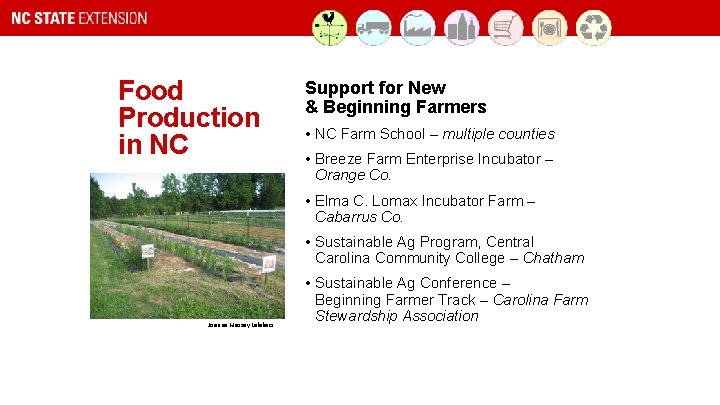
Food Production in NC Support for New & Beginning Farmers • NC Farm School – multiple counties • Breeze Farm Enterprise Incubator – Orange Co. • Elma C. Lomax Incubator Farm – Cabarrus Co. • Sustainable Ag Program, Central Carolina Community College – Chatham Joanna Massey Lelekacs • Sustainable Ag Conference – Beginning Farmer Track – Carolina Farm Stewardship Association
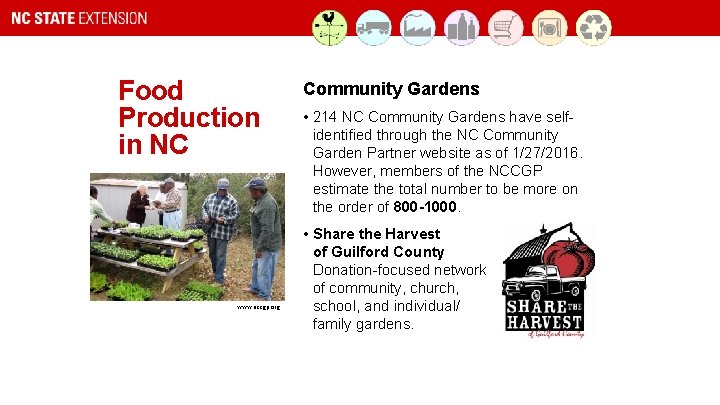
Food Production in NC www. nccgp. org Community Gardens • 214 NC Community Gardens have selfidentified through the NC Community Garden Partner website as of 1/27/2016. However, members of the NCCGP estimate the total number to be more on the order of 800 -1000. • Share the Harvest of Guilford County Donation-focused network of community, church, school, and individual/ family gardens.
Aggregation & Distribution in NC Food Hubs & Aggregation Facilities Sandhills Farm to Table, Moore County TRACTOR, Yancey County Feast Down East, Southeastern NC The Produce Box, Triangle, Triad, Wilmington Firsthand Foods, Durham County Eastern Carolina Organics, Durham County
Food Processing in NC Value-Added Processing through Shared-Use Kitchens • Blue Ridge Food Ventures, Buncombe County • Eastern Carolina Food Ventures, Incubator Kitchen, Duplin County • The Piedmont Food and Agricultural Processing Center, Orange County Joanna Massey Lelekacs • Warren Food. Works – Working Landscapes, Warren County
Marketing in NC Local brands can assist with authenticating local State Branding • Got to be NC Regional Branding • Piedmont Grown • Appalachian Grown • Feast Down East
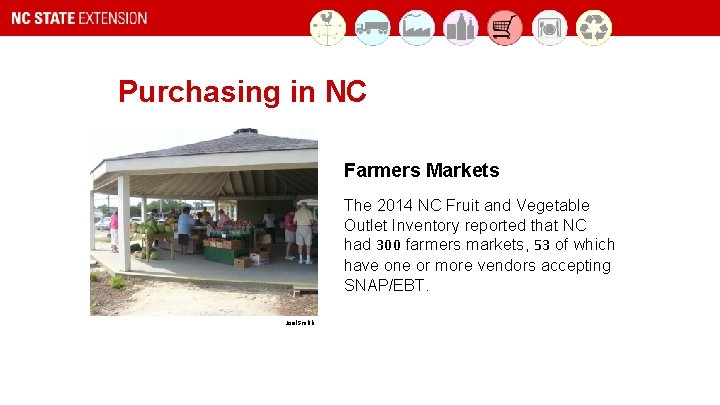
Purchasing in NC Farmers Markets The 2014 NC Fruit and Vegetable Outlet Inventory reported that NC had 300 farmers markets, 53 of which have one or more vendors accepting SNAP/EBT. Joel Smith
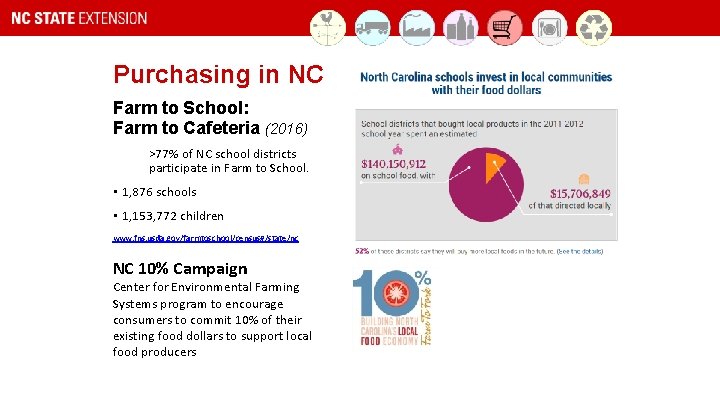
Purchasing in NC Farm to School: Farm to Cafeteria (2016) >77% of NC school districts participate in Farm to School. • 1, 876 schools • 1, 153, 772 children www. fns. usda. gov/farmtoschool/census#/state/nc NC 10% Campaign Center for Environmental Farming Systems program to encourage consumers to commit 10% of their existing food dollars to support local food producers
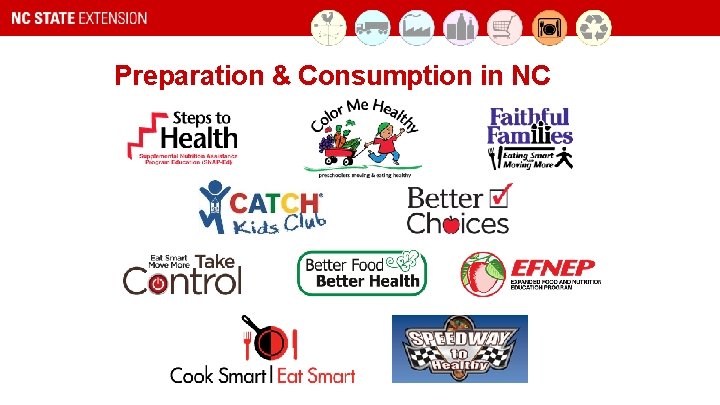
Preparation & Consumption in NC
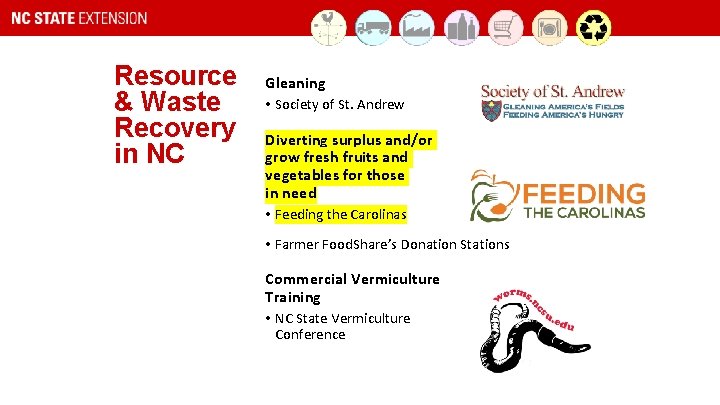
Resource & Waste Recovery in NC Gleaning • Society of St. Andrew Diverting surplus and/or grow fresh fruits and vegetables for those in need • Feeding the Carolinas • Farmer Food. Share’s Donation Stations Commercial Vermiculture Training • NC State Vermiculture Conference
This presentation was adapted with permission from the NC State Extension Master Food Volunteer Program’s Food Systems and Local Food Curriculum. Portions of this presentation were adapted from a presentation developed by the Center for Environmental Farming Systems. Photos identified as Creative Commons have an *Attribution-Sharealike 2. 0 Generic license. https: //creativecommons. org/licenses/by-sa/2. 0 **Attribution 2. 0 Generic license. https: //creativecommons. org/licenses/by/2. 0 ***Attribution-No Derivs 2. 0 Generic license. https: //creativecommons. org/licenses/by-nd/2. 0