
Food Safety What Do Clients Need to Know
![FSMA – Preventive Controls (PC) Rules Preventive controls for food facilities [Sec. 103] 1.](https://slidetodoc.com/presentation_image_h2/a64633f36d7bf6dc1d4e2472590a0eb9/image-8.jpg "FSMA – Preventive Controls (PC) Rules Preventive controls for food facilities [Sec. 103] 1.")
![FSMA – Preventive Controls (PC) Rules Preventive controls for food facilities [Sec. 103] 1.](https://slidetodoc.com/presentation_image_h2/a64633f36d7bf6dc1d4e2472590a0eb9/image-9.jpg "FSMA – Preventive Controls (PC) Rules Preventive controls for food facilities [Sec. 103] 1.")
![FSMA – Produce Safety Rule Produce safety standards [Sec. 105] 1. Naturally and unintentional/intentional](https://slidetodoc.com/presentation_image_h2/a64633f36d7bf6dc1d4e2472590a0eb9/image-12.jpg "FSMA – Produce Safety Rule Produce safety standards [Sec. 105] 1. Naturally and unintentional/intentional")
- Slides: 27
Food Safety: What Do Clients Need to Know in 2017? Jovana Kovacevic, Kari Larson, Stephanie Page May 19, 2017 Oregon State Bar Agricultural Law Section’s 2017 Ag Law Round Up CLE Photo Source: PSA Jovana Kovacevic, Ph. D Kari L. Larson, Esq. Stephanie Page, REHS Assistant Professor of Food Safety Food Innovation Center, Oregon State University jovana. kovacevic@oregonstate. edu Attorney K&L Gates kari. larson@klgates. com Director, Food Safety & Animal Health Oregon Department of Agriculture spage@oda. state. or. us
Goals of this session Ø Overview of the Food Safety Modernization Act (FSMA) Produce Safety Rule and Preventative Controls for Human Food Rule Ø Learn who is involved in the implementation of FSMA in Oregon o Oregon State University o Oregon Department of Agriculture o Other resources 2
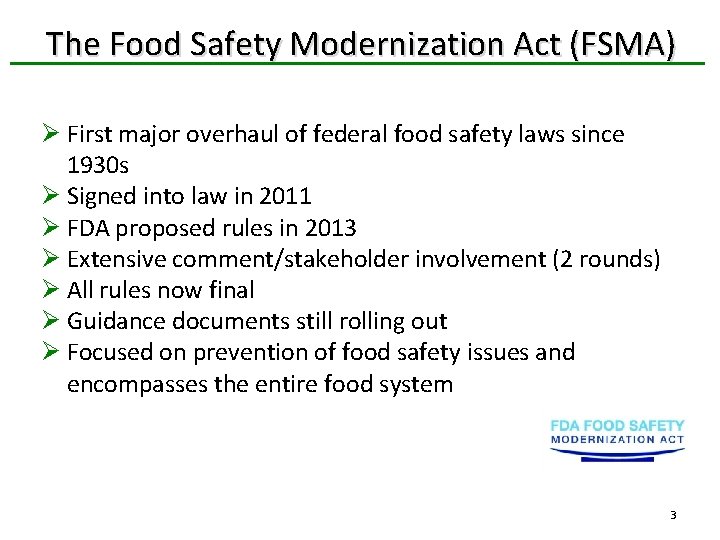
The Food Safety Modernization Act (FSMA) Ø First major overhaul of federal food safety laws since 1930 s Ø Signed into law in 2011 Ø FDA proposed rules in 2013 Ø Extensive comment/stakeholder involvement (2 rounds) Ø All rules now final Ø Guidance documents still rolling out Ø Focused on prevention of food safety issues and encompasses the entire food system 3
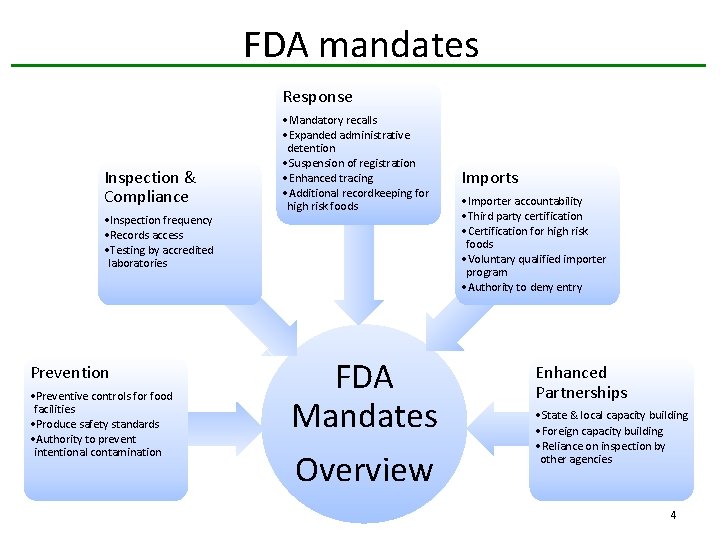
FDA mandates Response Inspection & Compliance • Inspection frequency • Records access • Testing by accredited laboratories Prevention • Preventive controls for food facilities • Produce safety standards • Authority to prevent intentional contamination • Mandatory recalls • Expanded administrative detention • Suspension of registration • Enhanced tracing • Additional recordkeeping for high risk foods FDA Mandates Overview Imports • Importer accountability • Third party certification • Certification for high risk foods • Voluntary qualified importer program • Authority to deny entry Enhanced Partnerships • State & local capacity building • Foreign capacity building • Reliance on inspection by other agencies 4
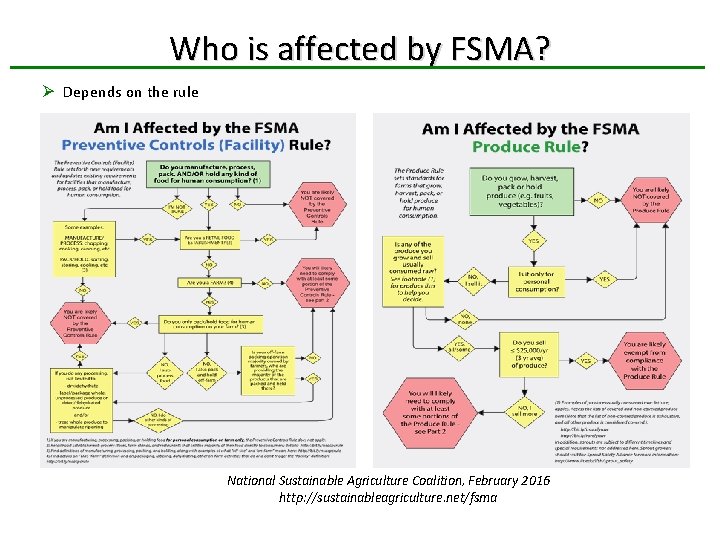
Who is affected by FSMA? Ø Depends on the rule National Sustainable Agriculture Coalition, February 2016 http: //sustainableagriculture. net/fsma 5
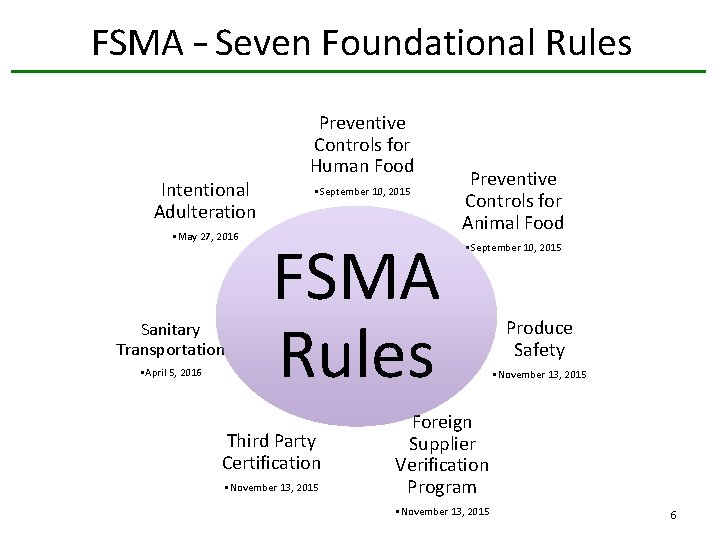
FSMA – Seven Foundational Rules Intentional Adulteration • May 27, 2016 Sanitary Transportation • April 5, 2016 Preventive Controls for Human Food • September 10, 2015 FSMA Rules Third Party Certification • November 13, 2015 Preventive Controls for Animal Food • September 10, 2015 Produce Safety • November 13, 2015 Foreign Supplier Verification Program • November 13, 2015 6
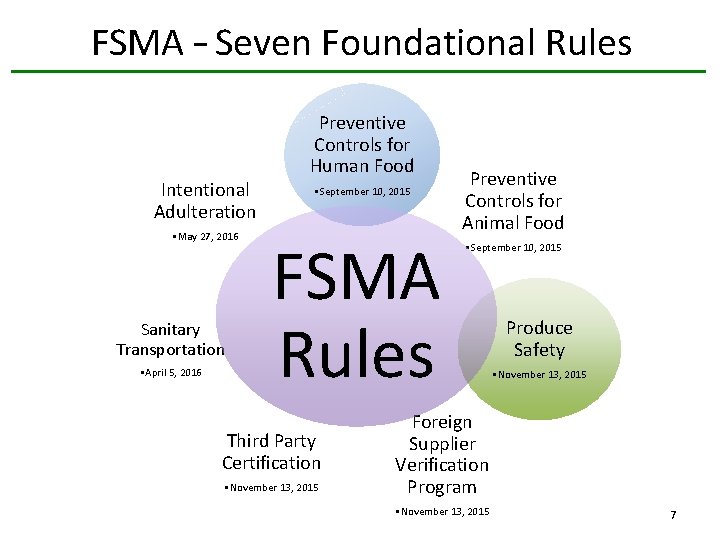
FSMA – Seven Foundational Rules Intentional Adulteration • May 27, 2016 Sanitary Transportation • April 5, 2016 Preventive Controls for Human Food • September 10, 2015 FSMA Rules Third Party Certification • November 13, 2015 Preventive Controls for Animal Food • September 10, 2015 Produce Safety • November 13, 2015 Foreign Supplier Verification Program • November 13, 2015 7
FSMA – Preventive Controls (PC) Rules Preventive controls for food facilities [Sec. 103] 1. Evaluate hazards 2. Specify prevention steps or controls 3. Specify monitoring of controls’ effectiveness 4. Maintain routine monitoring records 5. Specify corrective actions Current Good Manufacturing Practice (CGMP), Hazard Analysis, and Risk-Based Preventive Controls (PC) for Human Food [FDA-2011 -N-0920] - Final rule on September 10, 2015 - Facilities registered with FDA under sec. 415 • Not farms or retail food establishments • Includes domestic and imported food - Extemptions • Facilities storing unexposed packaged food • Other exemptions may be based on 8 facility size/sales
FSMA – Preventive Controls (PC) Rules Preventive controls for food facilities [Sec. 103] 1. Evaluate hazards 2. Specify prevention steps or controls 3. Specify monitoring of controls’ effectiveness 4. Maintain routine monitoring records 5. Specify corrective actions Table 1. PC compliance dates. Business Size c. GMP Compliance PC Compliance Small Business* 2 years 3 years (2017) (2018) Very Small Business◊ 3 years 4 years (2018) (2019) Other Businesses 1 year 2 years (2016) (2017) c. GMP, current good manufacturing practices. PC, preventive controls. *Small Business: fewer than 500 fulltime equivalent employees ◊ Very Small Business (human food): average <$1 M per year in sales of human food plus the market value of human food manufactured, processed, packed 9 or held without sale
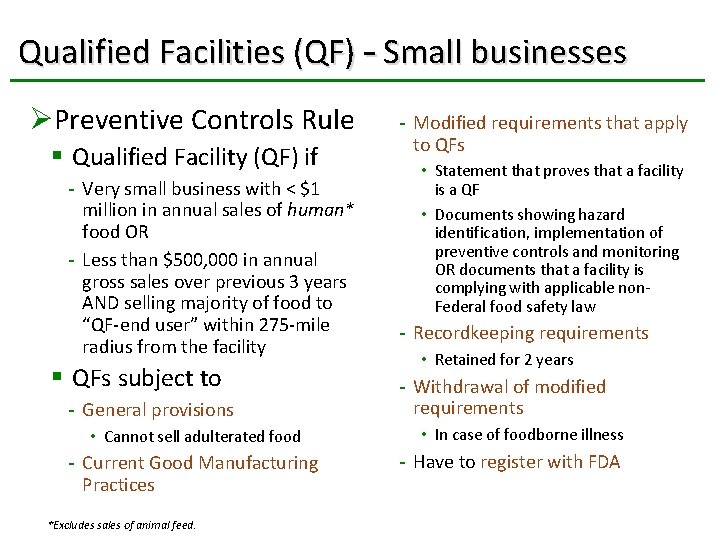
Qualified Facilities (QF) – Small businesses ØPreventive Controls Rule § Qualified Facility (QF) if - Very small business with < $1 million in annual sales of human* food OR - Less than $500, 000 in annual gross sales over previous 3 years AND selling majority of food to “QF-end user” within 275 -mile radius from the facility § QFs subject to - General provisions • Cannot sell adulterated food - Current Good Manufacturing Practices *Excludes sales of animal feed. - Modified requirements that apply to QFs • Statement that proves that a facility is a QF • Documents showing hazard identification, implementation of preventive controls and monitoring OR documents that a facility is complying with applicable non. Federal food safety law - Recordkeeping requirements • Retained for 2 years - Withdrawal of modified requirements • In case of foodborne illness - Have to register with FDA 10
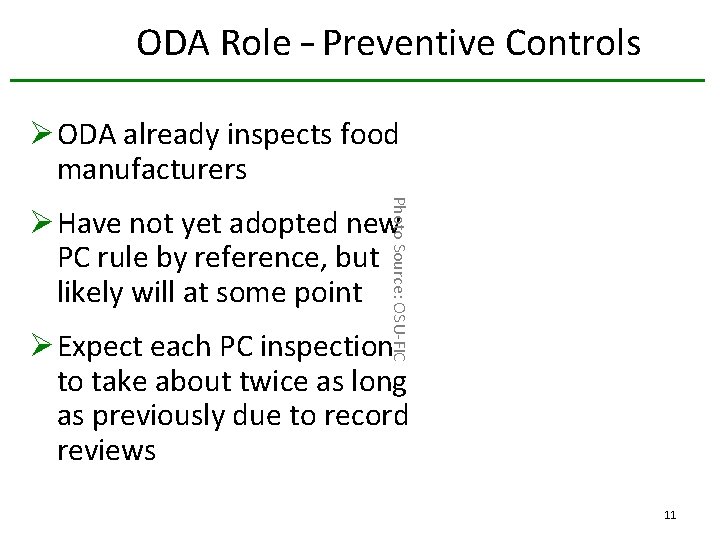
ODA Role – Preventive Controls Ø ODA already inspects food manufacturers Photo Source: OSU-FIC Ø Have not yet adopted new PC rule by reference, but likely will at some point Ø Expect each PC inspection to take about twice as long as previously due to record reviews 11
FSMA – Produce Safety Rule Produce safety standards [Sec. 105] 1. Naturally and unintentional/intentional hazards 2. Soil amendments 3. Hygiene 4. Packaging 5. Temperature control 6. Animals in the growing area/water Standards for the Growing, Harvesting, Packing, and Holding of Produce for Human Consumption [FDA-2011 -N-0921] - Final rule on November, 2015 - Key requirements • Agricultural water o Water quality and testing • Biological soil amendments o Raw manure and stabilized compost • Sprouts • Domesticated and wild animals • Worker training and health and hygiene • Equipment, tools and buildings 12
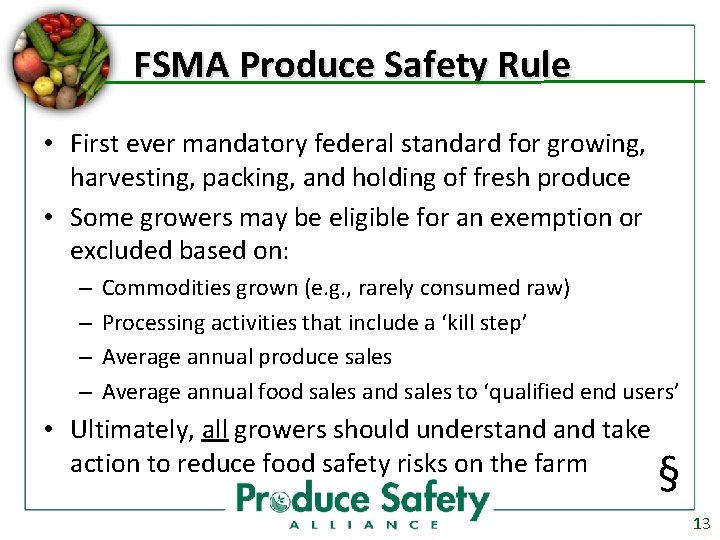
FSMA Produce Safety Rule • First ever mandatory federal standard for growing, harvesting, packing, and holding of fresh produce • Some growers may be eligible for an exemption or excluded based on: – – Commodities grown (e. g. , rarely consumed raw) Processing activities that include a ‘kill step’ Average annual produce sales Average annual food sales and sales to ‘qualified end users’ • Ultimately, all growers should understand take action to reduce food safety risks on the farm § 13
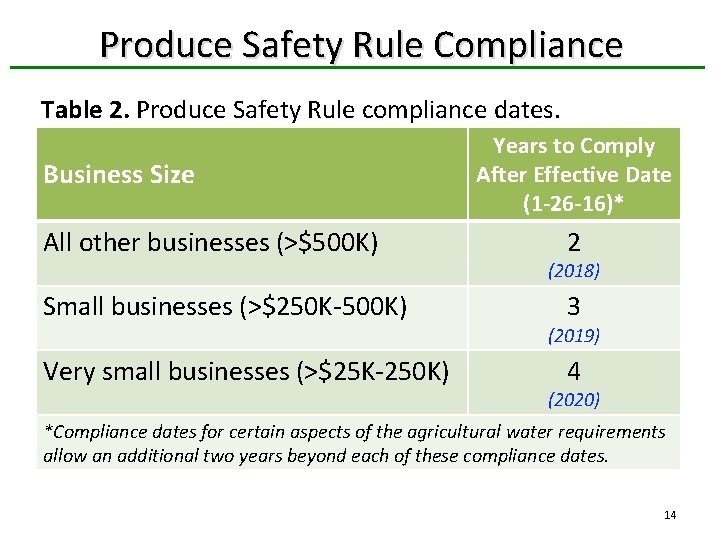
Produce Safety Rule Compliance Table 2. Produce Safety Rule compliance dates. Business Size All other businesses (>$500 K) Small businesses (>$250 K-500 K) Very small businesses (>$25 K-250 K) Years to Comply After Effective Date (1 -26 -16)* 2 (2018) 3 (2019) 4 (2020) *Compliance dates for certain aspects of the agricultural water requirements allow an additional two years beyond each of these compliance dates. 14
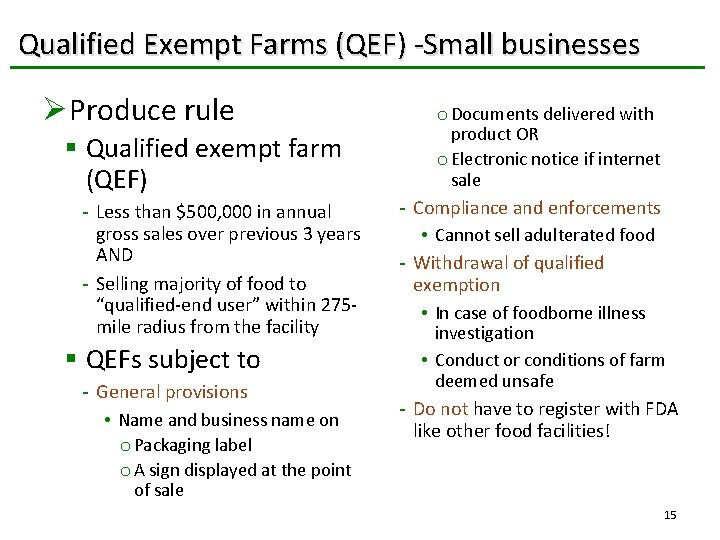
Qualified Exempt Farms (QEF) -Small businesses ØProduce rule § Qualified exempt farm (QEF) - Less than $500, 000 in annual gross sales over previous 3 years AND - Selling majority of food to “qualified-end user” within 275 mile radius from the facility § QEFs subject to - General provisions • Name and business name on o Packaging label o A sign displayed at the point of sale o Documents delivered with product OR o Electronic notice if internet sale - Compliance and enforcements • Cannot sell adulterated food - Withdrawal of qualified exemption • In case of foodborne illness investigation • Conduct or conditions of farm deemed unsafe - Do not have to register with FDA like other food facilities! 15
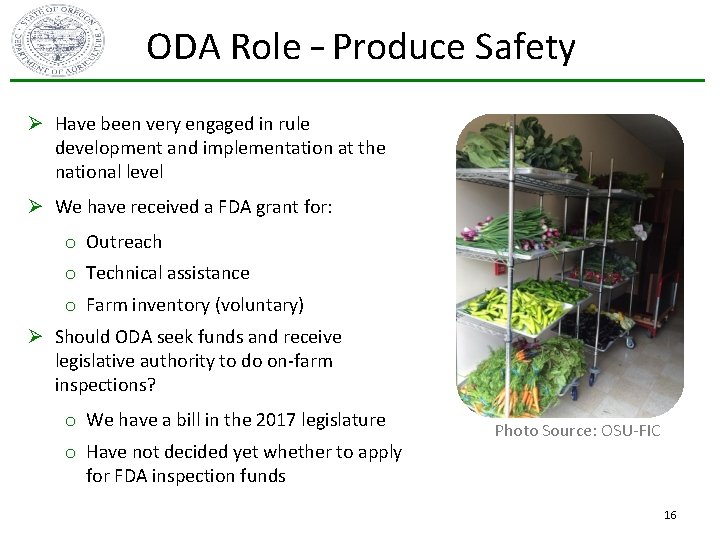
ODA Role – Produce Safety Ø Have been very engaged in rule development and implementation at the national level Ø We have received a FDA grant for: o Outreach o Technical assistance o Farm inventory (voluntary) Ø Should ODA seek funds and receive legislative authority to do on-farm inspections? o We have a bill in the 2017 legislature o Have not decided yet whether to apply for FDA inspection funds Photo Source: OSU-FIC 16
FSMA in Oregon Department of Agriculture (ODA) Stephanie Page Oregon State University – Western Regional Center to Enhance Food Safety Jovana Kovacevic Photo Source: PSA 17
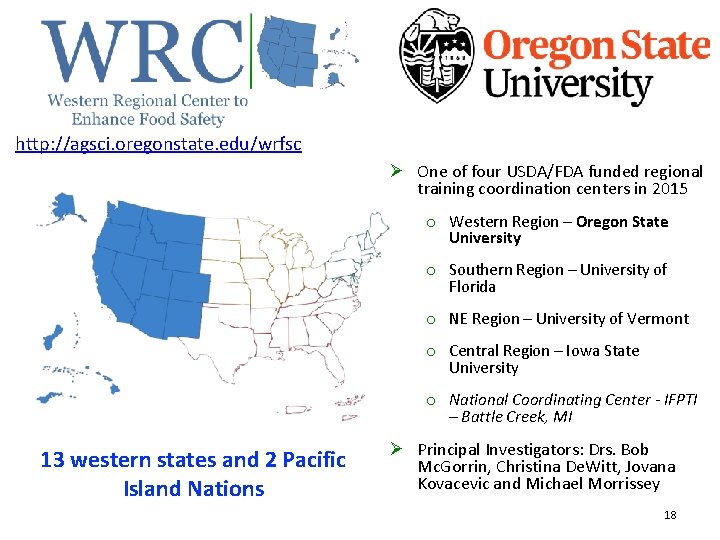
http: //agsci. oregonstate. edu/wrfsc Ø One of four USDA/FDA funded regional training coordination centers in 2015 o Western Region – Oregon State University o Southern Region – University of Florida o NE Region – University of Vermont o Central Region – Iowa State University o National Coordinating Center - IFPTI – Battle Creek, MI 13 western states and 2 Pacific Island Nations Ø Principal Investigators: Drs. Bob Mc. Gorrin, Christina De. Witt, Jovana Kovacevic and Michael Morrissey 18
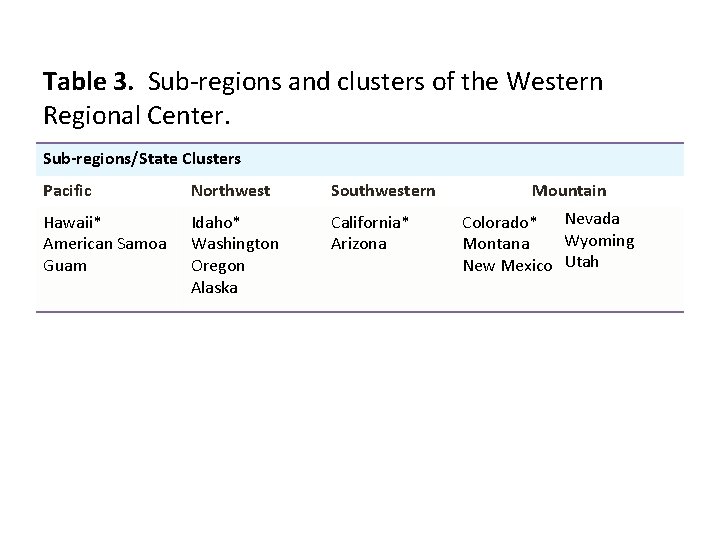
Table 3. Sub-regions and clusters of the Western Regional Center. Sub-regions/State Clusters Pacific Northwest Southwestern Hawaii* American Samoa Guam Idaho* Washington Oregon Alaska California* Arizona Mountain Colorado* Nevada Wyoming Montana New Mexico Utah 19
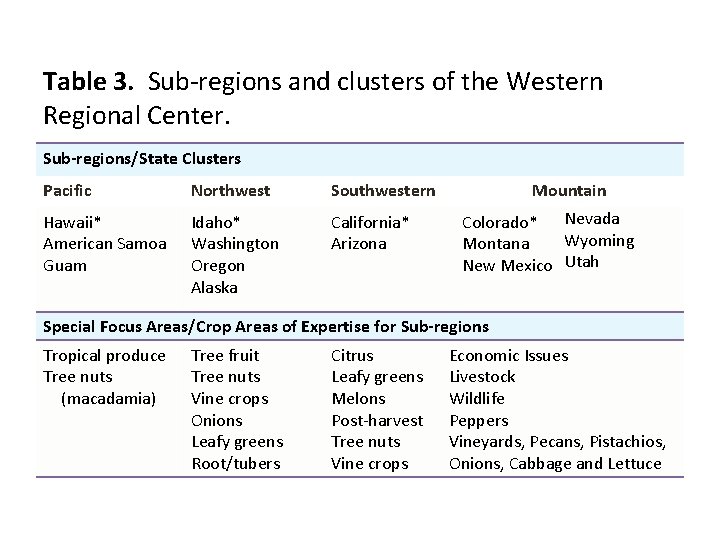
Table 3. Sub-regions and clusters of the Western Regional Center. Sub-regions/State Clusters Pacific Northwest Southwestern Hawaii* American Samoa Guam Idaho* Washington Oregon Alaska California* Arizona Mountain Colorado* Nevada Wyoming Montana New Mexico Utah Special Focus Areas/Crop Areas of Expertise for Sub-regions Tropical produce Tree nuts (macadamia) Tree fruit Tree nuts Vine crops Onions Leafy greens Root/tubers Citrus Leafy greens Melons Post-harvest Tree nuts Vine crops Economic Issues Livestock Wildlife Peppers Vineyards, Pecans, Pistachios, Onions, Cabbage and Lettuce 20
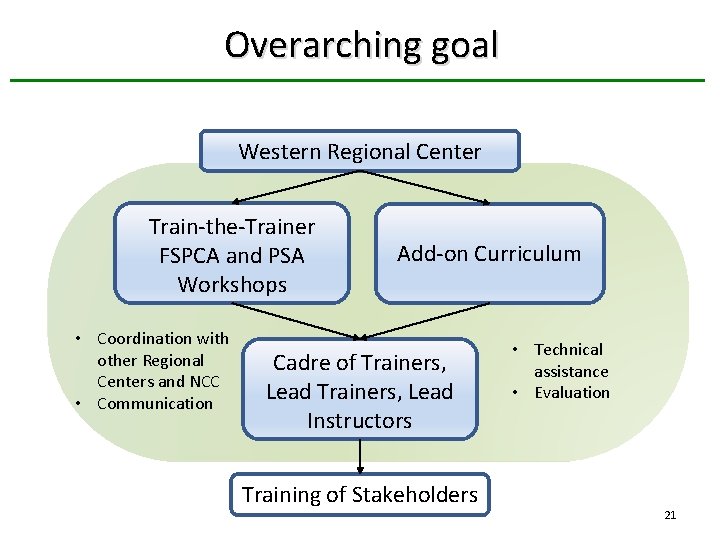
Overarching goal Western Regional Center Train-the-Trainer FSPCA and PSA Workshops • Coordination with other Regional Centers and NCC • Communication Add-on Curriculum Cadre of Trainers, Lead Instructors Training of Stakeholders • Technical assistance • Evaluation 21
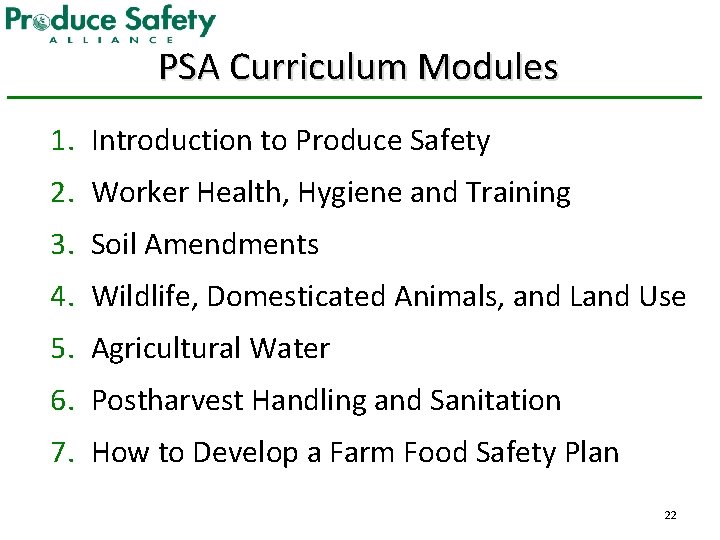
PSA Curriculum Modules 1. Introduction to Produce Safety 2. Worker Health, Hygiene and Training 3. Soil Amendments 4. Wildlife, Domesticated Animals, and Land Use 5. Agricultural Water 6. Postharvest Handling and Sanitation 7. How to Develop a Farm Food Safety Plan 22
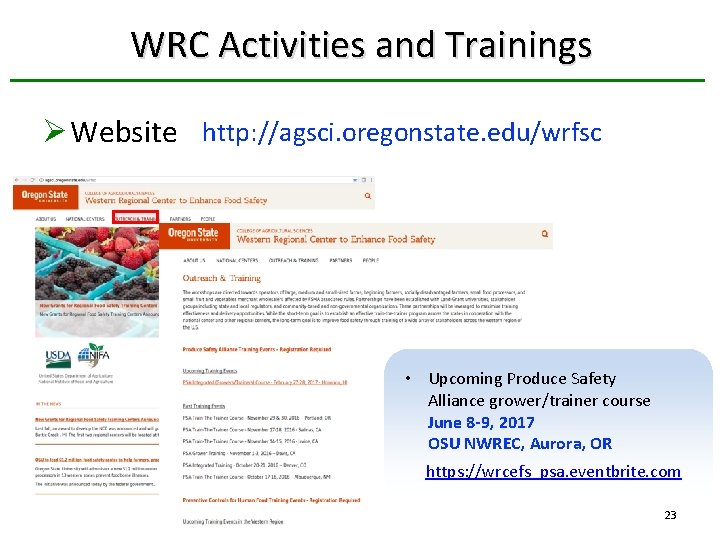
WRC Activities and Trainings Ø Website http: //agsci. oregonstate. edu/wrfsc • Upcoming Produce Safety Alliance grower/trainer course June 8 -9, 2017 OSU NWREC, Aurora, OR https: //wrcefs_psa. eventbrite. com 23
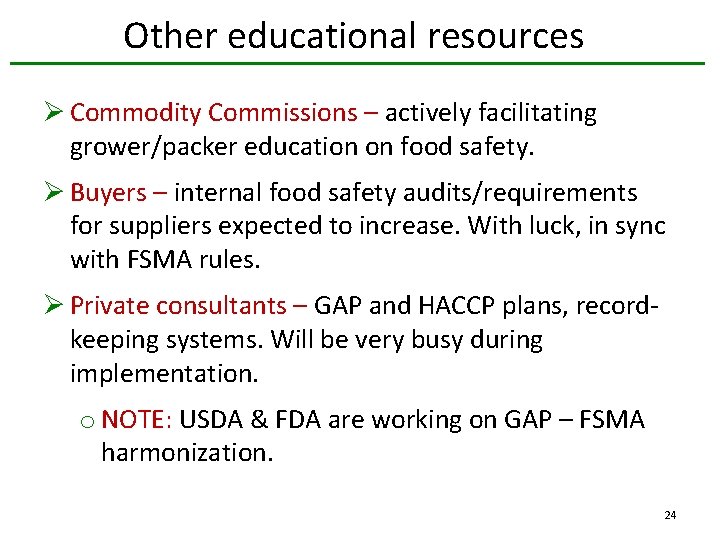
Other educational resources Ø Commodity Commissions – actively facilitating grower/packer education on food safety. Ø Buyers – internal food safety audits/requirements for suppliers expected to increase. With luck, in sync with FSMA rules. Ø Private consultants – GAP and HACCP plans, recordkeeping systems. Will be very busy during implementation. o NOTE: USDA & FDA are working on GAP – FSMA harmonization. 24
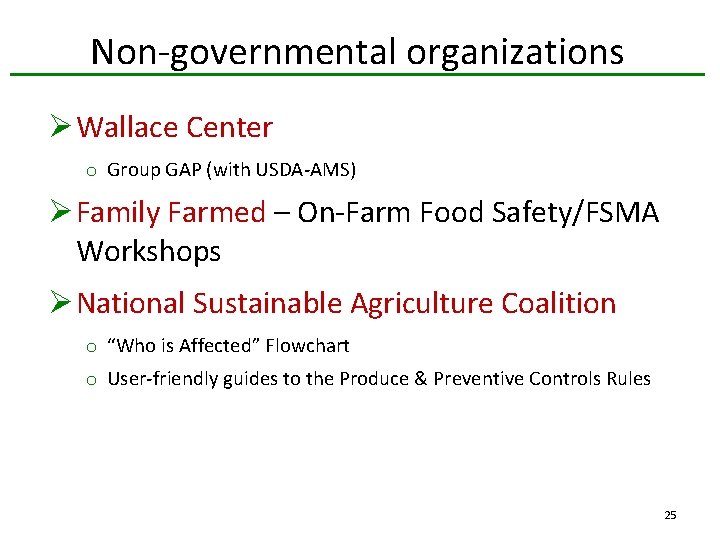
Non-governmental organizations Ø Wallace Center o Group GAP (with USDA-AMS) Ø Family Farmed – On-Farm Food Safety/FSMA Workshops Ø National Sustainable Agriculture Coalition o “Who is Affected” Flowchart o User-friendly guides to the Produce & Preventive Controls Rules 25
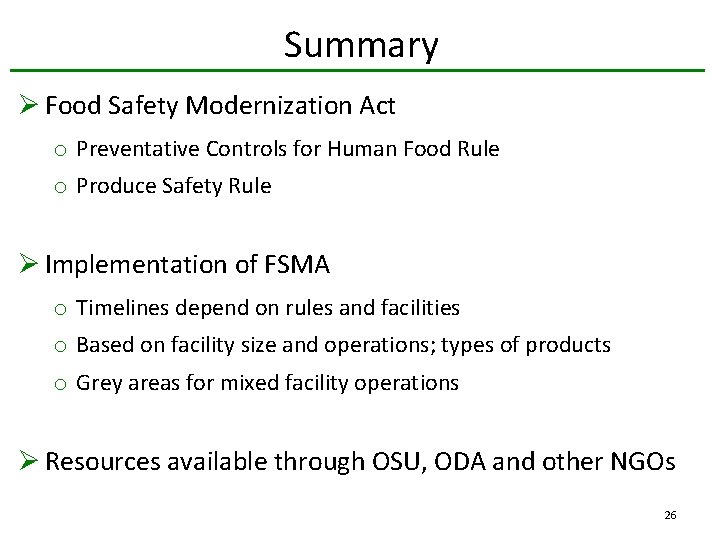
Summary Ø Food Safety Modernization Act o Preventative Controls for Human Food Rule o Produce Safety Rule Ø Implementation of FSMA o Timelines depend on rules and facilities o Based on facility size and operations; types of products o Grey areas for mixed facility operations Ø Resources available through OSU, ODA and other NGOs 26
Questions? Stephanie Page, REHS Director, Food Safety & Animal Health Oregon Department of Agriculture spage@oda. state. or. us Jovana Kovacevic, Ph. D Assistant Professor of Food Safety Food Innovation Center, Oregon State University jovana. kovacevic@oregonstate. edu Kari L. Larson, Esq. Attorney K&L Gates LLP kari. larson@klgates. com 27