
Food Safety Management System FSMS covering prerequisite programs

- Slides: 20
Food Safety Management System (FSMS) covering prerequisite programs (PRPs) and HACCP (Hazard Analysis And Critical Control Points). Tromsø, 18. 06. 2018. Mattilsynet – Norwegian Food Safety Authority Eivind Bjerck and Edvard Lorentzen Seafood Inspectors Fish and Food Section Region North, Troms and Svalbard Department
Requirements for Food safety • Food Safety is a key issue for food businesses (FBOs). The goal is to ensure a high level of protection of human health. • Food businesses in Norway have to ensure compliance with: - Regulation (EC) no. 178/2002 laying down the general principles and requirements of food law - Regulation (EC) No 852/2004 on the hygiene of foodstuffs - Regulation (EC) No 853/2004 on the specific hygiene rules for food of animal origin • These requirements are the legal basis for the Food Safety Management System (FSMS). Food Safety Management System Mattilsynet, 19 June 2018 (SV) 2
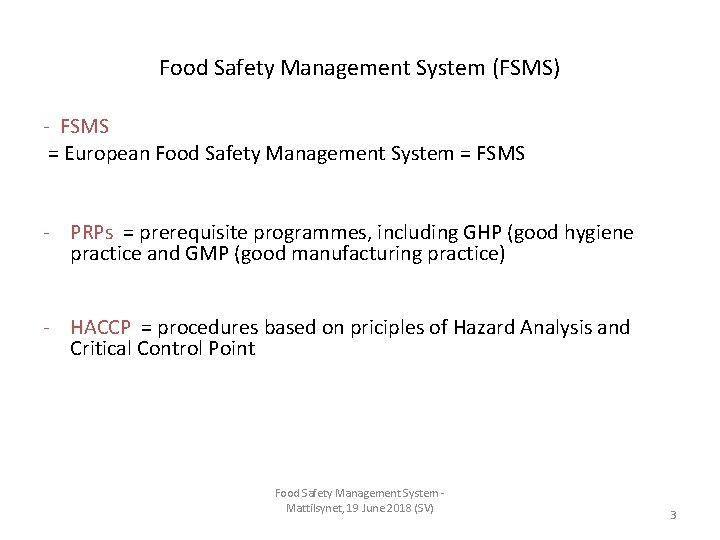
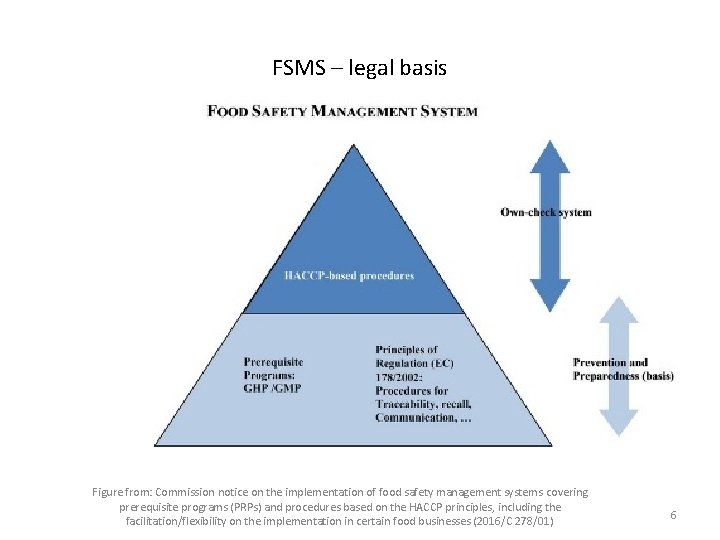
Food Safety Management System (FSMS) - FSMS = European Food Safety Management System = FSMS - PRPs = prerequisite programmes, including GHP (good hygiene practice and GMP (good manufacturing practice) - HACCP = procedures based on priciples of Hazard Analysis and Critical Control Point Food Safety Management System Mattilsynet, 19 June 2018 (SV) 3
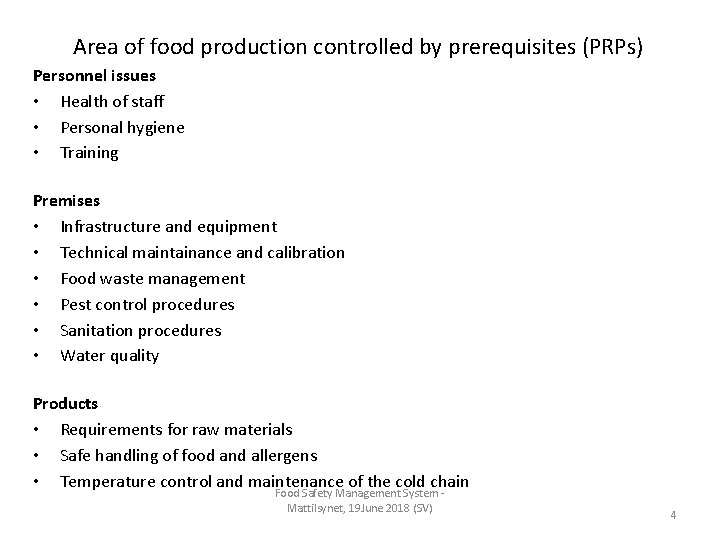
Area of food production controlled by prerequisites (PRPs) Personnel issues • Health of staff • Personal hygiene • Training Premises • Infrastructure and equipment • Technical maintainance and calibration • Food waste management • Pest control procedures • Sanitation procedures • Water quality Products • Requirements for raw materials • Safe handling of food and allergens • Temperature control and maintenance of the cold chain Food Safety Management System Mattilsynet, 19 June 2018 (SV) 4
Regulation (EC) no. 852/2004 - article 5 HACCP • HACCP is internationally recognised as the most effective means of controlling food-borne diseases and other hazards that influence food safety. • HACCP is a system of food safety assurance based on the prevention of food and feed safety problems. • HACCP is legal requirement for food business operators (FBOs) carrying out any stage of production, processing and distribution of food after primary production. • FBOs must put in place, implement and maintain procedures based on HACCP principles. Food Safety Management System Mattilsynet , 19 June 2018 (SV) 5
FSMS – legal basis Figure from: Commission notice on the implementation of food safety management systems covering prerequisite programs (PRPs) and procedures based on the HACCP principles, including the facilitation/flexibility on the implementation in certain food businesses (2016/C 278/01) 6
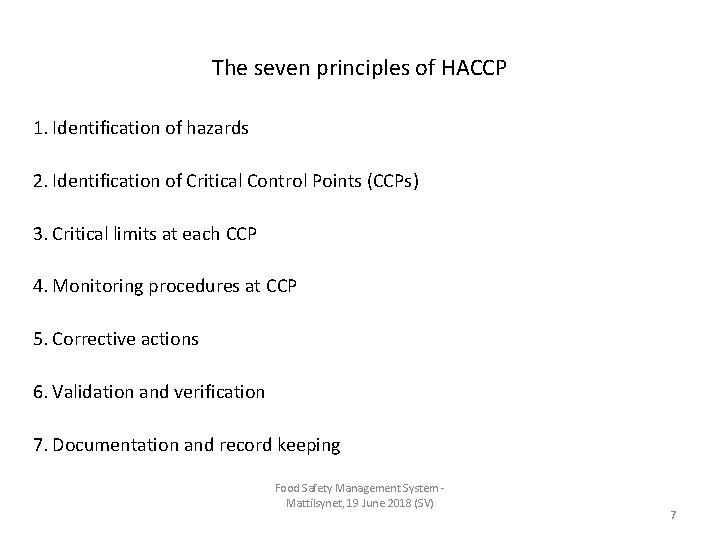
The seven principles of HACCP 1. Identification of hazards 2. Identification of Critical Control Points (CCPs) 3. Critical limits at each CCP 4. Monitoring procedures at CCP 5. Corrective actions 6. Validation and verification 7. Documentation and record keeping Food Safety Management System Mattilsynet, 19 June 2018 (SV) 7
Hazard, hazard analysis and prerequisite Hazard: food safety hazard is any biological, chemical or physical property that may make a food unsafe for human consumption. Hazard Analysis: The process of collecting and evaluating information on hazards and conditions leading to their presence to decide which are significant for food safety, therefore addressed to assess whether a CCP is under control. Prerequisite programs (PRPs): Preventive practices and conditions needed prior to and during the implementation of HACCP. Food Safety Management System Mattilsynet, 19 June 2018 (SV) 8
Link between PRPs and HACCP • A number of PRPs (prerequisites) must always be in place • FBO should identify hazards (HACCP principles 1) and hazard analysis (company specific or generic hazard analysis) that include - Identification of most relevant hazards - What control measures apply? • If all hazards can be controlled by PRPs, no need to further elaborate HACCP. If not, need for CCP and full HACCP • OPRPs are points in the production process with a smaller food safety risk or where no measurable limits exist. OPRPs are between PRPs and CCPs Food Safety Management System Mattilsynet, 19 June 2018 (SV) 9
HACCP – elements Hazard Prerequisite Verification Kommisjonskunngj øring PRP Validation Hazard analysis FSMS Documentation and records Critical Control Point (CCP) o. PRP Corective action Critical limit Monitoring Food Safety Management System Mattilsynet, 19 th June 2018 (SV) 10
HACCP principle 1: Hazard Analysis • Identifying food safety hazards includes both identifying the hazard and considers the necessary measures to control the hazard (control measures) • Clear identification of hazards is central to a successful HACCP. An exact description of the hazard (e. g. metal, Salmonella, nut allergen) and whether it is contaminating, growing or surviving a processing step enables clear controls and critical limits to be determined • When a hazard is not clearly defined it is difficult for FBOs to identify the appropriate control measure and difficult for the competent authority to assess whether food safety is sufficiently controlled Food Safety Management System Mattilsynet, 19 June 2018 (SV) 11
HACCP principles 2: Identification of Critical Control Points (CCPs) • A Critical Control Point (CCP) is a step or procedure in a food process at which a control can be applied with the resulting elimination of a food hazard or reduction to an acceptable level. • The identification of a critical point for the control of a hazard requires a logical approach. • The identification of critical control points means that the FBO should ensure that appropriate control measures are implemented and that the monitoring systems are established for each critical point. 12 Food Safety Management System Mattilsynet, 19 June 2018 (SV)
HACCP principles 3: Critical Limits at each CCP • Critical limits at CCP do not always require a fixed numerical value. Some monitoring procedures rely on a visual observation, for example, the change in physical properties (e. g. colour) of food during processing. • Other parameters include temperature, time, p. H, additive level, etc. In both observation and measurable parameters, the emphasis is on demonstrating that the critical point is under control. Critical limits at CCP can be established on the basis of: ü Experience (best practice) ü International documents (e. g. canning of food, pasteurisation of liquids where Codex Alimentarius standards exist) ü A guide to good practice Food Safety Management System Mattilsynet, 19 June 2018 (SV) 13
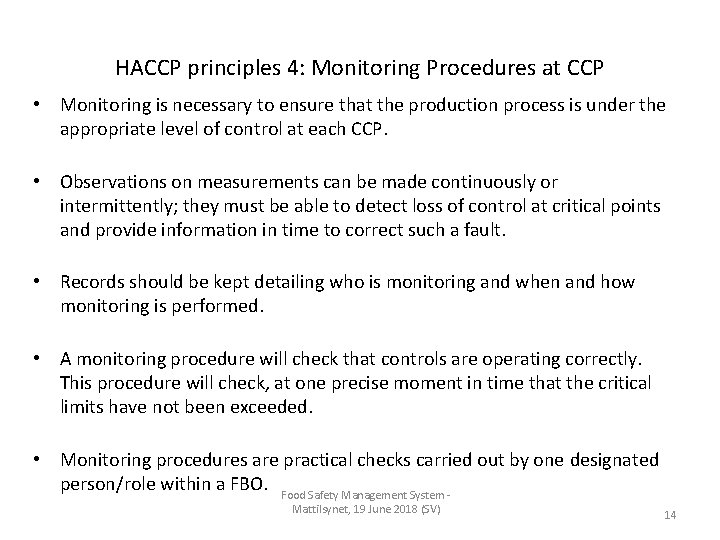
HACCP principles 4: Monitoring Procedures at CCP • Monitoring is necessary to ensure that the production process is under the appropriate level of control at each CCP. • Observations on measurements can be made continuously or intermittently; they must be able to detect loss of control at critical points and provide information in time to correct such a fault. • Records should be kept detailing who is monitoring and when and how monitoring is performed. • A monitoring procedure will check that controls are operating correctly. This procedure will check, at one precise moment in time that the critical limits have not been exceeded. • Monitoring procedures are practical checks carried out by one designated person/role within a FBO. Food Safety Management System Mattilsynet, 19 June 2018 (SV) 14
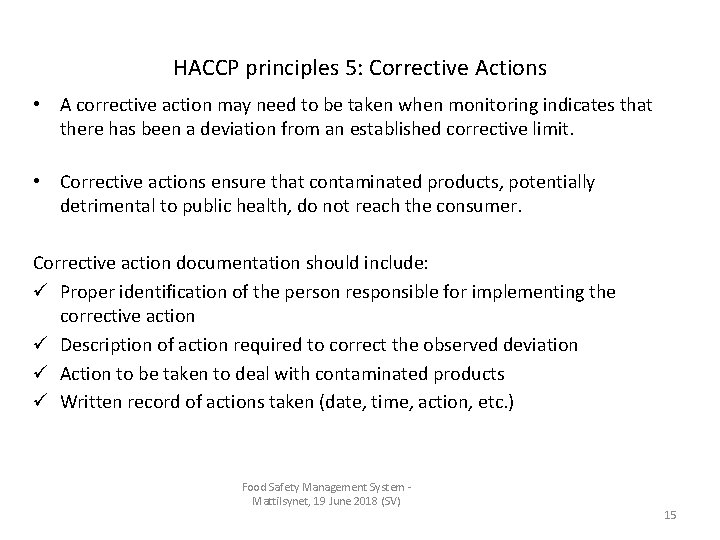
HACCP principles 5: Corrective Actions • A corrective action may need to be taken when monitoring indicates that there has been a deviation from an established corrective limit. • Corrective actions ensure that contaminated products, potentially detrimental to public health, do not reach the consumer. Corrective action documentation should include: ü Proper identification of the person responsible for implementing the corrective action ü Description of action required to correct the observed deviation ü Action to be taken to deal with contaminated products ü Written record of actions taken (date, time, action, etc. ) Food Safety Management System Mattilsynet, 19 June 2018 (SV) 15
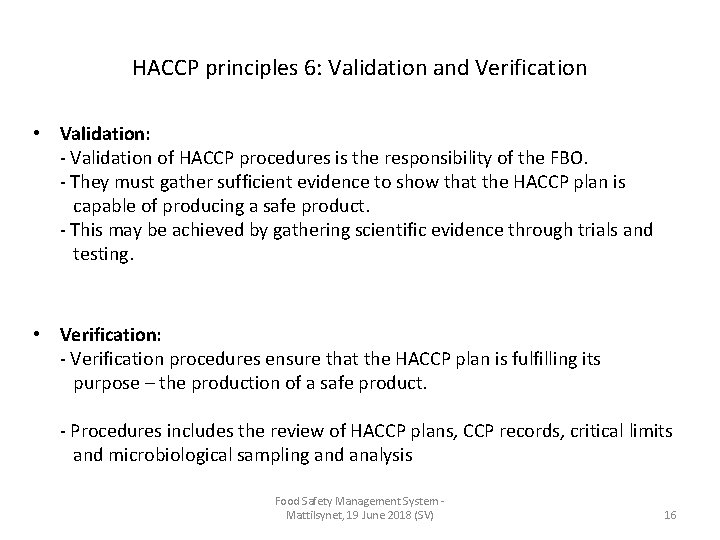
HACCP principles 6: Validation and Verification • Validation: - Validation of HACCP procedures is the responsibility of the FBO. - They must gather sufficient evidence to show that the HACCP plan is capable of producing a safe product. - This may be achieved by gathering scientific evidence through trials and testing. • Verification: - Verification procedures ensure that the HACCP plan is fulfilling its purpose – the production of a safe product. - Procedures includes the review of HACCP plans, CCP records, critical limits and microbiological sampling and analysis Food Safety Management System Mattilsynet, 19 June 2018 (SV) 16
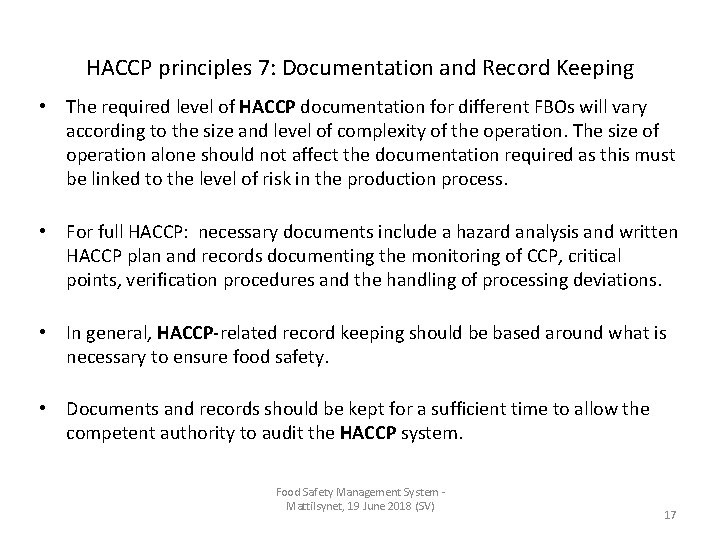
HACCP principles 7: Documentation and Record Keeping • The required level of HACCP documentation for different FBOs will vary according to the size and level of complexity of the operation. The size of operation alone should not affect the documentation required as this must be linked to the level of risk in the production process. • For full HACCP: necessary documents include a hazard analysis and written HACCP plan and records documenting the monitoring of CCP, critical points, verification procedures and the handling of processing deviations. • In general, HACCP-related record keeping should be based around what is necessary to ensure food safety. • Documents and records should be kept for a sufficient time to allow the competent authority to audit the HACCP system. Food Safety Management System Mattilsynet, 19 June 2018 (SV) 17
Inspection and Audit • Traditionally inspections concentrate on the hygiene aspects looking at the production process of the premises, the people and the practices (typically, the prerequisite food hygiene requirements) • An audit covering FSMS-HACCP systems will look at these aspects, but also follow the structured approach and examine the HACCP system • The auditor should examine documentation of the system and assess the practical implementation before any conclusions are drawn • The purposes of a competent authority audit of a HACCP system is to obtain evidence that: ü HACCP principles are effectively applied ü the prerequisites and control measures for CCPs are correctly implemented ü the system has been maintained Food Safety Management System Mattilsynet, 19 June 2018 (SV) 18
Benefits and limitations of a FSMS system Benefits • A Food Safety Management System (FSMS) has a proactive approach to food safety and is internationally recognised • A well maintained system that follows HACCP principles, ensures that a FBO is fulfilling regulations on food safety • FSMS -HACCP-guided systems ensure that FBO staff work consistently as a team, driven by food safety Limitations • HACCP relies upon having effective prerequisite food control in place • Prerequisite food control requires commitment from the FBO to food safety systems in general • FSMS-HACCP systems can be viewed as too difficult to understand, it requires resources for FBOs Management, commitment and disciplined staff are required Food Safety Management System Mattilsynet, 19 June 2018 (SV) 19
HACCP Principles - definitions Control Measures: Any action and activity that can be used to prevent or eliminate a food safety hazard or reduce it to an acceptable level. Corrective Action: Any action to be taken when the results of monitoring at the CCP indicate a loss of control. Critical Control Point (CCP): A step at which control can be applied and is essential to prevent or eliminate a food safety hazard or reduce it to an acceptable level. Critical Limit: A criterion which separates acceptability from unacceptability. Monitoring: The act of conducting a planned sequence of observations or measurements of control parameters to assess whether a CCP is under control. Validation: Obtaining evidence that the elements of the HACCP are effective. Verification: The application of methods; procedures, tests and other evaluations, in addition to monitoring to determine compliance with the HACCP plan. Food Safety Management System Mattilsynet, 19 June 2018 (SV) 20