
Food Safety In the Kitchen By Rudi Hernandez
Food Safety In the Kitchen By: Rudi Hernandez February 4, 2016
Food Safety Concerns • • Foodborne illnesses Handwashing Cross contamination Food temperatures Food leftovers Food storage times Defrosting Refrigerator rules
Foodborne Illness • Illness transmitted to human beings through food and water, caused by either an infectious agent or a poisonous substance; commonly known as food poisoning • According to the Centers for Disease Control and prevention, approximately 76 million Americans report experiencing foodborne illness each year

How to Prevent Foodborne Illness
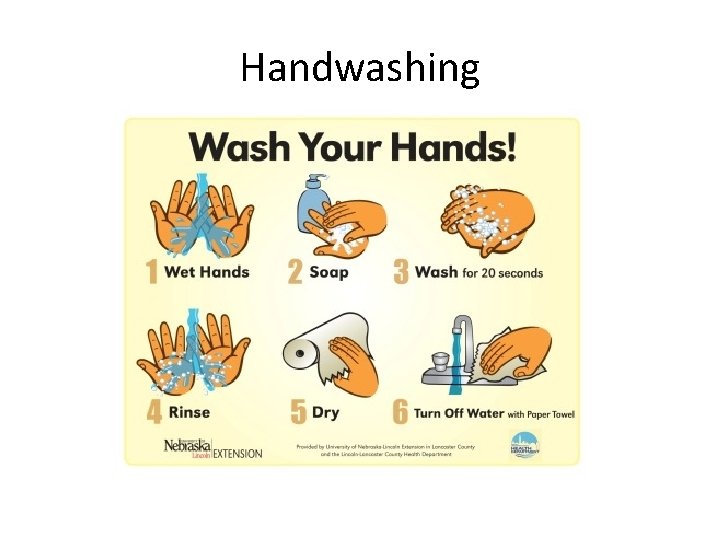
Handwashing
• One of the easiest and most effective ways to prevent foodborne illness is to wash your hands before and after preparing food • Scrub for at least 20 seconds with gentle soap under warm running water - sing “Happy Birthday” or say the ABC’s • Pay special attention to the areas underneath your fingernails and between your fingers
• It’s a good idea to remove rings while cooking because they can harbor bacteria • Always wash your hands after working with raw food and before progressing to the next raw food or clean vegetable • Warm water is key because hot water is too harsh on the skin and will break down the surface layer allowing bacteria to penetrate the skin
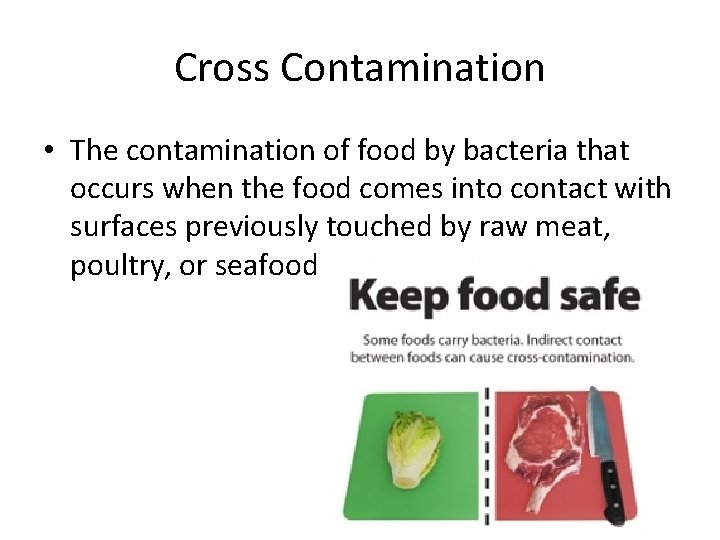
Cross Contamination • The contamination of food by bacteria that occurs when the food comes into contact with surfaces previously touched by raw meat, poultry, or seafood
• Keep raw eggs, meat, poultry, and seafood separate from other foods • Wash all utensils and surfaces ( such as cutting boards, platters, knives, containers) that have been in contact with these foods with hot, soapy water before using them again • Bacteria left on the surfaces from the raw meat can recontaminate the cooked meat or other foods – known as cross contamination
Food Temperatures • Keep hot foods hot - Cook foods long enough to reach internal temperatures that will kill microbes, and maintain adequate temperatures to prevent bacterial growth until the foods are served • Keep cold foods cold - Go directly home upon leaving the grocery store and immediately unpack foods into the refrigerator or freezer upon arrival - After a meal, refrigerate any leftovers immediately
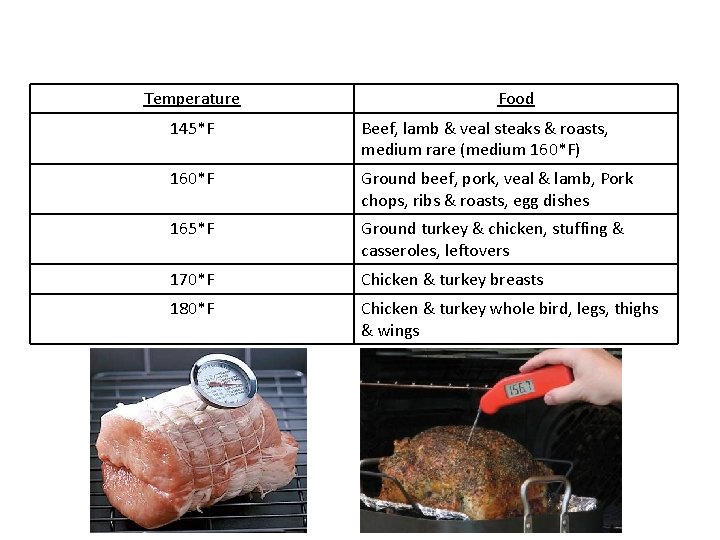
Temperature Food 145*F Beef, lamb & veal steaks & roasts, medium rare (medium 160*F) 160*F Ground beef, pork, veal & lamb, Pork chops, ribs & roasts, egg dishes 165*F Ground turkey & chicken, stuffing & casseroles, leftovers 170*F Chicken & turkey breasts 180*F Chicken & turkey whole bird, legs, thighs & wings
Food Leftovers • The majority of bacteria that cause foodborne illness prefer temperatures between 60 and 130*F • The bacteria grow best in temperatures between 80 and 100*F • Refrigeration and freezing are two of the most reliable methods of diminishing bacteria’s ability to cause illness
• After a meal, leftovers should be promptly refrigerated, EVEN IF STILL HOT, to discourage microbial growth • The standard rule for storing leftovers is: 2 hours/2 inches/4 days - Food should be refrigerated within 2 hours of serving - Food should be stored at a depth of no greater than 2 inches - Leftovers should only be refrigerated for up to 4 days • If you do not plan on using the food within four days, freeze it
• Not all bacteria in cool environments are killed, but the rate at which they reproduce is drastically reduced • Naturally occurring enzymes that cause food decomposition are stopped at freezing temperatures • Refrigeration: storage between 32 and 40*F • Freezing: storage below 32*F
Food (Storage Times) • Safe zone: 34 -40*F
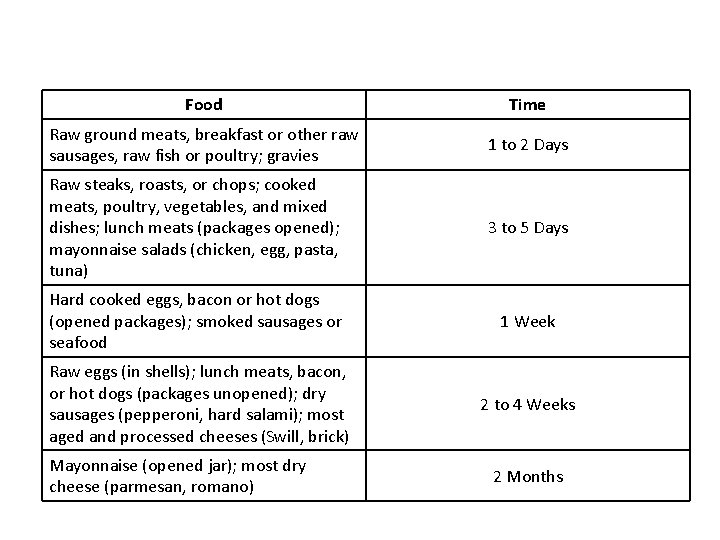
Food Time Raw ground meats, breakfast or other raw sausages, raw fish or poultry; gravies 1 to 2 Days Raw steaks, roasts, or chops; cooked meats, poultry, vegetables, and mixed dishes; lunch meats (packages opened); mayonnaise salads (chicken, egg, pasta, tuna) 3 to 5 Days Hard cooked eggs, bacon or hot dogs (opened packages); smoked sausages or seafood 1 Week Raw eggs (in shells); lunch meats, bacon, or hot dogs (packages unopened); dry sausages (pepperoni, hard salami); most aged and processed cheeses (Swill, brick) 2 to 4 Weeks Mayonnaise (opened jar); most dry cheese (parmesan, romano) 2 Months
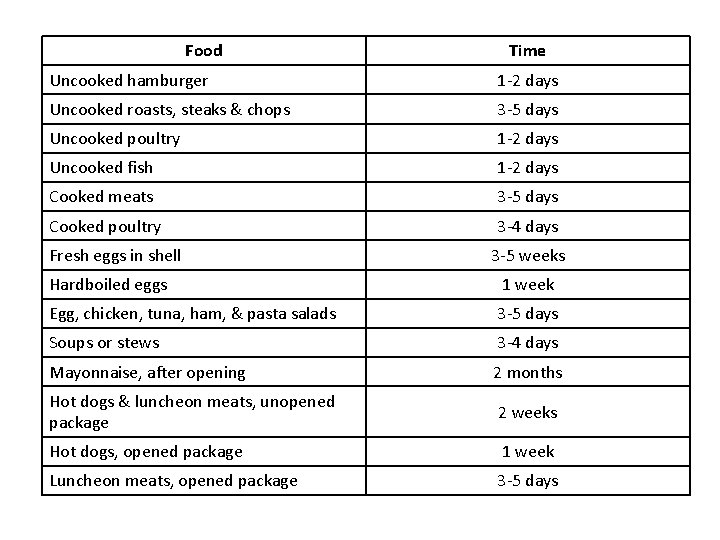
Food Time Uncooked hamburger 1 -2 days Uncooked roasts, steaks & chops 3 -5 days Uncooked poultry 1 -2 days Uncooked fish 1 -2 days Cooked meats 3 -5 days Cooked poultry 3 -4 days Fresh eggs in shell 3 -5 weeks Hardboiled eggs 1 week Egg, chicken, tuna, ham, & pasta salads 3 -5 days Soups or stews 3 -4 days Mayonnaise, after opening 2 months Hot dogs & luncheon meats, unopened package 2 weeks Hot dogs, opened package 1 week Luncheon meats, opened package 3 -5 days
Defrosting • The perfect place to thaw meat, poultry, or seafood, is on the bottom shelf of the refrigerator and in a large bowl to catch any of its juices • Never thaw frozen meat, poultry, or seafood on a kitchen counter or in a basin of warm water - Room temperatures allow growth of bacteria on the surface of food, although the inside may still be frozen
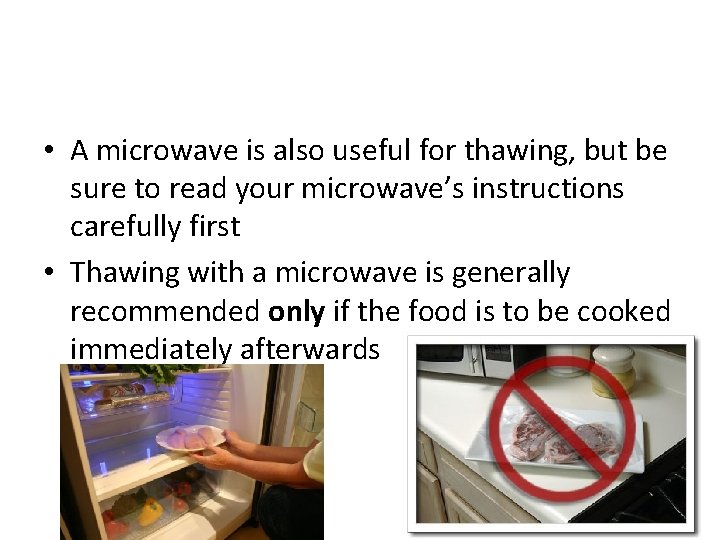
• A microwave is also useful for thawing, but be sure to read your microwave’s instructions carefully first • Thawing with a microwave is generally recommended only if the food is to be cooked immediately afterwards

Refrigerator Rules
• Eggs do best where the temperature is most consistent—on the middle shelf. Store in the original cartons (don’t transfer to the fridge egg container) • Milk should be on the middle, all the way in back, where it’s coldest • Yogurt, sour cream, and cottage cheese fare best in the middle. Keep expiration dates visible • Packaged raw meat should go on the super-cold bottom shelf. And if juices drip, they won’t contaminate the whole fridge.
• Vegetables stay fresh longer with a bit of humidity. The drawer labeled vegetables or high humidity is the moistest spot in the fridge. • Fruit belongs in the crisper. Leave vegetables and fruits unwashed until you use them. Water can promote mold and cause bacteria to grow • Deli meats belong in the shallow meat drawer, which is slightly colder than the rest of the fridge, or (if there’s no such drawer) on the bottom shelf.
• Butter and soft cheeses don’t need to be super cold, so they can live in the dairy compartment on the door (the warmest part of the fridge). Place them in an air tight container after opening • Condiments like ketchup, mayonnaise, and salad dressing are fine on the door. Same goes for pickles and jarred salsa. Nut oils, like sesame and walnut oils, belong in the refrigerator on the door • Orange juice can be stored on the door, as long as it’s pasteurized. Fresh-squeezed should be stored on the bottom shelf.
References • Google Images • Sforza, N. (Date unknown). How to organize your refrigerator drawers and shelves. Retrieved from http: //www. realsimple. com/homeorganizing/organizingkitchen/refrigerator-drawers • Thomas, J. & Manore, M. Nutrition: An Applied Approach. Benjamin Cummings. San Francisco: 2006 • Whitney, E. & Rolfes, S. Understanding Nutrition. Thomas Wadsworth. Belmont, CA: 2005
- Slides: 24