
Food Safety for the General Public Heidi Jones
Food Safety for the General Public Heidi Jones, Ph. D Student Walden University PUBH 8165 -3 Instructor: Dr. Lezah Brown-Ellington January 2013
Learning outcomes • Build awareness of potential food-borne illness • Identify 3 main causes of food-borne illness • Identify signs and symptoms of food-borne illness • Understand prevention methods
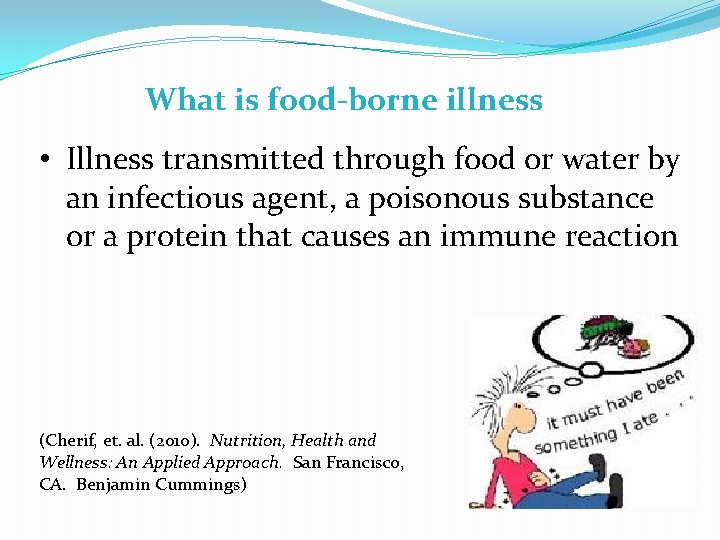
What is food-borne illness • Illness transmitted through food or water by an infectious agent, a poisonous substance or a protein that causes an immune reaction (Cherif, et. al. (2010). Nutrition, Health and Wellness: An Applied Approach. San Francisco, CA. Benjamin Cummings)
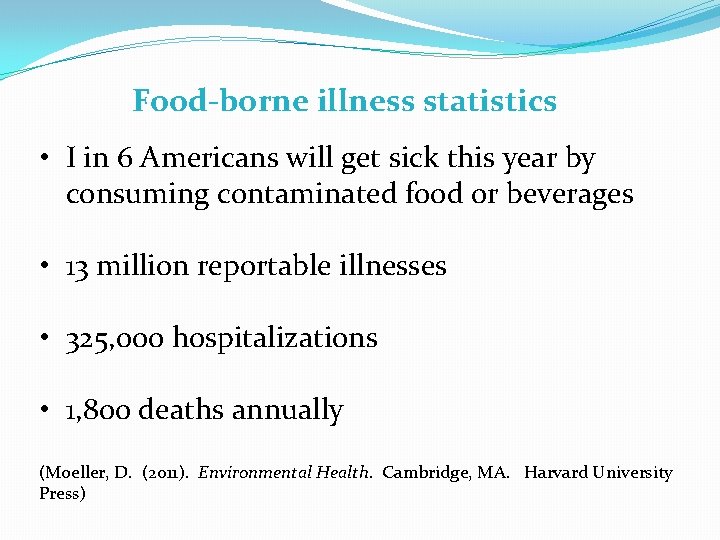
Food-borne illness statistics • I in 6 Americans will get sick this year by consuming contaminated food or beverages • 13 million reportable illnesses • 325, 000 hospitalizations • 1, 800 deaths annually (Moeller, D. (2011). Environmental Health. Cambridge, MA. Harvard University Press)
Primary cause of food-borne illness 1. Food that is improperly handled and subsequently consumed raw or insufficiently cooked 2. Food that is contaminated with animal feces and subsequently consumed raw or insufficiently cooked 3. Failure of food handlers to wash their hands after using the restroom (Cherif, et. al. , (2010). Nutrition, Health and Wellness: An Applied Approach. San Francisco, CA. Benjamin Cummings)
3 common causes of food-borne illness 1. Campylobacter jejuni 2. Salmonella 3. Escherichia coli (E coli)
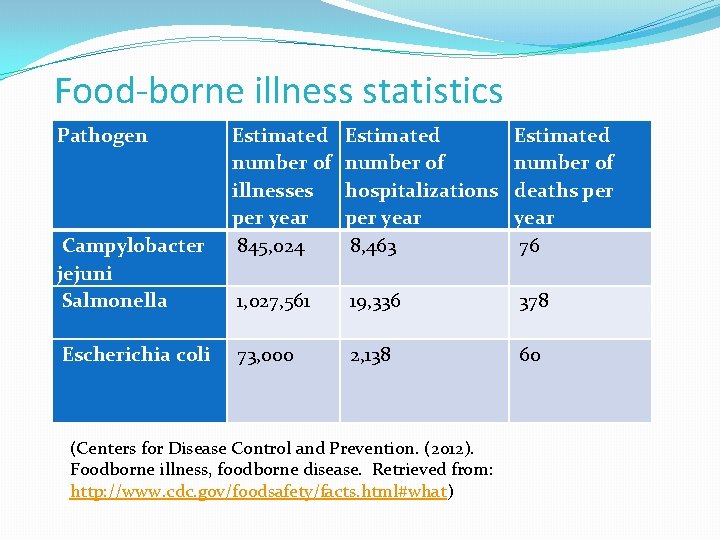
Food-borne illness statistics Pathogen Campylobacter jejuni Salmonella Escherichia coli Estimated number of illnesses per year 845, 024 Estimated number of hospitalizations per year 8, 463 Estimated number of deaths per year 76 1, 027, 561 19, 336 378 73, 000 2, 138 60 (Centers for Disease Control and Prevention. (2012). Foodborne illness, foodborne disease. Retrieved from: http: //www. cdc. gov/foodsafety/facts. html#what)
Government agencies that regulate food safety • • USDA: Oversees safety of meat, poultry and eggs CDC: Works with public health officials to promote and educate people about health and safety. Able to track information needed in identifying food-borne illness outbreaks EPA: Regulates use of pesticides and which crops they can be applied to. Establishes standards for water quality FDA: Regulates food standards of food products and bottled water. Regulates food labeling (Cherif, et. al. (2010). Nutrition, Health and Wellness: An Applied Approach. San Francisco, CA. Benjamin Cummings)
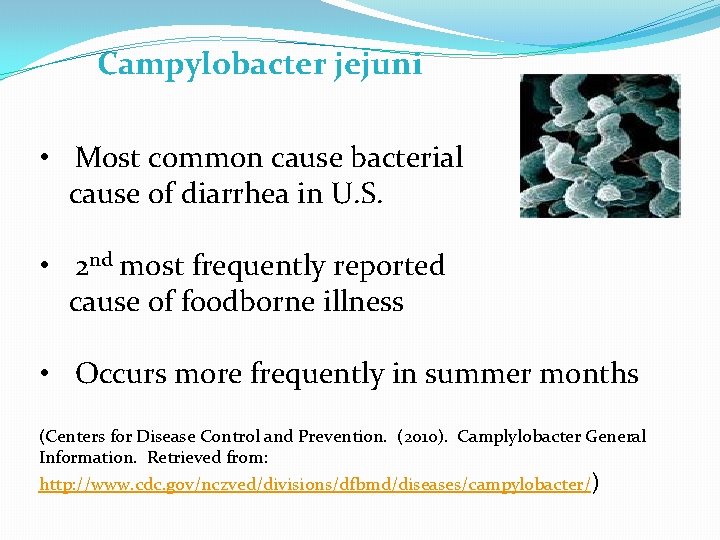
Campylobacter jejuni • Most common cause bacterial cause of diarrhea in U. S. • 2 nd most frequently reported cause of foodborne illness • Occurs more frequently in summer months (Centers for Disease Control and Prevention. (2010). Camplylobacter General Information. Retrieved from: http: //www. cdc. gov/nczved/divisions/dfbmd/diseases/campylobacter/)
Campylobacter jejuni • Incubation period: 1 -7 days • Duration: 7 -10 days • Symptoms: Fever, diarrhea, nausea, cramping • Foods most commonly affected: raw or undercooked meat, raw eggs (Cherif, et. al. , (2010). Nutrition, Health and Wellness: An Applied Approach. San Francisco, CA. Benjamin Cummings)
Campylobacter jejuni • Diagnosed: Culture from stool sample • Tx: Drink extra fluids, medications if indicated • Steps for prevention: Cook foods properly, avoid cross-contamination, proper hand washing (Cherif, et. al. , (2010). Nutrition, Health and Wellness: An Applied Approach. San Francisco, CA. Benjamin Cummings)
Groups at highest risk • Children • Elderly • Individuals with immunocompromised systems (Centers for Disease Control and Prevention. (2012). Salmonella. Retrieved from: http: //www. cdc. gov/salmonella/general/index. html)
Recent Campylobacter Outbreaks Ø 2008 campylobacter outbreak linked to unpasteurized milk • 16 cases • 1 states • 0 deaths • 8 hospitalizations (About Campylobacter. (2013). Alexandre Eco. Dairy Farms Raw Milk Campylobacter Outbreak. Retrieved from: http: //www. aboutcampylobacter. com/campylobacter_outbreaks/view/alexandre-ecodairy-farms-rawmilk-campylobacter-outbreak/)

What are public health agencies doing for campylobacter jejuni? • CDC: Through Food. Net, monitors the incidence and trends of campylobacter infections over time and conducts surveillance • UDSA: Conducts research on how to prevent infection in chickens • FDA: Produced Model Food Code for restaurants (Centers for Disease Control and Prevention. (2010). Camplylobacter General Information. Retrieved from: http: //www. cdc. gov/nczved/divisions/dfbmd/diseases/campylobacter/)
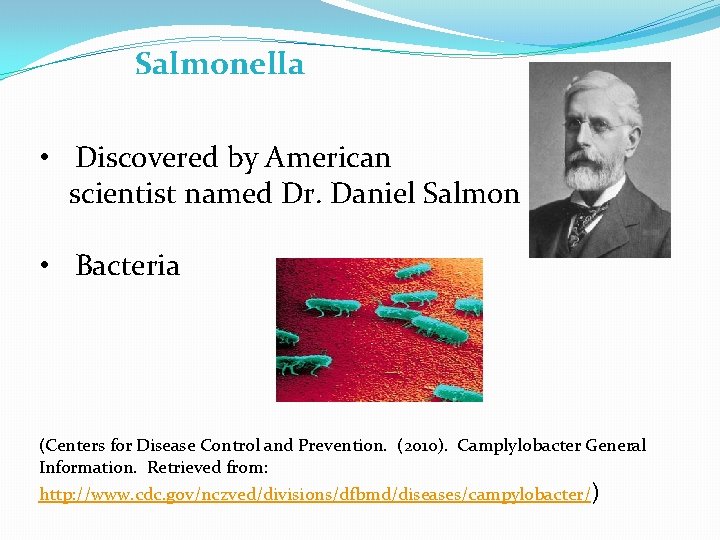
Salmonella • Discovered by American scientist named Dr. Daniel Salmon • Bacteria (Centers for Disease Control and Prevention. (2010). Camplylobacter General Information. Retrieved from: http: //www. cdc. gov/nczved/divisions/dfbmd/diseases/campylobacter/)
Salmonella • Incubation period: 12 -24 hours • Duration: 4 -7 days • Symptoms: Diarrhea, chills, fever, vomiting • Foods most commonly affected: Raw or undercooked eggs, undercooked poultry and meat, seafood, fruits and veggies (Cherif, et. al. , (2010). Nutrition, Health and Wellness: An Applied Approach. San Francisco, CA. Benjamin Cummings)
Salmonella • Diagnosed: Culture from stool sample • Tx: Drink extra fluids, in severe cases: IV fluids, antibiotics • Steps for prevention: Cook foods properly, avoid cross-contamination (Centers for Disease Control and Prevention. (2012). Salmonella. Retrieved from: http: //www. cdc. gov/salmonella/general/index. html)
Groups at highest risk • Children • Elderly • Individuals with immunocompromised systems (Centers for Disease Control and Prevention. (2012). Salmonella. Retrieved from:
Recent Salmonella Outbreaks Ø • • • 2012 Salmonella outbreak linked to Peanut Butter 42 cases 20 states 0 deaths 20 hospitalizations Recall Ø • • • 2012 Salmonella outbreak linked to cantaloupes 261 cases 24 states 3 deaths 94 hospitalizations Recall (Centers for Disease Control and Prevention. (2012). Salmonella Outbreaks. Retrieved from: http: //www. cdc. gov/salmonella/typhimurium-cantaloupe-0812/index. html)
What are public health agencies doing for salmonella? • CDC: Monitors frequency of salmonella infections in U. S. • FDA: Inspects imported foods, promotes better food preparation techniques • USDA: Monitors health of food animals, inspects egg pasteurization plants, regulates quality of slaughtered and processed meats (Centers for Disease Control and Prevention. 2010. Salmonella Additional Information. Retrieved from: http: //www. cdc. gov/salmonella/general/additional. html)
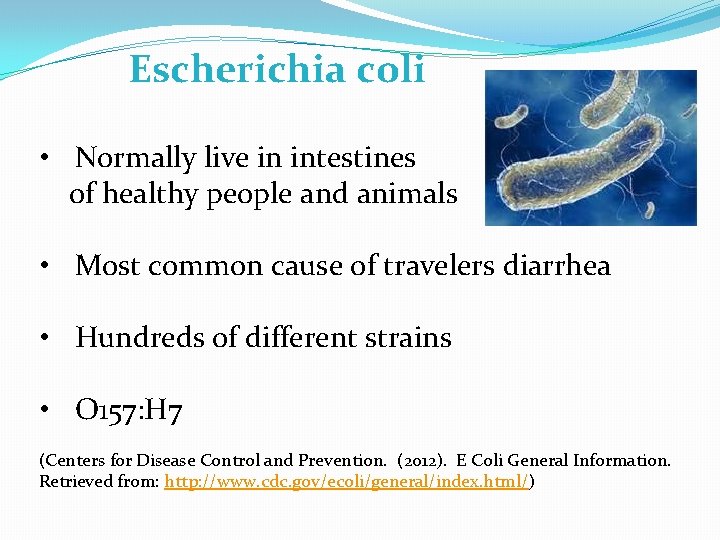
Escherichia coli • Normally live in intestines of healthy people and animals • Most common cause of travelers diarrhea • Hundreds of different strains • O 157: H 7 (Centers for Disease Control and Prevention. (2012). E Coli General Information. Retrieved from: http: //www. cdc. gov/ecoli/general/index. html/)
Escherichia coli • Incubation period: 2 -4 days • Duration: 5 -10 days • Symptoms: Diarrhea, abdominal cramps, nausea • Foods most commonly affected: Contaminated water, raw milk, rare ground beef, uncooked fruits and veggies (Cherif, et. al. , (2010). Nutrition, Health and Wellness: An Applied Approach. San Francisco, CA. Benjamin Cummings)
Escherichia coli • Diagnosed: Culture from stool samples • Treatment: Drink fluids • Steps for prevention: Thoroughly cook meat, avoid cross-contamination, wash hands thoroughly (Moeller, D. (2011). Environmental Health. Cambridge, MA. Harvard University Press)
Groups at highest risk • Children • Elderly • Individuals with immunocompromised systems (Mayo Clinic. (2011). E coli Risk factors. Retrieved from: http: //www. mayoclinic. com/health/e-coli/DS 01006/DSECTION=risk-factors)
Recent E coli Outbreaks Ø • • • 2012 E coli outbreak linked to Organic spinach 33 cases 5 states 0 deaths 13 hospitalizations Recall Ø 2012 E coli outbreak linked raw clover sprouts at Jimmy John’s • 29 cases • 11 states • 0 deaths • 7 hospitalizations (Centers for Disease Control and Prevention. (2012). Salmonella Outbreaks. Retrieved from: http: //www. cdc. gov/salmonella/typhimurium-cantaloupe-08 -12/index. html)
What are public health agencies doing for E coli? • CDC: Monitors frequency of e coli infections in U. S. • FDA: Inspects imported foods, promotes better food preparation techniques • UDSA: Monitors health of food animals, inspects egg pasteurization plants, regulates quality of slaughtered and processed meats • EPA: Regulates and monitors safety of drinking water (Centers for Disease Control and Prevention. 2010. Salmonella Additional Information. Retrieved from: http: //www. cdc. gov/salmonella/general/additional. html)
10 Rules for safe food preparation and consumption at home 1. Choose food processed for safety 2. Cook food thoroughly 3. Eat cooked food immediately 4. Reheat cooked food thoroughly 5. Store cooked foods immediately (Moeller, D. (2011). Environmental Health. Cambridge, MA. Harvard University Press)
10 Rules for safe food preparation and consumption at home 6. Avoid contact between raw & cooked foods 7. Wash hands repeatedly 8. Keep all kitchen surfaces clean 9. Protect foods from insects, rodents, etc. 10. Use clean water (Moeller, D. (2011). Environmental Health. Cambridge, MA. Harvard University Press)
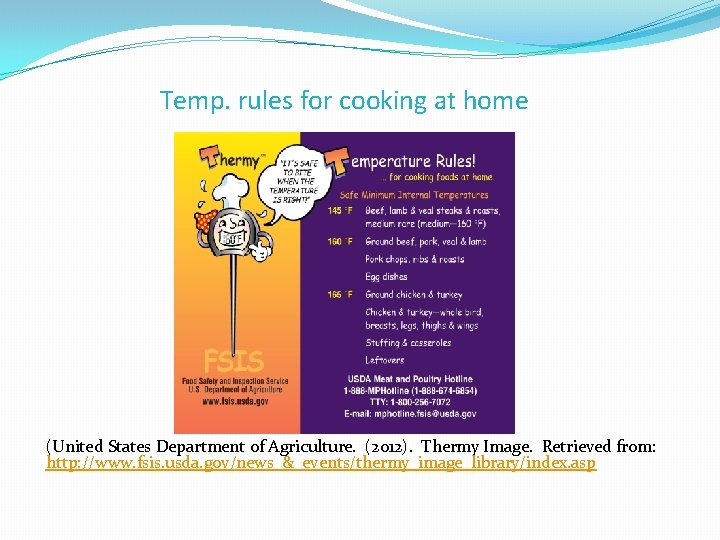
Temp. rules for cooking at home (United States Department of Agriculture. (2012). Thermy Image. Retrieved from: http: //www. fsis. usda. gov/news_&_events/thermy_image_library/index. asp
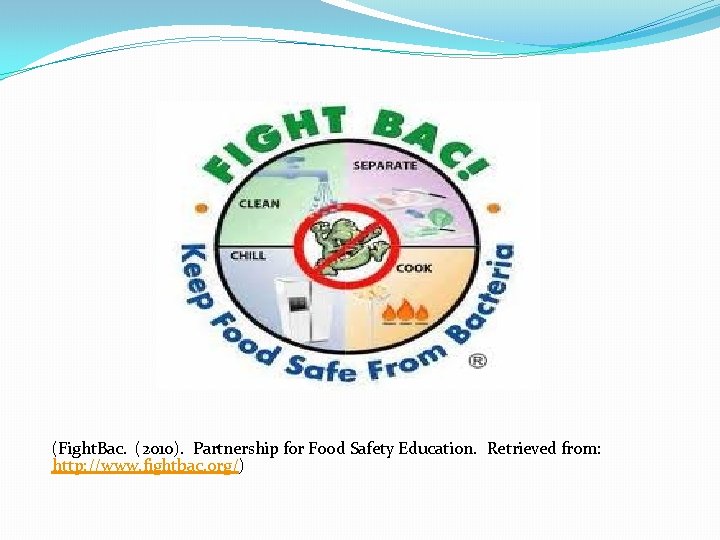
Prevention methods (Fight. Bac. (2010). Partnership for Food Safety Education. Retrieved from: http: //www. fightbac. org/)
Prevention tip video from FDA Click on the link below or right click and select “open hyperlink” to view video http: //www. fda. gov/For. Consumers/Consumer. Updates /ucm 204328. htm (Food and Drug Administration. (2012). Start at the Store: Prevent Foodborne Illness. Retrieved from: http: //www. fda. gov/For. Consumers/Consumer. Updates/ucm 204328. htm)
Tummy Trouble Quiz Click on the link below or right click and select “open hyperlink” to view video http: //www. medicinenet. com/tummy_trouble_quiz/q uiz. htm (Medicinenet. com. (2013). Tummy Trouble Quiz: Test your IQ of Digestive Diseases. Retrieved from: http: //www. medicinenet. com/tummy_trouble_quiz/quiz. htm)
In the event of a suspected foodborne illness 1. Preserve the evidence 2. Seek treatment as necessary 3. Call the local health department 4. Call the USDA Hotline (United States Department of Agriculture. (2011). Foodborne Illness and Disease. Retrieved from: http: //www. fsis. usda. gov/Fact_Sheets/Foodborne_Illness_What_Consumers_Need _to_Know/index. asp)
Additional information • CDC: www. cdc. gov • Food. Net: www. cdc. gov/foodnet • USDA Food Inspection & Safety Service: www. fsis. usda. gov • FDA: www. fda. gov • Your local health department
Conclusion �Conclusion of presentation �Any questions?
References Ø About Campylobacter. (2013). Alexandre Eco. Dairy Farms Raw Milk Campylobacter Outbreak. Retrieved from: http: //www. aboutcampylobacter. com/campylobacter_outbreaks/view/alexandreecodairy-farms-raw-milk-campylobacter-outbreak/) Ø Centers for Disease Control and Prevention. (2010). Camplylobacter General Information. Retrieved from: http: //www. cdc. gov/nczved/divisions/dfbmd/diseases/campylobacter / Ø Centers for Disease Control and Prevention. (2012). E Coli General Information. Retrieved from: http: //www. cdc. gov/ecoli/general/index. html/) Ø Centers for Disease Control and Prevention. (2012). Foodborne illness, foodborne disease. Retrieved from: http: //www. cdc. gov/foodsafety/facts. html#what
References Ø Centers for Disease Control and Prevention. (2012). Salmonella. Retrieved from: http: //www. cdc. gov/salmonella/general/index. html Ø Centers for Disease Control and Prevention. 2010. Salmonella Additional Information. Retrieved from: http: //www. cdc. gov/salmonella/general/additional. html Ø Centers for Disease Control and Prevention. (2012). Salmonella Outbreaks. Retrieved from: http: //www. cdc. gov/salmonella/typhimurium-cantaloupe-08Ø Cherif, et. al. (2010). Nutrition, Health and Wellness: An Applied Approach. San Francisco, CA. Benjamin Cummings)
References Ø Fight. Bac. (2010). Partnership for Food Safety Education. Retrieved from: http: //www. fightbac. org/) Ø Food and Drug Administration. (2012). Start at the Store: Prevent Foodborne Illness. Retrieved from: http: //www. fda. gov/For. Consumers/Consumer. Updates/ucm 204328. htm Ø Mayo Clinic. (2011). E coli Risk factors. Retrieved from: http: //www. mayoclinic. com/health/e-coli/DS 01006/DSECTION=riskfactors Ø Medicinenet. com. (2013). Tummy Trouble Quiz: Test your IQ of Digestive Diseases. Retrieved from: http: //www. medicinenet. com/tummy_trouble_quiz/quiz. htm
References Ø Moeller, D. (2011). Environmental Health. Cambridge, MA. Harvard University Press Ø United States Department of Agriculture. (2011). Foodborne Illness and Disease. Retrieved from: http: //www. fsis. usda. gov/Fact_Sheets/Foodborne_Illness_What _Consumers_Need_to_Know/index. asp Ø United States Department of Agriculture. (2012). Thermy Image. Retrieved from: http: //www. fsis. usda. gov/news_&_events/thermy_image_library /index. asp
- Slides: 39