
FOOD PRODUCT INNOVATION AND DEVELOPMENT CONCEPTS L 3
- Slides: 17
FOOD PRODUCT INNOVATION AND DEVELOPMENT CONCEPTS L 3
Learning objectives • What product development or innovation is • Purpose of developing new products • Basic development, formulation or design models
What is product development • Develop or design original or new products • Modify, better or improve existing products • Additions to existing products • Cost reductions – In order to satisfy the needs of consumers
Why develop new products? – How do you know when you need new products? • • • slow growth or no growth (to improve sale) consumer demand for change tight competition market change (to lower prices) higher-than-normal turnover in sales force fewer inquiries from prospective customers some competitors leave the market laboratory detection problem engineering technology production improvement packaging improvement
• Development of new food products involve all levels of a food company. – consumer relations – marketing – laboratory – engineering – production – packaging – transport – distribution
• Product development – series of stages • research associated with the design brief • development and production • launch and promotion • Evaluation occurs after each stage – to decide whether the project should continue • Stages may vary depending on whether the design brief came from within the company or as a result of consumer demand.
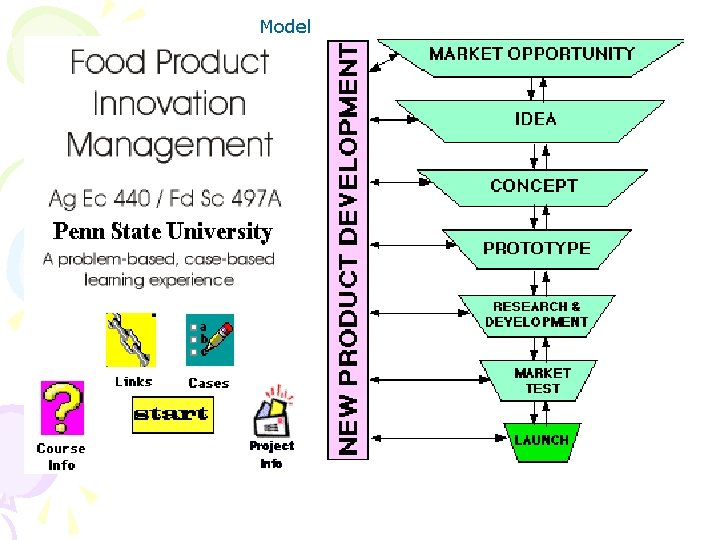
Model
Problem-based • Problem in the South Pacific/Fiji – High incidence and prevalence of chronic nutritionally-related diseases • Obesity, diabetes, cardiovascular diseases, cancer
Market opportunity • Developing products targeting people: – who are suffering from such chronic diseases – high risk population – Avoidance and prevention
Idea • Product that would help improve the condition • Eliminate the condition
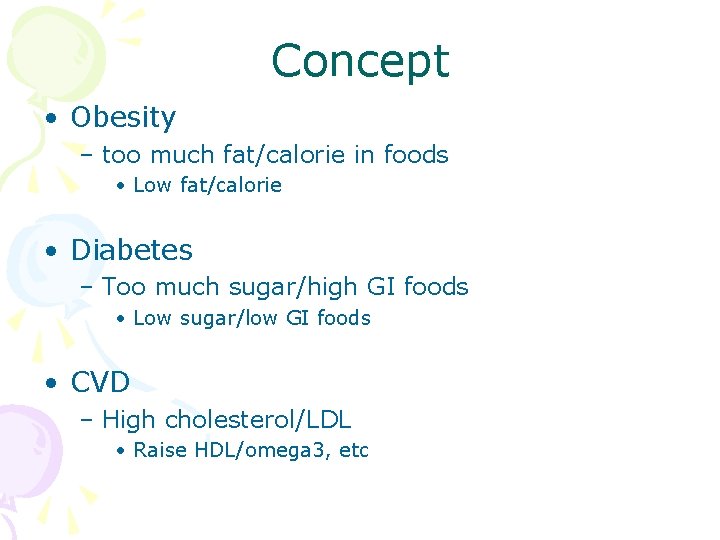
Concept • Obesity – too much fat/calorie in foods • Low fat/calorie • Diabetes – Too much sugar/high GI foods • Low sugar/low GI foods • CVD – High cholesterol/LDL • Raise HDL/omega 3, etc
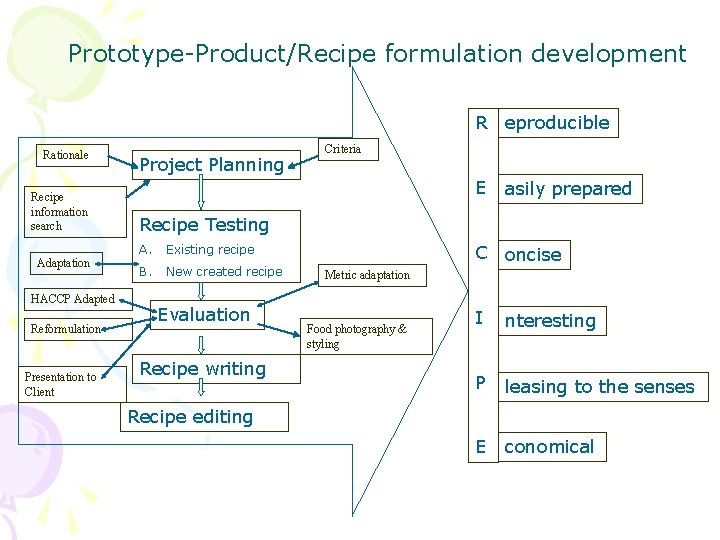
Prototype-Product/Recipe formulation development R eproducible Rationale Recipe information search Adaptation HACCP Adapted Reformulation Presentation to Client Project Planning Criteria E asily prepared Recipe Testing A. Existing recipe B. New created recipe Evaluation Recipe writing C oncise Metric adaptation Food photography & styling I nteresting P leasing to the senses E conomical Recipe editing
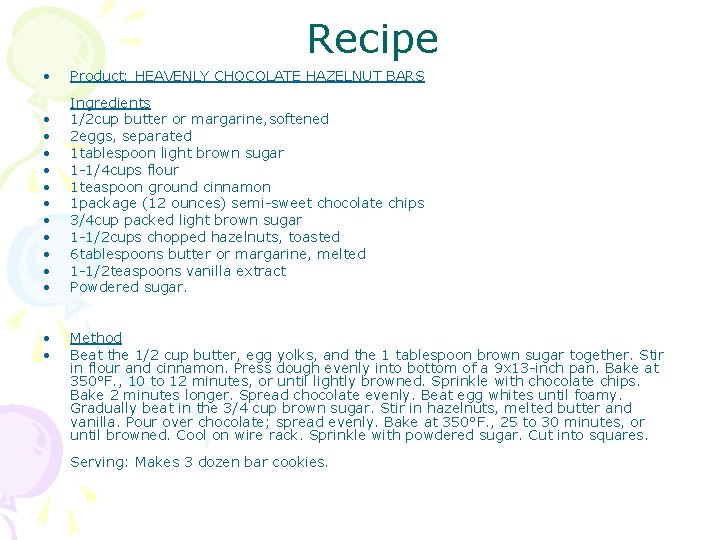
Recipe • Product: HEAVENLY CHOCOLATE HAZELNUT BARS • • • Ingredients 1/2 cup butter or margarine, softened 2 eggs, separated 1 tablespoon light brown sugar 1 -1/4 cups flour 1 teaspoon ground cinnamon 1 package (12 ounces) semi-sweet chocolate chips 3/4 cup packed light brown sugar 1 -1/2 cups chopped hazelnuts, toasted 6 tablespoons butter or margarine, melted 1 -1/2 teaspoons vanilla extract Powdered sugar. • • Method Beat the 1/2 cup butter, egg yolks, and the 1 tablespoon brown sugar together. Stir in flour and cinnamon. Press dough evenly into bottom of a 9 x 13 -inch pan. Bake at 350°F. , 10 to 12 minutes, or until lightly browned. Sprinkle with chocolate chips. Bake 2 minutes longer. Spread chocolate evenly. Beat egg whites until foamy. Gradually beat in the 3/4 cup brown sugar. Stir in hazelnuts, melted butter and vanilla. Pour over chocolate; spread evenly. Bake at 350°F. , 25 to 30 minutes, or until browned. Cool on wire rack. Sprinkle with powdered sugar. Cut into squares. Serving: Makes 3 dozen bar cookies.
Research and Development • Several sensory evaluation and further recipe improvement until appropriate sensory data is achieved
Market Test • First batch of new food product is market tested for consumer acceptance – Evaluate people buying, how much, how often, etc – Free sampling in supermarkets • Awareness
Launch • Celebration of hope of success for the new product
Conclusion • Product development requires appropriate skills and knowledge to be successful in the market place