
Food Preparation and Nutrition GCSE Revision 2019 Name
- Slides: 50
Food Preparation and Nutrition GCSE Revision 2019 Name: Target Grade: Examination (1 ¾ hours) Section A Section B Multiple choice Five questions each questions (20 with a number of sub marks) questions (80 marks)
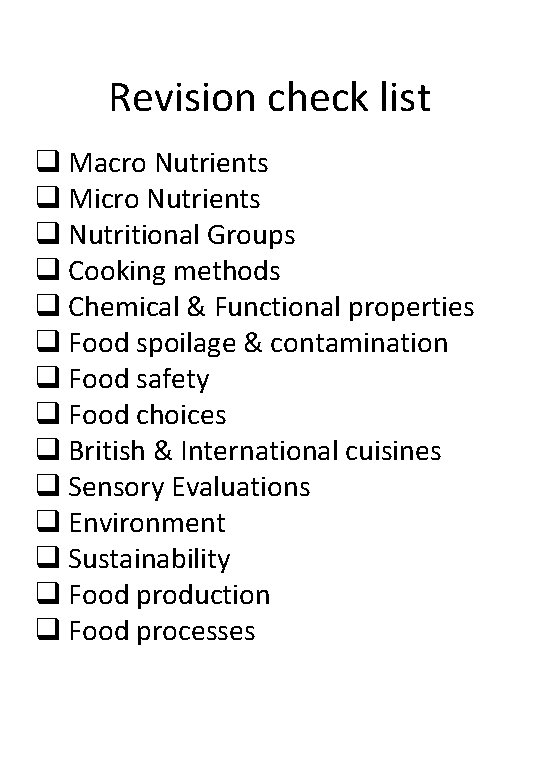
Revision check list q Macro Nutrients q Micro Nutrients q Nutritional Groups q Cooking methods q Chemical & Functional properties q Food spoilage & contamination q Food safety q Food choices q British & International cuisines q Sensory Evaluations q Environment q Sustainability q Food production q Food processes
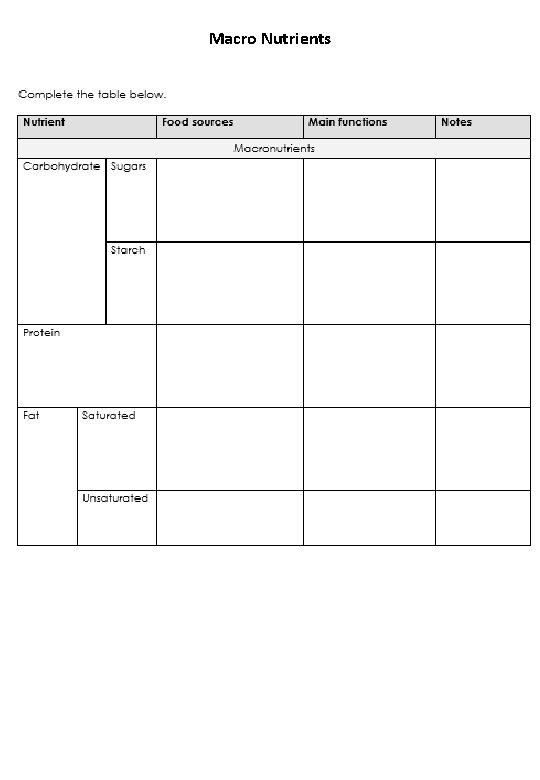
Macro Nutrients
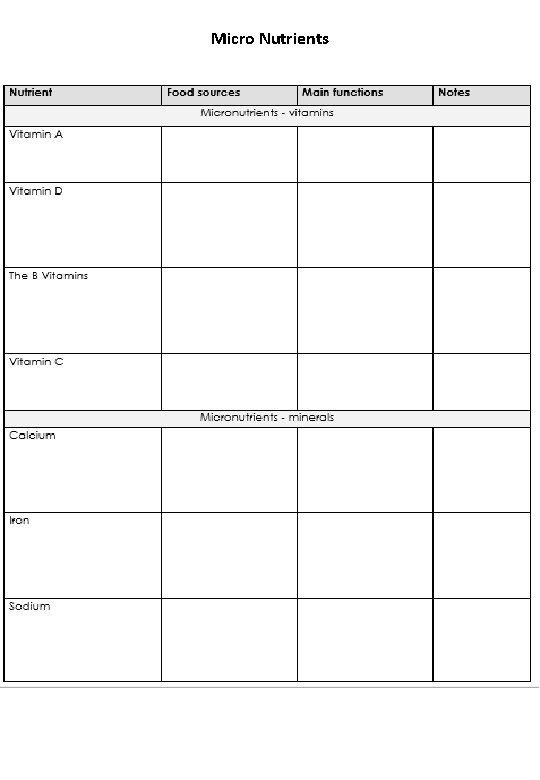
Micro Nutrients
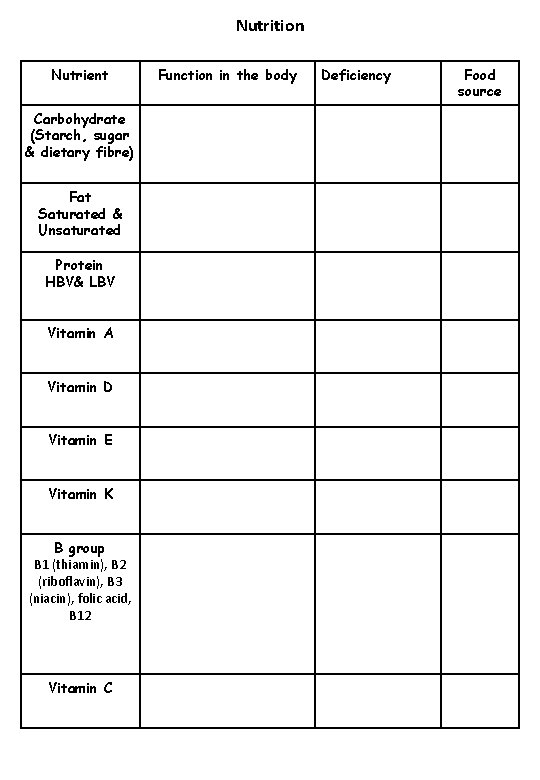
Nutrition Nutrient Carbohydrate (Starch, sugar & dietary fibre) Fat Saturated & Unsaturated Protein HBV& LBV Vitamin A Vitamin D Vitamin E Vitamin K B group B 1 (thiamin), B 2 (riboflavin), B 3 (niacin), folic acid, B 12 Vitamin C Function in the body Deficiency Food source
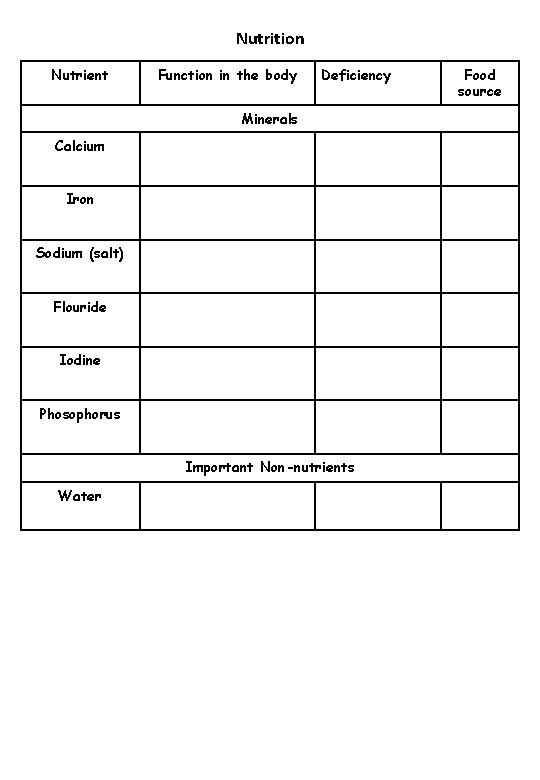
Nutrition Nutrient Function in the body Deficiency Minerals Calcium Iron Sodium (salt) Flouride Iodine Phosophorus Important Non-nutrients Water Food source
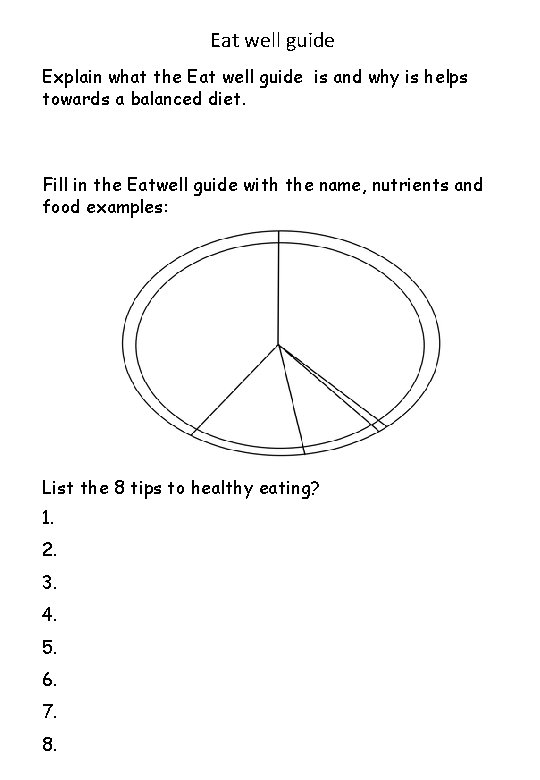
Eat well guide Explain what the Eat well guide is and why is helps towards a balanced diet. Fill in the Eatwell guide with the name, nutrients and food examples: List the 8 tips to healthy eating? 1. 2. 3. 4. 5. 6. 7. 8.
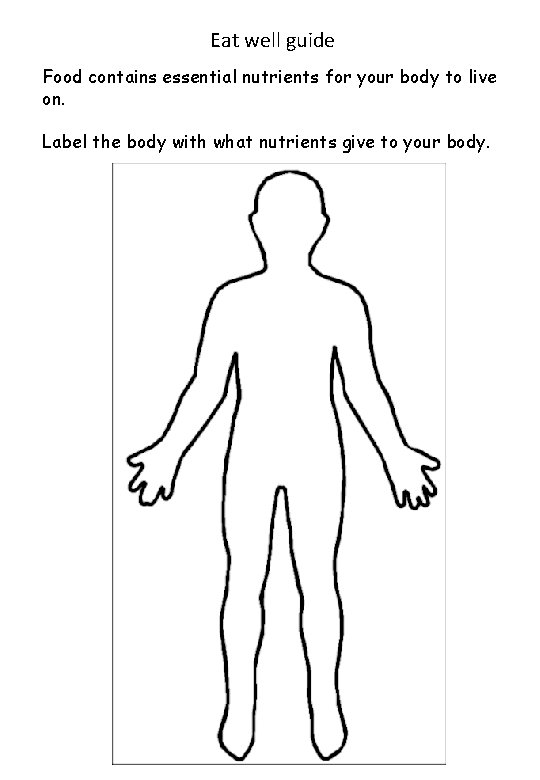
Eat well guide Food contains essential nutrients for your body to live on. Label the body with what nutrients give to your body.
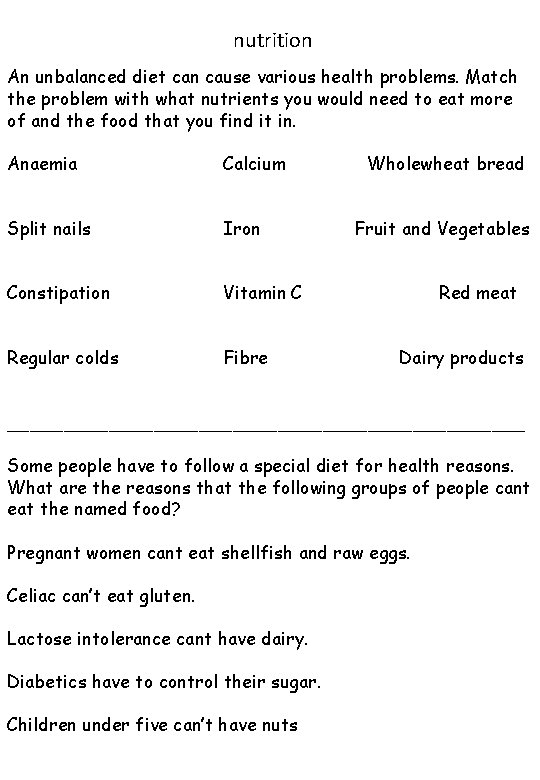
nutrition An unbalanced diet can cause various health problems. Match the problem with what nutrients you would need to eat more of and the food that you find it in. Anaemia Calcium Split nails Iron Constipation Vitamin C Regular colds Fibre Wholewheat bread Fruit and Vegetables Red meat Dairy products _______________________ Some people have to follow a special diet for health reasons. What are the reasons that the following groups of people cant eat the named food? Pregnant women cant eat shellfish and raw eggs. Celiac can’t eat gluten. Lactose intolerance cant have dairy. Diabetics have to control their sugar. Children under five can’t have nuts
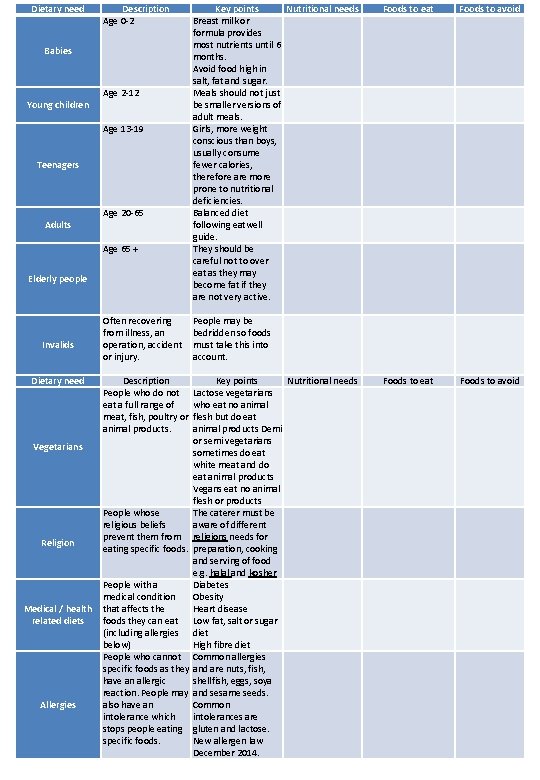
Dietary need Description Age 0 -2 Babies Young children Age 2 -12 Age 13 -19 Teenagers Adults Age 20 -65 Age 65 + Elderly people Invalids Dietary need Vegetarians Religion Medical / health related diets Allergies Often recovering from illness, an operation, accident or injury. Description People who do not eat a full range of meat, fish, poultry or animal products. Key points Nutritional needs Breast milk or formula provides most nutrients until 6 months. Avoid food high in salt, fat and sugar. Meals should not just be smaller versions of adult meals. Girls, more weight conscious than boys, usually consume fewer calories, therefore are more prone to nutritional deficiencies. Balanced diet following eatwell guide. They should be careful not to over eat as they may become fat if they are not very active. Foods to eat Foods to avoid People may be bedridden so foods must take this into account. Key points Nutritional needs Lactose vegetarians who eat no animal flesh but do eat animal products Demi or semi vegetarians sometimes do eat white meat and do eat animal products Vegans eat no animal flesh or products People whose The caterer must be religious beliefs aware of different prevent them from religions needs for eating specific foods. preparation, cooking and serving of food e. g. halal and kosher People with a Diabetes medical condition Obesity that affects the Heart disease foods they can eat Low fat, salt or sugar (including allergies diet below) High fibre diet People who cannot Common allergies specific foods as they and are nuts, fish, have an allergic shellfish, eggs, soya reaction. People may and sesame seeds. also have an Common intolerance which intolerances are stops people eating gluten and lactose. specific foods. New allergen law December 2014.
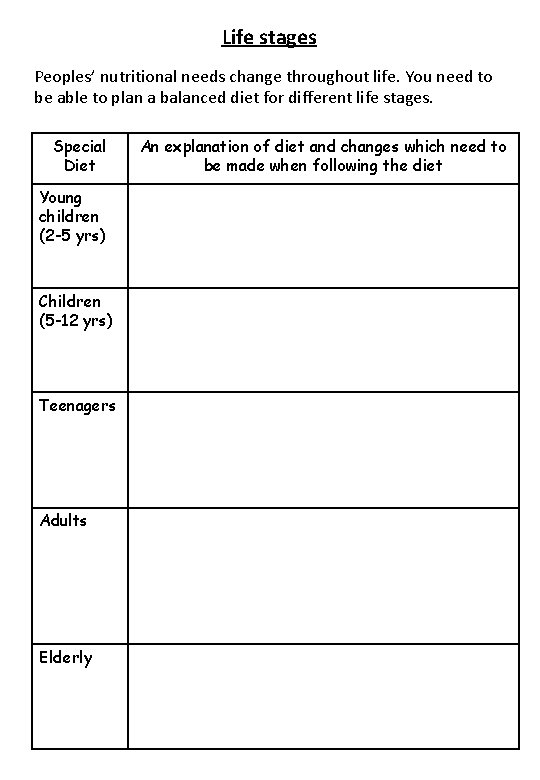
Life stages Peoples’ nutritional needs change throughout life. You need to be able to plan a balanced diet for different life stages. Special Diet Young children (2 -5 yrs) Children (5 -12 yrs) Teenagers Adults Elderly An explanation of diet and changes which need to be made when following the diet
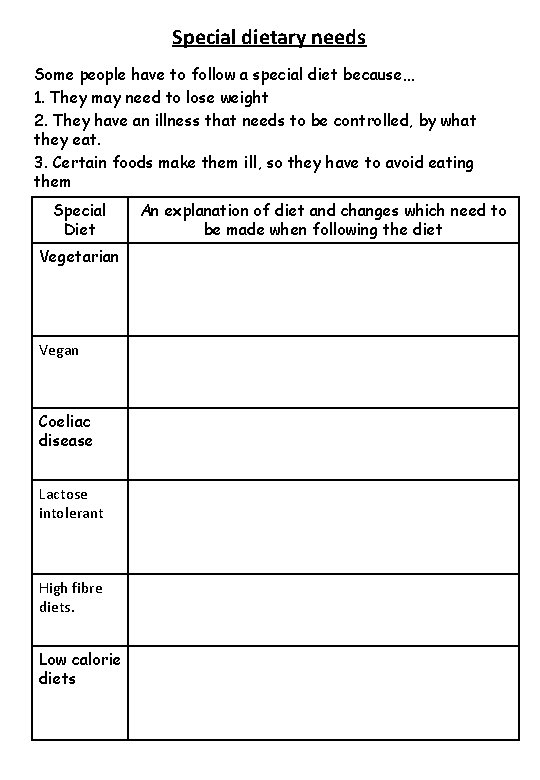
Special dietary needs Some people have to follow a special diet because… 1. They may need to lose weight 2. They have an illness that needs to be controlled, by what they eat. 3. Certain foods make them ill, so they have to avoid eating them Special Diet Vegetarian Vegan Coeliac disease Lactose intolerant High fibre diets. Low calorie diets An explanation of diet and changes which need to be made when following the diet
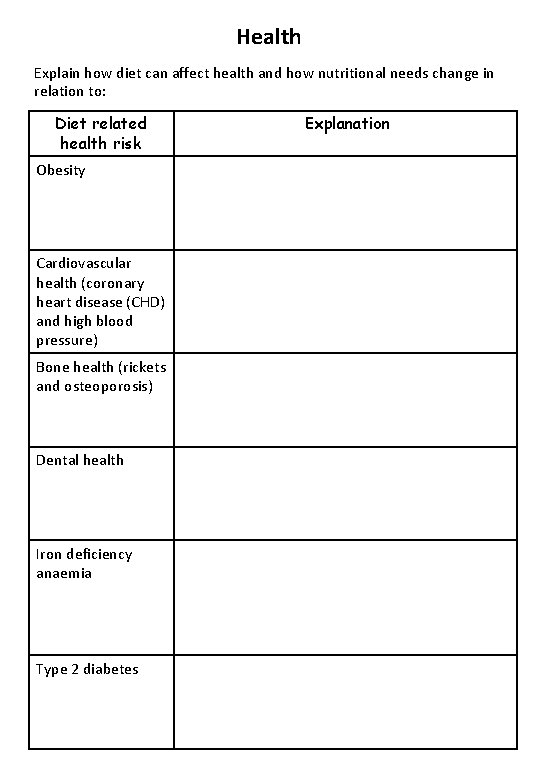
Health Explain how diet can affect health and how nutritional needs change in relation to: Diet related health risk Obesity Cardiovascular health (coronary heart disease (CHD) and high blood pressure) Bone health (rickets and osteoporosis) Dental health Iron deficiency anaemia Type 2 diabetes Explanation
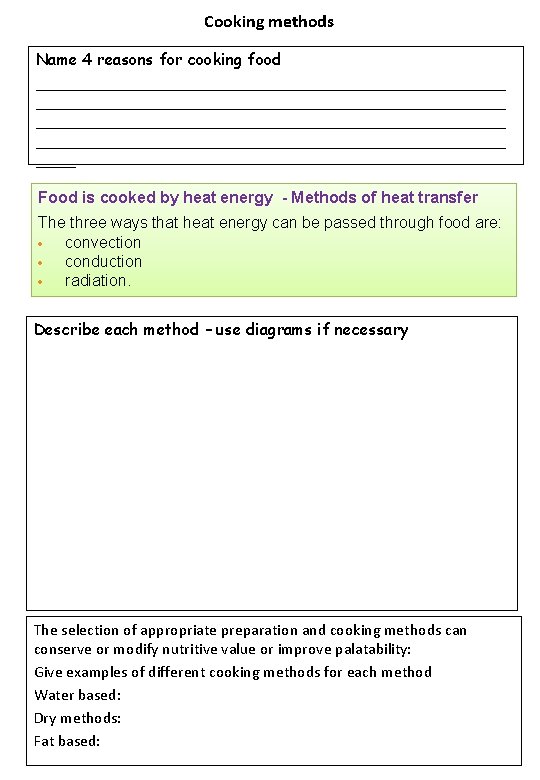
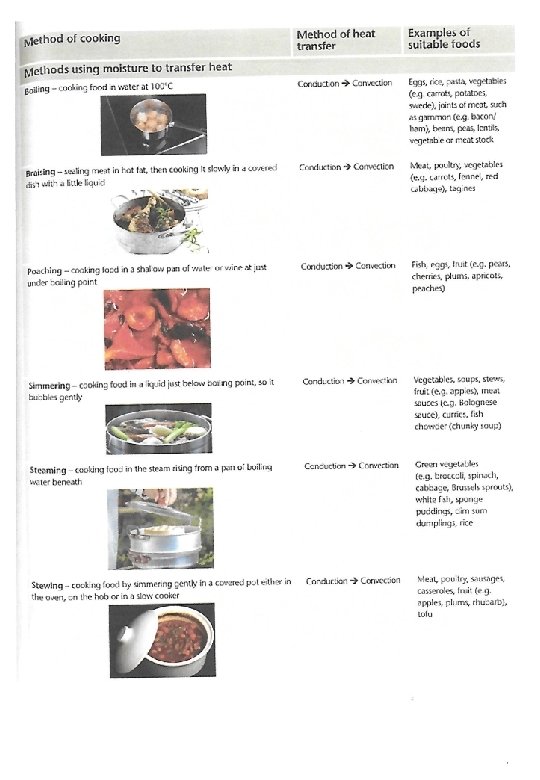
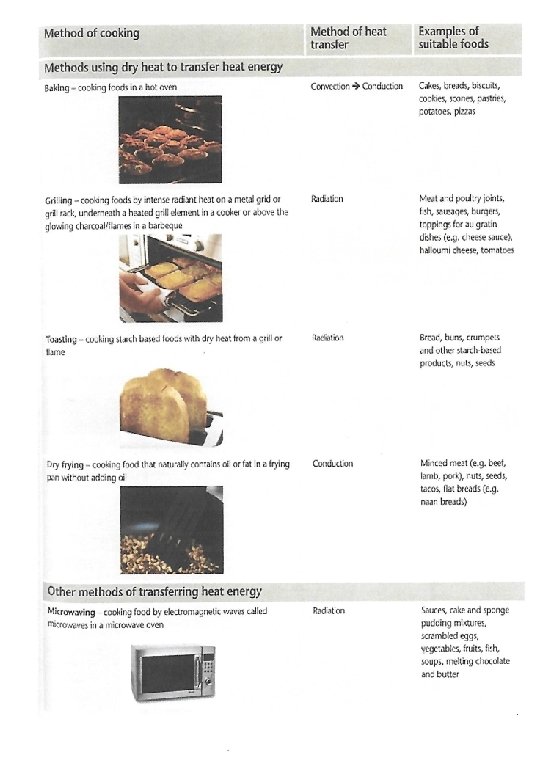
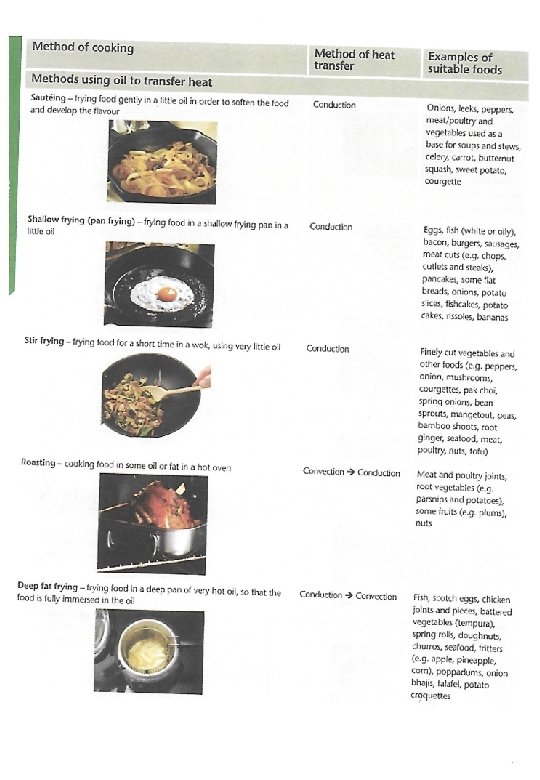
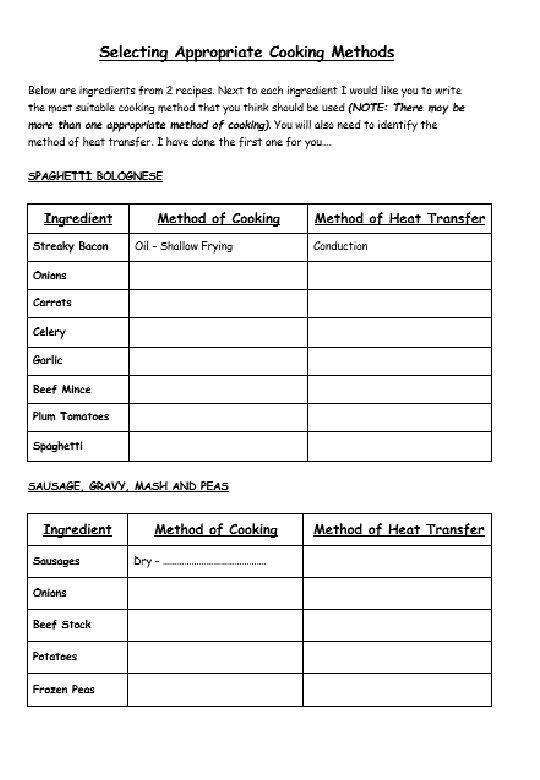
Cooking methods Name 4 reasons for cooking food _______________________________________________ ____ Food is cooked by heat energy - Methods of heat transfer The three ways that heat energy can be passed through food are: convection conduction radiation. Describe each method – use diagrams if necessary The selection of appropriate preparation and cooking methods can conserve or modify nutritive value or improve palatability: Give examples of different cooking methods for each method Water based: Dry methods: Fat based:
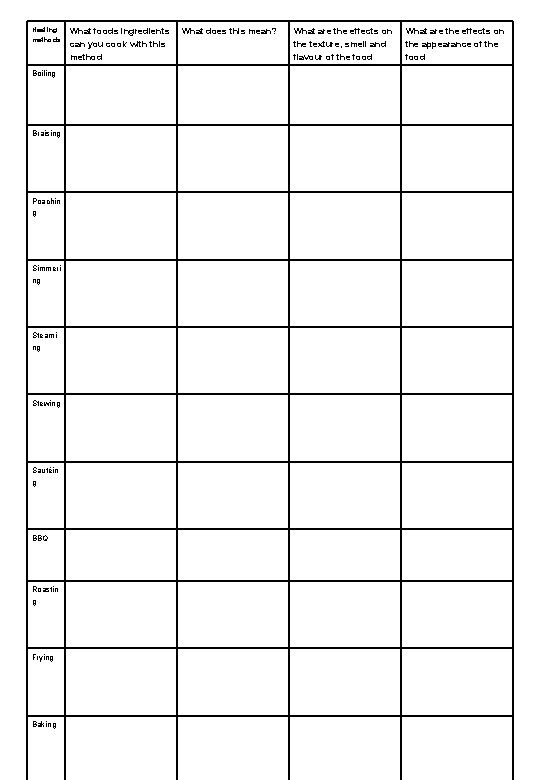
Heating methods Boiling Braising Poachin g Simmeri ng Steami ng Stewing Sautéin g BBQ Roastin g Frying Baking What foods ingredients can you cook with this method What does this mean? What are the effects on the texture, smell and flavour of the food What are the effects on the appearance of the food
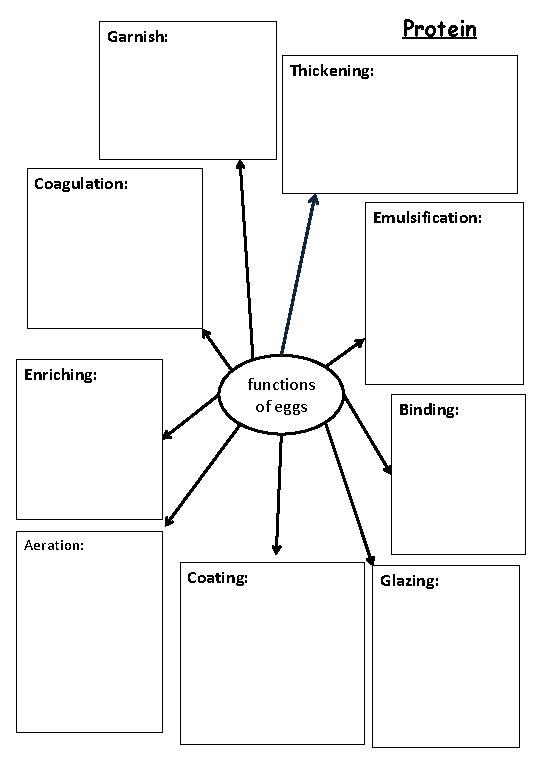
Protein Garnish: Thickening: Coagulation: Emulsification: Enriching: functions of eggs Binding: Aeration: Coating: Glazing:
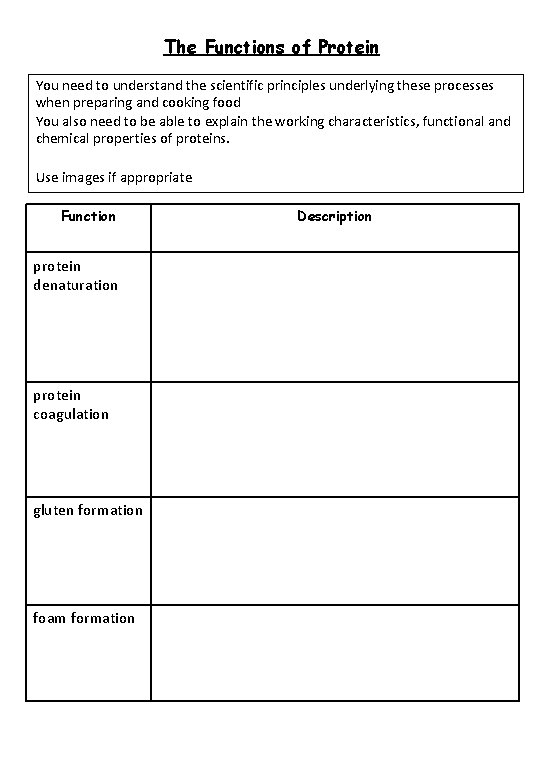
The Functions of Protein You need to understand the scientific principles underlying these processes when preparing and cooking food You also need to be able to explain the working characteristics, functional and chemical properties of proteins. Use images if appropriate Function protein denaturation protein coagulation gluten formation foam formation Description
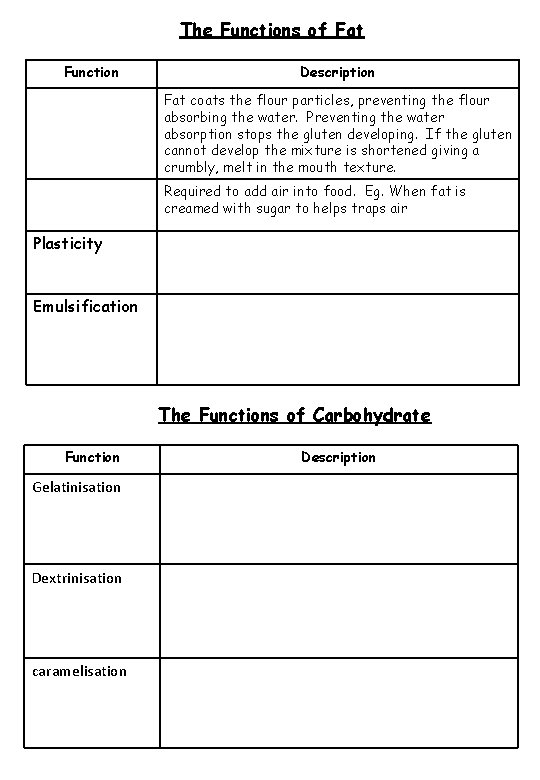
The Functions of Fat Function Description Fat coats the flour particles, preventing the flour absorbing the water. Preventing the water absorption stops the gluten developing. If the gluten cannot develop the mixture is shortened giving a crumbly, melt in the mouth texture. Required to add air into food. Eg. When fat is creamed with sugar to helps traps air Plasticity Emulsification The Functions of Carbohydrate Function Gelatinisation Dextrinisation caramelisation Description
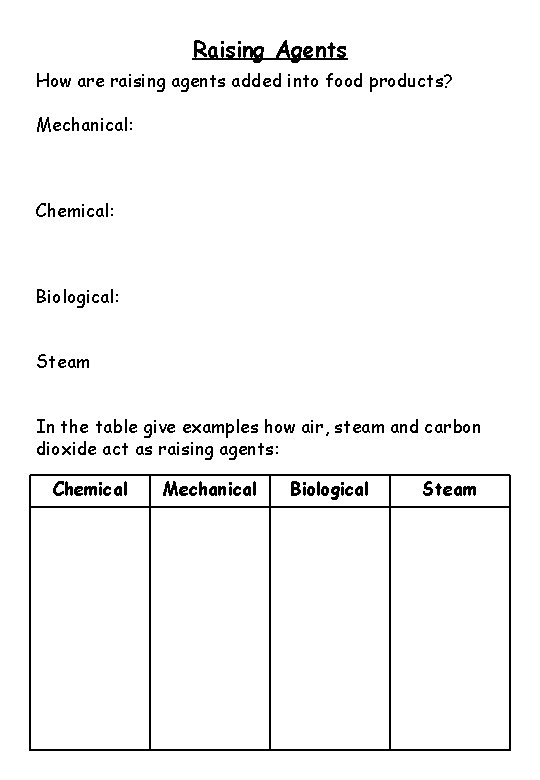
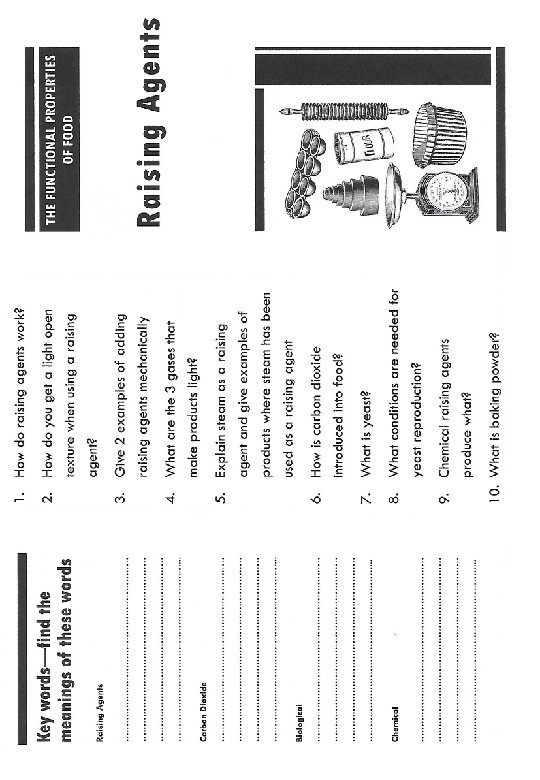
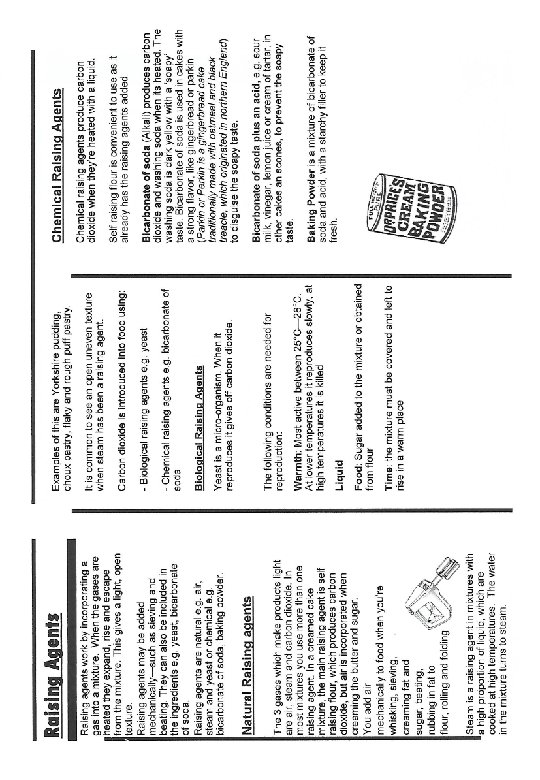
Raising Agents How are raising agents added into food products? Mechanical: Chemical: Biological: Steam In the table give examples how air, steam and carbon dioxide act as raising agents: Chemical Mechanical Biological Steam
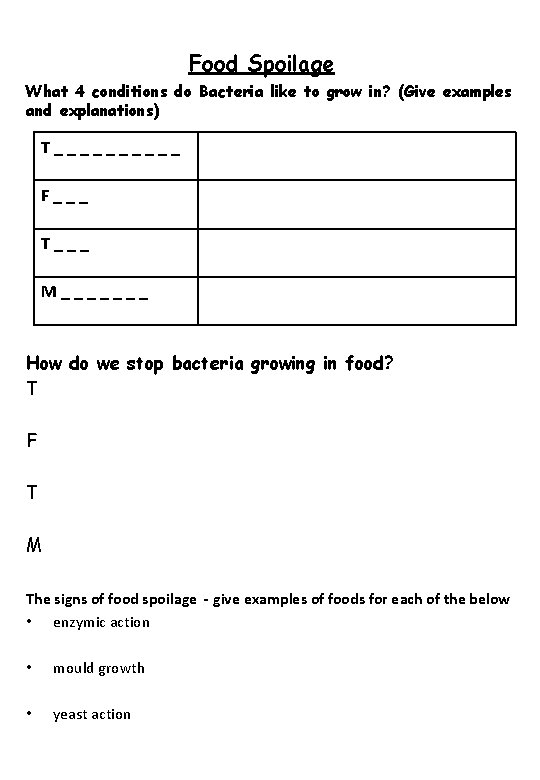
Food Spoilage What 4 conditions do Bacteria like to grow in? (Give examples and explanations) T_____ F___ T___ M_______ How do we stop bacteria growing in food? T F T M The signs of food spoilage - give examples of foods for each of the below • enzymic action • mould growth • yeast action
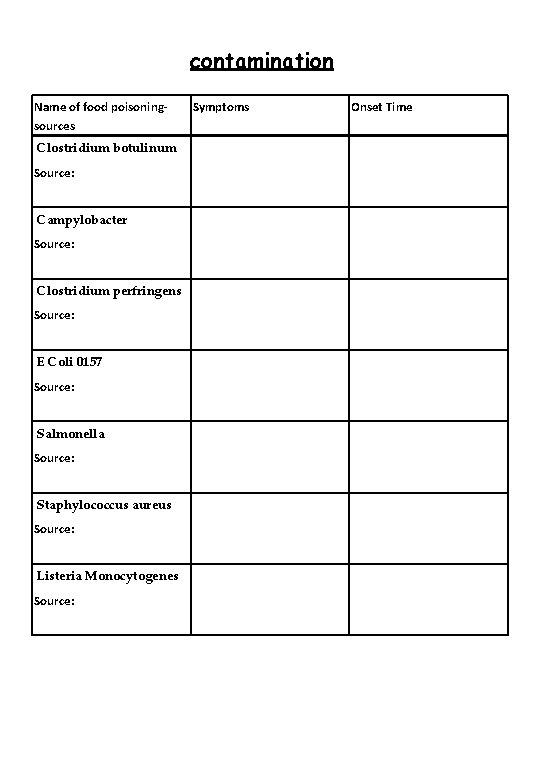
contamination Name of food poisoningsources Clostridium botulinum Source: Campylobacter Source: Clostridium perfringens Source: E Coli 0157 Source: Salmonella Source: Staphylococcus aureus Source: Listeria Monocytogenes Source: Symptoms Onset Time
What would you look for when buying products to determine if the food is safe to eat and fresh. Fresh fish ________________________________________ Fresh meat________________________________________ Fresh vegetables______________________________________ Fresh fruit________________________________________ Packaged food _______________________________________
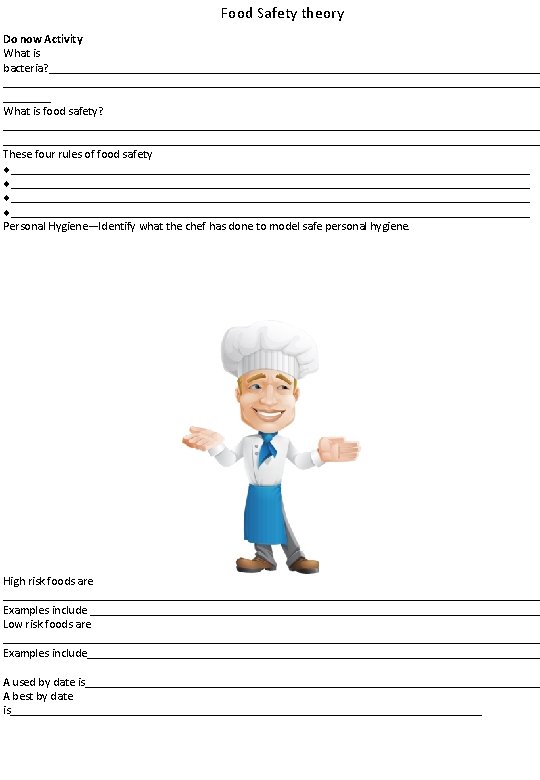
Food Hygiene How does food poisoning happen? Define what Pathogenic bacteria is. What are the 4 most common types of food poisoning and which foods carry them? 1. S 2. St 3. C 4. E. C 5. L What is a high risk food? Temperature -18 C 0 -5 C 5 -63 C 37 C 72 C What is happening to bacteria?
Food Storage Temperature of Freezer : When food is frozen bacteria…… Temperature of Fridge: When food is chilled bacteria…. What 4 essential rules need to be followed when reheating food? 1………………………………………………… 2…………………………………………………. . 3…………………………………………………. . 4…………………………………………………. How do you use a temperature food probe? Step 1: Step 2: Step 3: Step 4: What is meant by the term Ambient?
Food handling & Personal Hygiene List 7 things food handlers have to do to make sure their hygienic and safe in the kitchen. 1 2 3 4 5 6 7 Explain what cross-contamination is and when it could occur…. Red chopping board is for…………………… Green chopping board is for…………………. Yellow chopping board is for…………………. Blue chopping board is for…………………… White chopping board is for…………………. .
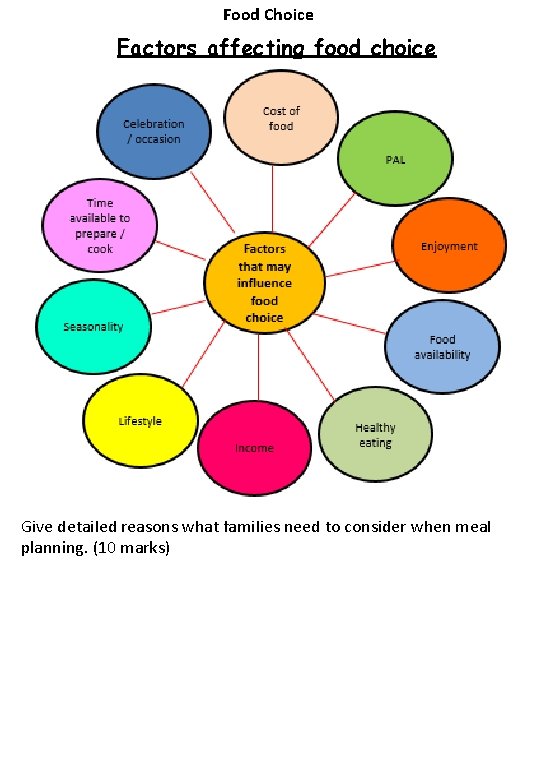
Food Choice Factors affecting food choice Give detailed reasons what families need to consider when meal planning. (10 marks)
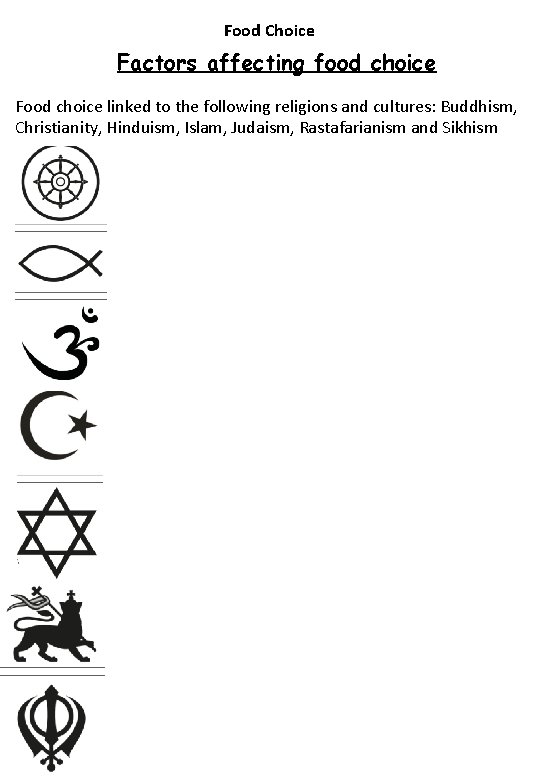
Food Choice Factors affecting food choice Food choice linked to the following religions and cultures: Buddhism, Christianity, Hinduism, Islam, Judaism, Rastafarianism and Sikhism
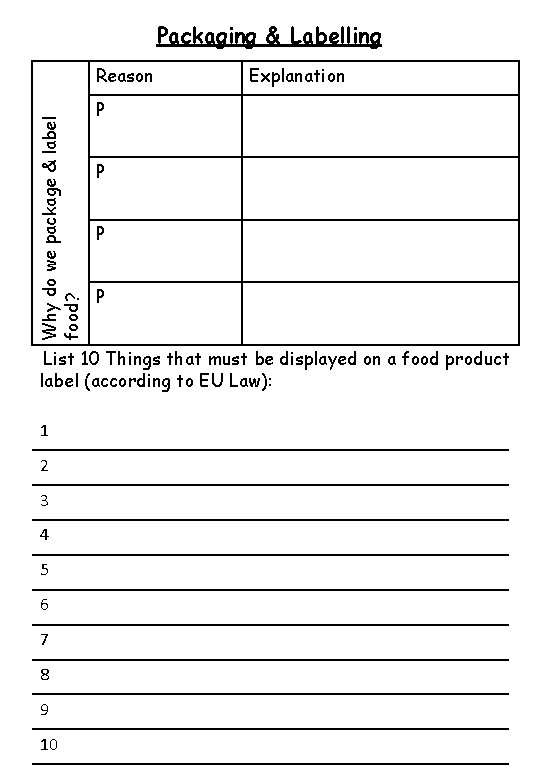
Packaging & Labelling Why do we package & label food? Reason Explanation P P List 10 Things that must be displayed on a food product label (according to EU Law): 1 2 3 4 5 6 7 8 9 10
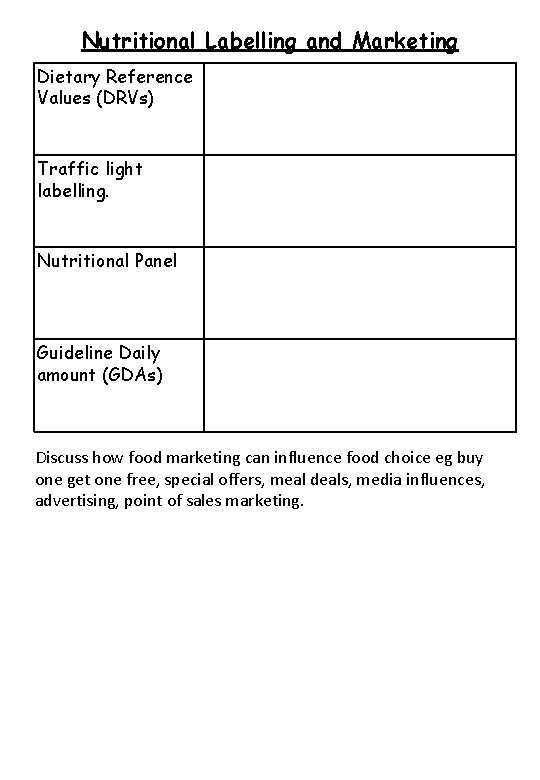
Nutritional Labelling and Marketing Dietary Reference Values (DRVs) Traffic light labelling. Nutritional Panel Guideline Daily amount (GDAs) Discuss how food marketing can influence food choice eg buy one get one free, special offers, meal deals, media influences, advertising, point of sales marketing.
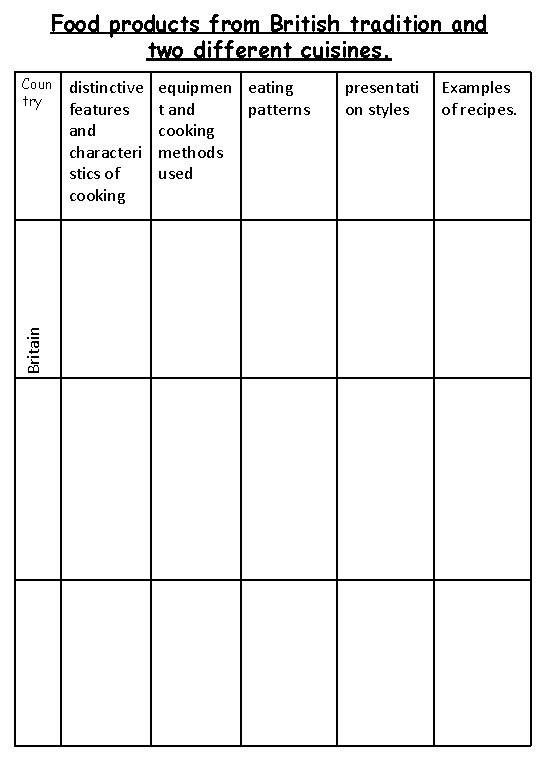
Food products from British tradition and two different cuisines. Britain Coun try distinctive features and characteri stics of cooking equipmen eating t and patterns cooking methods used presentati on styles Examples of recipes.
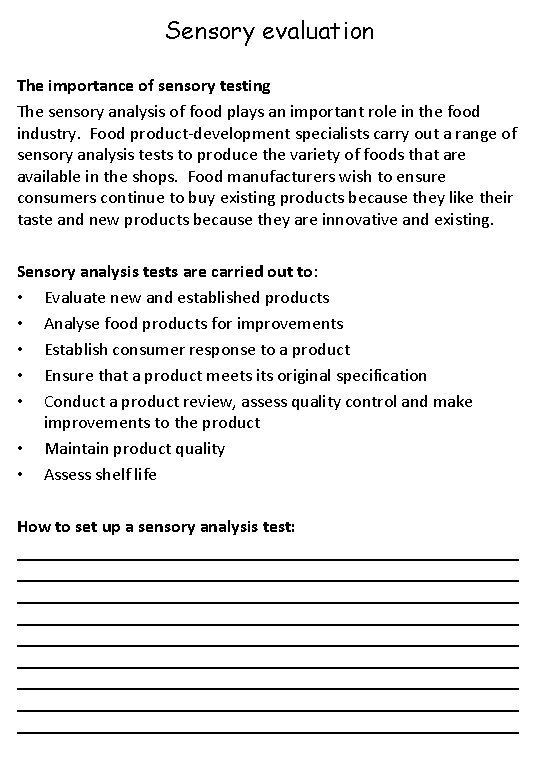
Sensory evaluation The importance of sensory testing The sensory analysis of food plays an important role in the food industry. Food product-development specialists carry out a range of sensory analysis tests to produce the variety of foods that are available in the shops. Food manufacturers wish to ensure consumers continue to buy existing products because they like their taste and new products because they are innovative and existing. Sensory analysis tests are carried out to: • Evaluate new and established products • Analyse food products for improvements • Establish consumer response to a product • Ensure that a product meets its original specification • Conduct a product review, assess quality control and make improvements to the product • Maintain product quality • Assess shelf life How to set up a sensory analysis test: ________________________________________________________ ________________________________________________________ ____________________________
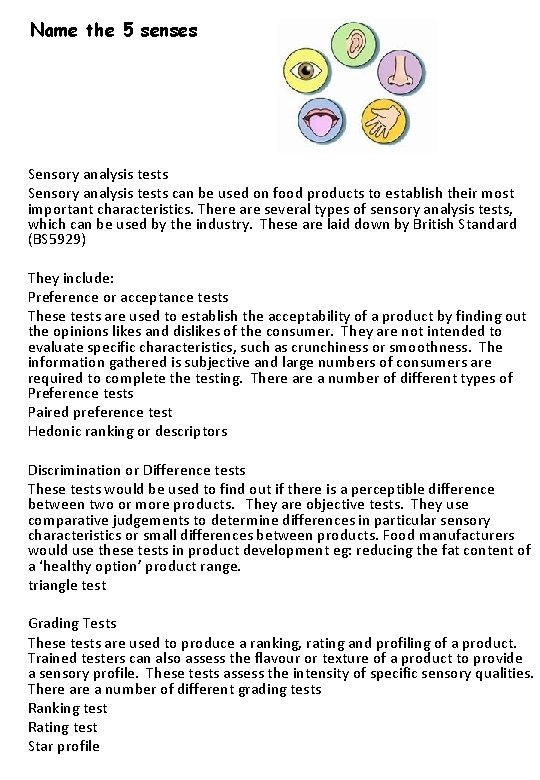
Name the 5 senses Sensory analysis tests can be used on food products to establish their most important characteristics. There are several types of sensory analysis tests, which can be used by the industry. These are laid down by British Standard (BS 5929) They include: Preference or acceptance tests These tests are used to establish the acceptability of a product by finding out the opinions likes and dislikes of the consumer. They are not intended to evaluate specific characteristics, such as crunchiness or smoothness. The information gathered is subjective and large numbers of consumers are required to complete the testing. There a number of different types of Preference tests Paired preference test Hedonic ranking or descriptors Discrimination or Difference tests These tests would be used to find out if there is a perceptible difference between two or more products. They are objective tests. They use comparative judgements to determine differences in particular sensory characteristics or small differences between products. Food manufacturers would use these tests in product development eg: reducing the fat content of a ‘healthy option’ product range. triangle test Grading Tests These tests are used to produce a ranking, rating and profiling of a product. Trained testers can also assess the flavour or texture of a product to provide a sensory profile. These tests assess the intensity of specific sensory qualities. There a number of different grading tests Ranking test Rating test Star profile
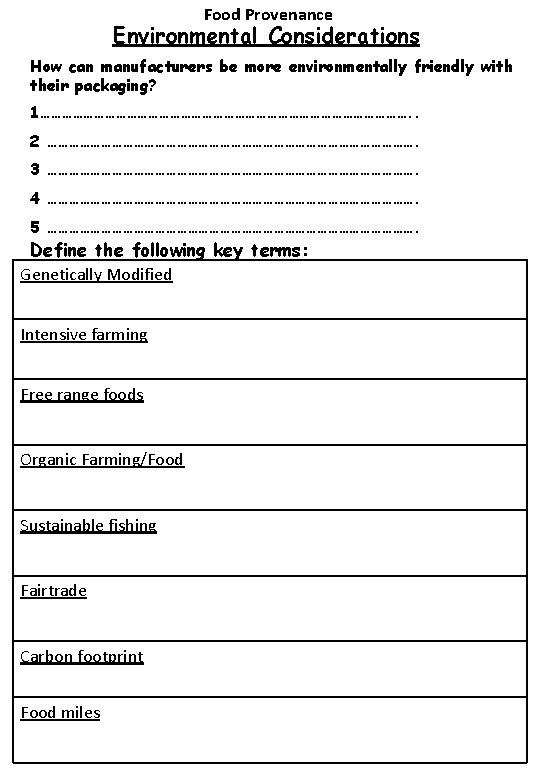
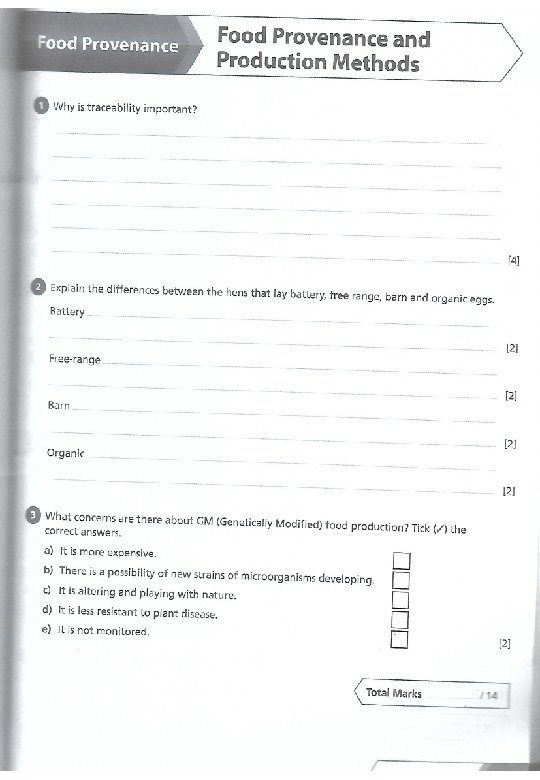
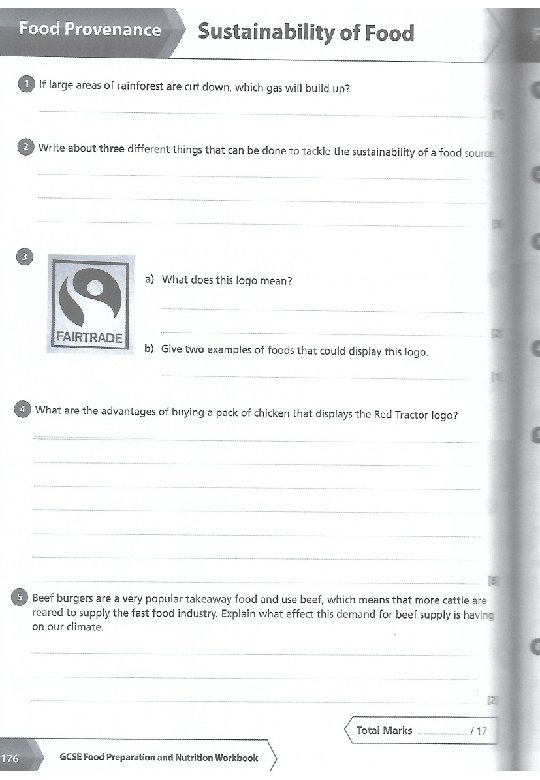
Food Provenance Environmental Considerations How can manufacturers be more environmentally friendly with their packaging? 1……………………………………………. . 2 ……………………………………………. 3 ……………………………………………. 4 ……………………………………………. 5 ……………………………………………. Define the following key terms: Genetically Modified Intensive farming Free range foods Organic Farming/Food Sustainable fishing Fairtrade Carbon footprint Food miles
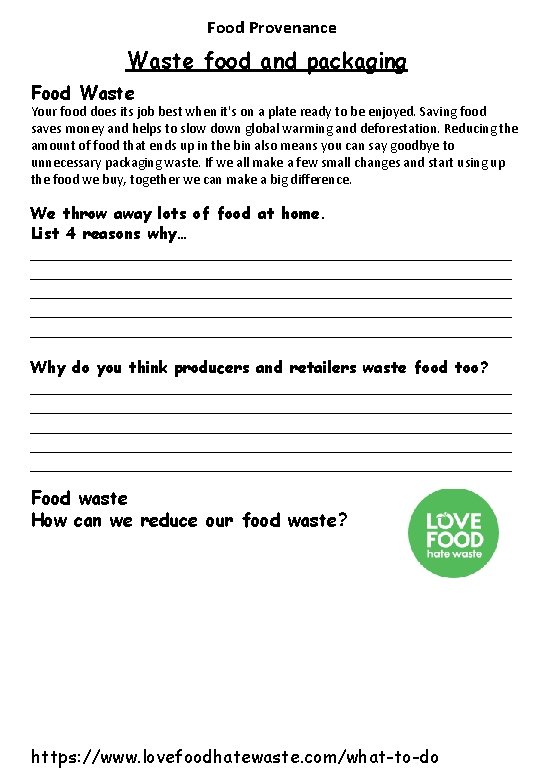
Food Provenance Waste food and packaging Food Waste Your food does its job best when it's on a plate ready to be enjoyed. Saving food saves money and helps to slow down global warming and deforestation. Reducing the amount of food that ends up in the bin also means you can say goodbye to unnecessary packaging waste. If we all make a few small changes and start using up the food we buy, together we can make a big difference. We throw away lots of food at home. List 4 reasons why… ________________________________________________ ________________________ Why do you think producers and retailers waste food too? ________________________________________________ ________________________ Food waste How can we reduce our food waste? https: //www. lovefoodhatewaste. com/what-to-do
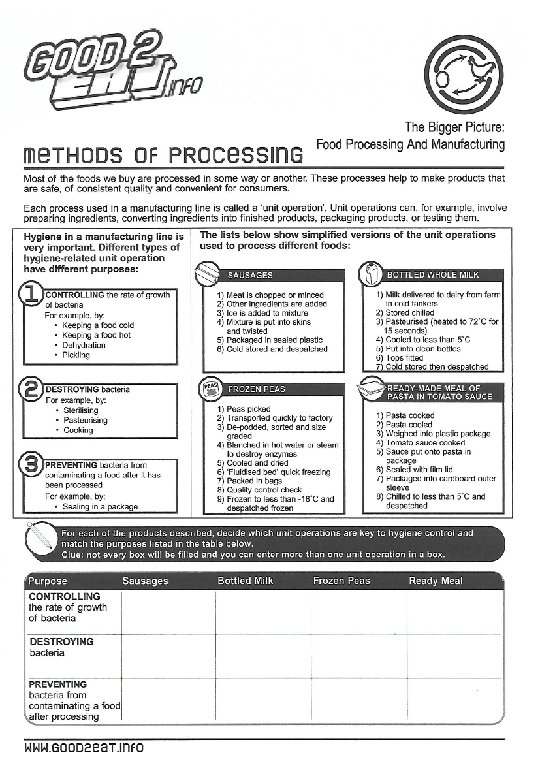
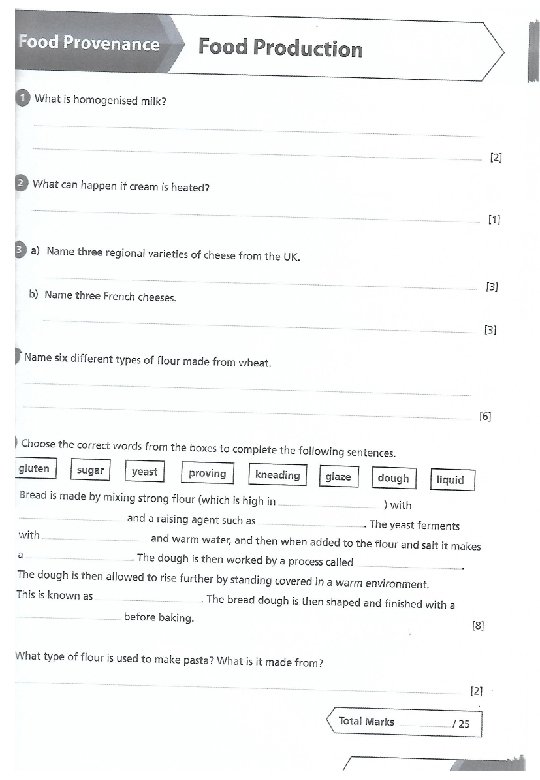
Food Provenance Primary and secondary processing Milk and Milk products Wheat
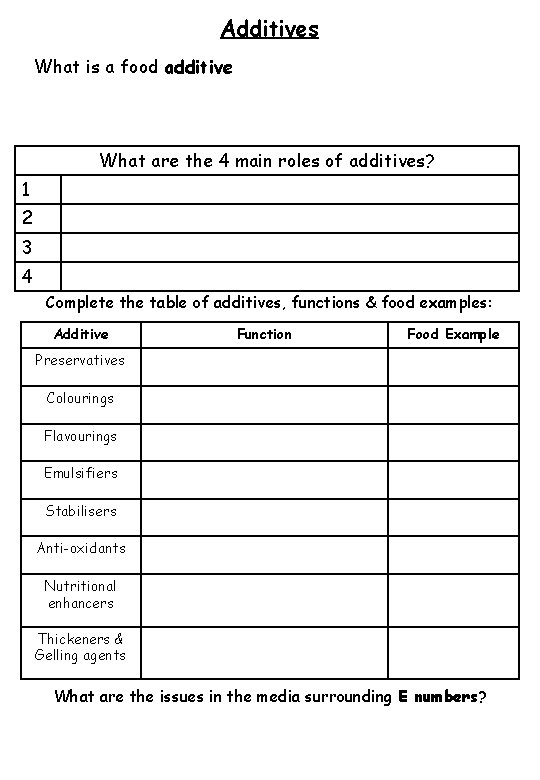
Additives What is a food additive What are the 4 main roles of additives? 1 2 3 4 Complete the table of additives, functions & food examples: Additive Function Food Example Preservatives Colourings Flavourings Emulsifiers Stabilisers Anti-oxidants Nutritional enhancers Thickeners & Gelling agents What are the issues in the media surrounding E numbers?
Technological developments to support better health and food production including fortification and modified foods with health benefits and the efficacy of these. Write some brief notes on the following: • cholesterol lowering spreads • health benefits of fortification • fortified foods: thiamin, niacin, calcium and iron added to white flour • folic acid and iron added to breakfast cereals • vitamins A and D added to fats and low fat spreads
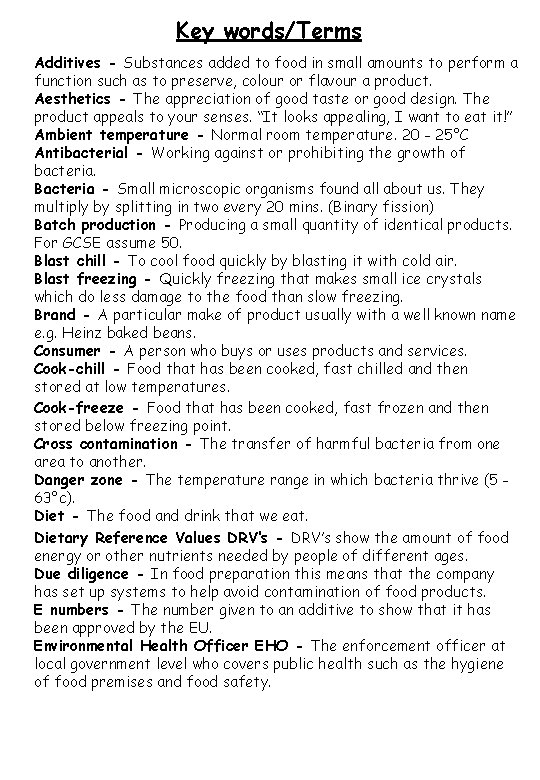
Key words/Terms Additives - Substances added to food in small amounts to perform a function such as to preserve, colour or flavour a product. Aesthetics - The appreciation of good taste or good design. The product appeals to your senses. “It looks appealing, I want to eat it!” Ambient temperature - Normal room temperature. 20 - 25°C Antibacterial - Working against or prohibiting the growth of bacteria. Bacteria - Small microscopic organisms found all about us. They multiply by splitting in two every 20 mins. (Binary fission) Batch production - Producing a small quantity of identical products. For GCSE assume 50. Blast chill - To cool food quickly by blasting it with cold air. Blast freezing - Quickly freezing that makes small ice crystals which do less damage to the food than slow freezing. Brand - A particular make of product usually with a well known name e. g. Heinz baked beans. Consumer - A person who buys or uses products and services. Cook-chill - Food that has been cooked, fast chilled and then stored at low temperatures. Cook-freeze - Food that has been cooked, fast frozen and then stored below freezing point. Cross contamination - The transfer of harmful bacteria from one area to another. Danger zone - The temperature range in which bacteria thrive (5 63°c). Diet - The food and drink that we eat. Dietary Reference Values DRV’s - DRV’s show the amount of food energy or other nutrients needed by people of different ages. Due diligence - In food preparation this means that the company has set up systems to help avoid contamination of food products. E numbers - The number given to an additive to show that it has been approved by the EU. Environmental Health Officer EHO - The enforcement officer at local government level who covers public health such as the hygiene of food premises and food safety.
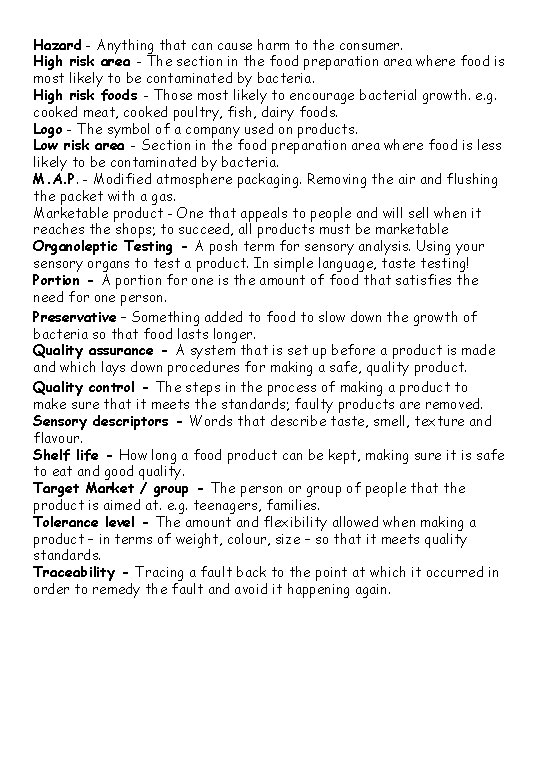
Hazard - Anything that can cause harm to the consumer. High risk area - The section in the food preparation area where food is most likely to be contaminated by bacteria. High risk foods - Those most likely to encourage bacterial growth. e. g. cooked meat, cooked poultry, fish, dairy foods. Logo - The symbol of a company used on products. Low risk area - Section in the food preparation area where food is less likely to be contaminated by bacteria. M. A. P. - Modified atmosphere packaging. Removing the air and flushing the packet with a gas. Marketable product - One that appeals to people and will sell when it reaches the shops; to succeed, all products must be marketable Organoleptic Testing - A posh term for sensory analysis. Using your sensory organs to test a product. In simple language, taste testing! Portion - A portion for one is the amount of food that satisfies the need for one person. Preservative – Something added to food to slow down the growth of bacteria so that food lasts longer. Quality assurance - A system that is set up before a product is made and which lays down procedures for making a safe, quality product. Quality control - The steps in the process of making a product to make sure that it meets the standards; faulty products are removed. Sensory descriptors - Words that describe taste, smell, texture and flavour. Shelf life - How long a food product can be kept, making sure it is safe to eat and good quality. Target Market / group - The person or group of people that the product is aimed at. e. g. teenagers, families. Tolerance level - The amount and flexibility allowed when making a product – in terms of weight, colour, size – so that it meets quality standards. Traceability - Tracing a fault back to the point at which it occurred in order to remedy the fault and avoid it happening again.