
FOOD POISONING 1 Introduction 2 Pathogenesis and Transmission

- Slides: 26
FOOD POISONING
1. Introduction 2. Pathogenesis and Transmission 3. Important foodborne pathogens/toxins/chemicals 4. Investigations and Lab diagnosis 5. Treatment and Prevention
Introduction Food Poisoning is any illness resulting from the ingestion of food or drink contaminated with Living bacteria or Other toxins or inorganic chemical substances & poisons from Plants & animals. Food borne disease outbreaks. Occurrence of 2 or more cases of similar illness resulting from ingestion of common food OR When observed number of paticular disease exceeds expected number
Introduction n n Global burden- high morbidity and mortality Infectious diarrhoea- 3 to 5 billion cases and 1. 8 million deaths annually CDC- 76 million cases of food borne diseases in US annually with appx. 5000 deaths In India- Integrated disease surveillance Project (IDSP) - Food poisoning outbreak reporting increased to more than double in 2009 from 2008 (120 in 2009 and 50 in 2008)
Types of food poisoning A. Bacterial Food poisoning B. Non- Bacterial Food poisoning
A. Bacterial Food poisoning Some important food-borne Bacterial pathogens Salmonella sp , Staph aureus , Clostridium sps. (botulinum, perfringens), Bacillus cereus , Brucella , Campylobacter, E. coli, Listeria , Vibrio cholera and V. parahemolyticus
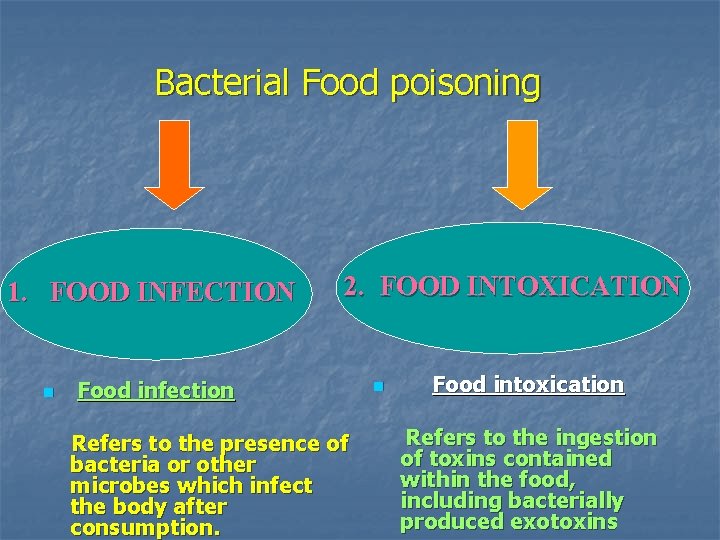
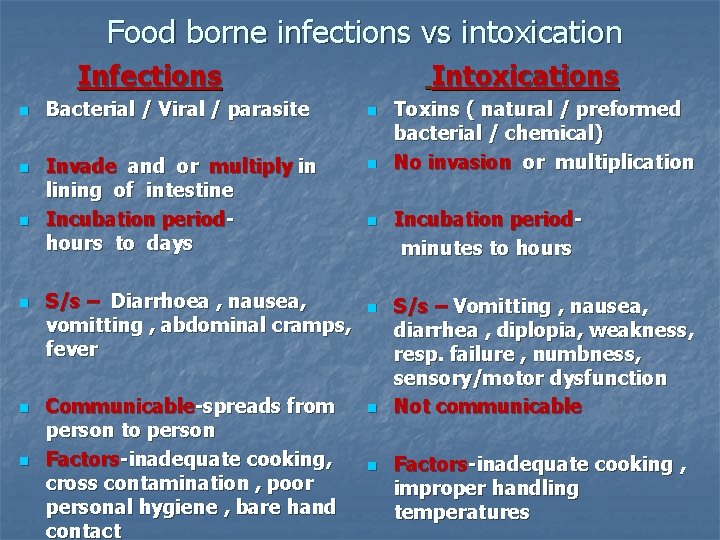
Bacterial Food poisoning 1. FOOD INFECTION n 2. FOOD INTOXICATION Food infection Refers to the presence of bacteria or other microbes which infect the body after consumption. n Food intoxication Refers to the ingestion of toxins contained within the food, including bacterially produced exotoxins
B. Non- Bacterial Food poisoning By chemicals: E. g: Arsenic Cu sulphate Mercury Cadmium Pesticides Sea foods Certain plants fertilizers
Causes n n n Ø Improper handling, preparation, or food storage. Large variety of toxins that affect the environment Chemicals, pesticides or medicines in food and naturally toxic substances like poisonous mushrooms. Good hygiene practices before, during, & after food preparation can reduce the chances of contracting an illness.
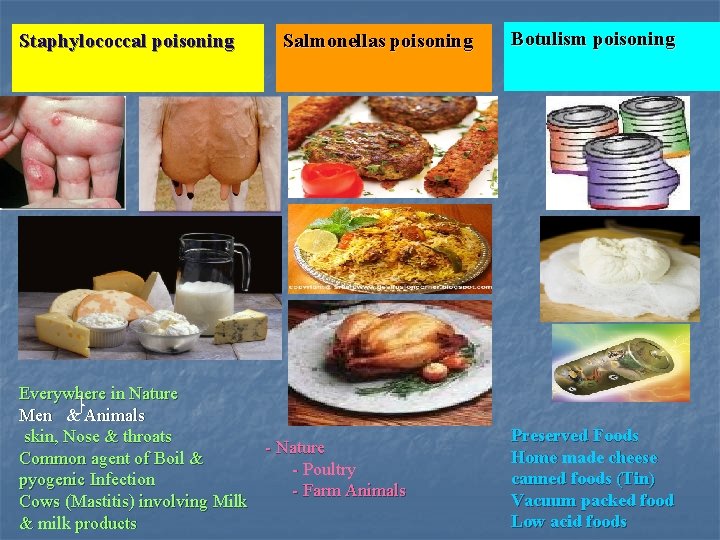
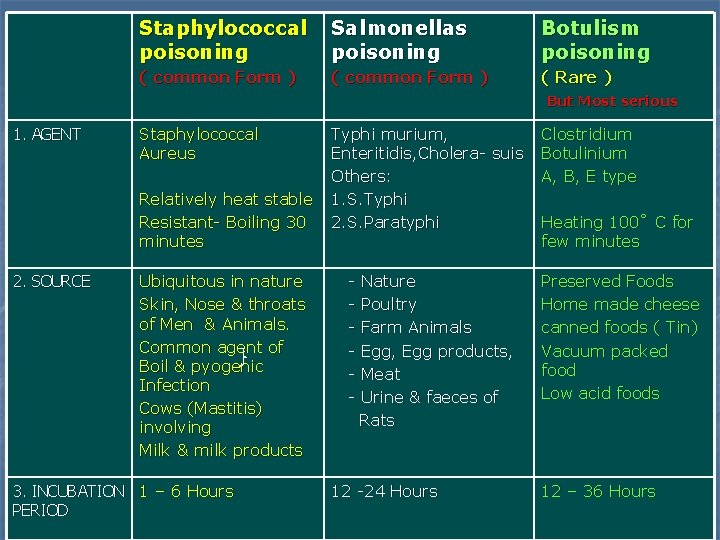
Staphylococcal poisoning Salmonellas poisoning Everywhere in Nature Men & Animals skin, Nose & throats - Nature Common agent of Boil & - Poultry pyogenic Infection - Farm Animals Cows (Mastitis) involving Milk & milk products Botulism poisoning Preserved Foods Home made cheese canned foods (Tin) Vacuum packed food Low acid foods
Transmission n Inoculum / size of infective dose - Can be as small as 10 -100 bacterial cysts for Shigella , EHEC , Giardia, E. histolytica or, 10^ 5 - 10^ 8 for Vibrio cholera, variable for salmonella Animals / humans harbouring infection shed in feces contaminate water , fruits , vegetables inadequate cooking / improper storage infection Warm temperature (10 -50 degree cent. )multiplication of pathogens
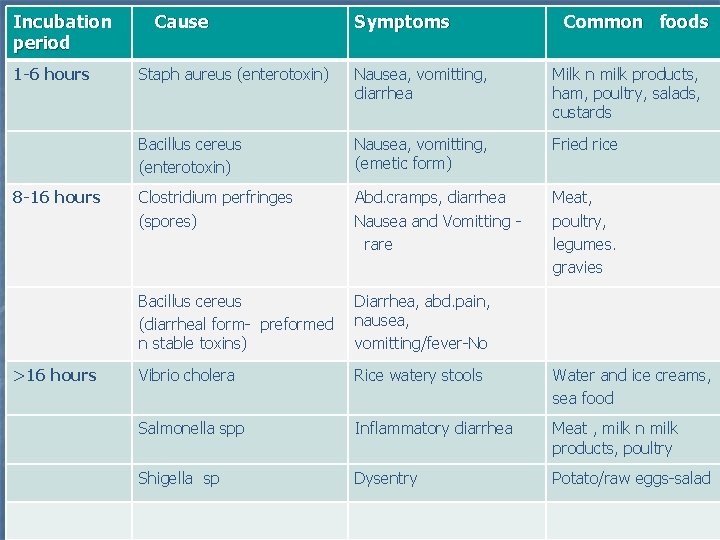
Incubation period 1 -6 hours 8 -16 hours >16 hours Cause Symptoms Common foods Staph aureus (enterotoxin) Nausea, vomitting, diarrhea Milk n milk products, ham, poultry, salads, custards Bacillus cereus (enterotoxin) Nausea, vomitting, (emetic form) Fried rice Clostridium perfringes (spores) Abd. cramps, diarrhea Nausea and Vomitting rare Meat, poultry, legumes. gravies Bacillus cereus (diarrheal form- preformed n stable toxins) Diarrhea, abd. pain, nausea, vomitting/fever-No Vibrio cholera Rice watery stools Water and ice creams, sea food Salmonella spp Inflammatory diarrhea Meat , milk n milk products, poultry Shigella sp Dysentry Potato/raw eggs-salad
Staphylococcal poisoning Salmonellas poisoning Botulism poisoning ( common Form ) ( Rare ) But Most serious 1. AGENT Staphylococcal Aureus Relatively heat stable Resistant- Boiling 30 minutes 2. SOURCE Ubiquitous in nature Skin, Nose & throats of Men & Animals. Common agent of Boil & pyogenic Infection Cows (Mastitis) involving Milk & milk products 3. INCUBATION 1 – 6 Hours PERIOD Typhi murium, Enteritidis, Cholera- suis Others: 1. S. Typhi 2. S. Paratyphi - Nature Poultry Farm Animals Egg, Egg products, Meat Urine & faeces of Rats 12 -24 Hours Clostridium Botulinium A, B, E type Heating 100˚ C for few minutes Preserved Foods Home made cheese canned foods ( Tin) Vacuum packed food Low acid foods 12 – 36 Hours
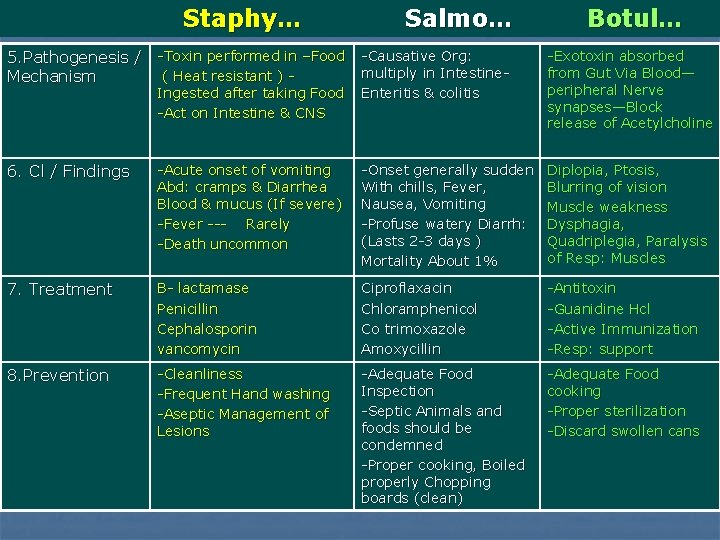
Staphy… Salmo… 5. Pathogenesis / -Toxin performed in –Food -Causative Org: multiply in Intestine( Heat resistant ) Mechanism Botul… Ingested after taking Food -Act on Intestine & CNS Enteritis & colitis -Exotoxin absorbed from Gut Via Blood— peripheral Nerve synapses—Block release of Acetylcholine 6. Cl / Findings -Acute onset of vomiting Abd: cramps & Diarrhea Blood & mucus (If severe) -Fever --- Rarely -Death uncommon -Onset generally sudden With chills, Fever, Nausea, Vomiting -Profuse watery Diarrh: (Lasts 2 -3 days ) Mortality About 1% Diplopia, Ptosis, Blurring of vision Muscle weakness Dysphagia, Quadriplegia, Paralysis of Resp: Muscles 7. Treatment B- lactamase Penicillin Cephalosporin vancomycin Ciproflaxacin Chloramphenicol Co trimoxazole Amoxycillin -Antitoxin -Guanidine Hcl -Active Immunization -Resp: support 8. Prevention -Cleanliness -Frequent Hand washing -Aseptic Management of Lesions -Adequate Food Inspection -Septic Animals and foods should be condemned -Proper cooking, Boiled properly Chopping boards (clean) -Adequate Food cooking -Proper sterilization -Discard swollen cans
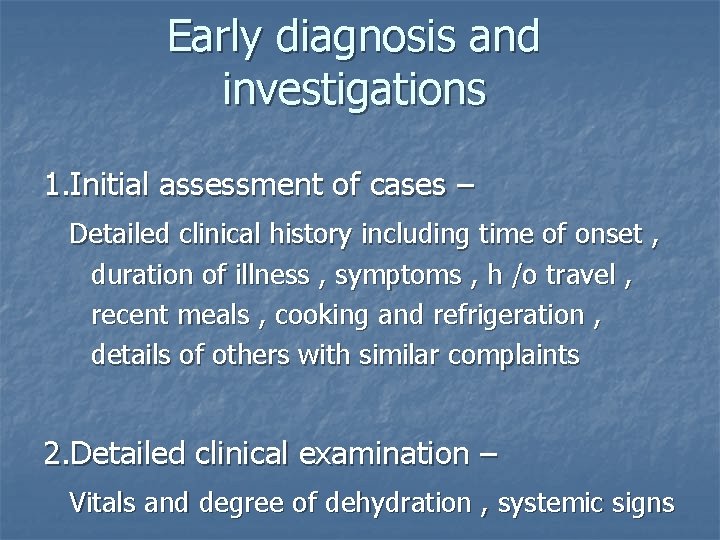
Early diagnosis and investigations 1. Initial assessment of cases – Detailed clinical history including time of onset , duration of illness , symptoms , h /o travel , recent meals , cooking and refrigeration , details of others with similar complaints 2. Detailed clinical examination – Vitals and degree of dehydration , systemic signs
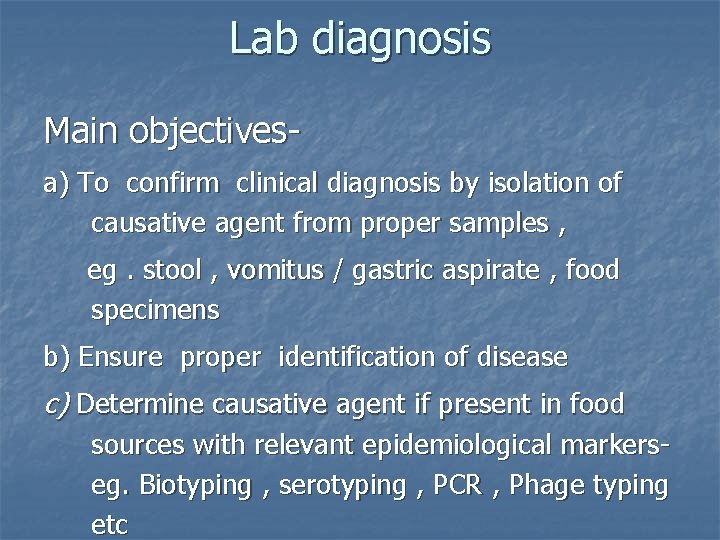
Lab diagnosis Main objectivesa) To confirm clinical diagnosis by isolation of causative agent from proper samples , eg. stool , vomitus / gastric aspirate , food specimens b) Ensure proper identification of disease c) Determine causative agent if present in food sources with relevant epidemiological markerseg. Biotyping , serotyping , PCR , Phage typing etc
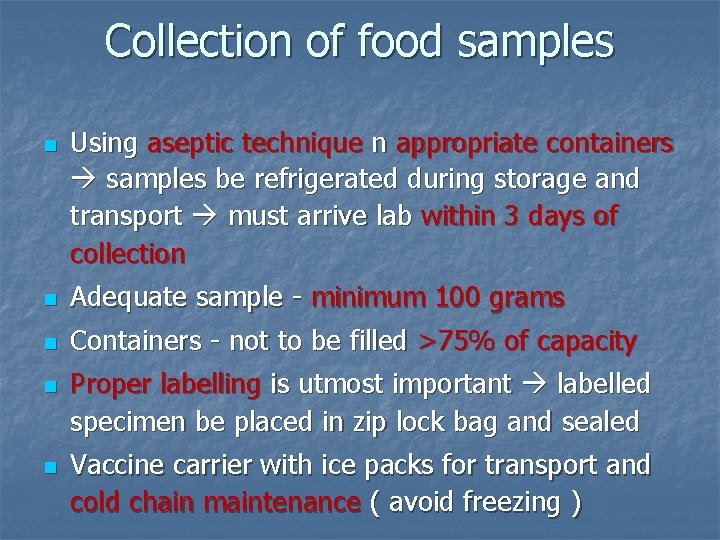
Collection of food samples n n n Using aseptic technique n appropriate containers samples be refrigerated during storage and transport must arrive lab within 3 days of collection Adequate sample - minimum 100 grams Containers - not to be filled >75% of capacity Proper labelling is utmost important labelled specimen be placed in zip lock bag and sealed Vaccine carrier with ice packs for transport and cold chain maintenance ( avoid freezing )
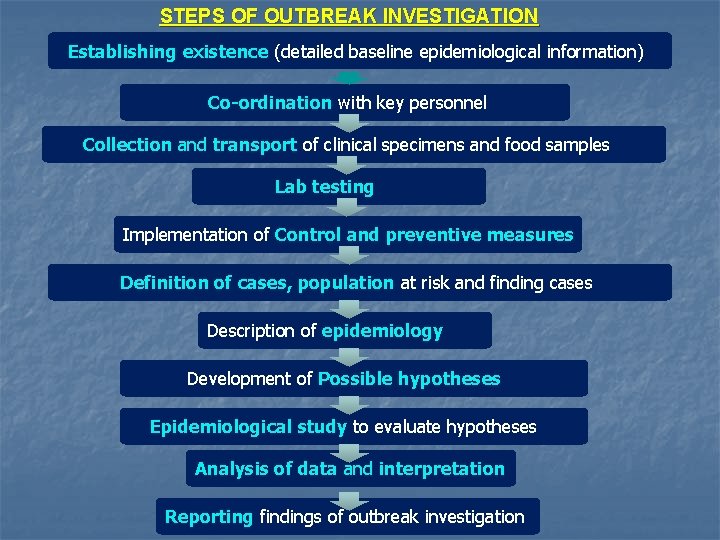
STEPS OF OUTBREAK INVESTIGATION Establishing existence (detailed baseline epidemiological information) Co-ordination with key personnel Collection and transport of clinical specimens and food samples Lab testing Implementation of Control and preventive measures Definition of cases, population at risk and finding cases Description of epidemiology Development of Possible hypotheses Epidemiological study to evaluate hypotheses Analysis of data and interpretation Reporting findings of outbreak investigation
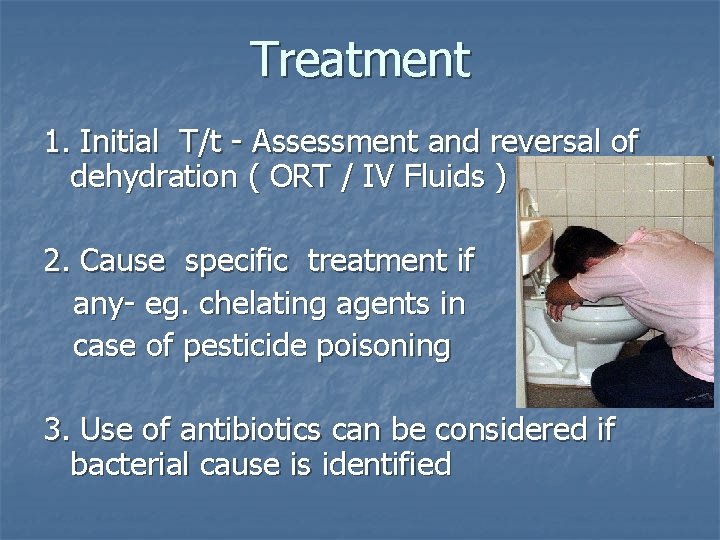
Treatment 1. Initial T/t - Assessment and reversal of dehydration ( ORT / IV Fluids ) 2. Cause specific treatment if any- eg. chelating agents in case of pesticide poisoning 3. Use of antibiotics can be considered if bacterial cause is identified
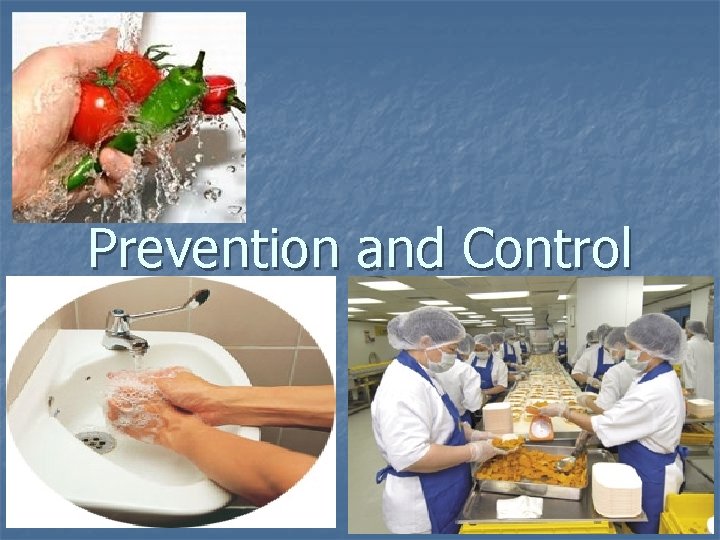
Prevention and Control
Five keys to Safer food 1. Keep Clean – Wash hands before handling food and often during preparation Wash hands after going to toilet Wash n sanitise all surfaces n equipment for food preparation-protect kitchen from insects , pets 2. Separate raw and cooked food. Separate raw meat , poultry n seafood from other foods Use separate utensils for handling raw foods Store food in containers to avoid contact between raw and cooked foods
3. Cook Thoroughly – esp. Meat , poultry , eggs and Seafood Bring soups n stews to boiling (ensure>70 degree temp) Reheat cooked food thoroughly 4. Keep food at safe temperature Dont leave cooked food at room temp. >2 hours Prompt refrigeration of cooked n perishable food Keep cooked food piping hot(>60 de. ) prior to serving Don’t store food too long even in refrigerator Don’t thaw frozen food at room temperature
5. Use safe water and raw materialsn Use safe water or treat to make it safe n Select fresh and wholesome fruits n Choose foods processed for safety - pasteurised milk n Wash fruits n vegetables if eaten raw n Don’t use food beyond expiry date ü Environmental measures - Discourage sewage farming for growing fruits and vegetables
Safety Regulations n n n Prevention of Food Adulteration Act , 1954 -To Ensure pure and wholesome food and to protect from fradulent practices Case of proven adulteration –Minimum imprisonment of 6 months and minimum fine of Rs 1000 envisaged Grievous Hurt-(320 IPC)- Death or such harm can be punished upto Life imprisonment and fine not <Rs 5000 Food Standards- Codex Alimentarius , Agmark standards, Bureau of Indian Standards National Nutrition Policy -1993 - Food Security
THANK YOU
Food borne infections vs intoxication Infections n n n Bacterial / Viral / parasite Invade and or multiply in lining of intestine Incubation periodhours to days S/s – Diarrhoea , nausea, vomitting , abdominal cramps, fever Communicable-spreads from person to person Factors-inadequate cooking, cross contamination , poor personal hygiene , bare hand contact Intoxications n n n Toxins ( natural / preformed bacterial / chemical) No invasion or multiplication Incubation periodminutes to hours S/s – Vomitting , nausea, diarrhea , diplopia, weakness, resp. failure , numbness, sensory/motor dysfunction Not communicable Factors-inadequate cooking , improper handling temperatures