
Food Microbiology 1 Unit 1 Taxonomy Historical Perspective
Food Microbiology 1 Unit 1 Taxonomy
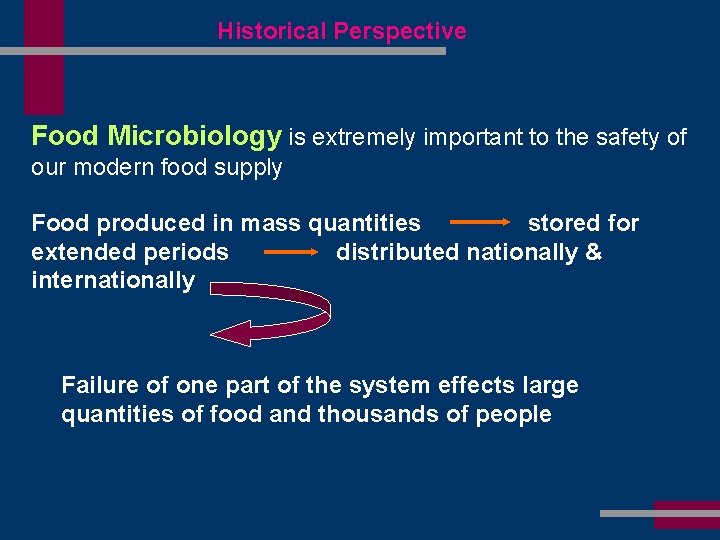
Historical Perspective Food Microbiology is extremely important to the safety of our modern food supply Food produced in mass quantities stored for extended periods distributed nationally & internationally Failure of one part of the system effects large quantities of food and thousands of people

Apply basic principles of food microbiology to: Ø Food production (on the farm) Ø Food processing Ø Distribution and retail operations Ø Food services and home preparations “From stable to table” “From farm to fork” “From gate to plate”
Louis Pasteur Ø Founder of the Science of Microbiology Ø Disproved theory of spontaneous generation of microorganism within food Ø Prevented spoilage by a process termed “ pasteurization”
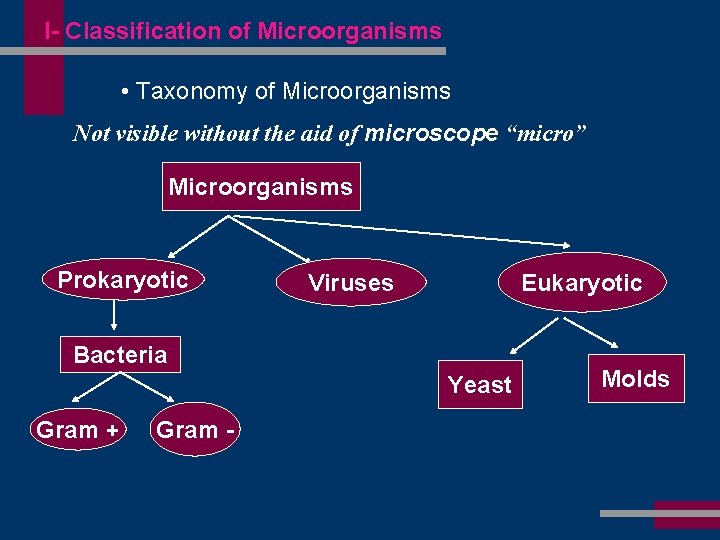
I- Classification of Microorganisms • Taxonomy of Microorganisms Not visible without the aid of microscope “micro” Microorganisms Prokaryotic Viruses Eukaryotic Bacteria Yeast Gram + Gram - Molds

Bacteria Yeasts Grow or multiply in foods Molds Parasites Viruses Survive but not grow in foods

Size of Microorganisms
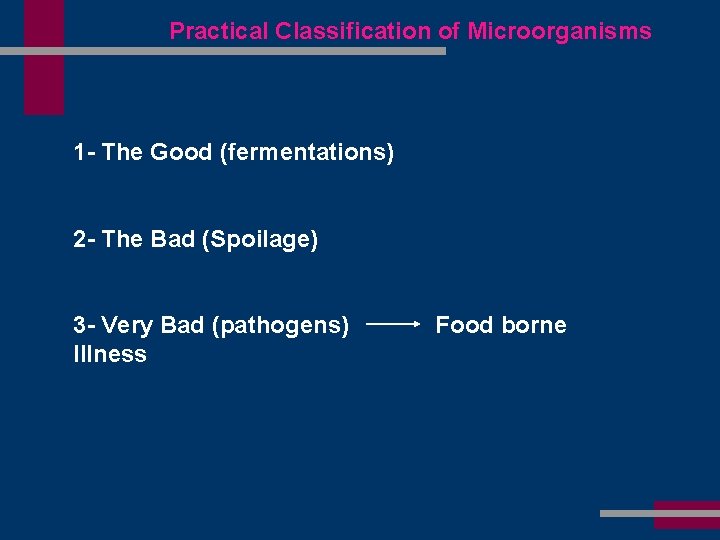
Practical Classification of Microorganisms 1 - The Good (fermentations) 2 - The Bad (Spoilage) 3 - Very Bad (pathogens) Illness Food borne
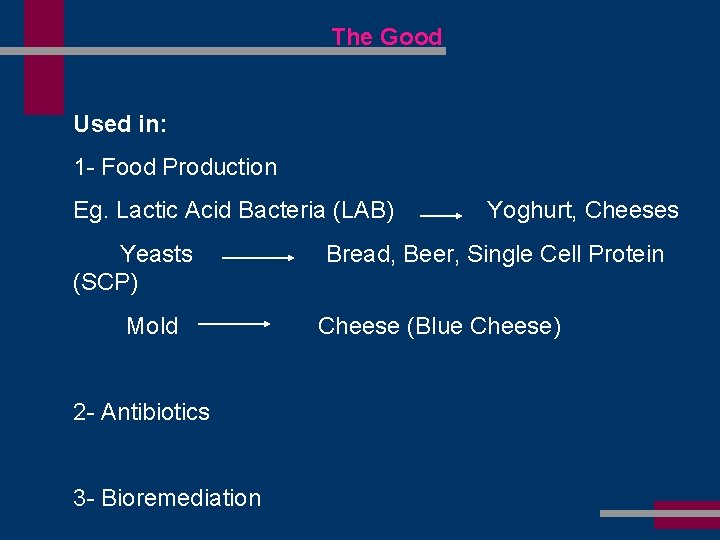
The Good Used in: 1 - Food Production Eg. Lactic Acid Bacteria (LAB) Yeasts (SCP) Mold 2 - Antibiotics 3 - Bioremediation Yoghurt, Cheeses Bread, Beer, Single Cell Protein Cheese (Blue Cheese)
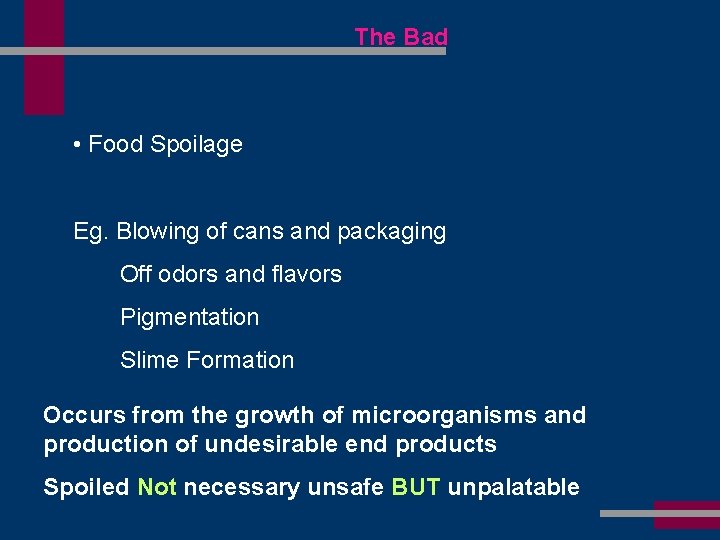
The Bad • Food Spoilage Eg. Blowing of cans and packaging Off odors and flavors Pigmentation Slime Formation Occurs from the growth of microorganisms and production of undesirable end products Spoiled Not necessary unsafe BUT unpalatable
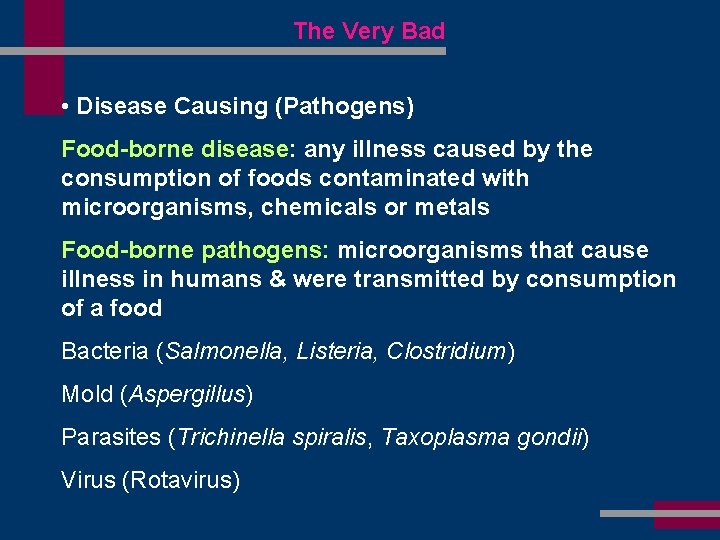
The Very Bad • Disease Causing (Pathogens) Food-borne disease: any illness caused by the consumption of foods contaminated with microorganisms, chemicals or metals Food-borne pathogens: microorganisms that cause illness in humans & were transmitted by consumption of a food Bacteria (Salmonella, Listeria, Clostridium) Mold (Aspergillus) Parasites (Trichinella spiralis, Taxoplasma gondii) Virus (Rotavirus)
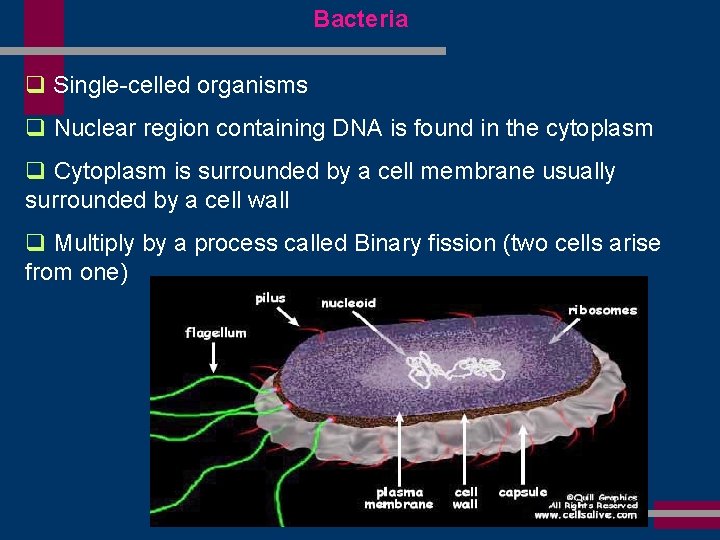
Bacteria q Single-celled organisms q Nuclear region containing DNA is found in the cytoplasm q Cytoplasm is surrounded by a cell membrane usually surrounded by a cell wall q Multiply by a process called Binary fission (two cells arise from one)

Nomenclature of Bacteria Escherichia GENUS coli SPECIES ATCC 13704 ID number • Names usually derived from latin or Greek (Eg. coli belonging to colon) • Escherichia named after Escherich who discovered the bacterium in 1895 • Abbreviated to E. coli/E. coli (underlined or italic) • Species name NOT Capitalized
Exceptions • Salmonella Ø Composed of closely related serovars Ø Genus Salmonella has only one species (Salmonella enterica) Therefore, they all are identified by serotypic names Eg. Salmonella enterica serotype Typhimurium (Salmonella Typhimurium)
How Bacteria are named? • Phenotypic Characteristic: Features and activities of the bacterium which can be determined by observation • Place first detected • Source of original isolation • Person who discovered
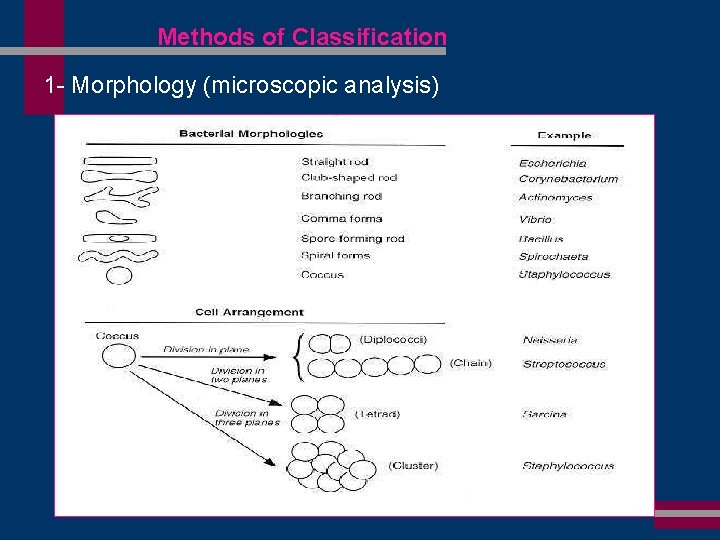
Methods of Classification 1 - Morphology (microscopic analysis)
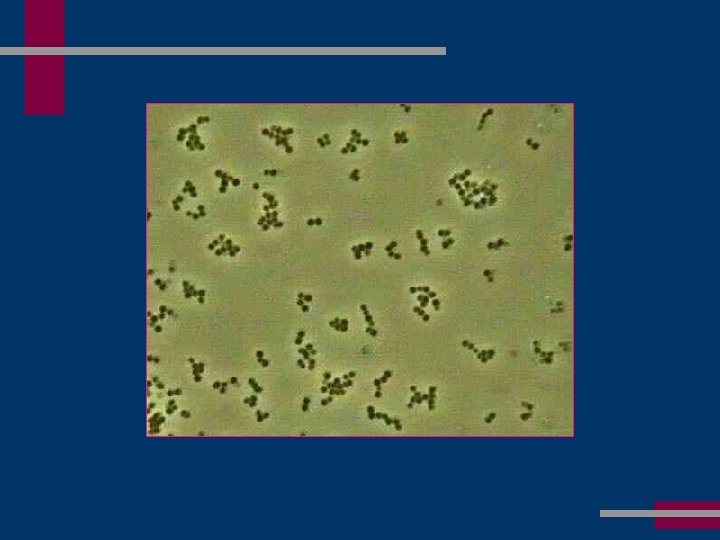
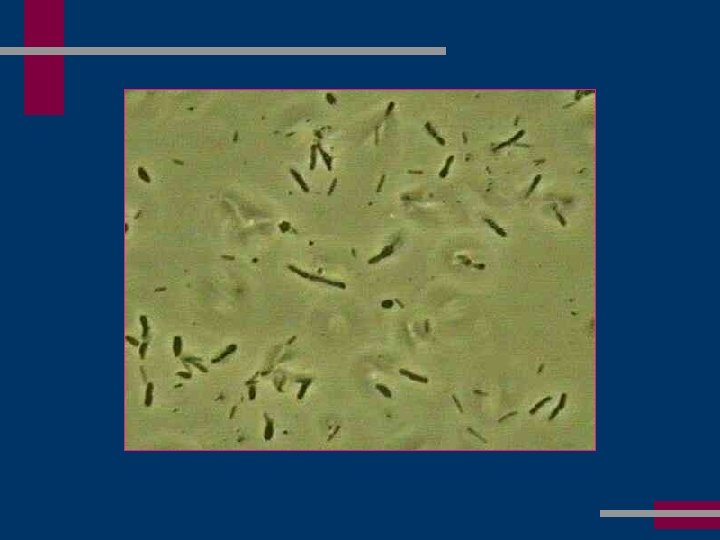
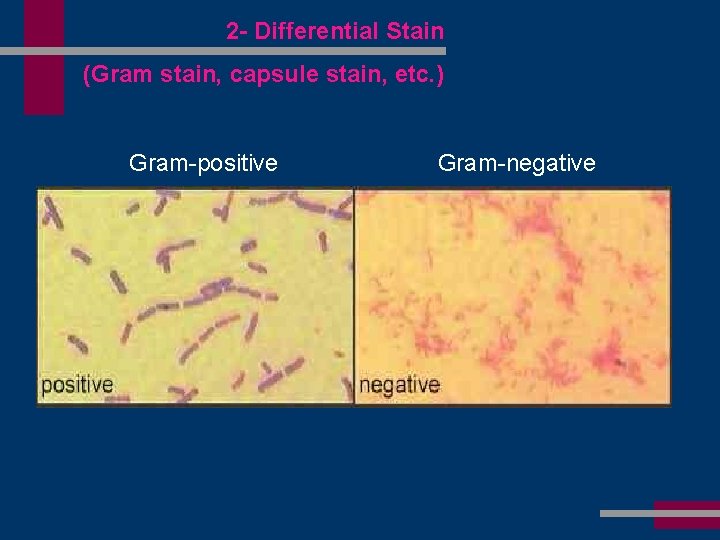
2 - Differential Stain (Gram stain, capsule stain, etc. ) Gram-positive Gram-negative
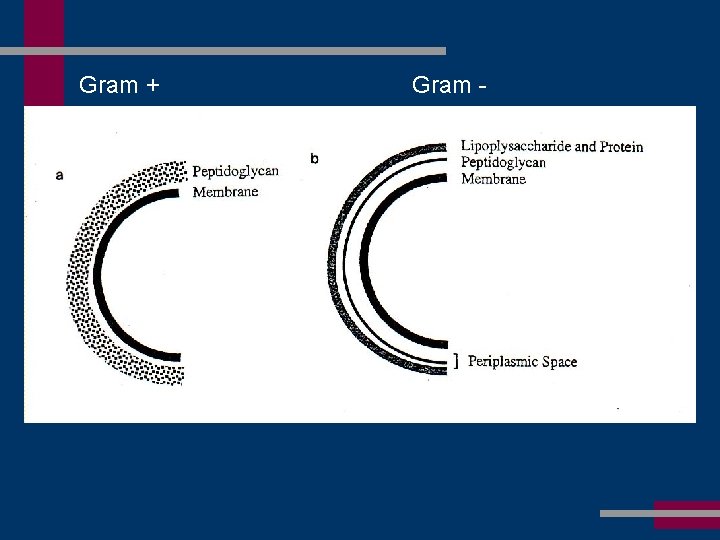
Gram + Gram -
3 - Biochemistry (Catabolic and Anabolic Pathways) • Specific enzymes: Catalase, Oxidase • Metabolic Products: e. g fermentation (lactic acid, acetic acid…) • Sugar Utilization (lactose, mannose, rammnose) API identification kits • Growth characteristics (temperature, anaerobe)
4 - Serology (Specific antibodies) (Slide agglutination) Ø Antigenic structure (Flagella, surface) test the whole cells or cell extracts for the possession of specific surface antigens by reaction with specific antibodies Ø Receptors -- Phage receptors test bacteria for possession of specific surface receptors by testing for sensitivity to a range of test phages (Phage typing (specific binding and lysis of bacteria) --Bacteriocin receptors ØToxins
5 - Amino Acid Sequencing (SDS-PAGE) 6 - Fatty acids 7 - Flow cytometry (Differences in electrical conductivity) 8 - DNA, Restriction enzyme maps
Development of advanced techniques has led to the re-evaluation of bacterial taxonomy But Bergey’s Manual of Systematic Bacteriology is still regarded as the foundation for classifying bacteria.
Key Questions In Microbiology that will be addressed in the course • What microorganisms are in food? • Do they represent a problem? • How can they be detected and enumerated? • What are the routes by which they enter the food chain? • How can they be controlled and eliminated?
Class Exercise Try to identify if the given microbes are involved in food spoilage, food borne illness and/or food fermentations
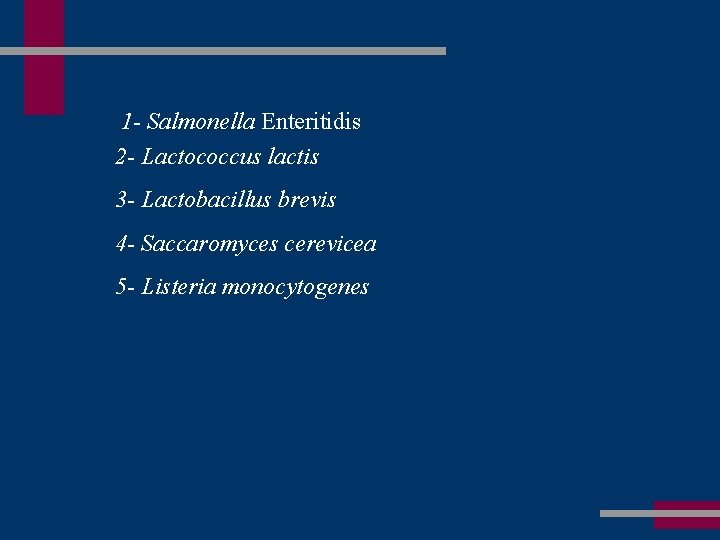
1 - Salmonella Enteritidis 2 - Lactococcus lactis 3 - Lactobacillus brevis 4 - Saccaromyces cerevicea 5 - Listeria monocytogenes
- Slides: 27