
FOOD LABELS Food Labels Food labels help us
FOOD LABELS

Food Labels Food labels help us determine the nutrient content of foods. They are required for most prepared foods, except those that don’t provide many nutrients, such as coffee and spices.

Components of Food Labels Product Name Net Contents Sell By/ Expiration Date Nutritional Claims Ingredients Food Label s Name and Address of the Manufacturer Nutrition Facts
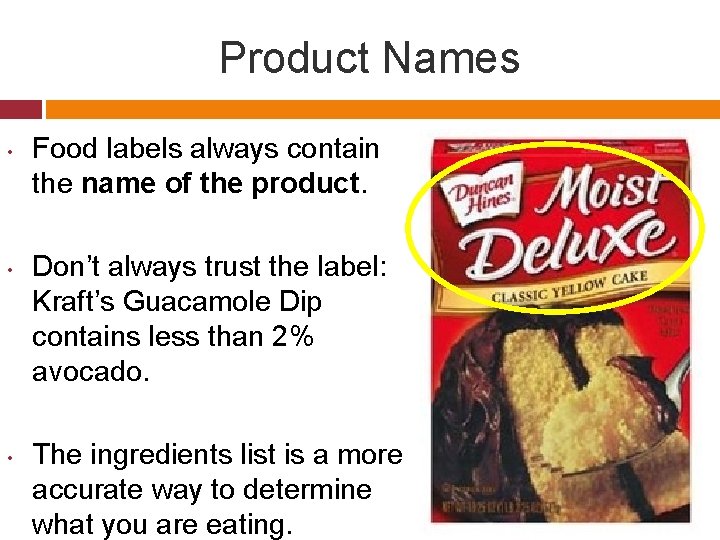
Product Names • • • Food labels always contain the name of the product. Don’t always trust the label: Kraft’s Guacamole Dip contains less than 2% avocado. The ingredients list is a more accurate way to determine what you are eating.

Net Contents Net contents tells you the weight, count, or quantity inside the package.

Name and Address of the Manufacturer • • The name and address of the manufacturer is important because it tells you who to contact in the event you have file a complaint about the product. You can also write to the manufacturer to complement their product- they may send you coupons in return.
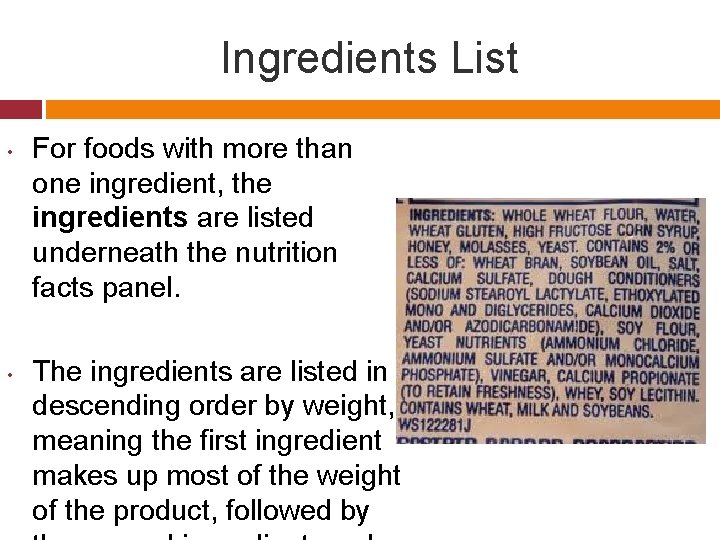
Ingredients List • • For foods with more than one ingredient, the ingredients are listed underneath the nutrition facts panel. The ingredients are listed in descending order by weight, meaning the first ingredient makes up most of the weight of the product, followed by

Ingredients List • Some ingredients labels list common allergies found in their processing plants, even if they are not contained in the particular food product.

Nutritional Claims • • Low Fat, Sugar Free, Low Calorie… Newer Terms: Vegan, Gluten Free, Trans Fat Free…
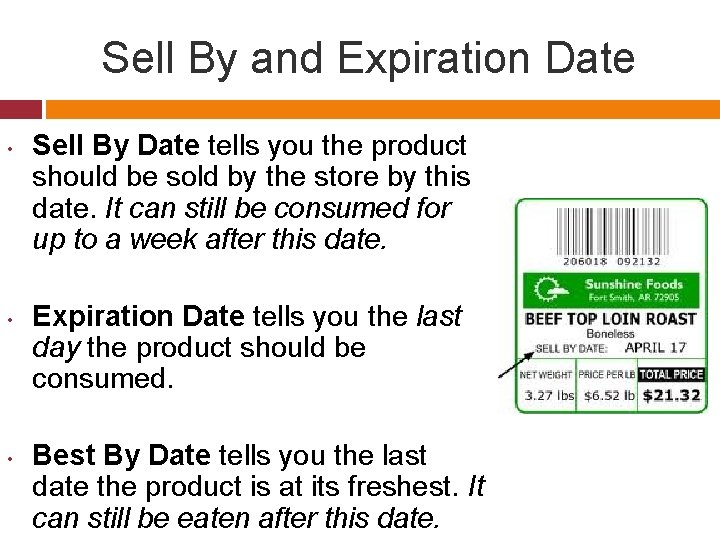
Sell By and Expiration Date • • • Sell By Date tells you the product should be sold by the store by this date. It can still be consumed for up to a week after this date. Expiration Date tells you the last day the product should be consumed. Best By Date tells you the last date the product is at its freshest. It can still be eaten after this date.
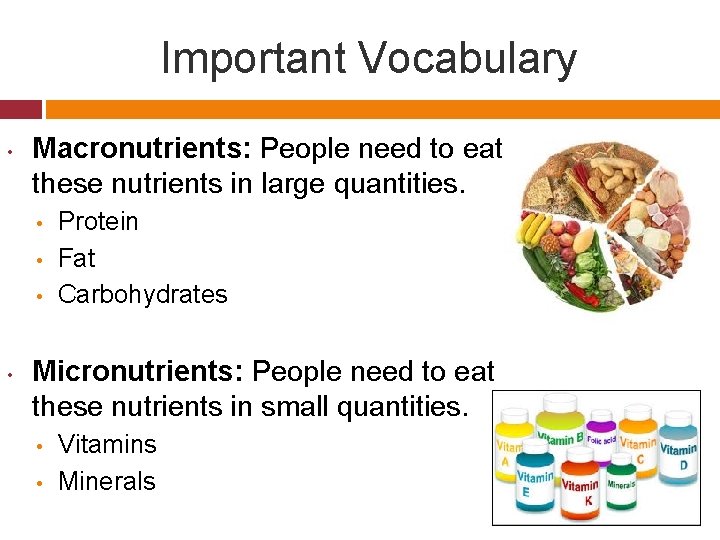
Important Vocabulary • Macronutrients: People need to eat these nutrients in large quantities. • • Protein Fat Carbohydrates Micronutrients: People need to eat these nutrients in small quantities. • • Vitamins Minerals

Nutrition Facts Panel Number of Servings and Serving Size Calories per Serving Macronutrie nts Micronutrien ts Percent Daily Value
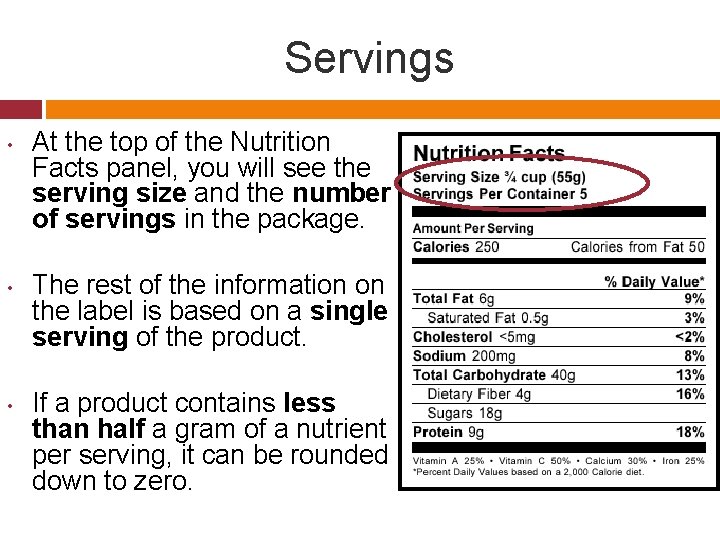
Servings • • • At the top of the Nutrition Facts panel, you will see the serving size and the number of servings in the package. The rest of the information on the label is based on a single serving of the product. If a product contains less than half a gram of a nutrient per serving, it can be rounded down to zero.

Calories • • Calories on the food label tell you how much energy is in the food product. Carbohydrates, Proteins, Fats, and Alcohol are the only items that contribute calories. Carbohydrate s • 4 calories per gram Proteins • 4 calories per gram Fats • 9 calories per gram Alcohol • 7 calories per gram

Macronutrients • Fats, carbohydrates, and proteins can be found on nutritional panels.
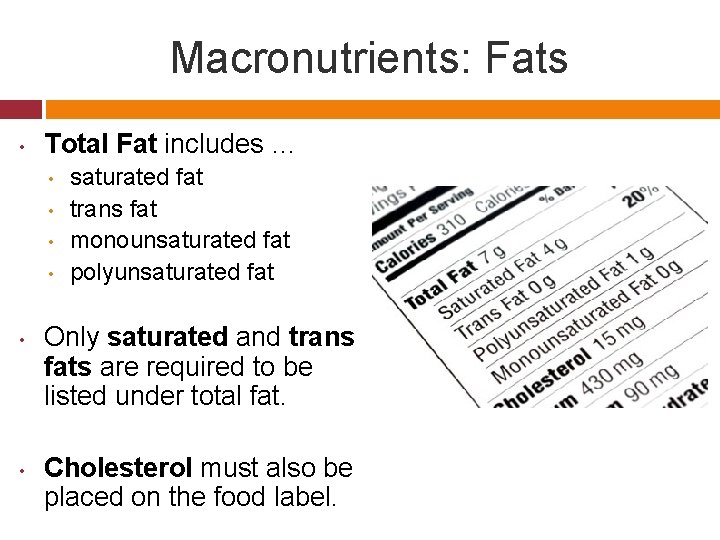
Macronutrients: Fats • Total Fat includes … • • • saturated fat trans fat monounsaturated fat polyunsaturated fat Only saturated and trans fats are required to be listed under total fat. Cholesterol must also be placed on the food label.
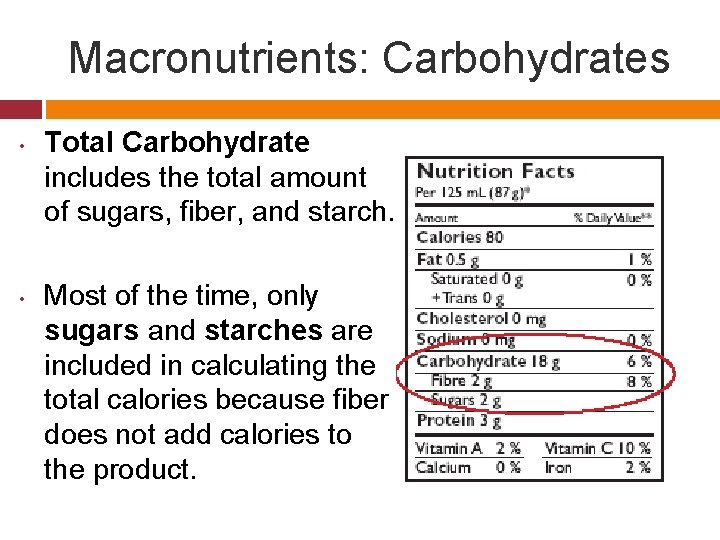
Macronutrients: Carbohydrates • • Total Carbohydrate includes the total amount of sugars, fiber, and starch. Most of the time, only sugars and starches are included in calculating the total calories because fiber does not add calories to the product.
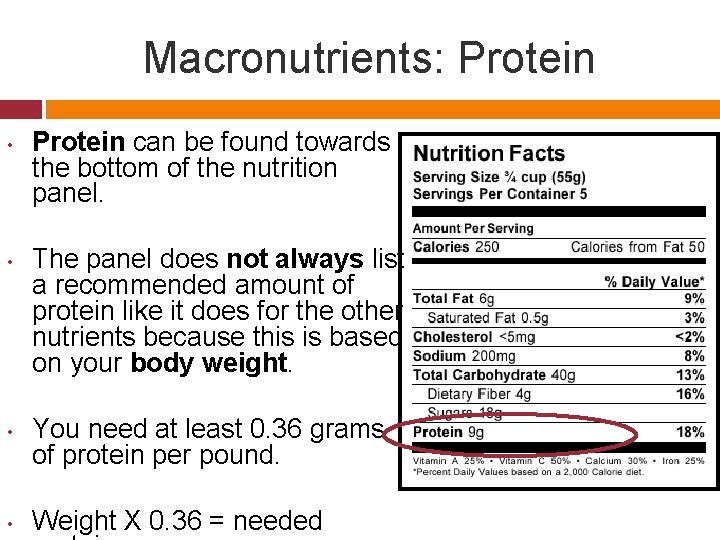
Macronutrients: Protein • • Protein can be found towards the bottom of the nutrition panel. The panel does not always list a recommended amount of protein like it does for the other nutrients because this is based on your body weight. You need at least 0. 36 grams of protein per pound. Weight X 0. 36 = needed
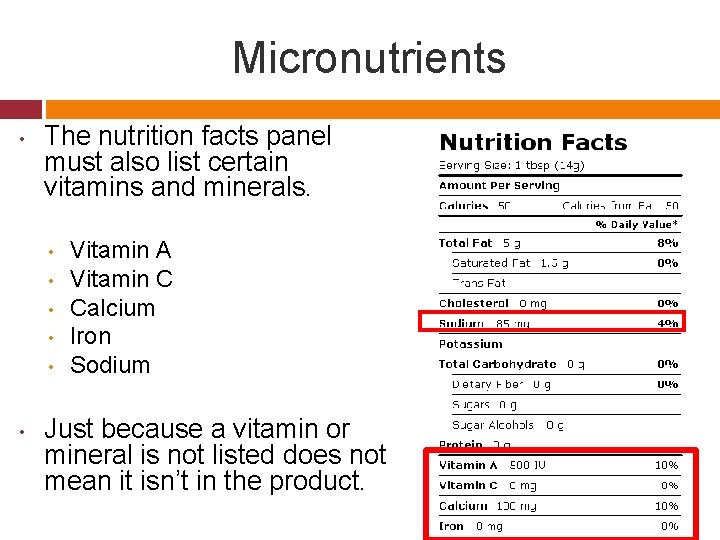
Micronutrients • The nutrition facts panel must also list certain vitamins and minerals. • • • Vitamin A Vitamin C Calcium Iron Sodium Just because a vitamin or mineral is not listed does not mean it isn’t in the product.

Percent Daily Value (DV) • Percent daily values (DV) tell you how much the nutrients in your food contribute to the recommended amount of nutrients a person eating 2, 000 calories a day should eat. • • • 5% or less = poor source 10%-19% = moderate/ good source 20% and over = high source
Picture Credits Product Names: Net Contents: http: //www. bombayharbor. com/Product/33382/Canned_Tomato_Paste. html Name and Address of the Manufacturer: http: //blog. goodguide. com/page/2/ Ingredients List: http: //ls 1 tech. com/forums/racers-lounge/1589829 -lunchtimeeating-healthy. html http: //www. riversideonline. com/health_reference/Immune-System/AA 00057. cfm Calories: http: //thewhitneyway. wordpress. com/2012/02/13/lets-talk-about-foodlabels/ Macronutrients: http: //nutritiondata. self. com/ Macronutrients: Fats: http: //www. myfoodnfitnessdiaries. com/2011/11/25/guestpost-nutrition-labels/ Macronutrients: Carbohydrates: http: //www. kraftcanada. com/en/healthy-livingideas/diabetes/nutritionknowhow/carbohydratecounting. aspx Micronutrients: http: //www. quitehealthy. com/nutrition-facts/countrycrock/L 379251. html Percent Daily Value: http: //thediabetesclub. com/not-reading-nutrition-labels-can -cost-you-dear-part-4/
- Slides: 21