
Food Labelling June 2003 British Nutrition Foundation 2003
Food Labelling June 2003 © British Nutrition Foundation 2003
Outline • What influences food labels • Legislation • Practical considerations • The future © British Nutrition Foundation 2003
Influences on food labelling • Legislation (UK & EU) • Enforcers • Consumers • Manufacturers & retailers © British Nutrition Foundation 2003 • Voluntary recommendations & bodies • Media • National structures & guidance
Legislation • Food Labelling Regulations 1996 • Other legislation – The Food Safety Act 1990 – Trade Description Act 1968 – Weights & Measures Act 1985 • Specific legislation covering some foods – e. g. bread, jam, chocolate, milk © British Nutrition Foundation 2003

What must be on a label? – name of food – list of ingredients (in descending order) – QUID information (if needed) – net quantity of food present (unless under 5 g) – date mark (use by and best before) – any special conditions or conditions of use – name & address of manufacturer, packager or seller – place of origin (if leaving out would mislead) © British Nutrition Foundation 2003 – any necessary instructions for use

What is QUID? – If an ingredient in the description of the product or is featured in a pack shot then the quantity of the ingredient must be declared as a percentage. – This is required as part of EU labelling law, and known as Quantitative Ingredient Declaration (QUID). © British Nutrition Foundation 2003
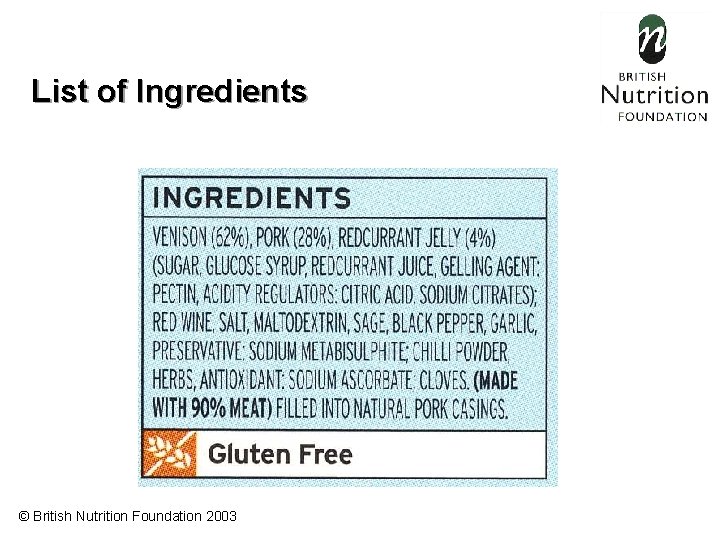
List of Ingredients © British Nutrition Foundation 2003
Other information – information on additives & other ingredients not legally required to be labelled – nutrients present in food – nutrition &/or health claims – information on allergens present in food – processing or production methods (e. g. organic) – logos & endorsements – guideline daily amounts © British Nutrition Foundation 2003
Labelling jargon • RDA - Recommended Daily Amount – part of EU directive on Nutrition Labelling – estimates of the amount of vitamins & minerals needed to meet or more than meet the needs of a group of adults • GDAs - Guideline Daily Amounts © British Nutrition Foundation 2003

Nutrition Labelling • not mandatory unless a nutrition claim is made • must be in 1 of 2 formats • Group 1 declaration – energy, protein, carbohydrate and fat • Group 2 declaration – as above plus sugars, saturates, fibre and sodium © British Nutrition Foundation 2003

Nutrition Labelling • In addition, these nutrients can be included in a nutrient declaration on a voluntary basis: – starch – monounsaturates, polyunsaturates or cholesterol – specified vitamins and nutrients present in significant amounts • If a claim is made about these nutrients they MUST be labelled © British Nutrition Foundation 2003

Nutrition Labelling Voluntary information Prescribed format Derived from Estimated Average Requirements for energy © British Nutrition Foundation 2003
Nutrition Claims • Any representation, other than the nutrition labelling, that states or implies that a food contains, or has a high or low amount of one or more nutrients is a nutrition claim • If a nutrition claim is made, nutrition labelling is mandatory © British Nutrition Foundation 2003
Nutrition Claims • Nutrient (or content) claims – refers to the level of a nutrient in a food e. g. source of calcium • Comparative claims – comparison of nutrient levels of 2 or more foods, using descriptors such as ‘higher’ or ‘lower’, e. g. contains % more calcium © British Nutrition Foundation 2003

Nutrition Claims • Nutrient function claims – refers to physiological role of nutrient in its relationship to growth, development or other normal functions e. g. aids in the development of strong bones & teeth • Medical claims are illegal e. g. prevents osteoporosis © British Nutrition Foundation 2003
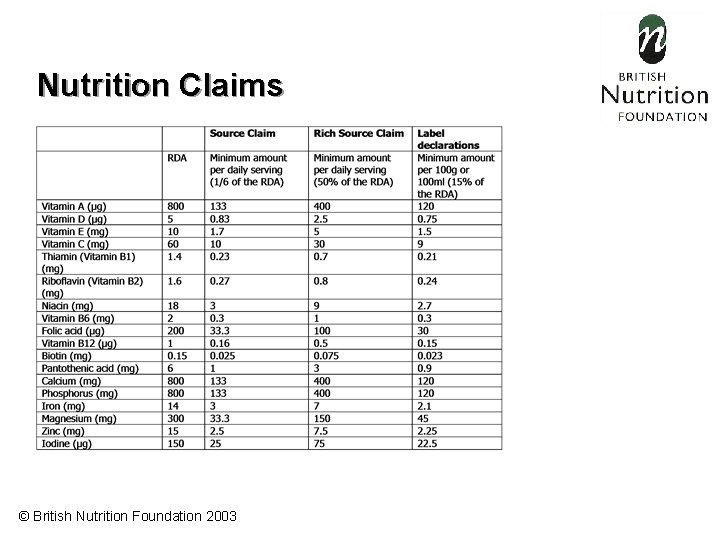
Nutrition Claims © British Nutrition Foundation 2003
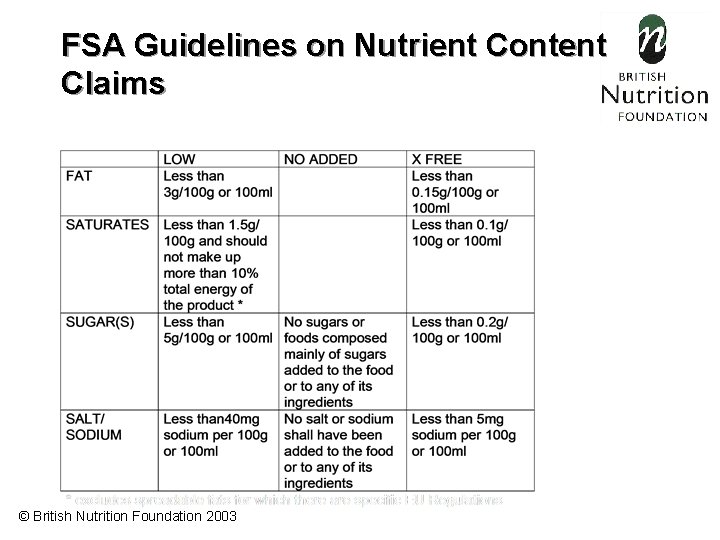
FSA Guidelines on Nutrient Content Claims © British Nutrition Foundation 2003
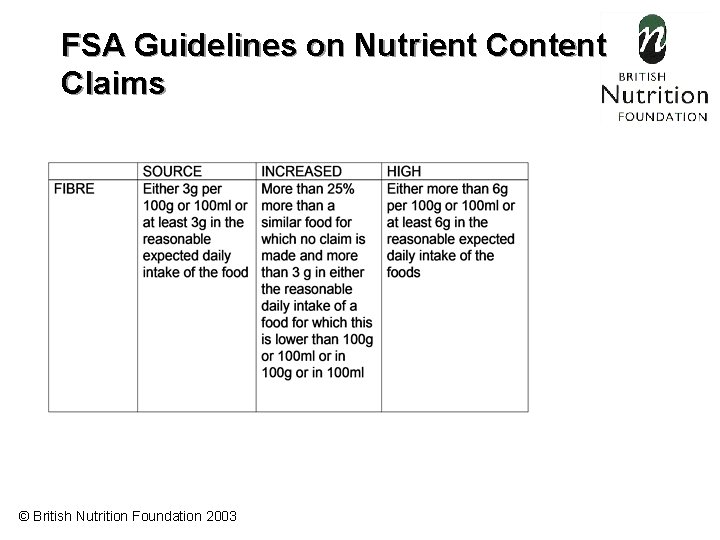
FSA Guidelines on Nutrient Content Claims © British Nutrition Foundation 2003
New EU Proposal on Claims • Will define many nutrient claims – low fat – light/lite (reduced by 25%) • Will prohibit some claims – ‘% fat free’ claims – use of the term ‘diet’ © British Nutrition Foundation 2003
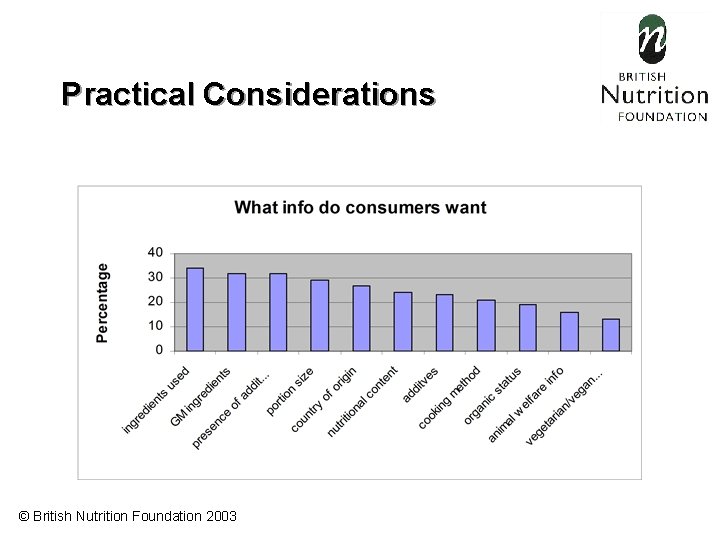
Practical Considerations • Space - priority of information? © British Nutrition Foundation 2003
Practical Considerations • Space – priority of information? • Legibility • Font size & colour • Colour – avoid red and green combinations © British Nutrition Foundation 2003
The Future • Legislation for health claims • Other ways to share detailed information about the foods we buy Examples: – bar codes – internet • Foods with no labels? What will happen? © British Nutrition Foundation 2003
Further Information • British Nutrition Foundation www. nutrition. org. uk • Food Standards Agency www. food. gov. uk • Institute of Grocery Distribution www. igd. com • Sainsbury’s Taste of Success www. jsainsbury. co. uk/tasteofsuccess © British Nutrition Foundation 2003
- Slides: 23