
Food Industry Safety Objectives To identify and apply
Food Industry Safety

Objectives • To identify and apply industry control standards as it pertains to food service • To explore management and employee responsibilities for workplace safety • To determine regulation and standards that guide food safety in the food service industry

Restaurant Food Safety Control Procedures • Wear hair restraints • Make sure uniform, apron, hands, forearms & fingernails are clean • Wash hands before starting work & whenever necessary

Restaurant Food Safety Control Procedures • Wash hands & exposed skin for at least 20 seconds • Do not work if you have an open wound, a cold or any other communicable illness • Do not work if exposed to E. Coli, Salmonella or Shigella
Restaurant Food Safety Control Procedures • Do not work if exposed to Hepatitis A • Handle dishes, glasses & silver by their bases • Store tableware in a clean dry place at least six inches from ground
Restaurant Food Safety Control Procedures • Wipe tables & counters with cloth rinsed in sanitization solution • Bring clean utensil to replace fallen one • Avoid unnecessary contact with soiled surfaces • Keep dirty dishes away from foods to be served • Pour refills without touching rim of the glass or cup • Notify guests that clean plates are to be used each time they return to self-serve areas
Restaurant Food Safety Control Procedures • Heat small quantities of food at a time • Stir frequently • Heat food close to service time • Use preheated foods whenever possible when preparing hot foods • Avoid crowding the refrigerator • Vent hot foods in an ice bath
Restaurant Food Safety Control Procedures • Use pre-chilled foods when preparing cold food items • Store cooked foods over raw foods • Never thaw raw foods at room temperature • Thaw foods under refrigeration in leak proof containers to prevent cross-contamination • Thaw foods under cold running water

Restaurant Food Safety Control Procedures • Use a different knife when cutting meat, poultry, seafood & vegetables • Use a different cutting board when dealing with meat, poultry, seafood & vegetables • Do not eat, drink, smoke or chew gum in food preparation areas
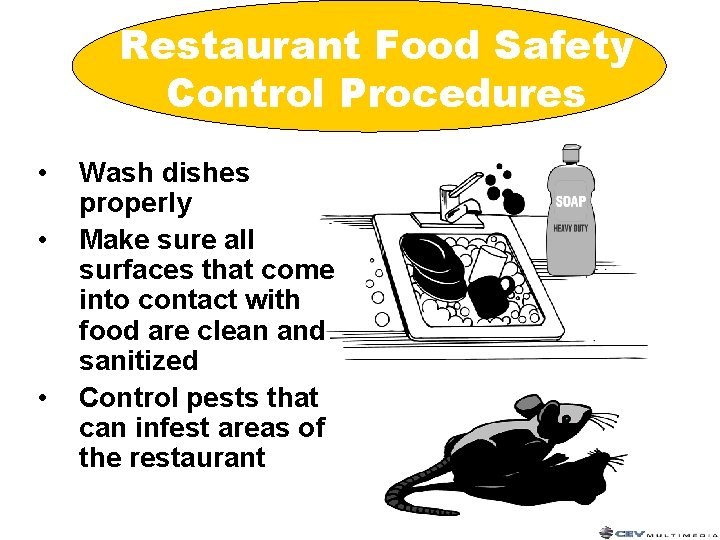
Restaurant Food Safety Control Procedures • • • Wash dishes properly Make sure all surfaces that come into contact with food are clean and sanitized Control pests that can infest areas of the restaurant
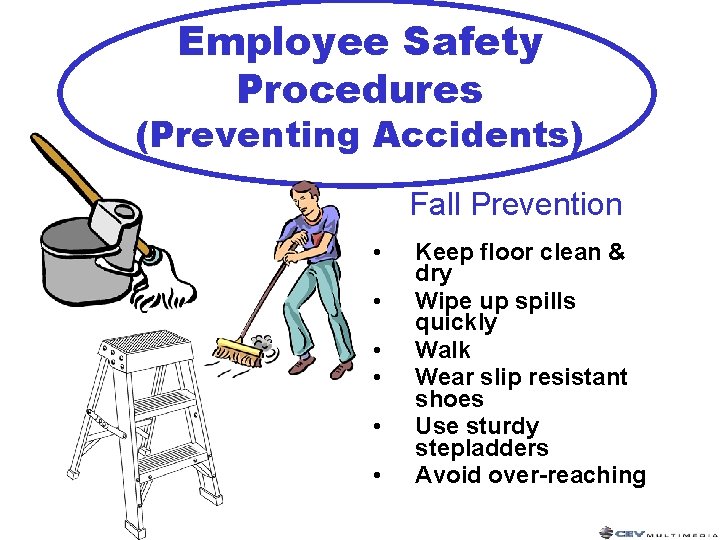
Employee Safety Procedures (Preventing Accidents) Fall Prevention • • • Keep floor clean & dry Wipe up spills quickly Walk Wear slip resistant shoes Use sturdy stepladders Avoid over-reaching
Employee Safety Procedures (Preventing Accidents) Fire Prevention • • • Keep range, ovens and hoods free from grease Do not overheat fats Never leave hot fat unattended Check pilot lights and all burners before lighting range Strike match before turning on the gas when lighting If there is a smell of gas when entering kitchen, check the pilot lights
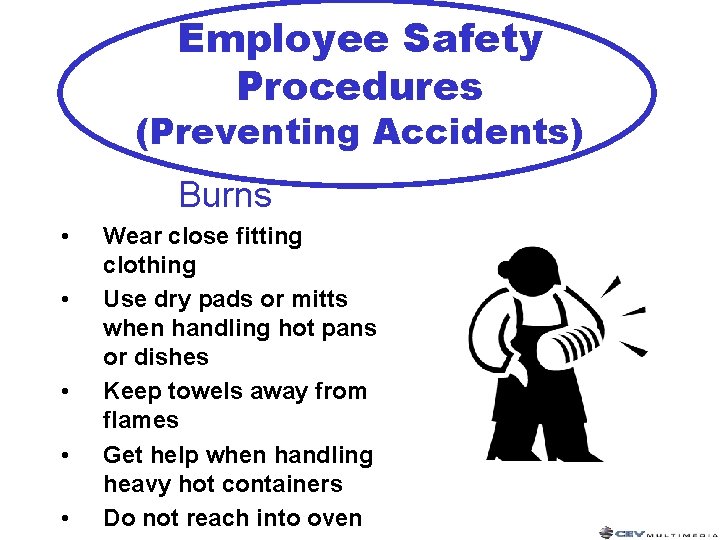
Employee Safety Procedures (Preventing Accidents) Burns • • • Wear close fitting clothing Use dry pads or mitts when handling hot pans or dishes Keep towels away from flames Get help when handling heavy hot containers Do not reach into oven
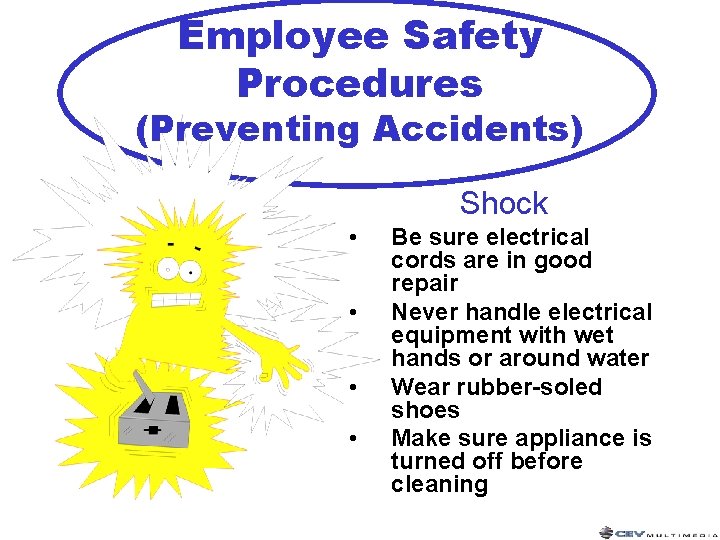
Employee Safety Procedures (Preventing Accidents) Shock • • Be sure electrical cords are in good repair Never handle electrical equipment with wet hands or around water Wear rubber-soled shoes Make sure appliance is turned off before cleaning
Employee Safety Procedures (Preventing Accidents) Cuts • • • Keep knives sharp Pick up knives by handle Never try to catch a knife Use safety guard when using slicing machine Use tampers to push food into chopper Pay attention to what you are doing • • Discard broken glass in proper receptacle Do not pick up broken glass with bare hands Handle glass and dishes carefully Discard open cans & lids quickly
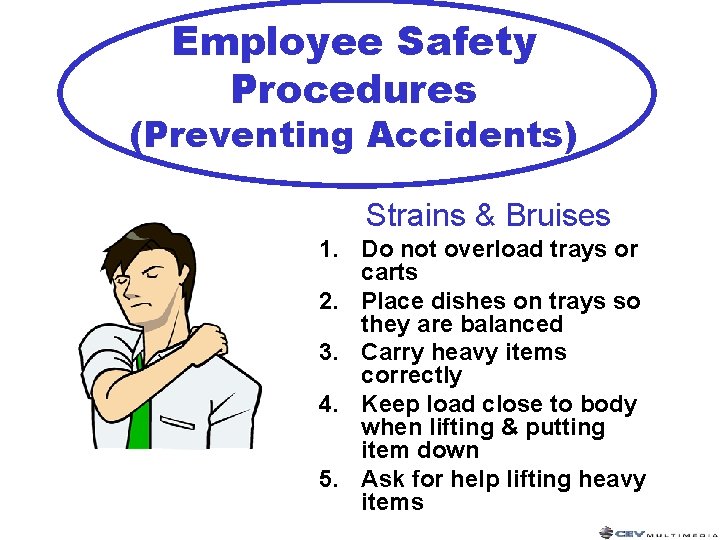
Employee Safety Procedures (Preventing Accidents) Strains & Bruises 1. Do not overload trays or carts 2. Place dishes on trays so they are balanced 3. Carry heavy items correctly 4. Keep load close to body when lifting & putting item down 5. Ask for help lifting heavy items
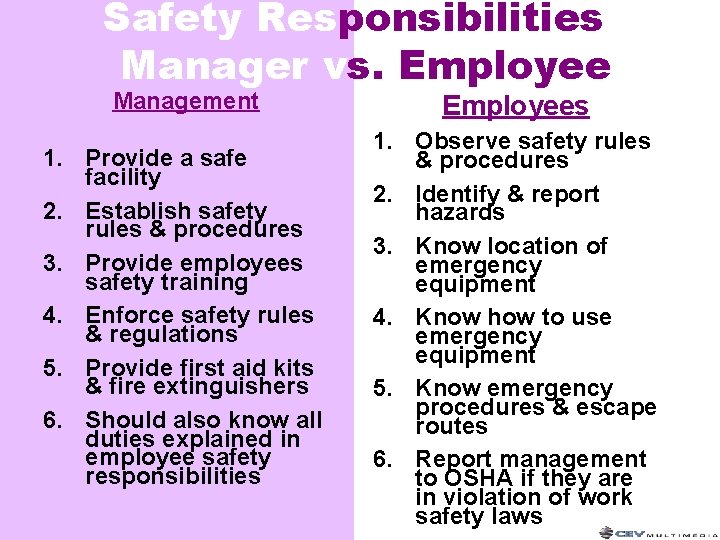
Safety Responsibilitiess Manager vs. Employee Management Employees 1. Provide a safe facility 2. Establish safety rules & procedures 3. Provide employees safety training 4. Enforce safety rules & regulations 5. Provide first aid kits & fire extinguishers 6. Should also know all duties explained in employee safety responsibilities 1. Observe safety rules & procedures 2. Identify & report hazards 3. Know location of emergency equipment 4. Know how to use emergency equipment 5. Know emergency procedures & escape routes 6. Report management to OSHA if they are in violation of work safety laws
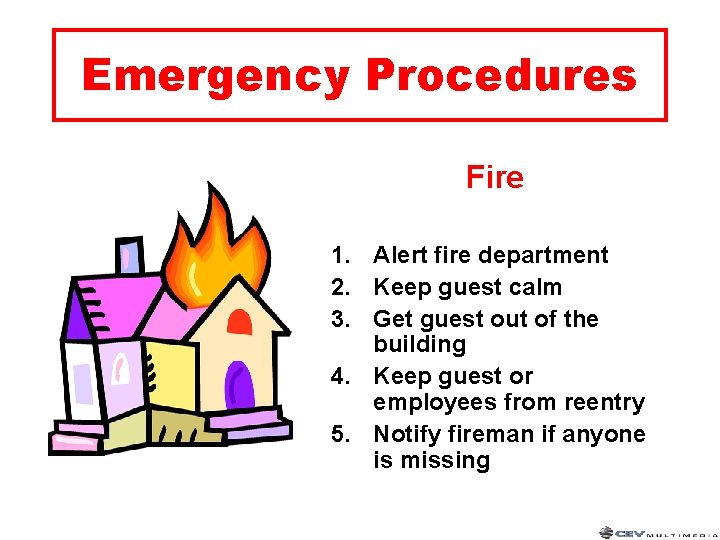
Emergency Procedures Fire 1. Alert fire department 2. Keep guest calm 3. Get guest out of the building 4. Keep guest or employees from reentry 5. Notify fireman if anyone is missing
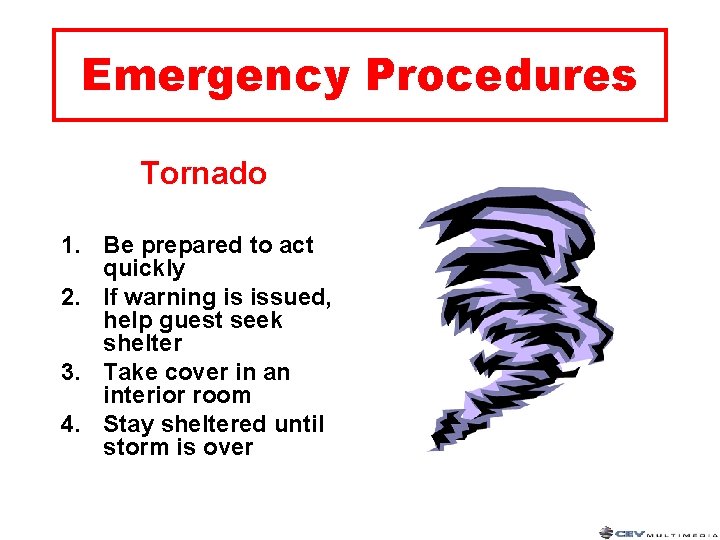
Emergency Procedures Tornado 1. Be prepared to act quickly 2. If warning is issued, help guest seek shelter 3. Take cover in an interior room 4. Stay sheltered until storm is over
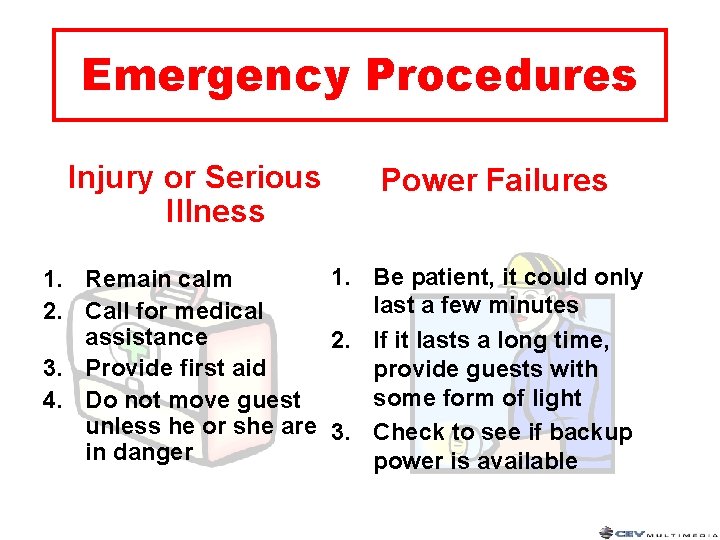
Emergency Procedures Injury or Serious Illness Power Failures 1. Be patient, it could only 1. Remain calm last a few minutes 2. Call for medical assistance 2. If it lasts a long time, 3. Provide first aid provide guests with some form of light 4. Do not move guest unless he or she are 3. Check to see if backup in danger power is available
Laws & Policies Governing Food Safety Purpose of Food Code • Safeguard public health • Provide safe food

Laws & Policies Governing Food Safety Hazardous Analysis Critical Control Point (HACCP) Purpose of HACCP To identify critical control points of food safety throughout its lifetime in the restaurant Critical Control Points 1. Purchasing & Receiving 2. Storage 3. Preparation 4. Holding 5. Serving
Laws & Policies Governing Food Service Safety Food Safety Training & Education Alliance 1. Goals Coordinate efforts of government, industry and academia 2. Change behaviors at the retail level 3. Remove barriers to communication by facilitating information Developed as a result of President’s exchange Food Safety Initiative in 1997

Restaurant Liabilities to Customers • Occupational Safety & Health Act of 1970 (OSHA) – give all injured employees medical help – workplace free of hazards – inform employees about hazardous chemicals – allow inspections to ensure a safe workplace
Laws & Policies Governing Food Service Safety Universal Precautions • Contact with blood must be avoided • All body fluids (except sweat) should be considered potentials for infection • Universal precautions applies to everyone
QUIZ
QUIZ 1. When observing proper restaurant food safety control procedures, an individual will do all of the following except: A. wear hair restraints B. pick up a utensil off the floor and place it back on the table C. wash hands & exposed skin for at least 20 seconds D. avoid unnecessary contact with soiled materials

QUIZ 2. (T/F) When preparing chicken and steak, the employee should use one cutting board and knife for the chicken and a different one for the steak. 3. (T/F) When preparing food in a restaurant, it is acceptable for the employee to eat, drink, smoke or chew gum. 4. When preparing hot meals in a restaurant, the employee should use ______ food items whenever possible.

QUIZ 5. In order to avoid a fall in a restaurant, an employee should do all of the following except: A. B. C. D. keep floor clean and dry wear slip resistant shoes walk wear skid resistant shoes 6. (T/F) The more grease an individual allows on the range, oven or hoods, the less likely there is to be a fire.
QUIZ 7. In order to prevent getting burned, an individual should: A. wear loose clothing B. use moist towels or mitts when handling hot pans or dishes C. reach into the oven D. get help when handling hot containers 8. (T/F) Rubber-soled shoes will increase your chances of receiving an electric shock.
QUIZ 9. (T/F) In an emergency situation one of the most effective tactics is to remain calm. 10. This organization was developed after the president’s Food Safety Initiative in 1997: A. B. C. D. Food Code OSHA FSTEA HACCP

QUIZ Match the Responsibility in Column A to the Worker in Column B B A 1. Provide a safe facility 2. Observe safety rules 3. Identify and report safety hazards 4. Enforce safety rules 5. Provide safety training 6. Know emergency procedures & escape routes 1. Manager 2. Employee
Acknowledgements Altman, Tracy A. FDA and USDA Nutrition Labeling Guide: Decision Diagrams, Checklists and Regulations. Lancaster, PA: Technomic Pub. Co, 1998. Barth, Stephen, David K. Hayes, Jack D. Ninemeier. Restaurant Law Basics. New York: Wiley, 2001. Cournoyer, Norman G. , Anthony G. Marshall, Karen L. Morris. Hotel, Restaurant, and Travel Law: A Preventive Approach. Albany, NY: Delmar Publishers, 1999. The Curriculum Center for Family and Consumer Sciences. Texas Tech University. www. hs. ttu. edu/ccfcs. 2002 Dahmer, Sondra J. , Kurt W. Kahl. Restaurant Service Basics. New York: Wiley, 2002. Research Coordinator Junior Rivera Production Assistants Allison Mangold Treena Aston Graphics Editor Clayton Franklin Executive Producer G. W. Davis Production Manager Geoff Scott ©MMVII CEV Multimedia, Ltd.
- Slides: 33