
Food Hygiene Safety Microbes in food This project
Food Hygiene & Safety Microbes in food This project has received funding from the European Union’s Horizon 2020 research and innovation programme under grant agreement No 727580.
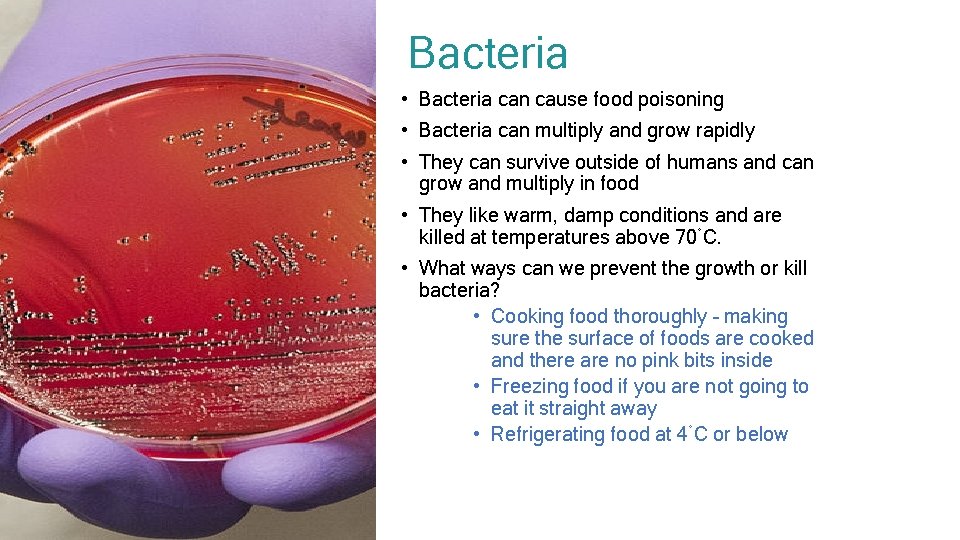
Bacteria • Bacteria can cause food poisoning • Bacteria can multiply and grow rapidly • They can survive outside of humans and can grow and multiply in food • They like warm, damp conditions and are killed at temperatures above 70°C. • What ways can we prevent the growth or kill bacteria? • Cooking food thoroughly – making sure the surface of foods are cooked and there are no pink bits inside • Freezing food if you are not going to eat it straight away • Refrigerating food at 4°C or below
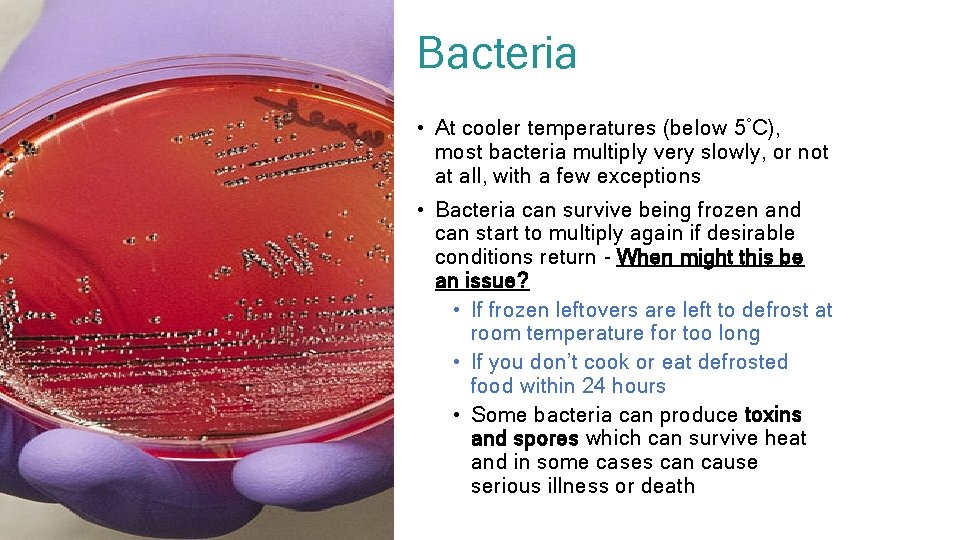
Bacteria • At cooler temperatures (below 5°C), most bacteria multiply very slowly, or not at all, with a few exceptions • Bacteria can survive being frozen and can start to multiply again if desirable conditions return - When might this be an issue? • If frozen leftovers are left to defrost at room temperature for too long • If you don’t cook or eat defrosted food within 24 hours • Some bacteria can produce toxins and spores which can survive heat and in some cases can cause serious illness or death
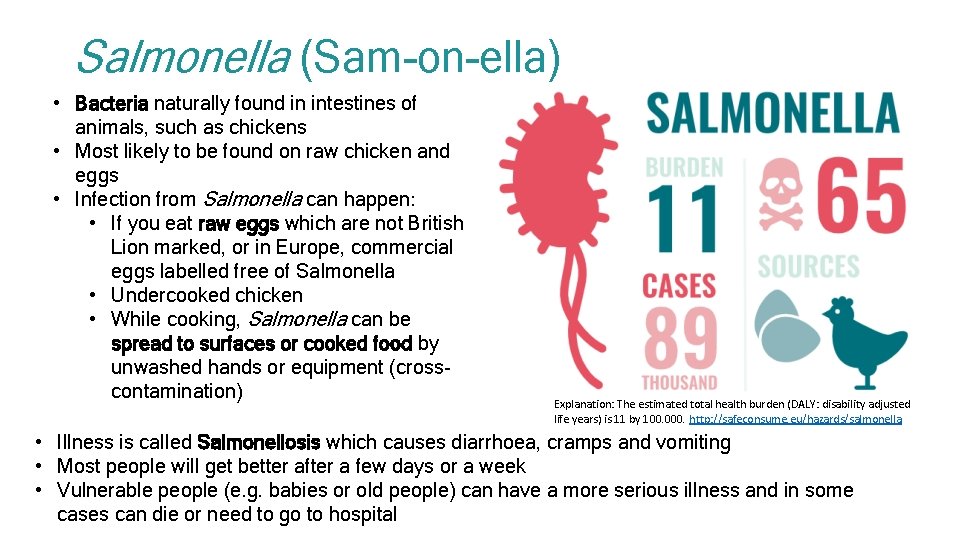
Salmonella (Sam-on-ella) • Bacteria naturally found in intestines of animals, such as chickens • Most likely to be found on raw chicken and eggs • Infection from Salmonella can happen: • If you eat raw eggs which are not British Lion marked, or in Europe, commercial eggs labelled free of Salmonella • Undercooked chicken • While cooking, Salmonella can be spread to surfaces or cooked food by unwashed hands or equipment (crosscontamination) Explanation: The estimated total health burden (DALY: disability adjusted life years) is 11 by 100. 000. http: //safeconsume. eu/hazards/salmonella • Illness is called Salmonellosis which causes diarrhoea, cramps and vomiting • Most people will get better after a few days or a week • Vulnerable people (e. g. babies or old people) can have a more serious illness and in some cases can die or need to go to hospital
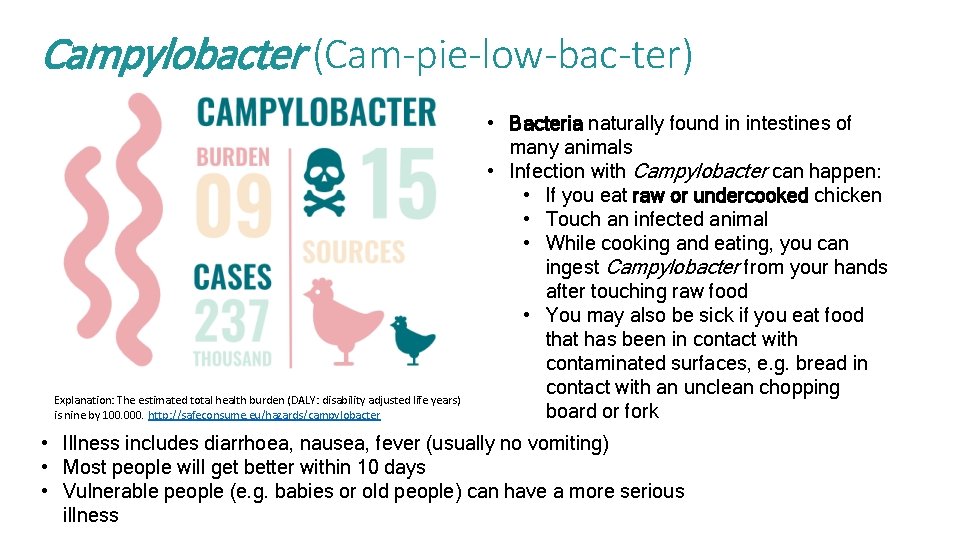
Campylobacter (Cam-pie-low-bac-ter) Explanation: The estimated total health burden (DALY: disability adjusted life years) is nine by 100. 000. http: //safeconsume. eu/hazards/campylobacter • Bacteria naturally found in intestines of many animals • Infection with Campylobacter can happen: • If you eat raw or undercooked chicken • Touch an infected animal • While cooking and eating, you can ingest Campylobacter from your hands after touching raw food • You may also be sick if you eat food that has been in contact with contaminated surfaces, e. g. bread in contact with an unclean chopping board or fork • Illness includes diarrhoea, nausea, fever (usually no vomiting) • Most people will get better within 10 days • Vulnerable people (e. g. babies or old people) can have a more serious illness
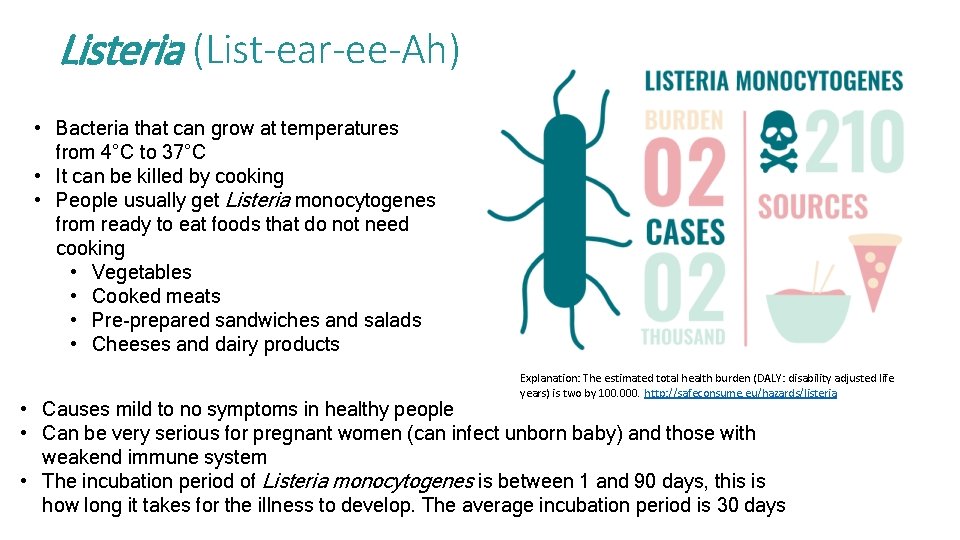
Listeria (List-ear-ee-Ah) • Bacteria that can grow at temperatures from 4°C to 37°C • It can be killed by cooking • People usually get Listeria monocytogenes from ready to eat foods that do not need cooking • Vegetables • Cooked meats • Pre-prepared sandwiches and salads • Cheeses and dairy products Explanation: The estimated total health burden (DALY: disability adjusted life years) is two by 100. 000. http: //safeconsume. eu/hazards/listeria • Causes mild to no symptoms in healthy people • Can be very serious for pregnant women (can infect unborn baby) and those with weakend immune system • The incubation period of Listeria monocytogenes is between 1 and 90 days, this is how long it takes for the illness to develop. The average incubation period is 30 days
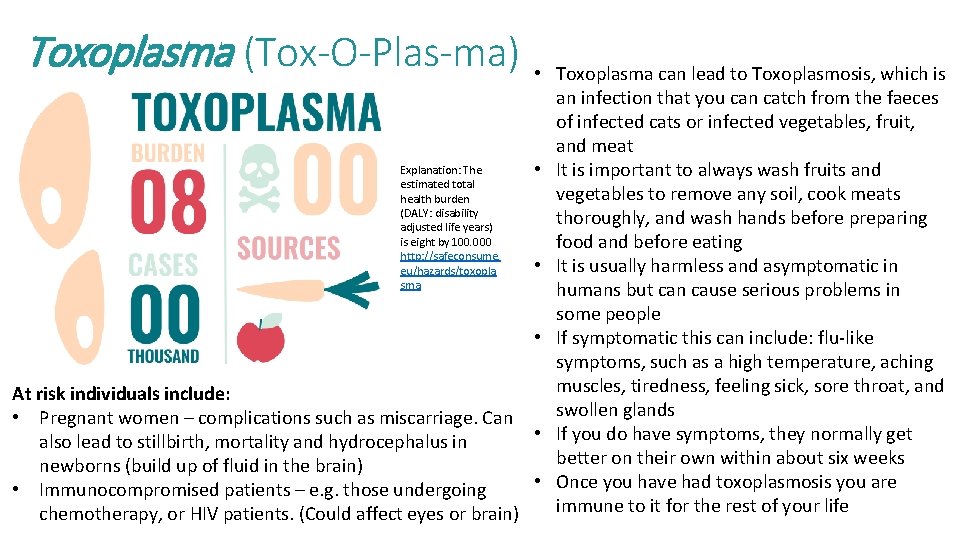
Toxoplasma (Tox-O-Plas-ma) • Explanation: The estimated total health burden (DALY: disability adjusted life years) is eight by 100. 000 http: //safeconsume. eu/hazards/toxopla sma • • • At risk individuals include: • Pregnant women – complications such as miscarriage. Can • also lead to stillbirth, mortality and hydrocephalus in newborns (build up of fluid in the brain) • • Immunocompromised patients – e. g. those undergoing chemotherapy, or HIV patients. (Could affect eyes or brain) Toxoplasma can lead to Toxoplasmosis, which is an infection that you can catch from the faeces of infected cats or infected vegetables, fruit, and meat It is important to always wash fruits and vegetables to remove any soil, cook meats thoroughly, and wash hands before preparing food and before eating It is usually harmless and asymptomatic in humans but can cause serious problems in some people If symptomatic this can include: flu-like symptoms, such as a high temperature, aching muscles, tiredness, feeling sick, sore throat, and swollen glands If you do have symptoms, they normally get better on their own within about six weeks Once you have had toxoplasmosis you are immune to it for the rest of your life
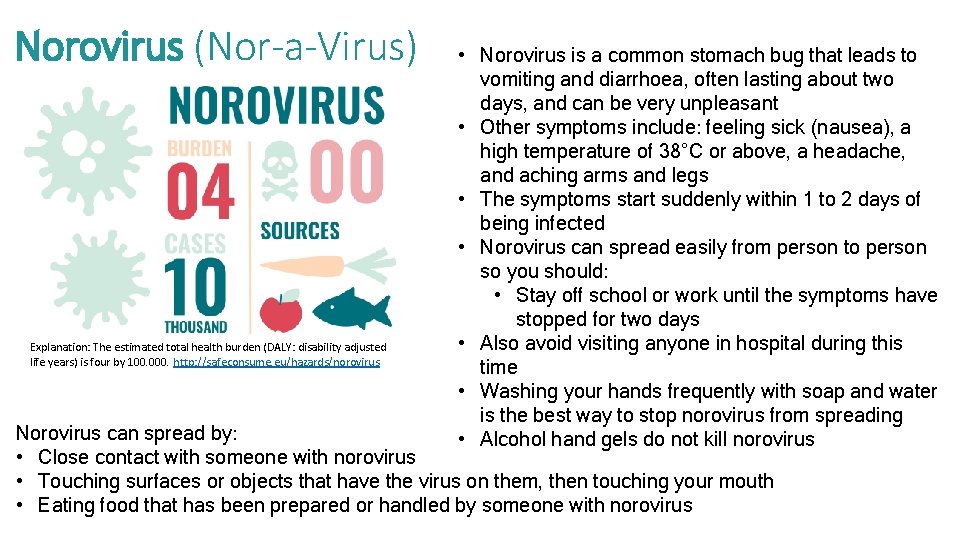
Norovirus (Nor-a-Virus) Explanation: The estimated total health burden (DALY: disability adjusted life years) is four by 100. 000. http: //safeconsume. eu/hazards/norovirus • Norovirus is a common stomach bug that leads to vomiting and diarrhoea, often lasting about two days, and can be very unpleasant • Other symptoms include: feeling sick (nausea), a high temperature of 38°C or above, a headache, and aching arms and legs • The symptoms start suddenly within 1 to 2 days of being infected • Norovirus can spread easily from person to person so you should: • Stay off school or work until the symptoms have stopped for two days • Also avoid visiting anyone in hospital during this time • Washing your hands frequently with soap and water is the best way to stop norovirus from spreading • Alcohol hand gels do not kill norovirus Norovirus can spread by: • Close contact with someone with norovirus • Touching surfaces or objects that have the virus on them, then touching your mouth • Eating food that has been prepared or handled by someone with norovirus
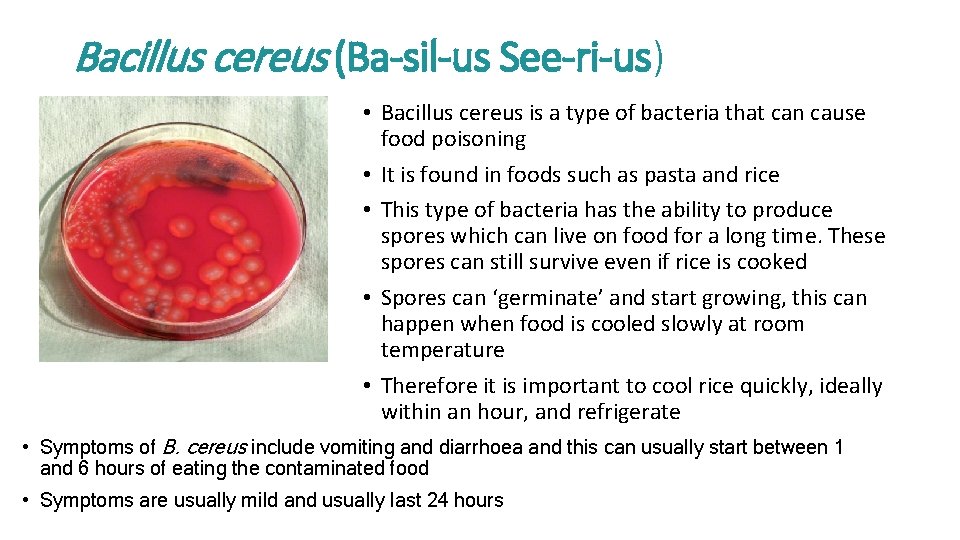
Bacillus cereus (Ba-sil-us See-ri-us) • Bacillus cereus is a type of bacteria that can cause food poisoning • It is found in foods such as pasta and rice • This type of bacteria has the ability to produce spores which can live on food for a long time. These spores can still survive even if rice is cooked • Spores can ‘germinate’ and start growing, this can happen when food is cooled slowly at room temperature • Therefore it is important to cool rice quickly, ideally within an hour, and refrigerate • Symptoms of B. cereus include vomiting and diarrhoea and this can usually start between 1 and 6 hours of eating the contaminated food • Symptoms are usually mild and usually last 24 hours
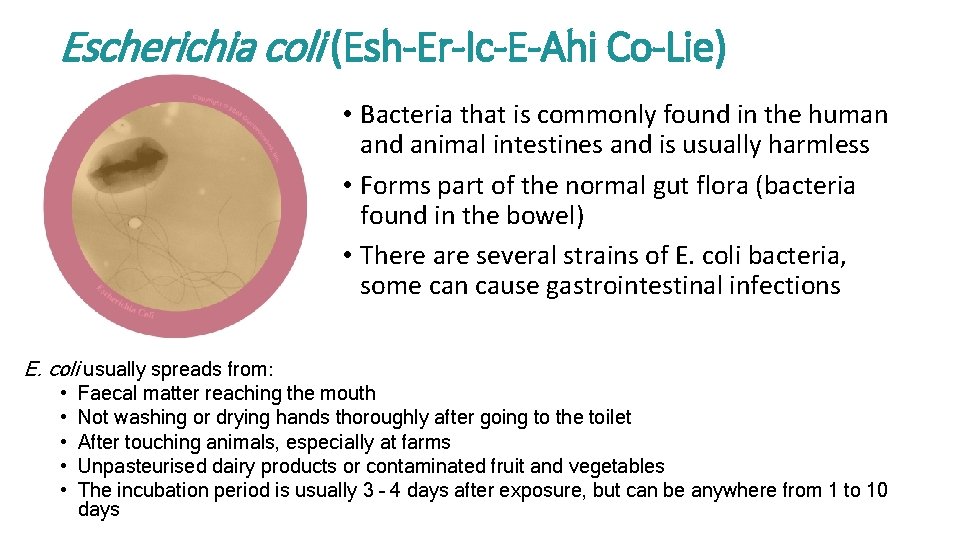
Escherichia coli (Esh-Er-Ic-E-Ahi Co-Lie) • Bacteria that is commonly found in the human and animal intestines and is usually harmless • Forms part of the normal gut flora (bacteria found in the bowel) • There are several strains of E. coli bacteria, some can cause gastrointestinal infections E. coli usually spreads from: • Faecal matter reaching the mouth • Not washing or drying hands thoroughly after going to the toilet • After touching animals, especially at farms • Unpasteurised dairy products or contaminated fruit and vegetables • The incubation period is usually 3 – 4 days after exposure, but can be anywhere from 1 to 10 days
- Slides: 10