
Food Handler Certification An Overview A Scott Gilliam
- Slides: 32
Food Handler Certification An Overview A. Scott Gilliam, MBA, CFSP Director, Food Protection Indiana State Department of Health (ISDH)
The Conference for Food Protection (CFP) l A non-profit organization that provides input into the formulation of retail food laws in America.
Stakeholders Represented in the CFP l Regulators l Retail Food Industry l Academic Institutions l Professional Organizations l Consumers
Objectives of the CFP l Identify retail food safety problems and promote solutions that are based on sound science l Promote the uniform interpretation and implementation of regulations governing food safety l Work with all stakeholders to disseminate information regarding food safety issues
Standing and Ad Hoc Committees l Several committees work between the regular meetings of the Conference to research problems, develop interventions and address various retail food safety issues – Example is the Retail Food Manager Certification Committee
Demonstration of Competency l The FDA Model Food Code requires retail food managers to demonstrate competency in food safety including knowledge of the: – causes of foodborne illness, – factors that contribute to these diseases, and – basic food safety measures that can be implemented to prevent foodborne illness
Three Ways to Demonstrate Competency – Have a history of high sanitation scores at the establishment – Answer questions posed by the inspector, or – Pass a CFP “Recognized” Food Protection Manager Certification Examination
ISDH Rule 410 IAC 7 -20 -95 (Indiana Version of the FDA Competency Provision) l Requires Foodborne Illness Prevention Training - Section 95 l Training must cover the same knowledge areas of competency as the FDA l Proven to be problematic
Concerns of the Regulatory Community l Agencies lack the skills and resources required to evaluate examinations, certification programs, and credentials l Agencies need to be sure that people who hold certificates are deemed to be competent through a valid, reliable and legally defensible process
Concerns of the Retail Food Industry l Training and testing must be readily available and at a reasonable cost l The lack of standardization across jurisdictions impedes reciprocity l Unregulated certification programs may result in meaningless credentials and people who are certified, but who may not be competent
CFP Accreditation Process l Intended to assure that certification programs: – use only instruments that have been developed according to sound psychometric principles to test managers – test managers only on information essential to food safety practices
CFP Accreditation Process l Ensures that legal and due process rights are maintained for certified individuals l Provides adequate test security l Prevents instructors from teaching to the test
Benefits to Regulatory Jurisdictions No need to expend resources to evaluate programs l Assured that all accredited programs have met, and continue to meet CFP Standards l Uniform national standard for compliance which facilitates reciprocity l
Benefits to Providers l Ensures that all programs have met minimum quality standards l Eliminates the need for certifying agencies to gain acceptance in hundreds of jurisdictions
Benefits to Candidates l Assures that the certificate is based on a valid, reliable, and legally defensible assessment process l Allows competitive market forces to benefit candidates (ie. , price of exams) without sacrificing examination quality
Benefits to Candidates l Allows reciprocity among jurisdictions without having to recertify l Protects a candidate’s due process and legal rights
Benefits to the Consumer l Better trained individuals in oversight positions will provide a safer food product and reduce disease spread l Will reduce employee turnover thereby minimizing the need for retraining which will translate into better quality service
Senate Bill 404 created Indiana Code 16 -42 -5. 2 l Created certification in Indiana l Mandates that the state develop a rule to administer the program l Mandates the state develop penalties for noncompliance
Food Handler Certification (FHC) Rule 410 IAC 7 -22 l Preliminarily adopted on November 13, 2002 by the ISDH Executive Board l Became effective June 13, 2003 l Mirrors state statute with some additions
Provisions of the new FHC rule: l Definitions l Requirements l Penalties
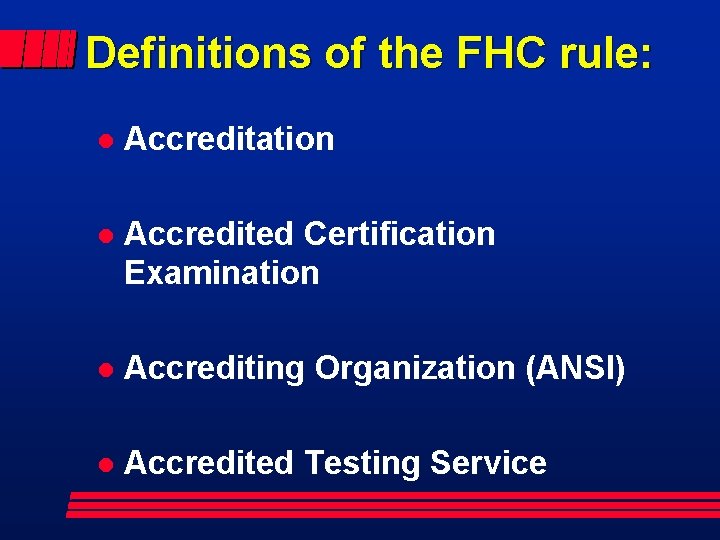
Definitions of the FHC rule: l Accreditation l Accredited Certification Examination l Accrediting Organization (ANSI) l Accredited Testing Service
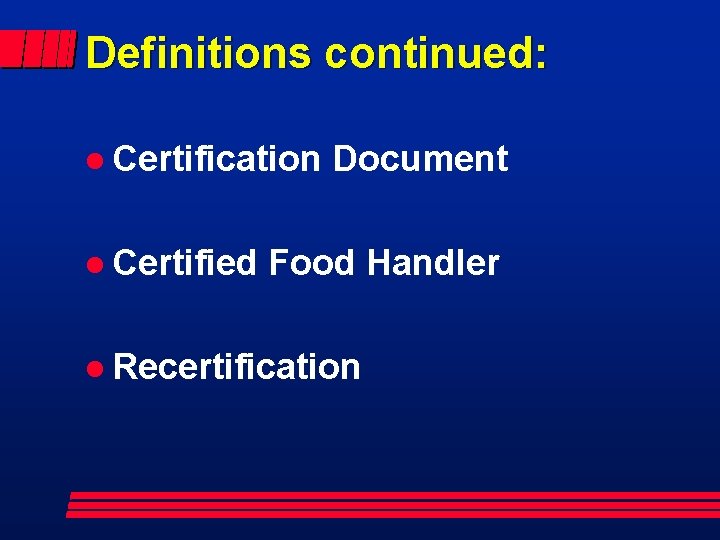
Definitions continued: l Certification l Certified Document Food Handler l Recertification
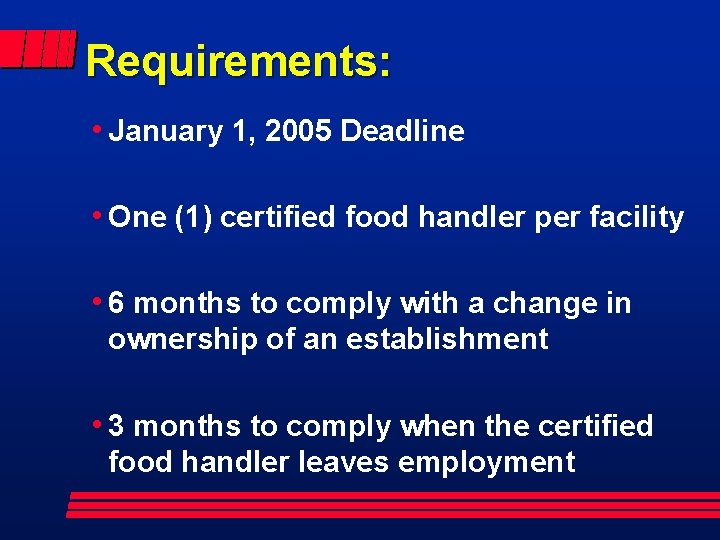
Requirements: h. January h. One 1, 2005 Deadline (1) certified food handler per facility h 6 months to comply with a change in ownership of an establishment h 3 months to comply when the certified food handler leaves employment
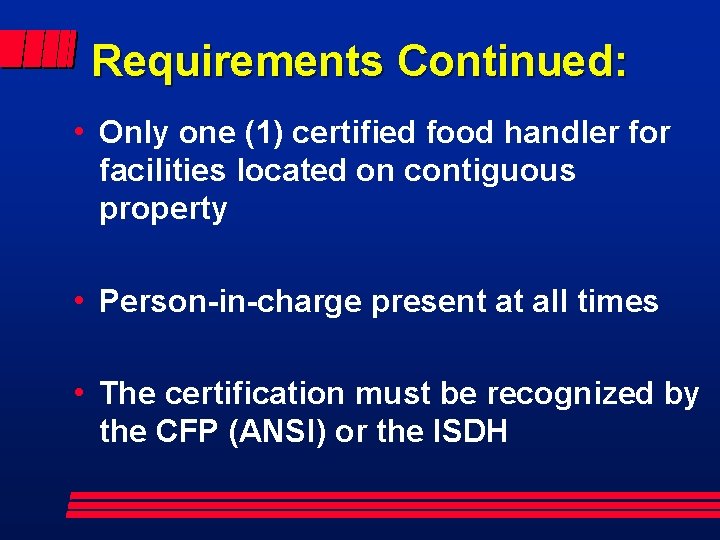
Requirements Continued: h Only one (1) certified food handler for facilities located on contiguous property h Person-in-charge h The present at all times certification must be recognized by the CFP (ANSI) or the ISDH
Certification Qualifications: l Successfully pass an accredited examination l Provide name, certification document and photo identification to regulatory authority upon request l Cannot represent themselves as certified unless legally certified
Additional Points: l Local Health Departments can not mandate any type of certification other than what is provided in the state law l Schools, prisons, jails must also comply l Certified person does not need to be present at all times
Exemptions to the law: l Hospitals, Nursing Homes, Assisted Living and Continuing Care Facilities l Food Establishments that minimally handle food, such as: – Serving precooked hot dogs/sausage products, nachos, pretzels, or frozen pizza – Preparing/serving continental breakfast
Exemptions continued: l Other minimal food operations – Preparing beverages or ice – Grinding coffee beans – Non-potentially hazardous prepackaged foods – Heating of bakery products – Providing food in its original package
Approved Providers of Exams: l Experior Assessments – www. experioronline. com – 800 -624 -2736
Approved Providers of Exams: l National Registry of Food safety Professionals – www. nrfsp. com 800 -446 -0257 l National Restaurant Association Educational Foundation – www. nraef. org 800 -765 -2122
Conclusion: l Rule is now in effect l Certification deadline is January 1, 2005 l Exemptions will have to be dealt with on a case by case basis, but the ISDH will provide guidance
Questions? www. in. gov/isdh/regsvcs/foodprot/ draftrule 1. htm