
Food for Thought The Globalization of Agriculture Chapter
Food for Thought: The Globalization of Agriculture Chapter 8
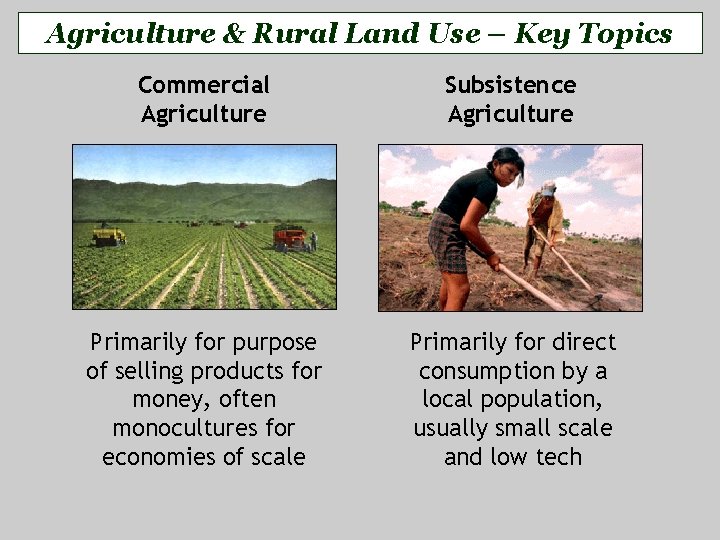
Agriculture & Rural Land Use – Key Topics Commercial Agriculture Subsistence Agriculture Primarily for purpose of selling products for money, often monocultures for economies of scale Primarily for direct consumption by a local population, usually small scale and low tech
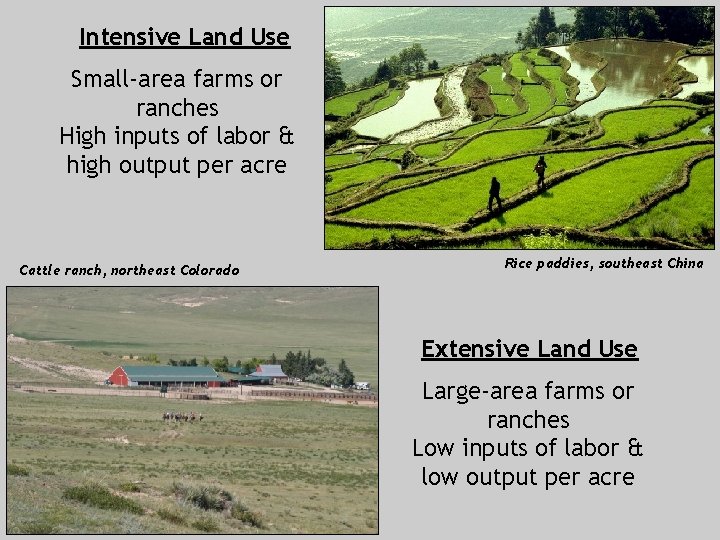
Intensive Land Use Small-area farms or ranches High inputs of labor & high output per acre Cattle ranch, northeast Colorado Rice paddies, southeast China Extensive Land Use Large-area farms or ranches Low inputs of labor & low output per acre
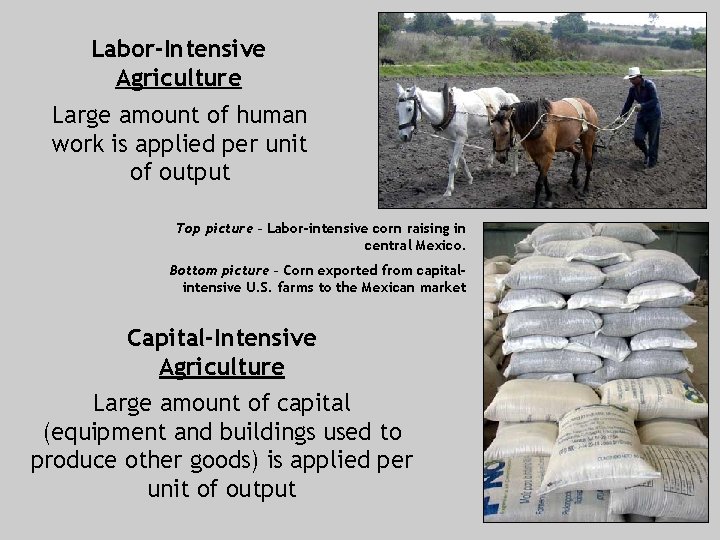
Labor-Intensive Agriculture Large amount of human work is applied per unit of output Top picture – Labor-intensive corn raising in central Mexico. Bottom picture – Corn exported from capitalintensive U. S. farms to the Mexican market Capital-Intensive Agriculture Large amount of capital (equipment and buildings used to produce other goods) is applied per unit of output
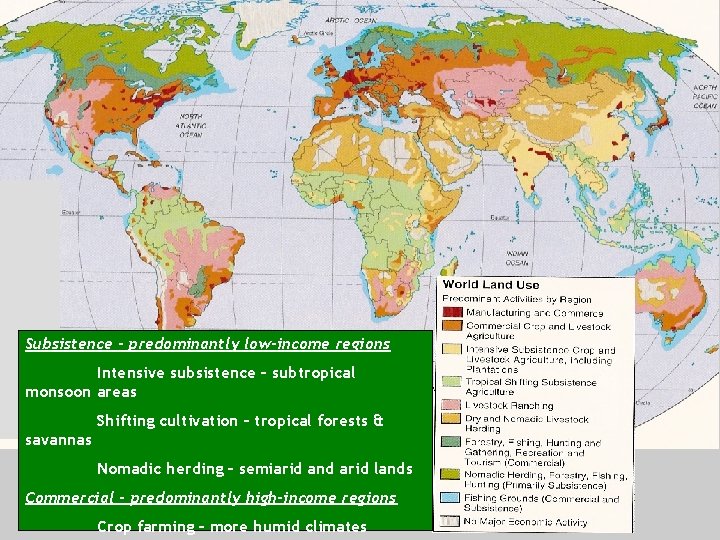
Subsistence – predominantly low-income regions Intensive subsistence – subtropical monsoon areas Shifting cultivation – tropical forests & savannas Nomadic herding – semiarid and arid lands Commercial – predominantly high-income regions Crop farming – more humid climates
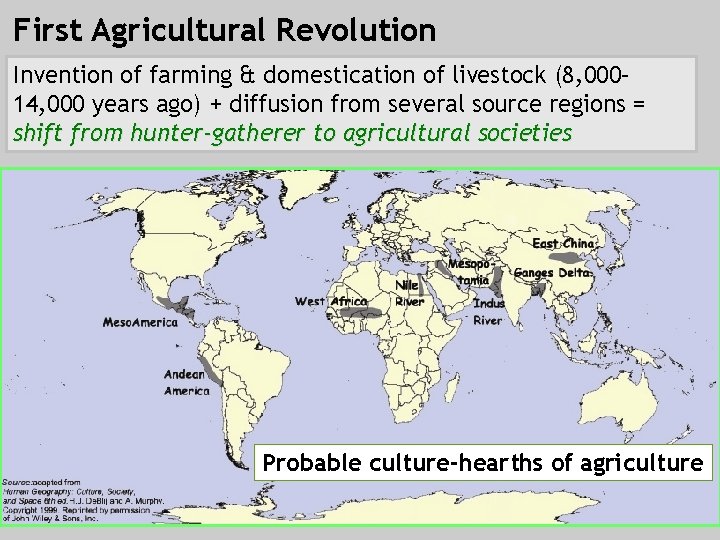
First Agricultural Revolution Invention of farming & domestication of livestock (8, 000– 14, 000 years ago) + diffusion from several source regions = shift from hunter-gatherer to agricultural societies Probable culture-hearths of agriculture
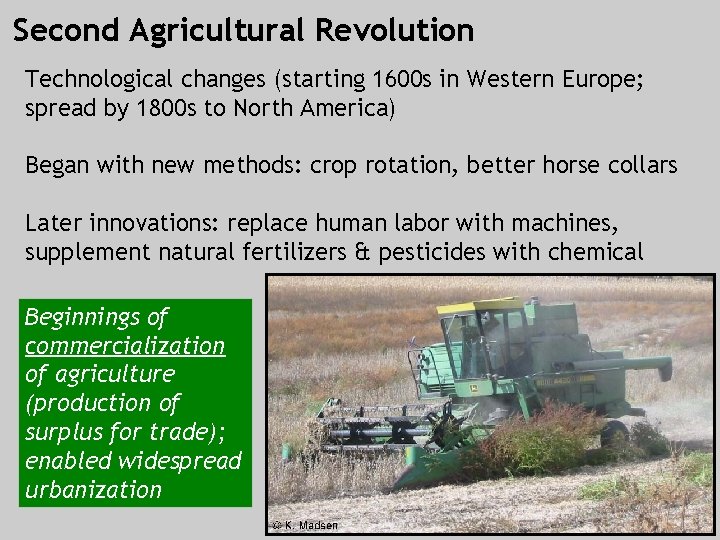
Second Agricultural Revolution Technological changes (starting 1600 s in Western Europe; spread by 1800 s to North America) Began with new methods: crop rotation, better horse collars Later innovations: replace human labor with machines, supplement natural fertilizers & pesticides with chemical Beginnings of commercialization of agriculture (production of surplus for trade); enabled widespread urbanization
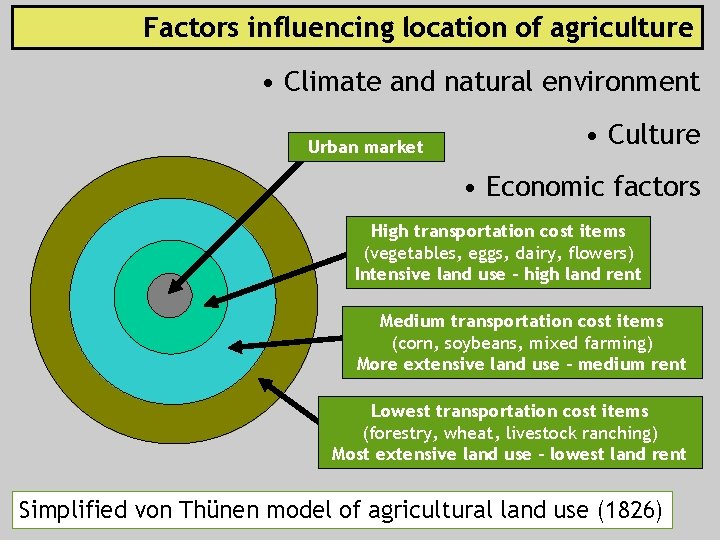
Factors influencing location of agriculture • Climate and natural environment Urban market • Culture • Economic factors High transportation cost items (vegetables, eggs, dairy, flowers) Intensive land use – high land rent Medium transportation cost items (corn, soybeans, mixed farming) More extensive land use – medium rent Lowest transportation cost items (forestry, wheat, livestock ranching) Most extensive land use – lowest land rent Simplified von Thünen model of agricultural land use (1826)
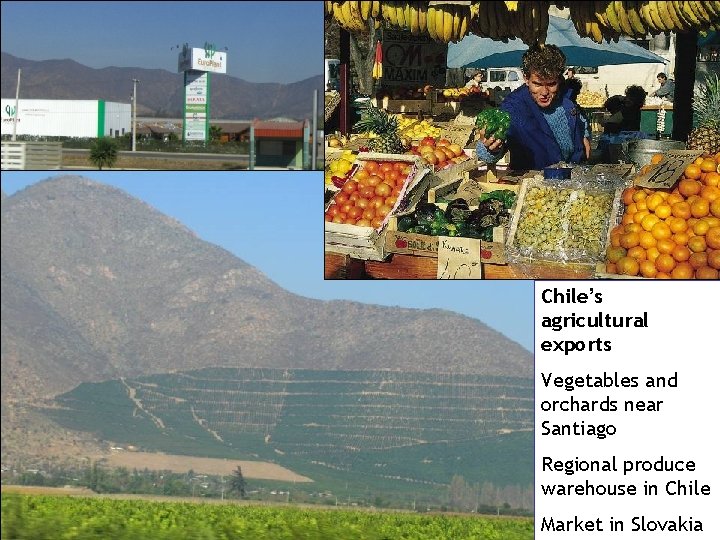
Chile’s agricultural exports Vegetables and orchards near Santiago Regional produce warehouse in Chile Market in Slovakia
Third Agricultural Revolution Since 1960 s - hybridized grains for better yields (“Green Revolution”) - greater reliance on synthetic fertilizers - genetically engineered crops - vertical integration of ownership (e. g. , Cargill, Con. Agra, ADM) - globalization of production A partial list of Con. Agra’s brands Swiss Miss Hunt’s Van Camp’s Marie Callender’s Wesson Hebrew National Slim Jim Egg Beaters Rosarita Chef Boyardee Reddi. Wip. Pam Peter Pan Orville Redenbacher’s Healthy Choice Banquet
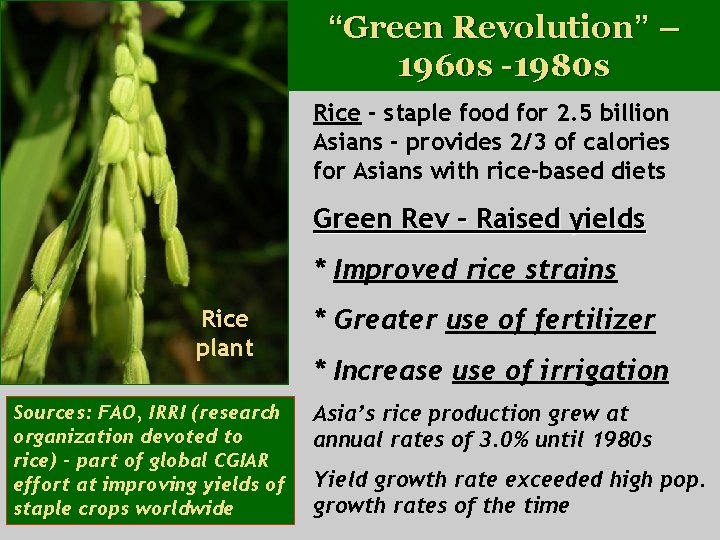
“Green Revolution” – 1960 s -1980 s Rice - staple food for 2. 5 billion Asians - provides 2/3 of calories for Asians with rice-based diets Green Rev – Raised yields * Improved rice strains Rice plant Sources: FAO, IRRI (research organization devoted to rice) – part of global CGIAR effort at improving yields of staple crops worldwide * Greater use of fertilizer * Increase use of irrigation Asia’s rice production grew at annual rates of 3. 0% until 1980 s Yield growth rate exceeded high pop. growth rates of the time

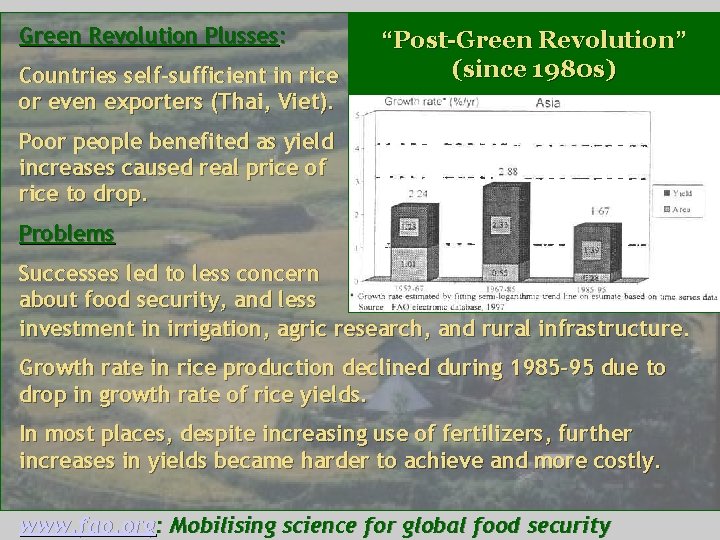
Green Revolution Plusses: Countries self-sufficient in rice or even exporters (Thai, Viet). “Post-Green Revolution” (since 1980 s) Poor people benefited as yield increases caused real price of rice to drop. Problems Successes led to less concern about food security, and less investment in irrigation, agric research, and rural infrastructure. Growth rate in rice production declined during 1985 -95 due to drop in growth rate of rice yields. In most places, despite increasing use of fertilizers, further increases in yields became harder to achieve and more costly. www. fao. org: Mobilising science for global food security
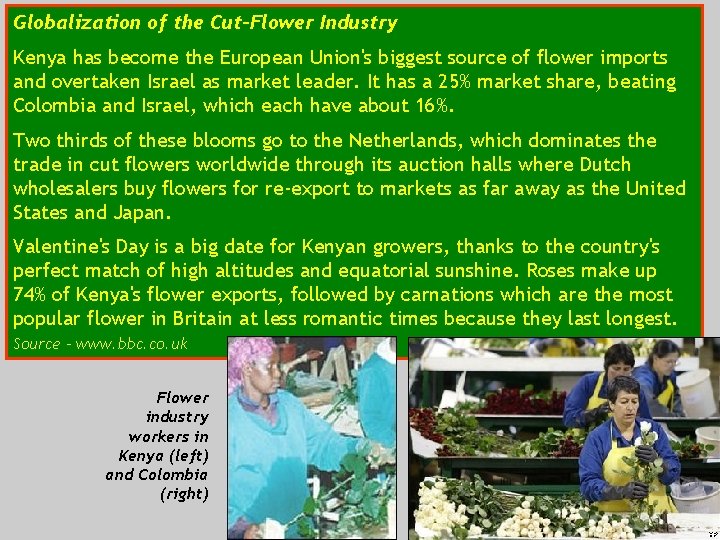
Globalization of the Cut-Flower Industry Kenya has become the European Union's biggest source of flower imports and overtaken Israel as market leader. It has a 25% market share, beating Colombia and Israel, which each have about 16%. Two thirds of these blooms go to the Netherlands, which dominates the trade in cut flowers worldwide through its auction halls where Dutch wholesalers buy flowers for re-export to markets as far away as the United States and Japan. Valentine's Day is a big date for Kenyan growers, thanks to the country's perfect match of high altitudes and equatorial sunshine. Roses make up 74% of Kenya's flower exports, followed by carnations which are the most popular flower in Britain at less romantic times because they last longest. Source – www. bbc. co. uk Flower industry workers in Kenya (left) and Colombia (right)
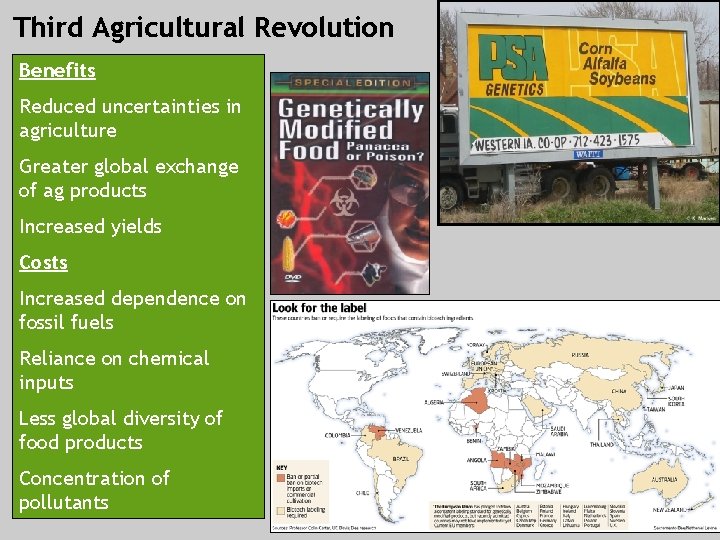
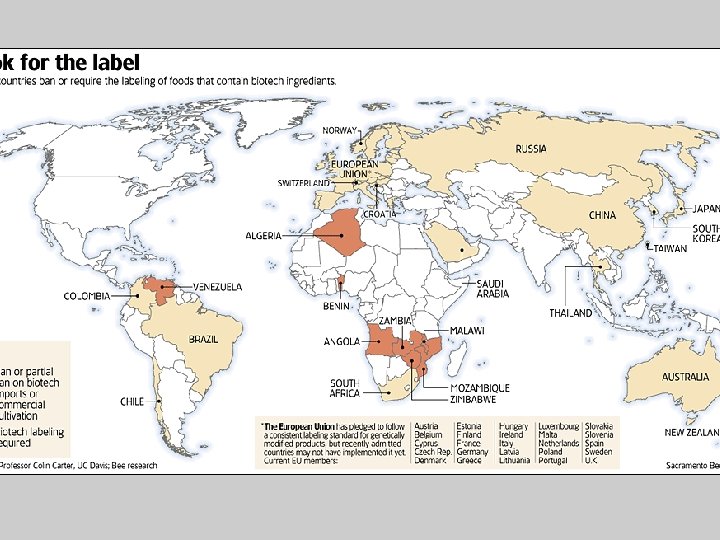
Third Agricultural Revolution Benefits Reduced uncertainties in agriculture Greater global exchange of ag products Increased yields Costs Increased dependence on fossil fuels Reliance on chemical inputs Less global diversity of food products Concentration of pollutants
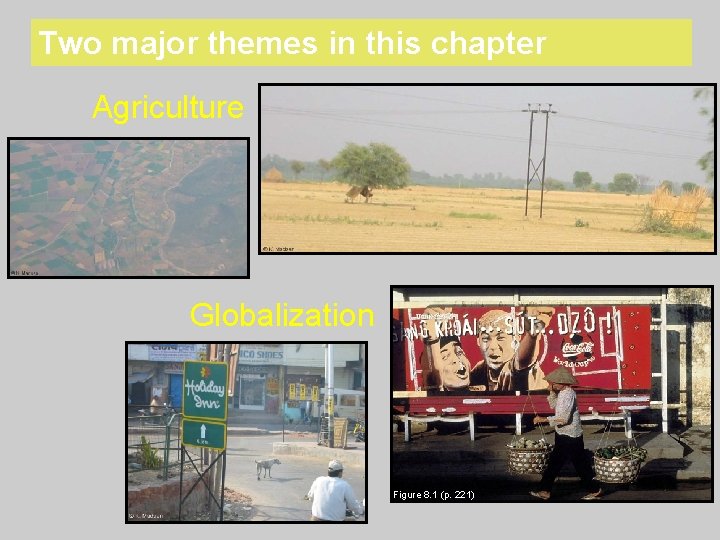
Two major themes in this chapter Agriculture Globalization Figure 8. 1 (p. 221)
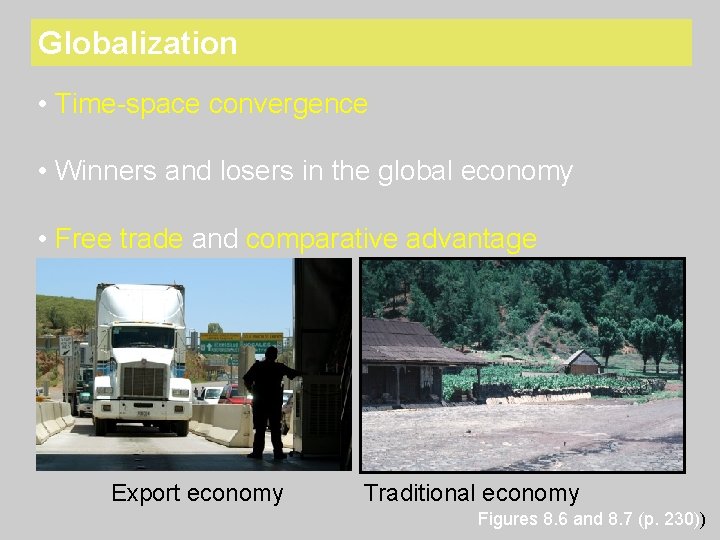
Globalization • Time-space convergence • Winners and losers in the global economy • Free trade and comparative advantage Export economy Traditional economy Figures 8. 6 and 8. 7 (p. 230))
North American Free Trade Agreement (NAFTA) • Implemented January 1, 1994 between the United States, Canada, and Mexico • Decreased and eventually eliminated tariffs to encourage economic activity • Dramatically increased trade between the three nations, from $337 billion in 1993 to $1. 182 trillion in 2011.
NAFTA and Mexico • Mexican comparative advantage in some agricultural crops • Reduction in traditional peasant lifestyles and crop mixes • Monoculture production for export: problems • Economic rationale has adverse cultural and social effects • Zapatista uprising
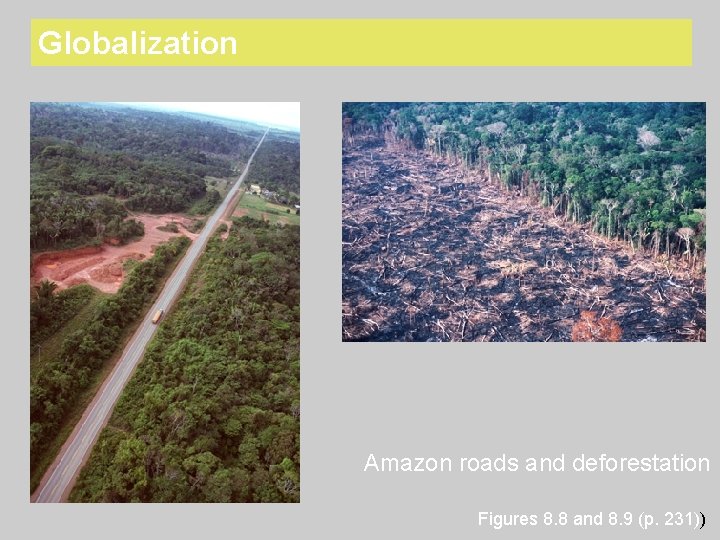
Globalization Amazon roads and deforestation Figures 8. 8 and 8. 9 (p. 231))
Resistance to Globalization and Industrial Agriculture LDCs object to agricultural subsidies in the United States and the European Union: • Unfair trade practices MDC consumers object to: • Oil-based production system • Environmental damage from pesticides, herbicides, and fertilizers • Unethical, inhumane treatment of animals • Monoculture mass production threatens food security • Emphasis on low nutrition processed foods • Weakened local culture and traditions
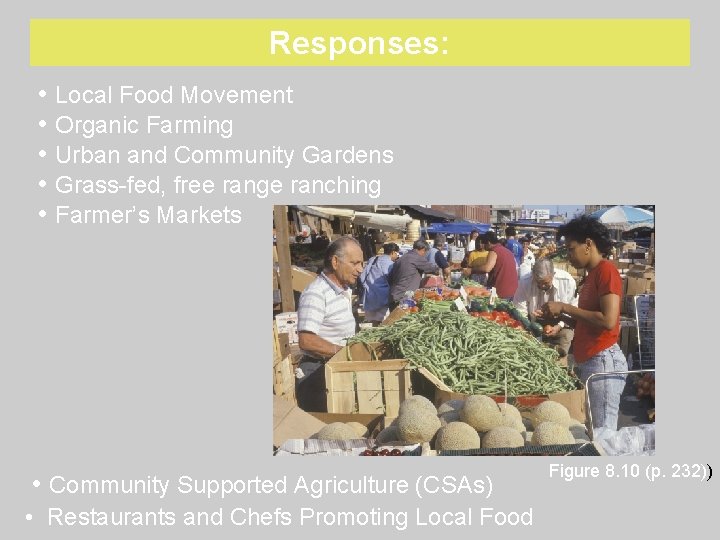
Responses: • Local Food Movement • Organic Farming • Urban and Community Gardens • Grass-fed, free range ranching • Farmer’s Markets • Community Supported Agriculture (CSAs) • Restaurants and Chefs Promoting Local Food Figure 8. 10 (p. 232))
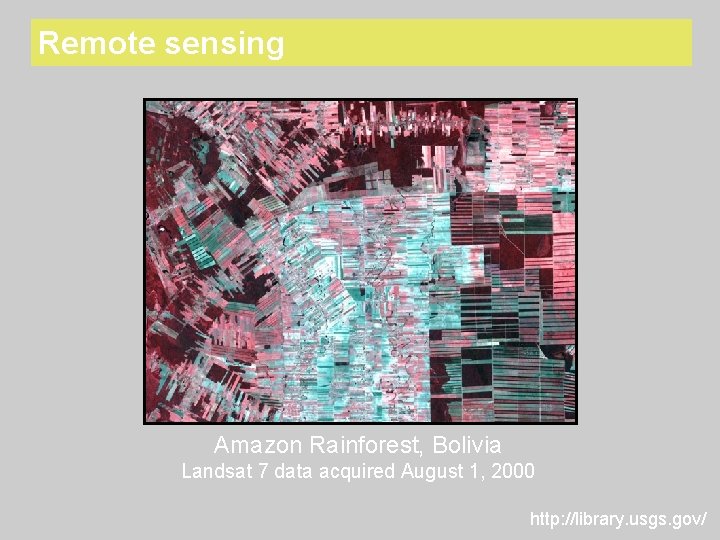
Remote sensing Amazon Rainforest, Bolivia Landsat 7 data acquired August 1, 2000 http: //library. usgs. gov/
The collecting of roots, seeds, fruit, and fiber from wild plants and the hunting and fishing of wild animals. Hunting and Gathering The intentional cultivation of crops and raising of livestock. Agriculture An industrialized, corporate form of agriculture organized into integrated networks of agricultural inputs and outputs controlled by a small number of large corporations. Agribusiness Output per unit land per unit time (e. g. , tons per acre per year). Yield Large-area farms or ranches with low inputs of labor per acre and low output per acre. Extensive Agriculture
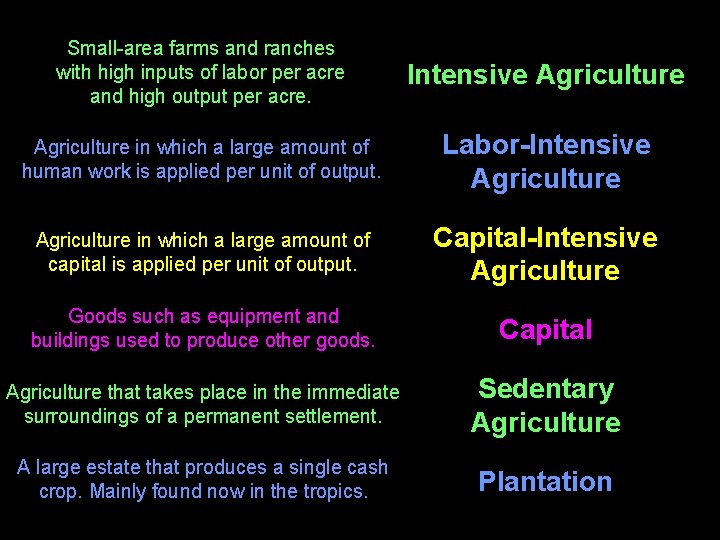
Small-area farms and ranches with high inputs of labor per acre and high output per acre. Intensive Agriculture in which a large amount of human work is applied per unit of output. Labor-Intensive Agriculture in which a large amount of capital is applied per unit of output. Capital-Intensive Agriculture Goods such as equipment and buildings used to produce other goods. Capital Agriculture that takes place in the immediate surroundings of a permanent settlement. Sedentary Agriculture A large estate that produces a single cash crop. Mainly found now in the tropics. Plantation
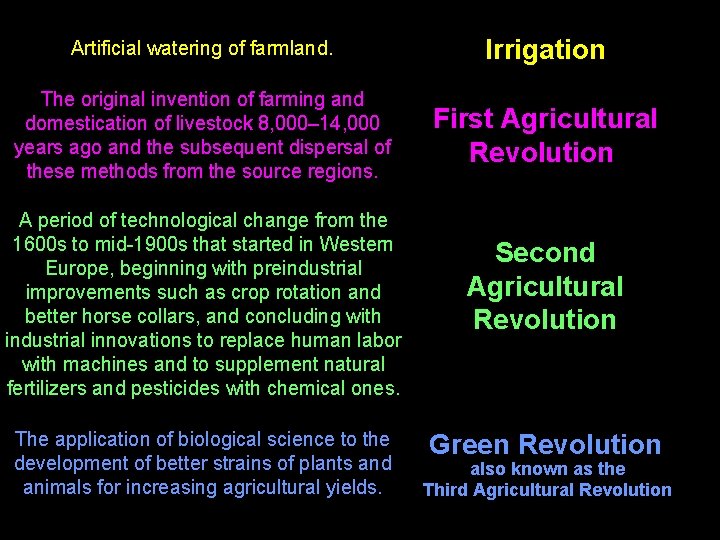
Artificial watering of farmland. Irrigation The original invention of farming and domestication of livestock 8, 000– 14, 000 years ago and the subsequent dispersal of these methods from the source regions. First Agricultural Revolution A period of technological change from the 1600 s to mid-1900 s that started in Western Europe, beginning with preindustrial improvements such as crop rotation and better horse collars, and concluding with industrial innovations to replace human labor with machines and to supplement natural fertilizers and pesticides with chemical ones. The application of biological science to the development of better strains of plants and animals for increasing agricultural yields. Second Agricultural Revolution Green Revolution also known as the Third Agricultural Revolution
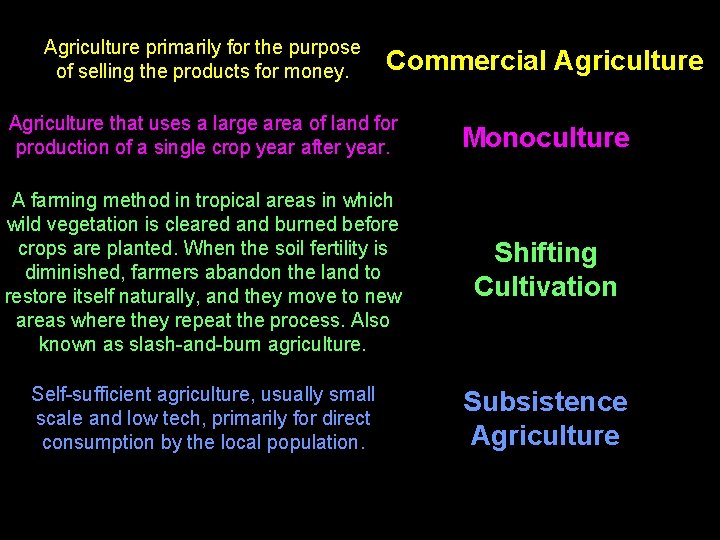
Agriculture primarily for the purpose of selling the products for money. Commercial Agriculture that uses a large area of land for production of a single crop year after year. Monoculture A farming method in tropical areas in which wild vegetation is cleared and burned before crops are planted. When the soil fertility is diminished, farmers abandon the land to restore itself naturally, and they move to new areas where they repeat the process. Also known as slash-and-burn agriculture. Shifting Cultivation Self-sufficient agriculture, usually small scale and low tech, primarily for direct consumption by the local population. Subsistence Agriculture
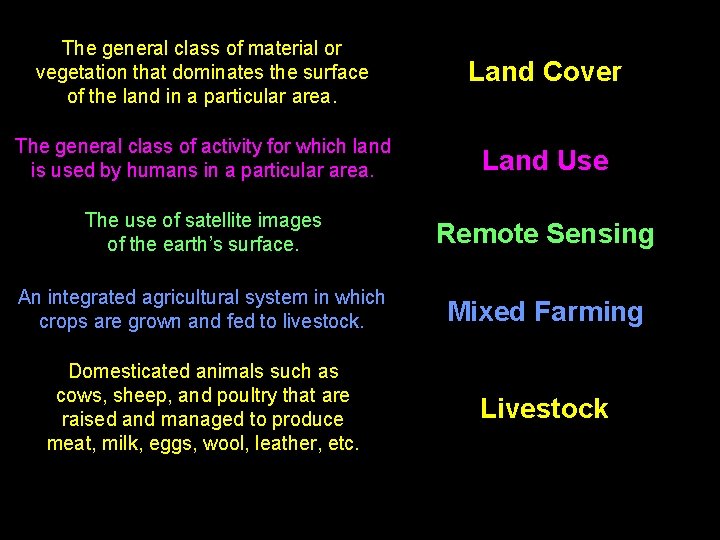
The general class of material or vegetation that dominates the surface of the land in a particular area. Land Cover The general class of activity for which land is used by humans in a particular area. Land Use The use of satellite images of the earth’s surface. Remote Sensing An integrated agricultural system in which crops are grown and fed to livestock. Mixed Farming Domesticated animals such as cows, sheep, and poultry that are raised and managed to produce meat, milk, eggs, wool, leather, etc. Livestock
Migratory movement of herders and their animals according to the availability of grazing land. Nomadism The increasing economic, cultural, demographic, political, and environmental interdependence of different places around the world. Globalism A measure of how much distance discourages movement between places, based on the time, energy, or dollar cost that must be expended. Friction of Distance Imports and exports between countries that are unrestricted by tariffs, quotas, or excessive approvals and paperwork. Free Trade
When one region is relatively more efficient at producing a particular product compared with other regions. Comparative Advantage The interaction between global processes and local lifestyles. This continuum is a two-way process in which the local and the global shape each other. Global-Local Continuum The rate at which the time separating two places decreases because of improvements in transportation or communication technology. Time-Space Convergence
After completing this chapter, you will be able to: • Differentiate among agricultural landscapes. • Understand how and why the same crops and livestock are produced in different ways in different regions of the world. • Recognize different land uses in satellite images. • Use remote sensing to study land use change.
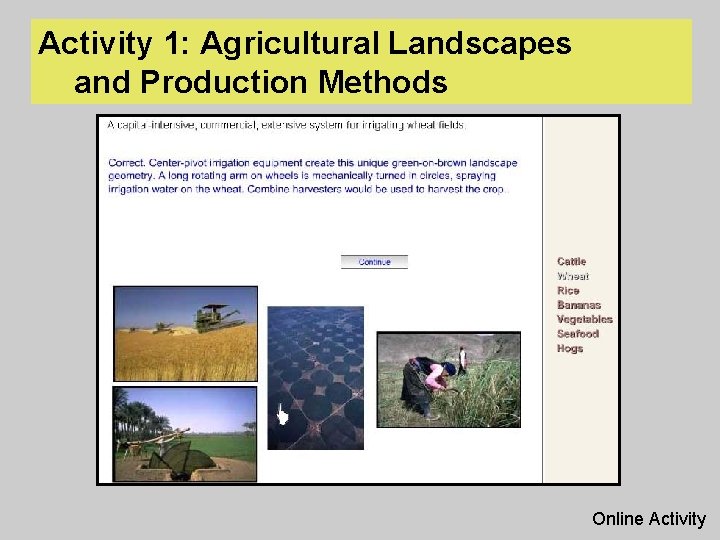
Activity 1: Agricultural Landscapes and Production Methods Online Activity
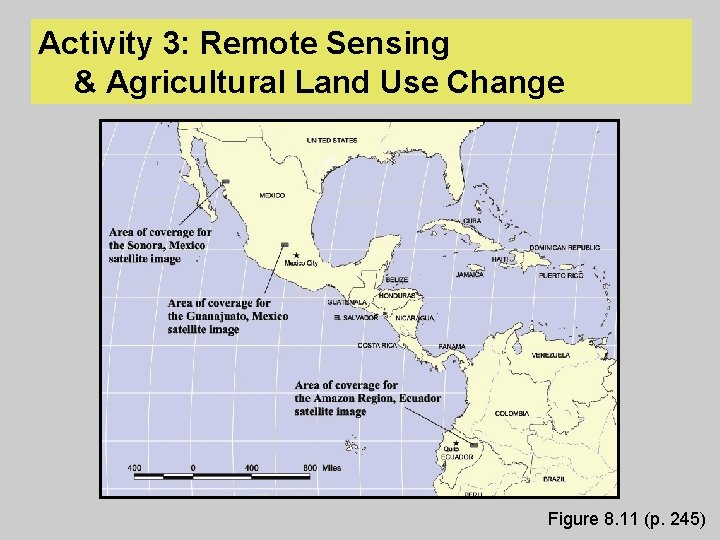
Activity 3: Remote Sensing & Agricultural Land Use Change Figure 8. 11 (p. 245)
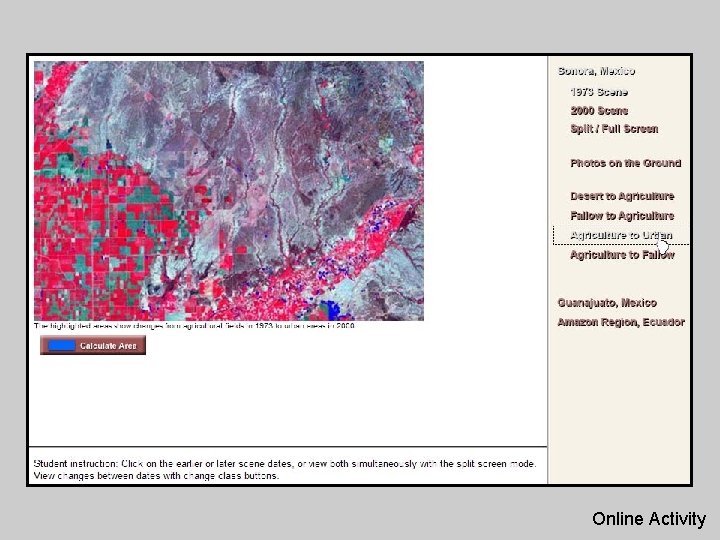
Online Activity
- Slides: 35