
Food Chemistry B Linda Wozniewski lwoziun edu Sharon
Food Chemistry (B) Linda Wozniewski lwoz@iun. edu Sharon Ramsey
Disclaimer n This presentation was prepared using draft rules. There may be some changes in the final copy of the rules. The rules which will be in your Coaches Manual and Student Manuals will be the official rules
Safety n Students must wear: Closed shoes n Slacks or skirts that come to the ankles n Lab coat or lab apron n Indirect vent or unvented chemical splash proof goggles. No impact glasses or visorgogs are permitted n Long-Sleeved Shirt (if wearing a lab apron) n
What Students MUST Bring n Impounded n n None Non-Impounded Homemade viscometer n Standard curve n A writing instrument n
What Students May Bring n n Non-programmable Calculator 1 sheet of paper on which anything is acceptable
What Supervisors Will Supply n Everything the student will need n This may include: Glassware n Reagents n Balances n Hot plates n Thermometers n Probes n Magnets n Stirrers n
Main Focus n n Chemistry of Food How to prepare students Experiment ideas Resources
Chemistry of Food n n n n a. Identify the sources of and understand the role of lipids, carbohydrates and proteins typically found in cookies, and use tests to identify these compounds, including the Benedict’s, Iodine and Brown Bag tests. b. When given samples of sweeteners, use the Benedict’s test to identify reducing sugars. c. When given samples of cupcake ingredients, use the Biuret test to identify and rank the ingredients by protein content. d. When given formulations, processes, and finished cupcakes, identify the error in the cupcake formulation and/or process used. e. Use standard labeling regulations to produce a label from information given. f. Determine the moisture loss and density of cupcakes. g. Identify leavening agents using chemical tests, and understand the role of the leavening agents in baked cupcakes.
Before your event n n Research! Understand the science first Experiments – eight mandatory (including Viscotester Production and Standard Curve)
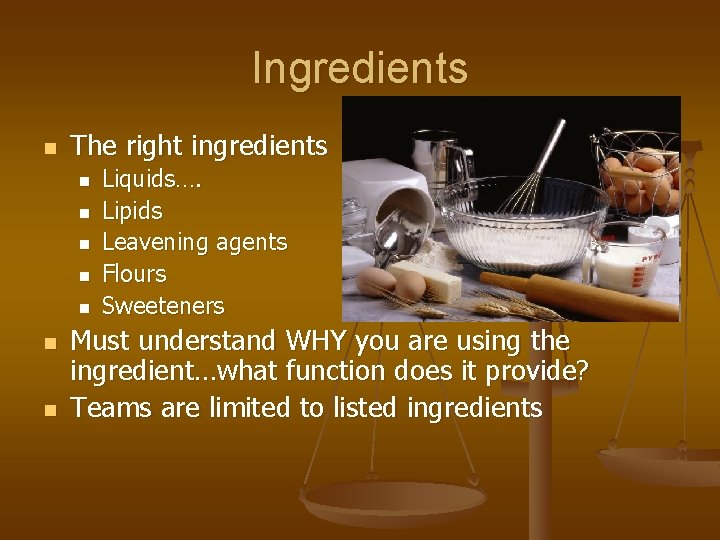
Ingredients n The right ingredients n n n n Liquids…. Lipids Leavening agents Flours Sweeteners Must understand WHY you are using the ingredient…what function does it provide? Teams are limited to listed ingredients
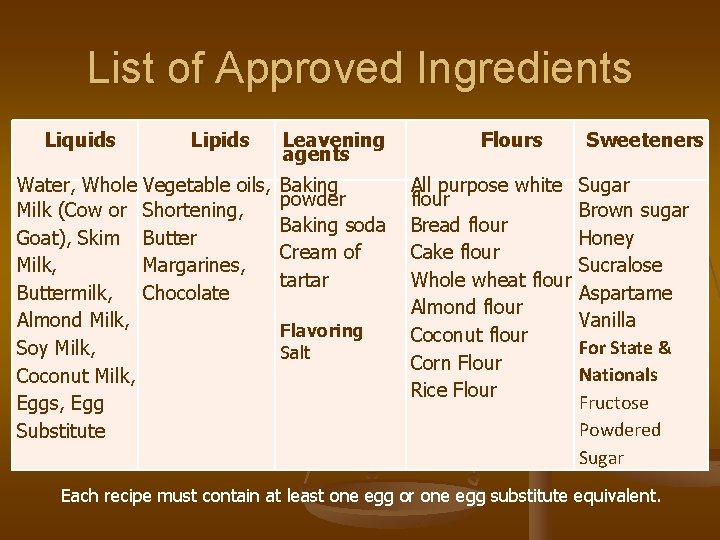
List of Approved Ingredients Liquids Lipids Water, Whole Vegetable oils, Milk (Cow or Shortening, Goat), Skim Butter Milk, Margarines, Buttermilk, Chocolate Almond Milk, Soy Milk, Coconut Milk, Eggs, Egg Substitute Leavening agents Baking powder Baking soda Cream of tartar Flavoring Salt Flours All purpose white flour Bread flour Cake flour Whole wheat flour Almond flour Coconut flour Corn Flour Rice Flour Sweeteners Sugar Brown sugar Honey Sucralose Aspartame Vanilla For State & Nationals Fructose Powdered Sugar Each recipe must contain at least one egg or one egg substitute equivalent.
Carbohydrates n n n Cox(H 2 O)y carbon along with hydrogen and oxygen in the same ratio as water Basic unit – monosaccharide Multiple units – n n disaccharide (2) trisaccharide (3) oligosaccharide (2 -10) polysaccharide (>10)
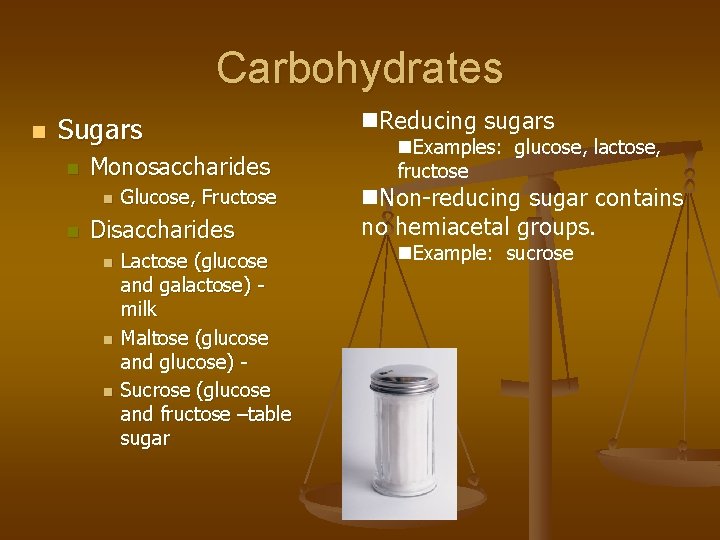
Carbohydrates n Sugars n Monosaccharides n n Glucose, Fructose Disaccharides n n n Lactose (glucose and galactose) milk Maltose (glucose and glucose) Sucrose (glucose and fructose –table sugar n. Reducing sugars n. Examples: glucose, lactose, fructose n. Non-reducing sugar contains no hemiacetal groups. n. Example: sucrose
Carbohydrates Polysaccharides n Examples: n n starch - glucose polymers, found in plants cellulose –found in plant fibers, insoluble Pectin-units are sugar acids rather than simple sugars, found in vegetables and fruits Branched vs. linear n Starches are a mixture of branched (amylopectin) and linear (amylose) polysaccharides
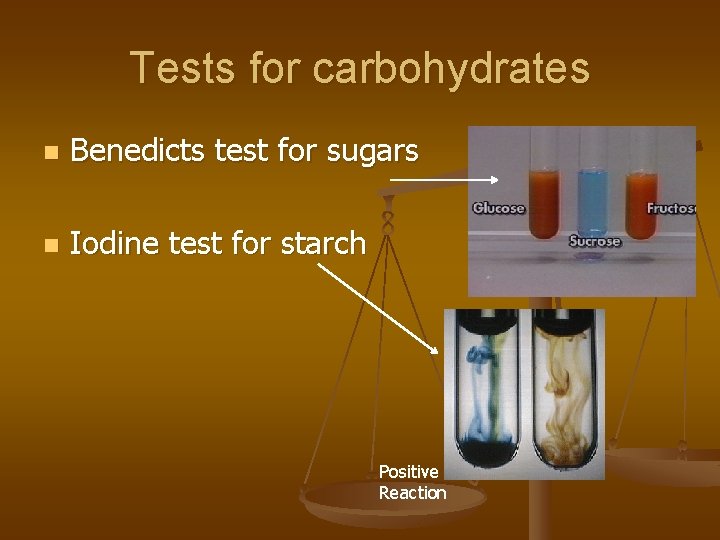
Tests for carbohydrates n Benedicts test for sugars n Iodine test for starch Positive Reaction
Benedict’s Test n n The Benedict's test allows us to detect the presence of reducing sugars (sugars with a free aldehyde or ketone group). All monosaccharides are reducing sugars. Some disaccharides are also reducing sugars. Other disaccharides such as sucrose are non-reducing sugars and will not react with Benedict's solution. Starches are also non-reducing sugars. The copper sulfate (Cu. SO 4) present in Benedict's solution reacts with electrons from the reducing sugar to form cuprous oxide (Cu 2 O), a red-brown precipitate. The final color of the solution depends on how much of this precipitate was formed, and therefore the color gives an indication of how much reducing sugar was present if a quantitative reagent was used. With increasing amounts of reducing sugar the result will be: green yellow orange red
Iodine Test n n n The Iodine test is used to test for the presence of starch. Iodine solution – Iodine is dissolved in an aqueous solution of potassium iodide - reacts with starch producing a deep blueblack color. Although the exact chemistry of the color change is not known, it is believed that the iodine changes the shape of the starch to change the color
Lipids Present as fats extracted from plants or animals (butter, vegetable oil) or as constituents of food (chocolate) n Contributions to foods: texture and flavor n Contain only Carbon, hydrogen and oxygen n Most common form for lipid in foods is as a triglyceride n What difference in texture would you see substituting vegetable shortening or vegetable oil for butter in the formulation? n
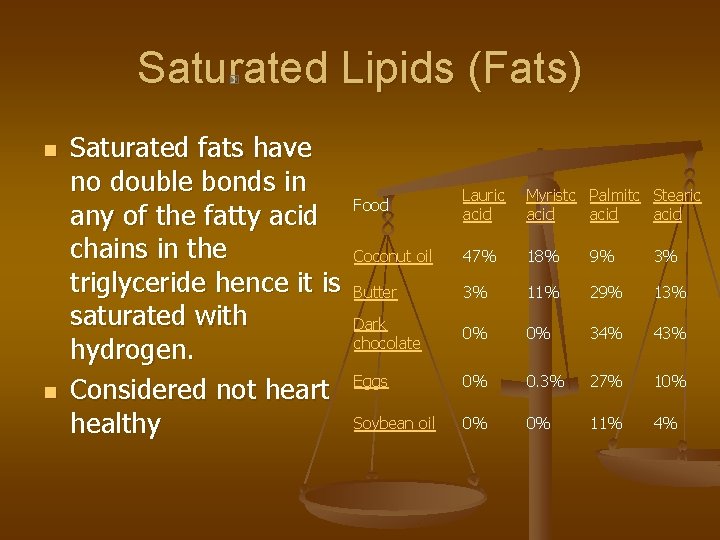
Saturated Lipids (Fats) n n Saturated fats have no double bonds in Food any of the fatty acid chains in the Coconut oil triglyceride hence it is Butter saturated with Dark chocolate hydrogen. Considered not heart Eggs Soybean oil healthy Lauric acid Myristc Palmitc Stearic acid 47% 18% 9% 3% 3% 11% 29% 13% 0% 0% 34% 43% 0% 0. 3% 27% 10% 0% 0% 11% 4%
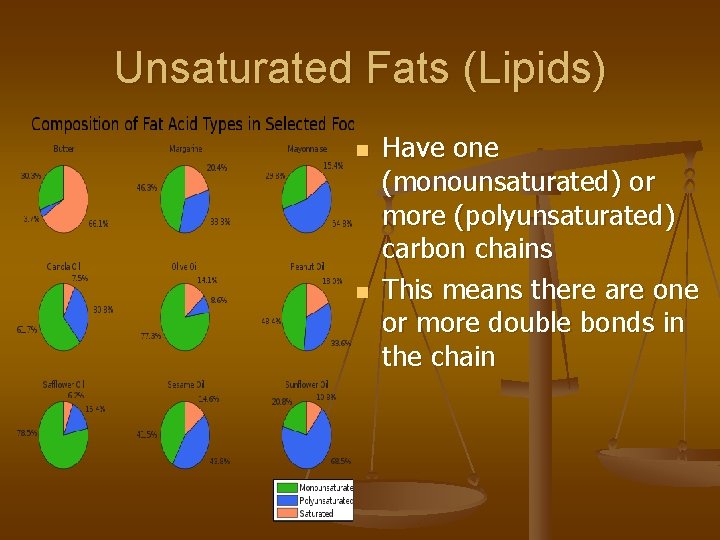
Unsaturated Fats (Lipids) n n Have one (monounsaturated) or more (polyunsaturated) carbon chains This means there are one or more double bonds in the chain
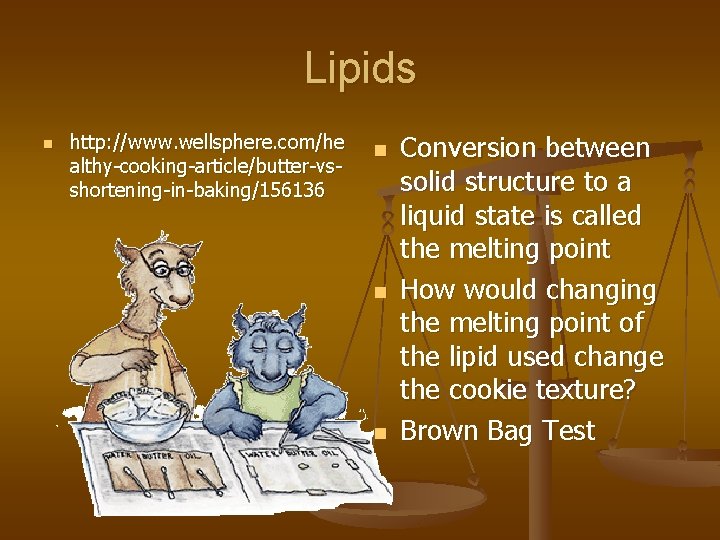
Lipids n http: //www. wellsphere. com/he althy-cooking-article/butter-vsshortening-in-baking/156136 n n n Conversion between solid structure to a liquid state is called the melting point How would changing the melting point of the lipid used change the cookie texture? Brown Bag Test
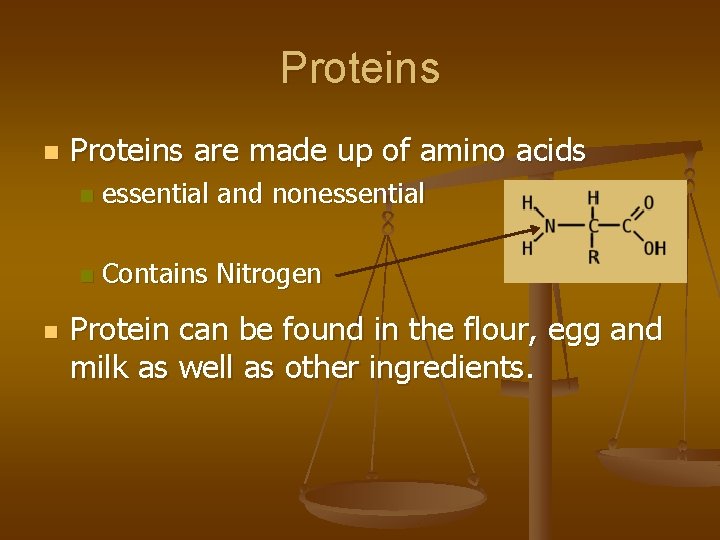
Proteins n n Proteins are made up of amino acids n essential and nonessential n Contains Nitrogen Protein can be found in the flour, egg and milk as well as other ingredients.
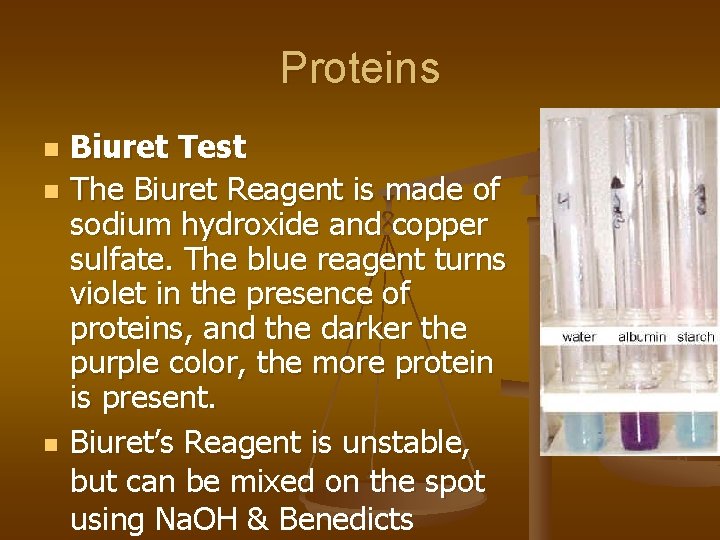
Proteins Biuret Test n The Biuret Reagent is made of sodium hydroxide and copper sulfate. The blue reagent turns violet in the presence of proteins, and the darker the purple color, the more protein is present. n Biuret’s Reagent is unstable, but can be mixed on the spot using Na. OH & Benedicts n
Leavening agents n n n Used to produce a gas that 'lightens' dough or batter. used to raise baked goods. water a leavening agent (pie crusts, some crackers) air incorporated into batter (angel and sponge cakes) expand when heated and cause the raising of the dough or batter when gas is trapped in matrix of gluten and starch from flour
Leavening agents n Baking soda n -Na. HCO 3 n Needs moisture plus an acid source such as vinegar, citrus juice, sour cream, yogurt, buttermilk, chocolate, cocoa (not Dutchprocessed), honey, molasses (also brown sugar), fruits or maple syrup to react n used to neutralize acids in foods n around 4 times as strong as baking powder n cause soapy flavor in high amounts
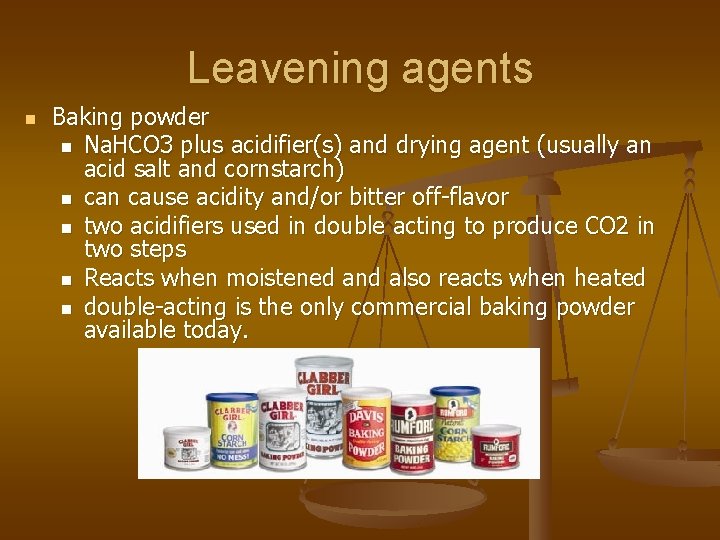
Leavening agents n Baking powder n Na. HCO 3 plus acidifier(s) and drying agent (usually an acid salt and cornstarch) n cause acidity and/or bitter off-flavor n two acidifiers used in double acting to produce CO 2 in two steps n Reacts when moistened and also reacts when heated n double-acting is the only commercial baking powder available today.
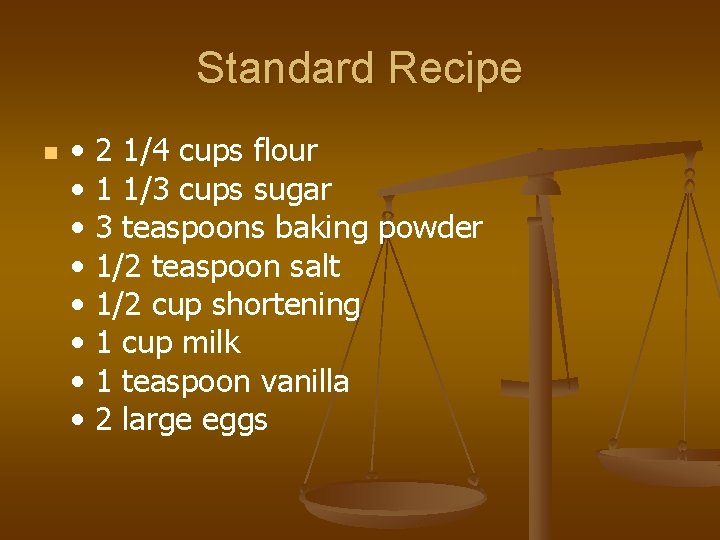
Standard Recipe n • 2 1/4 cups flour • 1 1/3 cups sugar • 3 teaspoons baking powder • 1/2 teaspoon salt • 1/2 cup shortening • 1 cup milk • 1 teaspoon vanilla • 2 large eggs
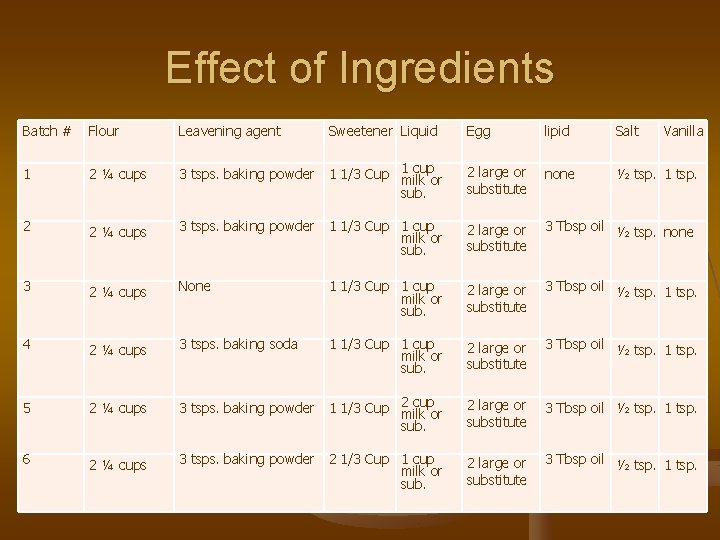
Effect of Ingredients Batch # Flour Leavening agent Sweetener Liquid Egg lipid Salt Vanilla 1 2 ¼ cups 3 tsps. baking powder 1 1/3 Cup 1 cup milk or sub. 2 large or none substitute 2 2 ¼ cups 3 tsps. baking powder 1 1/3 Cup 1 cup milk or sub. 2 large or 3 Tbsp oil ½ tsp. none substitute 3 2 ¼ cups None 1 1/3 Cup 1 cup milk or sub. 2 large or 3 Tbsp oil ½ tsp. 1 tsp. substitute 4 2 ¼ cups 3 tsps. baking soda 1 1/3 Cup 1 cup milk or sub. 2 large or 3 Tbsp oil ½ tsp. 1 tsp. substitute 5 2 ¼ cups 3 tsps. baking powder 1 1/3 Cup 2 cup milk or sub. 2 large or 3 Tbsp oil ½ tsp. 1 tsp. substitute 6 2 ¼ cups 3 tsps. baking powder 2 1/3 Cup 1 cup milk or sub. 2 large or 3 Tbsp oil ½ tsp. 1 tsp. substitute ½ tsp. 1 tsp.
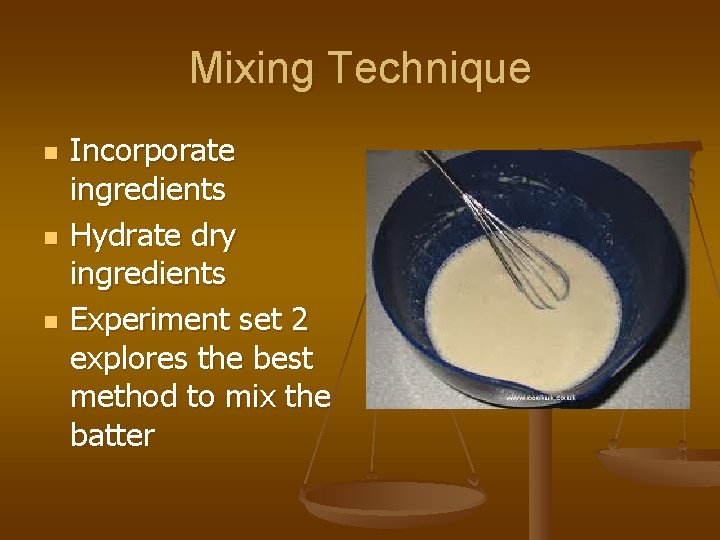
Mixing Technique n n n Incorporate ingredients Hydrate dry ingredients Experiment set 2 explores the best method to mix the batter
Standard Mixing n n n Preheat oven to 350 degrees. Line cupcake pans with paper liners. Combine flour, sugar, baking powder, and salt in a large mixing bowl. Add shortening, milk, and vanilla. Beat for 1 minute on medium speed. Scrape side of bowl with a spatula. Add eggs to the mixture. Beat for 1 minute on medium speed. Scrape bowl again. Beat on high speed for 1 minute 30 seconds until well mixed. Spoon cupcake batter into paper liners until 1/2 to 2/3 full. Bake for 20 to 25 minutes or until toothpick inserted in center comes out clean. Cool 5 minutes in pans then remove and place on wire racks to cool completely.
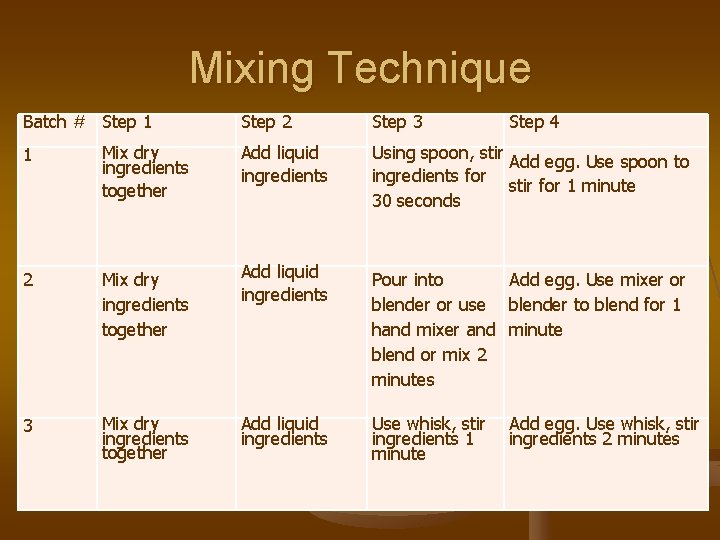
Mixing Technique Batch # Step 1 Step 2 Step 3 Step 4 1 Mix dry ingredients together Add liquid ingredients Using spoon, stir Add egg. Use spoon to ingredients for stir for 1 minute 30 seconds 2 Mix dry ingredients together Add liquid ingredients Pour into Add egg. Use mixer or blender or use blender to blend for 1 hand mixer and minute blend or mix 2 minutes 3 Mix dry ingredients together Add liquid ingredients Use whisk, stir ingredients 1 minute Add egg. Use whisk, stir ingredients 2 minutes
Notebook/3 -ring binder n Notebook keeping (teams are encouraged to bake Notebook keeping (t goods, observe and record the differences caused by adjusting the ingredients from the Approved List of Ingredients). Optional but suggested for keeping records of all experimental data and documentation n May be bound, spiral, or ring n Must securely hold all items n Don’t erase in lab notebook! n Document all references n Use pen
Notebook n n n i. Experiment Name – 2 Points ii. Hypothesis – 4 points iii. Variables: n n n n n a. Controlled Variable(s) – 2 points b. Independent Variable(s) – 2 points c. Dependent Variable(s) – 2 points iv. Materials (amount of each ingredient in grams or milliliters) – 4 points v. Procedure – 10 points vi. Qualitative observations during the experiment (be sure to include sensory score sheet) – 6 points vii. Quantitative observations during the experiment (Data table, graphs-be sure to include nutritional calculations, viscosity testing, density, and crumb testing results) – 10 points viii. Discussion of Results – 6 points ix. References – 2 points
Cupcake n n Use any combination of ingredients from the approved list as well as physical parameter changes (temperature, cupcake lining materials, etc. ) to formulate an ideal team cupcake. Teams may choose variables used in the first two experiments or use new variables. If a recipe from a cookbook or web site is used as a starting source, the source must be listed in the notebook. Aiming for a density of 0. 3 g/ml Aiming for less than 0. 3% of the mass of the cupcake to be left on liner or in crumbs when liner taken off Must have nutrition food label
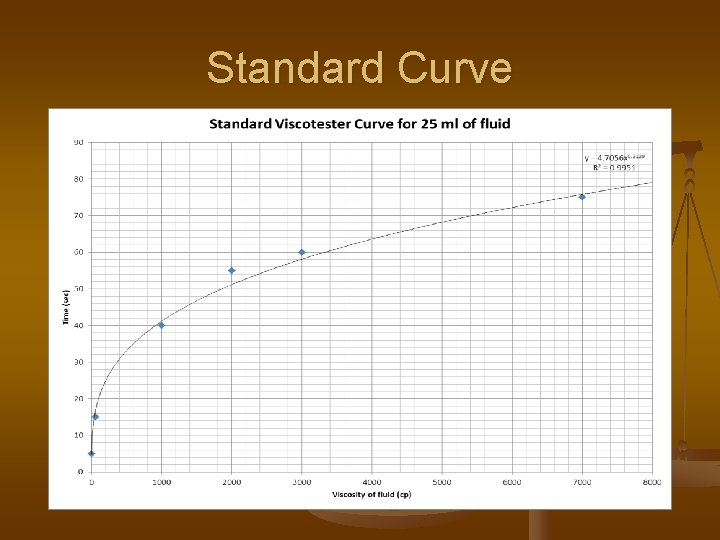
Viscotester n Made from 8 oz Styrofoam cup n n n Heat 16 penny nail with tea candle for ~1 minute (or until it gets too hot to hold) Punch hole from INSIDE into center bottom of cup Place tape over hole Time how long it takes for same amount of each standard liquid to break flow as it leaves When determining how much fluid to use, keep a couple of items in mind n The larger the amount of fluid the less influence reaction time will have on error. n The amount of fluid the event supervisor is likely to allow the team to have.
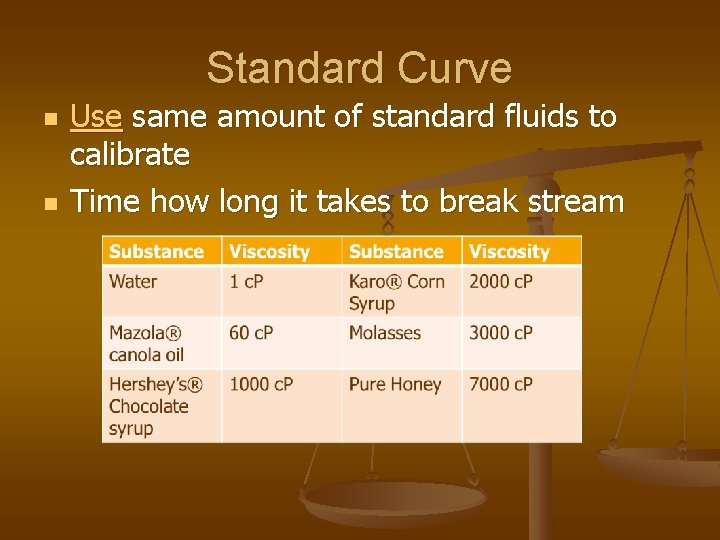
Standard Curve n n Use same amount of standard fluids to calibrate Time how long it takes to break stream
Standard Curve
Viscosity n n n n Students need to investigate viscosity of their batters and compare to final results. The resistance of a fluid to deformation. Temperature dependent *Dynamic or simple viscosity Kinematic viscosity: ratio of viscosity/density Shear viscosity – reaction to a shearing stress (pumping, spraying, etc. ) Must know general nomenclature
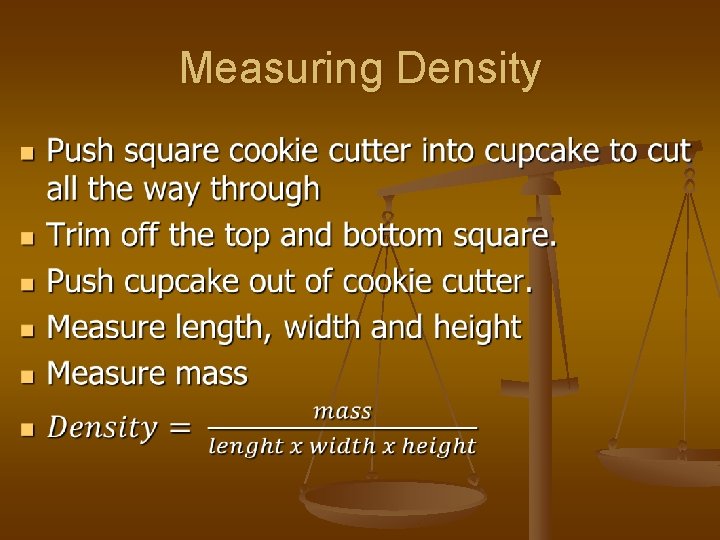
Measuring Density n
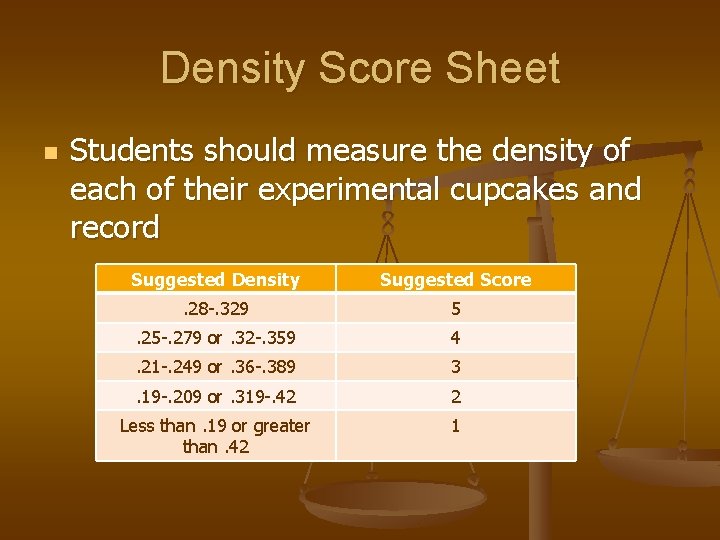
Density Score Sheet n Students should measure the density of each of their experimental cupcakes and record Suggested Density Suggested Score . 28 -. 329 5 . 25 -. 279 or. 32 -. 359 4 . 21 -. 249 or. 36 -. 389 3 . 19 -. 209 or. 319 -. 42 2 Less than. 19 or greater than. 42 1
Nutrition n n Students will create a food label for their cupcakes properly indicating serving size, calories, amount fat, unsaturated fat, carbohydrates, sugars, fiber, and protein, as well as accompanying daily value percentages. Students are NOT to be scored on how healthy the cupcake is, only on their ability to identify its role in a healthy diet.
Nutrition n n n n Calorie - amount of heat required to raise the temperature of 1 gram of water 1 degree Celsius. Kilocalorie (1000 calories) is the unit commonly used to represent energy values of foods -or Calorie with a C instead of a c Not all carbohydrates (or fats, or proteins) yield the exact same amount of energy when burned in a calorimeter, so common averages from studies (in kcal/g) are used Carbohydrates average 4. 1 kcal/gram in a bomb calorimeter, are about 98% digestible and yield 4 kcal/g when consumed Proteins average 5. 7 kcal/g in a bomb calorimeter, are not as easily digested and yield an average of 4 kcal/g when consumed Lipids average 9. 5 kcal/g in a bomb calorimeter, are 95% digested and yield an average of 9 kcal/g when consumed Fats (lipids) are the most concentrated source of food calories Carbohydrates are the cheapest source of calories, proteins the most expensive
Fiber n n Foods not digested by human digestive system Two types n Soluble Fiber-helps regulate blood sugar n n Found in Oats & Oat Bran, some Fruits & vegys Insoluble Fiber-helps clean out colon n Found in whole wheat, some fruit skins and vegys
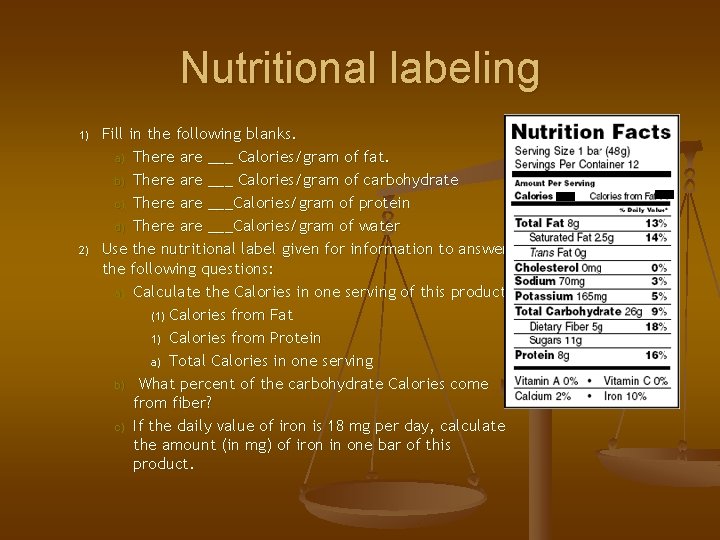
Nutritional labeling 1) 2) Fill in the following blanks. a) There are ___ Calories/gram of fat. b) There are ___ Calories/gram of carbohydrate c) There are ___Calories/gram of protein d) There are ___Calories/gram of water Use the nutritional label given for information to answer the following questions: a) Calculate the Calories in one serving of this product. (1) Calories from Fat 1) Calories from Protein a) Total Calories in one serving b) What percent of the carbohydrate Calories come from fiber? c) If the daily value of iron is 18 mg per day, calculate the amount (in mg) of iron in one bar of this product.
Nutrition Scoring n The labels will be scored as follows: n i. Creative Cupcake name (5 points) ii. Ingredient List in correct order (15 points) n iii. Nutritional Facts in correct order (15 points) n iv. Package Weight (10 points) n v. Company (team) Name and Address in the correct location (5 points) n vi. Label Information matches notebook (10 points) n
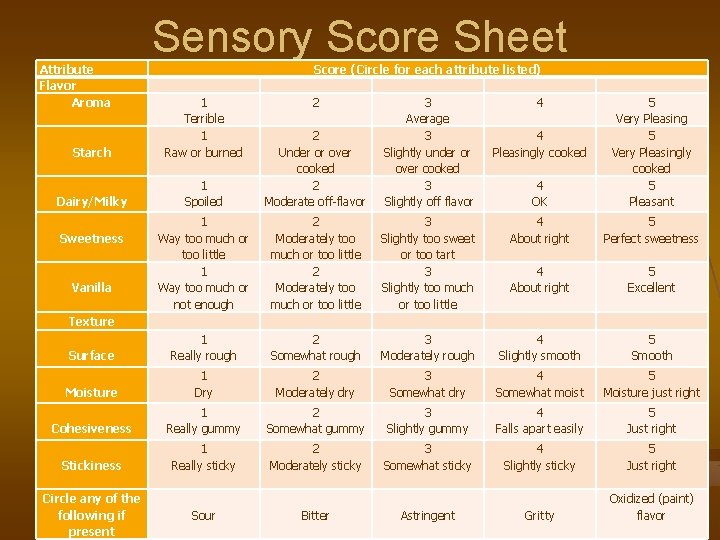
Attribute Flavor Aroma Sensory Score Sheet Score (Circle for each attribute listed) 2 3 4 Average 2 3 4 Under or over Slightly under or Pleasingly cooked over cooked 2 3 4 Moderate off-flavor Slightly off flavor OK Starch 1 Terrible 1 Raw or burned Dairy/Milky 1 Spoiled Sweetness 2 Moderately too much or too little 3 Slightly too sweet or too tart 3 Slightly too much or too little 4 About right 5 Perfect sweetness 4 About right 5 Excellent Texture 1 Way too much or too little 1 Way too much or not enough Surface 1 Really rough 2 Somewhat rough 3 Moderately rough 4 Slightly smooth 5 Smooth Moisture 1 Dry 2 Moderately dry 3 Somewhat dry 4 Somewhat moist 5 Moisture just right Cohesiveness 1 Really gummy 2 Somewhat gummy 3 Slightly gummy 4 Falls apart easily 5 Just right Stickiness 1 Really sticky 2 Moderately sticky 3 Somewhat sticky 4 Slightly sticky Circle any of the following if present Sour Bitter Astringent Gritty 5 Just right Oxidized (paint) flavor Vanilla 5 Very Pleasingly cooked 5 Pleasant

Resources n For Event Supervisors n n http: //mypage. iu. edu/~lwoz/socrime/index. htm For Lesson Plans for classroom use n http: //mypage. iu. edu/~lwoz/socrime/index. htm

Questions n. Thank You
Time to Experiment n n n We can make viscotesters We can simulate a standard curve data collection We can find the viscosity of a batter We can find the density of muffins We can work with some tests from a simulated test. It is your option
- Slides: 49