
Food chains and food webs WAL About how

Food chains and food webs WAL: About how energy moves through food chains and webs. Some All • How is energy lost from the ecosystem? • What is meant by the terms: trophic Most level, food chain, food web, producer, consumer and decomposer? • How does energy enter an ecosystem and become transferred between organisms?

Today we are covering from the specification: Pages 61 -63 of the textbook.

How does energy enter an ecosystem and become transferred between organisms? • The ultimate source of energy for organisms found in an ecosystem is sunlight. • This is converted to chemical energy by photosynthesising organisms and passed as food between other organisms.

Radiation from the Sun (solar or light energy) is the main source of energy for all living things. The suns light energy is ‘captured’ and used by green plants and algae during photosynthesis, to make new biomass. 6 CO 2 + 6 H 20 Light energy C 6 H 12 O 6 + 6 O 2

Key words Producer Secondary consumer Quaternary consumer Omnivore Food chain Trophic level Heterotroph Primary consumer Tertiary consumer Herbivore Carnivore Food web Autotroph Decomposer TASK: try to write a definition for each of these terms.

What is a food chain? • Organisms need energy to live • They get this energy by eating other organisms – E. g. A rabbit gets energy from the carrots it eats • A food chain shows how energy is passed through a series of animals – E. g. Carrot Rabbit Fox

Methods of Obtaining Energy • Organisms may be autotrophs (like plants) or heterotrophs (like animals). • Autotrophs use energy from the sun to produce their own materials for growth etc. • Heterotrophs use organic substances from other organisms for growth etc. http: //www. youtube. com/watch? v=O 7 e. QKSf 0 Lm. Y i. e. autotrophs are producers and heterotrophs are consumers.

Draw this diagram: Herbivores Carnivores Omnivores

What do they eat? Put these organisms into the correct categories: Grizzly bear Human Caterpillar Crow Fox Cat Grasshopper Pig Frog Slug Sparrowhawk Lion Horse Deer

What do they eat? Herbivore Caterpillar Grasshopper Slug Horse Deer Omnivore Grizzly bear Human Crow Pig Carnivore Fox Frog Sparrowhawk Lion Cat

Stoat 4 th trophic level Toad Trophic level – position in the food chain. Caterpillar Tertiary Consumer Gains energy by eating secondary consumers. Usually predators but may be scavengers or parasites • • Secondary Consumer Gains energy by eating primary consumers. Usually carnivores but can be omnivores • • • Primary Consumer • • 1 st trophic Grass level Gains energy by eating producers. Usually herbivores Producer • Makes food from sun using photosynthesis

Food chains • Food chains are diagrams that show what animals eat. • In habitats all animals and plants depend on each other. • If one animal or plant dies out it might affect the other animals.

Human Cow Grass What would happen to the cows if all the grass died out?

What are detritivores? Things that feed on detritus (dead or decaying material) giving it a bigger surface area for microorganisms to work on. LL 2008

Name some examples of detritivores LL 2008

Decomposers feed by releasing enzymes outside of their ‘body’, digesting the food externally and then absorbing the nutrients. Decay is caused by saprobionts. Bacteria & fungi are saprobionts. LL 2008

Constructing an ecosystem • A food chain is quite unrealistic – food webs are much better. • Within any ecosystem there are two main processes to consider: – The flow of energy through the ecosystem. – The cycling of elements through the ecosystem. • We are going to construct an ecosystem based on these two main principles.

Lettuce Makes its own food using energy from the sun. Hedgehog Eats slugs and caterpillars. Frog Eats grasshoppers. Eats lettuce. Grass Spider Eats aphids. Rabbit Sparrowhawk Eats lettuce and grass. Eats voles and thrushes. Makes its own food using energy from the sun. Aphid Thrush Vole Eats grasshoppers. Slug Eats lettuce. Eats grass. Eats slugs and spiders. Grass snake Fox Eats frogs. Caterpillar Eats hedgehogs, voles and rabbits. Grasshopper Eats grass.

Constructing an ecosystem • As well as the cards provided, you will also have to draw/add your own elements to the ecosystem as some are missing.

Constructing an ecosystem • Cut out all of the cards and try to arrange them in a logical ecosystem. • Once you’re happy, glue them down. • Draw arrows between organisms to show the flow of energy (and therefore feeding relationships) within the ecosystem. • Around the outside, list any abiotic factors which could affect the individuals in the ecosystem.
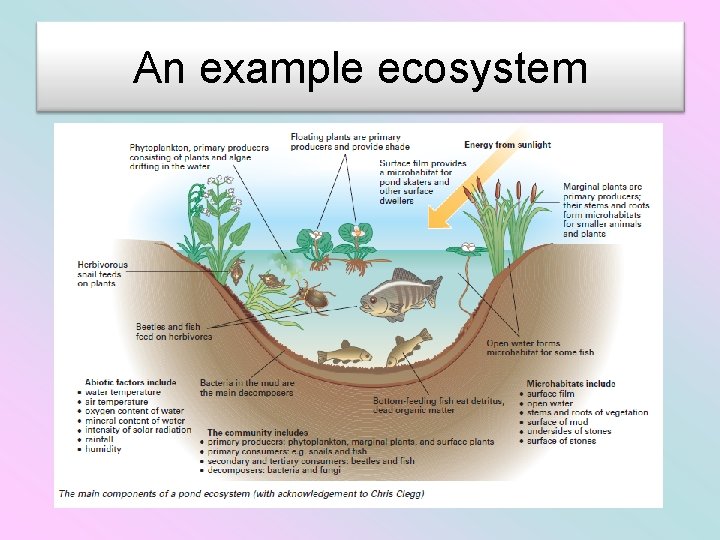
An example ecosystem

Food chains and food webs WAL: About how energy moves through food chains and webs. Some All • How is energy lost from the ecosystem? • What is meant by the terms: trophic Most level, food chain, food web, producer, consumer and decomposer? • How does energy enter an ecosystem and become transferred between organisms?

5, 4, 3, 2, 1 go… can you talk about food chains and food webs for 60 seconds mentioning as many as the key words as possible? Food web Producer Consumer Food chain Primary consumer Quaternary consumer Decomposer Detritivore Secondary consumer Habitat Omnivore Trophic level Energy loss Tertiary consumer Heat Carnivore Respiration Herbivore

Ecology Bingo Draw a 2 x 3 grid and fill it with 6 key words from todays lesson. . . Ecosystem Consumer Food chain Carnivore Producer Energy flow
- Slides: 24