
Food and Sustainability MAPPING THE COMMUNITY FOOD SYSTEM
Food and Sustainability MAPPING THE COMMUNITY FOOD SYSTEM IN LACHINE ERIK CHEVRIER
Importance of Action Based Research Why are action-based projects important? ◦ It is important to challenge the problematic dominant epistemological understandings of food. ◦ Instead we should produce ontological formations of the world we want by co-creating and corecreating social relations that produce positive outcomes on people and the planet. ◦ Action based learning theories incorporate students and facilitators as co-learners and co-collaborators. Together, they learn by doing. They also connect with the community. Ontology – Assumptions relating to how the social comes into being that inform all theories and ways of writing the social. (Frampton, Kinsman, Thompson, Tileczek, (2006))
The Dominant Epistemological View of Food? The world has or will soon have the agricultural technology available to feed the 8. 3 billion people anticipated in the next quarter of a century. The more pertinent question today is whether farmers and ranchers will be permitted to use that technology. Extremists in the environmental movement, largely from rich nations and/or the privileged strata of society in poor nations, seem to be doing everything they can to stop scientific progress in its tracks. It is sad that some scientists, many of whom should or do know better, have also jumped on the extremist environmental bandwagon in search of research funds. When scientists align themselves with antiscience political movements or lend their name to unscientific propositions, what are we to think? Is it any wonder that science is losing its constituency? We must be on guard against politically opportunistic, pseudo-scientists… Borlaug, N. , E. (2000) Ending World Hunger. The Promise of Biotechnology and the Threat of Antiscience Zealotry, Plant Physiology, 124(2) pp. 488.
Critique of Dominant Epistemological View of Food When poisons are introduced into agriculture to control pests, or when GMOs are introduced under the argument of “feeding the world, ” the justification given is always “science”. But “science” does not have a singular entity, and it did not come into existence within a vacuum. Today, what we generally refer to as “science” is in fact Western, mechanistic, reductionist modern science, which became the dominant practice of understanding the world during the Industrial Revolution and has continued as the dominant paradigm…. To shape the industrial system in the form of new, violent technologies, and to shape the capitalist system in the form of new, profit-driven economics, a certain type of science was promoted and privileged as the only scientific knowledge system. Two scientific theories came to dominate this new, industrial paradigm, and they continue to shape practices of food, agriculture, health, and nutrition even today. The first is a Newtonian-Cartesian idea of separation: a fragmented world made of fixed, immutable atoms…The second significant theory that has framed the knowledge paradigm for industrial agriculture is Darwin’s theory of competition as the basis for evolution…The Newtonian-Cartesian theory of fragmentation and separation and the Darwinian paradigm of competition, have led to a nonrenewable use of Earth’s resources, a nonsustainable model for food and agriculture, and an unhealthy model of health and nutrition. An emphasis on the legitimacy of these arguments as the sole “scientific” approach has created a knowledge apartheid by discounting the knowledge of Mother Earth. Shiva, V. (2016) Who Really Feeds the World, North Atlantic Books, pp. 4 – 7.
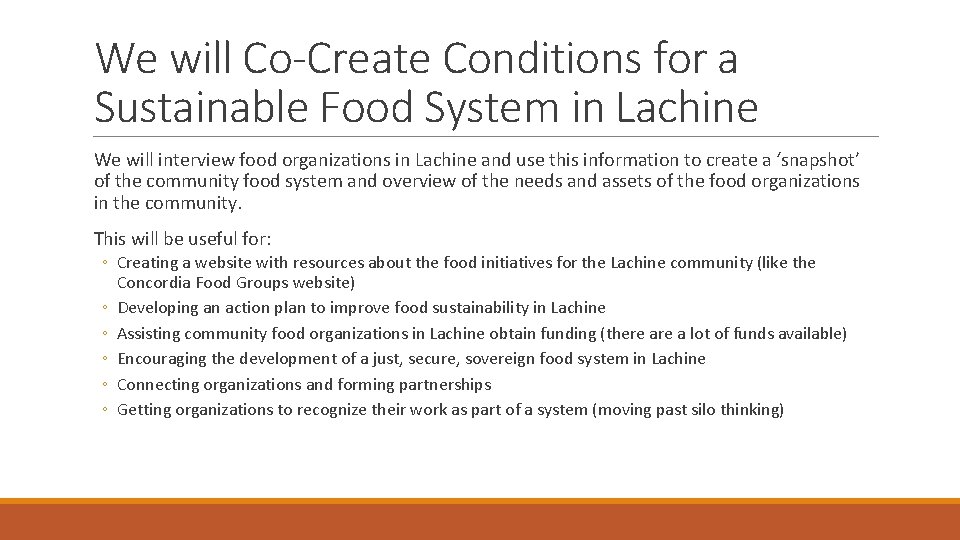
We will Co-Create Conditions for a Sustainable Food System in Lachine We will interview food organizations in Lachine and use this information to create a ‘snapshot’ of the community food system and overview of the needs and assets of the food organizations in the community. This will be useful for: ◦ Creating a website with resources about the food initiatives for the Lachine community (like the Concordia Food Groups website) ◦ Developing an action plan to improve food sustainability in Lachine ◦ Assisting community food organizations in Lachine obtain funding (there a lot of funds available) ◦ Encouraging the development of a just, secure, sovereign food system in Lachine ◦ Connecting organizations and forming partnerships ◦ Getting organizations to recognize their work as part of a system (moving past silo thinking)
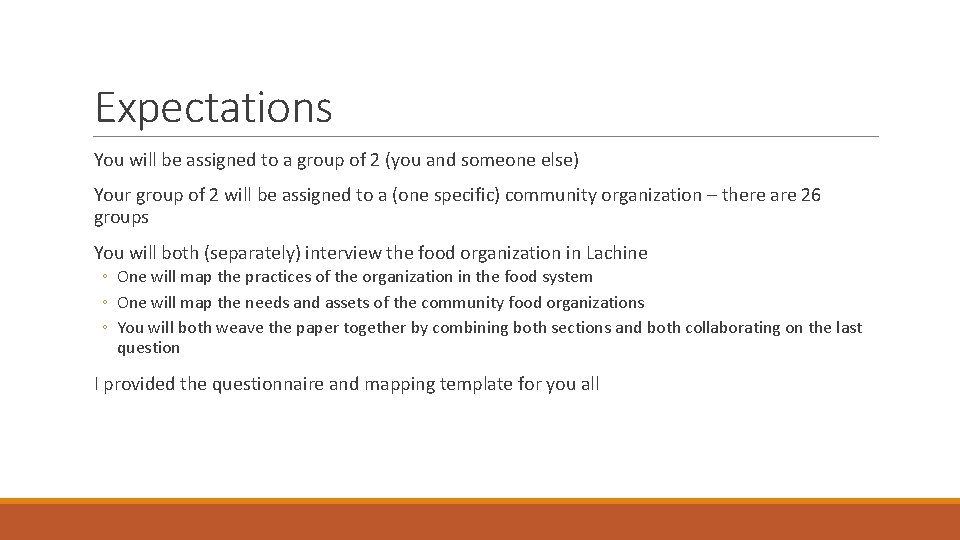
Expectations You will be assigned to a group of 2 (you and someone else) Your group of 2 will be assigned to a (one specific) community organization – there are 26 groups You will both (separately) interview the food organization in Lachine ◦ One will map the practices of the organization in the food system ◦ One will map the needs and assets of the community food organizations ◦ You will both weave the paper together by combining both sections and both collaborating on the last question I provided the questionnaire and mapping template for you all
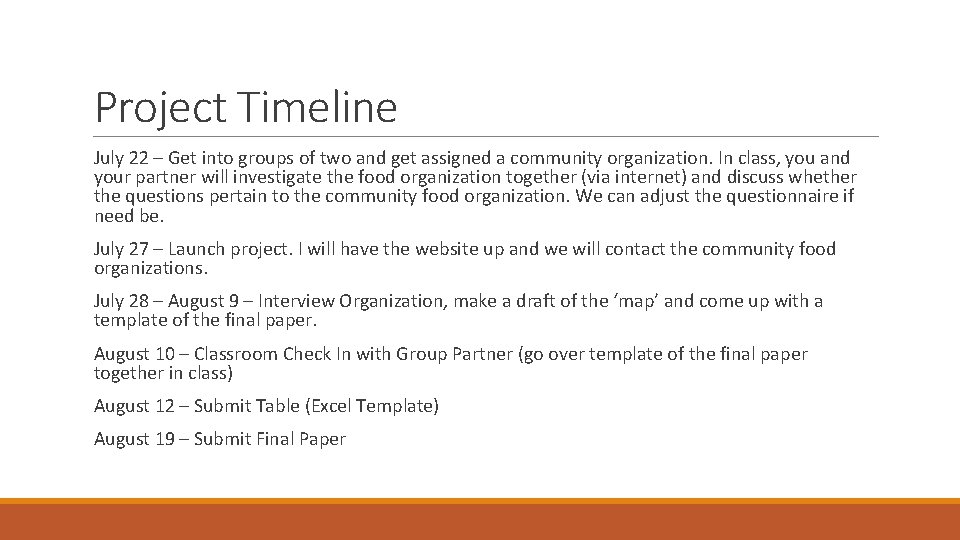
Project Timeline July 22 – Get into groups of two and get assigned a community organization. In class, you and your partner will investigate the food organization together (via internet) and discuss whether the questions pertain to the community food organization. We can adjust the questionnaire if need be. July 27 – Launch project. I will have the website up and we will contact the community food organizations. July 28 – August 9 – Interview Organization, make a draft of the ‘map’ and come up with a template of the final paper. August 10 – Classroom Check In with Group Partner (go over template of the final paper together in class) August 12 – Submit Table (Excel Template) August 19 – Submit Final Paper
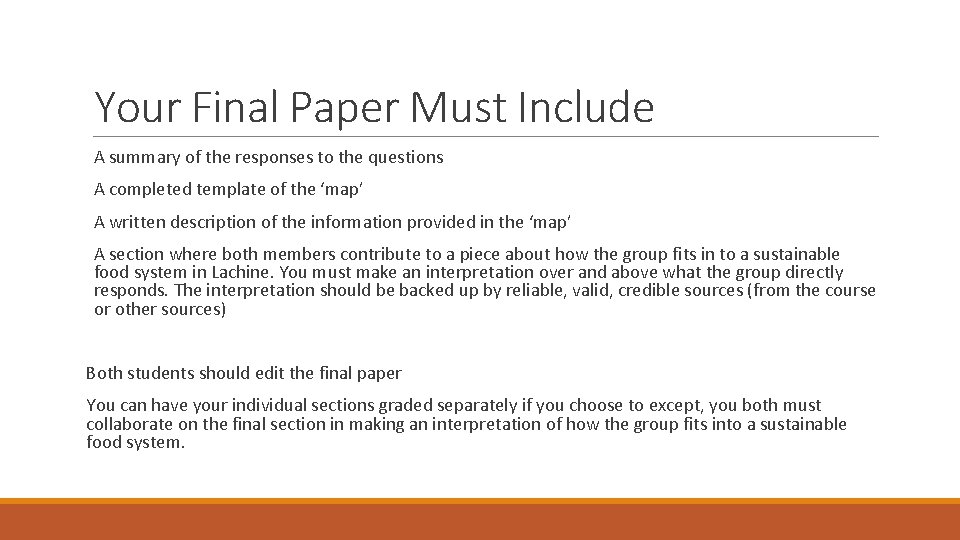
Your Final Paper Must Include A summary of the responses to the questions A completed template of the ‘map’ A written description of the information provided in the ‘map’ A section where both members contribute to a piece about how the group fits in to a sustainable food system in Lachine. You must make an interpretation over and above what the group directly responds. The interpretation should be backed up by reliable, valid, credible sources (from the course or other sources) Both students should edit the final paper You can have your individual sections graded separately if you choose to except, you both must collaborate on the final section in making an interpretation of how the group fits into a sustainable food system.
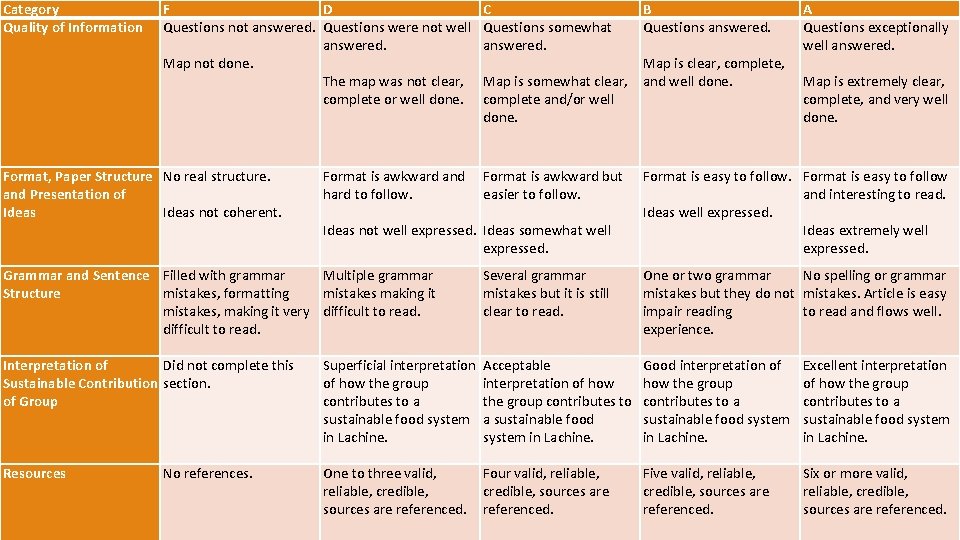
Category Quality of Information F D Questions not answered. Questions were not well answered. Map not done. The map was not clear, complete or well done. Format, Paper Structure No real structure. and Presentation of Ideas not coherent. Format is awkward and hard to follow. C Questions somewhat answered. Map is somewhat clear, complete and/or well done. Format is awkward but easier to follow. Ideas not well expressed. Ideas somewhat well expressed. B Questions answered. Map is clear, complete, and well done. A Questions exceptionally well answered. Map is extremely clear, complete, and very well done. Format is easy to follow and interesting to read. Ideas well expressed. Ideas extremely well expressed. Grammar and Sentence Filled with grammar Multiple grammar Structure mistakes, formatting mistakes making it mistakes, making it very difficult to read. Several grammar mistakes but it is still clear to read. One or two grammar No spelling or grammar mistakes but they do not mistakes. Article is easy impair reading to read and flows well. experience. Interpretation of Did not complete this Sustainable Contribution section. of Group Superficial interpretation of how the group contributes to a sustainable food system in Lachine. Acceptable interpretation of how the group contributes to a sustainable food system in Lachine. Good interpretation of how the group contributes to a sustainable food system in Lachine. Excellent interpretation of how the group contributes to a sustainable food system in Lachine. Resources One to three valid, reliable, credible, sources are referenced. Four valid, reliable, credible, sources are referenced. Five valid, reliable, credible, sources are referenced. Six or more valid, reliable, credible, sources are referenced. No references.
- Slides: 9