
Food and Nutrition Preparation Skills 1 The Claw
- Slides: 2
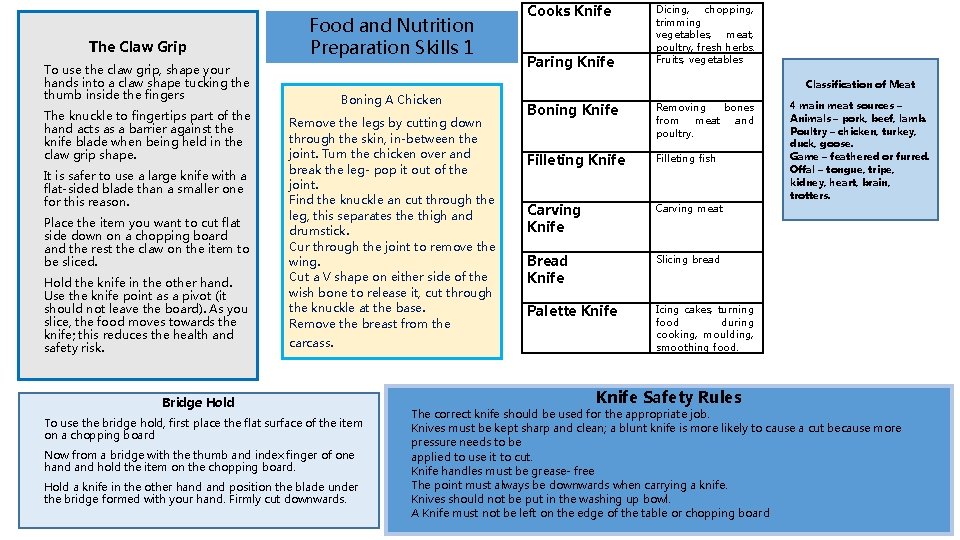
Food and Nutrition Preparation Skills 1 The Claw Grip To use the claw grip, shape your hands into a claw shape tucking the thumb inside the fingers The knuckle to fingertips part of the hand acts as a barrier against the knife blade when being held in the claw grip shape. It is safer to use a large knife with a flat-sided blade than a smaller one for this reason. Place the item you want to cut flat side down on a chopping board and the rest the claw on the item to be sliced. Hold the knife in the other hand. Use the knife point as a pivot (it should not leave the board). As you slice, the food moves towards the knife; this reduces the health and safety risk. Boning A Chicken Remove the legs by cutting down through the skin, in-between the joint. Turn the chicken over and break the leg- pop it out of the joint. Find the knuckle an cut through the leg, this separates the thigh and drumstick. Cur through the joint to remove the wing. Cut a V shape on either side of the wish bone to release it, cut through the knuckle at the base. Remove the breast from the carcass. Bridge Hold To use the bridge hold, first place the flat surface of the item on a chopping board Now from a bridge with the thumb and index finger of one hand hold the item on the chopping board. Hold a knife in the other hand position the blade under the bridge formed with your hand. Firmly cut downwards. Cooks Knife Paring Knife Boning Knife Filleting Knife Carving Knife Bread Knife Palette Knife Dicing, chopping, trimming vegetables, meat, poultry, fresh herbs. Fruits, vegetables Classification of Meat Removing bones from meat and poultry. Filleting fish Carving meat 4 main meat sources – Animals – pork, beef, lamb. Poultry – chicken, turkey, duck, goose. Game – feathered or furred. Offal – tongue, tripe, kidney, heart, brain, trotters. Slicing bread Icing cakes, turning food during cooking, moulding, smoothing food. Knife Safety Rules The correct knife should be used for the appropriate job. Knives must be kept sharp and clean; a blunt knife is more likely to cause a cut because more pressure needs to be applied to use it to cut. Knife handles must be grease- free The point must always be downwards when carrying a knife. Knives should not be put in the washing up bowl. A Knife must not be left on the edge of the table or chopping board
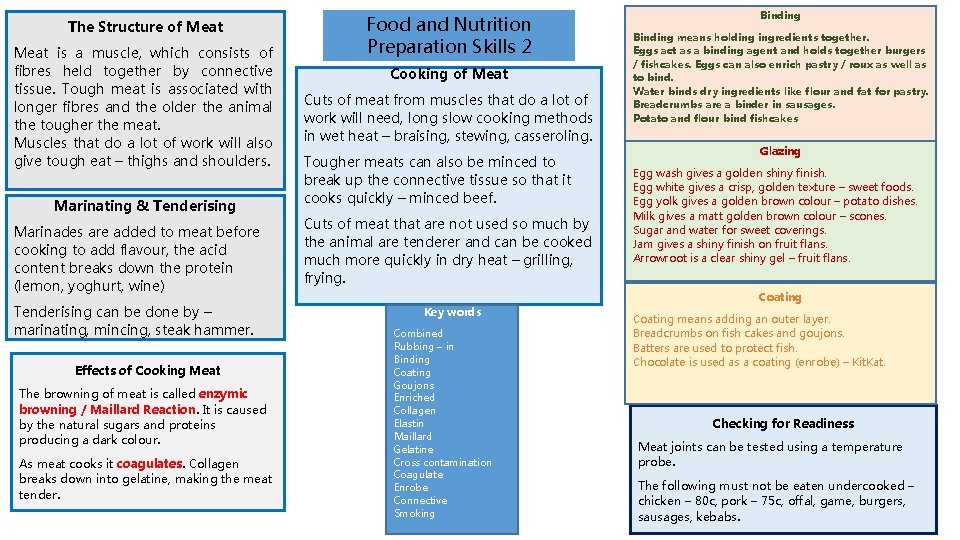
The Structure of Meat is a muscle, which consists of fibres held together by connective tissue. Tough meat is associated with longer fibres and the older the animal the tougher the meat. Muscles that do a lot of work will also give tough eat – thighs and shoulders. Marinating & Tenderising Marinades are added to meat before cooking to add flavour, the acid content breaks down the protein (lemon, yoghurt, wine) Tenderising can be done by – marinating, mincing, steak hammer. Effects of Cooking Meat The browning of meat is called enzymic browning / Maillard Reaction. It is caused by the natural sugars and proteins producing a dark colour. As meat cooks it coagulates. Collagen breaks down into gelatine, making the meat tender. Food and Nutrition Preparation Skills 2 Cooking of Meat Cuts of meat from muscles that do a lot of work will need, long slow cooking methods in wet heat – braising, stewing, casseroling. Tougher meats can also be minced to break up the connective tissue so that it cooks quickly – minced beef. Cuts of meat that are not used so much by the animal are tenderer and can be cooked much more quickly in dry heat – grilling, frying. Key words Combined Rubbing – in Binding Coating Goujons Enriched Collagen Elastin Maillard Gelatine Cross contamination Coagulate Enrobe Connective Smoking Binding means holding ingredients together. Eggs act as a binding agent and holds together burgers / fishcakes. Eggs can also enrich pastry / roux as well as to bind. Water binds dry ingredients like flour and fat for pastry. Breadcrumbs are a binder in sausages. Potato and flour bind fishcakes Glazing Egg wash gives a golden shiny finish. Egg white gives a crisp, golden texture – sweet foods. Egg yolk gives a golden brown colour – potato dishes. Milk gives a matt golden brown colour – scones. Sugar and water for sweet coverings. Jam gives a shiny finish on fruit flans. Arrowroot is a clear shiny gel – fruit flans. Coating means adding an outer layer. Breadcrumbs on fish cakes and goujons. Batters are used to protect fish. Chocolate is used as a coating (enrobe) – Kit. Kat. Checking for Readiness Meat joints can be tested using a temperature probe. The following must not be eaten undercooked – chicken – 80 c, pork – 75 c, offal, game, burgers, sausages, kebabs.