
Food and Culture ERIK CHEVRIER SEPTEMBER 7 T
Food and Culture ERIK CHEVRIER SEPTEMBER 7 T H , 2017
What is Culture? Raymond Williams ◦ A general process of intellectual, spiritual and aesthetic development. ◦ A particular way of life, whether of a people, period or group. ◦ The works and practices of intellectual and especially artistic activity. Nesbitt-Larking ◦ The general process of intellectual, spiritual, and artistic development of a people. ◦ The entire way of life of a people, in terms of those practices and facts through which they express their meaning. ◦ High culture – the works and practices of intellectual artistic activity ◦ Culture is the way of life of a people, in particular their evolving ideas, beliefs, and values as they are understood, communicated and represented. Bennett ◦ Culture consists of all those practices (or activities) that signify; that is, which produce and communicate meaning by the manipulation of signs in socially shared and conventionalized ways.
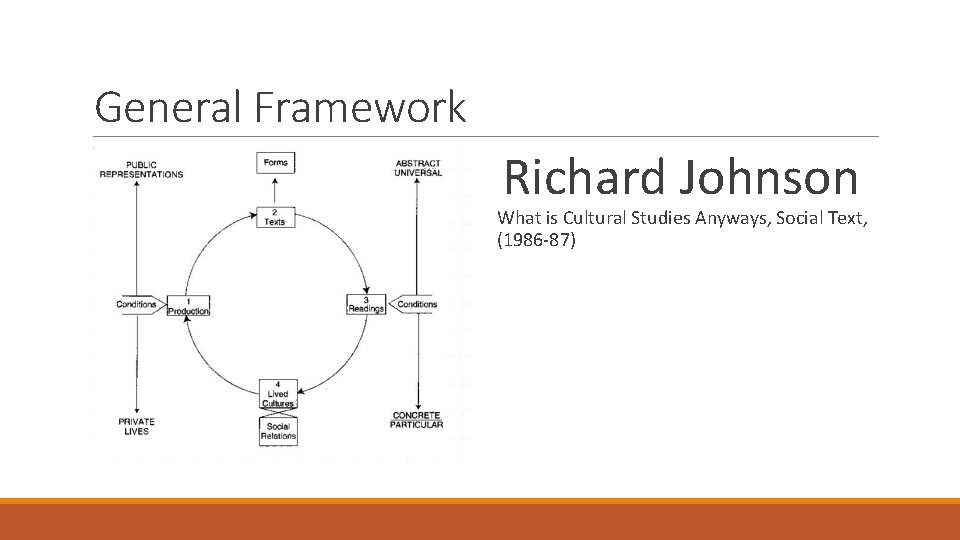
General Framework Richard Johnson What is Cultural Studies Anyways, Social Text, (1986 -87)
What is Food Culture? Food culture refers to the practices, attitudes, and beliefs as well as the networks and institutions surrounding the production, distribution, and consumption of food. It encompasses the concepts of foodways, cuisine, and food system and includes the fundamental understandings a group has about food, historical and current conditions shaping that group’s relationship to food, and the ways in which the group uses food to express identity, community, values, status, power, artistry and creativity. It also includes a groups’ definitions of what items can be food, what is tasty, healthy, and socially appropriate for specific subgroups or individuals and when, how, why, and with whom those items can or should be consumed. Source Dr. Long
Food and Culture – Meaning Behind Food – You Are What You Eat Whole Foods Market Karma Co-op IGA Dairy Farmers of Canada - Hockey Tim Horton's I am Canadian I am not Canadian
You Are What You Eat Anne Swidler ◦ Culture is toolkit or repertories ◦ A realistic cultural theory should lead us to expect not passive ‘cultural dopes’ but rather active, sometimes skilled users of culture whom we actually observe ◦ Culture should be viewed as a collection of culturally defined elements ◦ From a reparatory, individuals can pick elements that sustain habitual behaviors or select tools to explore new ways of acting in the world ◦ People have agency but are also led by cultural norms
You Are What You Eat Giddens ◦ Practical consciousness – Tacit understandings and intuitive decisions people make as they go about daily routines but they can’t always directly express. ◦ Discursive consciousness – Formal articulations and rationalizations for actions. Bourdieu ◦ Habitus - Tastes become internalized and converted into a disposition that generates meaningful practices and meaning-giving perceptions
You Are What You Eat Cognition is a dual process – Deliberate conscious process that is slow and reflexive & automatic process that is fast and intuitive. Schemas – Represent deep, largely ‘unconscious’ networks of neural associations that facilitate perception, interpretation and action…Schemas emerge from experience and allow people from becoming cognitively overburdened in daily life. (Vaisey) Ethical foodscape – A realm where good food is not simply viewed as an individual indulgence, but connects to collective obligations like sustainability, animal welfare, and social justice. (Goodman) Alternative hedonism – Consuming differently (ethically) can be a source of pleasure. (Soper)
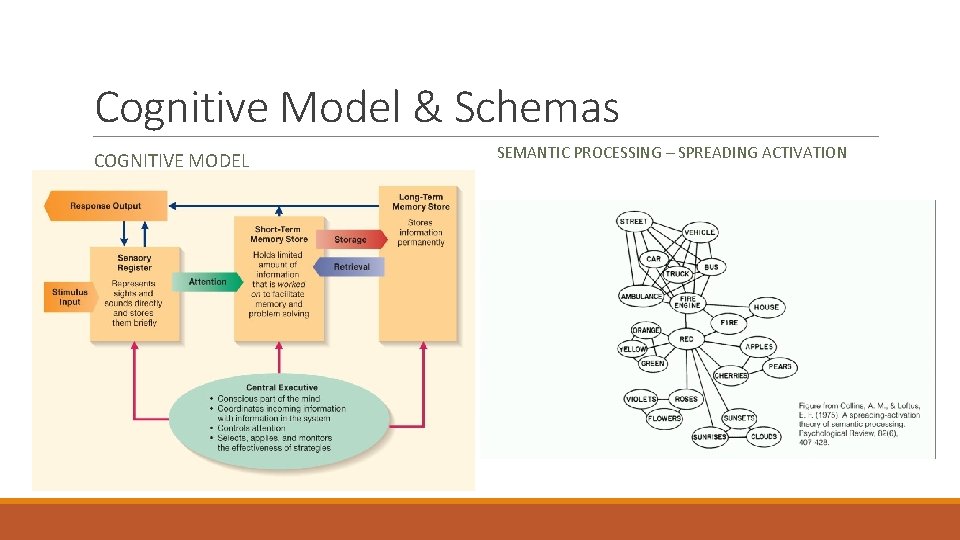
Cognitive Model & Schemas COGNITIVE MODEL SEMANTIC PROCESSING – SPREADING ACTIVATION
Discussion What do eat in a typical day? Where do you acquire food in your daily routine? i. e. home, restaurant, etc. How much of your daily food to you cook (including leftovers) in a typical day? Where do you typically shop for groceries? Why? ◦ Think about the last time you were shopping for food at a grocery store… ◦ ◦ What did you purchase? Why? Do you typically make a list before grocery shopping? If so, do you follow it? What can you remember about your subjective experience at the grocery store? What guides your food purchase decisions most? ◦ Automatic less calculated more impulsive choices? Or Well thought out, planned choices?
Videos Hero’s Sanctuary What’s wrong with Industrial Food? The World According to Monsanto Lobbyist

Le Frigo Vert Before next class, please check out! Le Frigo Vert
- Slides: 12