
Food and Culture ERIK CHEVRIER SEPTEMBER 5 T
Food and Culture ERIK CHEVRIER SEPTEMBER 5 T H , 2017
About Me Erik Chevrier Website: www. erikchevrier. ca Office hours: By request (10: 00 – 11 am Tuesdays and Thursday) & (Wednesday 4: 15 – 5: 15 PM) Office location: H-1125. 12 E-Mail: professor@erikchevrier. ca Research Project: Concordia Food Groups Research Project Facebook Group: Concordia Food Groups Facebook Group for the Class: https: //www. facebook. com/groups/foodandculture/
Food and Culture Write-Up Food is an important part of cultural studies. It is central to many cultural rituals, like feasts and festivals; it has been a catalyst for global resistance to capitalism, like in the food sovereignty movement; it is embedded with a variety of beliefs and customs, like religious diets (i. e. Kosher and Halal); it is a uniting force for the development of a social economy, like in the development of food cooperatives; it has also been a central theme in countless cultural texts, films and literature; most importantly, it is what keeps people alive. In this course, we will explore themes related to food and culture. We will focus on the political economy of food by examining how food is produced, transformed, distributed, consumed, and how food waste is managed in different areas of the world. We will take a critical perspective to analyze multinational food corporations, like Monsanto, by looking at the consequences of large scale industrialized farming, monoculture, and the privatization of genetics. These consequences include, the use of GMOs and the loss of biodiversity; reliance on fossil fuels and its contribution to climate change; use of glyphosate and the accompanying health effects; seed patents and loss of food sovereignty; use of natural resources and the depletion of water and food supplies; among others. We will also explore what certain cultures are doing to prevent these negative consequences. We will look at the slow food movement coming out of Italy and Ireland as a way of re-localizing food production, processing and consumption – aka. the farm to plate movement; we will examine the food sovereignty movement coming out of Mexico at La Via Campesina assembly in 1996 – which is now being popularized globally; we will learn about the Detroit Black Community Food Security Network and their initiative to reclaim food sovereignty, food justice and eliminate food insecurity; we will also look at sustainable production, like seed saving, indigenous practices, permaculture, rooftop gardening, and organic farming. Moreover, we will read about and discuss a variety of beliefs and customs regarding food by addressing the differences in cultural symbolism of plants and animals in different parts of the world. In this course, we will partake in the ‘practice’ of food. Students will cook a meal related to their cultural heritage to share with the class. They will write about and discuss the cultural significance, meaning and symbolism of the food that they prepared for the class. They will also perform research about the supply chain of the ingredients and environmental footprint, as well as the labour, gender, class, and racial relations that went into preparing the food. Student will also partake in food production, they will grow a plant from seed and must care for it until the class is complete.
Class Rules Students are expected to complete ALL the designated readings and watch ALL of the assigned videos BEFORE EACH CLASS. Students are also expected to attend ALL classes, and participate in class discussions. The power-point lecture notes will be posted on the course site on a biweekly basis before each class. Classroom Conduct: The governing principle of classroom conduct is mutual respect. Oppressive statements will not be tolerated in any form. This includes but is not limited to racism, sexism, classism, homophobia, transphobia, hate speech, bullying, and/or forms of derogatory statements. It is important that when others (including myself) speak, we listen quietly and do nothing to hinder the attentiveness of anyone around us. If anyone is perceived to be hindering the ability of others to be attentive, they will be warned by the instructor. If the behavior continues, they will be asked to leave the room. Late assignment policy: Unless I give you permission, late assignments will not be accepted without adequate documentation of medical or personal emergencies. Handing in Assignments: All assignments MUST be submitted in hard copy at the beginning of class on the due date. Any assignment submitted electronically will be subject to a reduction of 10% of the value of the assignment. Academic Honesty: Academic dishonesty is a serious offense and will not be tolerated. Acts of dishonesty include, but are not limited to, plagiarism. It is your responsibility to know and understand university and departmental policies. All acts of academic dishonesty will be reported. Please refer to the Undergraduate Calendar for complete details of offenses and penalties: http: //registrar. concordia. ca/calendar/17/17. 10. html
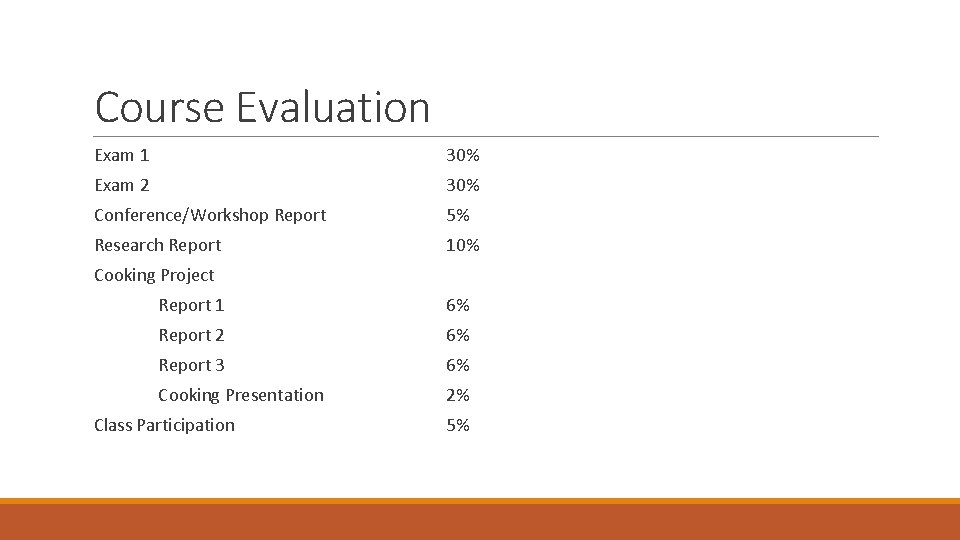
Course Evaluation Exam 1 30% Exam 2 30% Conference/Workshop Report 5% Research Report 10% Cooking Project Report 1 6% Report 2 6% Report 3 6% Cooking Presentation 2% Class Participation 5%
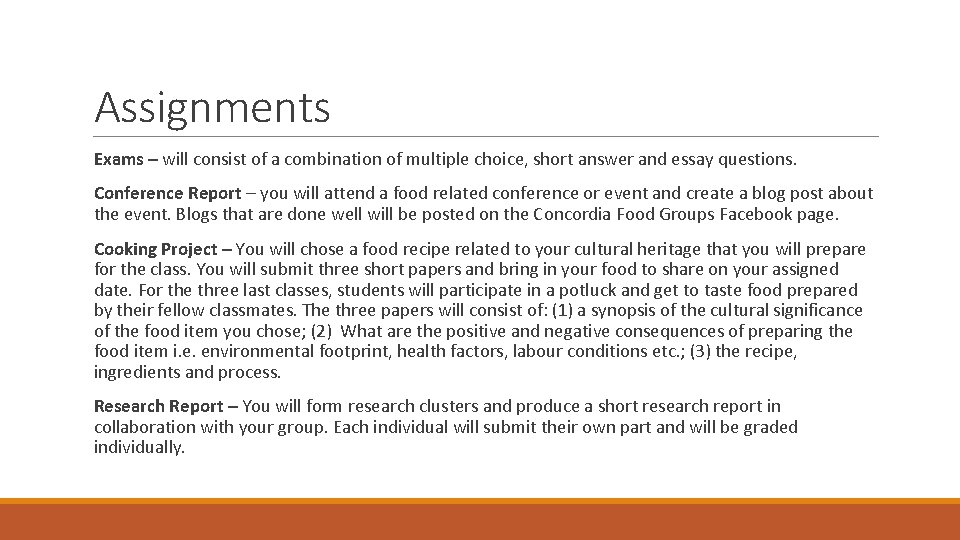
Assignments Exams – will consist of a combination of multiple choice, short answer and essay questions. Conference Report – you will attend a food related conference or event and create a blog post about the event. Blogs that are done well will be posted on the Concordia Food Groups Facebook page. Cooking Project – You will chose a food recipe related to your cultural heritage that you will prepare for the class. You will submit three short papers and bring in your food to share on your assigned date. For the three last classes, students will participate in a potluck and get to taste food prepared by their fellow classmates. The three papers will consist of: (1) a synopsis of the cultural significance of the food item you chose; (2) What are the positive and negative consequences of preparing the food item i. e. environmental footprint, health factors, labour conditions etc. ; (3) the recipe, ingredients and process. Research Report – You will form research clusters and produce a short research report in collaboration with your group. Each individual will submit their own part and will be graded individually.
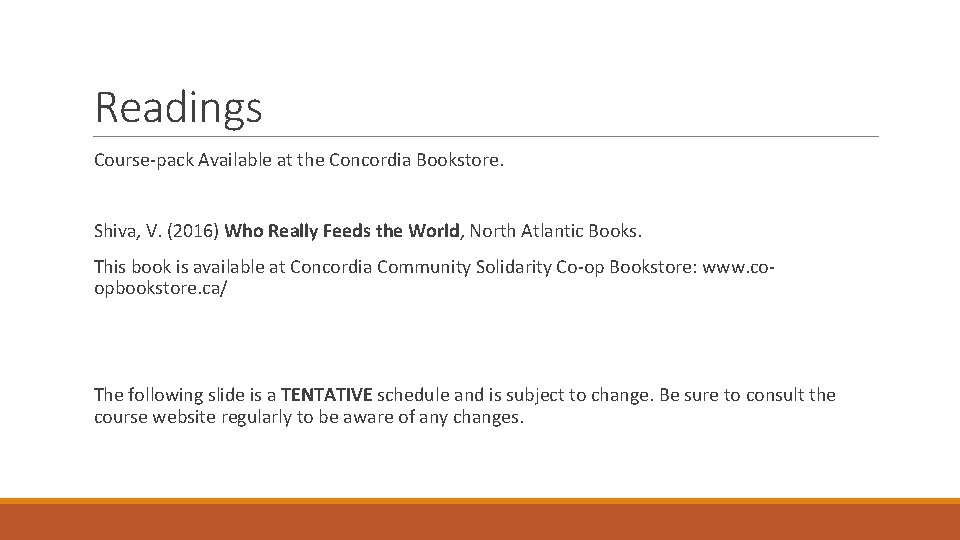
Readings Course-pack Available at the Concordia Bookstore. Shiva, V. (2016) Who Really Feeds the World, North Atlantic Books. This book is available at Concordia Community Solidarity Co-op Bookstore: www. coopbookstore. ca/ The following slide is a TENTATIVE schedule and is subject to change. Be sure to consult the course website regularly to be aware of any changes.
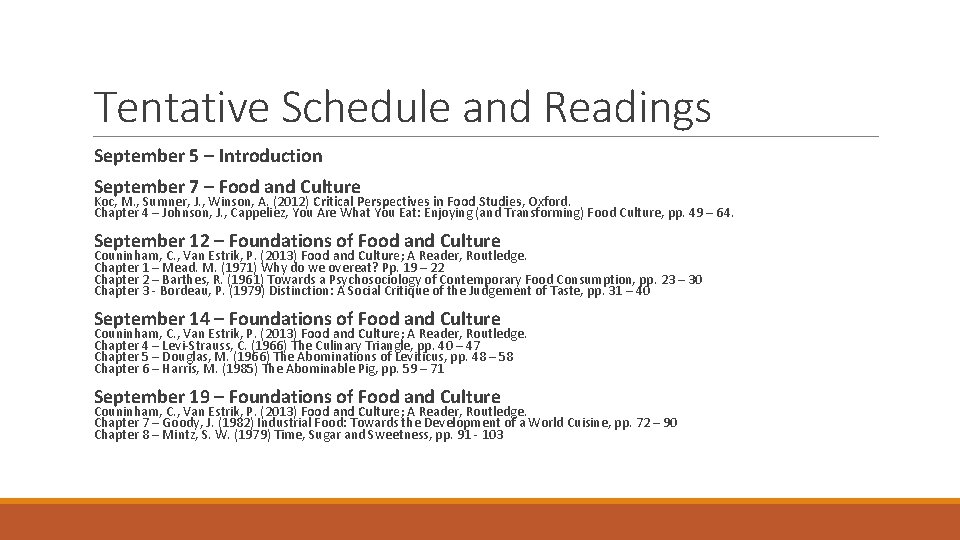
Tentative Schedule and Readings September 5 – Introduction September 7 – Food and Culture Koc, M. , Sumner, J. , Winson, A. (2012) Critical Perspectives in Food Studies, Oxford. Chapter 4 – Johnson, J. , Cappeliez, You Are What You Eat: Enjoying (and Transforming) Food Culture, pp. 49 – 64. September 12 – Foundations of Food and Culture Couninham, C. , Van Estrik, P. (2013) Food and Culture; A Reader, Routledge. Chapter 1 – Mead. M. (1971) Why do we overeat? Pp. 19 – 22 Chapter 2 – Barthes, R. (1961) Towards a Psychosociology of Contemporary Food Consumption, pp. 23 – 30 Chapter 3 - Bordeau, P. (1979) Distinction: A Social Critique of the Judgement of Taste, pp. 31 – 40 September 14 – Foundations of Food and Culture Couninham, C. , Van Estrik, P. (2013) Food and Culture; A Reader, Routledge. Chapter 4 – Levi-Strauss, C. (1966) The Culinary Triangle, pp. 40 – 47 Chapter 5 – Douglas, M. (1966) The Abominations of Leviticus, pp. 48 – 58 Chapter 6 – Harris, M. (1985) The Abominable Pig, pp. 59 – 71 September 19 – Foundations of Food and Culture Couninham, C. , Van Estrik, P. (2013) Food and Culture; A Reader, Routledge. Chapter 7 – Goody, J. (1982) Industrial Food: Towards the Development of a World Cuisine, pp. 72 – 90 Chapter 8 – Mintz, S. W. (1979) Time, Sugar and Sweetness, pp. 91 - 103
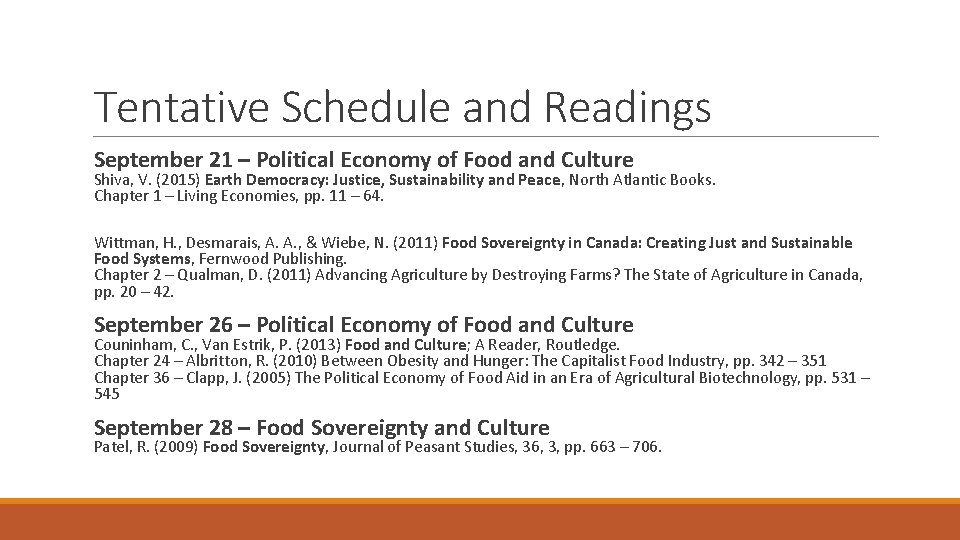
Tentative Schedule and Readings September 21 – Political Economy of Food and Culture Shiva, V. (2015) Earth Democracy: Justice, Sustainability and Peace, North Atlantic Books. Chapter 1 – Living Economies, pp. 11 – 64. Wittman, H. , Desmarais, A. A. , & Wiebe, N. (2011) Food Sovereignty in Canada: Creating Just and Sustainable Food Systems, Fernwood Publishing. Chapter 2 – Qualman, D. (2011) Advancing Agriculture by Destroying Farms? The State of Agriculture in Canada, pp. 20 – 42. September 26 – Political Economy of Food and Culture Couninham, C. , Van Estrik, P. (2013) Food and Culture; A Reader, Routledge. Chapter 24 – Albritton, R. (2010) Between Obesity and Hunger: The Capitalist Food Industry, pp. 342 – 351 Chapter 36 – Clapp, J. (2005) The Political Economy of Food Aid in an Era of Agricultural Biotechnology, pp. 531 – 545 September 28 – Food Sovereignty and Culture Patel, R. (2009) Food Sovereignty, Journal of Peasant Studies, 36, 3, pp. 663 – 706.
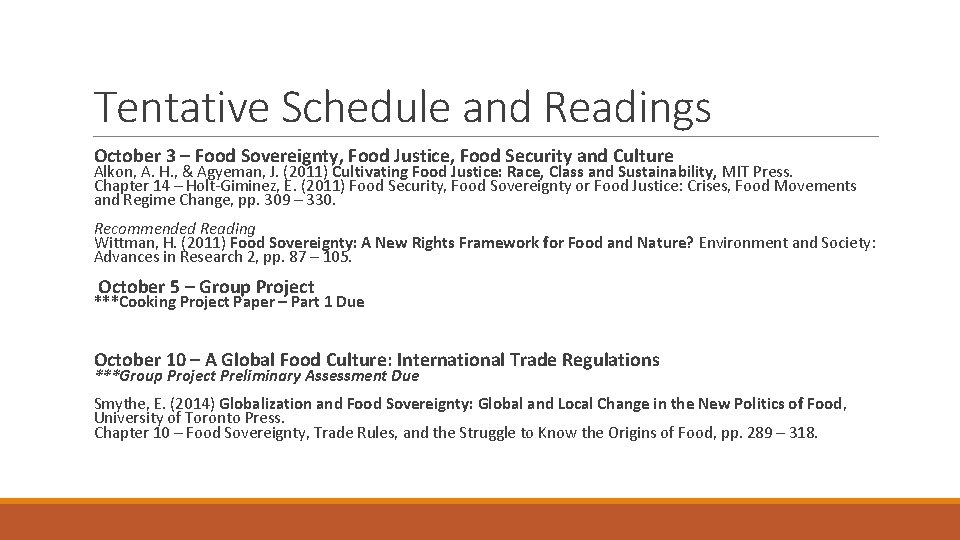
Tentative Schedule and Readings October 3 – Food Sovereignty, Food Justice, Food Security and Culture Alkon, A. H. , & Agyeman, J. (2011) Cultivating Food Justice: Race, Class and Sustainability, MIT Press. Chapter 14 – Holt-Giminez, E. (2011) Food Security, Food Sovereignty or Food Justice: Crises, Food Movements and Regime Change, pp. 309 – 330. Recommended Reading Wittman, H. (2011) Food Sovereignty: A New Rights Framework for Food and Nature? Environment and Society: Advances in Research 2, pp. 87 – 105. October 5 – Group Project ***Cooking Project Paper – Part 1 Due October 10 – A Global Food Culture: International Trade Regulations ***Group Project Preliminary Assessment Due Smythe, E. (2014) Globalization and Food Sovereignty: Global and Local Change in the New Politics of Food, University of Toronto Press. Chapter 10 – Food Sovereignty, Trade Rules, and the Struggle to Know the Origins of Food, pp. 289 – 318.
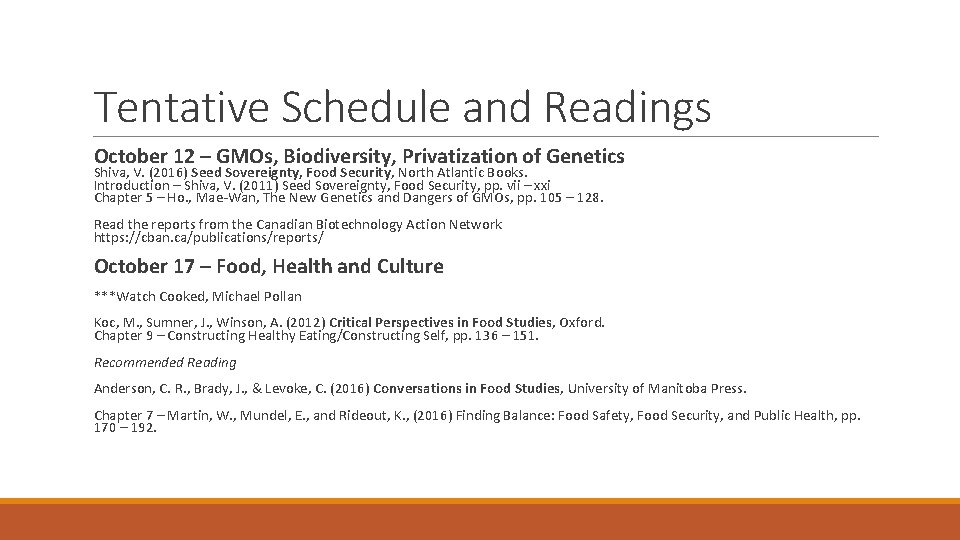
Tentative Schedule and Readings October 12 – GMOs, Biodiversity, Privatization of Genetics Shiva, V. (2016) Seed Sovereignty, Food Security, North Atlantic Books. Introduction – Shiva, V. (2011) Seed Sovereignty, Food Security, pp. vii – xxi Chapter 5 – Ho. , Mae-Wan, The New Genetics and Dangers of GMOs, pp. 105 – 128. Read the reports from the Canadian Biotechnology Action Network https: //cban. ca/publications/reports/ October 17 – Food, Health and Culture ***Watch Cooked, Michael Pollan Koc, M. , Sumner, J. , Winson, A. (2012) Critical Perspectives in Food Studies, Oxford. Chapter 9 – Constructing Healthy Eating/Constructing Self, pp. 136 – 151. Recommended Reading Anderson, C. R. , Brady, J. , & Levoke, C. (2016) Conversations in Food Studies, University of Manitoba Press. Chapter 7 – Martin, W. , Mundel, E. , and Rideout, K. , (2016) Finding Balance: Food Safety, Food Security, and Public Health, pp. 170 – 192.
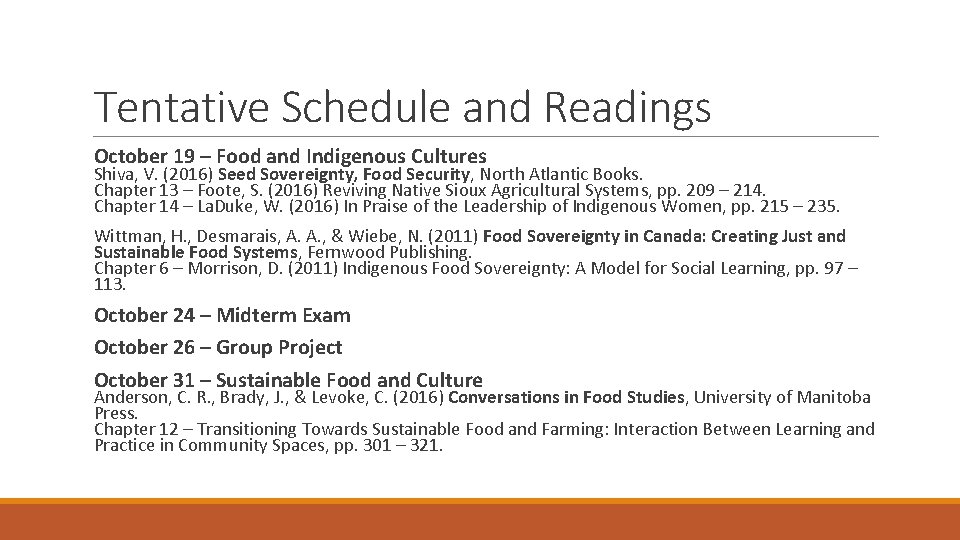
Tentative Schedule and Readings October 19 – Food and Indigenous Cultures Shiva, V. (2016) Seed Sovereignty, Food Security, North Atlantic Books. Chapter 13 – Foote, S. (2016) Reviving Native Sioux Agricultural Systems, pp. 209 – 214. Chapter 14 – La. Duke, W. (2016) In Praise of the Leadership of Indigenous Women, pp. 215 – 235. Wittman, H. , Desmarais, A. A. , & Wiebe, N. (2011) Food Sovereignty in Canada: Creating Just and Sustainable Food Systems, Fernwood Publishing. Chapter 6 – Morrison, D. (2011) Indigenous Food Sovereignty: A Model for Social Learning, pp. 97 – 113. October 24 – Midterm Exam October 26 – Group Project October 31 – Sustainable Food and Culture Anderson, C. R. , Brady, J. , & Levoke, C. (2016) Conversations in Food Studies, University of Manitoba Press. Chapter 12 – Transitioning Towards Sustainable Food and Farming: Interaction Between Learning and Practice in Community Spaces, pp. 301 – 321.
Tentative Schedule and Readings November 2 – Slow Food and Culture Couninham, C. , Van Estrik, P. (2013) Food and Culture; A Reader, Routledge. Chapter 28 – Leitch, A. , (2009) Slow Food and the Politics of “Virtuous” Globalization, pp. 409 – 425. Chapter 29 – Taco Bell, Maseca, and Slow Food: A Postmodern Apocalypse for Mexico’s Peasant Cuisine? , pp. 426 – 436. November 7 – Race, Class, Food and Culture White, M. M. , (2011) D-Town Farm: An African American Resistance to Food Insecurity and the Transformation of Detroit, Environmental Practice, 13, 4. November 9 – Who Really Feeds the World – Agroecology and Soils ***Cooking Project Paper – Part 2 Due Shiva, V. (2016) Who Really Feeds the World, North Atlantic Books. Introduction Chapter 1 – Agroecology Feeds the World, Not a Violent Knowledge Paradigm, pp. 1 – 14. Chapter 2 – Living Soils Feeds the World, Not Chemical Fertilizers, pp. 15 – 26 November 14 - Who Really Feeds the World – Pollinators and Biodiversity Shiva, V. (2016) Who Really Feeds the World, North Atlantic Books. Chapter 3 – Bees and Butterflies Feeds the World, Not Poisons and Pesticides, pp. 27 – 40. Chapter 4 – Biodiversity Feeds the World, Not Toxic Monocultures, pp. 41 – 54.
Tentative Schedule and Readings November 16 - Who Really Feeds the World – Seed Sovereignty and Small-Scale Farmers Shiva, V. (2016) Who Really Feeds the World, North Atlantic Books. Chapter 5 – Small-Scale Farmers Feed the World, Not Large-Scale Industrial Farms, pp. 55 – 65. Chapter 6 – Seed Freedom Feeds the World, Not Seed Dictatorship, pp. 67 – 84. November 21 - Who Really Feeds the World – Localization and Women Shiva, V. (2016) Who Really Feeds the World, North Atlantic Books. Chapter 7 – Localization Feeds the World, Not Globalization, pp. 85 – 111. Chapter 8 – Women Feed the World, Not Corporations, pp. 111 – 124. Chapter 9 – The Way Forward, pp. 125 – 139. November 23 – Cooking Project Presentations ***Final Day to Submit Conference Report ***Cooking Project Paper – Part 3 Due November 28 – Cooking Project Presentations November 30 – Cooking Project Presentations ***Research Report Due
Introduction – Let’s Talk About Food What is your name? What is your cultural background? What’s your favorite food? Why? What kind of food do you NOT like? Why not? Do you have any food allergies? Do you have any dietary conditions (vegan, vegetarian etc. )? Do you have experience producing food (gardening, farming, etc. )? Do you have experience transforming/processing food (cooking)? Do you have experience storing food (canning, fermenting, etc. )? What do you know about food waste management?
Videos Hero’s Sanctuary What’s wrong with Industrial Food? The World According to Monsanto Lobbyist
What do you know about industrial food? What is your current level of knowledge about industrial producing, processing, distribution and waste management? What are positive and negative consequences of industrial food practices? Please provide sources for evidence of claims if any are made. What are your current food practices regarding industrial food? ◦ Do you eat at restaurants a lot? ◦ Do you regularly buy already processed food items at the grocery store instead of untransformed ingredients? ◦ Do you buy factory farmed meat (if you consume meat)? ◦ Do you buy GMO and mass produced monoculture farmed vegetables? ◦ Do you buy foods with pesticides or organic produce? ◦ How important are the above questions to you?
Questions or Concerns? Thanks! Have a great day! Concordia Food Fair – Today, September 5 Reggies Terrace 11 am – 3 pm
- Slides: 18