
Food and Culture ERIK CHEVRIER SEPTEMBER 30 T
Food and Culture ERIK CHEVRIER SEPTEMBER 30 T H , 2019
Reading for Next Week I have modified the reading list for next week. Focus on: Shiva, V. (2015) Earth Democracy: Justice, Sustainability and Peace, North Atlantic Books. Chapter 1 – Living Economies, pp. 11 – 64. Please read if you have time: Wittman, H. , Desmarais, A. A. , & Wiebe, N. (2011) Food Sovereignty in Canada: Creating Just and Sustainable Food Systems, Fernwood Publishing. Chapter 2 – Qualman, D. (2011) Advancing Agriculture by Destroying Farms? The State of Agriculture in Canada, pp. 20 – 42.
Discussion What did you choose for your first food blog? ◦ What type of report are you doing? ◦ ◦ ◦ Interview Traditional paper Conference Interview How are you gathering evidence? How are you structuring your paper/project? What are some issues you may encounter? What are some topics you’ll address? What is the cultural significance of your food item? What was the main ‘findings’ for your report? What was discussed at the conference? Who are you interviewing?
Foundations of Food and Culture Pierre Bourdieu – Distinction: Social Critique of the Judgement of Taste *Published in 1979 What is the main message in Bourdieu’s article? What evidence/examples does Bourdieu refer to support his claims? What is the relationship between food, presentation and culture for teachers, professionals, and industrial and commercial employees? How does food convey information about class and gender? How is body type embodied in class and gender relations? How does schema play a role in our understanding of certain foods? What cultural significance is given to different types of food items?
Foundations of Food and Culture Pierre Bourdieu – Distinction: Social Critique of the Judgement of Taste *Published in 1979 ◦ Compared the spending habits of teachers, professionals, and industrial and commercial employees in respect to food, presentation and culture. ◦ Food is consumed differently between rich and poor, as well as between people of different professions. ◦ Food communicates ideas about social class and gender relations – food tastes are also shaped by social class, gender relations. ◦ ‘Taste, a class culture turned into nature, that is embodied, helps to shape the class body. ’ ◦ Body schema governs the selection of certain foods. ◦ Tastes in food cannot be considered in complete independence of the other dimensions of the relationships to the world, to others and one’s own body, through which the practical philosophy of each class is enacted. ◦ Each lifestyle can only really be constructed in relationship to the other, which is its objective and subjective negation, so that the meaning of behaviour is totally reversed depending on which point of view is adopted and on whether the common words which have to be used to name the conduct are invested with popular or bourgeois connotations, i. e. freedom & abundance. ◦ Emphasis from substance and function to form and manner – there is opposition between form, (social form) and substance.
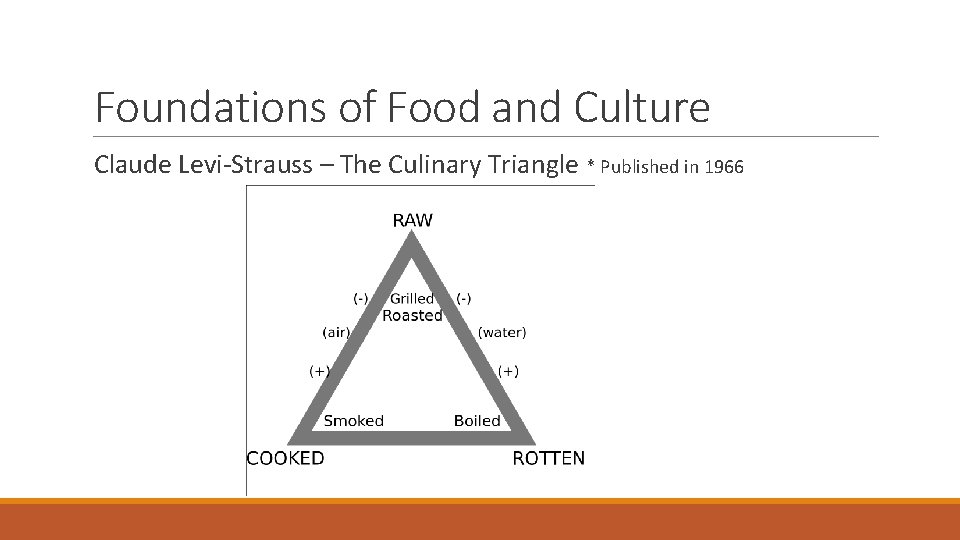
Foundations of Food and Culture Claude Levi-Strauss – The Culinary Triangle * Published in 1966 What is the main message in Levi-Strauss’s article? What evidence/examples does Levi-Strauss refer to support his claims? What is the culinary triangle? What is the relationship between culture and cooked, rotten and raw foods? What is the relationship between smoked, roasted and boiled foods and raw, cooked and rotten foods? How do cultures prepare foods across time and space?
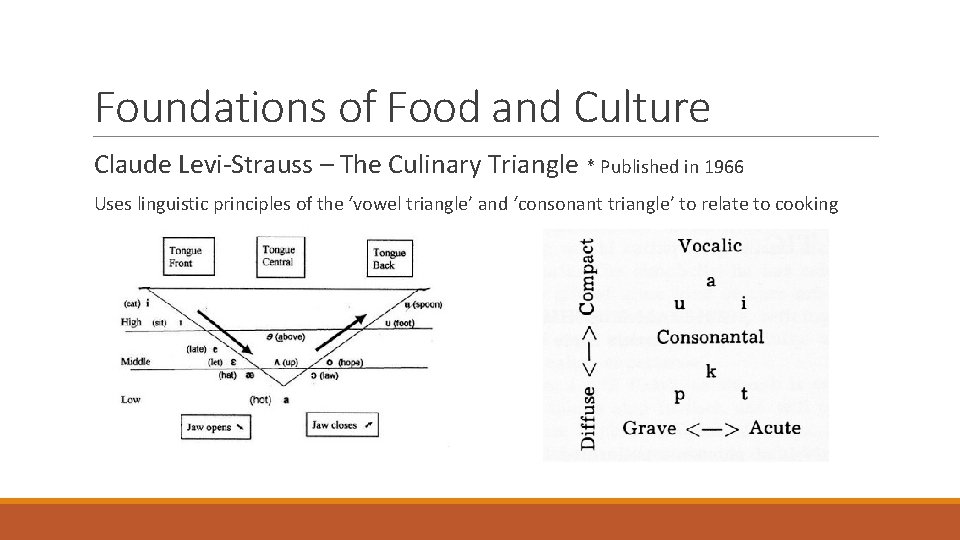
Foundations of Food and Culture Claude Levi-Strauss – The Culinary Triangle * Published in 1966 Uses linguistic principles of the ‘vowel triangle’ and ‘consonant triangle’ to relate to cooking
Foundations of Food and Culture Claude Levi-Strauss – The Culinary Triangle * Published in 1966
What you Should Know Claude Levi-Strauss’s theory of the culinary triangle Know examples given by Claude Levi-Strauss of cultures and their use of cooking, rotting, and raw food methods. You should also be able to name cultures that have used smoking, boiling and grilling methods. Here are some examples: ◦ Guayaki of Paraguay roast all their game, except when they prepare meat destined for the rites which determine the name of the child: meat must be boiled. ◦ Caingang of Brazil prohibit boiled meat for the widow and widower, and also for anyone who has murdered an enemy. ◦ Poconachi of Mexico interpret roasted as a compromise between the raw and the burned. After the universal fire, they relate – that which had not been burned became white, that which had burned was black, and that which had only been singed turned red. This explanation accounts for various colors of the corn and bean. Know the categories that Claude Levi-Strauss adds at the end of the article and understand how they relate to the culinary triangle, i. e. fried, grilled, and steamed. What about other processing techniques, i. e. fermentation?
Foundations of Food and Culture Jack Goody – Towards the Development of a World Cuisine *Published in 1982 What is the main message in Goody’s article? What are important factors in the development of a ‘World Cuisine’? What is the history of: 1 – Preserving 2 – Mechanization 3 – Retailing 4 – Transport Is adulteration of food a new concern? Why or why not? How does global food trade function today? What is the role of advertising in creating a global food cuisine?
Foundations of Food and Culture Jack Goody – Towards the Development of a World Cuisine *Published in 1982 The development of mass cuisine developed because of advances in four main areas: 1 – Preserving 2 – Mechanization 3 – Retailing 4 – Transport
Foundations of Food and Culture Towards the Development of a World Cuisine Preserving methods ◦ Salting meat and fish were salted as of the 15 th century to be shipped by sea ◦ Pickling was an early industrial activity ◦ Sugar was used to preserve fruit and meat Brief history of canning ◦ ◦ ◦ ◦ In 1681 – Invention of the ‘digester’ Canning ‘or bottling’ by Denis Papin in 1681 End of 17 th century – glass containers for medicine and wine at end of 17 th century 1804 – Appert opened bottling factory at Massy, near Paris – developed new improved methods 1814 – Donkin, Hall, Gamble set up canning factories in Bermondsey – food rations purchased by Navy 1821 – William Underwood began trading internationally in Boston – jellies, jams, pickles, ketchup, sauces 1825 – Kensett & Doggett set up cannery in New York 1870 – Rapid expansion of industrial canned goods, especially in France and Brittan 1847 & 1855 – Grimwade took a patent for condensed milk and powdered milk
Foundations of Food and Culture Towards the Development of a World Cuisine Brief History of Artificial Freezing ◦ Early 1800 s – Ice houses in Scotland, Russians conserve chickens in snow, natural ice was packed into refrigerators ◦ 1806 – Frederic Tudor began worldwide ice shipping company from Boston ◦ 1851 – Refrigerated rail cars in USA ◦ 1850 – James Harrison developed first practical ice making machine ◦ Development in branding and advertising – mass production & mass consumption ◦ 1823 – Mr. Lea & Mr. Perrins Worcestershire Sauce ◦ 1860 – Dr. Kellogg produced granola based foods ◦ 1890 s – Charles Post produced Post Toasties – marketed as health food ◦ Flaking, toasting, puffing, extrusion
Foundations of Food and Culture Towards the Development of a World Cuisine Mechanization and Transportation ◦ ◦ Mechanization of food production, preparation and canning. 1849 – Mechanism for pressing out can tops 1876 – Howe machine increased canning production Middle to late 1800 s – Development of Railways Retailing ◦ 1300 s – Company of Grocers ◦ Shift from open markets to closed shops 1600 s ◦ Late 1800 s early 1900 s – rapid expansion of retail outlets – advertising becomes significant Significant factors: - Separation of people from producing food, separation of people from arable land = people become dependent on food markets. - Adulteration of food is not a new concern - Time and space are major obstacles that were overcome to develop a world food system - Industrialization of means of production
Foundations of Food and Culture Sidney W. Mintz – Time, Sugar, Sweetness (published in 1979) What is the main message in Mintz article? What evidence does Mintz use to back up her claim? What are key terms used by Mintz? How did anthropologists study food? What is the history of sugar? What does Mintz say about sugar as a substance? What does Mintz say about the function of sugar? What meaning does sugar communicate? What is the relation between gender, class, privilege and sugar (over time and space)?
Foundations of Food and Culture Sidney W. Mintz – Time, Sugar, Sweetness (published in 1979) Anthropologists have been interested in studying food substances and techniques. ◦ Food and eating were studied by unusual circumstances and through classical literary accounts. ◦ Studies focus on patterned relationships between substances and human groups as forms of communication ◦ Relationships to be considered (consumption and production) ◦ With ‘The Age of Discovery’ foods were transported beyond their areas of cultivation and production Sugar is the main focus of this article ◦ ◦ Cannot be studied in isolation Sweetness is a taste that has infinite uses and functions Taste for sweetness varies immensely Sugar comes in many forms and is extracted from many sources
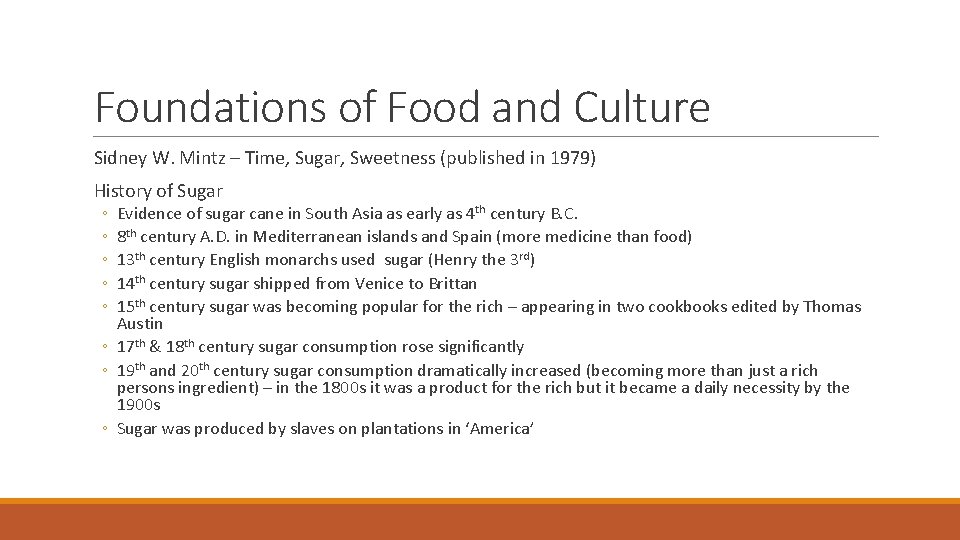
Foundations of Food and Culture Sidney W. Mintz – Time, Sugar, Sweetness (published in 1979) History of Sugar ◦ ◦ ◦ Evidence of sugar cane in South Asia as early as 4 th century B. C. 8 th century A. D. in Mediterranean islands and Spain (more medicine than food) 13 th century English monarchs used sugar (Henry the 3 rd) 14 th century sugar shipped from Venice to Brittan 15 th century sugar was becoming popular for the rich – appearing in two cookbooks edited by Thomas Austin ◦ 17 th & 18 th century sugar consumption rose significantly ◦ 19 th and 20 th century sugar consumption dramatically increased (becoming more than just a rich persons ingredient) – in the 1800 s it was a product for the rich but it became a daily necessity by the 1900 s ◦ Sugar was produced by slaves on plantations in ‘America’
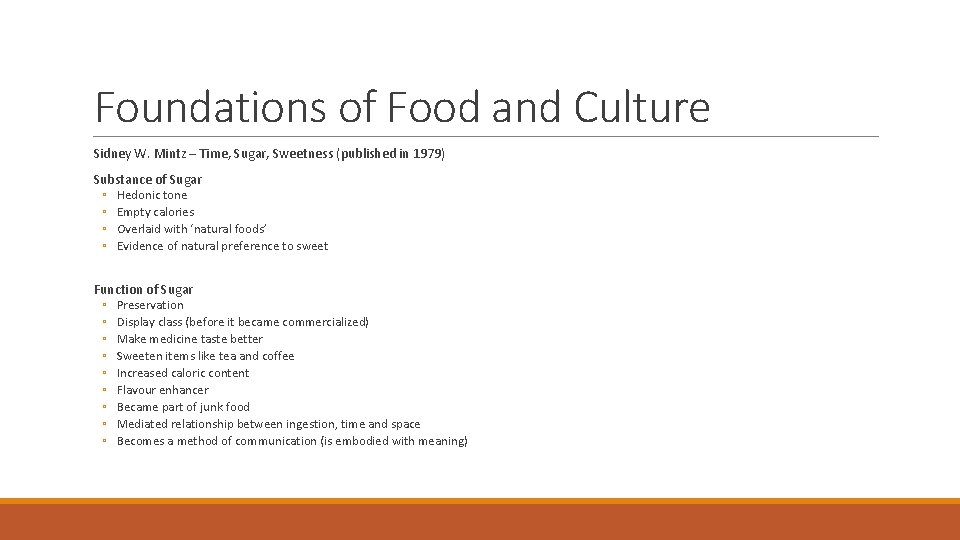
Foundations of Food and Culture Sidney W. Mintz – Time, Sugar, Sweetness (published in 1979) Substance of Sugar ◦ Hedonic tone ◦ Empty calories ◦ Overlaid with ‘natural foods’ ◦ Evidence of natural preference to sweet Function of Sugar ◦ Preservation ◦ Display class (before it became commercialized) ◦ Make medicine taste better ◦ Sweeten items like tea and coffee ◦ Increased caloric content ◦ Flavour enhancer ◦ Became part of junk food ◦ Mediated relationship between ingestion, time and space ◦ Becomes a method of communication (is embodied with meaning)
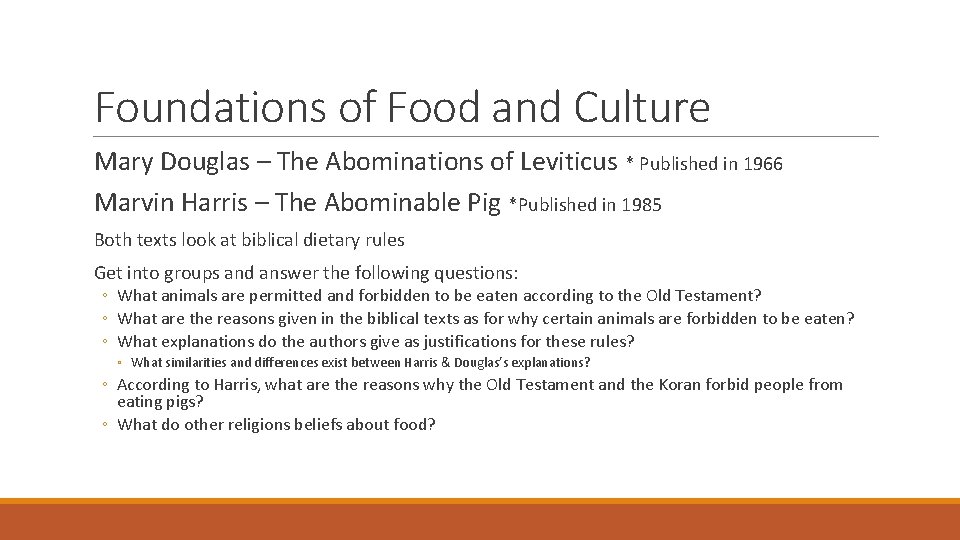
Foundations of Food and Culture Mary Douglas – The Abominations of Leviticus * Published in 1966 Marvin Harris – The Abominable Pig *Published in 1985 Both texts look at biblical dietary rules Get into groups and answer the following questions: ◦ What animals are permitted and forbidden to be eaten according to the Old Testament? ◦ What are the reasons given in the biblical texts as for why certain animals are forbidden to be eaten? ◦ What explanations do the authors give as justifications for these rules? ◦ What similarities and differences exist between Harris & Douglas’s explanations? ◦ According to Harris, what are the reasons why the Old Testament and the Koran forbid people from eating pigs? ◦ What do other religions beliefs about food?
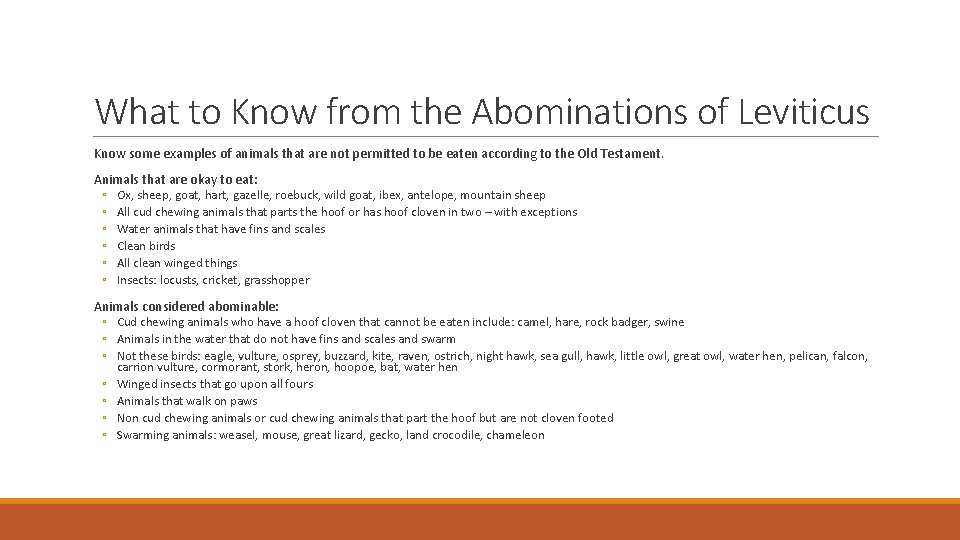
What to Know from the Abominations of Leviticus Know some examples of animals that are not permitted to be eaten according to the Old Testament. Animals that are okay to eat: ◦ Ox, sheep, goat, hart, gazelle, roebuck, wild goat, ibex, antelope, mountain sheep ◦ All cud chewing animals that parts the hoof or has hoof cloven in two – with exceptions ◦ Water animals that have fins and scales ◦ Clean birds ◦ All clean winged things ◦ Insects: locusts, cricket, grasshopper Animals considered abominable: ◦ Cud chewing animals who have a hoof cloven that cannot be eaten include: camel, hare, rock badger, swine ◦ Animals in the water that do not have fins and scales and swarm ◦ Not these birds: eagle, vulture, osprey, buzzard, kite, raven, ostrich, night hawk, sea gull, hawk, little owl, great owl, water hen, pelican, falcon, ◦ ◦ carrion vulture, cormorant, stork, heron, hoopoe, bat, water hen Winged insects that go upon all fours Animals that walk on paws Non cud chewing animals or cud chewing animals that part the hoof but are not cloven footed Swarming animals: weasel, mouse, great lizard, gecko, land crocodile, chameleon
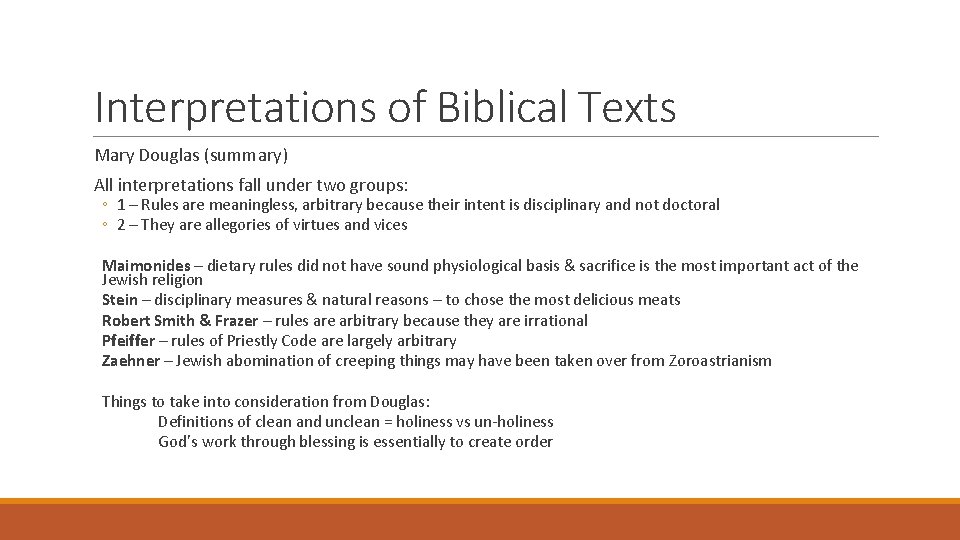
Interpretations of Biblical Texts Mary Douglas (summary) All interpretations fall under two groups: ◦ 1 – Rules are meaningless, arbitrary because their intent is disciplinary and not doctoral ◦ 2 – They are allegories of virtues and vices Maimonides – dietary rules did not have sound physiological basis & sacrifice is the most important act of the Jewish religion Stein – disciplinary measures & natural reasons – to chose the most delicious meats Robert Smith & Frazer – rules are arbitrary because they are irrational Pfeiffer – rules of Priestly Code are largely arbitrary Zaehner – Jewish abomination of creeping things may have been taken over from Zoroastrianism Things to take into consideration from Douglas: Definitions of clean and unclean = holiness vs un-holiness God’s work through blessing is essentially to create order
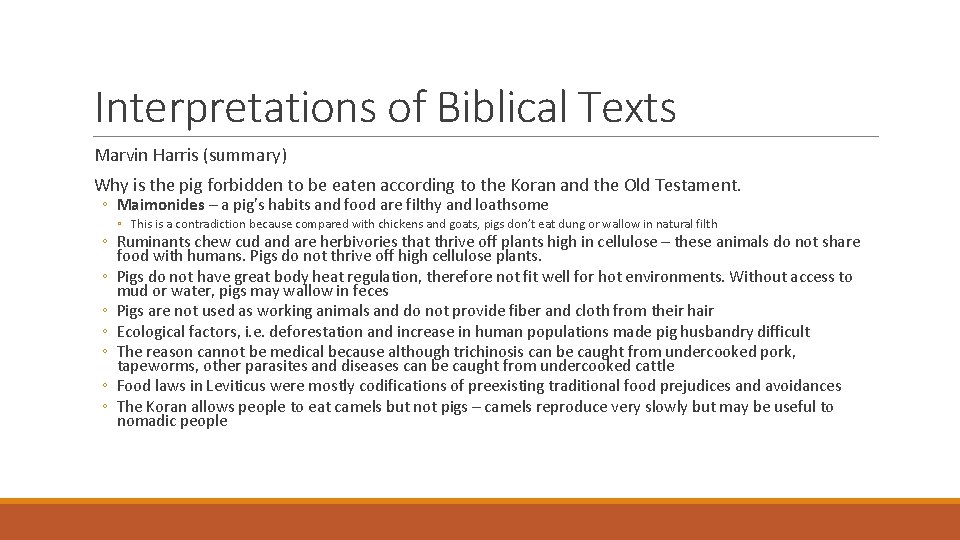
Interpretations of Biblical Texts Marvin Harris (summary) Why is the pig forbidden to be eaten according to the Koran and the Old Testament. ◦ Maimonides – a pig’s habits and food are filthy and loathsome ◦ This is a contradiction because compared with chickens and goats, pigs don’t eat dung or wallow in natural filth ◦ Ruminants chew cud and are herbivories that thrive off plants high in cellulose – these animals do not share food with humans. Pigs do not thrive off high cellulose plants. ◦ Pigs do not have great body heat regulation, therefore not fit well for hot environments. Without access to mud or water, pigs may wallow in feces ◦ Pigs are not used as working animals and do not provide fiber and cloth from their hair ◦ Ecological factors, i. e. deforestation and increase in human populations made pig husbandry difficult ◦ The reason cannot be medical because although trichinosis can be caught from undercooked pork, tapeworms, other parasites and diseases can be caught from undercooked cattle ◦ Food laws in Leviticus were mostly codifications of preexisting traditional food prejudices and avoidances ◦ The Koran allows people to eat camels but not pigs – camels reproduce very slowly but may be useful to nomadic people
Negative Consequences of Marketing The Nag Factor

Please watch! The Century of Self – Part 1 – Happiness Machine
Discussion Write down 5 things that come to your mind about the following food items. What cultural signs are attributed with each food item?

Coffee

Salad

Bread

Eggs

Soup

Cake

Cheese

Steak

Fruit

Candy

Pizza
Discussion What kind of food etiquette did your family follow at the diner table? ◦ ◦ ◦ Did you eat together? Did you have family conversations? Did you eat in front of the TV? What were the divisions of labour (i. e. cooking, cleaning dishes, preparation, etc. )? What kind of rules were set at the table? ◦ Language, preventing bodily functions, etc. … What other kind of food rituals can you remember partaking in as a child (parties, barbecues, corn roasts, gatherings, etc. )?

Thank you! Questions or concerns? Before next class, please visit the City Farm School Gardens and the Hive at Loyola!
- Slides: 38