
Food Allergies in Children Dr C Macaulay Dr
- Slides: 11
Food Allergies in Children Dr C Macaulay Dr C Lemer Dr R Bhatt
Background • Food allergy may be confused with food intolerance • Food allergy can be classified into Ig. E‐mediated and non‐Ig. E‐mediated reactions. • Ig. E‐mediated reactions are acute and frequently have a rapid onset. • Non‐Ig. E‐mediated food allergy is frequently delayed in onset. Most common foods causing allergies • fish • hens' eggs • kiwi fruit • peanuts and tree nuts • sesame • shellfish • soy • wheat.
Epidemiology • The prevalence of food allergy in Europe and North America has been reported to range from 6% to 8% in children up to the age of 3 years. • Only 25– 40% of self-reported food allergy is confirmed as true clinical food allergy by an oral food challenge
Focused history • A personal or family history of atopy is the most significant predictor of allergy. • Ask about history of the reaction – Timing – likely precipitants. • Include history of eczema, asthma, Gastroesophageal reflux • Note that the absence of signs or symptoms does not exclude a food allergy
Immediate reactions ‐Ig. E mediated • Occur within 2 hours of contact or ingestion • Symptoms are consistent and reproducible and include rashes, itching, wheeze, GI symptoms, angioedema and anaphylaxis • Skin prick tests (or blood tests for specific Ig. E antibodies to allergens/likely co‐‐‐allergens) can help diagnosis
Treatment in Ig. E Mediated • Exclusion • Should have dietician advice • Should have an Epi. Pen if history of anahylaxis or have food allergy and asthma
Delayed reactions – Non Ig. E mediated • Occur > 2 hrs after ingestion but within 2‐‐‐ 3 days • Often difficult to reproduce and symptoms less specific • May present: – eczema, colic, reflux, loose stools, constipation, food aversion • No tests help diagnosis
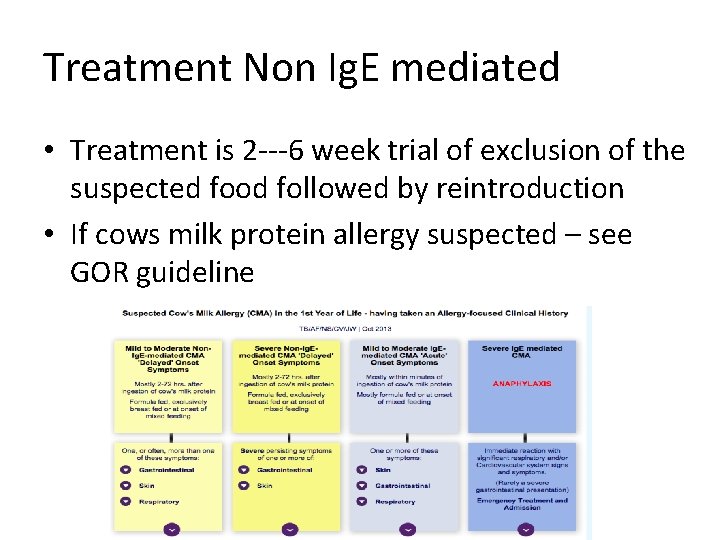
Treatment Non Ig. E mediated • Treatment is 2‐‐‐ 6 week trial of exclusion of the suspected food followed by reintroduction • If cows milk protein allergy suspected – see GOR guideline
When to refer • has had an anaphylactic reaction • had one or more severe delayed reactions • has immediate or delayed allergic reactions to multiple allergens or food groups, especially if there is faltering growth • has had acute allergic reaction with coexisting asthma • moderate – severe eczema where cross reactive or multiple food allergies suspected • has not responded to a single –allergen elimination diet Or: • There is strong clinical suspicion of Ig E‐‐‐mediated food allergy but allergy test results are negative
Top Tips • All children who are excluding multiple foods should be referred to a paediatric dietician • Most cases of urticaria lasting over several days are associated with a viral infection and do not represent a food allergy • Do not use serum‐‐‐specific Ig. E testing to diagnose delayed food allergy • Allergy UK : www. allergyuk. org/ has excellent advice sheets for families and clinicians
Resources • https: //www. nice. org. uk/guidance/cg 116 • Cows milk protein allergy: http: //cowsmilkallergyguidelines. co. uk/interacti ve‐algorithm/ • https: //www. allergyuk. org/childhood‐food‐ allergy/food‐allergy‐in‐babies‐and‐children