
Food Adulteration ISTE Talk Presented by SANJAY PATEL
Food Adulteration ISTE Talk Presented by SANJAY PATEL Chemical Engineering Department 5 th March 2013
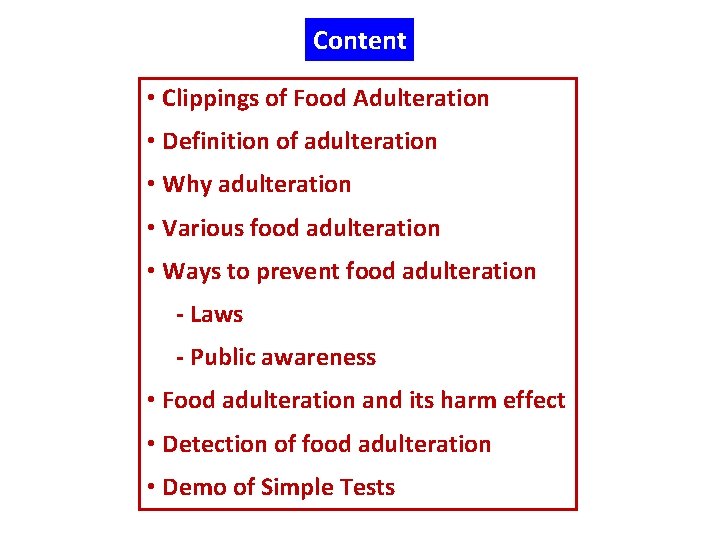
Content • Clippings of Food Adulteration • Definition of adulteration • Why adulteration • Various food adulteration • Ways to prevent food adulteration Laws Public awareness • Food adulteration and its harm effect • Detection of food adulteration • Demo of Simple Tests
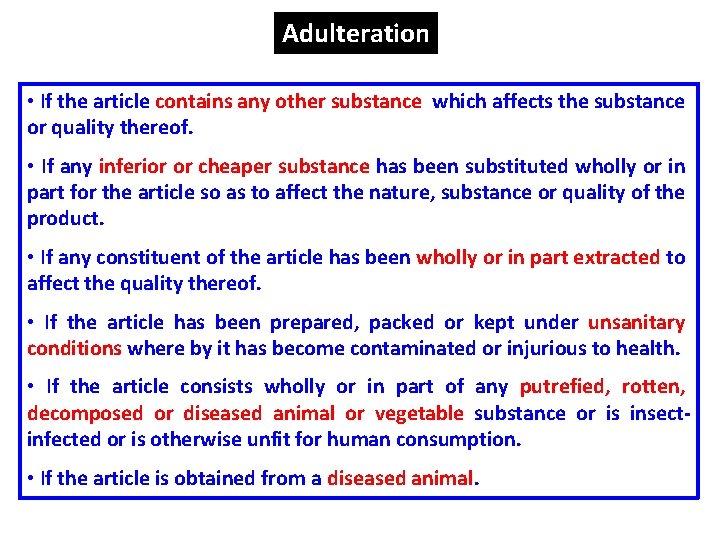
Adulteration • If the article contains any other substance which affects the substance or quality thereof. • If any inferior or cheaper substance has been substituted wholly or in part for the article so as to affect the nature, substance or quality of the product. • If any constituent of the article has been wholly or in part extracted to affect the quality thereof. • If the article has been prepared, packed or kept under unsanitary conditions where by it has become contaminated or injurious to health. • If the article consists wholly or in part of any putrefied, rotten, decomposed or diseased animal or vegetable substance or is insect infected or is otherwise unfit for human consumption. • If the article is obtained from a diseased animal.
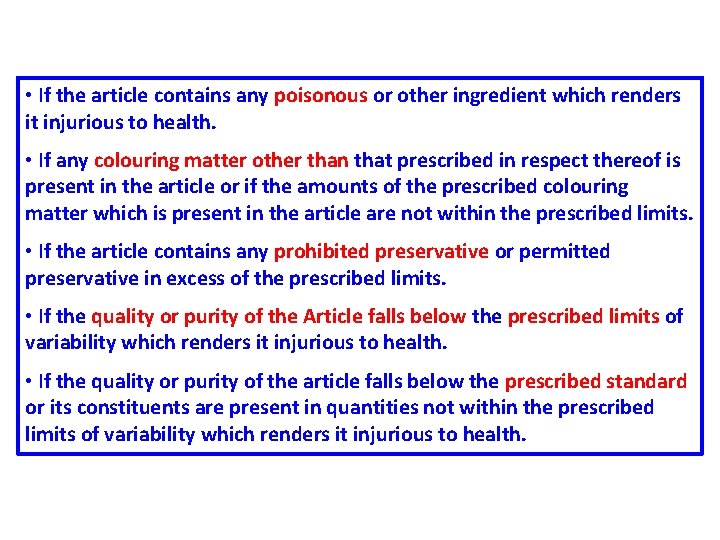
• If the article contains any poisonous or other ingredient which renders it injurious to health. • If any colouring matter other than that prescribed in respect thereof is present in the article or if the amounts of the prescribed colouring matter which is present in the article are not within the prescribed limits. • If the article contains any prohibited preservative or permitted preservative in excess of the prescribed limits. • If the quality or purity of the Article falls below the prescribed limits of variability which renders it injurious to health. • If the quality or purity of the article falls below the prescribed standard or its constituents are present in quantities not within the prescribed limits of variability which renders it injurious to health.
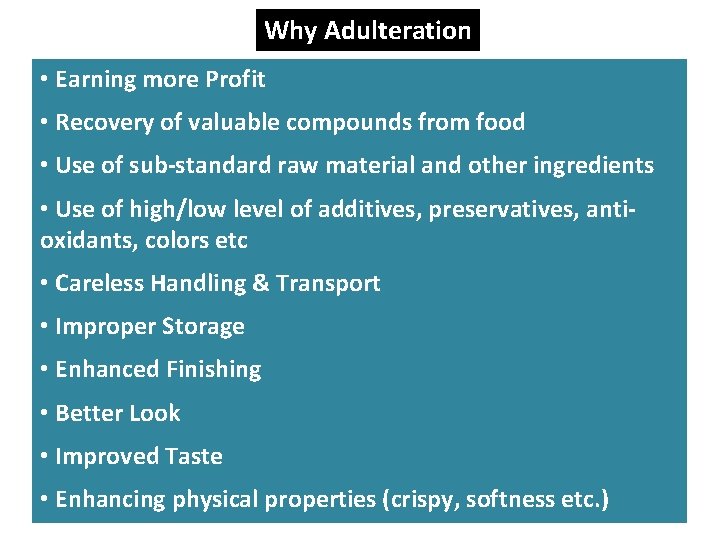
Why Adulteration • Earning more Profit • Recovery of valuable compounds from food • Use of sub standard raw material and other ingredients • Use of high/low level of additives, preservatives, anti oxidants, colors etc • Careless Handling & Transport • Improper Storage • Enhanced Finishing • Better Look • Improved Taste • Enhancing physical properties (crispy, softness etc. )
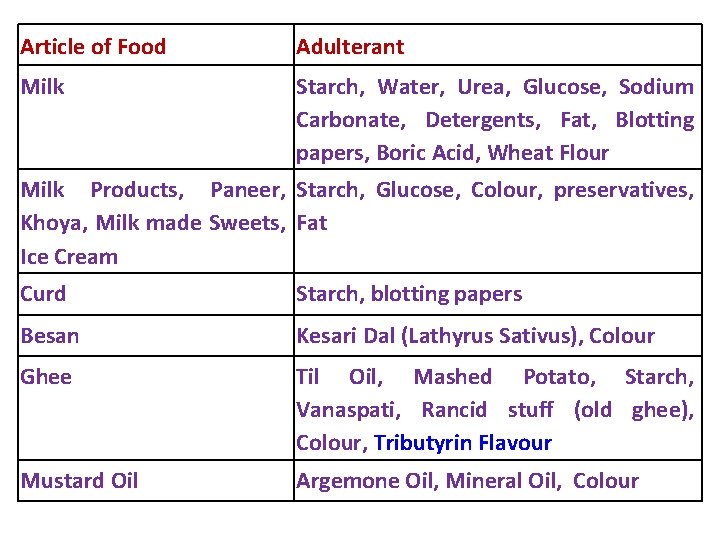
Article of Food Adulterant Milk Starch, Water, Urea, Glucose, Sodium Carbonate, Detergents, Fat, Blotting papers, Boric Acid, Wheat Flour Milk Products, Paneer, Starch, Glucose, Colour, preservatives, Khoya, Milk made Sweets, Fat Ice Cream Curd Starch, blotting papers Besan Kesari Dal (Lathyrus Sativus), Colour Ghee Til Oil, Mashed Potato, Starch, Vanaspati, Rancid stuff (old ghee), Colour, Tributyrin Flavour Mustard Oil Argemone Oil, Mineral Oil, Colour
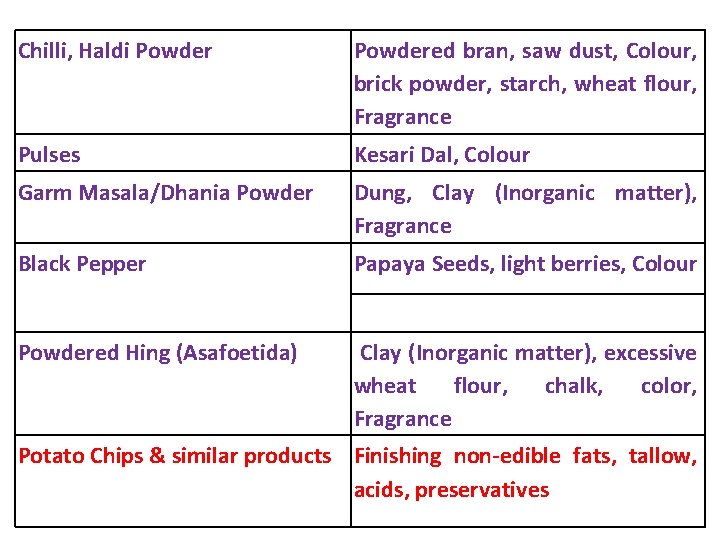
Chilli, Haldi Powdered bran, saw dust, Colour, brick powder, starch, wheat flour, Fragrance Pulses Kesari Dal, Colour Garm Masala/Dhania Powder Dung, Clay (Inorganic matter), Fragrance Black Pepper Papaya Seeds, light berries, Colour Powdered Hing (Asafoetida) Clay (Inorganic matter), excessive wheat flour, chalk, color, Fragrance Potato Chips & similar products Finishing non edible fats, tallow, acids, preservatives
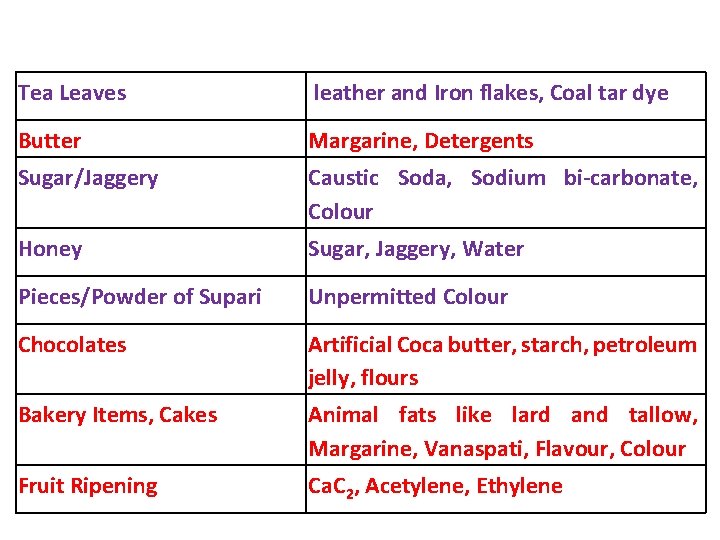
Tea Leaves leather and Iron flakes, Coal tar dye Butter Margarine, Detergents Sugar/Jaggery Caustic Soda, Sodium bi carbonate, Colour Honey Sugar, Jaggery, Water Pieces/Powder of Supari Unpermitted Colour Chocolates Artificial Coca butter, starch, petroleum jelly, flours Bakery Items, Cakes Animal fats like lard and tallow, Margarine, Vanaspati, Flavour, Colour Fruit Ripening Ca. C 2, Acetylene, Ethylene
• Wafers/Kurkure • Instant Foods • Fast Foods • Ready to Eat • Hotels/Road side Foods • Farsan • Loose Food Products • Medicines • Alcohols • Fruit Injections
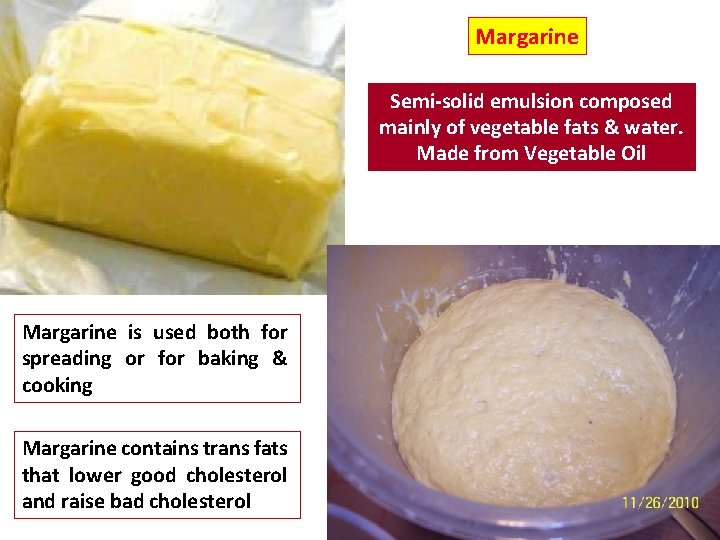
Margarine Semi solid emulsion composed mainly of vegetable fats & water. Made from Vegetable Oil Margarine is used both for spreading or for baking & cooking Margarine contains trans fats that lower good cholesterol and raise bad cholesterol
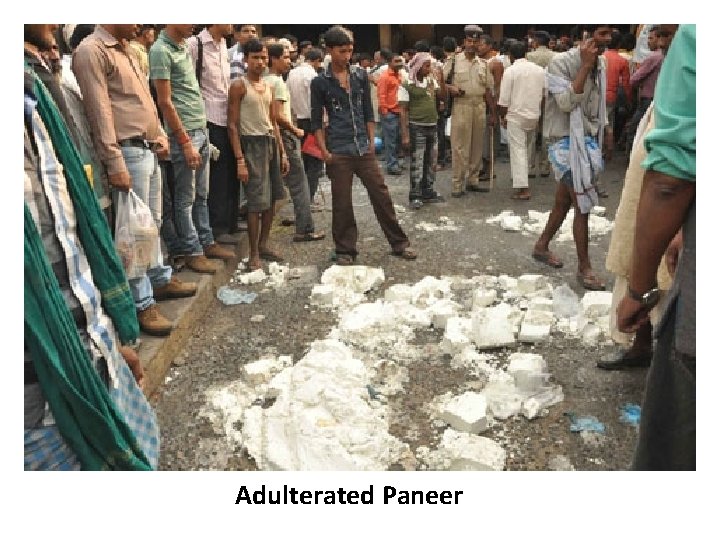
Adulterated Paneer
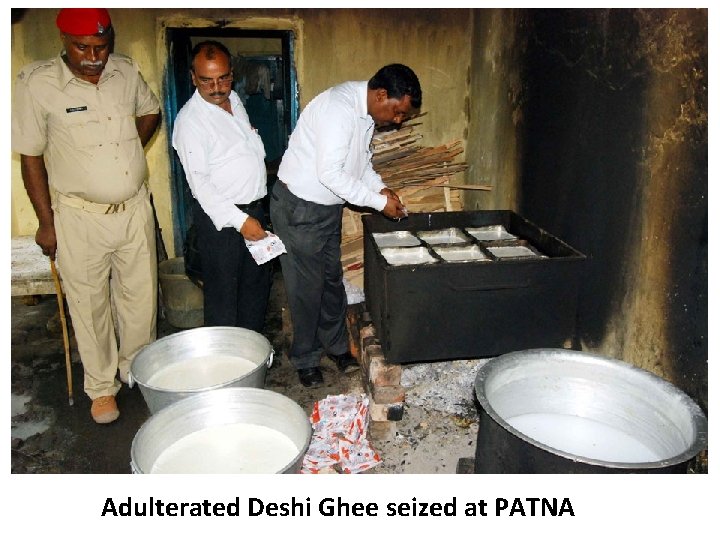
Adulterated Deshi Ghee seized at PATNA

Prevention of Food Adulteration Act & Rules (1955) (PFA) Prevention of Food Adulteration • By Laws (Food Inspectors, Analysts, Food Lab) • Public Awareness • Ethics of Manufactures & Distributors
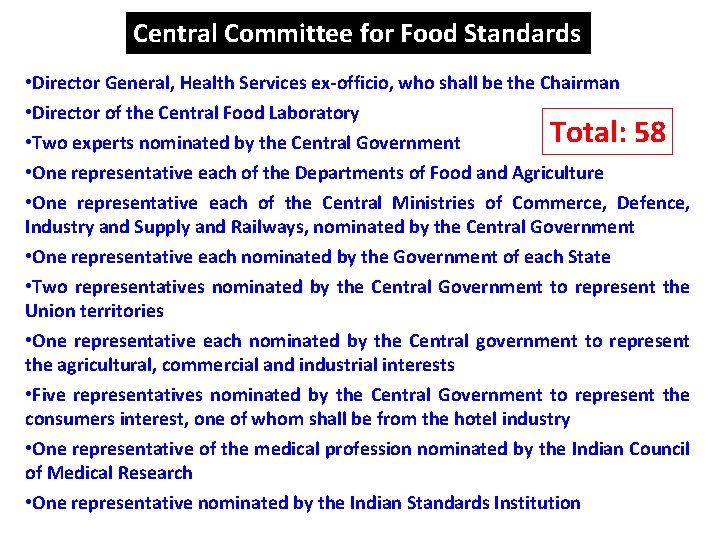
Central Committee for Food Standards • Director General, Health Services ex officio, who shall be the Chairman • Director of the Central Food Laboratory Total: 58 • Two experts nominated by the Central Government • One representative each of the Departments of Food and Agriculture • One representative each of the Central Ministries of Commerce, Defence, Industry and Supply and Railways, nominated by the Central Government • One representative each nominated by the Government of each State • Two representatives nominated by the Central Government to represent the Union territories • One representative each nominated by the Central government to represent the agricultural, commercial and industrial interests • Five representatives nominated by the Central Government to represent the consumers interest, one of whom shall be from the hotel industry • One representative of the medical profession nominated by the Indian Council of Medical Research • One representative nominated by the Indian Standards Institution
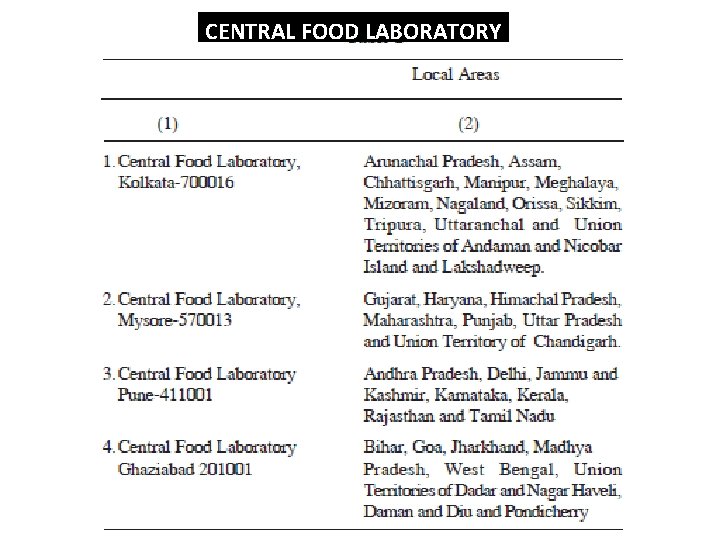
CENTRAL FOOD LABORATORY
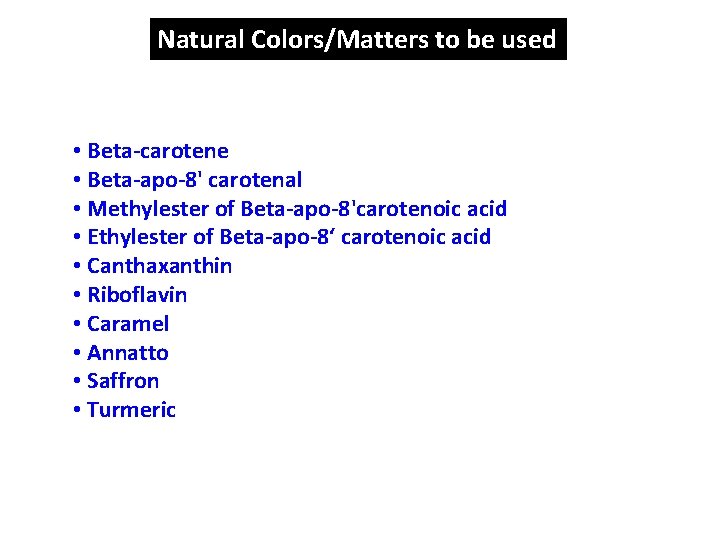
Natural Colors/Matters to be used • Beta carotene • Beta apo 8' carotenal • Methylester of Beta apo 8'carotenoic acid • Ethylester of Beta apo 8‘ carotenoic acid • Canthaxanthin • Riboflavin • Caramel • Annatto • Saffron • Turmeric
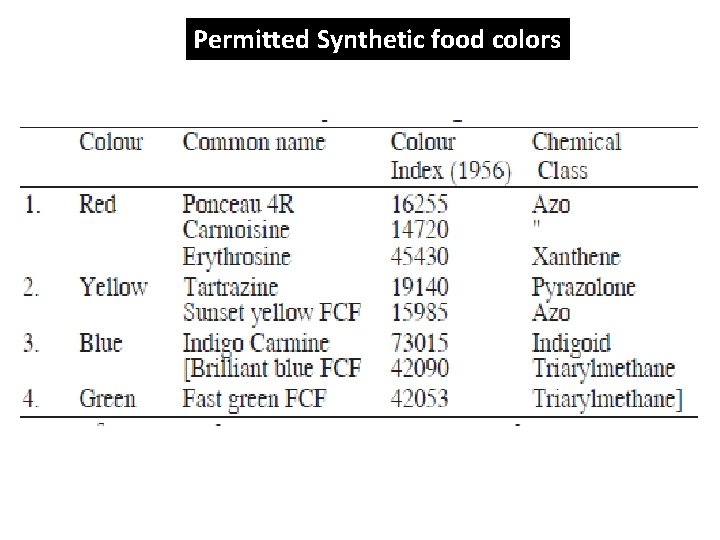
Permitted Synthetic food colors
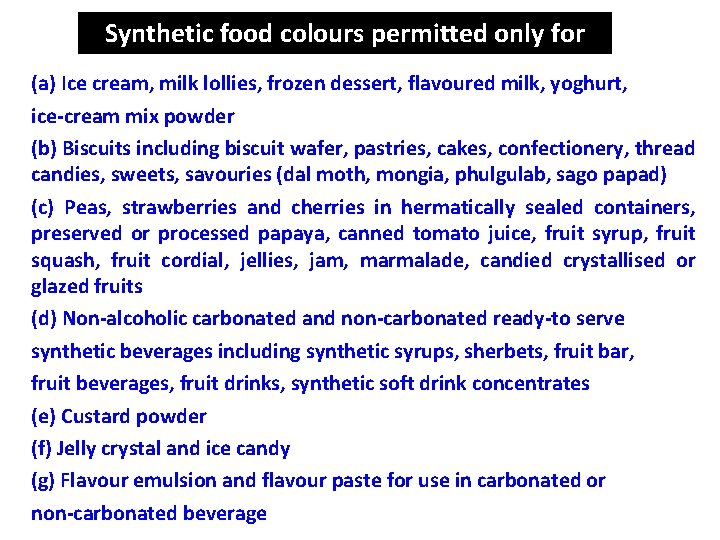
Synthetic food colours permitted only for (a) Ice cream, milk lollies, frozen dessert, flavoured milk, yoghurt, ice cream mix powder (b) Biscuits including biscuit wafer, pastries, cakes, confectionery, thread candies, sweets, savouries (dal moth, mongia, phulgulab, sago papad) (c) Peas, strawberries and cherries in hermatically sealed containers, preserved or processed papaya, canned tomato juice, fruit syrup, fruit squash, fruit cordial, jellies, jam, marmalade, candied crystallised or glazed fruits (d) Non alcoholic carbonated and non carbonated ready to serve synthetic beverages including synthetic syrups, sherbets, fruit bar, fruit beverages, fruit drinks, synthetic soft drink concentrates (e) Custard powder (f) Jelly crystal and ice candy (g) Flavour emulsion and flavour paste for use in carbonated or non carbonated beverage
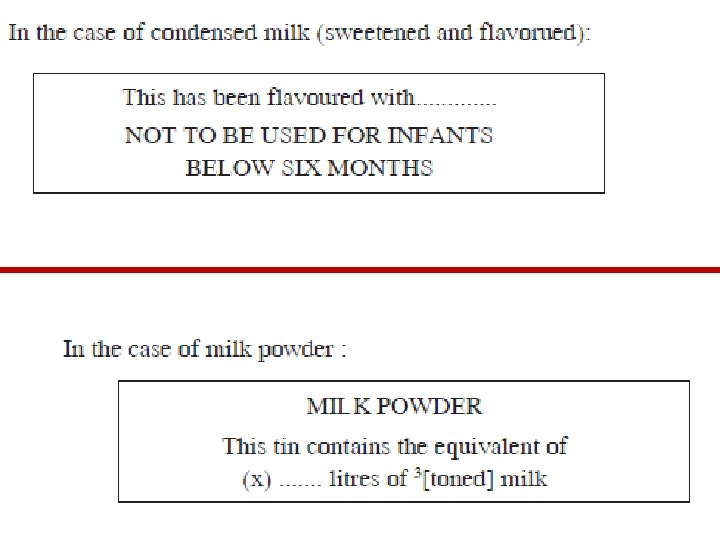
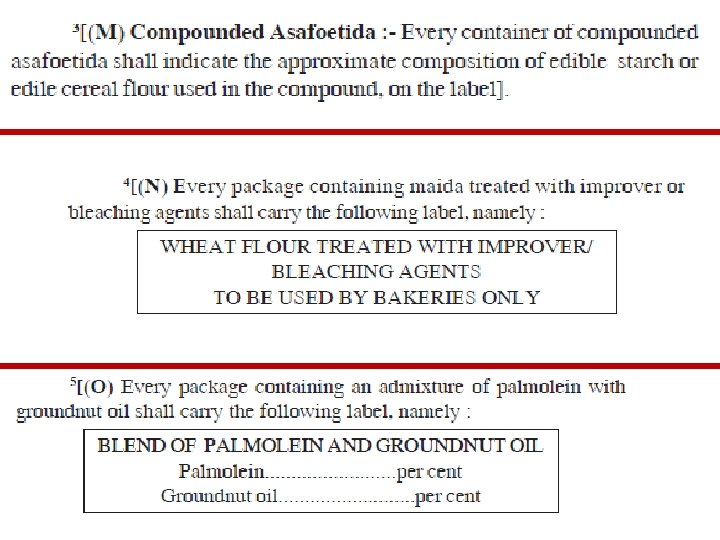
PACKING AND LABELLING OF FOOD (a) Name, trade name or description of food contained in the package (b) Names of ingredients used in the product in descending order of their composition by weight or volume as the case may be • Detailed guide line is made including matters, space, font sizes to be covered by information etc • Price, composition, veg or non veg symbols, batch, year, best before etc. • Specific warning IN CAPITAL LETTERS: i. e. Tobacco: Injurious to health • Baby food: Mother’s milk is best for your baby • Material specification for pickings and labels
Permissible colouring matter used are to be mentioned on the label I) CONTAINS PERMITTED NATURAL COLOUR(S) OR II) CONTAINS PERMITTED SYNTHETIC FOOD COLOUR(S) OR III) CONTAINS PERMITTED NATURAL AND SYNTHETIC FOOD COLOUR(S) Unauthorized addition of colouring matter prohibited Addition of inorganic matters and pigments prohibited
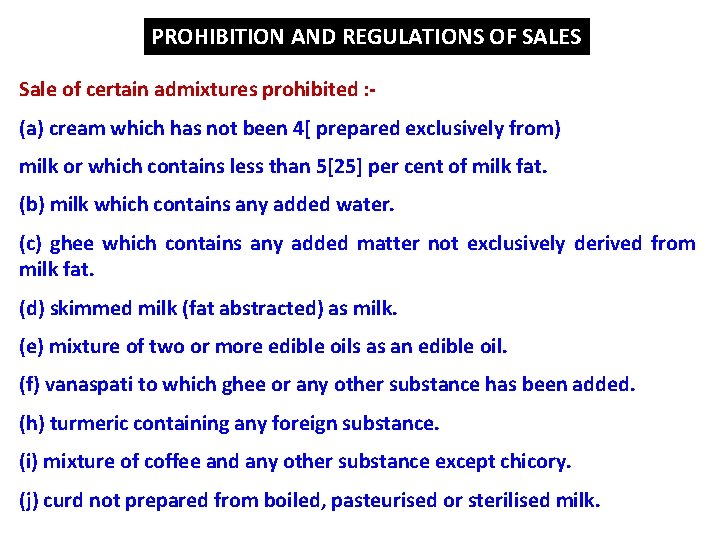
PROHIBITION AND REGULATIONS OF SALES Sale of certain admixtures prohibited : (a) cream which has not been 4[ prepared exclusively from) milk or which contains less than 5[25] per cent of milk fat. (b) milk which contains any added water. (c) ghee which contains any added matter not exclusively derived from milk fat. (d) skimmed milk (fat abstracted) as milk. (e) mixture of two or more edible oils as an edible oil. (f) vanaspati to which ghee or any other substance has been added. (h) turmeric containing any foreign substance. (i) mixture of coffee and any other substance except chicory. (j) curd not prepared from boiled, pasteurised or sterilised milk.
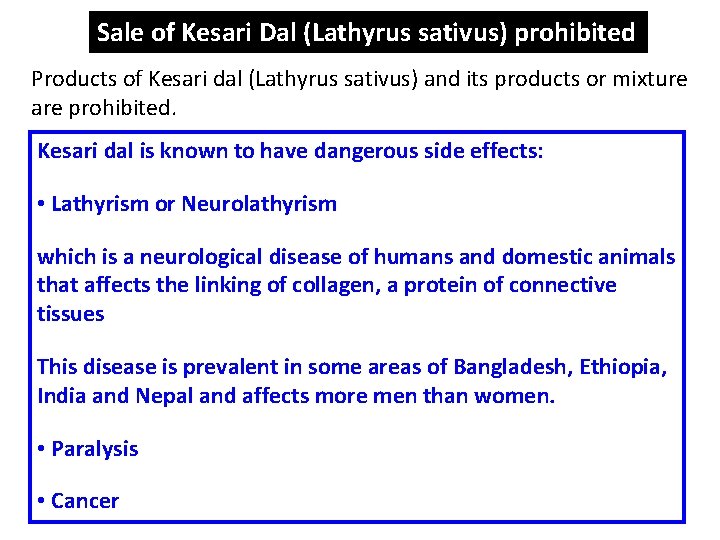
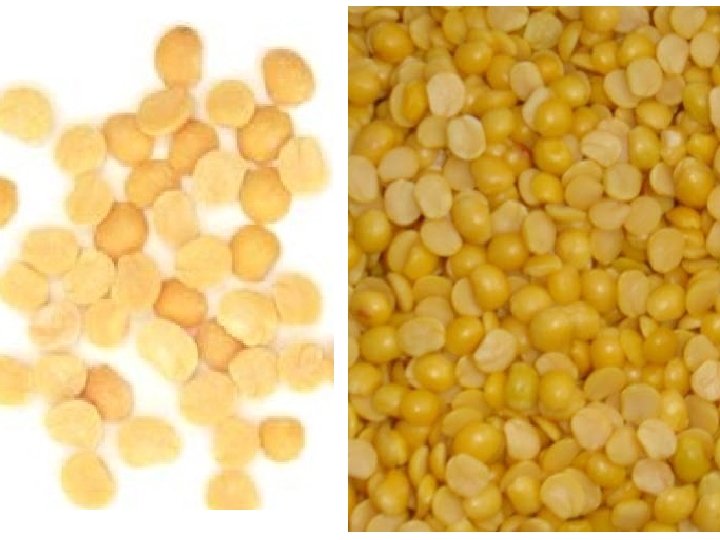
Sale of Kesari Dal (Lathyrus sativus) prohibited Products of Kesari dal (Lathyrus sativus) and its products or mixture are prohibited. Kesari dal is known to have dangerous side effects: • Lathyrism or Neurolathyrism which is a neurological disease of humans and domestic animals that affects the linking of collagen, a protein of connective tissues This disease is prevalent in some areas of Bangladesh, Ethiopia, India and Nepal and affects more men than women. • Paralysis • Cancer
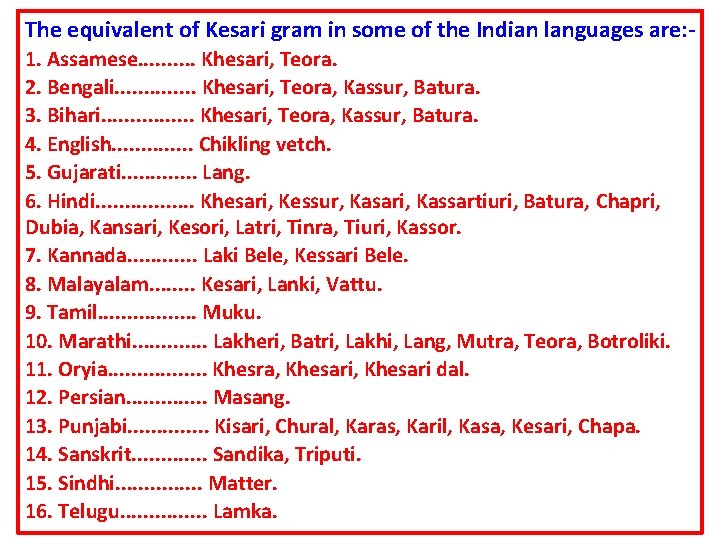
The equivalent of Kesari gram in some of the Indian languages are: 1. Assamese. . Khesari, Teora. 2. Bengali. . . Khesari, Teora, Kassur, Batura. 3. Bihari. . . . Khesari, Teora, Kassur, Batura. 4. English. . . Chikling vetch. 5. Gujarati. . . Lang. 6. Hindi. . . . Khesari, Kessur, Kasari, Kassartiuri, Batura, Chapri, Dubia, Kansari, Kesori, Latri, Tinra, Tiuri, Kassor. 7. Kannada. . . Laki Bele, Kessari Bele. 8. Malayalam. . . . Kesari, Lanki, Vattu. 9. Tamil. . . . Muku. 10. Marathi. . . Lakheri, Batri, Lakhi, Lang, Mutra, Teora, Botroliki. 11. Oryia. . . . Khesra, Khesari dal. 12. Persian. . . Masang. 13. Punjabi. . . Kisari, Chural, Karas, Karil, Kasa, Kesari, Chapa. 14. Sanskrit. . . Sandika, Triputi. 15. Sindhi. . . . Matter. 16. Telugu. . . . Lamka.
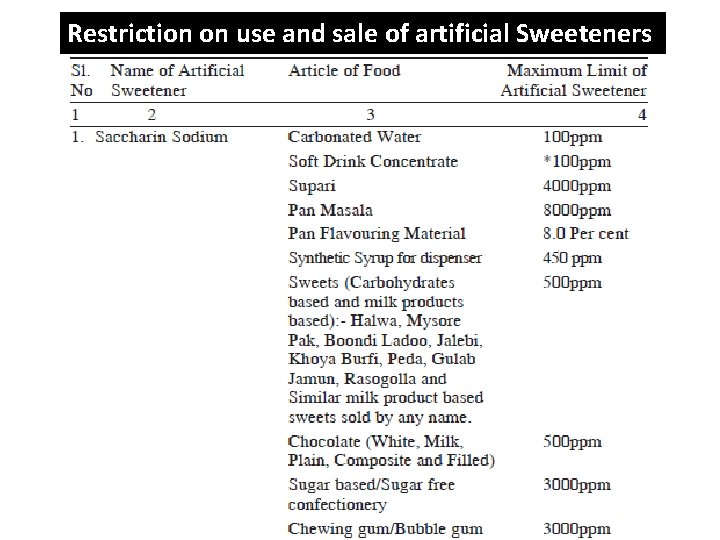
Restriction on use and sale of artificial Sweeteners
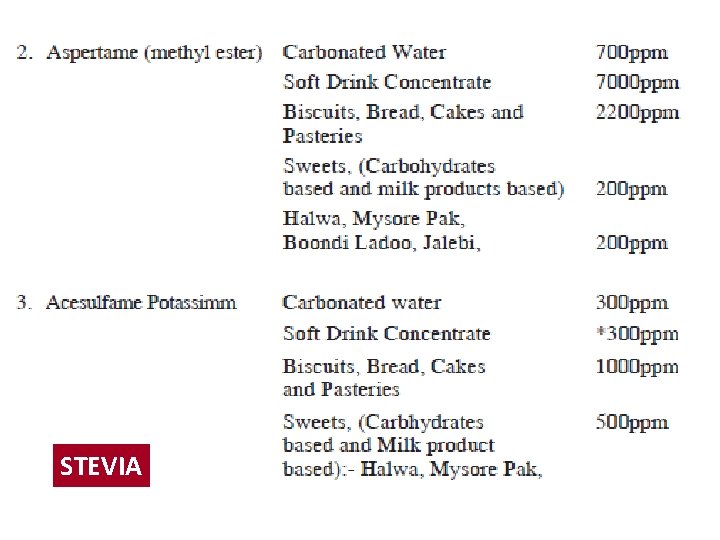
STEVIA
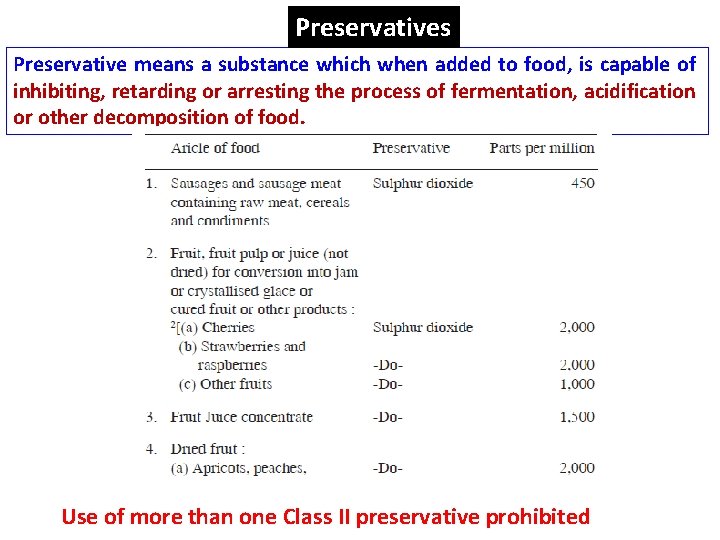
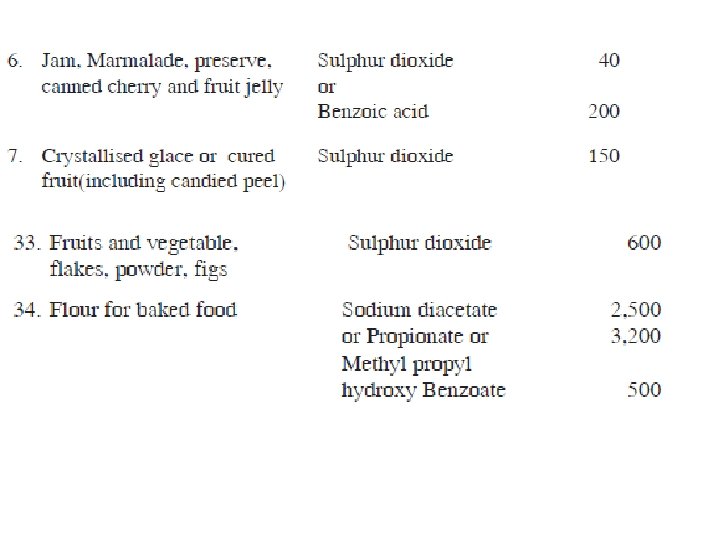
Preservatives Preservative means a substance which when added to food, is capable of inhibiting, retarding or arresting the process of fermentation, acidification or other decomposition of food. Use of more than one Class II preservative prohibited
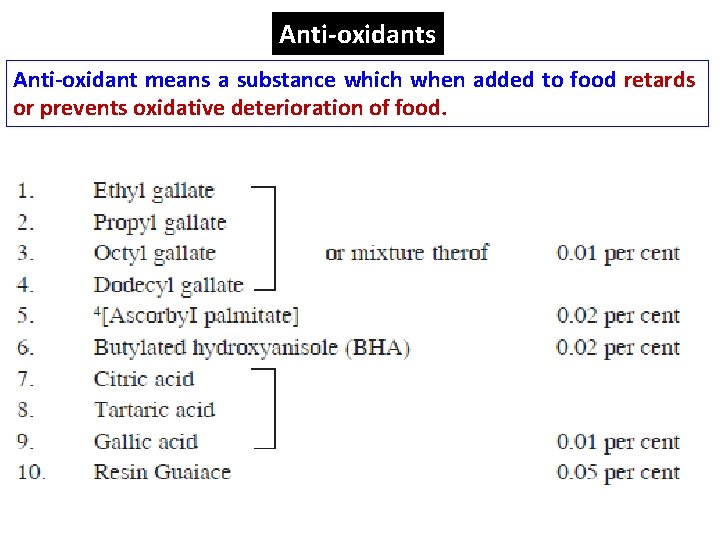
Anti oxidants Anti oxidant means a substance which when added to food retards or prevents oxidative deterioration of food.
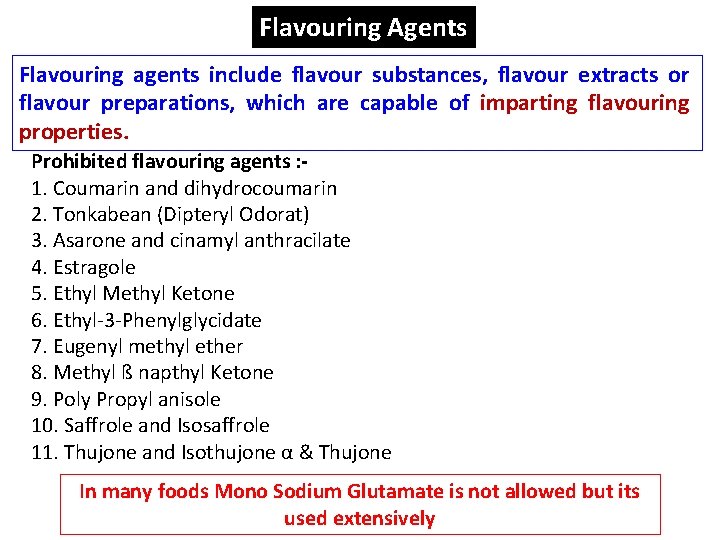
Flavouring Agents Flavouring agents include flavour substances, flavour extracts or flavour preparations, which are capable of imparting flavouring properties. Prohibited flavouring agents : 1. Coumarin and dihydrocoumarin 2. Tonkabean (Dipteryl Odorat) 3. Asarone and cinamyl anthracilate 4. Estragole 5. Ethyl Methyl Ketone 6. Ethyl-3 -Phenylglycidate 7. Eugenyl methyl ether 8. Methyl ß napthyl Ketone 9. Poly Propyl anisole 10. Saffrole and Isosaffrole 11. Thujone and Isothujone α & Thujone In many foods Mono Sodium Glutamate is not allowed but its used extensively
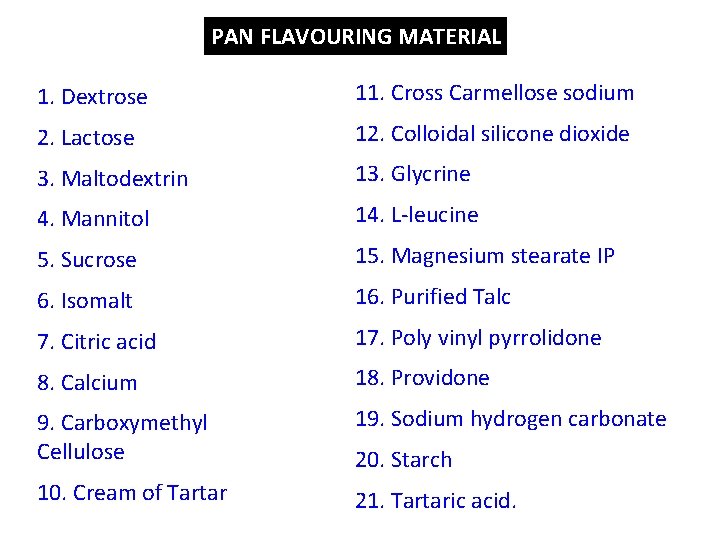
PAN FLAVOURING MATERIAL 1. Dextrose 11. Cross Carmellose sodium 2. Lactose 12. Colloidal silicone dioxide 3. Maltodextrin 13. Glycrine 4. Mannitol 14. L-leucine 5. Sucrose 15. Magnesium stearate IP 6. Isomalt 16. Purified Talc 7. Citric acid 17. Poly vinyl pyrrolidone 8. Calcium 18. Providone 9. Carboxymethyl Cellulose 19. Sodium hydrogen carbonate 10. Cream of Tartar 21. Tartaric acid. 20. Starch
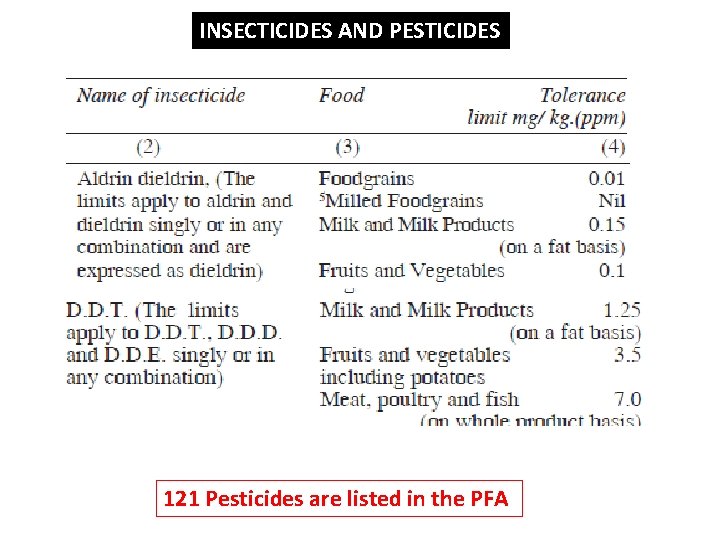
INSECTICIDES AND PESTICIDES 121 Pesticides are listed in the PFA
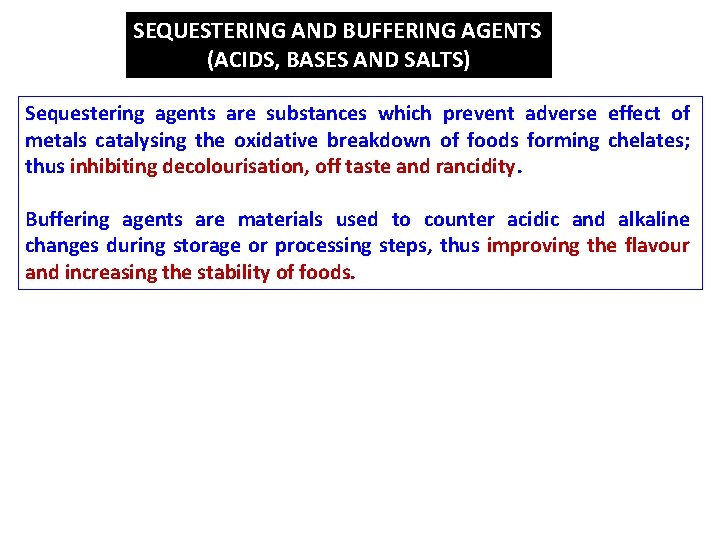
SEQUESTERING AND BUFFERING AGENTS (ACIDS, BASES AND SALTS) Sequestering agents are substances which prevent adverse effect of metals catalysing the oxidative breakdown of foods forming chelates; thus inhibiting decolourisation, off taste and rancidity. Buffering agents are materials used to counter acidic and alkaline changes during storage or processing steps, thus improving the flavour and increasing the stability of foods.
ANY READY MADE FOOD PURCHAGED FROM MARKET WILL HAVE PRESERVATIVES, PESTICIDES, BUFFERING AGENS, COLOR, FAVOURS, ANTI OXIDENTS, ADULTERATED SUBSTANCE
In PFA the various compositions, limits, confirmation tests, permitted components etc are reported for milk products, beverages, ice-creams, ghee, masala, fats, edible oils, vanaspati, solvent extracted flours, chocolates, water etc.
Effect of Adulterated Food
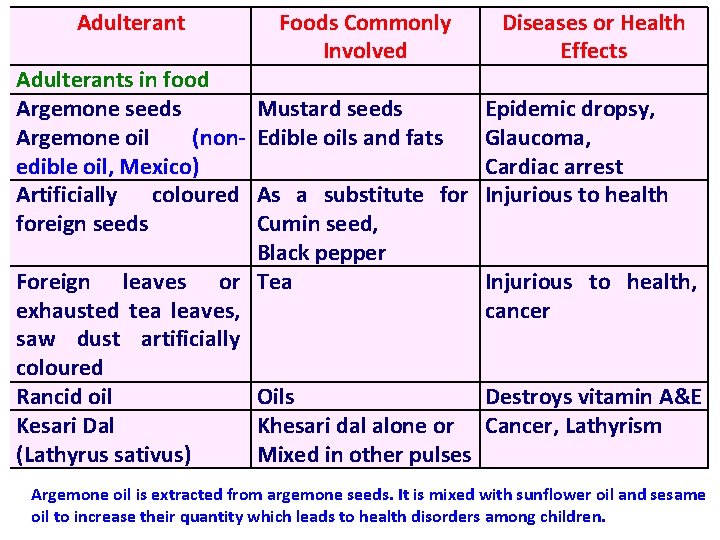
Adulterants in food Argemone seeds Argemone oil (non edible oil, Mexico) Artificially coloured foreign seeds Foods Commonly Involved Mustard seeds Edible oils and fats Diseases or Health Effects Epidemic dropsy, Glaucoma, Cardiac arrest As a substitute for Injurious to health Cumin seed, Black pepper Foreign leaves or Tea Injurious to health, exhausted tea leaves, cancer saw dust artificially coloured Rancid oil Oils Destroys vitamin A&E Kesari Dal Khesari dal alone or Cancer, Lathyrism (Lathyrus sativus) Mixed in other pulses Argemone oil is extracted from argemone seeds. It is mixed with sunflower oil and sesame oil to increase their quantity which leads to health disorders among children.
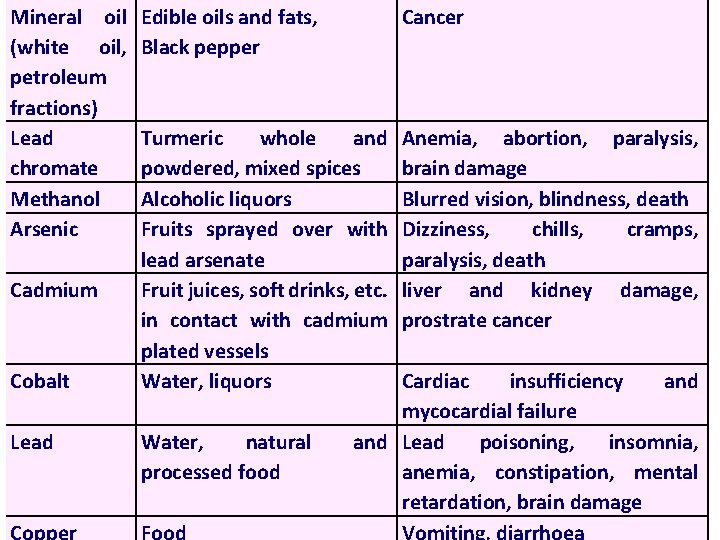
Mineral oil (white oil, petroleum fractions) Lead chromate Methanol Arsenic Cadmium Cobalt Edible oils and fats, Black pepper Cancer Turmeric whole and powdered, mixed spices Alcoholic liquors Fruits sprayed over with lead arsenate Fruit juices, soft drinks, etc. in contact with cadmium plated vessels Water, liquors Anemia, abortion, paralysis, brain damage Blurred vision, blindness, death Dizziness, chills, cramps, paralysis, death liver and kidney damage, prostrate cancer Lead Water, natural processed food Copper Food Cardiac insufficiency and mycocardial failure and Lead poisoning, insomnia, anemia, constipation, mental retardation, brain damage Vomiting, diarrhoea
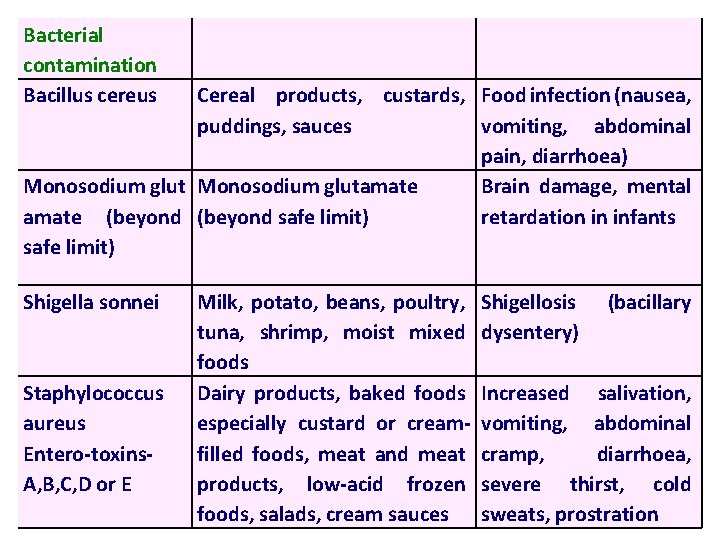
Bacterial contamination Bacillus cereus Shigella sonnei Milk, potato, beans, poultry, tuna, shrimp, moist mixed foods Dairy products, baked foods especially custard or cream filled foods, meat and meat products, low acid frozen foods, salads, cream sauces Cereal products, custards, Food infection (nausea, puddings, sauces vomiting, abdominal pain, diarrhoea) Monosodium glutamate Brain damage, mental amate (beyond safe limit) retardation in infants safe limit) Staphylococcus aureus Entero toxins A, B, C, D or E Shigellosis dysentery) (bacillary Increased salivation, vomiting, abdominal cramp, diarrhoea, severe thirst, cold sweats, prostration
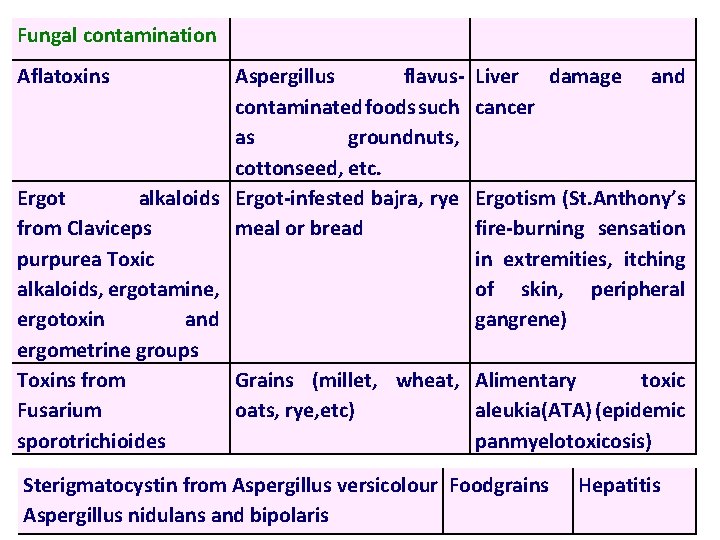
Fungal contamination Aflatoxins Liver damage cancer Aspergillus flavus contaminated foods such as groundnuts, cottonseed, etc. Ergot alkaloids Ergot infested bajra, rye from Claviceps meal or bread purpurea Toxic alkaloids, ergotamine, ergotoxin and ergometrine groups Toxins from Grains (millet, wheat, Fusarium oats, rye, etc) sporotrichioides and Ergotism (St. Anthony’s fire burning sensation in extremities, itching of skin, peripheral gangrene) Alimentary toxic aleukia(ATA) (epidemic panmyelotoxicosis) Sterigmatocystin from Aspergillus versicolour Foodgrains Aspergillus nidulans and bipolaris Hepatitis
Detection of Adulterated Food
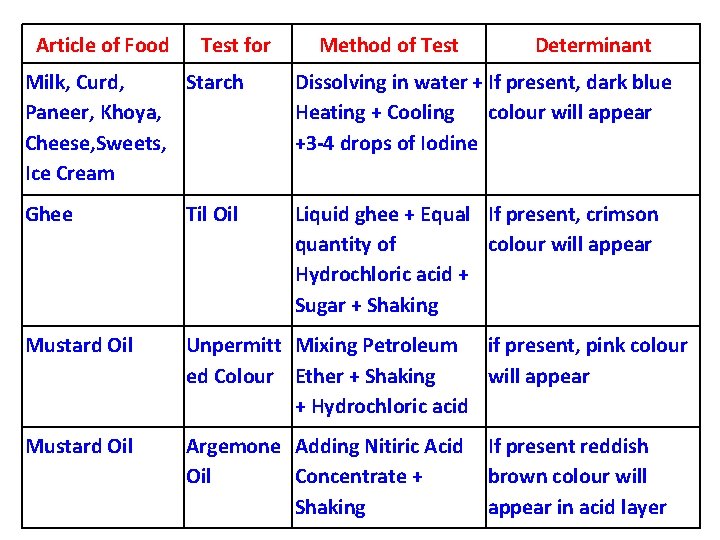
Article of Food Test for Method of Test Determinant Milk, Curd, Starch Paneer, Khoya, Cheese, Sweets, Ice Cream Dissolving in water + If present, dark blue Heating + Cooling colour will appear +3 4 drops of Iodine Ghee Til Oil Liquid ghee + Equal If present, crimson quantity of colour will appear Hydrochloric acid + Sugar + Shaking Mustard Oil Unpermitt Mixing Petroleum if present, pink colour ed Colour Ether + Shaking will appear + Hydrochloric acid Mustard Oil Argemone Adding Nitiric Acid If present reddish Oil Concentrate + brown colour will Shaking appear in acid layer
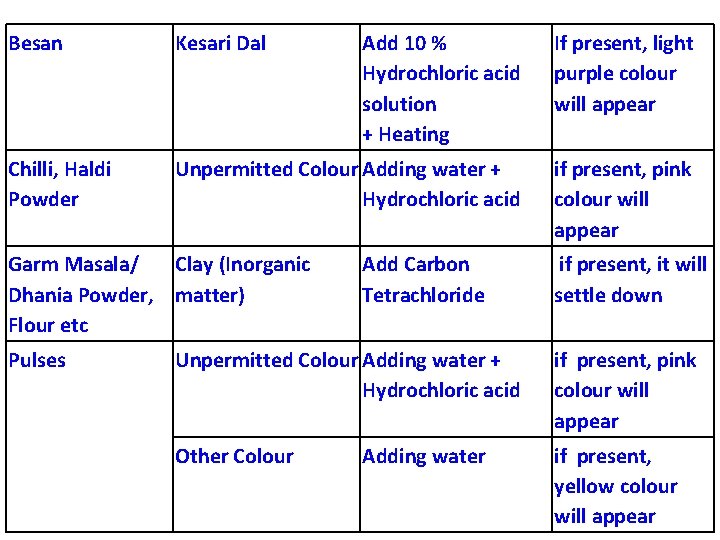
Besan Kesari Dal Add 10 % Hydrochloric acid solution + Heating If present, light purple colour will appear Chilli, Haldi Powder Unpermitted Colour Adding water + Hydrochloric acid if present, pink colour will appear Garm Masala/ Clay (Inorganic Dhania Powder, matter) Flour etc Pulses Add Carbon Tetrachloride if present, it will settle down Unpermitted Colour Adding water + Hydrochloric acid if present, pink colour will appear Other Colour if present, yellow colour will appear Adding water
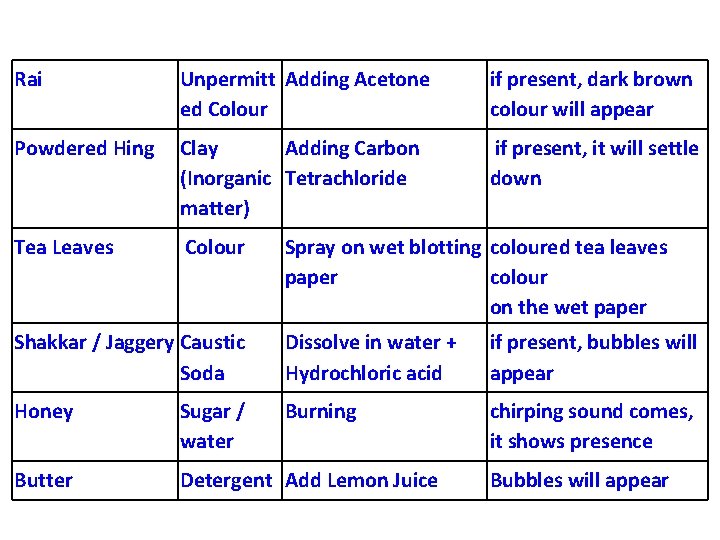
Rai Unpermitt Adding Acetone ed Colour if present, dark brown colour will appear Powdered Hing Clay Adding Carbon (Inorganic Tetrachloride matter) if present, it will settle down Tea Leaves Colour Spray on wet blotting coloured tea leaves paper colour on the wet paper Shakkar / Jaggery Caustic Soda Dissolve in water + Hydrochloric acid if present, bubbles will appear Honey Sugar / water Burning chirping sound comes, it shows presence Butter Detergent Add Lemon Juice Bubbles will appear
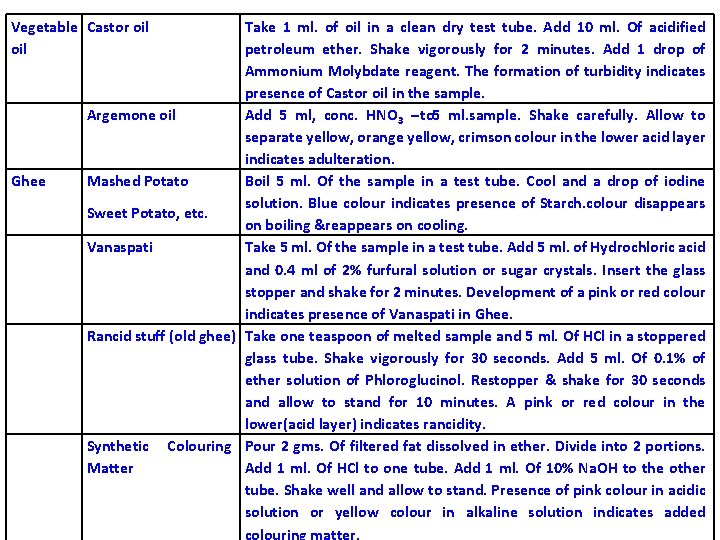
Vegetable Castor oil Ghee Take 1 ml. of oil in a clean dry test tube. Add 10 ml. Of acidified petroleum ether. Shake vigorously for 2 minutes. Add 1 drop of Ammonium Molybdate reagent. The formation of turbidity indicates presence of Castor oil in the sample. Argemone oil Add 5 ml, conc. HNO 3 to 5 ml. sample. Shake carefully. Allow to separate yellow, orange yellow, crimson colour in the lower acid layer indicates adulteration. Mashed Potato Boil 5 ml. Of the sample in a test tube. Cool and a drop of iodine solution. Blue colour indicates presence of Starch. colour disappears Sweet Potato, etc. on boiling &reappears on cooling. Vanaspati Take 5 ml. Of the sample in a test tube. Add 5 ml. of Hydrochloric acid and 0. 4 ml of 2% furfural solution or sugar crystals. Insert the glass stopper and shake for 2 minutes. Development of a pink or red colour indicates presence of Vanaspati in Ghee. Rancid stuff (old ghee) Take one teaspoon of melted sample and 5 ml. Of HCl in a stoppered glass tube. Shake vigorously for 30 seconds. Add 5 ml. Of 0. 1% of ether solution of Phloroglucinol. Restopper & shake for 30 seconds and allow to stand for 10 minutes. A pink or red colour in the lower(acid layer) indicates rancidity. Synthetic Colouring Pour 2 gms. Of filtered fat dissolved in ether. Divide into 2 portions. Matter Add 1 ml. Of HCl to one tube. Add 1 ml. Of 10% Na. OH to the other tube. Shake well and allow to stand. Presence of pink colour in acidic solution or yellow colour in alkaline solution indicates added colouring matter.
Some Simple Tests to detect Adulterated Food

Thanks
- Slides: 50