
FONTAN CIRCULATION Dr Bijilesh u Senior Resident Dept

FONTAN CIRCULATION Dr Bijilesh u Senior Resident, Dept. of Cardiology, Medical College, Calicut
• Normal mammal cardiovascular system double circuit connected in series —systemic —pulmonary • powered by a double pump —the right and left heart
• Many complex cardiac malformations - one functional ventricle • Maintain systemic and pulmonary circulation - not connected in series but in parallel • Major disadvantages – arterial desaturation – chronic volume overload to single ventricle - in time impair ventricular function
• 1971, Fontan and Baudet • Goal was to create a circulatory system in which the systemic venous blood enters the pulmonary circulation, bypasses the right ventricle, and thus places the systemic and pulmonary circulations in series driven by a single ventricle • All shunts on the venous, atrial, ventricular and arterial level are interrupted
• Advantages of a Fontan circuit include – (near) normalisation of the arterial saturation – abolishment of the chronic volume overload • Cost for such a circulation includes – Chronic hypertension and congestion of the systemic veins – decreased cardiac output • Cardiac output is no longer determined by the heart, but rather by transpulmonary flow

INDICATIONS FOR A FONTAN CIRCUIT • Cardiac malformation and a single functional chamber – dysfunctional heart valve – absent or inadequate pumping chamber • • Tricuspid atresia Pulmonary atresia with intact ventricular septum Hypoplastic left heart syndrome Double-inlet ventricle
SELECTION OF PATIENTS 1978, Choussat et al • 10 criteria for optimal results following the Fontan 1. age at operation between 4 and 15 years 2. presence of normal sinus rhythm 3. normal systemic venous connections 4. normal right atrial size 5. normal pulmonary arterial pressure (mean≤ 15 mm. Hg) 6. low pulmonary vascular resistance (4 Woods units/m 2) 7. adequate-sized PA with diameter ≥ 75% of the aorta 8. normal left ventricular ejection fraction ≥ 60% 9. absence of mitral valve insufficiency 10. absence of complicating factors from previous surgeries
• Refined by many centres • After repair – LA pressure must be low (determined by good LV fn) – transpulmonary gradient must be low (determined by the pulmonary vasculature) • Cardiac requirements nowadays are – unobstructed ventricular inflow (no atrioventricular valve stenosis, no regurgitation) – reasonable ventricular function – unobstructed outflow (no subaortic stenosis, and no coarctation
• Pulmonary requirements – non-restrictive connection from systemic veins to the PA – good sized PA without distortion – a well developed distal vascular bed – (near) normal PVR - 2. 5 U/m 2 – unobstructed pulmonary venous return – Marc Gewillig , Heart 2005; 91: 839– 846. doi: 10. 1136/hrt. 2004. 051789
Fontan Procedure • Since its original description, the Fontan circuit has known numerous modifications • Early modifications of the Fontan procedure connected pulmonary arteries to the right atrium
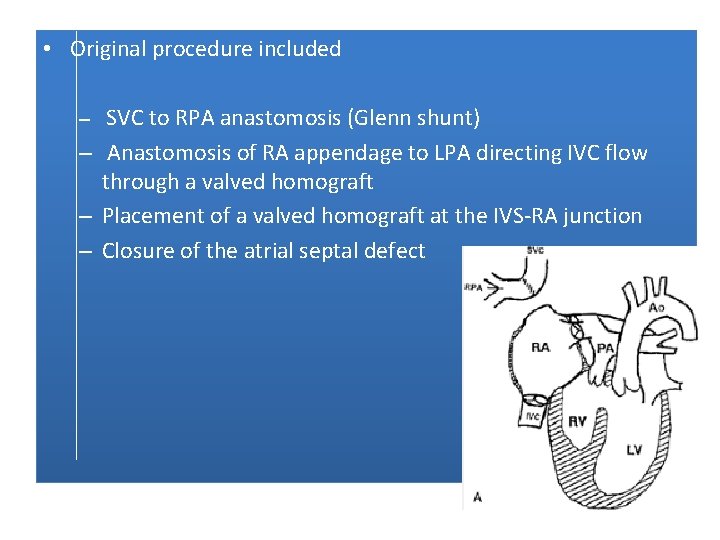
• Original procedure included – SVC to RPA anastomosis (Glenn shunt) – Anastomosis of RA appendage to LPA directing IVC flow through a valved homograft – Placement of a valved homograft at the IVS-RA junction – Closure of the atrial septal defect
• RA was included to - improve pulmonary blood flow, being a pulsatile chamber • Instead RA dilated and lost contractile function – Turbulence and energy loss – Decreased pulmonary blood flow de Leval et al
• Right atrial–pulmonary circuits - obsolete • Replaced with newer techniques - direct connection between each vena cava and PA • Bypass the right atrium and right ventricle • More efficient cavopulmonary blood flow to the lungs – reduce risk for arrhythmia and thrombosis
• Modern Fontan procedure involves connecting SVC and IVC to the RPA • Originally performed at the same time • Resulted in a marked increase in blood flow to the lungs - pulmonary lymphatic congestion, and pleural effusions • No longer performed together
• Currently total cavopulmonary Fontan circulation done in two stages – To allow body to adapt to different hemodynamic states – – Reduce overall surgical morbidity and mortality Allows a better patient selection and intermediate preparatory interventions
• As no ventricular contraction to pump blood through the lungs, elevated PAH is an absolute contraindication for Fontan procedure • At birth, it is impossible to create a Fontan circulation – PVR is still raised for several weeks – Caval veins and pulmonary arteries - too small
• Initially in the neonatal period, management must aim to achieve • Unrestricted flow from the heart to the aorta – coarctectomy – Damus- Kaye-Stansel – Norwood repair • Well balanced limited flow to the lungs – pulmonary artery band – modified Blalock-Taussig • Unrestricted return of blood to the ventricle – Rashkind balloon septostomy
Bidirectional Glenn Shunt / Hemi-fontan • At 4– 12 months of age • First half of creating a total cavopulmonary circulation circuit • End-to-side anastomosis between SVC & RPA • RPA is not divided, resulting in blood flow from the SVC into the right and left PA • Children may remain cyanotic because blood from the IVC is not directed to the lungs
Bidirectional Glenn Shunt / Hemi-fontan • Cardiac end of the divided SVC is attached to MPA or the under surface of RPA • Lower stump of SVC is connected to IVC with a conduit • Open end of the SVC is either oversewn or occluded with a polytetrafluoroethylene patch • Allows Fontan circulation to be completed later
• When patients reach 1– 5 years of age total cavopulmonary Fontan circuit is completed • IVC connected to pulmonary artery with a conduit
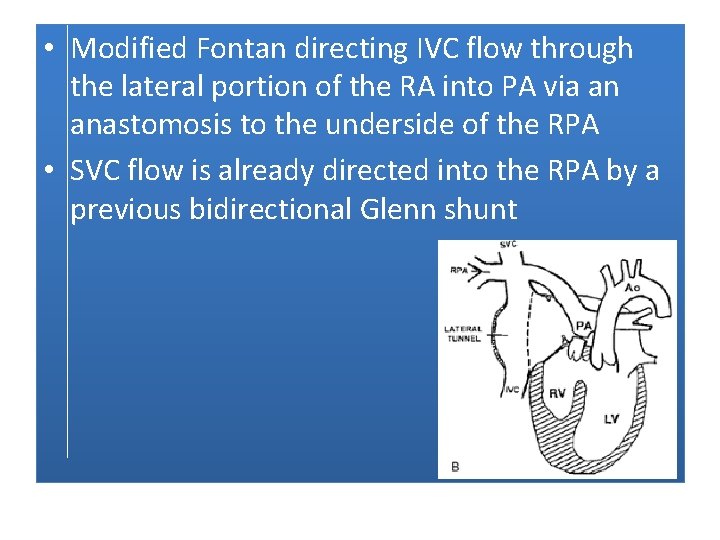
• Modified Fontan directing IVC flow through the lateral portion of the RA into PA via an anastomosis to the underside of the RPA • SVC flow is already directed into the RPA by a previous bidirectional Glenn shunt
• Internal conduit - pass through the right atrial chamber • External conduit - run completely outside the heart to the right side of the right atrium
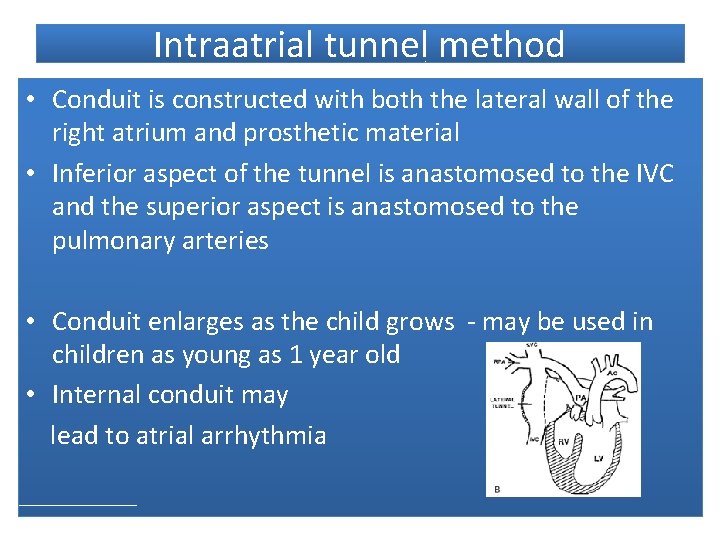
Intraatrial tunnel method • Conduit is constructed with both the lateral wall of the right atrium and prosthetic material • Inferior aspect of the tunnel is anastomosed to the IVC and the superior aspect is anastomosed to the pulmonary arteries • Conduit enlarges as the child grows - may be used in children as young as 1 year old • Internal conduit may lead to atrial arrhythmia
Extracardiac conduit method • Usually performed only in older than 3 years • PTFE tube graft is placed between the transected IVC and the pulmonary artery, bypassing RA • Entire atrium is left with low pressure - less atrial distention, arrhythmia, and thrombosis
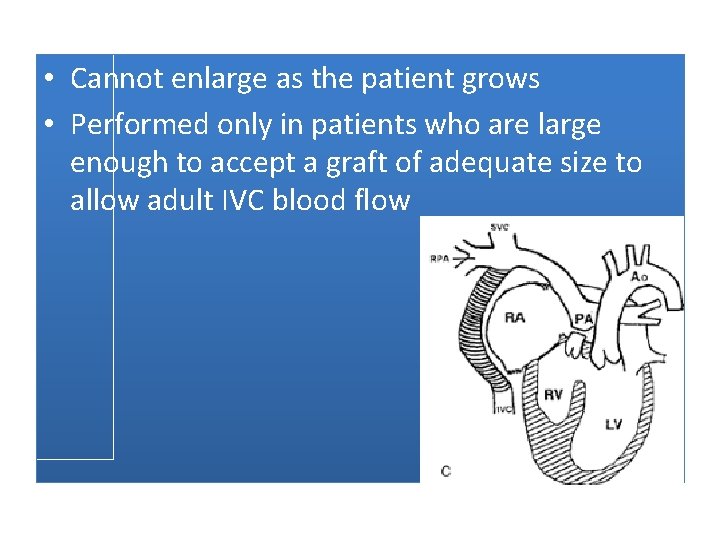
• Cannot enlarge as the patient grows • Performed only in patients who are large enough to accept a graft of adequate size to allow adult IVC blood flow
Fenestrated fontan • small opening or fenestration may be created between the conduit and the right atrium • Functions as a pop-off valve (a right-to-left shunt) – prevent rapid volume overload to the lungs – Limit caval pressure – Increase preload to the systemic ventricle – Increase cardiac output • cyanosis may result from the right-to-left shunt
• Fenestrations decrease postop pleural effusions • May be closed after patients adapt to new hemodynamics • Now, fenestrations are seldom created during the completion of the Fontan – improved patient selection and preparation – improved staging

• FONTAN PHYSIOLOGY
Early increase in preload • Fontan circulation provides definitive palliation for complex cardiac lesions not suitable for biventricular repair • Some form of palliation is done in early infancy • Results in a parallel pulmonary and systemic circulation and a net increase in preload
Reduction of preload • Most patients undergo a staged transition to their complete Fontan via Bidirectional Glenn • BDG procedure leads to marked decrease in preload • Degree of reduction depends on prior pulmonary to systemic flow ratio, which often exceeds 2: 1 • Reduction of preload results in reduced ventricular dilation and work
• Abnormal systolic ventricular performance is rarely a problem in early years of palliation prior to Fontan – Is sustained or improved in most, after completion of Fontan circuit • It was shown that restoration of normal systolic wall stress was achieved in most individuals undergoing a Fontan procedure prior to the age of 10 years • Sluysmans T et al. Natural history and patterns of recovery of contractile function in single left ventricle after Fontan operation. Circulation Dec 1992; 86(6): 1753– 61.
Early diastolic dysfunction • Increase in wall thickness coincident with the acute reduction in end-diastolic volume • Result s in abnormalities of early relaxation & characteristically reduced early rapid filling • Consequently, much of diastolic filling is dependent on atrial systole • Early diastolic dysfunction negatively impact recovery after subsequent Fontan operation
• Persistently abnormal early relaxation with worsening ventricular compliance markedly reduces ability of the ventricles to fill • Reduces pulmonary blood flow • Accounts for some of late failure seen in these patients • Worsen naturally with age as in the normal heart
• Avoidance of factors known to lead to worsening compliance (persistent LV outflow tract obstruction, hypertension) is of fundamental importance
• While diastolic abnormalities predominate early-on , systolic failure also becomes apparent in some patients late after the procedure
Systemic vascular bed • Many studies have reported uniformly elevated systemic vascular resistance after Fontan • Senzaki H, Masutani S, Kobayashi J, et al
Use of ACE inhibition in Fontan patients • Enalapril or placebo was given for 10 weeks in 18 patients approximately 14 years after the Fontan operation • Tendency to worsen exercise performance. • Reduced incremental cardiac index during exercise in the patients receiving enalapril • Kouatli et al , Enalapril does not enhance exercise capacity in patients after Fontan procedure. Circulation Sep 2 1997; 96(5): 1507– 12.

• Many patients continue to receive ACE inhibition, in the hope of a beneficial effect when given chronically • It is possible that there are subgroups that may benefit e. g. severe systolic dysfunction • Presently no evidence for this therapy being beneficial
The veno-pulmonary circuit • Major evolution in the hemodynamic design of the Fontan operation since its inception • Initial right atrial to pulmonary connection has been abandoned in favor of more streamlined versions
• Cardiac output - using respiratory mass spectrometry and an acetylene re-breathing method • There was no difference between the patient group at rest • Cardiac output & respiratory rate higher in the lateral tunnel group than the atriopulmonary group at low and moderate workloads • Rosenthal M et al Comparison of cardiopulmonary adaptation during exercise in children after the atriopulmonary and total cavopulmonary connection Fontan procedures. Circulation Jan 15 1995; 91(2): 372– 8.
• Work of breathing is a significant additional energy source to circulation in Fontan • Normal negative pressure inspiration has been shown to increase PBF after the atrial pulmonary connection and TCPC • Redington AN, Penny D, Shinebourne EA. Pulmonary blood flow after total cavopulmonary shunt. Br Heart J Apr 1991; 65(4): 213– 7
• Philadelphia group, using magnetic resonance flow measurements, have estimated that approximately 30% of the cardiac output can be directly attributed to the work of breathing in patients after the TCPC • Fogel MA, Weinberg PM, Rychik J, et al. Caval contribution to flow in the branch pulmonary arteries of Fontan patients Circulation Mar 9 1999; 99 (9): 1215– 21 .
Positive pressure ventilation • Increasing levels of PEEP during positive pressure ventilation is adverse to Fontan circulation • Higher the mean airway pressure, lower cardiac index • Maintain with minimum mean airway pressure compatible with normal oxygenation and ventilation • Williams DB, Hemodynamic response to positive end-expiratory pressure following right atrium-pulmonary artery bypass (Fontan procedure). J Thorac Cardiovasc Surg Jun 1984; 87(6): 856– 61 y
The pulmonary vascular bed • Low PVR is a prerequisite for early success after Fontan operation • Lower the total pulmonary resistance (PVR , pulmonary venous resistance and LA resistance) the better • LA resistance is influenced by the abnormal ventricular response
• Structural pulmonary venous abnormalities – Naturally occurring – May evolve as a result of abnormal hemodynamics • Atriopulmonary anastomosis- gross enlargement of RA may compress adjacent pulmonary veins
• Abnormalities of arteriolar resistance adversely influence early outcome, in terms of morbidity and mortality • Few data available regarding the long-term effects of the Fontan circulation on the pulmonary vascular bed. • Pulmonary thromboembolism is not infrequent - lead to adverse changes in vascular resistance
• Pulmonary artery flow in Fontan is relatively low velocity, laminar • Different to the normal pulsatile flow of pulmonary vascular bed in normal circulation • Release of nitric oxide from the endothelium is dependent on pulsatile flow in the normal circulation • Experimentally, reducing pulsatility leads to reduced NO production and an increase in vascular resistance • Nakano T et al, Pulsatile flow enhances endothelium-derived nitric oxide release in the peripheral vasculature. Am J Physiol Heart Circ Physiol Apr 2000; 278(4):

• COMPLICATIONS OF FONTAN CIRCULATION
• Creation of Fontan circulation is palliative by nature • Proved good results with ideal hemodynamics • Substantial morbidity and mortality – in those with unfavorable hemodynamics – those who underwent older surgical techniques
• Risk factors for complications include – elevated pulmonary artery pressure – anatomic abnormalities of the right and left pulmonary arteries – atrial-ventricular valve regurgitation – poor ventricular function
Late mortality • Late death is directly related to the number of risk factors for a Fontan operation • Unfavourable haemodynamics and risk factors are associated with an increased early and late attrition
Functional status and exercise tolerance • Most patients with a Fontan circulation to lead a nearly normal life, including mild to moderate sport activities • More than 90% of all hospital survivors are in NYHA functional class I or 2 • However, with time there is a progressive decline of functional status in some subgroups
Ventricular dysfunction • Ventricle of a functionally univentricular heart – Dilated, hypertrophic and hypocontractile • May fail after years of systemic loading • congenital malformation itself • original hemodynamic state of volume overload • Systemic ventricle may be a morphologic right or an indeterminate primitive ventricle • previous surgical interventions • High RA pressure may impair coronary blood flow - affect myocardial perfusion and function
• During the first months after birth - ventricle will always be volume overloaded • Leads to dilation and hypertrophy of LV • After unloading at the time of a Fontan operation, some regression to normalisation will occur frequently incomplete • Currently only a small shunt is allowed to persist for several months
• Ventricle thus evolves from being volume overloaded and overstretched, to overgrown and (severely) underloaded • Low preload results in remodelling, reduced compliance, poor ventricular filling, and eventually continuously declining cardiac output
• Lack of reaction to classic treatment strategies has given the ventricle in a Fontan circuit a very bad reputation • Little impact on ventricular function of – inotropes, afterload reducing agents, vasodilators, and b blockers • no impact on the reduced preload which is the dominant limiting factor
Arrhythmia • Many old circuits have atrial wall incorporated into the circuit causing atrial dilation • Dilatation predispose to – arrhythmia – swirling of blood in the enlarged atrium - stasis & clot formation – results in poor blood flow to the lungs • May have undergone atriotomy injure the sinus node or conducting fibers cause atrial arrhythmia
• Occur in up to 40% of the patients 10 years after surgery • Most common atrial tachycardia is intra-atrial reentry or atrial flutter • Immediate direct current DC version • Anticoagulation in view of the significant risk of a right atrial thrombus
• Long term treatment of atrial arrhythmia can involve medication and ablation • Conversion of the old Fontan circuit to an extracardiac cavopulmonary connection • Together with a right atrial maze and a reduction plasty
Collateral Vessels and Shunts Collateral vessels and shunts may lead to substantial right -to-left shunts and cyanosis • Incomplete closure or a residual atrial septal defect • Surgically created fenestration between the surgical conduits and RA • Surgical redirection of coronary sinus blood flow to LA • Formation of pulmonary AV malformations • Patent collateral vessels between systemic and pulmonary veins • Patent systemic veins that extend directly into LA
Left-to-right shunts • Aortopulmonary collateral vessels - common • May lead to hemodynamic shunting - results in volume overload of the systemic ventricle - increased PBF and pulmonary pressure • Arise from the thoracic aorta, internal mammary arteries, or brachiocephalic arteries
Blood Vessels • Increased frequency of pulmonary thromboembolic events – Dilated atrium – low cardiac output – coagulation abnormalities associated with hepatic congestion – chronic cyanosis–induced Polycythemia • Massive pulmonary embolism is the most common cause of sudden out-of hospital death in patients with Fontan circulation • Reported incidences of venous thromboembolism and stroke are 3%– 16% and 3%– 19%, respectively
Pulmonary Circulation • Fontan circulation results in a paradox of systemic venous hypertension (mean pr >10 ) pulmonary artery hypotension ( <15 mm Hg) • Due to absence of the hydraulic force of RV
• Absence of pulsatile blood flow and low mean pressure in the PA underfill the pulmonary vascular bed and increase PVR • Pulmonary arteries may be morphologically abnormal (small, discontinuous, or stenosed)
• PVR is an important determinant of cardiac output in Fontan circulation • Stenosis or leakage of surgical anastomoses between the venae cavae and pulmonary arteries may adversely affect pulmonary blood flow • Patients with borderline haemodynamics have been reported to deteriorate acutely after moving to altitude above 2000 m
Lymphatic System • Fontan circulation operates at or sometimes beyond the functional limits of the lymphatic system • Affected by high venous pressure and impaired thoracic duct drainage • Increased pulmonary lymphatic pressure may result in interstitial pulmonary edema or lymphedema • Leakage into the thorax or pericardium may lead to pericardial and pleural effusions (often right-sided) and chylothorax

Protein-losing enteropathy • Relatively uncommon manifestation of failing Fontan circulation • Cause is unclear • Loss of enteric protein may be due to elevated systemic venous pressure that is transmitted to the hepatic circulation • Lead to hypoproteinemia, immunodeficiency, hypocalcemia, and coagulopathy, • May occur in the long term
• PLE is a relatively rare complication • In an international multicentre study involving 35 centres and 3029 patients with Fontan repair between 1975 and 1995, PLE occurred in 114 patients - 3. 8% • Mertens L et al. Protein losing enteropathy after the Fontan operation J Thorac and Cardiovasc Surg 1998; 115: 1063– 73 • Very poor prognosis • Five year survival rate was 59%
Treatment options for PLE • • • Diet high in calories High protein content Medium chain triglyceride fat supplements Diuretics Several surgical options have been reported – relief of obstruction – conversion to streamlined cavopulmonary connection – atrioventricular–valve repair/replacement

Plastic bronchitis • Rare but serious complication • 1%– 2% of patients • Noninflammatory mucinous casts form in tracheobronchial tree and obstruct the airway • Dyspnea, cough, wheezing, and expectoration of casts - may cause severe respiratory distress with asphyxia, cardiac arrest, or death • Exact cause unknown
Plastic bronchitis • High intrathoracic lymphatic pressure or obstruction of lymphatic flow may lead to the development of lymphoalveolar fistula and bronchial casts • Medical management is difficult - often require repeat bronchoscopy to remove thick casts • Surgical ligation of the thoracic duct may cure plastic bronchitis by decreasing intrathoracic lymphatic pressure and flow
Reproduction: pregnancy • Most females after Fontan repair have normal menstrual patterns • Increased systemic venous pressure may trigger complications of right heart failure such as atrial arrhythmias, oedema, and ascites • Right-to-left shunt through a residual ASD will Increase - decrease in arterial saturation • Increased risk for venous thrombosis and pulmonary embolus • Successful pregnancy with delivery of normal children is possible.
Coagulopathies • Protein C, protein S, and antithrombin III deficiency • Most common cause of sudden out-of-hospital death in patients with a Fontan circuit • Chronic multiple pulmonary microemboli may lead to pulmonary vascular obstructive disease, a late complication – particularly lethal in a Fontan circulation.
• Some clinicians recommend anticoagulating every patient with a Fontan circuit • Subgroups of patients with a very low risk • Full anticoagulation in – previous thrombi – poor cardiac output – congestion, dilation of venous or atrial structures, – arrhythmia
• All patients having undergone Fontan surgery and follow-up at Children’s Hospital Boston were included if they were born before January 1, 1985, and lived
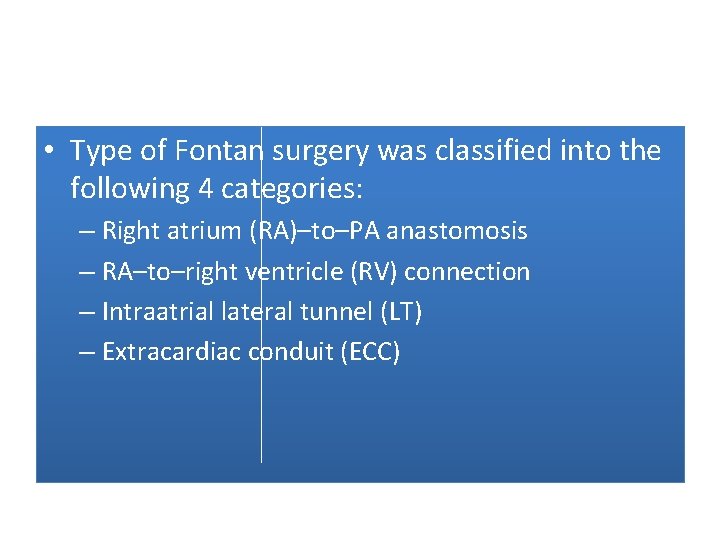
• Type of Fontan surgery was classified into the following 4 categories: – Right atrium (RA)–to–PA anastomosis – RA–to–right ventricle (RV) connection – Intraatrial lateral tunnel (LT) – Extracardiac conduit (ECC)
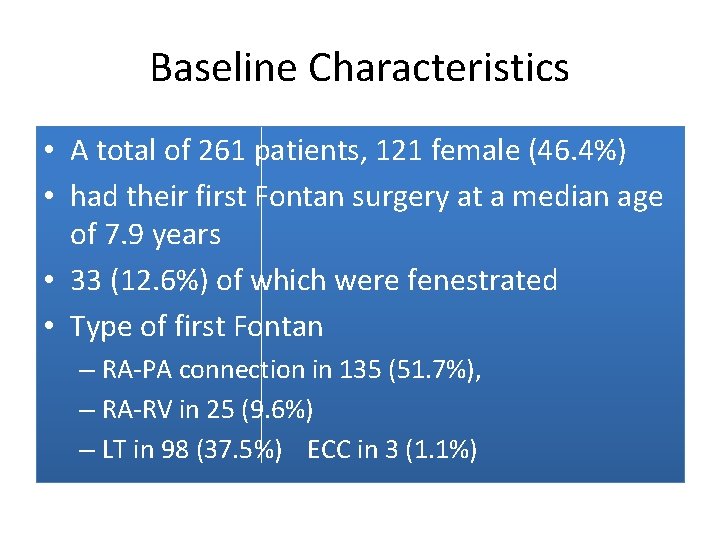
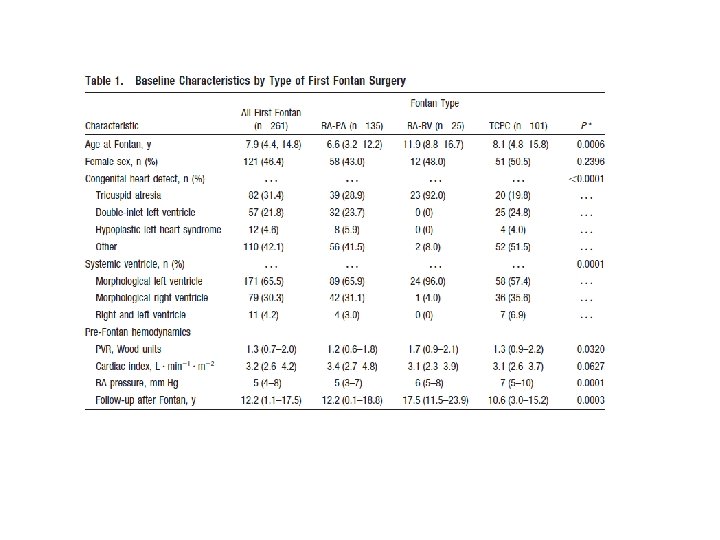
Baseline Characteristics • A total of 261 patients, 121 female (46. 4%) • had their first Fontan surgery at a median age of 7. 9 years • 33 (12. 6%) of which were fenestrated • Type of first Fontan – RA-PA connection in 135 (51. 7%), – RA-RV in 25 (9. 6%) – LT in 98 (37. 5%) ECC in 3 (1. 1%)
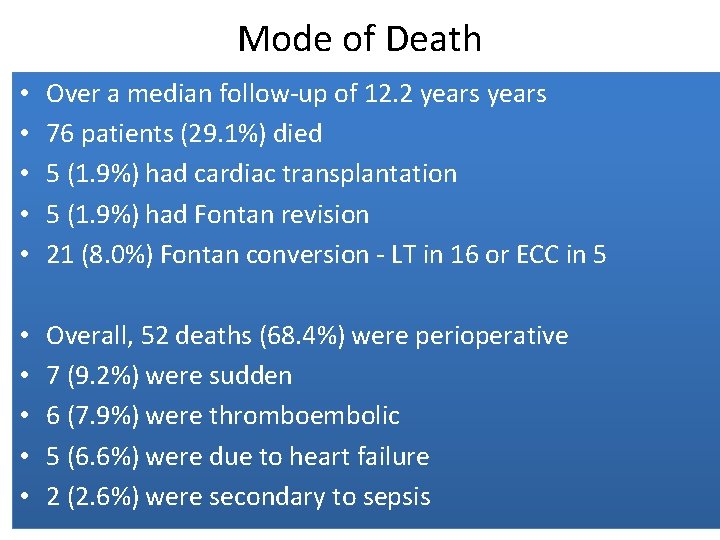
Mode of Death • • • Over a median follow-up of 12. 2 years 76 patients (29. 1%) died 5 (1. 9%) had cardiac transplantation 5 (1. 9%) had Fontan revision 21 (8. 0%) Fontan conversion - LT in 16 or ECC in 5 • • • Overall, 52 deaths (68. 4%) were perioperative 7 (9. 2%) were sudden 6 (7. 9%) were thromboembolic 5 (6. 6%) were due to heart failure 2 (2. 6%) were secondary to sepsis
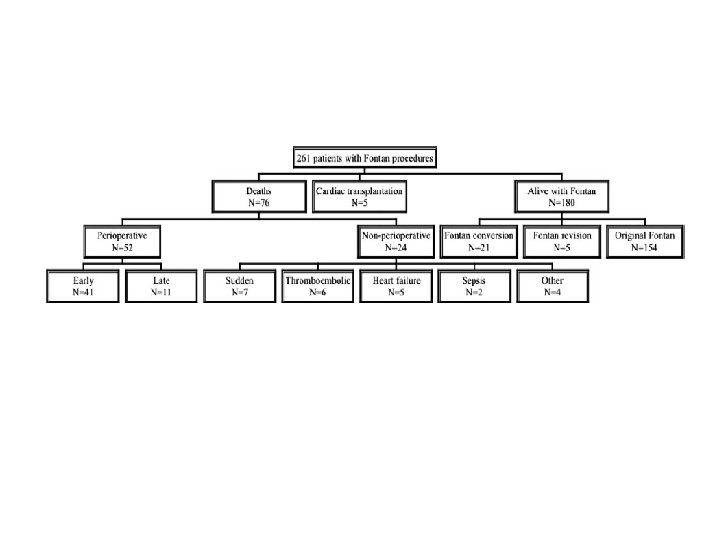
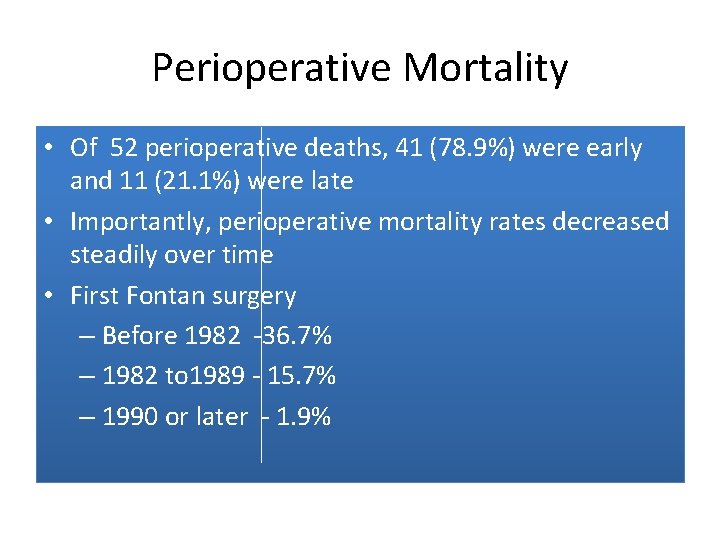
Perioperative Mortality • Of 52 perioperative deaths, 41 (78. 9%) were early and 11 (21. 1%) were late • Importantly, perioperative mortality rates decreased steadily over time • First Fontan surgery – Before 1982 -36. 7% – 1982 to 1989 - 15. 7% – 1990 or later - 1. 9%
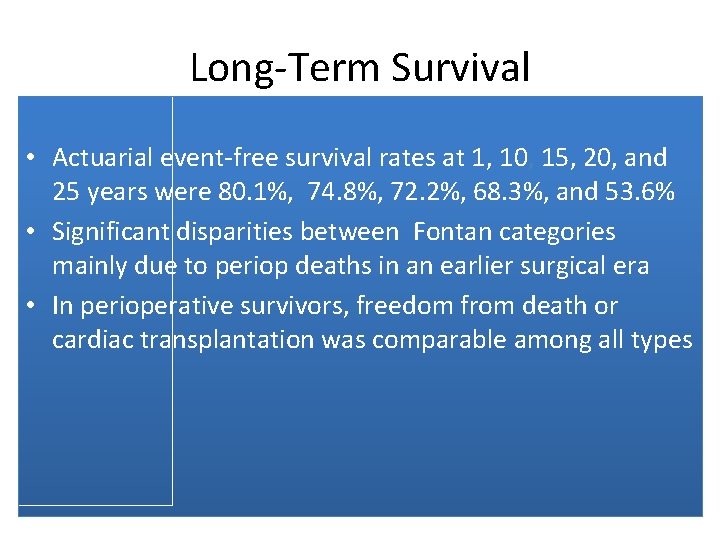
Long-Term Survival • Actuarial event-free survival rates at 1, 10, 15, 20, and 25 years were 80. 1%, 74. 8%, 72. 2%, 68. 3%, and 53. 6% • Significant disparities between Fontan categories mainly due to periop deaths in an earlier surgical era • In perioperative survivors, freedom from death or cardiac transplantation was comparable among all types
• In early survivors, overall actuarial freedom from death or cardiac transplantation at 1, 5, 10, 15, 20, and 25 years was 96. 9%, 93. 7%, 89. 9%, 87. 3%, 82. 6%, and 69. 6%, respectively
• Death resulting from thromboembolism occurred at a median age of 24. 9 years • 8. 7 years after Fontan surgery • Actuarial freedom from thromboembolic death was 98. 7% at 10 years and 90. 8% at 25 years • All patients had RA-PA Fontan surgeries except for 1 patient with an LT
Predictors of Thromboembolic Death in Perioperative Survivors • Atrial fibrillation • Lack of aspirin or warfarin therapy • Thrombus within Fontan
Heart failure • Heart failure–related deaths occurred at a mean age of 22. 9 • 4. 3 years after Fontan surgery • Actuarial freedom from death caused by heart failure was 99. 5% at 10 yrs and 95. 8% at 25 yrs • Risk factors were single RV morphology, higher postoperative RA pressure, and protein -losing enteropathy.
Sudden death • Sudden death occurred at a median age of 20. 2 years in 7 patients • 3 with RA-PA, 3 with LT, and 1 with RA-RV • 2. 9 years after Fontan surgery.
Conclusions • Leading cause of death was perioperative, particularly in an earlier era • Gradual attrition was noted thereafter, predominantly from thromboembolic, heart failure–related, and sudden deaths • 70% actuarial freedom from all-cause death or cardiac transplantation at 25 years
- Slides: 89