
Followup Training Main Purpose To collect Perkins Core
- Slides: 7
Follow-up Training
Main Purpose: To collect Perkins Core Performance Indicator — Post-program Placement (3 S 1) CTE concentrators who exited during the reporting year Were in placement 2 nd quarter after exiting high school: § Postsecondary Education/Advanced Training § Employment § Military Service § National and Community Service Programs § Peace Corps Volunteers
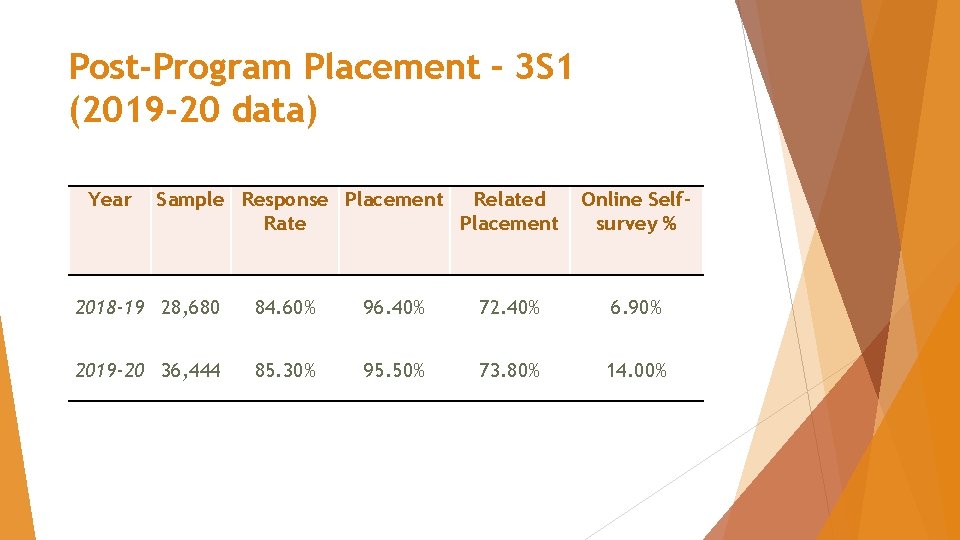
Post-Program Placement – 3 S 1 (2019 -20 data) Year Sample Response Placement Related Rate Placement Online Selfsurvey % 2018 -19 28, 680 84. 60% 96. 40% 72. 40% 6. 90% 2019 -20 36, 444 85. 30% 95. 50% 73. 80% 14. 00%
Importance of Response Rate Understand the importance of response rate to the quality of the CPI post-program placement indicator— 3 S 1. Perkins V requires states to report post-program placement of all CTE Concentrators. This means that we need to make a good faith effort to survey all qualified concentrators, as well as a good response rate to accurately portray all concentrators in the state. The value of the data collected through the Follow-Up Survey depends on an accurate report of the status of all concentrators. A good response rate is necessary to accurately portray all concentrators in the state. Previous verification studies have shown that districts with low response rates often under-report their placement rates because they failed to reach students who were employed during regular weekdays.
Low Response Rate A low response rate negatively affects buildings, CEPDs and the state by reducing the accuracy of the placement information used to evaluate CTE programs. Institutions with response rates below 80% may be found to be in noncompliance during a TRAC onsite monitoring visit. Districts with one or more buildings with response rates below 50% will be required to send a representative to a technical assistance workshop before next Follow-Up survey.
Tips When to call. It is particularly important that your follow up interviewers attempt to reach students in the evenings and on weekends in addition to during school hours. Answering Machines. It was helpful to leave a message stating the purpose of the call. Students were more apt to answer the next call. “A plea for help also works. ” Caller ID. Make your calls from the school. Students are more likely to answer if interviewers call from the school or they recognize the interviewer’s name. Use a cell phone or calling cards which do not activate Caller ID. Reaching students. A phone survey provides the highest response rates. Contact students by e-mail to tell them of the coming survey and to get a current phone number. Ask for e-mail accounts, especially universal accounts like Gmail/Hotmail accounts, before they leave school. Disconnects. Try to call a relative listed on the student’s emergency card to get a current number. If that fails, try mailing a postcard to the current address or a relative. A disconnected number does not eliminate the student from the pool of concentrators, so you should make every effort possible to reach the student. Other recommendations for improving the response rate can be found on page 9 in the protocol manual: http: //www. ptdtechnology. com/Portals/7/FUp_Protocol. Manual. pdf
Contact Information Yincheng Ye Ye. Y@michigan. gov 517 -241 -7652